




Abstract
The change patterns of well-being when under stress are contentious issues. The hedonic adaptation theory and sustainable happiness theory suggest divergent patterns, potentially tied to the distinction between hedonic and eudemonic well-being. This study aimed to explore how daily stress and lifetime stress influence short-term change patterns in hedonic and eudemonic well-being. The study involved 241 participants in a 14-day daily diary study. Unconditional and parallel latent growth models were constructed to examine the trajectories of well-being and how daily and lifetime stress influence baseline levels and change rates of well-being. Over the 14 days, a marked decline in both hedonic and eudemonic well-being was observed. Greater daily stress was correlated with lower baseline levels (β= −0.191, p = 0.011, 95%CI = [−0.315, −0.067]; β= −0.359, p < 0.001, 95%CI = [−0.481, −0.238]) and a slower decline rate (β= 0.346, p = 0.009, 95%CI = [0.130, 0.562]; β= 0.339, p = 0.001, 95%CI = [0.163, 0.515]) of both types of well-being. Lifetime stress had a minimal impact on baseline levels (β= −0.025, p = 0.003, 95%CI = [−0.039, −0.012]) and change rates (β= −0.016, p = 0.336, 95%CI = [−0.044, 0.011]) of hedonic well-being, aligning with the propositions of hedonic adaptation theory. Conversely, higher lifetime stress was linked to lower baseline levels (β= −0.141, p = 0.042, 95%CI = [−0.255, −0.027]) and a faster decline (β= −0.198, p = 0.040, 95%CI = [−0.356, −0.039]) in eudemonic well-being, consistent with the posits of sustainable happiness theory. This study revealed the inconsistent impacts of lifetime stress on hedonic and eudemonic well-being, with changes in eudemonic well-being proving to be more sustainable.
Keywords
Introduction
Mental well-being changes when under stress
Mental well-being is an enduring quest for human spiritual fulfillment and constantly changes in response to stressful situations, including setbacks, adversities, and hassles (Bliese et al., 2017). The substantial impact of major stressful life events on well-being is widely acknowledged, with events such as the loss of loved ones, financial crises, and major illnesses being intricately linked to increased susceptibility to mental health disorders (e.g., depression, anxiety, and self-harm) and an overall compromised mental well-being state (Bhattacharyya et al., 2023; Pries et al., 2020). The ramifications of stressful life events endure over time, requiring several months or even years for individuals to recover on one hand and shaping an individual's coping strategies and psychological resilience on the other, contributing to stress sensitization and proliferation (Paula et al., 2015). The daily hassles, as proximate sources of stress, disturb mental well-being, and researchers have accordingly been increasingly employing ecological momentary assessments and daily diary studies to investigate the impact of daily stressors on mental health from a micro-level perspective (Graf et al., 2016; Mühlenmeier et al., 2022). They have generally confirmed that daily stressors represent one of the most direct factors influencing well-being (Yan et al., 2022).
At this point, a question can be asked: in the context of a reality fraught with stressors, what pattern of change does mental well-being generally follow? Classical hedonic adaptation theory suggests that individuals exhibit adaptability in response to stressors and that external environmental factors do not have lasting effects on well-being (Luhmann & Intelisano, 2018). Despite the observed fluctuations in well-being, long-term well-being levels tend to be stable, and an individual's well-being inevitably regresses to its baseline level; this phenomenon is often recognized as the “hedonic treadmill” (Luhmann & Intelisano, 2018). This “baseline” well-being is occasionally referred to as the “set point” and is predominantly believed to be influenced by hereditary factors according to hedonic adaptation theory (Røysamb & Nes, 2019). Empirical studies have shown that positive events, such as shopping or travel, briefly boost well-being, which then returns to baseline levels (Kwon & Lee, 2020). Similarly, certain negative events such as unemployment result only in short-term decreases in well-being, aligning with the concept of psychological resilience.
The notion of the hedonic treadmill is undeniably pessimistic, as it posits that we can only continuously pursue fleeting moments of happiness and then return to our predetermined course throughout our lives. Positive psychologists have questioned this, with Lyubomirsky et al. (2005), for instance, advocating that happiness can be continuously enhanced and proposing the sustainable happiness theory. This theory asserts that well-being is influenced not only by genetic factors but also by circumstances and intentional activities, both contributing to enduring fluctuations in well-being (Sheldon & Lyubomirsky, 2021). In this model, the recovery of well-being following negative events (vs. positive events) takes more time, and it is often difficult for well-being to return to baseline levels. Considering the Personal Well-being Index and a 0–100 standard point range, the set point range of well-being is normally between 70 and 90 points; however, if negative events cause well-being to drop below 60 points, the likelihood of recovery to the set point range is minimal (Weinberg et al., 2016).
Intentional activities for the sustained improvement of well-being, such as gratitude and actionable activities (e.g., daily exercise), have also been confirmed to be efficient in numerous intervention studies and can thus serve to prevent hedonic adaptation (Lyubomirsky et al., 2005). These phenomena, namely the prolonged impact of negative events and the effectiveness of proactive interventions on well-being, disrupt the equilibrium state of well-being through intense or sustained stimuli and are referred to as “wellbeing transition” (Sun et al., 2021).
Differences between hedonic and eudemonic well-being
Both hedonic adaptation theory and sustainable happiness theory acknowledge that well-being varies with changes in the external environment. The point of contention lies in whether the set point of well-being, namely the equilibrium level, can be disrupted, and this discrepancy between the theories may be related to the distinction between hedonic and eudemonic well-being (Waterman, 2007). Hedonic adaptation theory is based on the concept of hedonic well-being, which places a central focus on happiness and contentment and has a dual structure encompassing life satisfaction (cognitive component) and positive and negative affect (affective component). It is a transient emotional experience that emphasizes momentary happiness (Huta & Waterman, 2014), making it more susceptible to disruption by proximate life events. However, it tends to return to its baseline levels after adaptation (Luhmann & Intelisano, 2018).
By contrast, eudemonic well-being represents a form of happiness that transcends temporal boundaries, with some considering it to align better with sustainability issues (Lima & Mariano, 2022). This concept places greater emphasis on long-term life objectives and fulfillment, viewing well-being as an outcome of the realization of one's latent potentials and the pursuit of meaning and values and underscoring the significance of internal development. In discussions surrounding eudemonic well-being, typically situated within the context of lifetime development studies (Winston, 2016), it signifies the internal fortitude cultivated by individuals in their relentless pursuit of excellence, which thereby often necessitates the transformation of superficial happiness into a more profound and enduring satisfaction (Anglim et al., 2020)—in turn characterized by resilience against the erosive effects of time. Therefore, contrary to hedonic well-being, eudemonic well-being demands active engagement in intellectually stimulating endeavors that propel individuals toward excellence. For example, the near-infinite opportunities for increasing the depth of challenges within professional domains offer boundless prospects for people to experience eudemonic well-being, effectively safeguarding well-being from easy decline (Waterman, 2007).
In light of these disparities between the conceptualizations of hedonic and eudemonic well-being, it may be that their responses to stress-induced alterations follow distinct change patterns, with hedonic well-being leaning toward the hedonic adaptation theory and eudemonic well-being aligned more with the sustainable happiness theory.
Hence, this study aimed to assess the well-being associated with both orientations. Traditionally, subjective well-being represents a hedonic orientation, encompassing life satisfaction and positive and negative emotions (Anglim et al., 2020). Psychological well-being is represented by a eudemonic orientation, including self-acceptance, environmental mastery, positive relations with others, personal growth, autonomy, and purpose in life (Keyes et al., 2008).
Short-term dynamic changes in well-being
Various scholars have delved into the dynamics of well-being. Conventional methodologies include longitudinal assessments spanning several time points (e.g., intervals of six months or one year) (Saadeh et al., 2020) and cross-sectional samples across diverse demographic cohorts to explore variations in well-being across different life stages (Steptoe et al., 2014). However, the advent of portable electronic devices has led to a surge in interest in more intensive and multipoint sampling methods. These approaches allow researchers to more closely observe and rigorously analyze individuals’ emotional experiences, behaviors, and life events over extended temporal windows; afford a more comprehensive understanding of protracted patterns (Mühlenmeier et al., 2022); facilitate data collection within naturalistic contexts; and enable the granular exploration of micro-level fluctuations in emotion, precipitating factors of emotional responses, and the impact of daily life events on individual well-being (Li et al., 2022). As a very common experiential sampling method, the daily diary methodology can effectively help academicians capture short-term dynamic changes in well-being.
Moreover, in scientific examinations of multi-time point longitudinal trajectories of variables, latent growth models have been common ground, with a specific emphasis on intercepts and slopes. The first denotes the baseline level of a change process, whereas the latter characterizes change rates (Grimm & Ram, 2018). Then, in response to variations in data structure across studies, scholars have devised derivatives of the latent growth model, including the curve-of-factor growth model and the factor-of-curves model (Wickrama et al., 2016). It remains, nonetheless, that compared with the plethora of research probing into well-being levels (Li et al., 2022; Saadeh et al., 2020), studies on the dynamics pertaining to the rate of change in well-being are scarce.
Despite this lack of scientific evidence, research shows that daily stress, as a proximal source of pressure, directly affects well-being change rates. For example, a heightened stress level at a particular sampling point is described to often indicate a sustained period of elevated stress (Larsson et al., 2016), resulting in a prolonged emotional low and a lack of conspicuous changes in the slope. Lifetime stress may also temporally extend its influence on well-being change rates, as early exposure to toxic stress environments can compromise individuals’ stress response systems, rendering them more sensitive to stressors (Peña et al., 2017).
Objectives and hypotheses
This research used a daily diary methodology to examine short-term change patterns in hedonic and eudemonic well-being. By combining daily observation with global measures, we believed it possible to investigate how lifetime stress and daily stress affect well-being change patterns (intercepts and slopes). The research hypotheses of this study are as follows:
Moreover, the effects of lifetime stress on hedonic and eudemonic well-being are divergent; hedonic well-being reflects pleasure in the present moment, whereas eudemonic well-being is more sustainable, and thus:
Methods
Procedure and participants
We used the pwr package in R to estimate the sample size for this study in advance, considering a f2 = 0.0625 and power=0.8, p = 0.05 and based on effect sizes from previous studies (Graf et al., 2016). The results showed the need for at least 163 study participants, and cogitating a 70% attrition rate, we planned to recruit at least 233 participants. The current study was approved by the Academic Review Board of the first author's affiliated institution.
The actual recruitment process led to the online enrollment of 268 Chinese undergraduate and graduate students who volunteered to participate in the research. Participants provided informed consent after receiving a detailed explanation of the study's purpose, procedures, and potential risks and benefits. Participants were instructed to complete an initial online assessment with items on demographic information such as age, gender, and lifetime exposure to stressful events (i.e., lifetime stress). Subsequently, they were required to engage in a 14-day consecutive daily survey with questionnaires distributed at 20:00 each day, prompting them to report their experiences based on the events of that specific day. To ensure a data-collection process as close as possible to the events, the questionnaire was made to be inaccessible after 24:00 of the given day, thus preventing retrospective completion on subsequent days. This study was preregistered on the Open Science Framework website before its implementation (OSF website: https://osf.io/xhjpy?view_only=5408f8e7822f463684423d0064df4e83).
Out of the initial sample, a final cohort of 241 participants completed the 12 days of the study (80% of the total study duration), and their data were included in the final analysis. The average age of participants was 21.51 (SD = 2.15), and 75 were men. The other 27 participants were excluded due to their inability to complete the data collection for the required duration. Among them, demographic information was not reported for two individuals. The average age of the other participants was 21.36 (SD = 2.04), and seven were men. The attrition analysis we conducted revealed that there were no significant differences between the attrition group and the non-attrition group with respect to age (F (1, 264) = 0.106, p = 0.745) and gender (χ2 = 0.103, p = 0.748). The final analysis excluded the data from participants who dropped out.
Measures
Global measures
Lifetime stress
The Life Events Scale for students (Clements & Turpin, 2000) was used to measure lifetime stress. The Chinese version was translated and back translated by English professionals and then reviewed by a psychology researcher. This scale comprises 35 items assessing whether an event occurred and, if an event occurred, its impact on mental health. Items were responded to on a nine-point response scale ranging from −4 (extremely negative) to 4 (extremely positive), the degree of the impact of events rated as negative (from −4 to −1) was summed, and higher scores indicated a higher lifetime stress.
Daily measures
Daily stress
The modified version of the Daily Events Survey (Genet & Siemer, 2012) was used to measure daily stress from negative life events experienced by participants. The Chinese version was translated and back translated by English professionals and then reviewed by a psychology researcher. It consists of 12 items distributed across the two dimensions of unpleasant social events (e.g., “Was excluded or left out by my group of friends”) and unpleasant achievement/academic events (e.g., “Fell behind in coursework or duties”). It is responded to on a five-point scale ranging from 0 to 4, where 0 is “this event did not occur today,” 1 is “occurred today and was neither pleasant nor unpleasant,” 2 is “occurred today and was somewhat unpleasant,” 3 is “occurred today and was pretty unpleasant,” and 4 is “occurred today and was extremely unpleasant.”
Daily emotion
The four items with the highest factor loadings in the 10-item Positive and Negative Affect Schedule Short Form (Thompson, 2007) were used to measure daily emotions. The Chinese translation refers to Huang et al. (2003).This scale includes two dimensions, namely positive affect (Determined and Attentive) and negative affect (Afraid and Nervous), and is responded to on a five-point response scale ranging from 1 (very slightly or not at all) to 5 (extremely). The Cronbach's alpha of positive affect ranged from 0.741 to 0.875, and negative affect ranged from 0.806 to 0.918. To distinguish multi-level reliability in daily data, we adopted the calculation method of Geldhof et al. (2014). For positive affect, the within-person Hancock's H was 0.999, and the between-person H was 0.983. For negative affect, the within-person Hancock's H was 0.912, and the between-person H was 0.777.
Daily life satisfaction
The Chinese modified version of the Satisfaction With Life Scale developed by Xiang et al. (2022) was used to measure daily life satisfaction. It includes two items more applicable to daily measurements (i.e., “Overall, the conditions of my day are excellent” and “I am satisfied with my life today”) and is responded to on a seven-point response scale ranging from 1 (strongly disagree) to 7 (strongly agree). The Cronbach's alpha ranged from 0.884 to 0.943. The within-person Hancock's H was 0.658, and the between person H was 0.983.
Daily eudemonic well-being
The Psychological Well-being subscale of the Mental Health Continuum-Short Form (Keyes et al., 2008) was adapted to measure daily eudemonic well-being. The Chinese translation refers to the version provided by Keyes and colleagues (2008). It includes six items corresponding to six dimensions: self-acceptance (“Today, I liked most parts of my performance”), environmental mastery (“Today, I am good at managing the responsibilities of my daily life”), positive relations with others (“Today, I have a warm and trusting relationship with others”), personal growth (“Today, I had experiences that challenged me to grow and become a better person”), autonomy (“Today, I am confident to think or express my own ideas and opinions”), and purpose of life (“Today, my life has a sense of direction or meaning to it”). It is responded to on a six-point response scale ranging from 1 (very strongly disagree) to 6 (strongly agree). The Cronbach's alpha ranged from 0.892 to 0.925. The within-person Hancock's H was 0.878, and the between-person H was 0.969.
Statistical analyses
The programs SPSS version 26.0 and Mplus version 8.3 were used to perform descriptive statistics and the latent growth model. First, we established an unconditional latent growth model to assess changes over time in hedonic and eudemonic well-being (Figure 1, Models 1 and 2); for the purpose of model simplification, the 14-day tracking variables were aggregated into seven variables (AVE1 to AVE7), with the average taken for consecutive two-day variables (Miao et al., 2017).

Hypothesized model of the current study. Note: DS = daily stress; PA = positive affect; NA = negative affect; LS = life satisfaction; HW = hedonic well-being; EW = eudemonic well-being; AVE t = average of day 2t-1 to day 2t.
Second, given that hedonic well-being comprises the dimensions of life satisfaction, positive affect, and negative affect, model construction required using a second-order latent growth model, specifically, the curve-of-factors growth curve model (Wickrama et al., 2016). The unconditional latent growth model for outcome yti of individual i at time t is as follows:




Furthermore, because daily stress is a multi-time point variable, we constructed a parallel latent growth model (Figure 1, Models 3 and 4) to explore the impact of daily stress and lifetime stress on well-being trajectories. The model fit was evaluated using the Comparative Fit Index (CFI), Tucker–Lewis Index (TLI), and Root Mean Square Error of Approximation (RMSEA). An acceptable model fit was determined by the criteria of CFI > 0.80, TLI > 0.80 (Hair et al., 2010) and RMSEA < 0.10 (Fabrigar et al., 1999).
Results
Descriptive statistics
Table 1 presents the descriptive statistics for the main variables. Lifetime stress and daily stress were negatively correlated with positive affect, life satisfaction, and eudemonic well-being and positively correlated with negative affect.
Descriptive statistics for the main variables.

Note: LTS = lifetime stress; PA = positive affect; NA = negative affect; LS = life satisfaction; EW = eudemonic well-being.
**: p < 0.01; *: p < 0.05.
Trajectories of hedonic and eudemonic well-being
To investigate the changes in hedonic well-being over time, an unconditional curve-of-factors model was employed for positive affect, negative affect, and life satisfaction in AVE1 to AVE7. Model fit indices showed an optimal fit to the data, with the parameters being as follows: χ2 = 210.05, df = 128, CFI = .980, TLI = .967, RMSEA = .052. The model resulted in a baseline value of 3.025 (p < 0.001, 95%CI = [2.926, 3.124]) and a significant mean slope of −0.019 (p = 0.014, 95%CI = [−0.034, −0.004]). The variances for the intercept and slope were 0.070 (p < 0.001) and 0.001 (p = 0.013), respectively, indicating significant variations across individuals in baseline and change rates of hedonic well-being.
To investigate the changes over time in eudemonic well-being, an unconditional latent growth model was employed for eudemonic well-being in AVE1–AVE7. Model fit indices demonstrated an acceptable fit to the data, with the parameters as described herein: χ2 = 461.075, df = 153, CFI = .884, TLI = .884, RMSEA = 0.092. The model resulted in a baseline value of 2.959 (p < 0.001, 95%CI = [2.883, 3.034]) and a significant mean slope of −0.021 (p = 0.006, 95%CI = [−0.034, −0.009]). The variances for the intercept and slope were 0.331 (p < 0.001) and 0.003 (p = 0. 029), respectively, indicating significant variations across individuals in baseline and change rates of eudemonic well-being.
Hedonic well-being trajectories in relation to stress
To investigate the influence of lifetime and daily stress on hedonic well-being trajectories, a conditional parallel curve-of-factors model was employed for daily stress, positive affect, negative affect, and life satisfaction in AVE1 to AVE7, with lifetime stress as a time-invariant predictor. The model fit indices were acceptable and as shown here: χ2 = 783.539, df = 351, CFI = .924, TLI = .906, RMSEA = .072.
Table 2 depicts that a lower baseline daily stress level was significantly correlated with higher baseline hedonic well-being (β = −0.191, p = 0.011, 95%CI = [−0.315, −0.067]) and positively associated with the growth slope of hedonic well-being (β = 0.346, p = 0.009, 95%CI = [0.130, 0.562]). Regarding lifetime stress, it was significantly negatively correlated with the intercept (β = −0.025, p = 0.003, 95%CI = [−0.039, −0.012]) but not with the slope of hedonic well-being (β = −0.016, p = 0.336, 95%CI = [−0.044, 0.011]; Figure 2).

Hedonic well-being trajectories in relation to stress.
Summary of standardized parameter estimates for the parallel process latent growth model of hedonic well-being.
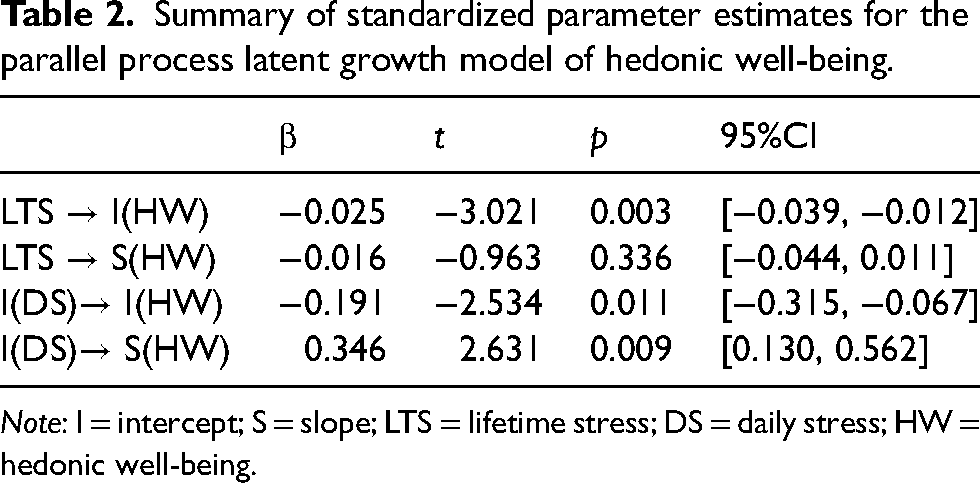
Note: I = intercept; S = slope; LTS = lifetime stress; DS = daily stress; HW = hedonic well-being.
Eudemonic well-being trajectories in relation to stress
To investigate the influence of lifetime and daily stress on the trajectories of eudemonic well-being, a conditional parallel process latent growth model was employed for daily stress and eudemonic well-being in AVE1 to AVE7, with lifetime stress as a time-invariant predictor. Once more, the model fit indices were acceptable and are described hereinafter: χ2 = 456.244, df = 153, CFI = .885, TLI = .885, RMSEA = .091.
Table 3 demonstrates that a lower baseline daily stress level was significantly correlated with higher baseline eudemonic well-being (β = −0.359, p < 0.001, 95%CI = [−0.481, −0.238]) and positively associated with the growth slope of eudemonic well-being (β = 0.339, p = 0.001, 95%CI = [0.163, 0.515]). Lifetime stress events were negatively correlated with the intercept (β = −0.141, p = 0.042, 95%CI = [−0.255, −0.027]) and slope of eudemonic well-being (β = −0.198, p = 0.040, 95%CI = [−0.356, −0.039]; Figure 3).
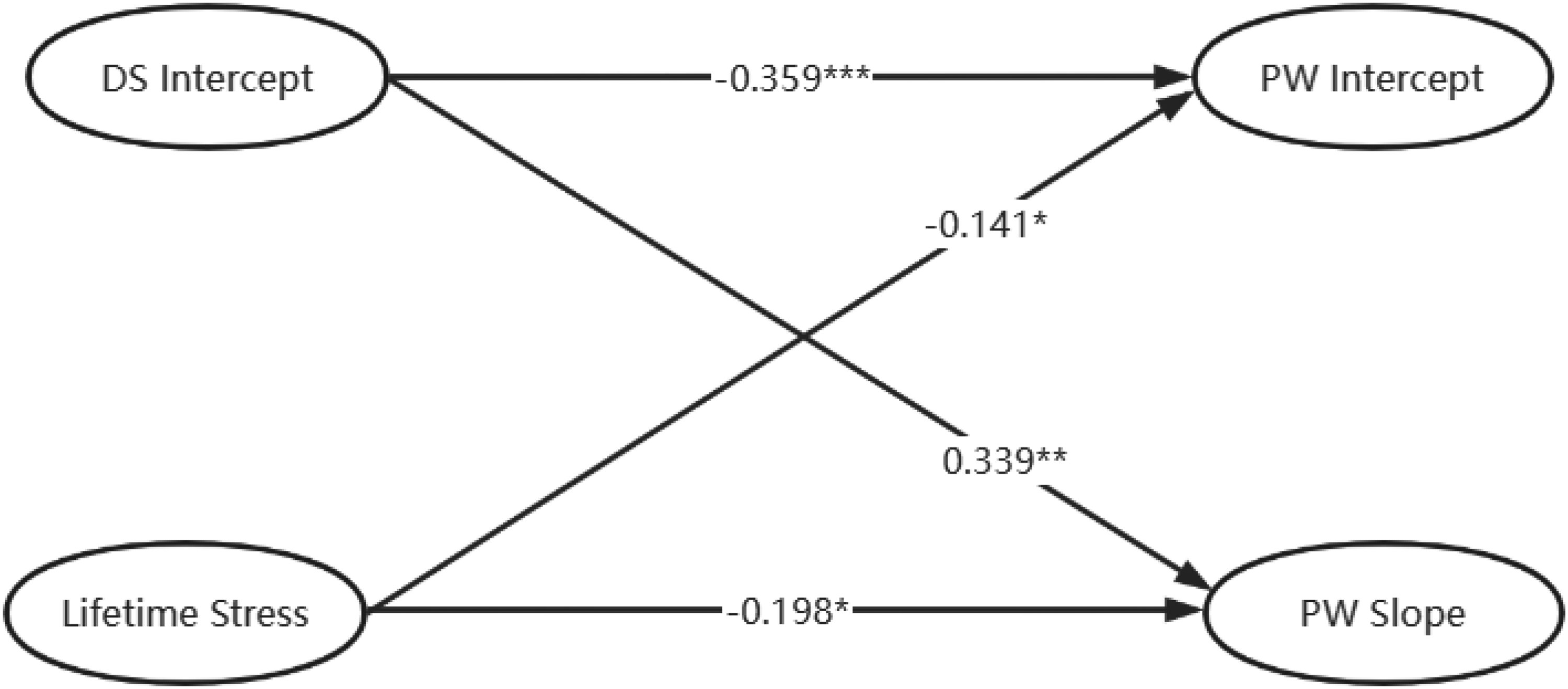
Eudemonic well-being trajectories in relation to stress.
Summary of standardized parameter estimates for parallel process latent growth model of eudemonic well-being.

Note: I = intercept; S = slope; LTS = lifetime stress; DS = daily stress; EW = eudemonic well-being.
Discussion
This study found a consistent decline in both hedonic and eudemonic well-being over the 14-day period procedures. Confirming H1, the results showed that daily stress predicted lower baseline well-being for both types of well-being as well as a slower decline rate of well-being. Moreover, and partially in line with H2, lifetime stress did not significantly affect the slope of hedonic well-being but did weakly (β= −0.025) influence baseline hedonic well-being. Regarding eudemonic well-being, lifetime stress significantly predicted both its baseline level and change slope, supporting H3; that is, individuals with higher lifetime stress exhibited poorer baseline eudemonic well-being and a faster decline over time.
The effect of daily stress on well-being
The established negative correlation between daily stress and mental health, affirmed by an extensive list of prior research (Falconier et al., 2015), was corroborated by the examination of daily stress and the intercept of well-being in this study. When confronted with daily stress, individuals may engage in recurrent cognitive resource mobilization to cope with challenges. This repeated mobilization can result in cognitive resource depletion, rendering the management of subsequent stressors more challenging (Park et al., 2016), thereby influencing mental well-being.
While confirming these prior well-established pieces of evidence, this research also introduced a novel exploration in the form of the correlation between daily stress and the slope of well-being, revealing a positive association. Despite the overarching declining trajectory of well-being over the 14 days, individuals experiencing higher daily stress exhibited a more gradual decrease. This pattern is intricately linked to the persistent nature of certain stressors (Bhattacharyya et al., 2023). While this study measured daily stressors, some stress events may endure for several days and weeks (e.g., an imminent weeklong examination that can create substantial academic pressure during a whole week), resulting in sustained reductions in mental well-being—and we cannot rule out that such situations may have coincided with the sampling window of this study.
However, regarding the correlation between stressful events, certain individuals are more likely to be influenced by prior negative events. Research has identified a link between negative childhood experiences and increased reporting of daily stress in adulthood (Mosley-Johnson et al., 2021). This association is tied to specific psychological traits and behavioral patterns: when confronted with negative life events, individuals with a history of negative experiences may be more prone to engage in negative attributions and cognitive styles (Wadsworth, 2015), which thereby make these individuals more susceptible to encountering stressful events (Hammen & Shahar, 2006).
The effect of lifetime stress on well-being
This study revealed that lifetime stress significantly influenced both the baseline level and change rate of eudemonic well-being. Despite being a distal stressor, lifetime stress has consistently attracted scholarly attention because of its enduring influence on mental health. Two controversial hypotheses, namely stress sensitization theory and psychological inoculation theory, have been proposed in this regard. The first emphasizes stress and its toxicity, suggesting that adverse experiences make individuals more sensitive and reactive to subsequent stressors, increasing the risk of mental disorders such as depressive symptoms (McLaughlin et al., 2010). The second theory, notwithstanding, posits that stress events also serve adaptive functions, with moderately early stress experiences protecting individuals from future stress and its potential negative effects (Liu, 2015).
More specifically, the results demonstrated that an increase in lifetime stress is associated with a decrease in eudemonic well-being as well as with a quicker pace of decline. These findings concur with the propositions in stress sensitization theory. Thus, although lifetime stress does not influence the decline in well-being as daily stress does, it may contribute to the emergence of psychological vulnerability, which is potentially associated with long-term learned helplessness. Additionally, prior stress events shape sensitivity to stress at the physiological level, manifesting as disrupted diurnal cortisol patterns and an enhanced cortisol response (Ouellet-Morin et al., 2019).
The divergences in hedonic and eudemonic well-being
This study established that lifetime stress differentially affects the two types of well-being under scrutiny, significantly predicting eudemonic but not hedonic well-being change trajectories; namely, hedonic adaptation theory and sustainable happiness theory seem not to be contradictory but, rather, contextually distinct. Previous empirical research, such as that by Joshanloo (2016), utilizing exploratory structural equation modeling and confirmatory factor analysis, supports this notion, discerning hedonic and eudemonic well-being and showcasing that they correlate and are independent of one another.
The changes in hedonic well-being in our sample align more closely with the suggestions of hedonic adaptation theory, where lifetime stress (as a long-term variable) does not predict changes in hedonic happiness. This is attributed to the diminishing impact of immediate life events over time, which allows hedonic well-being to return to its set point level (Luhmann & Intelisano, 2018). However, our study identified a subtle and significant influence of life events (i.e., through lifetime stress) on hedonic well-being, suggesting that individual set points are not static but adjustable according to personal experiences. This concept aligns with the refined notions in hedonic adaptation theory as discussed by Sheldon and Lyubomirsky (2012). The trajectory of hedonic well-being in this study was also unaffected by lifetime stress and thus was influenced solely by daily stressors. This aligns with the nature of the concept of hedonic well-being, reflecting transient emotional states and emphasizing the basic physiological and psychological responses triggered by immediate circumstances (Lee et al., 2018).
Both the baseline level and change rate of eudemonic well-being were influenced by lifetime stress in the sample of the current study. These results align with sustainable happiness theory (Lyubomirsky et al., 2005), showing that eudemonic well-being, characterized by a focus on goal pursuit and personal fulfillment, represents a more enduring state of happiness. These pieces of evidence also corroborate prior research findings, demonstrating that this type of well-being is relatively stable and continuous and tied to an individual's complex social and cultural capacities (Lee et al., 2018).
The distinct outcomes for hedonic and eudemonic well-being in this research entail that they may represent independent dimensions and should be differentiated in future studies. They further underpin that while increases in hedonic well-being may be transient and prone to relapse, interventions aimed at enhancing well-being could benefit from a greater focus on the pursuit of personal significance and meaning, as proposed by prior research (van Agteren et al., 2021).
Implications
Theoretically, this study is grounded in the marginal conditions established by hedonic adaptation theory and sustainable happiness theory. It substantively investigated well-being change trajectories following a 2 (stress types: daily and lifetime stress) × 2 (well-being types: hedonic and eudemonic well-being) analysis. This exploration serves to inspire us to differentiate these two orientations of well-being in subsequent studies (Joshanloo, 2016).
Methodologically, the combination of diary data and latent growth model methods to explore short-term change trajectories yields ideas for subsequent research. In addition, considering the descriptions in the classical theory that hedonic well-being is a latent variable comprising multiple components, this study constructed a curve-of-factors model, which served as a useful and novel exploration of the methodology. Although this research shows that the methodology is feasible (Wickrama et al., 2016), few researchers thus far have made such application of the method using real data.
Limitations and future directions
This study has some limitations that should be addressed in future research. First, regarding stress measurements, there is room for improvement in diversity and ecological validity. The diversification of measurement tools for stress could involve the incorporation of additional features that capture a broader spectrum of stressors; moreover, applying state-of-the-art ecological approach techniques in the ecological momentary assessment can enhance the ecological validity of the study, allowing for real-time and contextually rich stress data (Joseph et al., 2021). These enhancements would contribute to a more nuanced understanding of the intricate interplay between stress and the dynamic changes in mental well-being (Mühlenmeier et al., 2022). Future research adopting these refinements may provide a more comprehensive and ecologically valid exploration of the impact of stress on well-being trajectories.
Second, although this study provides valuable insights into short-term changes in well-being through subjective reports, the limitations inherent in the exclusive reliance on self-reported measures must be acknowledged. It is suggested that scholars incorporate objective physiological indicators, such as cortisol-awakening response and heart-rate variability, to their future endeavors. The cortisol-awakening response plays a role in preparing individuals for daily demands, is linked to various health outcomes, and can provide a more nuanced understanding of stress dynamics (O’Connor et al., 2021). Studies with these objective measures would benefit from not only bolstered methodological robustness but also the possibility of delivering a more holistic examination of the complex interplay between stress and well-being change trajectories.
Third, this study consolidated daily data over two-day periods to enhance the model fit, and this presents another limitation. This approach did aid in model optimization but concomitantly compromised data granularity and may have conflated the distinct stress patterns between weekdays and weekends (Miao et al., 2017). Weekends, which are known influencers of well-being, exhibit different stress dynamics. Future research could benefit from adopting extended tracking periods encompassing multiple seven-day cycles. This would allow for a more accurate capture of the potential weekly rhythms in stress and well-being (Hülsheger et al., 2022) and increase the level of detail of investigations into and knowledge of the daunting interplay between daily stressors and well-being.
Finally, despite the discovery of different patterns of stress effects on hedonic and eudemonic well-being, the model fit of stress on eudemonic well-being was not as good as we expected, which may limit the interpretability of this result. However, despite not meeting the more stringent fit criteria, the model showed an acceptable fit based on the thresholds proposed by, for example, Hair et al. (2010), which allow for more lenient thresholds in exploratory or complex models. However, these limitations should be taken into account when interpreting the results of the study. Although the hypothesized model showed some degree of empirical support, its overall fit did not fully meet conventional standards. Conclusions drawn from the model should therefore be considered preliminary.
Conclusion
This study reveals the short-term patterns of change in hedonic and eudemonic well-being under stress. Daily stress was found to predict lower baseline well-being for both well-being types as well as a slower rate of decline. In contrast, lifetime stress uniquely impacts eudemonic well-being, suggesting that the hedonic adaptation and sustainable happiness theories are not contradictory but contextually distinct. The research emphasizes the need to differentiate between the two orientations of well-being in future studies. Additionally, the methodology combining diary data with latent growth models provides a novel approach for future research to explore the short-term dynamics of well-being and stress, enhancing our understanding of the complex interplay between these factors.
Supplemental Material
sj-docx-1-pac-10.1177_18344909251352771 - Supplemental material for Short-term dynamic changes in mental well-being under stress: Exploring trajectories with latent growth model analysis
Supplemental material, sj-docx-1-pac-10.1177_18344909251352771 for Short-term dynamic changes in mental well-being under stress: Exploring trajectories with latent growth model analysis by Jinjin Ma, Yidi Chen, Meng Meng, Huini Peng and Yiqun Gan in Journal of Pacific Rim Psychology
Footnotes
Acknowledgements
We would like to express our appreciation to every member of our research group for their valuable comments on earlier versions of this article.
Declaration of conflicting interests
The authors declared no potential conflicts of interest with respect to the research, authorship, and/or publication of this article.
Funding
The authors disclosed receipt of the following financial support for the research, authorship, and/or publication of this article: The study was supported by the Grant 32171076 from the National Natural Science Foundation of China.
Data availability statement

Supplemental material
Supplemental material for this article is available online.
References
Supplementary Material
Please find the following supplemental material available below.
For Open Access articles published under a Creative Commons License, all supplemental material carries the same license as the article it is associated with.
For non-Open Access articles published, all supplemental material carries a non-exclusive license, and permission requests for re-use of supplemental material or any part of supplemental material shall be sent directly to the copyright owner as specified in the copyright notice associated with the article.
