




Abstract
The current study examined the trajectory of cyberbullying (verbal abuse, rumor spreading, image spreading, social exclusion) among adolescents and identified factors predicting inter-individual differences. Based on social control theory, the quality of social relationships with peers, teachers, and parents was used as predictive variables. Data from the first to third waves of the Korean Child and Youth Panel Survey 2018 were utilized, with a total of 2,579 representative middle school students participating. Results from the latent growth model suggest that cyberbullying perpetration among adolescents tends to decrease over time. The quality of peer relationship was positively associated with the intercept of all four types of cyberbullying but negatively associated with changes in cyberbullying, indicating an accelerated reduction in cyberbullying. The quality of the relationship with teachers was negatively associated with the intercept of verbal abuse. The quality of the relationship with parents showed no association with cyberbullying when controlling for the quality of other social relationships (i.e., peer, teacher) and control variables (i.e., self-esteem, gender). These findings highlight the importance of fostering positive peer relationships to mitigate cyberbullying behaviors among adolescents in the long term.
Keywords
Introduction
Cyberbullying has become a worldwide problem among adolescents (Ang, 2015). It has emerged as a new form of bullying through the Internet and electronic devices. Cyberbullying can be referred to as deliberate harm, embarrassment, or social exclusion via electronic devices (Patchin & Hinduja, 2006). After the COVID-19 outbreak, the majority of school and daily activities are conducted online, thereby increasing the prevalence of cyberbullying (The Ministry of Education, 2021). There have been reports of tremendous negative effects of cyberbullying experiences on adolescent development (Tokunaga, 2010).
Given the increasing prevalence and harmful outcomes of cyberbullying, understanding theoretical influencing factors of who is more likely to conduct cyberbullying in adolescents is a critical question in society. In this study, Hirschi's (1969) social control theory was applied to explain how the quality of social relationships—with peers, teachers, and parents—affects cyberbullying perpetration among Korean adolescents. Cyberbullying encompasses various behaviors, such as verbal abuse, spreading rumors, sharing images, and social exclusion. Since these behaviors may be influenced differently by social relationships, the study examines the distinct impacts of each relationship type on different forms of cyberbullying. Additionally, longitudinal changes are tracked to capture both the current state and the progression of cyberbullying over time.
Interpersonal relationships and cyberbullying
Social control theory explains why some people do not commit crimes (Hirschi, 1969). It assumes that the motivation to commit delinquent acts is constant; thus, people commit delinquent acts when the factors that prevent this motivation are absent. Based on this theory, adolescents do not commit a crime because they have attachment with others (e.g., peers, teachers, and parents), commitment and involvement in conventional activities (e.g., studying), and beliefs about the importance of following moral norms. That is, if students have high-quality social relationships, things to commit and involve, and beliefs about moral values, they tend not to commit delinquent acts like cyberbullying. Studies have been performed to comprehend students’ bullying by adapting the social control theory (Cecen-Celik & Keith, 2019; Choi & Dulisse, 2021).
Among the influencing factors, attachment is critical and fundamental in predicting student delinquent behaviors. Attachment bonds emphasize social interactions with others. Social interactions with peers, teachers, and parents could play a crucial role in predicting adolescents’ cyberbullying behaviors. According to social ecological theory, adolescents are influenced by interactions within various environmental systems, with the microsystem—comprising relationships with peers, teachers, and parents—having the most direct impact on their development (Bronfenbrenner, 1979). This perspective underscores the interconnectedness in shaping adolescent cyberbullying behaviors. Social ecological theory has been applied to explain cyberbullying in adolescents, arguing that relationships with peers, teachers, and parents critically influence cyberbullying (e.g., Cross et al., 2015).
Peer relationships and cyberbullying
Peer relationships are critical factors in predicting cyberbullying among adolescents. Establishing and maintaining social dominance in peer groups is one of the most important motivations for traditional bullying perpetration (Espelage & Swearer Napolitano, 2003; Reijntjes et al., 2013). Therefore, having peer support, popularity, or preference is a critical factor in classical bullying. However, it has been questioned whether this peer relationship is critical in cyberbullying. Given the nature of cyberbullying (e.g., anonymity and lack of physical contact), motivation to maintain social status would be less important than classical bullying. Rather, having peer attachment would lay down aggressive behavior in cyberspace by satisfying their innate needs like affiliation (Assor et al., 2018). Therefore, peer relationships would affect the lowering of cyberbullying longitudinally. A previous study supports this hypothetical explanation by demonstrating that low-quality peer relations are positively associated with cyberbullying (Williams & Guerra, 2007). However, cyberbullying also occurs in peer networks, similar to classical bullying; thus, peer relationships may have a positive association with cyberbullying in a cross-sectional manner. It is possible that, when adolescents have a large network of friends, they tend to be involved in cyberbullying. This contradictory role of peer relationships in cross-sectional and longitudinal views should be examined empirically.
Relationships with teachers and cyberbullying
Teacher relationships would have a crucial role in predicting adolescents’ cyberbullying. Compared with elementary school, spending time in school increases in middle school; thus, the social context in school is critical to understanding adolescents’ behaviors. Cyberbullying perpetrators showed a low level of feeling of being cared by their teachers (Sourander et al., 2010). Teacher connectedness is negatively associated with cyberbullying (Paniagua et al., 2022). Among the factors of school climate (i.e., safety, support, relationship with teacher, relationship with classmates), only safety and the relationship with teachers were negatively associated with cyberbullying (Guarini et al., 2012). Students with high-quality relationships with teachers have a heightened perception of a positive school climate and a sense of safety in school (Kowalski et al., 2019; Zych et al., 2019). These studies support the notion that positive relationships with teachers strengthen students’ attachment with school and feeling safety in school, thus lowering the possibility of engaging in cyberbullying.
On the other hand, the fact that cyberbullying can occur outside of school, 24 h a day, 7 days a week, suggests that the relationship with teachers may not be significant in influencing cyberbullying. However, previous studies have shown that even though cyberbullying occurs outside of school (i.e., in cyberspace), most victims know who the perpetrator is, indicating that cyberbullying often occurs within the school context (Slonje et al., 2013). School experiences have also been shown to be directly related to cyberbullying victimization (Holfeld & Leadbeater, 2017). Previous studies suggest that while the influence of the teacher relationship on cyberbullying could be limited compared to traditional bullying, it can still have an impact.
Relationships with parents and cyberbullying
Studies have demonstrated that relationships with parents have a crucial role in externalizing behavioral problems in children (Ybarra & Mitchell, 2004). Children who lack emotional attachment with their parents show concurrent and later aggression and delinquency (Hoeve et al., 2012). Similarly, previous studies have consistently shown that parental relationships are negatively associated with all forms of bullying, including cyberbullying (Wang et al., 2009). Adolescents with negative family contexts show higher levels of cyberbullying (Bayraktar et al., 2015; Hemphill & Heerde, 2014). Cyberbullying perpetrators show fewer emotional bonds with their parents (Ybarra & Mitchell, 2004). In addition, when adolescents have supportive parents, their delinquent behaviors decrease (Donnellan et al., 2005; Fanti et al., 2012). These studies demonstrated that warm and supportive parenting styles play a crucial role in preventing cyberbullying. Although a negative association between parent relationships and cyberbullying has been demonstrated in cross-sectional studies, the effects of parental relationships on longitudinal changes in cyberbullying are less acknowledged.
Generally, it is known that as children get older, they are less likely to be influenced by their parents. In particular, middle school is the period when adolescents spend more time with friends than with parents, and want to live independently from them. As children grow from 10 to 18 years old, their time spent at home decreases by approximately 14% to 35% (Larson et al., 1996). Naturally, youth spend less time with their families and more time with their peers during adolescence (Smetana et al., 2006). During adolescence, the relationship with the primary caregiver is not directly associated with bullying but is indirectly associated through the mediation of peer relationships (Charalampous et al., 2018). Therefore, it is possible that even if parental influence is critical in predicting adolescents’ cyberbullying, its effects may not be strong enough to impact adolescents as they grow, especially when compared to the effects of peer relationships
Development of cyberbullying in adolescents
Adolescence is the period of dynamic psychological and physical development; thus, having a developmental view to understand their behaviors is important. Compared with studies that found longitudinal changes in traditional bullying (i.e., face-to-face bullying), limited studies have been performed on trajectories of cyberbullying. Furthermore, studies on the longitudinal pattern of cyberbullying are inconsistent and have yielded conflicting results. For instance, there has been no age variation in the level of cyberbullying (Werner et al., 2010), but other studies have demonstrated an increase in cyberbullying and online harassment (Guo, 2016; Hinduja & Patchin, 2008; Ybarra & Mitchell, 2004). Some studies have found a decrease in cyberbullying as adolescents grow (Kim et al., 2017; Zhang et al., 2021), whereas others reported an inverted U shape, in which cyberbullying peaked in middle school and decreased in high school (Calvete et al., 2010; Tokunaga, 2010; Williams & Guerra, 2007). This may be due to differences in measures of cyberbullying, statistical approaches, and cross-cultural differences. Therefore, more studies using validated measures (e.g., considering cultural context) and sophisticated statistical approaches (e.g., latent growth model) in various countries are needed.
Cyberbullying in Korean culture
In South Korea, the prevalence of cyberbullying among adolescent increased by 12.4% from 29.2% in 2021 to 41.6% in 2022 (Korea Communications Commission & National Information Society Agency, 2023). This contrasts with a 6.2% decrease in adults’ experience of cyberbullying, from 15.8% in 2021 to 9.6% in 2022, indicating that cyberbullying is becoming more prevalent among adolescents. South Korea exhibits among the highest rates of internet usage and smartphone penetration globally. Adolescents spent time on the Internet for 17.6 h per week in 2019, but this skyrocketed to 27.6 h in 2021 (Korean National Statistical Office, 2021). Forty percent of teenagers showed excessive dependence on smartphones (Ministry of Gender Equality and Family, 2024), which increases the likelihood of cyberbullying.
Cyberbullying should be studied with consideration of the cultural context (Park et al., 2021). In contrast to Western nations, South Korea exhibits a more collectivist cultural orientation. The Korean terminologies for bullying are “wang-ta” or “gipdan-ttadolim,” which refer to social exclusion, highlighting the prevalence of bullying within social dynamics. This distinction underscores the necessity for employing measurement instruments that account for the specific conditions of cyberbullying in Korean society.
In Korean middle schools, each class is assigned a homeroom teacher. Typically, each class consists of approximately 25 students, and the homeroom teacher remains responsible for these students throughout the academic year. Unlike in Western countries where students change classrooms for different subjects, Korean students remain in the same classroom for most of their lessons, with exceptions for activities such as physical education. The homeroom teacher is required to visit the classroom at the beginning and end of each school day to deliver various announcements and provide guidance on daily life. Moreover, the homeroom teacher is tasked with detecting and addressing issues such as school violence and cyberbullying (Bang & Lee, 2009). These cultural differences suggest that relationships within the school environment such as peer relationship and teacher relationship are likely to play a critical role in predicting cyberbullying among Korean adolescents. However, there is a lack of literature concerning the association between quality of social relationships and cyberbullying in Korea.
The current study
The current study was the first attempt to administer social control theory to predict three years of cyberbullying trajectory in Korea. This study focused on four types of cyberbullying that most commonly observed among Korean adolescents: verbal abuse, rumor spreading, image spreading, and social exclusion (Korean Institute of Criminology and Justice, 2015). As peers, teachers, and parents are crucial parts of the social context of adolescents, these quality of relationships and adolescents’ trajectories of cyberbullying perpetration were studied.
The research questions were as follows: How do intra-individual differences in cyberbullying perpetration occur over three years? Do quality of social relationships (with peers, teachers, and parents) explain the inter-individual differences in cyberbullying in the first wave (intercepts) and longitudinal changes (slope)? Using nationwide representative data, the trajectories of cyberbullying in adolescents from middle school and their association with social relationships in the first year of middle school were investigated.
For the first research question, insufficient and inconsistent research on the specific investigation of each type of cyberbullying hindered the formulation of any definitive and detailed hypotheses. It was possible that cyberbullying would increase in middle school due to the increased use of the Internet, electronic devices, and dependence on smartphones (Korean National Statistical Office, 2021). However, studies conducted in Korea found a decrease in cyberbullying as adolescents grew older (Kim et al., 2017); thus, the current study explored the trajectories of cyberbullying.
For the second research question, it was hypothesized that social relationships were negatively associated with cyberbullying based on social control theory (Hirschi, 1969). However, since cyberbullying also had characteristics that occurred in peer networks and involved social status, having relationships with peers would be positively associated with cyberbullying perpetration cross-sectionally, but it could be a protective factor longitudinally (Espelage & Swearer Napolitano, 2003; Reijntjes et al., 2013). Teacher and parental relationships were negatively associated with cyberbullying, but the association became less important or null as adolescents grew older (Hemphill & Heerde, 2014; Williams & Guerra, 2007).
Methods
Participants
Data from the Korean Children and Youth Panel Survey (KCYPS) 2018, conducted by the National Youth Policy Institute (NYPI), were used (https://www.nypi.re.kr/archive/board?menuId=MENU00329). The KCYPS was designed to understand both the cross-sectional characteristics and longitudinal changes in youth's overall development over time, and to identify individual characteristics and environmental factors that affect individual growth and development. A stratified multi-stage cluster sampling method was used to select the sample. First, 16 administrative districts were stratified. Second, schools were randomly chosen from each district using proportionate probability sampling. School numbers were determined according to the population proportions. After choosing the school, one class was randomly selected. The data and measures are publicly available and can be accessed at the following link: https://www.nypi.re.kr/archive/mps/program/examinDataCode/dataDwloadAgreeView?menuId=MENU00226.
The first wave of the KCYPS 2018 consisted of 7th grade (1st grade of middle-school) students. The data were collected from August to November. The survey contents and procedures were approved by the institutional review board (IRB) committee of NYPI, and informed consent for participation was obtained from the adolescents and their legal guardians (National Youth Policy Institute, 2018). The KCYPS followed with 2,579 students (male: 1,399; 54.2%; female: 1,180; 45.8%). The basic demographic characteristics of the participants were as follows: 98.5% of the participants were raised in a Korean family, and 1.5% were raised in a family with non-Korean parents. The fathers’ educational levels were below middle school (1.5%), below high school (29.6%), college or university graduation (54.6%), and graduate or above (9.7%). Mothers’ educational levels were below middle school (2.3%), below high school (34.6%), college or university graduation (55.0%), and graduate or above (5.2%). The median monthly income was approximately 4 million Korean won. The current study used data from first wave (7th grade) to third wave (9th grade). The attrition rates of the second wave were 5.8% (152 participants), and those of the third wave were 7.9% (206 participants).
Measures
Cyberbullying
To measure cyberbullying, this study utilized a scale developed by the Korean Institute of Criminology and Justice (2015). The development process of the cyberbullying items was as follows. First, a draft of the cyberbullying types was created by reviewing and comparing categories used in previous studies. A focus group interview was then conducted with ten adolescents (boys and girls in the second and third years of middle school) to gather their perceptions of these categories, actual experiences, and any behaviors that might have been overlooked. Based on their feedback, the draft was revised. Following this, a pilot survey was conducted with one high school student (first year), one middle school student (second year), and four elementary school students (fifth and sixth years) to assess the readability and clarity of the questionnaire. After further revisions, a final set of 15 single-item questions measuring the perpetration of 15 types of cyberbullying was developed. The survey was administered to 5,356 students from elementary (fifth grade and above), middle, and high schools across South Korea (excluding Jeju), and the validity of the items was confirmed based on the survey results (Korean Institute of Criminology and Justice, 2015). In this study, four types of cyberbullying that showed the highest prevalence—verbal abuse, rumor spreading, image spreading, and social exclusion—were selected. The question, “Have you done the following on your smartphone or computer (internet) in the past year?” was presented first. Following which, based on the types of cyberbullying behaviors in Korean adolescents, frequency of verbal abuse (e.g., “I have sent abusive or harsh words to someone”), rumor spreading (e.g., “I have spread bad rumors about someone to others”), image spreading (e.g., “I have sent or secretly forwarded someone's unwanted photos, bizarre pictures, images, or videos to others l”), social exclusion (e.g., “I have intentionally uninvited someone to a chatroom or ignored their comments or messages”), were measured with a six-point Likert scale (“never” = 1, “one to two times yearly” = 2, “once per month” = 3, “two to three times per month” = 4, “once weekly” = 5, and “many times weekly” = 6).
Peer relationship quality
The quality of relationships with peers were measured with 8 items from the Peer Relationship Quality Scale for Adolescents, which was developed and validated for Korean adolescents (Bae et al., 2015). The scale includes intimate exchange (e.g., “My friends confide in me about upsetting and difficult things”), social support (e.g., “My friends like me and follow me”), and satisfaction with peer relationships (e.g., “I have a good relationship with my friends”). A high score indicated a better quality of peer relationships. Cronbach's alpha in a previous study (Bae et al., 2015) was .85, and that of the current study was .90.
Teacher relationship quality
The quality of relationships with teachers were measured with 3 items from the Student–Teacher Attachment Relationship Scale (STARS), which was developed and validated for Korean adolescents (Kim & Kim, 2009). The scale includes acceptance (e.g., “My teacher respects my opinion and lets me speak freely”), and accessibility (e.g., “My teacher always has time for me whenever I want”). A high score indicated a better quality of relationship with teachers. Acceptance refers to the behavioral characteristic of being sensitive to and positively receptive towards various behavioral signals or emotional expressions from students and accessibility refers to the extent to which students feel their teacher is approachable (Kim & Kim, 2009). These characteristics are important aspects of assessing the quality of teacher–student relationships. The more students perceive their teachers as accepting and accessible, the more likely teachers are to serve as a secure base, which is known to be beneficial for students’ socio-emotional adaptation (AL-Yagon & Mikulincer, 2006). The original scale consisted of 14 items, but only three items were used in this study, excluding those regarding the relationship with the teacher in terms of academic aspects (e.g., “My teacher believes that I can get good grades in the future”). Cronbach's alpha for the relations with teachers was .57.
Parent relationship quality
The quality of relationships with parents was measured with 8 items from the Korean Version of Parents as Social Context Questionnaire for Adolescents (PSCQ_KA), developed and validated for Korean adolescents (Kim & Lee, 2017). The scale was based on a motivational model of parenting (Skinner et al., 2005), including 4 items of warmth (e.g., “My parents express that they love me”) and 4 items of autonomy supports (e.g., “My parents try to understand my thoughts”). Warmth and autonomy support from parents can fulfill the three basic human needs identified by self-determination theory: the needs for relatedness, autonomy, and competence (Deci & Ryan, 2000). These are also considered crucial aspects of assessing the quality of adolescent–parent relationships (Bülow et al., 2022). Cronbach's alpha in a previous study (Kim & Lee, 2017) was .88, and that in the current study was .93.
Self-esteem
Self-esteem was included as a control variable. Self-esteem was measured 5 items from the Korean Version of Rosenberg's Self-esteem Scale (Rosenberg, 1965), which was developed and validated for Korean adolescents by the NYPI. The original scale consisted of 10 items, 5 of which were positively worded and 5 of which were negatively worded, however, based on prior research indicating that the two constitute constructions, only the 5 of positively worded items were used in this study. Cronbach's alpha for the self-esteem was .85.
Statistical analysis
Descriptive statistics were performed using SPSS 18 (SPSS, Chicago, Illinois, USA), and latent growth models were analyzed using Mplus 6.12 (Muthén & Muthén, 2010). To address missing values in the data, Little's missing completely at random (MCAR) test (Little, 1988) was carried out for all variables. The results indicated that the data were missing completely at random (χ2 = 30.714, df = 29, p = .38). Based on these results, the missing values were addressed with Full Information Maximum Likelihood (FIML). Before the main inferential analysis, normality of the variables was tested using the rule of thumb of skewness <|3| and kurtosis <|20| (Kline, 2005). Items of cyberbullying did not meet this criterion, thus, Maximum Likelihood estimator with robust standard errors (MLR) estimator was utilized (Muthén & Muthén, 2010).
Descriptive statistics and Pearson's correlations were calculated first. And then, latent growth models were analyzed for each 4 types of cyberbullying (i.e., verbal abuse, rumor spreading, image spreading and social exclusion). Items for quality of social relationships (i.e., peer, parent) and self-esteem were parceled for the stability of the structural equation models (Little et al., 2002). Unconditional latent growth models were analyzed for 4 types of cyberbullying, separately for each gender using multi-group analysis. The latent slope with the factor loadings from each indicator in the first, second, and third waves was constrained to 0, 1, and 2, respectively compared with the no-change model, where the means and variances of slopes were constrained to be 0. Only when this model fit the data were the multi-group unconditional and conditional latent growth models analyzed. For the multi-group unconditional model, means and variances of latent intercepts and slopes factors were constrained to be equal across gender. This model was used as a baseline, that is, the conditional latent growth model.
In the conditional model, latent intercepts and slopes were regressed on predictor variables such as the quality of social relationships and self-esteem. Since self-esteem is a critical factor that can influence both the likelihood of being involved in cyberbullying and the severity of its effects (Patchin & Hinduja, 2010), it was used as a control variable. Finally, a multigroup analysis by gender was conducted to examine if the factor loadings of each predictor (measurement invariance) and the paths from predictors to latent intercepts and slopes (structural invariance) differed by gender. Gender is known to influence the experience and effects of cyberbullying (Li, 2006; Yang et al., 2021); thus, possible differences between genders were considered.
For the goodness of model fit, the root mean square error of approximation (RMSEA), comparative fit index (CFI), and the Tucker–Lewis index (TLI) were used. When the RMSEA was close to .05, and the CFI and TLI were close to .95 (Hu & Bentler, 1999; Little, 2013), the model was considered adequate. For the model comparison, a rule of thumb with change of the CFI < −.01 was used for equality assumption. It was based on the fact that the chi-square difference test is too sensitive to large sample sizes (Cheung & Rensvold, 2002).
Ethical statement
All procedures in this study were conducted in accordance with the protocols approved by the KGU-20240102-HR-111. Written informed consent for participation was obtained from the participants.
Results
Descriptive statistics and correlations
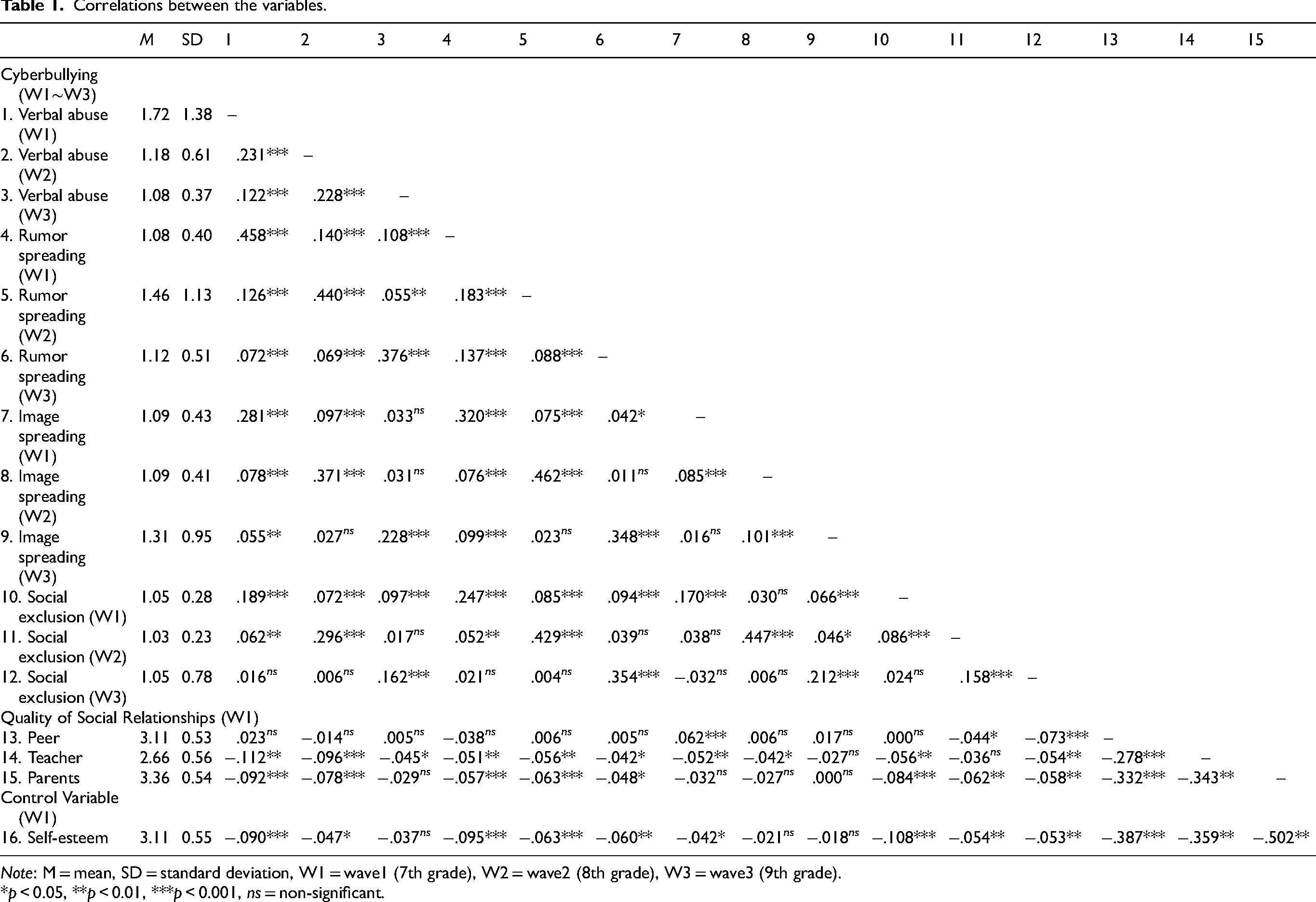
The means, standard deviations, and correlations among variables are presented in Table 1. The correlations between each of the cyberbullying variables measured in the same wave ranged from .162 to .458 (all ps < .001). The correlations between variables of quality of social relationships with peers, teachers, and parents were positively significant, and ranged from .278 to .343 (all ps < .001). Peer relationship quality was not related to most cyberbullying behaviors, while those with teachers [ranged from −.042 (p < .05) to −.112 (p < .001)] and parents [ranged from −.048 (p < .05) to −.092 (p < .001)] were negatively related to cyberbullying behaviors.
Correlations between the variables.
Note: M = mean, SD = standard deviation, W1 = wave1 (7th grade), W2 = wave2 (8th grade), W3 = wave3 (9th grade).
*p < 0.05, **p < 0.01, ***p < 0.001, ns = non-significant.
Unconditional latent growth models
Unconditional latent growth models were used to estimate the trajectories of 4 types of cyberbullying (verbal abuse, rumor spreading, image spreading, social exclusion) of each gender. The model fits are presented in Table 2. For all types of cyberbullying, model fits of the linear change model (model 1) were found to be good (RMSEA = .032 to .038, TLI = .968 to .927, CFI = .975 to 979). The following analyses of multi-group unconditional models (model 2) revealed that the means and variances equality constraints on latent intercepts and slopes between male and female do not significantly reduce the model fit of the unconditional linear growth model (ΔCFI = = + .001 to −.002). Accordingly, this model, where the trajectories of 4 types of cyberbullying were assumed to be equal across gender, was used as a baseline model of the following conditional latent growth model.
Tests of model comparisons for multi-group unconditional latent growth models.
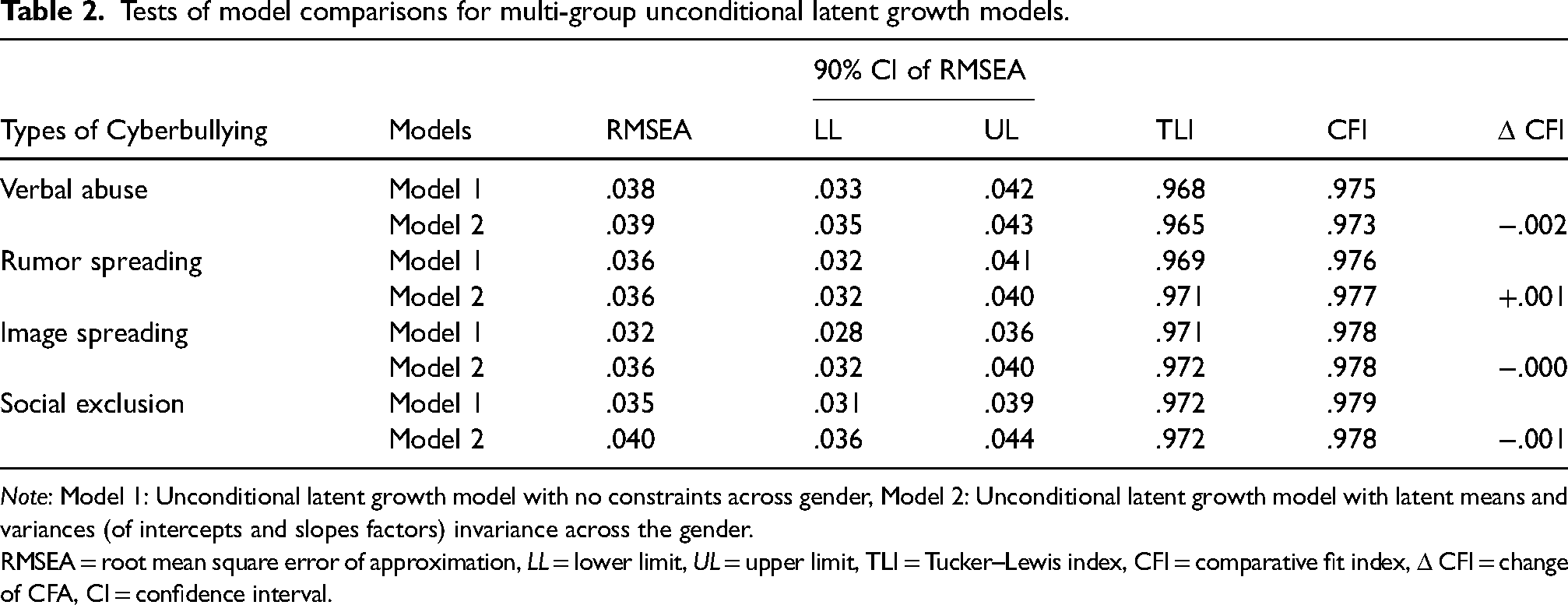
Note: Model 1: Unconditional latent growth model with no constraints across gender, Model 2: Unconditional latent growth model with latent means and variances (of intercepts and slopes factors) invariance across the gender.
RMSEA = root mean square error of approximation, LL = lower limit, UL = upper limit, TLI = Tucker–Lewis index, CFI = comparative fit index, Δ CFI = change of CFA, CI = confidence interval.
The means and variances of latent intercepts and slopes in the final unconditional latent growth models are presented in Table 3. The means of slopes in cyberbullying were −0.017 to −0.223 (all ps < .001), which means that there were significant decreases for all types of cyberbullying over the three waves. In addition, all the variances of the intercepts (0.014 to 0.553) and slopes (0.006 to 0.142) were statistically significant, which means that there were significant individual differences in the trajectories of cyberbullying for both initial status and change rate.
Intercepts and slopes of cyberbullying.

*p < 0.05, **p < 0.01, ***p < 0.001.
Association between the quality of social relationships and cyberbullying
The quality of social relationships (i.e., peers, teachers, and parents) and a control variable (i.e., self-esteem) were included in the final unconditional latent growth model. Multi-group analysis showed that there were no gender differences in the path coefficients. The model fits are presented in Table 4. For all types of cyberbullying, model fits of the conditional growth model with no constraints across gender (model 1) were found to be good (RMSEA = .035 to .040, TLI = .964 to .972, CFI = .972 to .978). The following analyses of multi-group conditional models with measurement invariance (model 2) and structural invariance (model 3) do not significantly reduce the model fit of the unconditional linear growth model (ΔCFI = = −.001 to + .006). Accordingly, model 3, where the conditional trajectories of four types of cyberbullying were assumed to be equal across gender, was selected as the final model.
Tests of model comparisons for multi-group conditional latent growth models.

Note: Model 1: The conditional growth model with no constraints across gender. Model 2: The model with measurement invariance across the groups, Model 3: The model with structural invariance across the groups.
RMSEA = root mean square error of approximation, CI = confidence interval, LL = lower limit, UL = upper limit, TLI = Tucker–Lewis index, CFI = comparative fit index, Δ CFI = change of CFA.
The specific estimates from the final model are presented in Table 5, and the main results with standardized estimates are shown in Figure 1. Peer relationships were significantly associated with the intercepts of all types of cyberbullying (β = .155, p < .001 for verbal abuse, β = .184, p < .001 for rumor spreading, β = .260, p < .001 for image spreading, β = .147, p < .05 for social exclusion), and negatively associated with the slopes of all types of cyberbullying (β = −.117, p < .05 for verbal abuse, β = −.292, p < .01 for rumor spreading, β = −.200, p < .01 for image spreading, β = −.171, p < .01 for social exclusion). This suggests that adolescents with high peer relationships in the first year of middle school (7th grade) were more likely to engage in all types of cyberbullying, but peer relationships accelerate the longitudinal decrease in cyberbullying perpetration.

Associations between the quality of social relationships (peer, teacher, parents) and changes of cyberbullying: (A) verbal abuse, (B) rumor spreading, (C) image spreading, (D) social exclusion. The standardized estimates and significance are presented. For understandability, the non-significant paths, paths of the control variables (self-esteem, gender), indicators, error terms, and covariance among the exogenous variables are not presented. *p < .05, **p < .01, ***p < .001.
Results of final conditional growth models of cyberbullying.
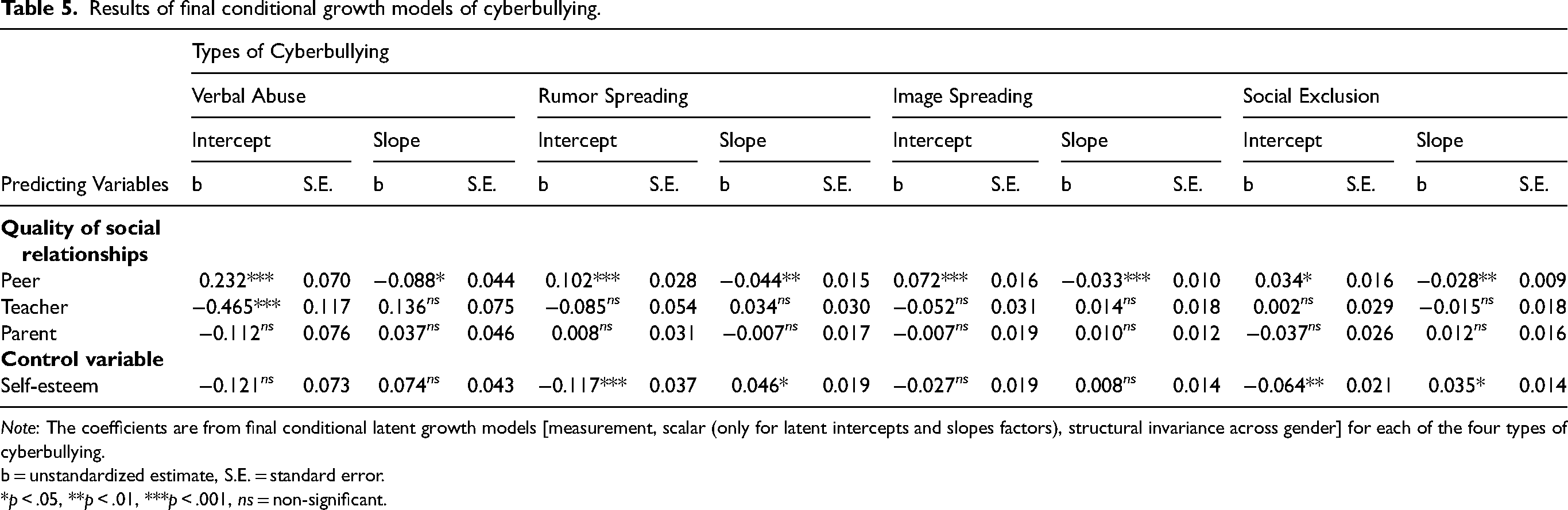
Note: The coefficients are from final conditional latent growth models [measurement, scalar (only for latent intercepts and slopes factors), structural invariance across gender] for each of the four types of cyberbullying.
b = unstandardized estimate, S.E. = standard error.
*p < .05, **p < .01, ***p < .001, ns = non-significant.
The quality of teacher relationships was negatively associated with the intercepts of only verbal abuse (β = −.243, p < .001), while no significant associations were found with other types of cyberbullying, nor were the associations with the slopes of any type of cyberbullying. It means that the adolescents with a high quality of teacher relationships in the first year of middle school (7th grade) were less likely to engage in verbal abuse cross-sectionally, but there were no significant differences in the decreasing trends of verbal abuse in longitudinal. The quality of the relationship with parents showed no association when controlling for the quality of other social relationships (i.e., peer, teacher) and control variables (i.e., self-esteem, gender).
Discussion
The current study investigated the trajectory of adolescents’ cyberbullying and its association with the quality of social relationships (peers, teachers, and parents) within the framework of social control theory. In middle school (7th to 9th grade), the level of cyberbullying tended to decrease. The quality of peer relationships was positively associated with intercept of all four types of cyberbullying, but negatively associated with changes of cyberbullying. The quality of relationship with teachers was negatively associated with the onset of verbal abuse but showed no association with the onset of social aspects of cyberbullying (i.e., spreading rumors, image bullying, social exclusion). The quality of relationship with parents showed no association when other quality of social relationships (i.e., peer, teacher) and control variables (i.e., self-esteem, gender) were controlled. The study has several strengths, particularly in its measurement of cyberbullying, statistical approach, and cross-cultural perspective. First, it uses a cyberbullying scale developed for Korean adolescents, which reflects the local cultural context and captures the most common forms of cyberbullying in Korea (Korean Institute of Criminology and Justice, 2015). Second, the study employs latent growth modeling to analyze three years of longitudinal data, identifying individual differences in the levels and changes of cyberbullying behaviors. This model also accounts for the impact of peer, teacher, and parental relationships, offering a more comprehensive understanding of these influences. Lastly, by focusing on Korea, a society where collectivism and social harmony are emphasized, the study provides cross-cultural insights that enhance the generalizability of social control theory, which has mostly been studied in Western contexts.
The results of this study broaden the scope of social control theory by demonstrating that the role of the quality of social relationships in adolescents’ cyberbullying varies depending on the types of cyberbullying (i.e., verbal abuse, spreading rumors, image bullying, social exclusion), the subjects of relationships (i.e., peers, teachers, parents), and the temporal perspectives (i.e., cross-sectional or longitudinal). Differentiating the types of cyberbullying helps to provide a specific understanding of each type. By delineating these distinct categories, the current study allows for more precise identification and analysis of cyberbullying behaviors, which can enhance the development of targeted interventions and prevention strategies. Furthermore, the effects of crucial social relationships in adolescence (i.e., peers, teachers, and parents) on changes in cyberbullying were simultaneously examined within a single model. This model controlled for other key social relationship influences and analyzed how each relates to changes in cyberbullying. This approach enables us to identify which social relationships are relatively important influences and in what direction they affect changes in cyberbullying among adolescents. This can inform which relationships to focus on for understanding and preventing cyberbullying.
The prevalence of cyberbullying tends to decrease as adolescents grow older. Despite of the reports that there is an increase in the absolute time spent on electronic devices and their familiarity (Korean National Statistical Office, 2021), the risk of committing oneself cyberbullying perpetration decreased. This can be attributed to the fact that this study examined how the patterns of cyberbullying change within individuals. Using a latent growth model, this study identified how the degree of cyberbullying changes over time within individuals and found that the extent of cyberbullying decreases within individuals over time. National-level surveys (e.g., Korean National Statistical Office, 2021) reporting an increase in cyberbullying do not examine changes within individuals but rather assess the proportion of adolescents engaging in cyberbullying each year.
The findings revealed a complex relationship between the quality of peer relationships and cyberbullying, with peer-relationship quality being positively associated with cyberbullying in the short term, but negatively associated with it over time. This seemingly contradictory pattern may be explained by the dual dimensions embedded within peer relationships: popularity and preference. In the short term, higher popularity—often linked to a desire for social dominance—may drive increased engagement in cyberbullying, as adolescents seek to assert or enhance their social status. In contrast, over the long term, peer preference, which reflects more genuine, reciprocal relationships, may promote prosocial behaviors and reduce the likelihood of cyberbullying.
Research consistently shows that popularity, often defined by social visibility and influence rather than deep emotional connections, is linked to higher levels of cyberbullying. Adolescents who seek or maintain popularity may use cyberbullying as a tool to assert dominance, manipulate social hierarchies, or target peers perceived as threats to their status (Wright, 2014). This behavior is reinforced by the fact that cyberbullying can directly contribute to increased social status. For example, adolescents who engage in cyberbullying often experience a rise in perceived popularity due to the attention and power that such acts afford them within peer groups (Wegge, 2016). This mutual reinforcement between social status and bullying behaviors creates a feedback loop where the desire for popularity drives cyberbullying, and successful bullying enhances one's status, further encouraging the behavior (Badaly et al., 2013).
On the other hand, preference, which reflects positive, mutually supportive relationships based on trust and emotional closeness, may serve as a protective factor against cyberbullying. Over time, adolescents with high-quality, preferred friendships are more likely to internalize prosocial values, develop empathy, and feel less inclined to engage in aggressive or harmful behaviors like cyberbullying. These relationships provide emotional security and validation, reducing the need for adolescents to resort to bullying for social validation. Therefore, while peer popularity may increase the likelihood of cyberbullying in the short term, strong, positive peer relationships—based on preference rather than status—can help reduce such behaviors longitudinally, promoting more stable and prosocial peer dynamics.
Even if there is a positive relationship between peer relationships and cyberbullying in the short term, peer relationships can act as a factor preventing cyberbullying longitudinally. Peer attachment is considered one of the critical factors distinguishing life-course-persistent antisocial behavior from adolescence-limited antisocial behavior (Moffitt, 1993). Without positive support from peers, antisocial behavior observed in adolescence can become life-course-persistent rather than adolescence-limited. Indeed, peer attachment has been identified as an important predictor distinguishing chronic cyberbullying perpetrators from those who sharply decrease in perpetration in middle school (Kim et al., 2017).
The longitudinal finding of reduced engagement in cyberbullying among adolescents with high-quality peer relationships could be also attributed to the development of positive personal attributes fostered by these relationships. For instance, peer support has been found to positively impact the understanding of negative emotions and the inhibition of impulsive behavior (Arató et al.,2022). That is the formation of high-quality peer relationships may enhance adolescents’ emotional regulation, thereby decreasing their propensity to engage in cyberbullying. Given that improvements in personal characteristics (e.g., emotional regulation) take time to develop, it is plausible that friendship quality is negatively related to cyberbullying over the long term. These interpretations warrant further investigation in future research.
The quality of peer relationships showed the significant association with the intercepts and slopes of cyberbullying such as rumor spreading and social exclusion, compared to the quality of teachers’ or parents’ relationships. It is noteworthy that the simple Pearson correlations between peer relationships and cyberbullying (i.e., rumor spreading, social exclusion) were lower than those with teachers’ and parents’ relationships. The correlation between rumor spreading in wave 1 and quality of peer relationship was non-significant, but correlation with teachers’ relationships was .051, and correlation with parents’ relationships was .057. However, this association was reversed when the variables were simultaneously considered in the latent growth model. These results showed that the statistical approaches and longitudinal view of the study would be a critical factor in comprehending the associations among the variables and disentangle the inconsistency of the results.
A previous study showed that peer relationships had the largest effect on lowering cyberbullying among the variables of peer relationship, school involvement, and parental control (Kim, 2022). This result is consistent with the findings of the current study that peer relationships are negatively associated with the slope of cyberbullying. A meta-analysis study also showed that negative peer influence showed the largest effect size with cyberbullying among the variables of negative family environment, negative school climate, and negative peer influence (Guo, 2016). These may result from the longitudinal role of peer relationships in reducing cyberbullying.
In a previous study, attitudes toward cyberbullying mediated the association between peer relationships and the level of cyberbullying (Kim, 2022). Attitude and consensual social norms regarding cyberbullying are critical for cyberbullying (Akers & Jensen, 2011). Therefore, having close friends who care about adolescents may lower cyberbullying longitudinally by establishing social norms that harm others as wrong behaviors. The underlying mechanisms between quality of social relationships and cyberbullying should be tested in future studies.
The number of very close friends was positively associated with cyberbullying perpetration and victimization in Korea but not in Australia (Lee et al., 2017). These results are in line with the fact that peer relationships play an ambivalent role in cyberbullying in Korea. Combined with the results of the current study, the presence of close friends’ networks increases the possibility of frequent interaction in electronics, such as text messaging on mobile devices or using social media. Frequent social interactions in electronics could be positively associated with cyberbullying from a cross-sectional perspective. However, having high-quality peer relationships could provide positive developmental characteristics like emotional support, self-validation, and fulfilment of basic needs such as affiliation from a longitudinal perspective (Buhrmester, 1998). Thus, this could contribute to not getting involved in cyberbullying as time goes by.
The quality of relationship with teachers was negatively associated with the onset of verbal abuse but showed no association with the onset of social aspects of cyberbullying (e.g., spreading rumors, image bullying, social exclusion). These results suggest that social support from teachers may help reduce generalized overt aggression (e.g., verbal abuse), but it may not be sufficient to decrease personalized relational aggression directed toward friends or acquaintance in cyberspace.
The current study focused on teachers’ acceptance and accessibility as indicators of the quality of teacher–student relationships. However, previous research has demonstrated that teachers’ active monitoring of cyberbullying incidents and promoting a school climate where bullying is unacceptable play crucial roles in reducing and preventing cyberbullying (Cilliers & Chinyamurindi, 2020; Grifoni et al., 2021). Therefore, having a good relationship characterized by high acceptance and accessibility may not be sufficient to critically lower cyberbullying, especially in its relational aspects.
Relationships with parents were not associated with the initial level of cyberbullying. It is generally believed that relationships with primary caregivers (in this study, the parents) can significantly impact social development. However, based on an integrative model that considers the influence of multiple social relationships, it can be assumed that the relationship with parents may not directly influence adolescents’ cyberbullying but rather indirectly through their relationships with teachers and peers. In fact, the influence of the mother–adolescent relationship on traditional bullying perpetration was completely mediated by the quality of peer relationships (i.e., peer trust) and teacher relationships (i.e., teacher communication) (Charalampous et al., 2019).
It is worth noting that the current study examined the role of parents’ warmth and autonomy support, not parents’ supervision. This may cause a null association between parental relationships and changes in cyberbullying. Although there is a lack of studies adapting latent growth modeling to find parents’ characteristics and cyberbullying, a previous study demonstrated that parents’ involvement is associated with the intercept and slope of bullying through children's low self-esteem and delinquent peers (Cho et al., 2019). Attachment with parents is not directly associated with direct aggression and delinquent behaviors but is mediated by cognitive distortion or parental monitoring (de Vries et al., 2016). These results reflect the possibility that parents’ effects would not directly affect cyberbullying, but indirectly, by changing children's characteristics in a longitudinal view.
Limitations
The current study has several limitations. First, this study used single-item measures for each type of cyberbullying. While these measures have been employed in previous studies, single-item scales have inherent limitations. For example, it is not possible to calculate reliability estimates, raising concerns about the consistency and precision of the measures. Additionally, single-item scales may introduce reporting biases. Future research should consider using more comprehensive, multi-item scales that have been rigorously developed and validated to provide more accurate and reliable assessments. Second, the quality of social relationships (with peers, parents, and teachers) measured in the first year was used to predict changes in cyberbullying. While this approach provides valuable insights, it does not account for potential fluctuations in the quality of these relationships over time. Future research should consider longitudinal assessments to capture the dynamic nature of social relationships and their impact on cyberbullying trajectories. Third, the current study only investigated the role of social relationships in cyberbullying; however, the social control theory also suggests commitment, involvement, and belief about the importance of following moral norms associated with delinquent behaviors. Therefore, further studies are needed to determine the association between these variables and adolescents’ cyberbullying. Fourth, the teacher–student relationship scale used in this study focused on aspects of acceptance and accessibility, but excluded items related to academic support and teacher perceptions of students’ academic abilities. While this allowed for a more targeted analysis of relational quality, it may have limited the scope of the construct by not fully capturing other important dimensions, such as trust and emotional support. Future research should incorporate a broader range of items to better reflect the complexity of teacher–student relationships and enhance the reliability of the measures used. Despite these limitations, the items of the current study focused on important aspects of acceptance and accessibility, which are critical for understanding the quality of teacher–student relationships. Future research should consider incorporating a greater number of items and including academic-related questions to improve the reliability of this measurement.
Implications
The findings of the current study showed that the quality of peer relationships plays a positive role in reducing various forms of cyberbullying, including cyber verbal abuse, rumor spreading, image spreading, and social exclusion in the long term. However, in the short term, peer relationships may potentially increase the likelihood of cyberbullying. Therefore, when developing cyberbullying prevention programs for middle school students, it is crucial to educate them that caring and cooperation, rather than bullying and aggression, are the truly “cool” behaviors. Additionally, it is important to teach them strategies for forming healthy peer relationships and interacting positively with others.
Moreover, understanding that different types of social relationships have varying impacts on different forms of cyberbullying is essential for designing effective prevention programs. For instance, enhancing the quality of peer relationships may be most effective in the long term for reducing cyber rumor spreading and other forms of relational cyberbullying, such as cyber social exclusion and image spreading. However, it might be less effective for reducing overt forms of cyberbullying, such as verbal abuse. Improving relationships with adults, like teachers, may help decrease involvement in overt forms of cyberbullying in the short term but may have no effect on reducing relational cyberbullying. Therefore, when developing programs aimed at reducing overt forms of cyberbullying, it is crucial to focus on improving relationships with teachers and peers. Conversely, when developing programs aimed at reducing other relational forms of cyberbullying, focusing on enhancing the quality of peer relationships rather than teacher relationships may be more effective.
Previous research has debated whether cyberbullying is a distinct form of traditional bullying. This study demonstrates that cyberbullying can be classified similarly to traditional bullying. Like traditional bullying, cyberbullying can also be divided into verbal and social aspects. The relationship between social relationships and cyberbullying varies depending on whether the cyberbullying is verbal (i.e., verbal abuse) or relational (i.e., rumor spreading, image spreading, social exclusion). These findings suggest that distinguishing between verbal and relational aspects of cyberbullying might be more effective for understanding the phenomenon.
Conclusions
Altogether, the current study implies that adolescents’ quality of social relationships are critical factors in predicting the trajectories of cyberbullying, but the associations differ depending on the types of cyberbullying, the types of social relationships, and whether the analysis is cross-sectional or longitudinal. Among social relationships, a high quality of peer relationships plays a more significant role in lowering cyberbullying over the long term. Programs that promote intimacy and the quality of friendships are crucial in preventing and reducing cyberbullying perpetration.
Supplemental Material
sj-docx-1-pac-10.1177_18344909251319620 - Supplemental material for Trajectory of cyberbullying and its association with the quality of social relationships in adolescents: A latent growth modeling approach
Supplemental material, sj-docx-1-pac-10.1177_18344909251319620 for Trajectory of cyberbullying and its association with the quality of social relationships in adolescents: A latent growth modeling approach by Soowon Park and Boungho Choi in Journal of Pacific Rim Psychology
Footnotes
Data availability statement

Declaration of conflicting interests
The authors declared no potential conflicts of interest with respect to the research, authorship, and/or publication of this article.
Ethics approval statement
Ethical approval for this study/case/case series was obtained from the National Youth Policy Institute.
Funding
The authors received no financial support for the research, authorship, and/or publication of this article.
Supplemental material
Supplemental material for this article is available online.
References
Supplementary Material
Please find the following supplemental material available below.
For Open Access articles published under a Creative Commons License, all supplemental material carries the same license as the article it is associated with.
For non-Open Access articles published, all supplemental material carries a non-exclusive license, and permission requests for re-use of supplemental material or any part of supplemental material shall be sent directly to the copyright owner as specified in the copyright notice associated with the article.
