




Abstract
The JPRP Special Issue on Growth Mindset in Chinese Context was put together to address three questions. First, is the growth mindset less popular among the Chinese than Americans and Europeans? Second, is the growth mindset less relevant to human performance and psychological well-being in Chinese societies than in Western societies? Third, can the effectiveness of growth-mindset interventions in Chinese societies be enhanced, and if yes, how? In this editorial article, we review the research literature on growth mindset in the Chinese context. Our review focuses on articles published in the last five years (2019–2024). Most of these articles were published in English outlets. This review aims to situate the 13 articles included in the present issue in a broader theoretical background. The present editorial article consists of five sections: (1) the relative prevalence of the growth mindset in Chinese and Western societies; (2) evidence for the beneficial psychological and achievement effects of growth mindset in Chinese societies; (3) the supportive conditions for the development of a growth mindset; (4) the effectiveness of growth mindset interventions in Chinese societies; and (5C) future directions for growth mindset research in the Chinese context.
Growth mindset, also known as incremental theory, is the belief that a valued attribute can grow. In contrast, fixed mindset, also known as entity theory, is the belief that a valued attribute is immutable (Dweck, 1999). Take intelligence as an example. The belief in malleable intelligence can turn on the self-improvement motive and focus one's attention on how fast one's ability can grow. Believers in incremental intelligence would habitually track their progress in intellectual growth, realistically set the next growth milestone, formulate useful strategies, and mobilize effective striving. To believers in mutable intelligence, success will evoke satisfaction, whereas failure will bring disappointment and energize remedial effort. In contrast, the belief in immutable intelligence can activate the self-assessment motive and focus one's attention on how good one's ability is. Believers in fixed intelligence will use their current performance to diagnose the levels of their innate intelligence, and view expenditure of effort as an indicator of and compensation for low ability. For believers of fixed intelligence, success will evoke euphoria, whereas failure will prime defeatism, helplessness, and task disengagement (Chiu et al., 2023).
There is consistent correlational, neurological, and experimental evidence for the hypothesized positive effects of growth mindset on an individual's self-appraisal, task engagement, task performance, achievements, and psychological well-being (Dweck, 1999). These benefits have been observed in different psychological domains (e.g., academic achievement, creativity, interpersonal relations, leadership). Positive effects of growth mindset interventions (e.g., improved psychological well-being and academic performance) have been widely reported (Yeager et al., 2019), and these effects are particularly pronounced in environments with strong normative support for the growth mindset (Yeager et al., 2021).
Nonetheless, results from the 2018 Program for International Student Assessment (PISA-2018) study suggest that the growth mindset is not popular in Chinese societies and may not be relevant to the psychological well-being and achievement of the Chinese. Specifically, the study found that the percentage of students who presented a growth mindset was lower in Chinese cities (Beijing, Hong Kong, Jiangsu, Macau, Shanghai, and Zhejiang) than in the USA, UK, and Europe. Furthermore, according to the PISA-2018 report, the positive correlation between the presence of a growth mindset and academic performance was relatively low among Chinese students, although the presence of a growth mindset had more positive correlations with self-efficacy and more negative correlations with fear of failure in these Chinese cities than in other cities (Organization for Economic Cooperation and Development, 2018).
These findings raise three important questions, which the current special issue seeks to address. First, is the growth mindset less popular among the Chinese than Americans and Europeans? Second, is the growth mindset less relevant to human performance and psychological well-being in Chinese societies than in American and European societies? Third, can the effectiveness of growth-mindset interventions in Chinese societies be enhanced, and if yes, how?
Between 2019 and 2024, more than a hundred research articles on Chinese people's growth mindset were published in English outlets. The psychological ramifications of growth mindset research in many different psychological domains have been investigated. Tens of thousands of Chinese participants had been tested. These participants came from different age groups, ranging from kindergarteners to elderlies, and were recruited from different regions of China. In this editorial article, drawing on this rapidly expanding research literature and the 13 articles included in our special issue, we will provide some preliminary answers to the questions the current special issue intends to address.
The present editorial article consists of five sections. The first section appraises the evidence for the relative prevalence of the growth mindset in Chinese and Western societies. We conclude that the jury is still out because the criteria for measurement equivalence were not met in most cross-cultural studies. The second section evaluates the evidence for the beneficial psychological and achievement effects of growth mindset in Chinese societies. Results of cross-sectional, neurological, longitudinal and experimental studies show that the growth mindset is relevant to human performance, motivation, achievement, and well-being in Chinese societies. The third section reviews the pertinent literature to identify the supportive conditions for the development of growth mindset. The fourth section assesses the effectiveness of growth mindset interventions in Chinese societies. In the fifth section, we discuss several future directions for growth mindset research in the Chinese context.
Is growth mindset less popular in Chinese (vs. Western) societies?
As mentioned above, the PISA-2018 study shows that the percentage of students having a growth mindset is lower in some Chinese cities than in the USA, the UK, and Europe. However, the PISA-2018 study used only one fixed mindset item to measure the growth mindset. The measurement equivalence of this item across cultures has not been established.
Lebuda et al. (2023) invited trained judges to rate the videographic materials produced by the semi-finalists in the “Got Talent!” TV show on the intensity of fixed, growth, and mixed mindset. Contrary to the PISA-2018 study results, compared to American semi-finalists’ materials, Chinese semi-finalists’ materials received higher growth-mindset ratings. However, the “Got Talent!” TV semi-finalists were not representative samples of the Chinese or Americans.
Sun et al. (2021) found that Chinese university students in Beijing had lower endorsement of the growth mindset (intelligence) than did American university students in Ann Arbor. However, their study also shows that when asked to spontaneously define what intelligence was, Chinese students were more likely than their American peers to mention a more fluid and less crystallized definition of intelligence. Furthermore, Zhang et al. (2019) compared Chinese and Finnish middle-school students and found that both Chinese and Finnish students held a growth mindset. However, Chinese students did not differentiate intelligence from giftedness as clearly as Finnish students did. In short, the Chinese and Westerners do not have the same understanding of what intelligence is.
Zhang et al. (2020a) had also compared Chinese and Finnish students on their preferences for different types of praises. They found that Finnish students preferred neutral praise, whereas Chinese students favored both process-focused praise that reinforced the growth mindset and person-focused praise that fortified the fixed mindset. Zhang et al. (2020b) also found that although both Chinese and Finnish teachers endorsed the growth mindset, they had different pedagogical preferences. Finnish teachers who endorsed the growth mindset favored growth mindset pedagogy. However, Chinese teachers who endorsed the growth mindset used strategies that embodied the growth mindset as well as those that embodied the fixed mindset. These findings suggest that, unlike the Finnish, the Chinese may not view the growth mindset as being antithetical to the fixed mindset.
The findings of Chiu et al. (2023, this issue) could explain Zhang et al.'s results. Chiu et al. (2023) found that in Hong Kong, a sizeable percentage of teachers and parents endorse an ambivalent mindset—they believe that intelligence is both fixed and malleable. These parents and teachers believe that one can become more intelligent over time, but they expect people who are smarter than others will continue to be so. Thus, although these parents and teachers think that one's intelligence can grow over time, they behave like fixed mindset parents and teachers when their children/students display undesirable self-regulatory behaviors. They would deliver person-focused praise, think that only less able people need to work hard, and persuade their children/students to lower their expectation to avoid future failures. These practices may have detrimental effects on adult–child relationships.
In summary, due to issues related to the measurement of the growth mindset (e.g., use of a single-item measure to assess the growth mindset), sample non-representativeness, and cross-cultural differences in the lay conception of intelligence, there is not sufficient data to evaluate the validity of the claim that the growth mindset regarding intelligence is less popular in Chinese (vs. Western) societies.
Does growth mindset matter in the Chinese context?
Cross-sectional, correlational evidence
Since 2000, hundreds of studies have been reported in English-language publications on the psychological and achievement benefits of the growth mindset in the Chinese context. Tens of thousands of Chinese participants from different age groups, geographical regions, and professions have been tested, using a variety of research design and methods, including cross-sectional studies, neurological assessment, longitudinal studies, and experimental studies. The most widely studied growth mindset is the mindset regarding intelligence, although growth mindsets regarding other personal attributes (e.g., creativity, leadership, emotions, meaning in life) have also been studied. In this section, we will provide a comprehensive review of these recent studies. Several conclusions can be drawn from this review:
Although in China, the growth mindset was an imposed etic (a construct imported from a foreign culture; Van de Vijver & Leung, 2021) from North American psychology, there is ample evidence for its functional equivalence in Chinese societies. Growth mindset is positively associated with many adaptive cognitive, motivational, emotional, and behavioral characteristics in Chinese societies. Growth mindset is a more popular and impactful belief when certain supportive conditions are present. In addition to mindsets regarding one's own attributes (self-beliefs), meta-mindsets or beliefs about significant others’ mindsets, as well as worldviews or mindsets regarding the sociocultural environment are also relevant to the psychological adjustment of the Chinese people.
In China, growth mindset is a psychological construct originated in and borrowed from American culture, although some early evidence supporting its validity was obtained in correlational and experimental studies conducted in Hong Kong (Hong et al., 1999). Growth mindset (also known as incremental theory) was proposed by Carol Dweck and her team when she taught at the University of Illinois. The theory gained global attention with the publication of extensive evidence attesting to the psychological benefits of having a growth mindset (e.g., see Dweck, 1999; Dweck et al., 1995). Given the foreignness of the growth mindset construct in the Chinese context, it is important to evaluate its cross-cultural conceptual and functional equivalence in Chinese societies.
As we mentioned in the last section, lay people from different cultures may understand what intelligence is differently. The question here is: Regardless of how people define an attribute (e.g., intelligence), in Chinese societies, is viewing this attribute as malleable (vs. immutable) accompanied by the same psychological characteristics hypothesized in the original theory? If the answer is yes (no), the conceptual and functional equivalence growth mindset can (cannot) be established in Chinese societies.
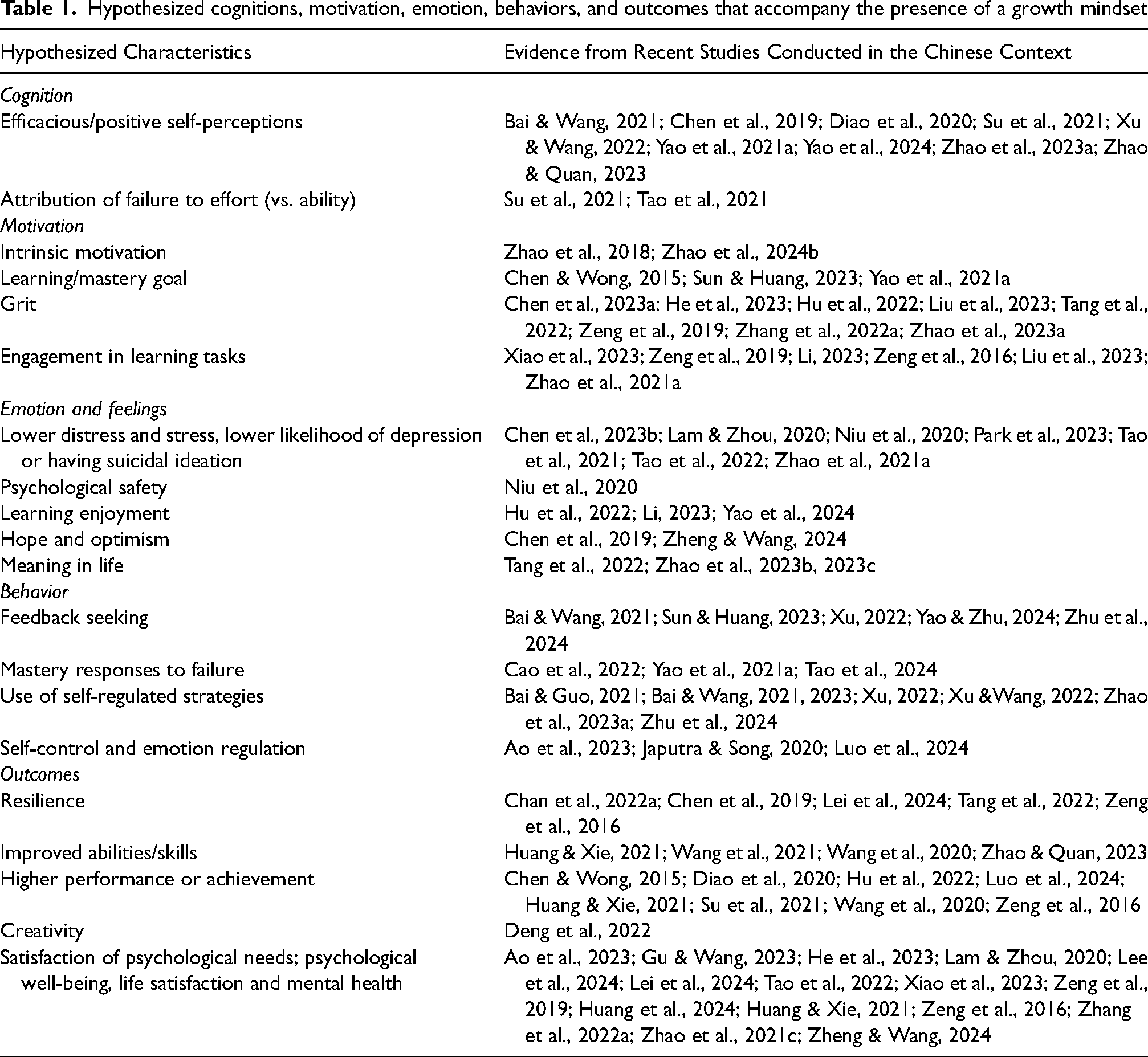
As illustrated in Table 1, the theory of growth mindset hypothesizes that the presence of growth mindset is accompanied by certain cognitive, motivational, emotional, and behavioral characteristics, as well as certain well-being and performance outcomes (column 1 of Table 1). Column 2 of Table 2 lists the recent cross-sectional studies conducted in the Chinese context that have confirmed these hypotheses. Specifically, the presence of growth mindset is accompanied by self-efficacy and positive self-perceptions, attribution of failure to effort (vs. ability), intrinsic motivation, embracing learning/mastery goals, grit, engagement in learning tasks, low levels of distress, low likelihood of depression, psychological safety, enjoyment of learning, hope, optimism, meaning in life, feedback seeking, mastery responses to failure, use of self-regulated strategies, self-control, emotion regulation, resilience, improved abilities or skills, high performance or achievement, creativity, satisfaction of psychological needs, psychological well-being, life satisfaction, and mental health. These results were obtained from samples that spanned a wide age range (from primary school children to older adults) and covered students, consumers, and adults from different professions (e.g., teaching, auditing, business, nursing). Furthermore, these studies were conducted in different regions of Mainland China, Hong Kong, Macau and Singapore.
Hypothesized cognitions, motivation, emotion, behaviors, and outcomes that accompany the presence of a growth mindset
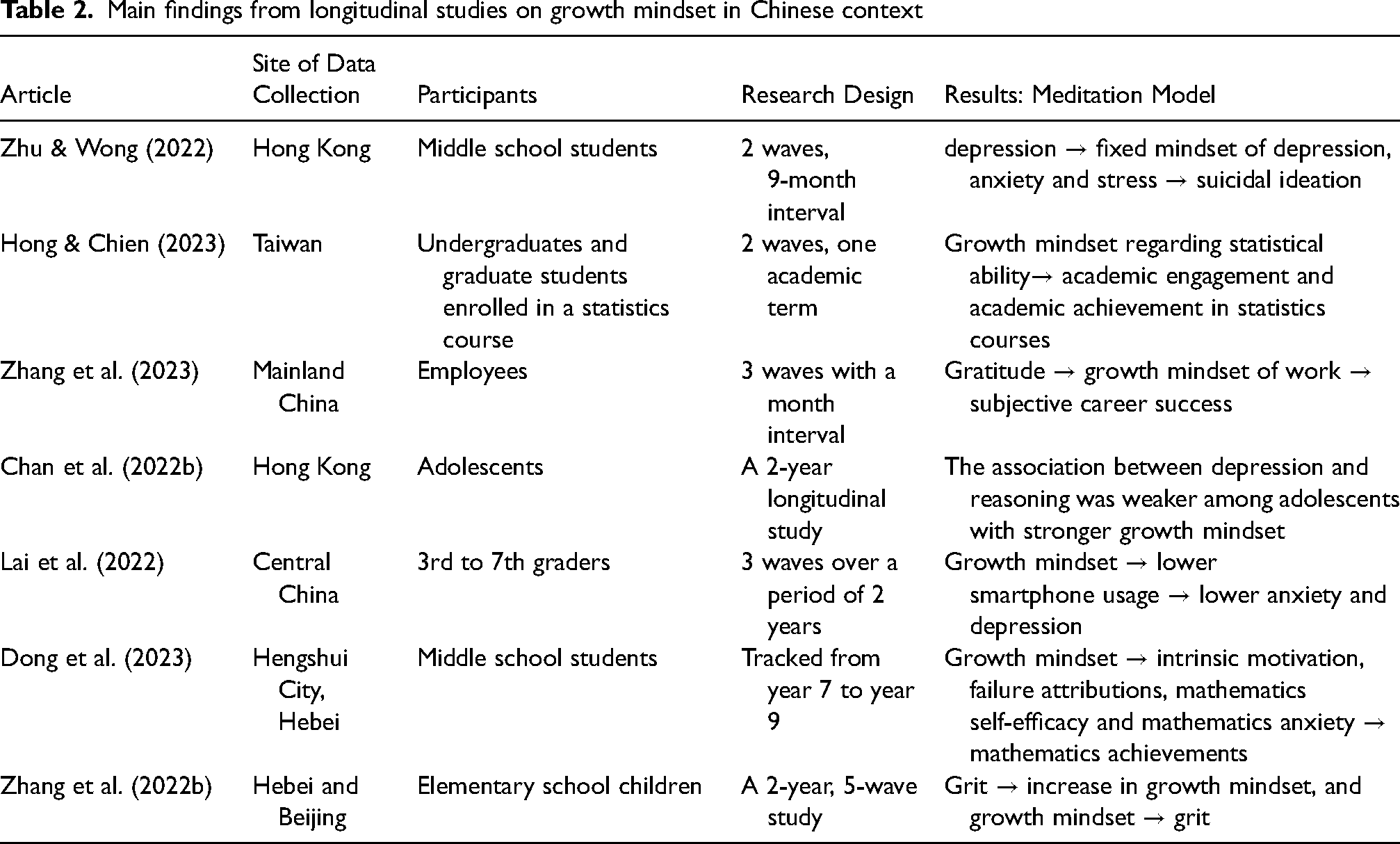
Main findings from longitudinal studies on growth mindset in Chinese context
Studies reported by Tao et al. (2022, this issue) and Lee et al. (2023, this issue) extend this literature. Tao et al. (2024, this issue) showed that among university students in Macau, China, the presence of a growth mindset was accompanied by lower levels of fear of failure (see also Kwan et al., 2022) and a lesser tendency to use emotion-focused strategies. Lee et al. (2023, this issue) showed that in Hong Kong, primary and secondary school teachers who had a stronger growth mindset were more receptive to innovative changes in teaching practices (e.g., online teaching during the COVID-19 pandemic) even when the resources and support for the changes were insufficient.
Table 1 lists studies conducted in the Chinese context. In addition to these studies, there are also studies that have examined the psychological correlates of growth mindset among Chinese immigrants in other countries. For example, in a study of Chinese migrant children in the USA, Joo et al. (2023) found that the presence of a growth mindset among migrant children attenuated the connection between perceived discrimination and the tendency of these children to display internalizing and externalizing behaviors.
Most studies reported in the articles listed in Table 1 have researched the psychological correlates of the growth mindset regarding intelligence. However, a sizable number of studies have studied the growth mindset regarding other human attributes, including the growth mindset regarding creativity (e.g., Li et al., 2021; Zhou et al., 2020), language (e.g., Dong, 2022; Wang & Ren, 2023; Yu & Ma, 2024), English writing ability (e.g., Bai et al., 2021), translation (e.g., Tian et al., 2023), vocabulary learning (e.g., Teng et al., 2024), digital literacy (e.g., Meng et al., 2024), teamwork (Zhao et al., 2021b), work (e.g., Zhang & Zhang, 2021), personality (e.g., Japutra & Song, 2020), and the human mind (e.g., Dang & Liu, 2022). The results showed that the presence of a growth mindset regarding a certain attribute is associated with theoretically relevant psychological variables in the same attribute domain. For example, Huang et al. (2023, this issue) introduced to the literature the construct of the growth mindset regarding meaning in life. Their studies found that the growth mindset of meaning in life is conceptually and empirically distinct from the growth mindset of intelligence. Furthermore, the presence of a growth mindset regarding meaning in life was positively associated with tolerance of uncertainty and psychological well-being. These results provided evidence for the nomological consistency and hence the conceptual and functional equivalence of growth mindset in the Chinese context.
The evidence for the nomological consistency of the growth mindset construct reviewed above shows that growth mindset has the same psychological meaning in its originating cultural context and the Chinese context. However, because most of this evidence was gathered from cross-sectional studies using self-reports from a single information source, it is possible that the nomological consistency noted above was an artifact of self-generated validity (Feldman & Lynch, 1988): research participants used retrieved answers to earlier survey questions (e.g., growth mindset items) as guides when they responded to later questions (e.g., intrinsic motivation). Thus, it is premature to conclude from this evidence that the presence of growth mindset confers psychological benefits in Chinese societies.
Researchers can address the issue of self-generated validity by collecting data for the independent and dependent measures from different information sources (Feldman & Lynch, 1988). For example, Yang and Xu (2022, this issue) had organization leaders assess their own level of humility, employees report their growth mindset regarding creativity, and employees’ supervisors evaluate the employees’ creativity at work. Their results showed that humble leaders tended to have employees with a growth mindset of creativity and higher creative performance at work. These results, which were based on information from different sources, cannot be attributed to self-generated validity.
Researchers can also address the issue of self-generated validity by using different methods to measure the independent and dependent variables. For example, Jia et al. (2023a) had Chinese adults report their growth mindset and collected these self-reports with neuroimaging data from the same participants. The results showed that individual differences in self-reported mindset were associated with the regional gray matter volume of the medial orbitofrontal cortex. Likewise, using the same methodological approach, Wang et al. (2018) found that self-reports of growth mindset mediated the association between the regional gray matter volume in the left dorsolateral prefrontal cortex and self-reports of grit.
Longitudinal evidence
Still, these findings, because of their correlational nature, do not lend support to the claim that growth mindset confers psychological benefits in the Chinese context. Several recently published longitudinal studies have attempted to establish the alleged temporal causal effects of the growth mindset. Table 2 presents the main findings of these studies, which are consistent with the findings from the cross-sectional studies.
Evidence from controlled experiments
Stronger support for the claim that growth mindset confers psychological benefits in the Chinese context came from several laboratory experiments in which growth mindset was situationally induced in the laboratory. Techniques of growth mindset inducement used include teaching the concept of growth mindset to the participants by asking participants to read “scientific materials” or attend a short course on the growth mindset (Ng et al., 2020; Song et al., 2022; Zhao et al., 2023b), and practicing growth mindset-related pedagogical strategies (e.g., process praise, Li & Bates, 2019). Results showed that situational inducement of growth mindset increased mastery motivation, academic resilience (Ng et al., 2020), and meaning in life (Zhao et al., 2023b), improved performance on moderately difficult post-failure tasks (Li & Bates, 2019), and attenuated the effect of stereotype threat on women's mathematics performance (Song et al., 2022).
Geng et al. (2022, this issue) extended this finding in the domain of intertemporal decision-making. People prefer smaller-sooner rewards (vs. larger-later ones) in the face of uncertainty. Geng et al. (2024) used the reading material technique to situationally induce the growth mindset of personality. They found that the growth-mindset manipulation could eliminate this decision-making bias.
Because these studies used explicit priming techniques to activate the growth mindset, demand characteristics posed a threat to the validity of the results. Using implicit growth-mindset manipulation and/or implicit outcome measures can help assuage this concern. For example, in an unpublished doctoral dissertation, Lin (2021) primed growth mindset with growth mindset-related words, and found that implicit growth mindset priming shortened participants’ reaction times to positive words (an implicit outcome measure). This result confers confidence in the causal effect of growth mindset on information processing.
Supportive conditions for the development of growth mindset
If growth mindset confers psychological benefits, what are the factors that would strengthen one's growth mindset in the Chinese context? First, having a supportive environment is conducive to the development of a growth mindset and can accentuate the beneficial effects of the growth mindset. Among mainland Chinese students, the perception that the school has a supportive climate is associated with stronger endorsement of growth mindset (Chen et al., 2024a; Liu, 2023). Furthermore, mainland Chinese university students’ intention toward self-regulated learning is the strongest when they have a growth mindset and perceive their teachers to be supportive (Jiang et al., 2023).
When a school has established a growth mindset climate, simply reminding students of the school climate is sufficient to generate the psychological benefits of the growth mindset. Tong et al. (2023, this issue) conducted an experiment in a secondary school in Hong Kong. This school had persistently promoted growth mindset among its students through a schoolwide sports program. In this study, students’ growth mindset was positively associated with the willingness to take challenging tasks. Interestingly, when these students were primed with the symbol of the sports program that promoted the growth mindset, all of them showed greater willingness to take challenging tasks, compared to those in the control (no priming) group.
Second, when parents or teachers have a growth mindset, their children and students also tend to have a growth mindset and have better psychological adjustment. Mainland Chinese elementary and junior high school students had lower levels of mathematics anxiety if their parents had a growth mindset and its aligned failure attributions (Xie et al., 2022). Children who migrated from Mainland China to Hong Kong reported higher levels of resilience and psychological growth if they mother had a growth mindset (Qu et al., 2021). In a one-year longitudinal study of Hong Kong primary school students, Kwok and Fang (2022) found that parental growth mindset regarding psychological aggression at time 1 predicted children's well-being at T2. Padilla et al. (2022) reported that teachers’ growth mindset predicted improvement in Chinese elementary and junior high students in the USA over a period of two years. Evidence for intergeneration transmission of growth mindset was reported in a recent 5-wave longitudinal study (Chen & Liu, 2023). The participants in this study were 4th graders in Beijing. These children showed higher levels of growth mindset after 2.5 years if their mother had a growth mindset that did not decline rapidly.
Third, parents’ and teachers’ support for autonomy is important for the development of the growth mindset. There is consistent evidence that parental autonomy support is positively associated with Mainland Chinese and Hong Kong Chinese elementary school students’ growth mindset (Chen et al., 2024b; Kim et al., 2017; Li et al., 2023). Among Mainland Chinese university students, growth mindset endorsement is positively related to perceived parental autonomy support and teacher autonomy support (Ma et al., 2020, 2022a; Qi & Lee, 2023). Another study showed that girls in Lanzhou had the best behavioral adjustment if they had a strong growth mindset and experienced teacher autonomy support (Ma et al., 2022b).
Although support for autonomy is positively related to the growth mindset, the evidence reviewed above, given its correlational nature, is not sufficient to confirm that hypothesis that support for support for autonomy fosters the development of the growth mindset. Zhao et al. (2023c, this issue) addressed this limitation by inducing an autonomous orientation in a laboratory experiment. Their study showed that after being primed with an autonomous orientation, Mainland Chinese 6th graders had stronger endorsement of the growth mindset than their counterparts in the control condition.
In short, there is evidence for the connection between growth mindset and support for autonomy. With this connection, one may hypothesize that the effect of growth mindset would be more pronounced among Chinese individuals who have internalized the value of being an autonomous learner, a value that is incongruent with the collectivist ethos in traditional Chinese culture. Huang et al. (2022, this issue) offered the first evidence for this hypothesis. They showed that Chinese university students’ growth mindset measured at the beginning of an academic semester predicted their mental health at the end of the semester, and this predictive relationship was stronger among students endorsing lower levels of collectivist or traditional values.
In summary, research has identified three conditions that are conducive to the development of the growth mindset in the Chinese context. These conditions are: (1) the school climate is supportive, (2) parents and teachers endorse the growth mindset, and (3) there is parental and teacher support for autonomy.
Growth mindset interventions in the Chinese context
Evidence for the effectiveness of growth-mindset interventions in the Chinese context would further strengthen the claim that growth mindset has positive psychological effects in the Chinese context. Table 3 lists the recent growth mindset intervention studies conducted in China. The site of data collection covered Hong Kong, Taiwan, and Mainland China. All studies were conducted in the school context, and the participants in these intervention studies included students in kindergartens, elementary schools, high schools, and universities.
Main findings from growth mindset intervention studies in Chinese context
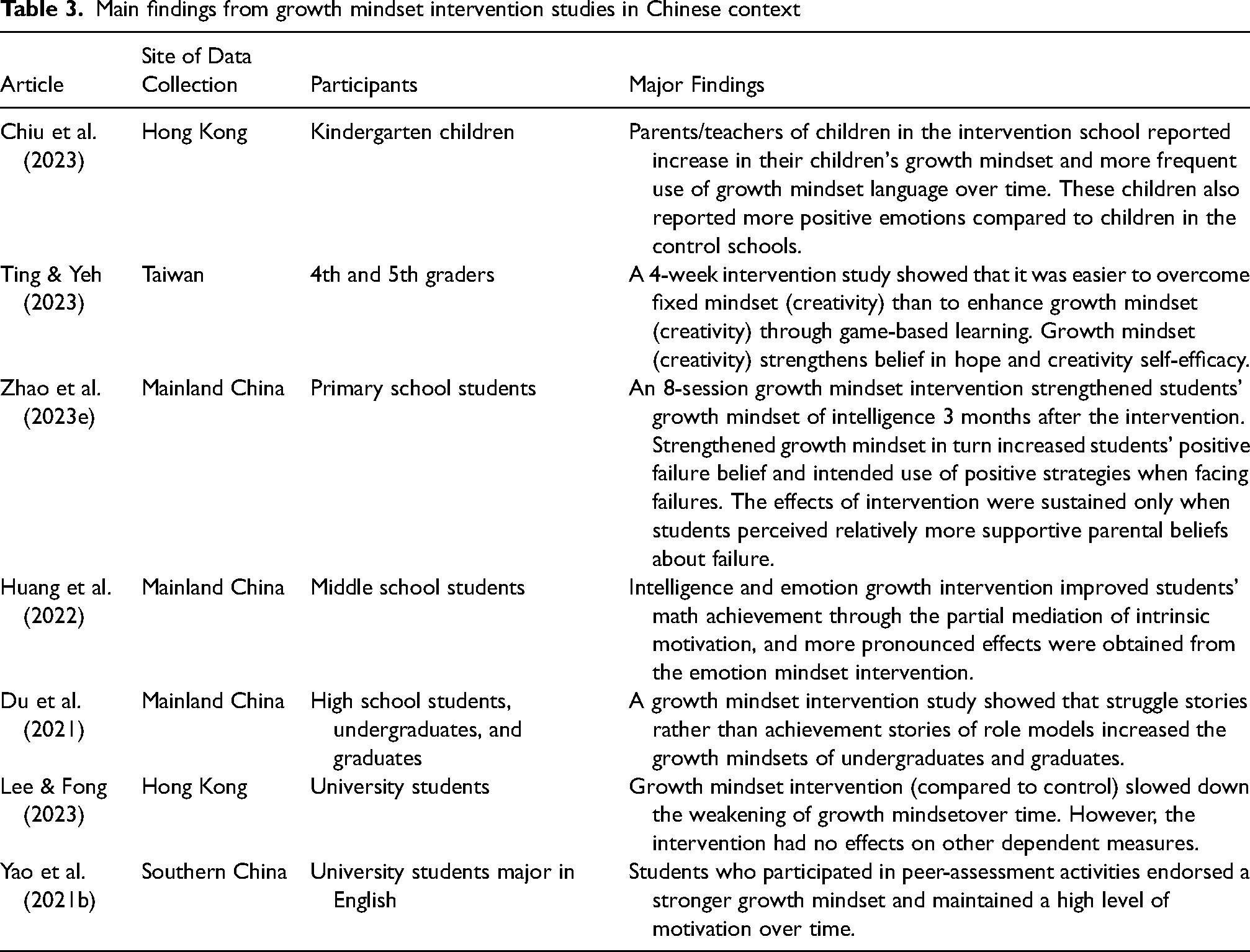
The intervention strategies used varied across studies. One strategy is to develop a specially designed short course to teach students the concept of growth mindset (Huang et al., 2022; Zhao et al., 2023e; Lee & Fong, 2023) and its aligned mastery-oriented learning practices (Zhao et al., 2023e). Another strategy is to design new learning activities or materials, such as game-based learning (Ting & Yeh, 2023) and struggle stories of role models (Du et al., 2021). A third strategy is to incorporate the teaching of growth mindset in the school curricula, pedagogies, and teacher–student interactions (Chiu et al., 2024; Yao et al., 2021b). Positive outcomes of these interventions were reported in these studies. The results showed that growth-mindset interventions could (a) strengthen the participants’ growth mindset, (b) improve their emotions, self-perceptions, intrinsic motivation, and mathematics achievement, and (c) fortify their belief in hope, positive failure belief, and intention to use positive strategies when facing failures.
The studies reported in two articles in the current issue extend the intervention literature. First, Xia et al. (2022, this issue) incorporated the teaching of growth mindset in the curriculum of a mandatory 6-week mental health course taken by junior high school students in economically disadvantaged areas of China. Compared to the control group, the treatment group endorsed the growth mindset more strongly, and had higher levels of grit and a lesser tendency to make fixed trait attributions.
Second, based on the finding that situational inducement of an autonomous orientation could strengthen the growth mindset, Zhao et al. (2023c, this issue) designed a brief intervention program that aimed to focus students’ attention on their interests, values, and passion, and guided students to formulate a plan that would leverage their strengths. This intervention successfully strengthened Chinese 5th graders’ growth mindset.
Although the results from intervention studies are encouraging, the consistency and durability of the interventions’ effects varied across studies. Interventions that embedded the concept of growth mindset in school practices and students’ natural learning environment had the most durable and consistent positive effects (Chiu et al., 2023; Xia et al., 2024; Yao et al., 2021b). Specially designed intervention activities (game-based learning) had inconsistent outcomes; they were more efficacious in overcoming the fixed mindset than strengthening the growth mindset (Ting & Yeh, 2023). Brief courses designed specifically for teaching the growth mindset also had inconsistent outcomes. The brief intervention in the Lee and Fong study (2023) was able to slow down the decline of growth mindset, but had no effects on other outcome measures. The eight-session course in the Zhao et al. study (2023e) strengthened students’ growth mindset and mastery-oriented coping. However, these effects were sustained only when students perceived relatively more supportive parental beliefs about failure. These observations are consistent with the finding that the growth mindset prevails and confers psychological benefits particularly when the environment and significant others embrace the growth mindset and its aligned practices. According to this line of reasoning, embedding growth mindset training in the school curriculum and students’ daily social interactions (including interactions with parents, teachers, and peers) should produce the most consistent and sustainable effects. Furthermore, such interventions also help to transform the normative and social environment into one that supports the development of growth mindset. This intervention strategy shifts the focus of the intervention from designing standalone course activities and materials to empowering teachers and parents, enabling them to master the design principles of growth mindset development and habitually incorporate these principles and their aligned practices into their teaching or child training (Chiu et al., 2023).
Conclusions and future directions
In summary, because of the lack of cross-cultural equivalence in the conceptualization of intelligence, it is premature to conclude whether the growth mindset regarding intelligence is less popular in the Chinese (vs. Western) context. Given the lack of cross-cultural equivalence in the lay definition of intelligence or other attributes, constructing cross-cultural measures with metric equivalence will be a future research challenge.
Nonetheless, although growth mindset is an imported construct, the belief in the malleability of a personal attribute is associated with a host of cognitive, motivational, affective, behavioral, and performance outcomes hypothesized in the theory of growth mindset. Results from cross-sectional correlational studies, longitudinal studies, and laboratory experiments converge to support the claim that growth mindset is a relevant personal growth construct in the Chinese context. Finally, in the Chinese context, growth mindset gains popularity among students when the normative and interpersonal environment supports an autonomous orientation.
Several research questions merit future research. First, most current growth mindset research in the Chinese context has focused on people's beliefs about personal attributes, although a few studies have started to examine the effects of people's beliefs about societal attributes. For example, some researchers have studied Chinese people's beliefs about the malleability of socioeconomic status (SES). In two longitudinal studies, it was found that people who have a growth mindset regarding SES tended to have lower levels of depression and anxiety and higher levels of self-esteem and subjective well-being (Zhao et al., 2021e; Zhao et al., 2023d). In another cross-sectional study, it was found that middle school students with a growth mindset regarding SES had higher academic achievement (Zhao et al., 2021d). Furthermore, adolescents with a growth mindset regarding SES exhibited a steeper diurnal cortisol slope, which is a sign of effective stress coping (having a flatter diurnal cortisol slope is a mediator between chronic psychosocial stress and poor mental and physical health outcomes; Zhao et al., 2024a). Finally, having a growth mindset regarding SES orients individuals to expect higher levels of upward social mobility in society. Past studies in Singapore found that growth mindset was accompanied by higher academic performance only when perceived upward mobility was high (i.e., SES was believed to be malleable; Jia et al., 2021).
In China, students from lower SES tend to have lower academic achievement (Liu et al., 2020). Consistent with this general finding, Fang et al. (2022, this issue) reported that in China, students who were induced to self-categorize as a low SES student had lower levels of learning engagement, compared to those who were induced to categorize themselves as a higher SES student. Fang et al. (2024) further found that having a growth mindset regarding intelligence can reduce the SES gap in learning engagement. Xia et al. (2022, this issue) also found that teaching growth mindset regarding intelligence to economically disadvantaged students improved their perseverance and mastery-oriented coping. Thus, having a growth mindset may help close the SES achievement gap. Combining insights from the above findings, we hypothesize that the efficacy of growth mindset (intelligence) intervention is effective in closing the SES achievement gap only when people who participate in the intervention also believe that SES is malleable. This is a hypothesis that merits future research.
In addition to mindset about societal attributes, several recent studies conducted in China started to explore the effects of meta-mindsets or mindsets attributed to others. For example, Li et al. (2023) found that children who attribute a growth mindset to their caregivers tended to have a growth mindset themselves. Dong (2024) reported that high school students who attributed a growth mindset to their English teachers’ tend to have a growth mindset and use self-regulated strategies more in online learning. Jia et al. (2023b) found that high school students who attributed a fixed mindset to their headteachers tended to pursue performance goals rather than mastery goals. Chan et al. (2020) found that in Hong Kong, even when the schools strongly supported teaching innovations and the teachers possessed a growth mindset, teachers would welcome teaching innovations only when they believed that other teachers also endorsed a growth mindset. Lastly, Chan et al. (2023, this issue) found that mindsets are more strongly associated with intrapersonal outcomes, and meta-mindsets are more strongly associated with interpersonal outcomes. For example, in Hong Kong, primary school students’ mindsets had stronger predictive relationship with children's academic engagement than did the mindsets they attributed to other classmates. However, compared to children's mindset regarding personal qualities, the mindsets children attributed to their classmates had stronger predictive relationship with enjoyment of social interactions.
This finding points to an important future direction in growth mindset research. Most researchers in China have treated growth mindset as a personality variable. However, growth mindset could also be a meta-mindset or a perceived norm. Would the effect of mindset be more pronounced when the meta-mindset norm is salient in the context, as the results of Lou and Li's cross-cultural study (2023) suggests? In this study, by analyzing the 2018 PISA data, it was found that growth mindset had stronger predictive relationships with multiple performance outcomes in societies with salient growth mindset norms. Future research is needed to understand how people construct growth meta-mindset and how mindset and meta-mindset interact to influence an individual's cognitive, motivational, affective, and behavioral responses. Additionally, if mindset is more predictive of intrapersonal phenomena and meta-mindset is more predictive of interpersonal phenomena, as the Chan et al. (2023, this issue) study showed, researchers need to choose the appropriate measure depending on the nature of the phenomena they seek to explain.
Finally, most researchers have relied on self-reports to measure growth mindset and its hypothesized outcomes. Results from these studies could be interpreted as artifacts of self-generated validity (Feldman & Lynch, 1988). Some studies have used neurological and biometric measures to capture the outcome variables (Jia et al., 2023a; Wang et al., 2018; Zhao et al., 2024a). Some researchers had explored the use of word priming to activate the growth mindset in experimental studies (Lin, 2021). Recently, Sik, Cummins, and Jobs (2024) have developed implicit measures of growth mindset. We welcome future research that uses more diverse methods to test and extend the theory of growth mindset.
To conclude, growth mindset is a simple construct with important psychological and social implications. Research on growth mindset in the Chinese context has flourished since 2020. This special issue aims to provide a timely review of the state of art in this research. Each article in this special issue adds insights to our understanding of the theory's applicability in the Chinese context. We hope that this editorial article can offer readers of this special issue a bird's-eye view of the theoretical and empirical progress we have made, as well as the progress we could continue to make in future research.
Footnotes
Declaration of conflicting interests
The authors declared no potential conflicts of interest with respect to the research, authorship, and/or publication of this article.
Funding
The authors disclosed receipt of the following financial support for the research, authorship, and/or publication of this article: Preparation of this article was supported by a research grant the Research Grants Council of Hong Kong, China awarded to the Chi-yue Chiu and Hiu-Sze Chan (1462232).

Article note
The publication year of the following references has been corrected in the text and reference list of the article.