




Abstract
The purpose of this study was to examine the bidirectional relationship between religiosity and psychological well-being in a sample of American adults. The study used data from the Midlife in the United States (MIDUS) study, collected at three time points over approximately 20 years. The results showed a weak positive correlation between religiosity and psychological well-being at the between-person level. However, the results of the random-intercept cross-lagged panel model revealed that within-person changes in religiosity did not predict future changes in psychological well-being, and vice versa. The findings suggest that these variables are not significant predictors of each other, at least in the long term, and that the relationship between the two is most likely not causal. These findings challenge the commonly held belief that religion is beneficial to well-being and suggest the need for further longitudinal research and more rigorous statistical methods.
Introduction
Literature reviews and meta-analyses suggest a robust positive relationship between religiosity and mental well-being and the absence of mental distress (e.g., Hackney & Sanders, 2003; Koenig, 2009). This general notion was confirmed in a study by 120 teams from 24 countries (Hoogeveen et al., 2022), who found a positive relationship between religiosity and various aspects of mental well-being. Tay et al. (2014) and Sedikides and Gebauer (2013) argue that religiosity promotes well-being because it helps people meet their inherent human needs, such as self-esteem, reduction of uncertainty, meaning in life, and social belonging. However, these conclusions are based predominantly on cross-sectional studies. A smaller number of longitudinal studies have also been conducted. A meta-analysis of longitudinal studies (Garssen et al., 2021) also found small positive relationships between religiosity and mental well-being.
There has been a lack of within-person studies in this area of research. The longitudinal studies that have examined the temporal (i.e., lagged) relationship between religiosity and well-being have typically not distinguished between within-person and between-person levels of analysis. Without a sufficient number of studies providing information on purely temporal within-person relationships between two variables, not much can be said about the direction of these relationships (Brandt & Morgan, 2022). Two recent long-term longitudinal studies (Joshanloo, 2021, 2023) examined the temporal within-person relationships between dimensions of hedonic/subjective well-being (i.e., life satisfaction, affective well-being) and religiosity in the USA and Australia, and found zero or nearly zero associations. Subjective well-being focuses on an individual's subjective experience of pleasure and satisfaction with their life. It typically involves the measurement of emotions and life satisfaction. Eudaimonic well-being, on the other hand, focuses on a person's sense of purpose, meaning, and self-actualization. It emphasizes personal growth and fulfillment and is linked to factors such as meaning in life, autonomy, mastery, and positive relationships (Ryan & Deci, 2001). Ryff's (1989) psychological well-being model is a widely accepted multidimensional model of eudaimonic well-being consisting of six key dimensions: autonomy, environmental mastery, personal growth, positive relationships, purpose in life, and self-acceptance. This model conceptualizes psychological well-being as a multidimensional construct that encompasses various aspects of optimal psychological functioning. Specifically, autonomy refers to one's independence and self-determination; environmental mastery refers to one's ability to manage one's environment and circumstances; personal growth refers to continued self-development and the realization of one's potential; positive relationships refers to having satisfying interpersonal relationships; purpose refers to having meaning, direction, and intentionality; and self-acceptance refers to having a positive sense of self and acceptance of one's past life.
Longitudinal studies have found positive associations between religiosity and various components of psychological well-being, such as meaning in life (Krause & David Hayward, 2012) and self-control (Marcus & McCullough, 2021). However, these studies have not separated within-person and between-person levels. To fill this gap, the present study used a data set spanning approximately two decades to examine the temporal within-person associations between religiosity and psychological well-being. The religiosity scale used in the study assesses an individual's overall religiosity and the importance of religion in their life. The psychological well-being scale used is based on Ryff's (1989) comprehensive model of psychological well-being.
Methods
Participants
Data are from the Midlife in the United States (MIDUS) project, Wave 1 (collected 1995–1996), Wave 2 (2004–2006), and Wave 3 (2013–2014). There were 653 individuals (9.2% of all available participants) who did not respond to any of the variables during the study and were therefore not included. A total of 6,455 people answered at least one variable across the three waves and formed the sample for this study (age at Wave 1, mean = 46.83, SD = 12.93, females = 52.5%). All research materials and data are publicly available (http://midus.wisc.edu). Of the included participants, 2,653 individuals (41.1%) participated in all three waves, 1,512 (23.4%) participated in two waves, and 2,290 (35.5%) participated in only one wave. In other words, 3,802 individuals (58.9%) did not participate in at least one wave.
Measures
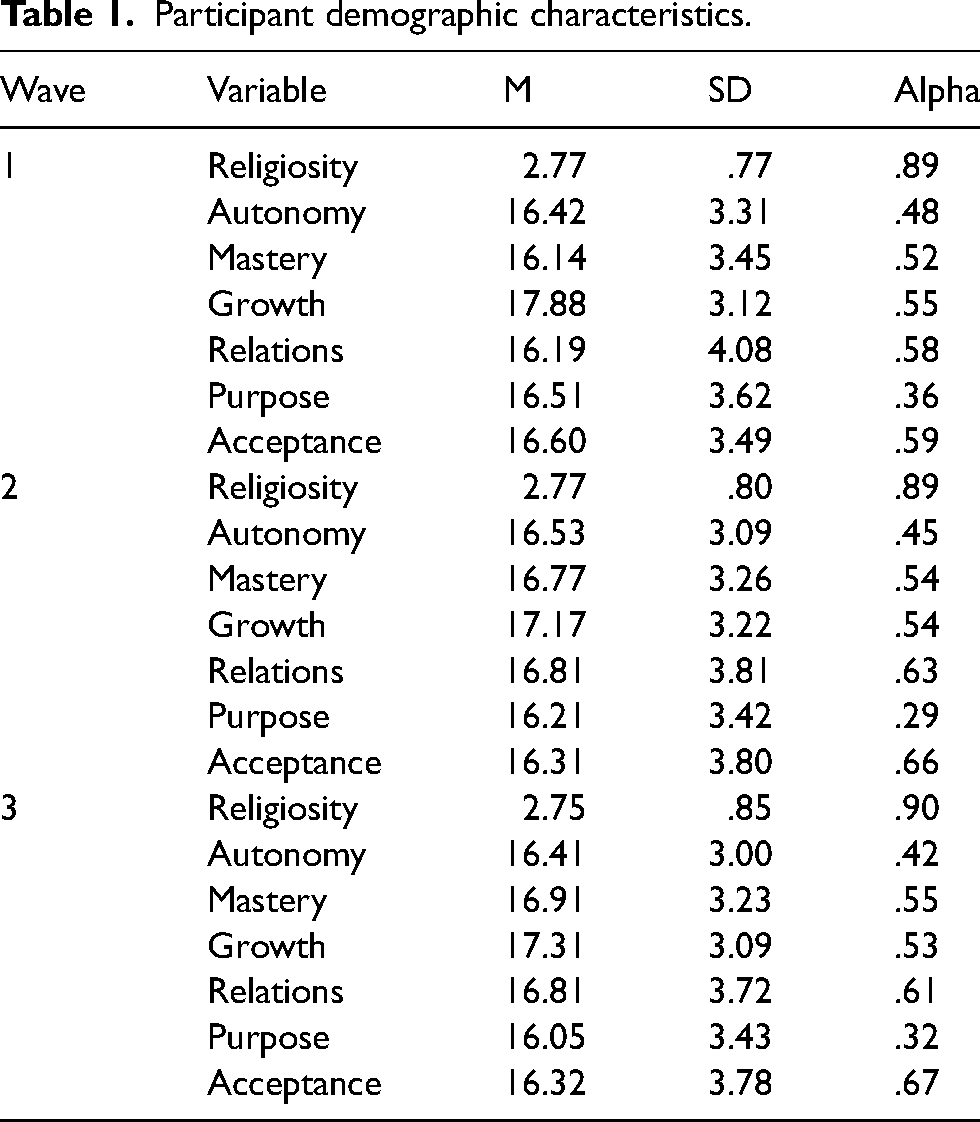
Internal consistencies and descriptive information are shown in Table 1.
Participant demographic characteristics.
Statistical analysis
A random intercept cross-lagged panel model (RI-CLPM) was used to analyze the data. This technique separates between-person differences from within-person variation (Hamaker et al., 2015). Between-person effects represent time-invariant associations that do not imply directionality or causality. In contrast, cross-lagged paths at the within-person level capture directional predictive relationships between variables. More specifically, the within-person processes reflect fluctuations around an individual's own typical or baseline levels of well-being and religiosity over the study period. The cross-lagged effects specifically show whether deviations from an individual's expected well-being at an earlier point in time predict deviations from his or her expected level of religiosity at a later point in time (and vice versa from religiosity to later well-being). By modeling dynamic change around baseline values unique to each individual, the RI-CLPM allows for testing directional within-person hypotheses while controlling for time-invariant between-person differences in the variables.
Models were estimated using the robust maximum likelihood estimator (MLR) in Mplus. A Comparative Fit Index (CFI) of at least .90, a Root Mean Square Error of Approximation (RMSEA) of at most .07, and a Standard Root Mean Square Residual (SRMR) of at most .08 were used as thresholds for acceptable fit in this study. Predictive paths between state variables were held equal over time. All observed variables were regressed on gender and baseline age.
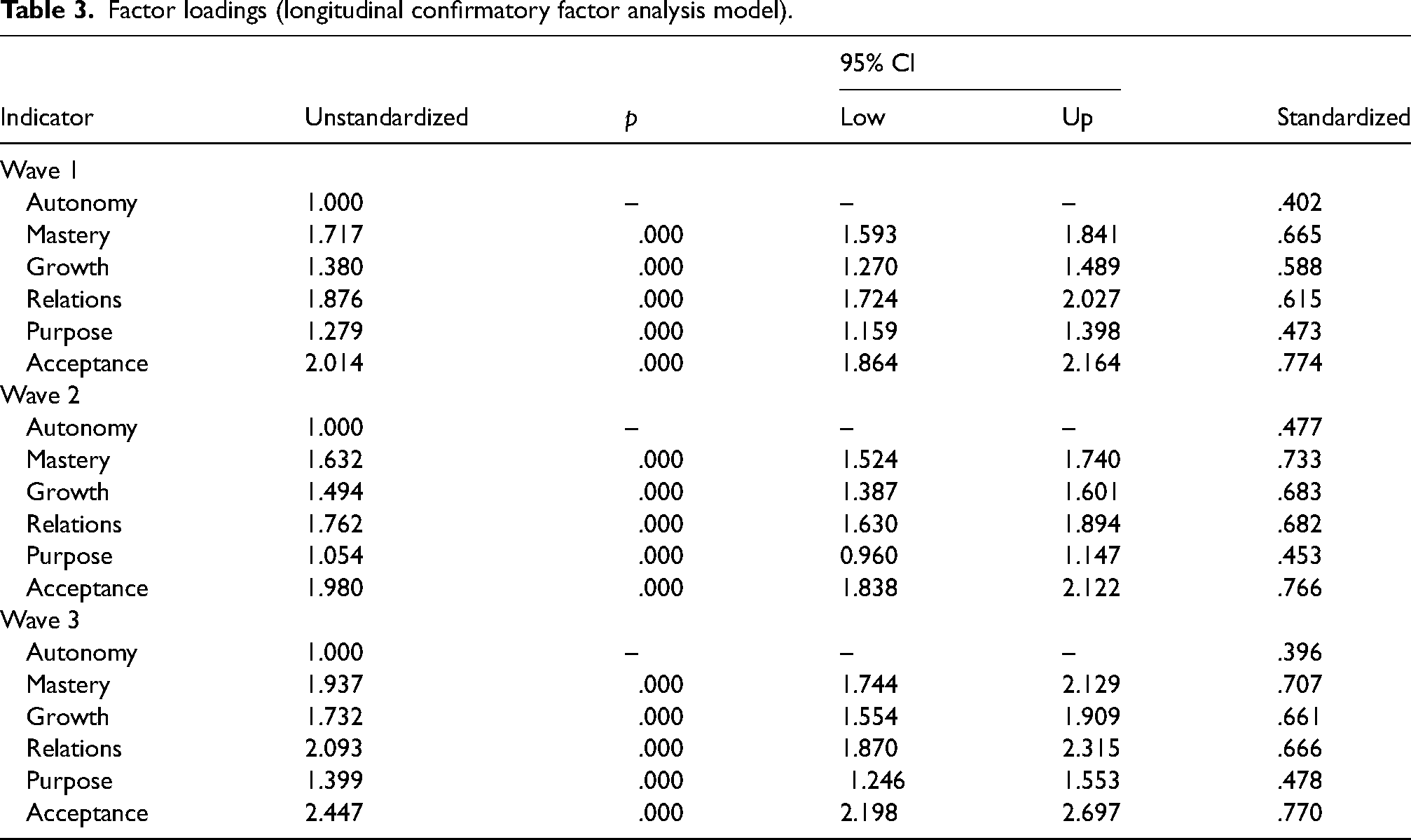
Religiosity was used as an observed variable, while psychological well-being was used as a latent variable. Thus, it was possible to test the measurement invariance of psychological well-being over time. Because the focus was on examining structural relationships rather than mean differences, the analysis focused on testing the invariance of the metric (factor loadings) across time (Newsom, 2015). A longitudinal confirmatory factor model was specified with psychological well-being, as reflected by its six constituent dimensions, at each time point. This baseline model showed a good fit to the data (Table 2). In addition, the factor loadings were found to be acceptable (Table 3). Imposing equality constraints on the factor loadings over time resulted in negligible changes in model fit (Table 2, metric model). Thus, the assumption of metric invariance over time was consistent with the data, suggesting that participants understood and responded to the measures of psychological well-being consistently across the three assessments. With metric invariance established, equality constraints on factor loadings were maintained for testing the reciprocal effects of religiosity and well-being in the RI-CLPM.
Fit indices.

Factor loadings (longitudinal confirmatory factor analysis model).
In the sample analyzed, 58.9% of participants had missing data for at least one wave. Supplementary analyses (Supplementary Tables S1-S3) revealed that individuals with complete versus incomplete data differed significantly on some study variables, albeit with mostly small effect sizes (< .32). Full information maximum likelihood (FIML) estimation was used to appropriately handle missing data. FIML uses all available observed data points in the sample without discarding or removing cases with missing values. In addition, a binary indicator of missingness (0 = no missing waves; 1 = one or more missing waves) was included as an auxiliary variable in the models. The inclusion of auxiliary variables allows for the reduction of potential estimation biases due to missing data (Enders, 2022). In summary, FIML estimation and the auxiliary variable approach facilitated a less biased model testing.
Results
The RI-CLPM fitted the data well (Table 2). The main results of this analysis are reported in Table 4. There was a small and positive between-person correlation (r = .108) between the two variables. The within-person auto-regressive effects were significant for both religiosity and psychological well-being, suggesting that deviations from one's estimated mean at one time point are expected to be followed by deviations in the same direction at the next time point. To examine the temporal within-person relationships, the cross-lagged effects were examined. None of the cross-lagged effects was significant. This suggests that being higher or lower than one's typical level in one variable is not associated with being higher or lower than one's typical value of the other variable at the next time point. Therefore, within-person change in one variable does not precede within-person change in the other.
Random-intercept cross-lagged model results for religious salience.
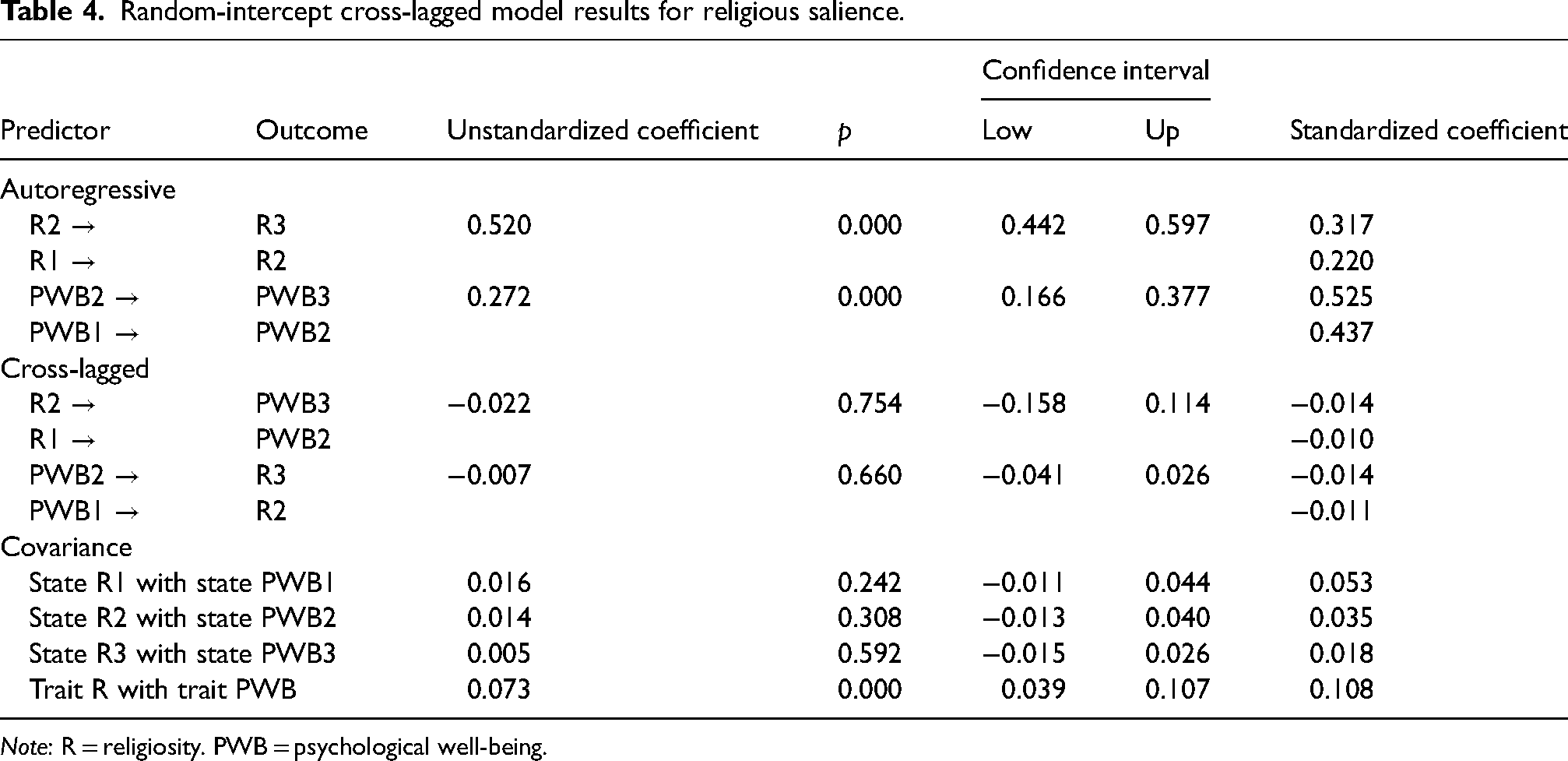
Note: R = religiosity. PWB = psychological well-being.
Discussion
The small positive correlation found between religiosity and psychological well-being at the between-person level suggests that more religious individuals tend to report slightly higher levels of psychological well-being. This between-person correlation is ambivalent in terms of temporal sequence and causal direction. It is plausible that third variables (e.g., personality traits, stable environmental factors, or genetic factors) cause religiosity and well-being to covary. Thus, a small between-person correlation alone provides little insight into the direction of associations between two variables. It merely indicates a probability that high religiosity and high well-being occur together.
To determine if changes in one variable are associated with subsequent changes in the other variable, this study went beyond between-person analysis by investigating cross-lagged effects at the within-person level. The findings demonstrate that no temporal within-person association could be established. These results imply that drawing conclusions from cross-sectional findings alone can be misleading. While slightly high levels of psychological well-being may be observed among more religious individuals, this does not automatically indicate that religiosity directly enhances well-being—a common misinterpretation of the cross-sectional findings. Similarly, although previous longitudinal studies have provided valuable insights, they have often failed to distinguish between within-person and between-person effects. A more accurate assessment of the longitudinal relationship between two variables requires examining how within-person changes in one variable relate to within-person changes in the other over time, that is, the approach adopted in this study. By demonstrating a lack of temporal link between changes in religiosity and psychological well-being, the present study challenges the assumption that increased religious involvement and salience leads to improved psychological well-being. The results are consistent with two recent RI-CLPM studies (Joshanloo, 2021, 2023) that found no associations between religiosity and subjective well-being. The results are also in keeping with those of Prati (2023), calling into question “the practical significance and utility of using religion per se for the prediction of well-being” (p. 1).
In a comprehensive study involving 1,619,300 participants from 166 countries, a striking 71.4% of respondents affirmed the importance of religion in their daily lives (Joshanloo & Gebauer, 2020). This significant number underscores the persisting global importance of religious beliefs and their potential relevance in various contexts, including therapeutic and counseling settings. Various psychological models and frameworks (for reviews, see Moon et al., 2023; Wilt et al., 2018) propose that increased religiosity provides physical and mental health benefits by enhancing dimensions of psychological well-being. More specifically, these models postulate pathways by which religious beliefs and behaviors enrich facets such as meaning in life, relationships, and perceived social support, which in turn confer resilience to distress and morbidity. However, the current study found no evidence to support the hypothesized positive effect of religiosity on psychological well-being. In light of these findings, psychologists and clinicians may need to exercise caution when making generalized assumptions about the relationship between religiosity and well-being. Notably, these findings neither indicate that increased religiosity enhances psychological well-being nor do they suggest that it diminishes well-being.
It is important to consider some limitations when interpreting these findings. In particular, the relationship between religiosity and psychological well-being may vary across cultures due to differences in religious norms, beliefs, and practices (Hoogeveen et al., 2022). Therefore, the conclusions drawn from this study may not apply to other cultural contexts and backgrounds. To gain a comprehensive understanding of the relationship between religiosity and well-being, future research should incorporate samples from various cultural backgrounds. Secondly, although a longitudinal design offers advantages over cross-sectional approaches, causal inferences from such observational data must be made with caution. These results do not definitively rule out causal relationships, as analyses of nonexperimental data cannot conclusively disentangle causation from correlation. Unmeasured confounds could explain why changes in one variable did not precede the other in this sample. Although the results provide novel insights into long-term intra-individual dynamics, they should not be overstated as evidence against causal relationships altogether. Nonetheless, the findings do importantly demonstrate the absence of robust long-term predictive effects that warrant a reevaluation of putative causal assumptions.
Another noteworthy limitation is that this study examined the long-term relationship between these variables. The current results suggest that changes in levels of religiosity do not have a large effect on future well-being in the long term. Short-term within-person studies (e.g., studies with lags of one week or one month or experience sampling studies) might find a stronger influence of religiosity on future well-being. For example, Kent et al. (2021) found an association between daily spiritual/religious experiences and well-being in an experience-sampling study.
This study offers a preliminary understanding of the long-term connection between religiosity and psychological well-being. Further research is necessary to expand upon and validate these findings. Understanding the influence of factors such as cultural norms, religious traditions, and developmental stages would improve our understanding of the links between these variables. The findings of this study highlight the need for complementary research using other rigorous methodologies. Experimental and intervention designs would allow for more definitive causal inferences. The integration of mixed methods with qualitative explorations could shed light on personal narratives that shape trajectories of well-being. By using diverse samples and methodological approaches, we can gain a more comprehensive understanding of the complex relationships between religiosity and well-being across cultures.
Another avenue for future research is to investigate potential moderators of the relationship between religiosity and well-being. For example, two potential moderators are social integration within religious communities and religious motivation. Those who are deeply involved in supportive religious communities may experience greater well-being benefits than those who practice more independently. In addition, the motivation behind one's religious beliefs and practices could play a role. Intrinsic motivation, driven by personal faith, may lead to higher levels of well-being because it aligns beliefs with daily life, as opposed to external factors. Taking these moderators into account in future research may reveal more nuanced patterns in the longitudinal relationship between religiosity and psychological well-being.
In conclusion, the data did not establish a clear connection between changes in religiosity and well-being over time. These findings contradict the commonly held belief that increased religious engagement leads to sustained improvements in individual well-being. While short-term longitudinal studies might identify significant effects, the absence of long-term within-person associations found in this research calls for caution when asserting lasting well-being benefits of religiosity. The results emphasize the need to look beyond cross-sectional evidence and analytical methods that fail to disentangle between-person differences from within-person processes. Incorporating within-person analyses as a supplementary approach can help prevent the perpetuation of oversimplified assumptions regarding the importance of religiosity for well-being.
Supplemental Material
sj-docx-1-pac-10.1177_18344909241262209 - Supplemental material for No evidence of longitudinal association between religiosity and psychological well-being: Challenging prevailing assumptions
Supplemental material, sj-docx-1-pac-10.1177_18344909241262209 for No evidence of longitudinal association between religiosity and psychological well-being: Challenging prevailing assumptions by Mohsen Joshanloo in Journal of Pacific Rim Psychology
Footnotes
Data and materials

Declaration of conflicting interests
The author declared no potential conflicts of interest with respect to the research, authorship, and/or publication of this article.
Ethics approval and consent to participate
Funding
The author received no financial support for the research, authorship, and/or publication of this article.
Supplemental material
Supplemental material for this article is available online.
References
Supplementary Material
Please find the following supplemental material available below.
For Open Access articles published under a Creative Commons License, all supplemental material carries the same license as the article it is associated with.
For non-Open Access articles published, all supplemental material carries a non-exclusive license, and permission requests for re-use of supplemental material or any part of supplemental material shall be sent directly to the copyright owner as specified in the copyright notice associated with the article.
