




Abstract
Parental psychological control has been consistently shown to have a strong impact on adolescents’ self-development and mental well-being. However, the majority of research on the link between parental psychological control, self-esteem, and mental health is conducted in Western nations and has primary focused on global self-esteem. The current study drew on non-Western data and tested a mediation model in which adolescents’ academic and social self-esteem were hypothesized to mediate the association between parental psychological control and depression. A large sample (N = 3,257) of adolescents in southern China reported perceived psychological control from both their mother and father, their academic and social self-esteem, and depressive symptoms. Structural equation modeling results indicated that both mother and father control had significant direct effects on adolescent depression as well as significant indirect effects on depression through lower academic self-esteem. Social self-esteem failed to mediate the association between parental control and depression. Theoretical and practical implications of these findings are discussed.
Adolescence is a critical developmental stage when individuals start to form a self-identity (e.g., Arnett, 2000; Erikson, 1968). Parental psychological control has been consistently shown to have a strong impact on children's self-development and psychological well-being (see Barber et al., 2005 for a review). However, the bulk of research relating parental psychological control to adolescent development is primarily based on studies conducted in the US and other Western nations (see Barber et al., 2005; Wang et al., 2007). The current research was designed to extend previous work by bringing a culture-sensitive perspective in the theorizing and empirical investigation of the role of parental psychological control in adolescent development. Following self-determination theory (e.g., Deci & Ryan, 1985; Ryan & Deci, 2000), we developed a mediation model where the associations between parental psychological control and adolescents’ depressive symptoms are mediated by dual mediators—adolescents’ academic and social self-esteem. We tested this model in a large sample of adolescents from China.
Parental psychological control, adolescent self-esteem, and their well-being
Parental control has been suggested to be a key dimension of parental behaviors that have a broad-range impact on children's development (e.g., Barber et al., 2005; Pettit et al., 2001). Two forms of parental control are commonly differentiated: psychological control and behavioral control. Parental psychological control refers to a parent's attempts to manipulate children's emotional and mental experiences through psychological techniques such as love withdrawal and guilt induction, whereas parental behavioral control is exerted in order to manage a child's behaviors such as implementing rules and restrictions, monitoring, as well as incorporating rewards and punishments (e.g., Barber, 1996). The current research focused on parental psychological control because previous research suggested that parental psychological control has a consistent, stronger association with children's psychosocial problems, especially internalizing problems such as anxiety and depression (e.g., Barber et al., 2005; Conger et al., 1997; Pettit et al., 2001), whereas the effect of parental behavioral control is less consistent—depending on the degree and type of the control, behavioral control may have a positive, negative, or no association with children's problems (e.g., Wang et al., 2016).
While multiple theoretical perspectives such as symbolic interaction perspective (Openshaw & Thomas, 1990) and attachment theory (Bowlby, 1973; Pietromonaco & Feldman Barrett, 2000) have offered great insight into the relationship between parental psychological control to children's psychological outcomes, we suggest that self-determination theory (SDT) provides a uniquely useful guide to understanding this relationship. SDT is a theory of human motivation—to what degree a behavior is due to intrinsic motivations (i.e., self-determination) or extrinsic motivations (e.g., Deci & Ryan, 1985; Ryan & Deci, 2000). According to SDT, three basic, innate psychological needs are critical to the feeling of self-determination: autonomy, competence, and relatedness. When these needs are fulfilled, individuals tend to feel self-motivated and self-determined, which, in turn, has significant positive implications for their self-identity and psychological well-being; in contrast, thwarting any of these fundamental needs may undermine intrinsic motivation and have a negative impact on individuals’ self-worth (e.g., Ryan & Deci, 2000). Because psychologically controlling parents constrain their children's decisions and behaviors through the more intangible emotional manipulations, it may gradually create a chronic sense for the children that they have little say in their own lives, regardless of what they truly want for themselves. This would greatly block the fulfillment of their need for autonomy (e.g., Barber et al., 2005; Openshaw & Thomas, 1990). As a consequence, these young individuals are more likely to suffer from low self-esteem characterized by feelings of inadequacy and a lack of positive self-regard (Rosenberg, 1979). Such negative beliefs regarding oneself contribute to symptoms of depression (Beck, 1967).
Recent meta-analysis by Sowislo and Orth (2013) suggested a causal effect of self-esteem on depression rather than vice versa. In line with these conceptualizations, adolescents’ self-esteem has been theorized to act as a mediator through which parental psychological control influences adolescent depression (Robertson & Simons, 1989). This mediation model has received consistent empirical support in several studies (Conger et al., 1997; Garber et al., 1997; Kouros & Garber, 2014; Plunkett et al., 2007). It is important to note that almost all previous studies in this area measured adolescent depression through self-reported symptoms rather than formally clinically diagnosed depression disorder. Similarly, self-reported depressive symptoms are the focus of the current study and are referred to as “depression” for simplicity.
Considering the Chinese cultural context for the mediation model of parental psychological control, self-esteem, and depression
Adolescent development is embedded within the immediate familial context, and more broadly in the sociocultural contexts (e.g., Bronfenbrenner, 1992). These contextual influences should be given important consideration in the theorizing and research of parent–adolescent interactions and adolescent development. To date the vast majority of work on parental psychological control and adolescents’ self-esteem and depression has been conducted in the US and other WEIRD (i.e., Western, educated, industrialized, rich, democratic) areas (see reviews in Barber et al., 2005; Wang et al., 2007). It is imperative to increase the volume of this work in non-WEIRD populations.
Studying this topic in China would nicely complement the Western research because of several unique aspects of the Chinese culture. First, China is traditionally a collectivistic society. Unlike individualistic cultures characterized by independence where each person is distinct and unique, collectivistic cultures are characterized by interdependence—every person is interconnected with other members of the group, and thus each individual self has a reduced role in one's own being (e.g., Markus & Kitayama, 1991). Second, parental authority and children's filial piety are vital in traditional Chinese parent–child relationships (e.g., Bedford & Yeh, 2019). As a result, parental psychological control may be better rationalized and accepted, leaving less negative effects on adolescent development.
Although these unique characteristics of the Chinese culture may lead to the suspicion that parental psychological control may not be as detrimental in China, SDT nevertheless would predict that the mediation model of parental psychological control—adolescent self-esteem—depression should still hold in China. According to SDT, the three basic needs for autonomy, competence, and relatedness are part of innate human nature and transcend cultural boundaries; further, satisfying these fundamental needs is essential to one's optimal functioning, whereas failing to fulfill those essential needs threatens one's well-being (e.g., Chirkov et al., 2003; Ryan & Deci, 2000). This tenet has received support in both independence- and interdependence-oriented cultures (e.g., Chen et al., 2015; Chirkov et al., 2003). Thus, even in a collectivistic culture like China, individuals including young adolescents would also have the fundamental need for personal autonomy.
Chinese parenting practices stem from two crucial Chinese value systems known as Confucianism and Taoism that advocate the inhibition of individuality and self-assertion while emphasizing obeying parental authority, fulfilling family and social obligations, and maintaining interpersonal harmony. Psychological control is commonly used in Chinese parenting to accomplish these goals. A typical example is the shaming practice—when children fail to meet their expectations, Chinese parents may tend to blame them for losing the parents’ “face” and tarnishing the family's reputation. Although psychological control practices such as shaming and pressuring may be considered more acceptable in Chinese culture as well as other collectivistic cultures (e.g., Markus & Kitayama, 2003; Wu et al., 2002), these strategies may nevertheless diminish adolescents’ self-esteem and increase the risk of depressive symptoms.
While SDT suggests that the basic psychological needs are universal, it does not imply the way they are satisfied is invariant across different cultures. On the contrary, SDT emphasizes the influence of local culture on the manifestation and fulfillment of these needs in a given culture (Chirkov et al., 2003; Ryan & Deci, 2000). Therefore, when considering the role of self-esteem in the link of parental psychological control and adolescent depression in the Chinese culture, we propose a significant modification and extension to the main mediation model: rather than studying self-esteem as a global sense of self-regard, we examined adolescent self-esteem in two key separate domains—academic and social self-esteem (see Figure 1). These two specific domains of self-esteem tap two distinct, core areas of one's self concepts—intrapersonal and interpersonal aspects respectively; furthermore, they do not necessarily overlap with global self-esteem (Baumeister et al., 2003). For example, just because a teenage boy has great self-confidence in school does not necessarily mean he takes pride in his social abilities to the same degree. Depending on the individual child, he may or may not have overall high regard for himself. It is likely that academic and social self-esteem take independent routes contributing to adolescent depression.
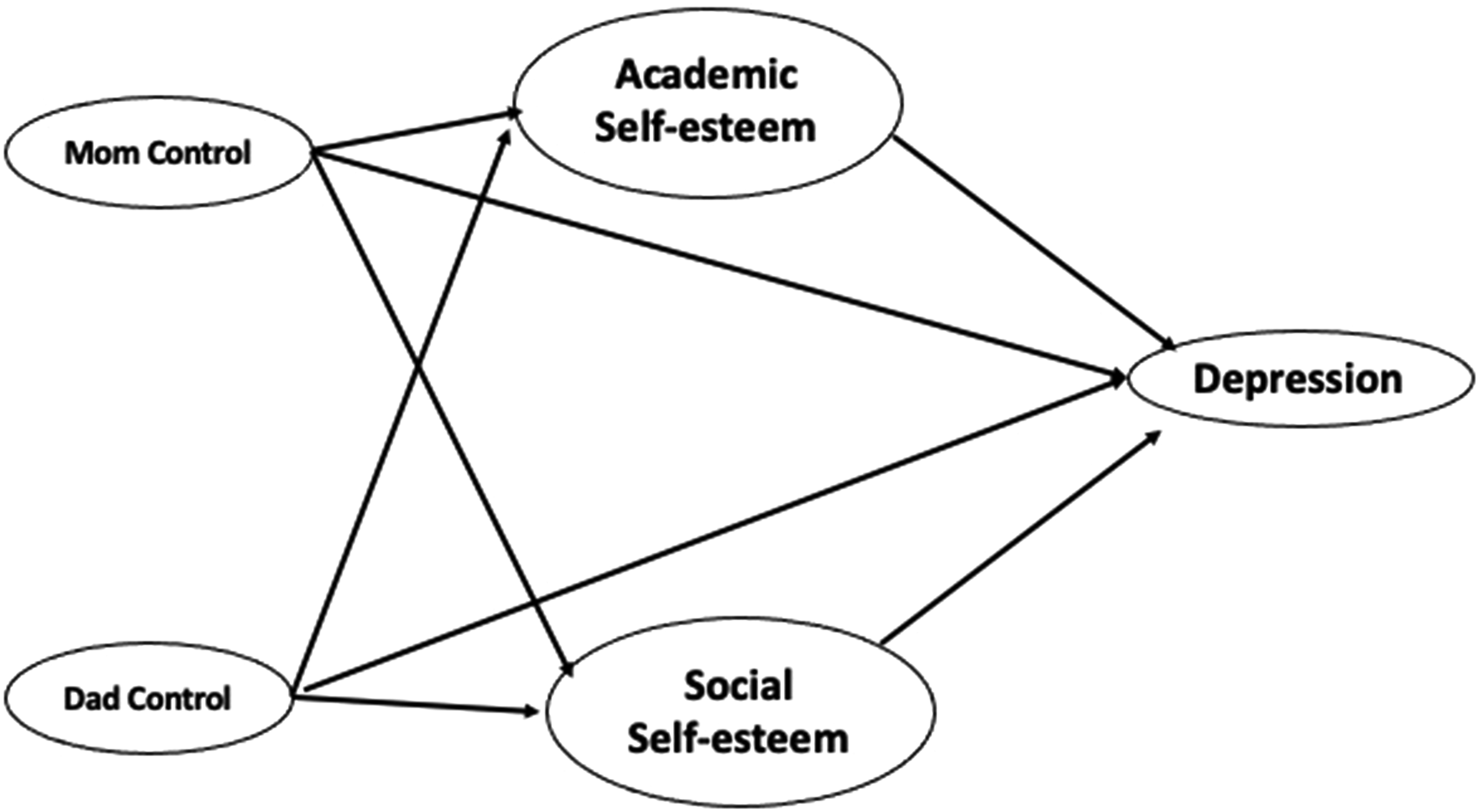
The conceptual diagram of the proposed dual mediation model.
Separating effects of academic and social self-esteem is particularly meaningful in light of the cultural context. Western culture tends to show that individuals draw their self-worth from a variety of sources including school or work competence and social relations (see Crocker & Wolfe, 2001). For example, Dapp et al.’s (2023) recent meta-analysis of 38 longitudinal studies, which were all Western samples with one exception, indicated that the aggregated effect sizes that academic and social self-esteem have on global self-esteem were quite close (.12 vs. .10), suggesting a relative equal importance of academic and social self-esteem to one's general self-worth in the West. However, in China, children's academic achievement is the paramount concern for both parents and adolescents themselves, overshadowing other desires and skill acquisitions (e.g., Chao & Tseng, 2002). The vast majority of middle-class Chinese parents consider education as crucial for their children's life and stay highly involved in children's academic activities (e.g., Zou et al., 2013). Thus, we expect that academic self-esteem will play a more important role than social self-esteem in adolescent depression.
Additionally, it is also important to include both father control and mother control in the examination of Chinese parental psychological control and adolescent outcomes. In China, while fathers and mothers are both actively involved in childrearing, mothers tend to provide more nurturing care (e.g., attending to day-to-day needs, communicating between father and children), fathers tend to focus on the child's academic achievements and success for family pride (e.g., Liu & Merritt, 2018). Additionally, Chinese mothers tend to apply more behavioral control (e.g., monitoring, discipline, global demandingness) whereas fathers exert more psychological control due to their more authoritative position and authoritarian demeanor (Shek, 2005). Thus, mother and father control may serve distinct functions in children's development. The current study assessed mother and father control separately, and tested the hypothesis that they will independently predict adolescent self-esteem and depressive symptoms (see Figure 1).
Previous research and current study
Research focusing on the relationship between Chinese parents’ psychological control and adolescent well-being is rising but remains limited. For example, in a multicultural study, Barber et al. (2005) found that parental psychological control had a significant positive association with Chinese adolescent depression, although the strength of the association was one of the lowest among the 11 ethnic groups examined. Wang et al. (2007) compared longitudinal patterns of parental psychological control and adolescents’ emotional well-being in an American and Chinese sample. Their results indicated parental psychological control predicted worsened emotional well-being for adolescents in both samples over the six-month period. Finally, Luebbe et al. (2018) reported that parental psychological control was positively associated with adolescent anxiety. However, these studies did not consider adolescent self-esteem. Moreover, the majority of previous studies on parental psychological control and adolescent well-being did not separate mother and father control but rather treated them as one construct (e.g., Barber et al., 2005; Garber et al., 1997; Pettit et al., 2001; Wang et al., 2007).
Most relevant to the current study, Wang et al. (2016) related various aspects of parenting to adolescent self-esteem and depressive symptoms (as well as school adjustment and problem behaviors) in a Chinese sample (n = 589). The researchers found that adolescent self-esteem was a full mediator of the association between parental support and adolescent depressive symptoms, as well as a partial mediator of the relation between maternal punitiveness and adolescent depressive symptoms. Contrary to their prediction, parental love withdrawal—a key aspect of psychological control—only had weak associations with adolescent depression (r = .13). The authors called future research to replicate this surprising finding with a more extensive measure of parental psychological control because parental love withdrawal was the only aspect of parental psychological control considered in the study and was measured with only two of the original items due to measurement issues. Moreover, although this study assessed father's and mother's parenting separately, they were not modeled simultaneously (due to the complexity of their conceptual model). Finally, to the best of our knowledge, no previous study on this topic, including Wang et al. (2016), has distinguished academic and social self-esteem.
The current study was designed to deepen the understanding of parental psychological control, adolescent self-esteem, and their depressive symptoms in the Chinese culture. To address some of the limitations in previous research, we (a) used an extensive measure of parental psychological control, (b) included adolescents’ academic and social self-esteem, and (c) assessed and modeled mother and father control independently in the prediction of adolescent self-esteem and depression. Based on the theoretical guidance of SDT and in light of previous findings, we developed the following hypotheses:
both mother and father control independently predict adolescent (academic and social) self-esteem and depression; specifically, mother and father control are negative predictors of adolescent academic and social self-esteem but positive predictors of depression;
both adolescent academic and social self-esteem are independent mediators of parental psychological control and adolescent depression;
adolescent academic self-esteem plays a more important role in the negative association between parental psychological control and depression in comparison to social self-esteem.
Methods
Participants
Participants were recruited from local middle and high schools in a rural town (population of approximately 500,000 people) and a large city (population of over 13 million people) in southern China. We included both rural and urban participants so that the findings would be more generalizable. The choice of participating schools and classes as well as sample size was based on convenience and not on random sampling. The ratio of boys and girls did not differ significantly between the urban and rural sample: X2 (1) = 1.732, p = .188. The total sample included 3,257 participants. A sensitivity analysis indicated that this large sample provides sufficient (80%) statistical power to detect effect size as small as .07–.08 for our specific SEM model. Basic demographic information of the sample is summarized in Table 1.
Sample demographics summary.
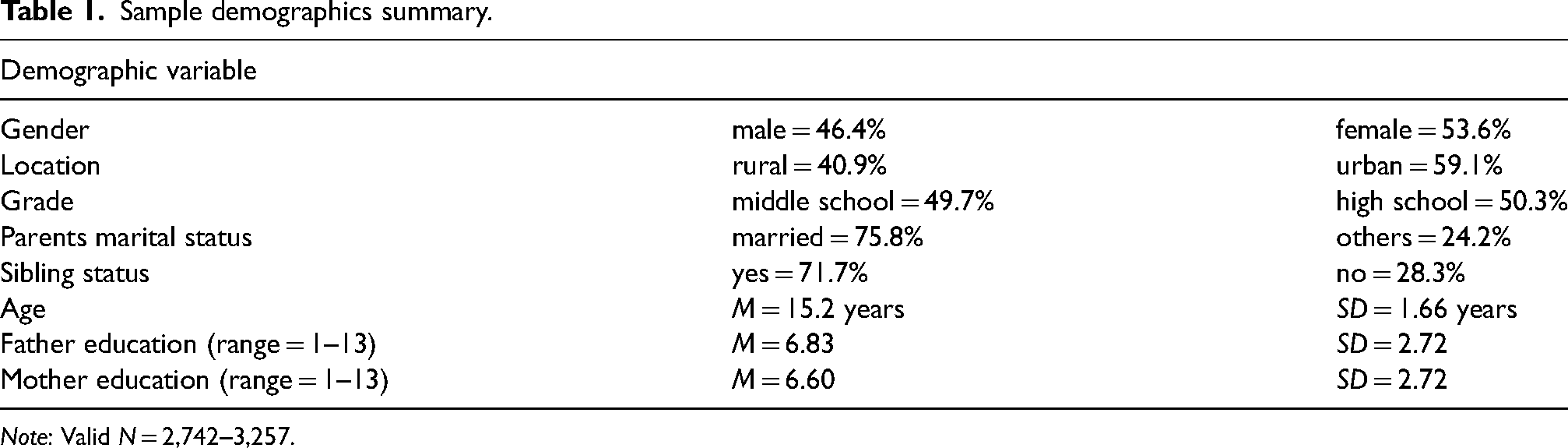
Note: Valid N = 2,742–3,257.
Procedure
Members of the research team distributed paper questionnaires at a convenient time during a class meeting in participating classes. Students were informed of the general purpose of the study and that the study was anonymous and voluntary. They spent approximately 15–20 min. completing the questionnaire. No incentive was provided. This study received local IRB approval at the first author's institution.
Measures
All measures were translated from English to Mandarin by two researchers who are bilingual and have a doctoral degree in psychology. The two authors actively considered culturally sensitive language while adhering to authenticity in translation. When discrepancy arose, they debated and negotiated until an agreement was reached. A high school Mandarin teacher proofread the translated version to make sure the language was appropriate for adolescents. Finally, a small pilot study was conducted in a local middle school and students from two classes were probed for questions to ensure that they were able to comprehend the survey questions. The survey included a range of questions regarding adolescents’ academic, mental, and relationship well-being. We provide detailed descriptions of the measures relevant to the purpose of the current study. Cronbach's alphas of these measures are presented in Table 2. For transparency purpose, the entire dataset of all measures is accessible on OSF: https://osf.io/ztm5a/files/osfstorage/636e477307a7d40a97b96a91
Descriptives and alpha reliability of mother control, father control, academic self-esteem, social self-esteem, and depression symptom.
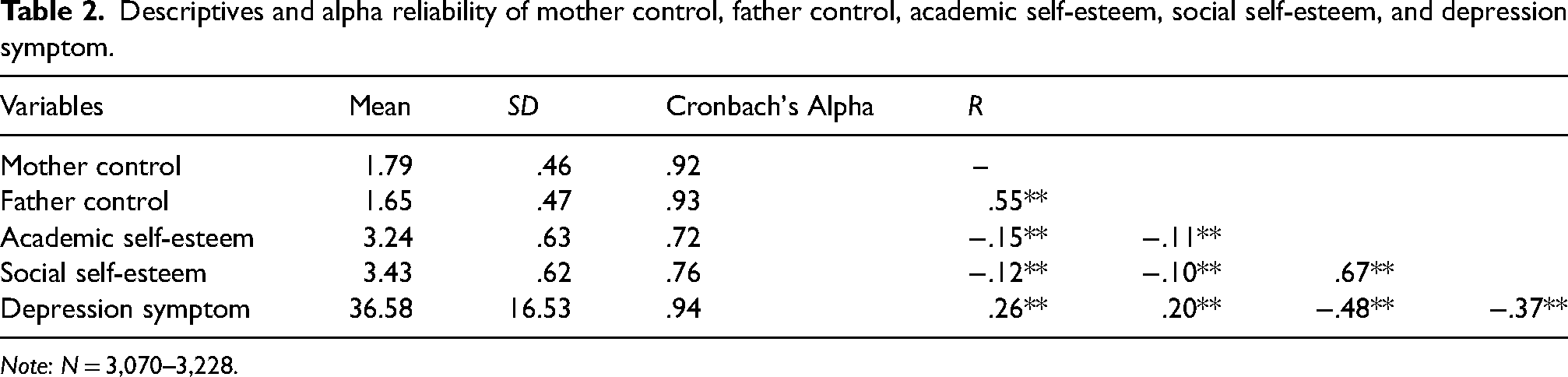
Note: N = 3,070–3,228.
Demographic questionnaire
Adolescent participants reported demographic characteristics such as their age, sex (boy = 0, girl = 1), location (urban = 1, rural = 0), marital status of parents (married = 1, others = 0), sibling status (yes = 1 and no = 0), and parent education level (response choice ranged from 1 = no schooling completed to 13 = doctorate degree).
Parental psychological control
Adolescents reported perceptions of their mother's and father's psychological control separately on a 21-item measure. These items came from two widely used measures of parental psychological control originally created by Barber (1996) and Schaefer (1965). Example items are “my mother/father is less friendly with me, if I do not see things her/his way” and “my mother/father wants to control whatever I do.” This measure has been used in several Chinese studies that reported excellent reliability and validity (Luebbe et al., 2018; Wang et al., 2007). Items were rated on the following 3-point scale: 1 = “not at all like him/her,” 2 = “somewhat like him/her,” 3 = “very much like him/her.”
Academic and social self-esteem
Coopersmith's (1967) Self-esteem Inventory was chosen because it (a) was specifically designed to assess self-esteem of children and adolescents and (b) includes multiple subscales targeting different domains of self-esteem. This measure has demonstrated good reliability and validity (see a review by Butler & Gasson, 2005). Each subscale contains eight items. The Academic and Social Self-esteem subscales were selected for the current study. Example items are “I am not doing as well in school as I would like” (reverse item for the Academic Self-esteem subscale) and “I am popular with peers at my age” (for the Social Self-esteem subscale). Participants responded on a 5-point scale, ranging from 1 = “strongly disagree” to 5 = “strongly agree.” To the best of our knowledge, no previous study has used this measure in Chinese samples. Therefore we attempted an exploratory factor analysis (EFA) with the data. The EFA results indicated that for the Academic Self-esteem subscale, only four of the eight original items loaded on the academic self-esteem factor with factor loadings above .40. Similarly, four of the eight original items in the Social Self-esteem subscale loaded on the social self-esteem factor with factor loadings above .40 as well. Thus academic and social self-esteem would each be measured by four items in the structural equation modeling analysis. When only considering these eight items that were retained, the EFA showed that eigenvalue was 3.143 for the first factor (academic self-esteem) and 1.780 for the second factor (social self-esteem). The two factors together were able to explain a total of 49.7% of the variance of the items.
Depressive symptoms
Adolescents responded to the revised Center for Epidemiologic Studies of Depression Scale, which includes 20 depressive symptoms (Eaton et al., 2004). Example items are “I did not like myself” and “I lost interest in my usual activities.” This self-report measure of depressive symptoms is frequently used in mental health research in China and has demonstrated good reliability and validity (see Jiang et al., 2019 for a review). Participants rated the frequency of experiencing each symptom in the past week using the following scale: 1 = “never or less than a day,” 2 = “one or two days,” 3 = “three to four days,” 4 = “five to seven days,” 5 = “everyday.”
Results
Descriptive and preliminary analyses
We first examined the descriptive statistics and intercorrelations of the main variables (see Table 2). All correlations were statistically significant and ranged from small to strong in size (Cohen, 1988). Mother and father control had a strong positive correlation, so did academic and social self-esteem. Both mother and father control had negative associations with academic and social self-esteem, respectively. Depression was positively correlated with both parents’ control, and negatively correlated with the two types of domain-specific self-esteem.
We also conducted preliminary analysis with the main variables. A paired sample t-test indicated that adolescent children perceived mother control to be significantly higher than father control (t (1, 3,069) = 18.689, p < .001, d = .337, medium effect, 95% Confidence Interval (CI) of d = [.301, .374]). Another paired sample t-test showed that the sample reported significantly greater social self-esteem than academic self-esteem (t (1, 3,227) = 22.063, p < .001, d = .388, medium effect, 95% CI of d = [.353, .424]). A series of independent sample t-tests were conducted to test the differences in boys’ and girls’ perceptions of parental psychological control, academic and social self-esteem, and depressive symptoms. Table 3 presents the means, standard deviations of the 5 variables within each sex, and the t-test statistics. The results yielded a significant sex difference on all variables except for social self-esteem. However, most of these sex differences had a small effect size (d < .20). Only one sex difference reached medium size—father control, indicating boys reported greater father control than girls did.
Comparing adolescent boys and girls’ reports of mother control, father control, academic self-esteem, social self-esteem, and depression symptom.
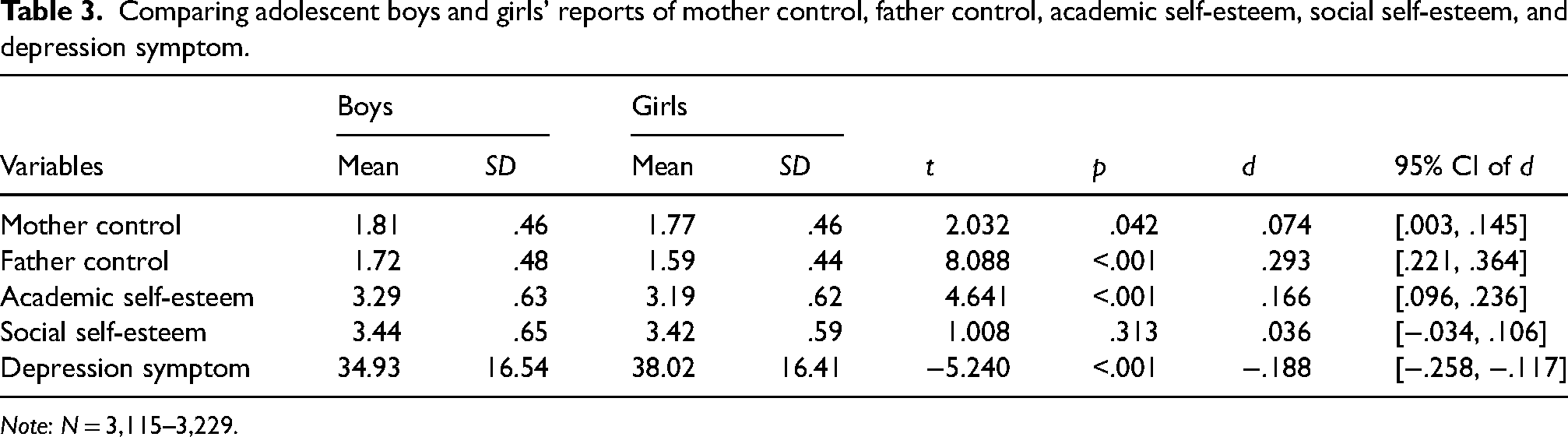
Note: N = 3,115–3,229.
Before testing the mediation model, we conducted the common method bias test using the Harman single-factor test. The results revealed that the total variance explained by the first common factor was 29.66%, less than the standard of 40% proposed by Podsakoff et al. (2003). Therefore there was little concern with a common method bias problem.
We then performed confirmatory factor analysis as the first step of structural equation modeling (SEM) to estimate the model fit for the proposed measurement model with a maximum likelihood estimation. All SEM analyses were conducted in R using the Lavaan package (Rosseel, 2012). Please see Figure 2 for the conceptual diagram. The measurement model includes five latent variables, including the two predictors—mother control and father control, the two mediators—academic and social self-esteem, and the outcome—depression. Each latent variable was measured by 3–4 observed variables. All observed variables were mean-centered prior to SEM analysis. Participants who missed more than 10% of the data of these measured variables were excluded from analyses. Multiple imputations were used to replace the missing data for all variables. We considered four common fit indices: χ2, comparative fit index (CFI), standardized root mean square residual (SRMR), and the point estimate of root mean square error of approximation (RMSEA) and its 90% CI. The conventional standards to evaluate model fit are as follows: a statistically significant χ2 indicates a considerable discrepancy between the proposed model and the data; however, χ2 is strongly impacted by sample size and thus other fit indices should be considered when large samples are used. A CFI above .90 and a SRMR below .08 are usually regarded as a good fit. For RMSEA, the criteria for an acceptable fit are that the point estimate is .08 or lower and the upper value of the 90% CI is .10 or lower.
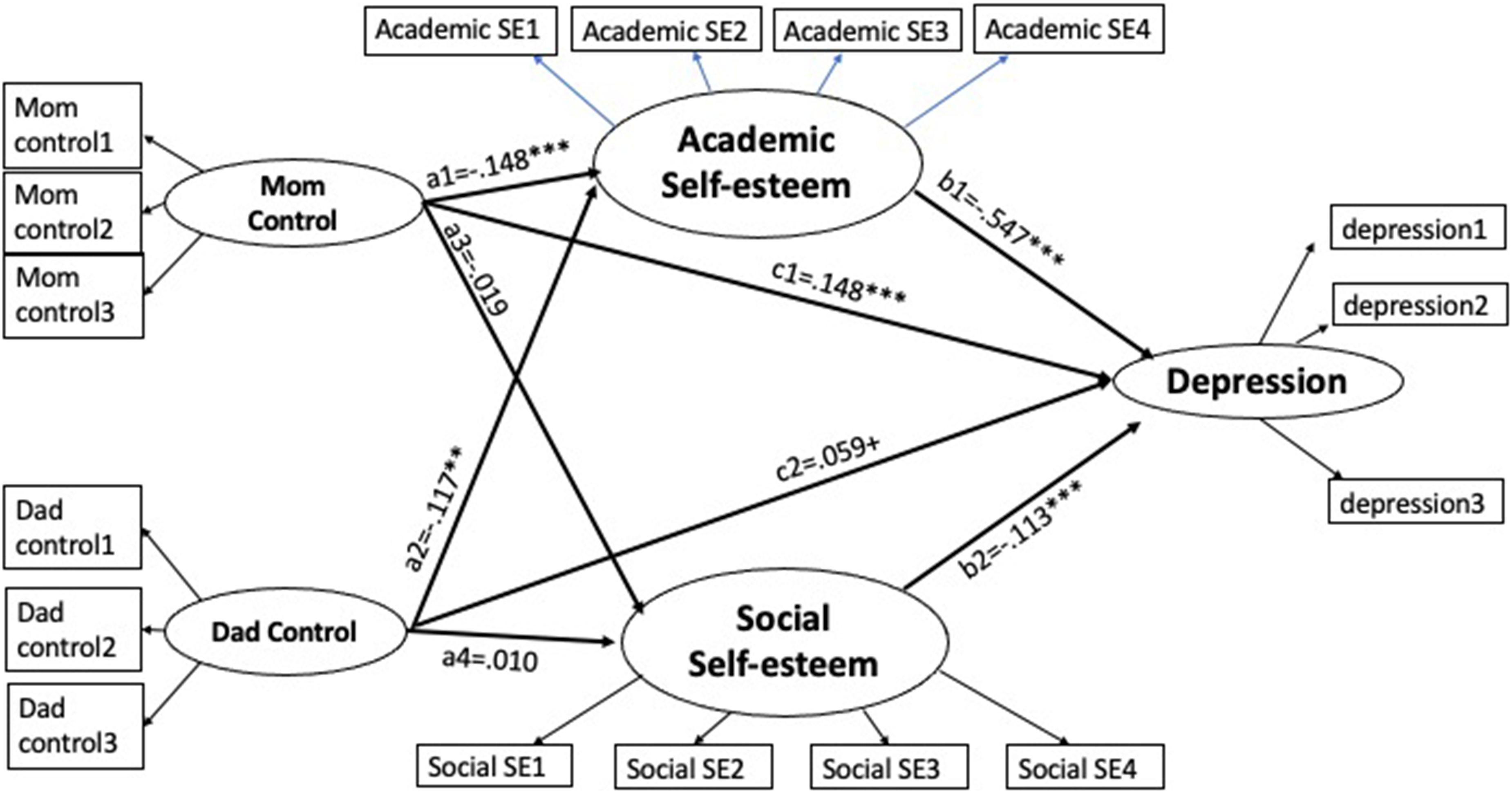
Standard regression coefficients based on SEM results (+p < .10, *p < .05, **p < .01, and ***p < .001).
In this measurement model, the latent variables mother control and father control each were measured by 21 items, and depression was measured by 20 items. Due to the relatively large number of items, we created three parcels as observed variables for each of these latent variables. Specifically, we randomly aggregated six to seven items within each measure to form a parcel. For the latent variables academic and social self-esteem, they each were measured by four observed variables as explained earlier in the measures. The confirmatory factor analysis showed that χ2 was 1,452.044 (p < .001). As expected, the χ2 was large and significant due to the sample size. The CFI was .931. The SRMR was .033. The point estimate of RMSEA was .073 and its 90% CI was .070–.077. All of these results meet the standards stated earlier for a good model. Moreover, all observed variables had statistically significant factor loadings (all ps < .001) on their designated latent variables. These results suggested that the observed variables did a fine job measuring the latent variables.
Testing the mediation model
According to our proposed mediation model (see Figure 2), the associations between the two predictors (mother control and father control) and the outcome (adolescent depression) will be mediated by two mediators (academic and social self-esteem). The SEM analyses for the conceptual mediation model showed that the χ2 was 1,647.058 (p < .001). Again the χ2 was large and significant due to the sample size. The CFI was .921. The SRMR was .070. The point estimate of RMSEA was .078 and its 90% CI was .075–.082. All of these results are well within the standards stated earlier for a good model. Therefore, we can conclude that the sample data provided sufficient support for the proposed mediation model. Next we examined the parameter estimates. Figure 2 shows the standard estimates of all conceptual paths in the mediation model. All paths reached statistical significance with two exceptions: the paths from mother control (p = .624) and father control (p = .808) to social self-esteem failed to be significant, suggesting that parental control from both mother and father did not play a significant role in adolescents’ social self-esteem. Therefore, while social self-esteem was a significant negative predictor of adolescent depression, it failed to mediate the association between parental control and depression. On the other hand, both mother control and father control were statistically significant predictors of academic self-esteem, which in turn, significantly predicted depression. We obtained bootstrapping results (5,000 replications) for the indirect and direct effects. The total indirect effect mother control had on depression through academic and social self-esteem was .083, SE = .023, Z = 3.696, p < . 001, 95% CI = [.039, .127]. For father control, the total indirect effect was .063, SE = .023, Z = 2.769, p = . 006, 95% CI = [.018, .107]. While mother control had a significant direct effect (.135) on depression: SE = .031, Z = 4.292, p < . 001, 95% CI = [.073, .197], father control had a marginally direct effect (.059) on depression: SE = .032, Z = 1.875, p = . 061, 95% CI = [−.003, .122]. Taken together, these results suggest that academic self-esteem partially mediated the relationship between parental psychological control and adolescent depression.
Comparing mother and father control
We further explored whether mother control and father control had differential effects on adolescents’ academic and social self-esteem and depression. To test this, we placed three equality constraints on the paths from mother control and father control to each of the other three variables: academic self-esteem, social self-esteem, and depression. The SEM results showed that there was only minimal difference between the constrained model and baseline model (χ2 difference = 3.357, df = 3, p = .340), suggesting that mother and father control had rather similar effect sizes on adolescent self-esteem and depression.
Comparing academic and social self-esteem
Our initial SEM results indicated that social self-esteem did not mediate the relationship between parental control and depression because parental control did not predict social self-esteem. To further test the hypothesis that academic self-esteem plays a more important role in depression than social self-esteem, we placed an equality constraint on the paths from academic and social self-esteem to depression. The SEM results showed that there was a significant difference between the constrained model and baseline model (χ2 difference = 171.670, df = 1, p < .001), suggesting that academic and social self-esteem did not have the same effects on depression. Specifically, academic self-esteem (Beta = −.547, Z = −21.233, p < .001, 95% CI = [−.597, −.496) had significantly stronger negative effects on depression than social self-esteem did (Beta = −.113, Z = −3.650, p < .001, 95% CI = −.174, −.052).
Testing for sex differences
Because initial results indicated that adolescent boys and girls in the sample differed significantly in their perceived parental control, academic and social self-esteem, and depressive symptoms, we further conducted multi-group SEM to test whether the mediation model fits equally well in boys and girls. When all conceptual paths in the mediation model were constrained to be equal across the boy and girl samples, the SEM results showed that the difference between the equality constrained model and the baseline model was not statistically significant despite the large sample (χ2 difference = 14.399, df = 8, p = .072), suggesting that the mediation model held relatively equally for boys and girls.
Discussion
Although the parental psychological control—self-esteem—depression model has received consistent support in Western studies, it has not been extensively tested in non-WEIRD nations. The current study aimed to address this gap in the literature. Additionally, the current study has several other strengths that further added to its cultural significance: First, we focused on two types of key domain-specific self-esteem: academic and social self-esteem in this mediation model. Second, we assessed father and mother control separately and tested their roles in adolescent self-esteem and depression. Finally, we recruited a large adolescent sample (n > 3,000) to allow for sufficient statistical power to detect small effect sizes.
Overall, the results provide partial support for the proposed mediation model of adolescents’ perceived parental psychological control, self-esteem, and depressive symptoms. Specifically, adolescents’ academic self-esteem acted as a significant (partial) mediator of the association between parental control and adolescent depression, whereas social self-esteem failed to mediate this association because both mother and father control did not significantly predict social self-esteem. Both mother and father control had significant indirect effects on adolescent depression through lower academic self-esteem, as well as significant direct effects on depression. Additionally, there was little evidence to suggest that the mediation model would hold differentially between boys and girls, nor between mother and father control.
Parental psychological control and adolescent well-being
Despite the traditional belief that parents have total authority on children and children are expected to unconditionally obey their parents in Chinese culture, our findings indicated that parental over-control nevertheless has both direct and indirect detrimental effects on depressive symptoms. These findings are consistent with the general pattern of the associations between parental psychological control, self-constructs, and depression reported in previous research conducted in Western cultures (e.g., Conger et al., 1997; Garber et al., 1997; Plunkett et al., 2007). More importantly, these findings are in line with those obtained from previous studies involving Chinese samples, showing that parental psychological control predicts lower parent–child relational quality (Shek, 2005), poorer adolescent emotional functioning (Wang et al., 2007), and greater adolescent depression (Barber et al., 2005) and anxiety (Luebbe et al., 2018). Thus, the current research nicely dovetails with previous reports from both WEIRD and Chinese samples, suggesting a universally negative role of parental psychological control in children's development and well-being.
These current findings regarding (Chinese) parental psychological control provided strong support for SDT. Specifically, it appears that even in an interdependent culture where the self is considered less centered and parental psychological control might be more justified, adolescent children nevertheless experience depressive symptoms when their parents exert excessive psychological control over them, resulting in diminished self-worth presumably because the psychological control interferes with an adolescent child's innate need for autonomy (Bush et al., 2002). Together, these findings indicate that adolescents’ need for autonomy may not be unique to individualistic cultures but also evident in collectivistic cultures.
This finding was also in line with the SDT argument that autonomy and independence are two orthogonal concepts—independence refers to not relying on others for tangible and intangible support, whereas autonomy refers to acting based on one's own inner interest and values but not external influences (e.g., Chirkov et al., 2003; Ryan & Deci, 2000). Thus, just because a person is independent or growing up in an independence-oriented culture does not necessarily mean s/he is strongly autonomous; likewise, people with a collectivistic orientation do not necessarily have less strong autonomous needs. More importantly, our finding suggested that regardless of the specific culture, when one's need for autonomy is compromised, for example, due to excessive psychological control from the parents, poorer outcomes and ill-being are likely to occur.
It is important to note that in the SDT literature, parental psychological control is mostly related to the discussion of children's need and development of autonomy (e.g., Joussemet et al., 2008). It would be interesting to speculate how parental psychological control may impact the other two fundamental needs—competence and relatedness. The SDT literature (e.g., Grolnick & Ryan, 1989; Grolnick et al., 1997) has suggested that parental provision of structure (i.e., clear and consistent rules) is central to promote children's sense of competence, whereas positive parental involvement, warmth, and support enhance children's sense of relatedness. Presumably parental psychological control may undermine children's need for competence because psychological control is mostly intangible emotional manipulation and provides no clear structure. Parental psychological control may also thwart children's sense of relatedness as psychological control and manipulation create strong barriers to building a true, meaningful, trustworthy connection to the children. It would be worthwhile to test these roles of parental psychological control in children's development of competence and relatedness in future research.
Contrary to our expectation, mother and father control did not show significantly differential effects on adolescent self-esteem and depression. In the meanwhile, they each contributed independently to the prediction of adolescent academic self-esteem and depression. Together, these results suggest that, despite their strong positive correlation, mother and father control appear to influence academic self-esteem and depression in separate ways; moreover, they seem to carry equal weight in their independent influences on adolescent children's functioning and well-being. This is consistent with other studies showing that mother and father control had substantial concordance as well as important subtle differences (Lansford et al., 2014). It would be important for future research to elucidate the mechanisms that mother and father control impact child and adolescent self-esteem as well as depression, respectively.
The role of self-esteem in parental psychological control–adolescent depression link
A major novel aspect of the current study was the approach we adopted in the conceptualization and assessment of self-esteem. Unlike previous studies that exclusively relied on the global sense of self-esteem, we examined two types of key domain-specific self-esteem—academic and social self-esteem in the relation of parental psychological control and depression. We believe this is a necessary and important extension to previous research considering a unique aspect of many East Asian cultures—an overwhelming emphasis on academic achievement in parenting and child development. Two findings provided strong support for the prediction Chinese adolescents’ academic self-esteem should play a more important role in the association between parental psychological control and depression than their social self-esteem: First, academic self-esteem was a significantly mediator of parental control and depression, whereas social self-esteem was not a mediator because mother and father control did not have a significant effect on social self-esteem. In other words, parental psychological control likely led to lower academic self-esteem, which in turn contributed to worse depressive symptoms. However, parental psychological control did not seem to have a strong impact on adolescents’ social self-esteem. This was not a surprise because a typical development in adolescence is that children start to shift the focus of their social world from their parents to peers. However, clearly Chinese adolescents’ academic self-esteem continues to be shaped by their parents’ psychological control, unfortunately in a negative way.
A more important finding was that while both academic and social self-esteem significantly predicted depression, academic self-esteem had a remarkably stronger association with depression than did social self-esteem. This suggests that, consistent with our expectation, academic self-esteem carries significantly more weight in adolescents’ self-concepts and development of depressive symptoms. While high self-esteem may boost self-confidence and hopefulness (e.g., Dumont & Provost, 1999), it is disconcerting that Chinese adolescents’ mental adjustment is disproportionately over-reliant on academic self-esteem. Because of the overwhelming academic pressure and competition, Chinese youths tend to suffer from lower self-esteem despite their fine academic performance when compared to other nations (e.g., Leung & Wong, 1997). This may be one important reason why the depression rate has been steadily increasing among Chinese children and adolescents in recent years (see Zhou et al., 2018). This finding of the imbalance between academic and social self-esteem in Chinese adolescents is quite extraordinary because there has been only limited research even in the Western cultures exploring the relative contributions of academic and social self-esteem to adolescents’ well-being. This limited Western research has shown a consistent pattern that for adolescents in the West, their social self-esteem tends to be of equal, if not more, importance as academic self-esteem to their stress reduction and well-being (e.g., Fenzel, 2000) and global self-value perceptions (Dapp et al., 2023). In other words, Western children seem to be able to draw their self-confidence from multiple sources while Chinese children overly rely on their academic self-esteem (as opposed to social self-esteem). However, because the current study only included academic and social self-esteem, it is unclear how other types of domain-specific self-esteem (such as appearance, athletic, morality) that usually contribute to Western children's global self-perceptions would compare to academic self-esteem in Chinese children.
This novel finding about Chinese adolescents’ imbalanced self-esteem provided further nuanced support for SDT (Ryan & Deci, 2000). Specifically, SDT not only emphasizes the universality of the basic needs, but is also sensitive to potential variabilities due to culture-specific factors that influence the route by which these needs are expressed. In our case, because the Chinese culture cultivates a strong emphasis on academic performance, it likely creates a significant imbalance between academic self-esteem and social self-esteem. Accordingly, parental psychological control leads to far more damages in children's academic self-esteem than in their social self-esteem. More importantly, diminished academic self-esteem is associated with far worse depressive symptoms for the adolescent child than weakened social self-esteem.
Limitations and future directions
While the current research shed some light on Chinese adolescents’ depressive symptoms, it was not without limitations. First, despite the large sample size, the current sample was not a representative sample of Chinese adolescents. Different regions of China and other Eastern cultures should be included in future studies on parental psychological control and adolescent functioning. Second, all reports were obtained from adolescents’ perceptions of their parents’ parental psychological control. While examining parental psychological control from the children's perspective is important, it is possible that the parents may have different perceptions of their own parenting. Thus, it would be useful to study parental psychological control from both the parents’ and adolescent's views. Third, following SDT, we made a strong assumption that the need for autonomy is the key to the link between parental psychological control and adolescent self-esteem and depression. However, the need for autonomy was not measured in this study and it would be useful for future research to measure this need and directly test the assumption. Fourth, while the key measures used in the study have shown acceptable reliabilities and validities, none of these measures was developed in the Chinese culture and therefore it is possible that they may not fully capture the culture-unique aspects of the constructs under investigation. Future research could seek to replicate these findings using locally developed measures. Finally, the cross-sectional design of the current study did not allow examination of the changes in Chinese adolescents’ autonomy needs, self-esteem, as well as parental psychological control. Moreover, while parental psychological control has been theorized to have negative impact on adolescent well-being, it is important to recognize that children with depressive symptoms may carry negative views of parental psychological control. Longitudinal research following up adolescent–parent dyads over adolescence would be extremely helpful to understand the developmental trajectory and causal direction of the parental psychological control–self-esteem–adolescent depression nexus.
Conclusions
To recapture, the current study was the first to test the mediation model (parental psychological control–self-esteem–depression) in a Chinese adolescent sample. Our findings generally provided support for this mediation model, reconfirming two culture-general findings: (a) parental psychological control has harmful effects on adolescent self-development and mental well-being, and (b) the need for autonomy is fundamental and adolescent self-esteem is critical to their well-being. Moreover, mother control and father control made independent contributions to the prediction of self-esteem and depression. A novel extension in the current study is the examination of academic and social self-esteem. We were able to show that while both were significant predictors of depression, only academic self-esteem but not social self-esteem was able to mediate the link between parental control and adolescent depression, highlighting the significance of academic self-esteem in Chinese youth culture.
Given the current results, it would be particularly useful to educate Chinese parents about the importance of children's autonomy needs and the negative implications of parental psychological control despite the fact that it might be considered normal in the Chinese culture. Additionally, given the novel finding on academic and social self-esteem, fruitful routes to reduce the risk of depression in Chinese adolescents may include using interventions to (a) de-emphasize the importance of academic performance in self-evaluations, (b) improve adolescents’ academic self-esteem without adding more pressure on their shoulders, and (c) educate adolescents and their parents about developing a more balanced self-construct by drawing attention to non-academic domains of self-esteem such as social, athletic, and moral domains.
Supplemental Material
sj-docx-1-pac-10.1177_18344909241252310 - Supplemental material for Academic but not social self-esteem mediates the association between Chinese adolescents’ perceived parental psychological control and depressive symptoms
Supplemental material, sj-docx-1-pac-10.1177_18344909241252310 for Academic but not social self-esteem mediates the association between Chinese adolescents’ perceived parental psychological control and depressive symptoms by Hao Wu, Shanhong Luo, Tyler White, Annelise Klettner and Chunxia Wei in Journal of Pacific Rim Psychology
Footnotes
Declaration of conflicting interests
The authors declared no potential conflicts of interest with respect to the research, authorship, and/or publication of this article.
Funding
The authors disclosed receipt of the following financial support for the research, authorship, and/or publication of this article: this work was supported by the 2024 Guangzhou Medical University Research Enhancement Initiative, 2022 Guangdong Province Medical Research Fund, 2023 Guangzhou Medical University Discipline Establishment Fund—Psychology—A Multi-dimensional Exploration of Adolescent Wellbeing, 2023 Guangzhou Medical University First Class Major Establishment Undergraduate Innovation Ability Enhancement Fund, 2022 Guangzhou Medical University Student Innovation Competence Enhancement Fund—Humanity and Social Sciences Project (grant number 2024SRP222, B2022287, 02-445-2301293XM, 02-408-2304-12082XM, 02-408-19137XM).

Supplemental material
Supplemental material for this article is available online.
References
Supplementary Material
Please find the following supplemental material available below.
For Open Access articles published under a Creative Commons License, all supplemental material carries the same license as the article it is associated with.
For non-Open Access articles published, all supplemental material carries a non-exclusive license, and permission requests for re-use of supplemental material or any part of supplemental material shall be sent directly to the copyright owner as specified in the copyright notice associated with the article.
