




Abstract
In today's highly uncertain and complex environment, innovation plays a critical role in an organization's survival and development. Therefore, examining factors that drive employee innovative behavior is necessary. Drawing from meta-theory of personality, this study explores the influence of critical thinking disposition on employee innovative behavior. Using data from a three-wave questionnaire survey of 481 employees, the analysis reveals that: (1) intrinsic motivation mediates the positive relationship between critical thinking disposition and employee innovative behavior; (2) supervisor support for innovation moderates the positive relationship between critical thinking disposition and intrinsic motivation. This relationship is stronger when supervisors provide high levels of support for innovation than low levels of support; and (3) supervisor support for innovation also moderates the indirect influence of critical thinking disposition on innovative behavior through intrinsic motivation. This effect is stronger when supervisors offer high levels of support for innovation. These findings enhance our understanding of the mechanisms through which critical thinking disposition influences innovative behavior. Moreover, they have important practical implications for managers in implementing staff selection and training, and creating a supportive environment that promotes employee innovative behavior.
Keywords
In a highly uncertain and complex environment, there is consensus regarding the importance of innovation for an organization's survival and success (Janssen et al., 2004). The success of organizational innovation depends on employee creativity, which involves generating novel ideas, along with innovative behavior, which encompasses both generating and implementing new ideas in the workplace (Scott & Bruce, 1994). This is because individuals are responsible for the development, dissemination, response to, and refinement of novel ideas (Van de Ven, 1986). Two broad categories of antecedents to employee creativity and innovative behavior have been identified: (1) organizational and context-related factors, such as organizational culture and climate (Scott & Bruce, 1994), leadership (Pan et al., 2013; Tu & Lu, 2013), human resource management (Alfes et al., 2013), and job characteristics (Oldham & Cummings, 1996); and (2) individual differences, including problem-solving styles (Scott & Bruce, 1994), cognitive styles (Yang & Zhang, 2012), and openness to experience (Prabhu et al., 2008; Tan et al., 2019). However, compared to organizational and context-related antecedents, there has been relatively little research on the individual factors influencing employee creativity and innovative behavior within the context of related process mechanisms and boundary conditions (Volery & Tarabashkina, 2021).
China has recognized the significance of cultivating innovative talent for national and organizational development. However, it still lacks first-class innovative talent, as highlighted by Qian Xuesen's question on the inability of Chinese schools to nurture distinguished innovative talent in science and technology (Zhu, 2014). The answer to this question lies in that Chinese education places less attention on fostering students’ critical thinking and critical spirit. Given the importance of critical thinking in creativity and innovation, researchers have started exploring the influence of critical thinking disposition on employee creativity and innovative behavior (Jiang & Yang, 2014; Qiang et al., 2020; Tu et al., 2015). Critical thinking refers to rational and reflective thinking focused on deciding what to do or believe. It encompasses two parts: critical thinking disposition and critical thinking skills (Facione, 2000). Critical thinking skills encompass six core cognitive abilities: interpretation, analysis, evaluation, inference, explanation, and self-regulation However, critical thinking disposition refers to a consistent internal motivation or inclination to apply critical thinking skills in problem solving and decision making (Facione, 2000). It is an enduring personality trait rather than a variable psychological state (Qiang et al., 2020). Individuals with a high critical thinking disposition are described as having a positive critical spirit, demonstrating inquisitiveness, keenness of mind, a commitment to rationality, and thirst for reliable information (Facione, 2011). Their pursuit of innovative behavior stems from intrinsic motivation driven by the enjoyment and satisfaction derived from seeking truth, rather than external rewards or punishments. Intrinsic motivation is considered a personal characteristic for fostering employee creativity and innovative behavior (Devloo et al., 2015; Tu & Lu, 2013), and it serves as an important mechanism through which personality traits influence employee creativity (Prabhu et al., 2008; Sears et al., 2018; Tan et al., 2019). However, the relationship between critical thinking disposition and innovative behavior through intrinsic motivation is yet to be examined. McCrae and Costa's (1996) meta-theory of personality suggests that basic individual tendencies influence individual behavior through characteristic adaptations. Therefore, this study hypothesizes and tests the mediating role of intrinsic motivation in the relationship between critical thinking disposition and employee innovative behavior. Basic tendencies, such as critical thinking disposition, refer to fundamental abilities and dispositions that describe individual differences. Characteristic adaptations, such as intrinsic motivation, refer to concrete expressions of abstract basic tendencies in the form of specific skills, preferences, attitudes, behavioral patterns, and work motivation.
Research has found that individual characteristics, such as openness to experience and cognitive needs, and contextual factors, including support for innovation and job autonomy, interact to affect individual outcomes like positive mood and innovative behavior (Madrid et al., 2014; Wu et al., 2014). Given that critical thinking involves challenging authorities, it is crucial for supervisors to create a supportive environment that encourages employees to think critically. Supervisor support for innovation is crucial in conveying the organization's values and rewards for innovation (Montani et al., 2017). This encourages employees to question established practices and fosters an environment that activates critical thinking disposition. Therefore, it is possible that supervisor support for innovation enhances the relationship between critical thinking disposition and intrinsic motivation. McCrae and Costa's (1996) meta-theory of personality contends that basic individual tendencies (e.g., critical thinking disposition) interact with the environment (e.g., supervisor support for innovation) to affect individual characteristic adaptations (e.g., intrinsic motivation). This study draws on this theory to posit and test the possible moderating role of supervisor support for innovation in the relationship between critical thinking disposition and intrinsic motivation.
Therefore, using the meta-theory of personality as a theoretical framework, this study constructed a moderated mediation model incorporating the following hypotheses (Figure 1). First, intrinsic motivation mediates the relationship between critical thinking disposition and innovative employee behavior. Second, supervisor support for innovation moderates the relationship between critical thinking disposition and intrinsic motivation. Third, supervisor support for innovation moderates the indirect effect of critical thinking disposition on innovative behavior through intrinsic motivation.
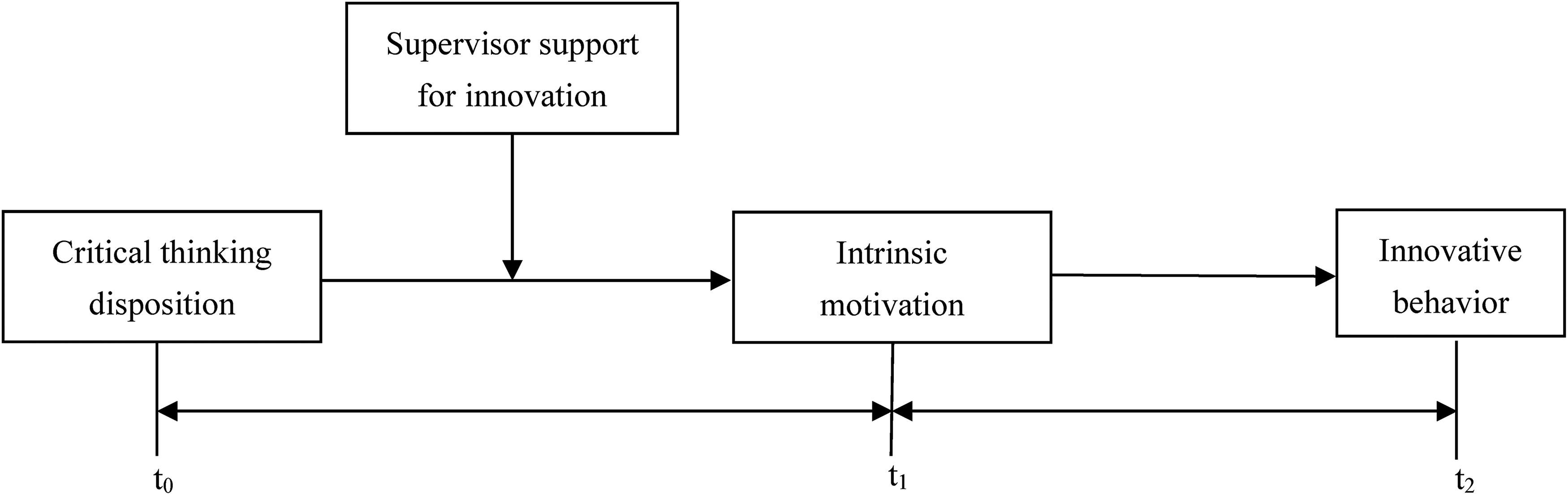
The hypothesized model.
In previous studies investigating the effect of critical thinking disposition on employee creativity and innovative behavior, researchers identified mediators such as creative self-efficacy (Jiang & Yang, 2014; Qiang et al., 2020) and knowledge sharing (Tu et al., 2015), and moderators such as leader–member exchange (Jiang & Yang, 2014) and self-efficacy (Tu et al., 2015). However, due to a lack of an integrative theoretical framework that can encapsulate all the variables, previous studies have not been able to provide a comprehensive and systematic explanation of how and when critical thinking disposition influences employee creativity and innovative behavior. By testing the moderated mediation model (Figure 1), this study contributes to the literature in several ways. First, by drawing on the integrative meta-theory of personality, this study broadens the theoretical perspective used to explain the underlying mechanisms through which personal disposition affects employee creativity and innovative behavior. Second, by identifying intrinsic motivation as a mediator and supervisor support for innovation as a moderator, this study sheds light on the process mechanism and boundary condition that influence the relationship between critical thinking disposition and innovative employee behavior. Finally, this study provides practical implications for managing innovative talent and encouraging employee innovative behavior.
Theoretical foundation and study hypotheses
The meta-theory of personality
The meta-theory of personality summarizes the types of variables that all personality theories must consider and outlines the relationships between five broad categories: (1) basic tendencies, (2) characteristic adaptations, (3) objective biography, (4) self-concept, and (5) external influences (McCrae & Costa, 1996). In this study, the most relevant categories are basic tendencies, characteristic adaptations, and objective biography. Basic tendencies are the fundamental abilities and dispositions that describe differences between individuals, while characteristic adaptations are the concrete manifestations of abstract basic tendencies and take the form of specific skills, habits, preferences, attitudes, and behavioral patterns. Objective biography encompasses a person's significant thoughts, feelings, and actions throughout their life, which personality theories aim to predict. The meta-theory suggests that basic tendencies indirectly influence objective biography through characteristic adaptations, and that characteristic adaptations result from the interactions between basic tendencies and environments (McCrae & Costa, 1996). It argues that developing a personality theory involves specifying the content of these five broad categories and identifying their causal relationships. In this study, we suggest three points. First, critical thinking disposition is considered a basic tendency as it is an enduring stable personal quality that aligns with observable behavioral changes and determines an individual's potential and direction. Second, intrinsic motivation is a characteristic adaptation because it is a learned motivational response developed through the interaction between the basic tendency of critical thinking disposition and the environment, specifically, supervisor support for innovation. It also represents a concrete expression of the abstract basic tendency of critical thinking disposition. Finally, innovative behavior is categorized as an objective biography because it is an overt behavior that can be predicted by critical thinking disposition.
Critical thinking disposition and intrinsic motivation
Intrinsic motivation refers to the internal drive to engage in a task for inherent enjoyment and satisfaction (Deci et al., 1989). Previous research has found that personality traits can influence intrinsic motivation (Watanabe et al., 2011). In this study, we hypothesize that critical thinking disposition may influence intrinsic motivation.
Individuals with a high critical thinking disposition demonstrate a probing inquisitiveness (Facione et al., 1994). They are intrinsically motivated because they actively seek the enjoyment that comes from acquiring new knowledge and experiences, and the sense of competence that derives from reducing ambiguity in their work (Huang, 2021). These individuals have a strong desire to explore and understand new concepts (Facione et al., 1994) and find meaning and satisfaction in ever-changing work requirements, thus possessing high levels of intrinsic motivation (Watanabe et al., 2011). Their perseverance in seeking truth allows them to continuously develop expertise and talent in a particular domain and find fulfilment in activities relevant to their field (Prabhu et al., 2008). Individuals with a high level of critical thinking disposition question authority, initiate change, and take courageous leadership roles (Jiang & Yang, 2014; Facione et al., 1994). They experience a sense of competence and autonomy when overcoming environmental constraints and executing effective change (Sears et al., 2018). Intrinsically motivated employees exhibit greater curiosity, cognitive flexibility, and a willingness to resolve problems in non-traditional ways (Amabile, 1996). According to the meta-theory of personality, characteristic adaptations, such as specific skills, preferences, attitudes, working motivations, and behavioral patterns, are the concrete manifestations of basic tendencies (i.e., fundamental abilities and enduring qualities that describe individual differences, such as critical thinking disposition; McCrae & Costa, 1996). Hence, we postulate:
Hypothesis 1: Critical thinking disposition is positively related to intrinsic motivation.
Intrinsic motivation and innovative behavior
Intrinsic motivation influences an employee's decision to sustain and maintain creative efforts. It has been widely recognized as the most prominent personal characteristic that promotes employee creativity and innovative behavior (Devloo et al., 2015; Tu & Lu, 2013). When employees feel a sense of enjoyment and satisfaction in their work (i.e., those who are intrinsically motivated), they are more willing to explore and experiment, thus, increasing their likelihood of engaging in innovative behavior (Devloo et al., 2015). Moreover, intrinsically motivated employees are more likely to translate their motivation into high levels of effort. Particularly when engaging in tasks requiring creativity, cognitive flexibility, and conceptual understanding, they are more likely to demonstrate high levels of job performance (Tu & Lu, 2013). Intrinsic motivation promotes innovative behavior because intrinsically motivated employees tend to be goal-oriented and persistent in the face of challenges. This mindset helps them explore promising ideas in depth and systematically address obstacles that prevent the successful realization of an idea (Devloo et al., 2015). The meta-theory of personality suggests that characteristic adaptations such as intrinsic motivation can predict individual behavior such as innovative behavior (McCrae & Costa, 1996). Hence, we hypothesize:
Hypothesis 2: Intrinsic motivation is positively related to innovative behavior.
The mediating role of intrinsic motivation
The meta-theory of personality suggests that basic tendencies affect objective biographies through characteristic adaptations (McCrae & Costa, 1996). Basic tendencies encompass fundamental abilities and dispositions that describe individual differences, including sensory-motor capability, physical, learning, verbal, spatial abilities, perceptual style, and personality traits. Characteristic adaptations represent the concrete manifestations of these basic tendencies and include specific learned skills, habits, preferences, attitudes, and behavior patterns. Among these variables, work habits are relevant to our study and encompass characteristic motivational responses, such as effort exertion, tendencies to approach or avoid situations, persistence, attention to detail, and planning. Objective biography refers to every significant thing that a person has felt, thought, said, and done throughout their life, including overt behaviors. It is the outcome variable that theories of personality often aim to predict. Empirical studies have provided evidence for the meta-theory of personality. For instance, intrinsic motivation has been found to mediate the relationships between openness to experience and conscientiousness and continuous learning (Watanabe et al., 2011), as well as openness, self-efficacy, and proactive personality, and employee creativity (Prabhu et al., 2008; Sears et al., 2018). It has been found that intrinsic motivation and creative process mediate the relationship between openness to experience and employee creativity (Tan et al., 2019). Drawing on the meta-theory of personality and related empirical findings, and combining Hypotheses 1 and 2, we postulate the following:
Hypothesis 3: Intrinsic motivation mediates the relationship between critical thinking disposition and innovative behavior.
The moderating role of supervisor support for innovation
Supervisor support for innovation refers to employees’ perceptions of their supervisors providing them with resources, assistance and encouragement for idea generation and implementation, respecting their innovative effort, as well as promoting the expression of divergent suggestions and thoughts (Montani et al., 2017; Yu et al., 2016). The meta-theory of personality suggests that basic tendencies, including critical thinking disposition, interact with environments such as supervisor support for innovation to affect characteristic adaptations like intrinsic motivation (McCrae & Costa, 1996). According to the meta-theory of personality, this study hypothesizes that critical thinking disposition interacts with supervisor support for innovation to affect intrinsic motivation.
When supervisors embrace innovative ideas, encourage innovative contributions, and collaborate with employees to generate and implement innovative ideas, they communicate that the organization values and recognizes the importance of innovation (Montani et al., 2017). The strength of the relationships between individual dispositions and behavioral outcomes is greater in environments that facilitate the expression of these dispositions (Tett & Burnett, 2003). In the presence of supervisors supporting innovation and affirmation in organizations valuing innovation, employees who possess a disposition toward critical thinking will prioritize innovation and fully utilize their qualities, such as curiosity, truth-seeking, broadmindedness, critical thinking self-confidence, analyticity, and systematicity. This will provide them with increased opportunities to experience feelings of competence and self-determination, leading to higher levels of intrinsic motivation. Conversely, in situations where supervisors do not support innovation, employees with a disposition toward critical thinking may perceive innovation as unimportant. Their innovation-facilitating qualities will be constrained, and their need for competence and self-determination will remain unfulfilled, leading to relatively lower levels of intrinsic motivation.
Based on research findings, when supervisors provide higher levels of support, employees who are confident in their task-performance abilities receive confirmation from their supervisors (Chen et al., 2016). Therefore, these employees demonstrate greater job interest, leading to a stronger relationship between employees’ belief in their ability to perform tasks and intrinsic motivation. Conversely, when supervisors provide little support, the self-perceptions of employees who have faith in their ability to perform tasks are not validated by their supervisors, resulting in reduced job interest, and a weaker relationship between belief in their ability to perform tasks and their intrinsic motivation. Building on this understanding, we can infer that, under high levels of supervisor support for innovation, the self-perception of employees with high critical thinking self-confidence (employees high in critical thinking disposition have confidence in their critical thinking) will have their self-perceptions validated by their supervisors. Consequently, these employees are likely to experience high levels of intrinsic motivation compared to those working under lower levels of supervisor support for innovation. Summarizing the above analysis, we hypothesize the following:
Hypothesis 4: Supervisor support for innovation moderates the relationship between critical thinking disposition and intrinsic motivation such that this relationship is stronger under high rather than low levels of supervisor support for innovation.
According to the analytic framework of moderated mediation (Edwards & Lambert, 2007), we integrated the mediation hypothesis (Hypothesis 3) and first-stage moderation hypothesis (Hypothesis 4) to posit the following:
Hypothesis 5: Supervisor support for innovation moderates the mediating effect of intrinsic motivation on the relationship between critical thinking disposition and innovative behavior such that this mediating effect is stronger under high levels of supervisor support for innovation compared to low levels.
Methods
Sample and procedure
An online questionnaire survey was conducted among employees of three companies. The researchers contacted the human resource (HR) managers of these three companies and explained the survey's objective. The HR managers consented to participate in our survey and informed their employees about this survey's objective, ensuring anonymity, confidentiality, and voluntary participation. Each participant was assigned a number code by their HR managers. The survey was conducted at three time points. At time point t0, respondents rated their own critical thinking disposition. At time point t1, they rated their supervisors’ support for innovation and their own intrinsic motivation. At time point t2, they rated their own innovative behavior. Each time point was separated by approximately three weeks. A total of 590 employees participated in the survey. After effectively matching the data at the three time points, a valid sample of 481 employees was obtained, resulting in an effective response rate of 81.53%. In the valid sample, 81% of respondents were male, 54.7% had a college diploma or above, 83.6% were non-manager employees, the average age was 37.58 years (SD = 7.74), and mean organizational tenure was 12.04 years (SD = 6.98).
Measures
The four main study variables were rated on a five-point Likert scale (1 = strongly disagree, 5 = strongly agree).
Critical thinking disposition. Critical thinking disposition was measured using a five-item scale adapted from Jiang and Yang's (2014) study. A sample item reads, “I am willing to adopt potential solutions outside of existing protocols or procedures” (α = .85).
Intrinsic motivation. Intrinsic motivation was measured with a five-item scale developed by Tierney et al. (1999) and translated into Chinese by Pan et al. (2013). A sample item reads, “I enjoy improving existing processes or products” (α = .86).
Supervisor support for innovation. Supervisor support for innovation was measured using a five-item scale developed by Yang et al. (2013). A sample item reads, “My supervisor is tolerant of the loss resulting from his or her follower's innovative failure” (α = .86).
Innovative behavior. Innovative behavior was measured using a nine-item scale developed by Janssen (2000) and translated into Chinese by Liu et al. (2015). A sample item reads, “I often search out new working methods, techniques, or instruments” (α = .95).
Control variables. Because demographic variables might influence employee innovative behavior (Yin et al., 2018), this study controlled for the following demographic variables: gender, age, education, position, and organizational tenure.
Statistical analysis
First, discriminative validity testing and common method variance (CMV) testing were performed using MPLUS 7.0 to determine whether the four main study variables were distinct constructs and whether the CMV issue was significant for our study. Second, descriptive statistics and correlation analysis were conducted using SPSS 17.0 to examine the characteristics and correlations of the variables. Third, a hierarchical regression analysis was performed using SPSS 17.0 to test the mediation and moderation hypotheses. Finally, a total effect moderation model analysis was performed using SPSS 17.0 to test the moderated mediation hypothesis (Edwards & Lambert, 2007).
Results
Discriminative validity testing
MPLUS 7.0 was utilized to test the discriminative validity of the four main study variables, namely: (1) critical thinking disposition, (2) intrinsic motivation, (3) supervisor support for innovation, and (4) innovative behavior. As shown in Table 1, the four-factor model fit the data best (χ2/df = 2.63, root mean square error of approximation [RMSEA] = 0.06, comparative fit index [CFI] = 0.95, Tucker–Lewis index [TLI] = 0.95, standardized root means squared residual [SRMR] = 0.04), indicating that these four main study variables were different constructs.
The test of discriminate validity of the study variables

Note: N = 481. CT = critical thinking disposition; IM = intrinsic motivation; SS = supervisor support for innovation; IB = innovative behavior.
Common method variance testing
First, Harman's single-factor test was performed to examine possible CMV. As shown in Table 1, the single-factor model fit the data poorly (χ2/df = 13.02, RMSEA = 0.16, TLI = 0.59, CFI = 0.63, SRMR = 0.13), indicating that CMV was not a major problem in our study. Considering that Harman's single-factor test is not too sensitive to CMV (Zhou & Long, 2004), we employed the method of controlling for a latent common methods variance factor to further test CMV. By adding a latent common methods variance factor to the four-factor model shown in Table 1, we obtained a five-factor model (χ2/df = 2.76, RMSEA = 0.06, CFI = 0.95, TLI = 0.94, SRMR = 0.06). Compared to the four-factor model, the fitting indices of the five-factor model to the data were not improved but became poorer (△CFI = −0.00, △TLI = −0.00; △RMSEA = 0.00, △SRMR = 0.02), indicating that CMV was not serious in our study (Hou et al., 2004).
Descriptive statistics and correlation analysis
As shown in Table 2, critical thinking disposition was positively related to intrinsic motivation (r = 0.39, p < 0.01) and innovative behavior (r = 0.37, p < 0.01), and intrinsic motivation was positively related to innovative behavior (r = 0.60, p < 0.01), providing preliminary evidence for our study hypotheses.
Means, standard deviations, reliabilities, and correlations among the study variables
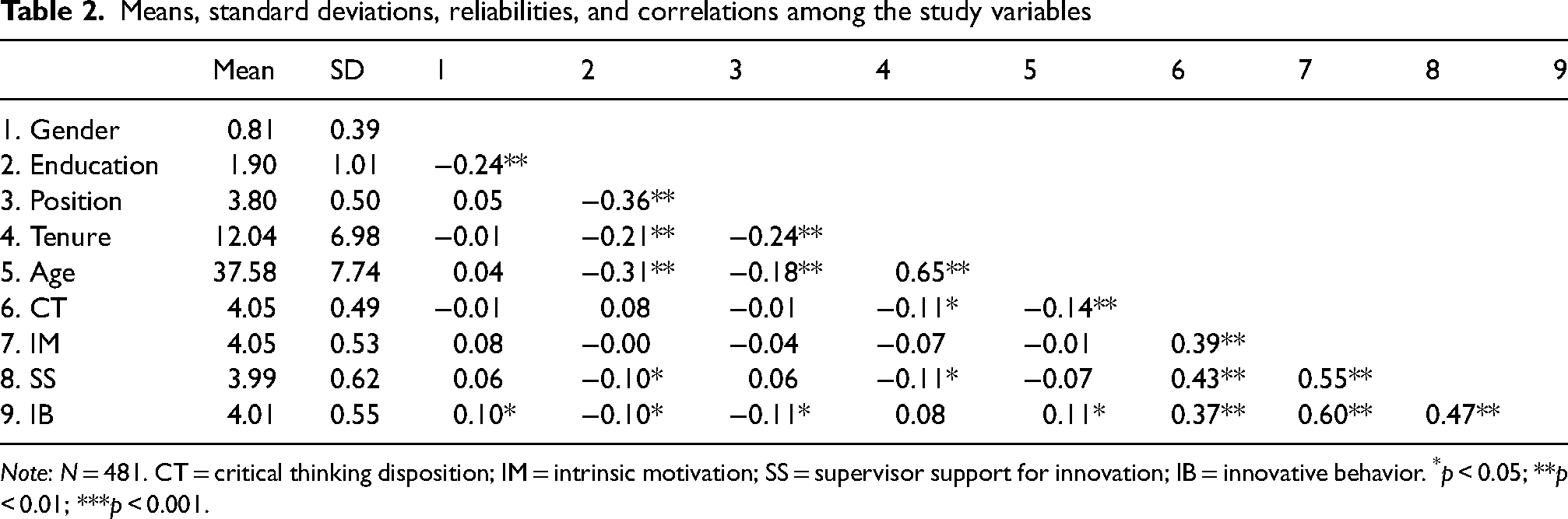
Note: N = 481. CT = critical thinking disposition; IM = intrinsic motivation; SS = supervisor support for innovation; IB = innovative behavior. *p < 0.05; **p < 0.01; ***p < 0.001.
Hypotheses testing
A hierarchical regression analysis was conducted to test hypotheses 1–4. As shown in Model 2 in Table 3, while controlling for gender, education, position, age, and tenure, critical thinking disposition exhibited a positive association with intrinsic motivation (β = 0.40, t = 9.31, p < 0.001), thereby supporting Hypothesis 1. Furthermore, as shown in Model 7 in Table 3, intrinsic motivation demonstrated a positive association with innovative behavior after controlling for the control variables (β = 0.60, t = 16.62, p < 0.001), thus providing support for Hypothesis 2.
Results for hierarchical regression analysis
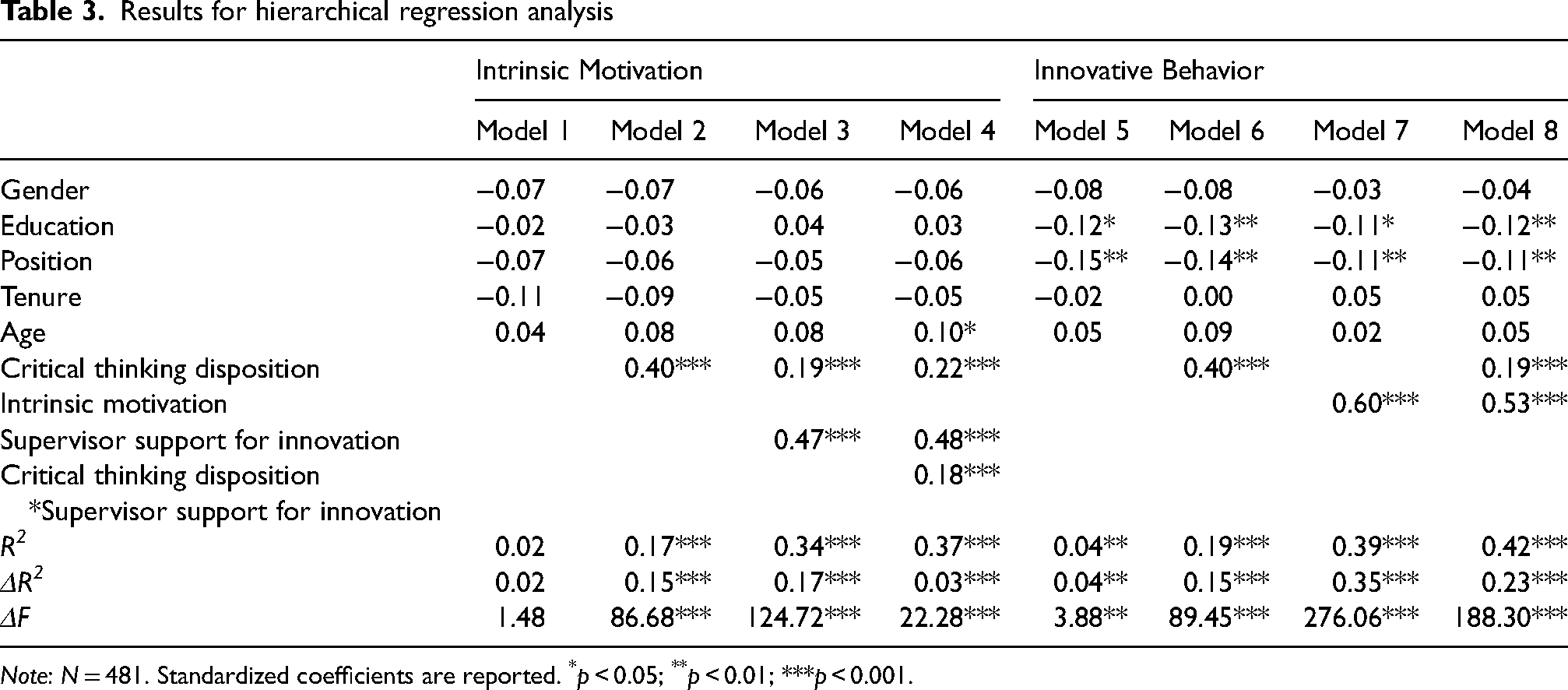
Note: N = 481. Standardized coefficients are reported. *p < 0.05; **p < 0.01; ***p < 0.001.
According to Kenny et al. (1998), establishing the mediating role of M in the relationship between X and Y needs to satisfy the following four conditions: (1) X is related to M, (2) M is related to Y, (3) X is related to Y, and (4) the relationship between X and Y is nonsignificant (complete mediation), or significant but its strength is reduced (partial mediation) when M is added to the model. In our study, the relationships between critical thinking disposition and intrinsic motivation (Hypothesis 1), between intrinsic motivation and innovative behavior (Hypothesis 2), and between critical thinking disposition and innovative behavior (β = 0.40, t = 9.46, p < 0.001; Model 6) were all significant. These findings indicate that the first through third conditions are satisfied. Moreover, when intrinsic motivation was included in the model as a mediator, the strength of the relationship between critical thinking disposition and innovative behavior was reduced but remained significant (Model 6: β = 0.40, t = 9.46, p < 0.001 → Model 8: β = 0.19, t = 4.88, p < 0.001). Therefore, intrinsic motivation played a partial mediating role in the relationship between critical thinking disposition and innovative behavior, thus supporting Hypothesis 3. We conducted a bootstrapping analysis in the PROCESS regressions to further test the significance of this mediation effect by setting the number of bootstraps at 5000 (Preacher & Hayes, 2008). The results revealed that the 95% confidence interval (CI) of this mediation effect did not include 0 (95% bias-corrected CI = [0.17, 0.31]) and that the direct effect of critical thinking disposition on innovative behavior was significant (b = 0.21, SE = 0.04, t = 4.88, p < 0.001), suggesting a partial mediating role of intrinsic motivation in the relationship between critical thinking disposition and innovative behavior, thus providing further support for Hypothesis 3.
To test Hypothesis 4 (supervisor support for innovation moderates the relationship between critical thinking disposition and intrinsic motivation), we followed Aiken and West's (1991) recommendation to mean-center critical thinking disposition and supervisor support for innovation in the interaction term. As shown in Model 4 in Table 3, the effect of the interaction term between critical thinking disposition and supervisor support for innovation on intrinsic motivation was positive and significant (β = 0.18, t = 4.72, p < 0.001); as shown in Figure 2, the positive influence of critical thinking disposition on intrinsic motivation was stronger under high (β = 0.33, t = 6.77, p < 0.001) compared to low (β = 0.11, t = 2.18, p = 0.03) levels of supervisor support for innovation. Therefore, Hypothesis 4 is supported.
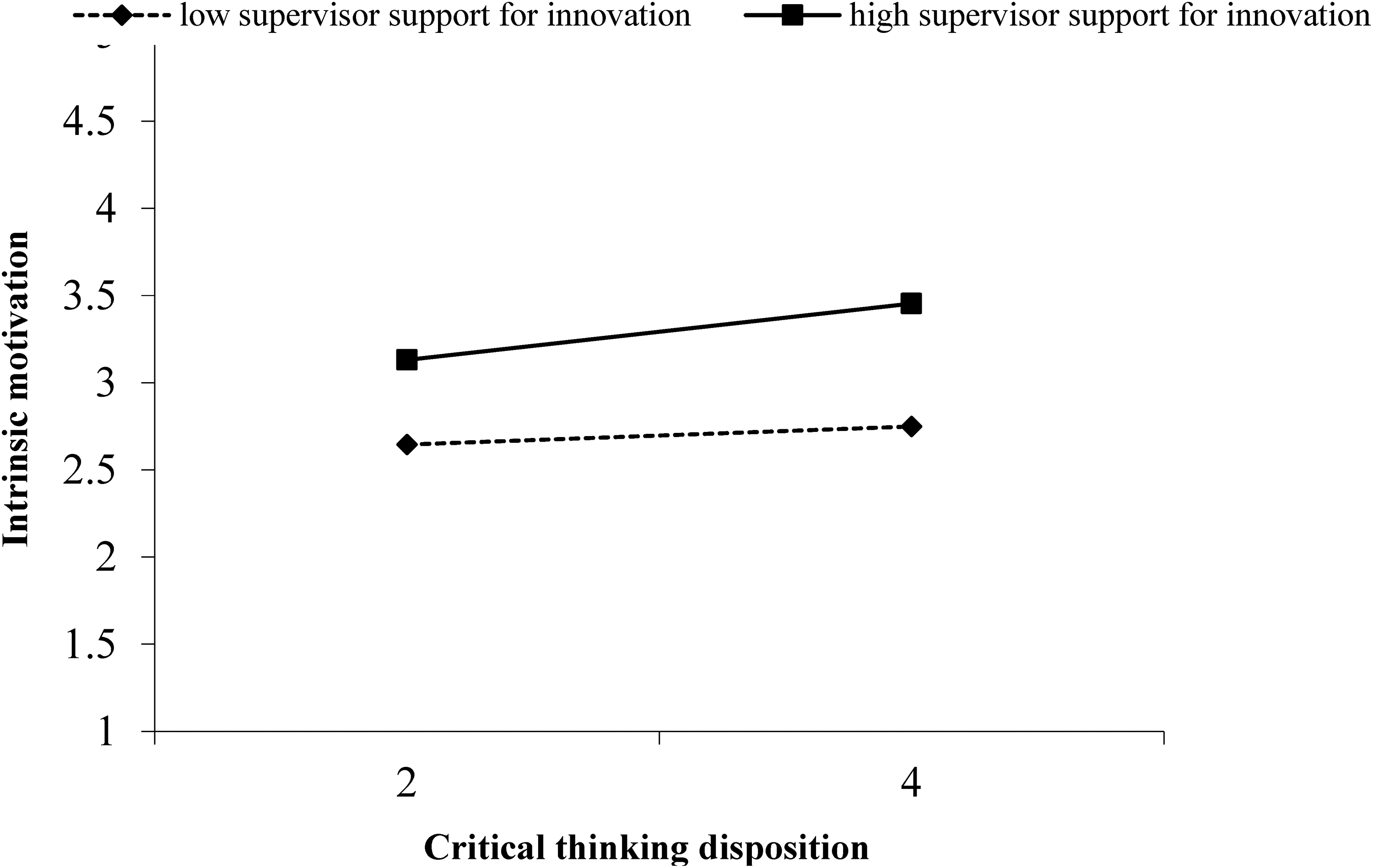
The relationship between critical thinking disposition and intrinsic motivation is moderated by supervisor support for innovation.
A total effect moderation model was utilized to test the moderated mediation hypothesis (Hypothesis 5; Edwards & Lambert, 2007). Equations 1 and 2 are formulated as follows:

A regression analysis was conducted to estimate the coefficients in (1) and (2), as shown in Table 4. Next, these coefficients were used to calculate simple effects as shown in Table 5. Tests of differences for the first stage, second stage, and direct effect in Table 5 are equal to tests of aXZ5, bMZ20, and bXZ20, respectively, as shown in Table 4. Tests of differences for the indirect and total effects were based on bias-corrected CIs derived from 1,000 bootstrap estimates. As shown in Table 5, although difference of the indirect effect of critical thinking disposition on innovative behavior through intrinsic motivation was marginally significant when using a two-tailed test (Δb = 0.09, 95% bias-corrected CI = [ − 0.01, 0.19], p < 0.1), it was significant when using a single-tailed test (Δb = 0.09, 90% bias-corrected CI = [0.01, 0.18], p < 0.1), and thus Hypothesis 5 is supported.
Coefficient estimates

Note: N = 481. aX5, aZ5, and aXZ5 are the unstandardized coefficient estimates from Equation 1. bX20, bM20, bZ20, bXZ20, and bMZ20 are the unstandardized coefficient estimates from Equation 2. *p < 0.05; **p < 0.01; ***p < 0.001.
Analysis of simple effects
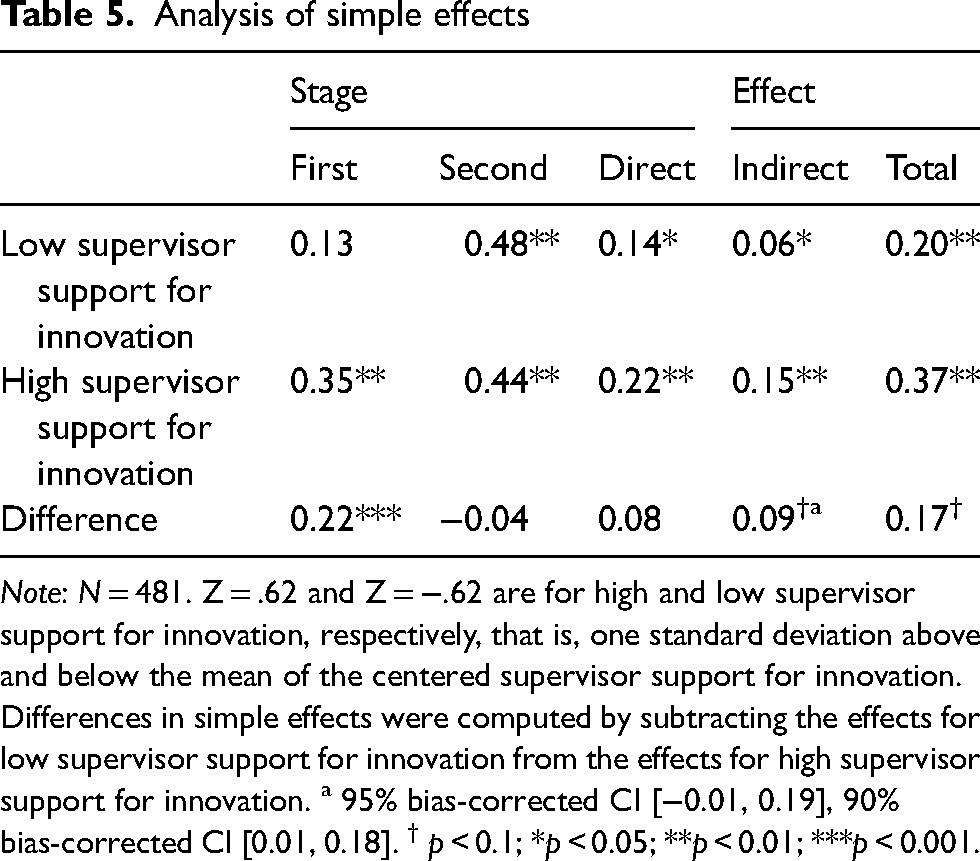
Note: N = 481. Z = .62 and Z = −.62 are for high and low supervisor support for innovation, respectively, that is, one standard deviation above and below the mean of the centered supervisor support for innovation. Differences in simple effects were computed by subtracting the effects for low supervisor support for innovation from the effects for high supervisor support for innovation. a 95% bias-corrected CI [−0.01, 0.19], 90% bias-corrected CI [0.01, 0.18]. † p < 0.1; *p < 0.05; **p < 0.01; ***p < 0.001.
Discussion
Based on the meta-theory of personality, this study explores how and when critical thinking disposition influences employee innovative behavior. The results reveal that critical thinking disposition indirectly influences employee innovative behavior through intrinsic motivation. Further, the results show that supervisor support for innovation moderates the effect of critical thinking disposition on intrinsic motivation and its indirect effect on innovative behavior through intrinsic motivation, such that these effects are stronger under high rather than low levels of supervisor support for innovation.
Theoretical implications
First, this study broadens the theoretical perspectives that explain how personality traits influence employee creativity and innovative behavior. Recent research has focused mainly on the process mechanisms whereby contextual factors such as leadership (e.g., Pan et al., 2013; Tu & Lu, 2013) and human resource management (e.g., Alfes et al., 2013) influence employee creativity and innovative behavior. However, research on the process mechanisms by which individual factors influence employee creativity and innovative behavior has been scant. Recently, the influence of personality traits such as openness to experience (Prabhu et al., 2008; Tan et al., 2019), perseverance (Prabhu et al., 2008), and proactivity (Sears et al., 2018) on employee creativity has triggered the interest of researchers, leading to the development of mechanisms such as intrinsic motivation (Prabhu et al., 2008; Sears et al., 2018; Tan et al., 2019), creative process engagement (Tan et al., 2019), and interactional justice (Sears et al., 2018). However, these studies lack an integrative theoretical framework that can encapsulate the relationships between all study variables. Consequently, they fail to provide a systematic explanation of how personality traits influence employee creativity and innovative behavior. The meta-theory of personality suggests that basic tendencies, namely fundamental abilities and dispositions, influence individual behavior through characteristic adaptations, specifically learned reactions resulting from the interaction between basic tendencies and the environment (McCrae & Costa, 1996). Our study cites and confirms the arguments of the meta-theory of personality. Future research might draw on this integrative theoretical framework to explore the inner mechanisms by which personality traits influence employee creativity and innovative behavior.
Second, this study explores the mechanism of intrinsic motivation through which critical thinking disposition can influence innovative behavior. When people experience high levels of intrinsic motivation, they tend to be more creative (Oldham & Cummings, 1996). Given the importance of intrinsic motivation in promoting employee creativity and innovative behavior, previous researchers have examined the impact of contextual factors such as ethical leadership (Tu & Lu, 2013), leader creativity (Pan et al., 2013), and supervisor support (Chen et al., 2016), as well as individual factors such as openness to experience (Prabhu et al., 2008; Tan et al., 2019), self-efficacy (Prabhu et al., 2008), and proactivity (Sears et al., 2018), on employee creativity and innovative behavior through the intrinsic motivation mechanism. However, it has not been confirmed whether critical thinking disposition influences innovative behavior through this intrinsic motivation mechanism. In our study, we confirm the mediating role of intrinsic motivation in the relationship between critical thinking disposition and innovative behavior. Individuals who have the disposition toward critical thinking possess characteristics such as curiosity, broadmindedness, truth-seeking, and making prudent judgements based on evidence and inference. They derive pleasure and satisfaction from engaging in inquiry at work which leads to high levels of intrinsic work motivation. This intrinsic motivation allows them to generate and implement novel ideas. Our study further reveals the mechanism through which critical thinking disposition influences innovative behavior, deepening our understanding of how the influence of critical thinking disposition on innovative behavior takes place.
Finally, this study highlights when critical thinking disposition influences intrinsic motivation, and subsequently, innovative behavior. Research has found that leadership and followers’ individual factors interact to shape their reactions (Chen et al., 2016; Kim et al., 2015). For example, Kim et al. (2015) found that transformational leadership enhances the relationships between followers’ core self-evaluation and their job satisfaction and affective organizational commitment. This type of leadership helps followers with high core self-evaluation to exhibit trait-related behaviors and better utilize the potential benefits of high core self-evaluation for their work outcomes. In this study, we find that the relationship between critical thinking disposition and intrinsic motivation is stronger when there are high levels of supervisor support for innovation rather than low levels. This is because supervisor support for innovation clearly communicates to employees that the organization values innovation, and thereby helps activate their critical thinking disposition. The moderating role of supervisor support for innovation in the first stage enables this variable to moderate the entire mediation effect.
Practical implications
First, organizations should prioritize developing critical thinking disposition in employees as it plays a critical role in promoting innovative behavior. Organizations should regard a critical thinking disposition as an important criterion during the staff selection process. This can be achieved by modifying behavioral interviews and psychological tests to identify candidates with a significant critical thinking disposition. To induce and foster employees’ critical spirit, organizations should create an atmosphere that embraces employees who question authority and are bold in making assumptions, while being careful in proving them. Supervisors can also develop a critical thinking disposition in followers through modeling (Facione, 2000).
Second, because critical thinking disposition has a significant effect on innovative behavior through the mechanism of intrinsic motivation, organizations should facilitate rather than impede this relationship. For example, organizations should confer job autonomy to employees with a significant critical thinking disposition and place them in achievement-oriented environments to fully energize their intrinsic work motivation.
Finally, the more supervisors provide support for innovation, the more employees who have a disposition toward critical thinking are intrinsically motivated. Therefore, supervisors should provide a high level of support for innovation, particularly for those with a significant critical thinking disposition, and create favorable conditions for fully utilizing their critical thinking disposition.
Limitations and future directions
While collecting data from the same source as this study may raise concerns regarding CMV, our CMV test results indicated that it was not a major problem in our study. Nevertheless, future research should collect data from different sources to rigorously test our results. Furthermore, the partial mediation role of intrinsic motivation in our study implies that there may be other possible mediating mechanisms in the relationship between critical thinking disposition and innovative behavior. Individuals who possess a disposition toward critical thinking are curious and bold in making assumptions but careful in proving them. This continuous exercise of critical thinking will help improve their innovative abilities and, consequently, facilitate the implementation of innovative behavior. Therefore, future research should explore the potential mediating role of innovative ability in the relationship between critical thinking disposition and innovative behavior. Additionally, the intellectual stimulation dimension of transformational leadership may reinforce the effect of critical thinking disposition, while the leader charisma dimension may weaken it (Jiang & Yang, 2014). Moreover, extrinsic rewards have the potential to both diminish and enhance people's intrinsic motivation (Chen et al., 2016). Therefore, future research should investigate the possible moderating roles of transformational leadership and extrinsic rewards in the hypothesized relationships.
Supplemental Material
sj-docx-1-pac-10.1177_18344909241231847 - Supplemental material for Effect of critical thinking disposition on employee innovative behavior: A meta-theory of personality perspective
Supplemental material, sj-docx-1-pac-10.1177_18344909241231847 for Effect of critical thinking disposition on employee innovative behavior: A meta-theory of personality perspective by Zhihua Xu and Fu Yang in Journal of Pacific Rim Psychology
Supplemental Material
sj-doc-2-pac-10.1177_18344909241231847 - Supplemental material for Effect of critical thinking disposition on employee innovative behavior: A meta-theory of personality perspective
Supplemental material, sj-doc-2-pac-10.1177_18344909241231847 for Effect of critical thinking disposition on employee innovative behavior: A meta-theory of personality perspective by Zhihua Xu and Fu Yang in Journal of Pacific Rim Psychology
Footnotes

Declaration of conflicting interests
The authors declared no potential conflicts of interest with respect to the research, authorship, and/or publication of this article.
Funding
The authors disclosed receipt of the following financial support for the research, authorship, and/or publication of this article: This work was supported by the Guangdong Provincial Soft Science Research Plan Project (grant number 2020A1010020053).
Supplemental material
Supplemental material for this article is available online.
References
Supplementary Material
Please find the following supplemental material available below.
For Open Access articles published under a Creative Commons License, all supplemental material carries the same license as the article it is associated with.
For non-Open Access articles published, all supplemental material carries a non-exclusive license, and permission requests for re-use of supplemental material or any part of supplemental material shall be sent directly to the copyright owner as specified in the copyright notice associated with the article.
