




Abstract
Although various internet memes (IMs) were disseminated and popularized during the COVID-19 pandemic, the degree to which people appreciate them is unclear. In this study, people's appreciation of three kinds of typical IMs, which respectively conveyed the humorous (H-IM), encouraging (E-IM), and aggressive (A-IM) feelings towards the pandemic and the consequences it brought about, along with one objective description (OD) serving as the control condition, were compared. The results showed that the E-IMs and H-IMs were significantly more appreciated and loved than the A-IMs, thus supporting the prediction of positive psychology and humor regulation of negative emotion but failing to support the theory of psychology catharsis that emphasizes the need of making aggression to release tense and angry feelings caused by the pandemic. The results also showed that creativity played a mediating role for the positivity component in E-IMs and the humor component in H-IMs when predicting their fondness ratings. For the H-IMs, creativity could even fully mediate the impact of humor for exerting regulation effects on negative emotions evoked by the pandemic-related affairs such as home quarantine. This result revealed the creative nature of the IMs and showed that IMs are a kind of insightful cognitive restructuring that people make as a creative adaption to unfavorably changed situations caused by the pandemic.
The COVID-19 pandemic brought about substantial challenges to people's lives and evoked complicated psychological and social reactions. One interesting phenomenon that resulted from the pandemic was the promotion of a great deal of internet memes (IMs), which were generally recognized as “cultural unit[s] disseminated through social media via creative imitation” (Davison, 2012; Sebba-Elran, 2021), as well as other innovative ways that reflected semantic representation and (re)interpretation of the reality caused by the pandemic. Though IMs may typically take the form of humorous expressions frequently including political themes (Wong & Holyoak, 2021), they involve many different genres and topics. For example, Akram and colleagues (2020) studied IMs that conveyed positive and negative attitudes, and Sebba-Elran (2021) found that the humorous IMs regarding the COVID-19 pandemic could concern different themes during different phases of the pandemic in Israel and exert complicated implications on people's reflections on illness, death, distancing, isolation, anxiety, and adapting to new restrictions as a result of the pandemic. In the present study, people's preference and acceptance towards three types of IMs along with the reference condition and objective description (OD), were investigated. The three types were the “encouraging” IMs that conveyed positive and hopeful emotions and attitudes (E-IMs) towards coping with the pandemic, the “humorous” IMs that conveyed whimsical and self-mockery attitudes (H-IMs) toward pandemic-related affairs, for example staying at home for long periods, and the “aggressive” IMs that conveyed angry feelings and attitudes (A-IMs). The setting of these types of IMs were based on the preliminary collection and categorization of the IMs that were typically expressed and widely spread on the Internet in China between late 2019 and mid-2020. In contrast to the comprehensive consideration on the multifaceted social meanings, functions, and implications of IMs (e.g., Sebba-Elran, 2021), a specific perspective on individuals’ subjective feeling, the appreciation of the IMs, was taken in this study. These individual-level, holistic, subjective representations and evaluations are important because first, individuals tend to process, memorize, and utilize information that piques their curiosity rather than information that they perceive to be dull (Fastrich et al., 2018; Marvin & Shohamy, 2016), and second, the individual-level cognitive information processing (for example the memorability of the materials) constitutes the general psychological basis for the maintaining, diffusing, and inheriting of given information such as a story or an IM in society and even in culture (Boyer & Ramble, 2001). This research perspective could also provide a clue for understanding how IMs could help to modulate people's feelings, especially whether they alleviate the negative feelings during the COVID-19 pandemic.
The making and propagating of these different types of internet memes is related to the changes of social situations, especially the stress that occurred as a result of COVID-19. Moreover, reading and appreciating these memes could also in turn regulate and affect people's attitudes and mentality to these affairs (Davison, 2012; Sebba-Elran, 2021). Different theories make predictions on people's preferences and acceptance for the different types of memes. In particular, the theory of psychological catharsis predicts that people's special preference for the A-IMs is because the aggressive expressions conveyed could help to let out and alleviate the pandemic-related tension and anxiety (Denzler & Förster, 2012; Erdelyi, 1985; Freud, 1895). This constitutes the prediction that A-IMs are the favorite type of IMs (Hypothesis 1). In contrast, the perspective of positive psychology predicts that people's particular interest in the E-IMs is because the positive attitudes and emotions conveyed could regulate and replace the negative emotions produced by the pandemic (Fredrickson, 1998, 2001, 2004), and this constitutes Hypothesis 2 of this study. Lastly, the theory on the role of humor in regulating emotion, especially coping with the negative emotion and stress in both laboratory settings (Samson et al., 2014; Wu et al., 2021) and real-life situations (Erdman, 1993; Henman, 2001; Nezu et al., 1988), predicts that people's specific favoring of the H-IMs is because of their function in producing the insightful, amusing, and relaxed cognitive reappraisals on the pandemic-related unfavorable affairs (Hypothesis 3). Furthermore, given that IMs usually provide novel, appropriate, and often funny interpretations regarding social phenomena and people's experiences, they always have the essential feature of creativity (Kuipers, 2002; Milner, 2016; Nissenbaum & Shifman, 2018; Shifman, 2013; Wiggins & Bowers, 2015). Thus, it was of particular interest to investigate how the creative feature would contribute to people's appreciation and adopting of IMs to re-represent and reinterpret reality in new ways.
In sum, the present research made comparisons among people's preference for different types of typical pandemic-related IMs that appeared on the Internet. The first merit of this study is that it has relatively high ecological validity because all the IM materials and their categorizations were taken timely from the Internet and the data used in this study were sampled from the same population who have been experiencing the pandemic. Second, research hypotheses were examined under a relatively strictly controlled experimental condition where different types of IM sentences were carefully phrased and presented with comparable length, comprehensibility, and level of elaboration, including methods of rhyme. Third, this study examined the validity of the predictions made by different kinds of theories (such as that of psychological catharsis, positive psychology, and humorous regulation of emotion). Finally, this study examined the role of creativity, which was proposed to be the essential feature of IMs, in mediating the impacts of IM's humorous or positive factors on the subjective preference or fondness of the IMs. It is because previous studies found that both the generating and the understanding of the humorous reinterpretation or reappraisals on the unpleasant stimuli, alleviating their negative affect, required the essential components of creativity (Papousek et al., 2019; Wu et al., 2021). Moreover, recent neuroimaging research found the use of humor to cope with unpleasant emotions could be realized by the joint enhanced functional connectivity in both the “haha!” (the humorous feeling) and “aha!” (the creative cognition) neural pathways, whereas only the strengthening of the latter neural pathway could significantly predict the reappraisal's negative emotion regulation effects (Wu et al., 2021), thus suggesting the decisive roles of the creativity component in humorous regulation of negative emotion. This might result in a novel hypothesis on the role of IMs during the pandemic. That is, the cognitive processing of IMs could function as a kind of creative interpretation and adaption to the pandemic situation.
Study 1
Participants
Thirty physically and mentally healthy undergraduate or graduate students (17 females and 13 males) with a mean age of 23.17 ± 2.28 years participated as paid volunteers. The study was approved by the related Ethical Committee of Capital Normal University.
Materials
The IM materials adopted in this study were the IM sentences that appeared on the Internet in China during the pandemic between late 2019 and mid-2020, and the experimental investigations were conducted from July to August of 2020 (Study 1) and May of 2021 (Study 2). Some IM researchers (for example, Sebba-Elran, 2021) pointed out that people's focus of attention and the themes of IMs may continue to change during the progress of the virus pandemic. However, in China, the policies of pandemic prevention and control were consistent and efficient, so people's social mentality and attitudes towards the pandemic were generally stable, especially during the period of experimental data collection. Based on the main goal of the present study, as well as on the research group members’ discussion and preliminary classification of the IMs that were widely collected from the Internet, three major kinds of typical IMs, the “encouraging IMs” (H-IM), the “humorous IMs” (H-IM), and the “aggressive IMs” (A-IM) that respectively conveyed the positive and hopeful, the humor and self-mockery, and the angry and aggressive feelings towards the pandemic and the consequences it brought about, were identified and selected as the target of research. Five representative items from each of the H-IM, E-IM, and A-IM item pools were selected along with five OD sentences that objectively described facts about the COVID-19 pandemic and were used as the reference condition. In order to have ideal materials for the experimental testing, the expression of each IM sentence was carefully modified so that their original meanings did not change, and each sentence had a comparable sentence length of thirty-five to thirty-eight Chinese characters or single words and delicate features such as rhyming.
Five graduate students who majored in creative psychology and had experiences in evaluating such kinds of materials were required to rate each IM on its comprehension, elaboration, sense of reality, positivity, negativity, aggression and malice, fondness, acceptance, creativity, novelty, humor, empathy, and catharsis (the exact requirement of these ratings are given in Table 1) on a 9-point scale, where 1 stands for the lowest level and 9 for the highest level. The evaluation results indicated that the positivity score of the E-IMs, the humor score of the H-IMs, and the aggressiveness score of the A-IMs were respectively higher than that of the other types of IMs as well as the OD ones in their corresponding rating scores, thus proving the validity of the experimental materials classification (see Table S2 and Figure S1).
Contents of ratings.

Procedure
During the experimental session, participants were presented with the IMs one by one in a random order, and they were required to rate each target IM's features on a 9-point scale. The contents of ratings were given in Table 1. Each trial of IM sentence evaluation was started by a 500–800 ms cross-viewing interval calling for the attention of participants. After that, the target IM sentence was presented on the screen and participants were required to read and understand its meaning. They would press a key to go to the next interface for rating once they thought they had completely comprehended the sentence. All the ratings related to the target sentence were given in a random order after the target sentence presentation. Each item of rating instruction (e.g., the positivity rating) would stay on the screen until individual input his/her judgment, and then the next rating instruction interface would be displayed until all the evaluations for that target sentence were completed. The experiment was conducted by E-Prime. During the testing of each participant, the experimenter stayed online across the whole experimental procedure to monitor and direct, if necessary, the implementation of testing. Before the formal testing, all participants were well instructed, and they completed a practice test with an identical procedure using another set of four IM sentences different from the ones used in the formal experimental session.
Results
Means and standard deviation
The scores for means and standard deviations (M ± SD) and reliability on comprehension, humor, positivity, aggression, fondness, creativity, and catharsis dimensions in four types of memes and sentences are displayed in Table S4 and Table S1. General linear model for repeated measures was used to analyze the differences in dimensions among the four types of memes and sentences. Pairwise comparisons were performed to examine the follow-up effects of the significant repeated measures and the results are displayed in Figure S2.
In comprehension, results indicated that the rating scores of the four types (H-IM, E-IM, A-IM, OD) were around 8.00. 8.29 ± 0.61, 8.13 ± 0.73, 7.99 ± 0.82, 8.22 ± 0.69, respectively, and had no significant difference, F(1, 29) = 2.57, p = 0.06. All four types were comprehended very well.
In the ratings of humor, positivity, and aggression, which were mainly manipulated in the types of IMs, the scores of the four types had significant differences, F(1, 29) = 106.00, p < 0.001; F(1, 29) = 40.04, p < 0.001; F(1, 29) = 74.19, p < 0.001, respectively. Results of pairwise comparisons indicated that the subjects gave the highest humor scores to the H-IMs (M = 6.69, SD = 1.36), the highest positivity scores to the E-IMs (M = 7.81, SD = 1.05), and the highest aggression score to the A-IMs (M = 4.43, SD = 1.99). This proved the manipulation of different IM types were generally valid.
For the rating of fondness, the major concern of this study because it directly reflected the individual preference for different IMs, subjects made significantly different ratings across the four types, F(1, 29) = 23.64, p < 0.001. They gave the highest fondness scores to the H-IMs (M = 6.24, SD = 1.32) and E-IMs (M = 6.11, SD = 1.79), followed by the A-IMs (M = 4.11, SD = 1.70) and the ODs (M = 4.09, SD = 1.56). How humor predicted fondness would be studied in the subsequent analyses. Subjects also rated the creativity scores of the four IM types significantly differently, F(1, 29) = 10.65, p < 0.001. Results of pairwise comparisons indicated that the subjects gave moderately high creativity scores to the H-IMs (M = 5.27, SD = 1.36) and the A-IMs (M = 5.09, SD = 1.52), followed by the E-IMs (M = 4.37, SD = 1.92) and the ODs (M = 3.52, SD = 2.21). Subjects rated the catharsis scores of four types significantly differently, F(1, 29) = 23.64, p < 0.001; they gave moderately high catharsis scores to the H-IMs (M = 5.61, SD = 1.73) and the A-IMs (M = 4.95, SD = 2.04), followed by the E-IMs (M = 4.25, SD = 2.23) and the ODs (M = 2.05, SD = 1.32). The following correlation and mediation analysis would focus on the H and E-IMs, respectively, and mainly study the relationships among the creativity, fondness, humor (in H-IM), and positivity (in E-IM) to test the main hypothesis on the role of creativity.
Correlation analyses in H-IM
Table 2 summarized the Pearson correlations among the humor, creativity, positivity, fondness, and catharsis dimensions of the H-IMs. There was a moderate and reliable association between humor and fondness, as well as between creativity and fondness. Humor had a weak but reliable correlation (r = .371, p < .05) with creativity, as well as humor with positivity (r = .382, p < .01). Positivity had a strong correlation with fondness (r = .717, p < .001). Catharsis had no significant correlation with humor, creativity, positivity, and fondness (respectively, r = .355, p = .054; r = .189, p = .324; r = .072, p = .705; r = .265, p = .157); hence, there was no further subsequent analysis regarding catharsis in H-IMs.
Pearson correlations among humor, creativity, positivity, fondness, and catharsis of H-IM type memes.

Note: N = 30. ***p < 0.001; **p < 0.01; *p < 0.05.
Mediation analyses in H-IMs
Creativity was tested as a mediator of humor on fondness using PROCESS Model 4 (Hayes, 2013) in SPSS 26 (i.e., a mediation model) with 95% bias-corrected bootstrap confidence interval (CI) created by 10,000 bootstrap resamples. The power of mediation effect was computed by MedPower (Kenny, 2017). Creativity partially mediated the link between humor and fondness in H-IMs. A significant indirect effect of humor on fondness via creativity was .15 with a 95% CI [.12, .41] and a power of .34. Figure 1 indicated that a significant total effect of humor on fondness was β = .48, SE = .16, p < .01, 95% CI [.15, .80]. Humor was associated with increased creativity, β = .37, SE = .18, p < .05, 95% CI [.11, .73], and creativity was associated with increased fondness, β = .40, SE = .16, p < .05, 95% CI [.07, .72]. A significant direct effect of humor on fondness was β = .33, SE = .16, p < .05, 95% CI [.01, .65]. The proportion of mediated effect (indirect/total) was 0.31, suggesting that the pathway accounts for a certain proportion of the effect of humor on increased fondness. The positivity mediation path was not significant, as an indirect effect of humor on fondness via positivity was .23 with a 95% CI [−.06, .47].

Partial mediation of the effect of humor (H-IM) on fondness (H-IM) via creativity (H-IM). Note: * p < .05, ** p < .01.
Correlation and mediation analyses in E-IM
Table 3 summarized the Pearson correlations among the humor, creativity, positivity, fondness, and catharsis dimensions of the E-IMs. It showed a moderate and reliable association between positivity and fondness (r = .493, p < .01.), as well as between positivity and creativity (r = .489, p < .01). Creativity had a strong correlation with fondness (r = .708, p < .001) while aggression had a weak correlation with fondness (r = .391, p < .05), and had no significant correlation with positivity or creativity (r = .301, p = .107; r = .218, p = .248). Hence, there was no further subsequent analysis regarding catharsis in E-IMs.
Pearson correlations among positivity, creativity, fondness, and catharsis of E-IM type memes.

Note: N = 30. ***p < 0.001; **p < 0.01; *p < 0.05.
Creativity was tested as a mediator of positivity on fondness using the same method mentioned above. Creativity (E-IM) fully mediated the link between positivity (E-IM) and fondness (E-IM). A significant indirect effect of positivity on fondness via creativity was .51 with a 95% CI [.25, .96] and a power of .77. Figure 2 indicated that a significant total effect of positivity on fondness was β = .84, SE = .28, p < .01, 95% CI [.27, 1.42]. Positivity was associated with increased creativity, β = .89, SE = .30, p < .01, 95% CI [.28, 1.51], and creativity was associated with increased fondness, β = .57, SE = .14, p < .001, 95% CI [.28, .86]. A nonsignificant direct effect of positivity on fondness was β = .33, SE = .26, p < .01, 95% CI [−.20, .86]. The proportion of mediated effect (indirect/total) was 0.61 suggesting that the pathway accounts for a high proportion of the effect of positivity on increased fondness.

Full mediation of the effect of positivity (E-IM) on fondness (E-IM) via creativity (E-IM). Note: * p < .05, ** p < .01, *** p < .001.
Discussion
The results of Study 1 found that there was no significant difference on the understanding rating scores among the four types of IMs, and the targeted features of each type of sentence, that is, the positivity rating of E-IM, the humor rating of H-IM, and the aggressiveness rating of A-IM, were the highest among the corresponding ratings of all type of sentences, indicating that the controlling of basic sentence characteristics and the manipulating of the target features were generally valid. For the fondness rating scores, which were the major concern of this study, the values for the H-IMs and E-IMs were significantly higher than those for the A-IMs and ODs. This observation was generally in line with the prediction of humorous emotion regulation and positive psychology hypothesis (Hypotheses 2 and 3) but not that of psychological catharsis (Hypothesis 1). This suggested that both positivity and humor factors could be beneficial to promote the fondness rating scores; this could be due to the fact that these two features might together enable people to resist the strong negative feelings aroused by the pandemic in both individual and social-level mentality. However, the fondness ratings of the A-IMs were relatively low, which was somewhat surprising, especially given that the A-IMs exhibited creativity and humor rating scores that were significantly higher than those of the E-IMs. This implied that, for the A-IMs, the humor and creativity features could not directly result in superior fondness ratings. This result is in line with a recent study that found that positivity plays a full mediating role for the creativity level of creative reappraisal on unpleasant pictures to predict the reappraisal's emotion regulation efficacy (Li et al., 2022). In spite of this observation, for the E and the H-IMs, creativity was proved to be critical, as it played a full mediating role for positivity in E-IMs and humor in H-IMs when predicting their fondness ratings. This observation was generally consistent with the point of view that regards creativeness as the essential feature of IMs (Kuipers, 2002; Nissenbaum & Shifman, 2018; Sebba-Elran, 2021).
One possible limitation of Study 1 was that it only evaluated the degree to which people liked and accepted different kinds of IMs and did not directly evaluate whether or not they could really help to alleviate the unfavorable feelings and emotions caused by the pandemic. Study 2 particularly focused on how the H-IMs could reduce the discomfort feelings caused by the pandemic, especially the home quarantine. The reasons only H-IMs were used as the target of investigation rather than other types of IMs were because the H-IMs were the most typical and popular form of IM, the H-IMs, was one of the most appreciated and favored, as indicated by Study 1, and the topics of the H-IMs in the study were relatively specific, as they mainly focused on the issue of home quarantine caused by the pandemic. Thus, it would be more “target-specific” to examine H-IM's regulatory effects in coping with the discomforting feelings associated with home quarantine.
Study 2
Participants
Twenty-five physically and mentally healthy undergraduate or graduate students (19 females and 6 males) with a mean age of 23.36 ± 2.17 years participated as paid volunteers. The study was approved by the related Ethical Committee of Capital Normal University.
Materials
The materials of Study 2 were the H-IM sentences that were used in Study 1.
Procedure
The procedure was the same as in Study 1, except only the H-IM sentences were presented, and an additional rating requirement, the degree of alleviation, which reflected the extent to which this IM could help to reduce the discomfort feelings caused by the pandemic (especially home quarantine), was added.
Results
Means, standard deviations, and correlations
Comprehension dimension scores in H-IMs were high (M = 8.66, SD = 0.52) and the estimate of reliability was high and acceptable (α = 0.884). Subjects comprehended the memes very well.
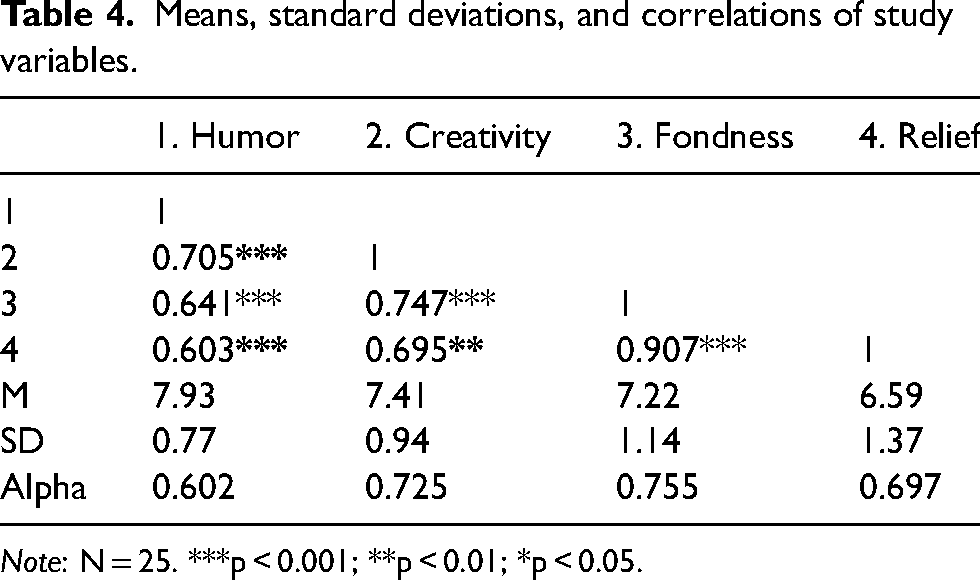
Table 4 showed the M, SD, the values of Cronbach's alpha of the questionnaires, and correlations of measures of humor, creativity, fondness, and emotional relief dimensions. All reliabilities were acceptable. The rating scores of humor were high (M = 7.93, SD = 0.77).
Means, standard deviations, and correlations of study variables.
Note: N = 25. ***p < 0.001; **p < 0.01; *p < 0.05.
Table 4 also summarized the Pearson correlations among the humor, creativity, fondness, and relief dimensions of H-IM-type memes. Results indicated strong associations among humor, creativity, fondness, and emotional relief. Humor had a significantly strong correlation with creativity, fondness, and relief (respectively, r = .705, p < .001; r = .641, p < .001; r = .603, p < .001). Creativity had a significantly strong correlation with fondness and relief (respectively, r = .747, p < .001; r = .695, p < .001).
Mediation analyses
Using the same method mentioned above, creativity fully mediated the association between humor and fondness. A significant indirect effect of humor on fondness via creativity was .61 (SE = .24) with a 95% CI [.25, 1.19] and a power of .99. Figure 3 indicated that the significant total effect of humor on fondness was β = .95, SE = .26, p < .01, 95% CI [.42, 1.47]. Humor was associated with increased creativity, β = .86, SE = .22, p < .001, 95% CI [.41, 1.31], and creativity was associated with increased fondness, β = .86, SE = .22, p < .001, 95% CI [.41, 1.31]. A nonsignificant direct effect of humor on fondness was β = .33, SE = .27, ns, 95% CI [−.23, .90]. The proportion of mediated effect (indirect/total) was .65, suggesting that the pathway accounts for a high proportion of the effect of humor on increased fondness.
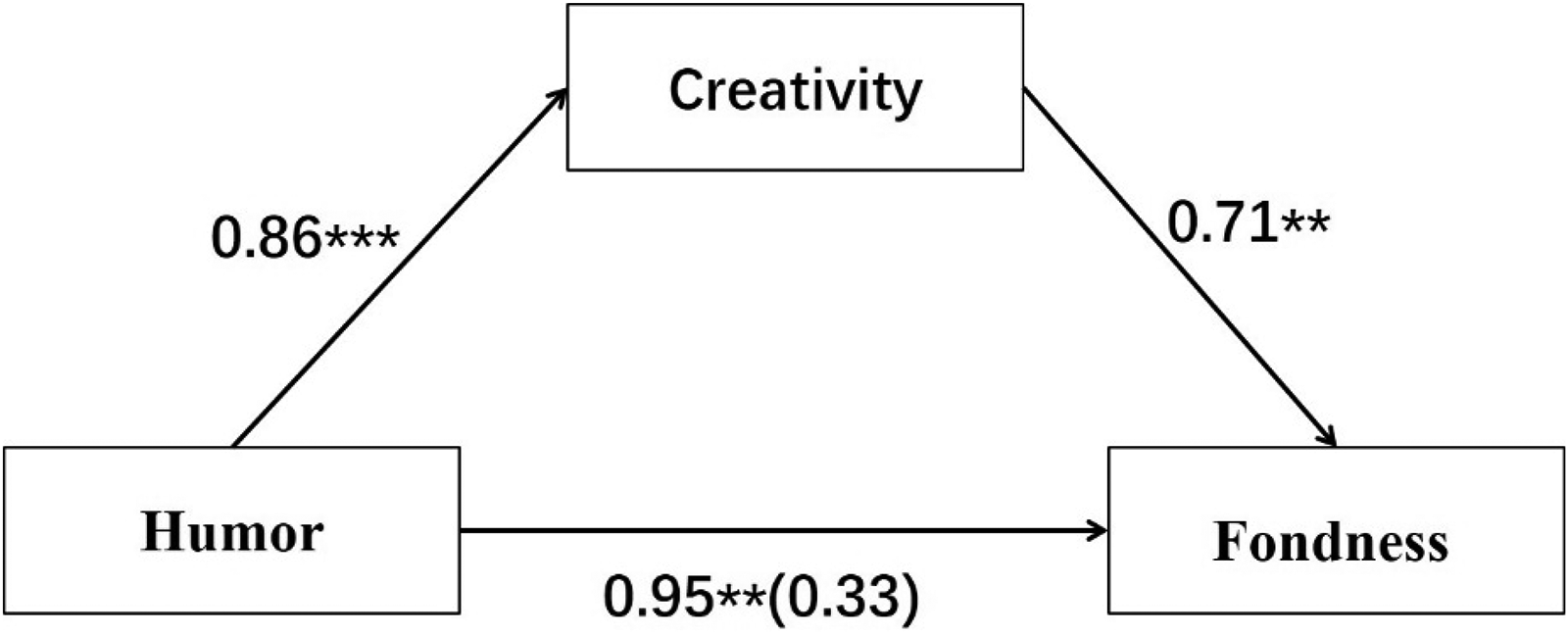
Full mediation of the effect of humor on fondness via creativity. Note: * p < .05, ** p < .01, *** p < .001.
Creativity also fully mediated the association between humor and emotional relief. A significant indirect effect of humor on emotional relief via creativity was .67 (SE = .32) with a 95% CI [.18, 1.55] with a power above .99. Figure 4 indicated that the significant total effect of humor on emotional relief was β = 1.07, SE = .36, p < .01, 95% CI [.33, 1.81]. Humor was associated with increased creativity, β = .86, SE = .22, p < .001, 95% CI [.41, 1.31], and creativity was associated with increased emotional relief, β = .78, SE = .28, p < .01, 95% CI [.21, 1.36]. A nonsignificant direct effect of humor on fondness was β = .40, SE = .42, ns, 95% CI [−.47, 1.27]. The proportion of mediated effect (indirect/total) was .63, suggesting that the pathway accounts for a high proportion of the effect of humor on increased fondness.

Full mediation of the effect of humor on emotional relief via creativity. Note: ** p < .01, *** p < .001.
Discussion
The results of Study 2 replicated those of Study 1 by finding the key mediating role of creativity for humor in H-IMs when predicting its fondness ratings. Study 2 was conducted nine months (May 2021) after Study 1 with an independent group of participants, so that the experimental effects were reliable and stable and did not change across the progress of the pandemic. Moreover, Study 2 also directly evaluated how the H-IMs could help to alleviate the discomfort feelings associated with the home quarantine and was generally in line with the view on IM's nature of creative adaption to the challenge of the pandemic (Nissenbaum & Shifman, 2018). However, in contrast to a previous study on the creative reappraisal of negative pictures that found the factor of positivity played a full mediating role between creativity and regulation effectiveness (Li et al., 2022), the present study found that the factor of creativity played a full mediating role between humor and regulation effectiveness. This difference could be because both positive and negative reappraisals were adopted in Li and colleagues’ study, while in the present study only H-IMs, which were relatively high in their humor and positivity level, were adopted. Considering that subjects could make their evaluation toward a given piece of IM not only based on the specific content of the target IM itself but also based on the impression of the whole IM list they read, which functioned as the general “background” or “reference frame,” the simplified experimental design of Study 2 that only included H-IMs alone might risk losing control or reference conditions for making contrast. Fortunately, the results of Study 2 on H-IMs replicated that of Study 1 by finding that the factor of creativity mediated the association between humor and fondness, thus suggesting that the major observation on H-IMs was unchanged in both the mixed IMs presentation experimental settings (Study 1) and in the H-IMs only settings (Study 2).
Both Studies 1 and 2 found that the order of people's fondness ratings on different kinds of IMs (i.e., they liked H-IM and E-IM more than the A-IM and OD) as well as the moderating role of the creativity factor impacted the humor component in H-IMs in the fondness ratings. However, previous studies found that the themes or contents of IM kept changing across different phases of the pandemic, thus implying that peoples’ preferences for the types of IMs could also change (Sebba-Elran, 2021). Given that the psychological and social mentality consequences produced by the COVID-19 pandemic could be fundamentally the same, these unchanged social psychological responses might result in people always preferring some types of IMs (for example the humor or positive ones) over the others (for example the aggressive ones) across the progress of the pandemic. To test this, in Study 3, a new group of 63 participants was recruited and asked to conduct the same evaluation using the same set of IMs as Study 1 in November of 2022.
Study 3
Participants
At least a sample size of 57 is required for a medium effect size given a power of 0.8 (Fritz & Mackinnon, 2007). In Study 3, 63 physically and mentally healthy undergraduate or graduate students (31 females and 32 males) with a mean age of 20.41 ± 1.56 years participated as paid volunteers. Thirty-three subjects reported having no quarantine experience and 30 subjects reported having one or more quarantine experiences. The study was approved by the related Ethical Committee of Capital Normal University.
Materials
The materials of Study 3 were the same as in Study 1.
Procedure
During the experimental session, participants were presented with the IMs in the order of H-IM, OD, E-IM, and A-IM, and they were required to rate each target IM's features on a 9-point scale. The eight contents of ratings used in study 2—humor, creativity, fondness, relief, positivity, aggression, comprehension, and catharsis—were given one by one in a random order. The experiment was conducted online.
Results
Means, standard deviations, and correlations
Comprehension dimension scores in H-IMs, E-IMs, A-IMs, and OD were high (respectively, 7.17 ± 1.62, 7.40 ± 1.81, 6.56 ± 2.31, and 6.98 ± 1.94) and the estimate of reliability was high and acceptable (respectively, α is 0.851, 0.958, 0.941, 0.901).
In the ratings of humor, positivity, and aggression, the scores of the four types of IMs had significant differences, F(1, 62) = 550.85, p < 0.001; F(1, 62) = 747.71, p < 0.001; F(1, 62) = 430.40, p < 0.001, respectively. Results of pairwise comparisons indicated that the subjects gave the highest humor scores to the H-IMs (M = 5.76, SD = 1.63), the highest positivity scores to the E-IMs (M = 6.94, SD = 1.90), and the highest aggression scores to the A-IMs (M = 5.64, SD = 2.19). This proved that the manipulation of different types of IMs was generally valid.
Participants made significantly different ratings of fondness across the four types, F(1, 62) = 461.69, p < 0.001. They gave the highest fondness scores to the E-IMs (M = 5.03, SD = 2.51) and H-IMs (M = 5.00, SD = 1.58), which was not significantly different from the pairwise comparisons, followed by the A-IMs (M = 3.29, SD = 2.04) and the ODs (M = 2.82, SD = 1.68). Participants also rated the creativity scores of the four IM types significantly differently, F(1, 29) = 606.13, p < 0.001. Results of pairwise comparisons indicated that the subjects gave moderately high creativity scores to the H-IMs (M = 5.60, SD = 1.63) and the A-IMs (M = 4.85, SD = 2.21), followed by the E-IMs (M = 4.38, SD = 2.42) and the ODs (M = 2.44, SD = 1.63).
There was no significant difference between the dimension scores given by participants having none and one or more quarantine experiences (see Table S7).
Table 5 showed the M, SD, values of Cronbach's alpha of H-IM type memes, and correlations of measures of humor, creativity, fondness, and emotional relief dimensions. All reliabilities were acceptable. The humor rating scores were high (M = 5.76, SD = 1.63).
Means, standard deviations, and correlations of study variables.

Note: N = 63. ***p < 0.001; **p < 0.01; *p < 0.05.
Table 5 also summarized the Pearson correlations among the humor, creativity, fondness, and relief dimensions of H-IM type memes. Results indicated strong associations among humor, creativity, fondness, and emotional relief. Humor had a significantly strong correlation with creativity, fondness, and relief (respectively, r = .767, p < .001; r = .765, p < .001; r = .646, p < .001). Creativity had a significantly strong correlation with fondness and relief (respectively, r = .683, p < .001; r = .658, p < .001).
Mediation analyses
Using the same method mentioned above, creativity partially mediated the association between humor and fondness. A significant indirect effect of humor on fondness via creativity was .17 (SE = .10) with a 95% CI [.02, .39] and a power of .40. Figure 5 indicates that the significant total effect of humor on fondness was β = .74, SE = .26, p < .001, 95% CI [.30, .83]. Humor was not significantly associated with increased creativity, β = .23, SE = .22, ns., 95% CI [−.02, .47], but creativity was associated with increased fondness, β = .86, SE = .22, p < .001, 95% CI [.41, 1.31]. The direct effect of humor on fondness was β = .54, SE = .13, p < .001, 95% CI [.30, .81]. The proportion of mediated effect (indirect/total) was .24, suggesting that the pathway accounts for a relatively low proportion of the effect of humor on increased fondness.

Partial mediation of the effect of humor on fondness via creativity. Note: *** p < .001.
Creativity also partially mediated the association between humor and emotional relief. A significant indirect effect of humor on emotional relief via creativity was .31 (SE = .15) with a 95% CI [.06, .64] and a power of .80. Figure 6 indicated that the significant total effect of humor on emotional relief was β = .65, SE = .09, p < .001, 95% CI [.47, .83]. Humor was associated with increased creativity, β = .76, SE = .08, p < .001, 95% CI [.60, .93], but creativity was not significantly associated with increased emotional relief, β = .40, SE = .21, ns., 95% CI [−.01, .81]. A nonsignificant direct effect of humor on fondness was β = .35, SE = .18, ns, 95% CI [−.02, .71]. The proportion of mediated effect (indirect/total) was .47, suggesting that the pathway accounts for a high proportion of the effect of humor on increased relief.

Partial mediation of the effect of humor on emotional relief via creativity. Note: *** p < .001.
Discussion
In Study 3, two major results were found. One result was that relative to Study 1 and/or 2, people's ratings on the degree of humor, creativity, fondness, positivity, and relief (the efficacy of the IM in alleviating unpleasant emotions) all decreased. This could be due to the fact that the IM's themes and the way of expressing them were no longer interesting for the participants. The other result was that the basic pattern of people's preference for different kinds of IMs did not change. That is, they liked the H-IM and E-IM types more than the A-IM and OD types, and the H-IM's creativity factor was also found to play partial moderating roles on the impacts of humor factor on the rating of fondness or relief, but in a less robust manner. In a sense, this implied that the sorts of pandemic-evoked psychological distress, as well as the consequent psychological needs and the way to satisfy them, did not change across the progress of the COVID-19 pandemic.
General discussion
As a psychological, cultural phenomenon, IMs exist widely during the COVID-19 pandemic. Although its generation and dissemination could be stimulated and motived by complicated social and cultural factors and could also result in various kinds of mind and behavior consequences (Sebba-Elran, 2021), an obvious and direct psychological reason for the prevalence of IMs is that people like them. The present study focused on people's appreciation of different kinds of IMs and found that E-IM and H-IM were more vigorously welcomed. This suggested that people may prefer the positive and amusing sayings rather than the aggressive and abreacting ones. However, it did not mean that people did not have the desire and/or need for aggression during the period of pandemic. The present study just proved that under a strictly controlled experimental situation, people's appreciation for the humor and encouragement IMs was higher than that for the aggressive ones. Some reasons that might account for why fewer people prefer the aggressive IMs are that the topics of the A-IMs were only restricted to the wearing of masks and home quarantine, which might reduce people's appreciation for them, and that individuals’ internal needs for positive and amusing things could be stronger than those for making aggression as the pandemic threatened everyone and brought about extensive stress. This is somewhat different from the situation during ordinary times where some people may prefer more aggressive messages, especially on the Internet.
In addition, it was found that creativity is critical for both the E-IMs and H-IMs for them to be liked by people. Creativity played a mediating role for the humor level of the H-IMs and the positivity level of the E-IMs when predicting their fondness ratings. Furthermore, the regulatory effects that the H-IMs’ humor factor may have on alleviating the feelings of discomfort produced by home quarantine during the pandemic were also found to be fully mediated by the IMs’ creativity. In sum, the results generally supported the view that IMs are kinds of social psychological creations that reflect people's creative reappraisal and adaption to the challenge of the pandemic (Sebba-Elran, 2021).
Implications and limitations
One important implication of this study was that it found that the humor type of IM could alleviate the feelings of discomfort during the pandemic. There was concern for this widespread psychological distress during the pandemic (e.g., Yu et al., 2020). How to regulate the pandemic-related unfavorable emotional arousal was an important issue of psychological study and intervention (Yuan & Li, 2020). The finding of the H-IMs’ potential capability for down-regulating the psychological distress during the pandemic home quarantine was not only consistent with the general view that humor could help to cope with negative emotion (Mallya et al., 2019; Nezu et al., 1988) but also consistent with the social practice during the pandemic. For example, in Tianjin City, it was reported that the locally featured Amusing Allegro Show was used to organize the nucleic acid examination for COVID-19, and it was welcomed by the community (Bao & Yan, 2022). The humorous regulation investigated in the present study only concerned with the issue of home quarantine, which could be a major source for discomfort feelings during the pandemic, thus providing a target-specific examination of H-IMs’ regulatory effects. Although an intervention effect with direct and clear functional (psychological) routes (i.e., the one that specifically targeted home quarantine) could be identified through such a way, it also exerted obvious restrictions for a more general and comprehensive conclusion regarding the emotional regulatory effects of all kinds of H-IMs appearing during the pandemic to be proposed.
One limitation is that the IM items selected in this study also had their restrictions. In contrast to the IMs that frequently take the form of parodies that produce “a stylistic confrontation, a modern recoding which establishes difference at the heart of similarity” (Hutcheon, 1985), through the creative restructuring of famous movies, TV shows, paintings, or other kinds of art, the three kinds of IMs adopted in the present study exhibited a less dominant feature of parodies. In the H-IMs, however, some sentences did have the style of parodies, for example regarding going to different rooms during home quarantine period as vacation travel. However, the IMs selected in this study could be typically found on the Internet during the pandemic in China. The lack of parody style could be related to the social cultural differences, as well as the fact that during the COVID-19 pandemic situation it was somewhat novel for people to evoke their association with well-known art pieces. It was not until 2022 that more of these types of IMs, such as the modification of a famous song to describe the situation in home quarantine, could be found. Future studies may use the Big Data approach to exhaustively collect and categorize the IMs that appeared during the pandemic and comprehensively evaluate people's appreciation of them.
Another limitation was the sampling of participants. Though there were 30 subjects in Study 1 and 25 subjects in Study 2, the power of mediation effect in Studies 1 and 2 was not low—all were at medium or high level. The participants were all in the younger group and the generalizability had limitations. In future studies, other age groups should be explored for the variability in preferences for IMs
In addition, it should be noted that the humorous, encouraging, and aggressive attitudes in the IMs were examined using IMs generated with different content in this study, although IMs using the same content expressing the three attitudes would be the ideal way to examine the hypothesis. However, appropriate materials were not able to be found and the use of different content across conditions might have limited the power of conclusion.
In sum, this study compared people's preference and appreciation of different kinds of IMs that were typically found online during the COVID-19 pandemic in a relatively strictly controlled situation and found that the IMs that conveyed positive and hopeful emotions (E-IMs) and the ones that conveyed humor and self-mockery emotions (H-IMs) were preferred over those that conveyed angry and aggressive emotions (A-IMs). This finding was in line with the view of positive psychology and humorous regulation of negative emotions but was inconsistent with the theory of psychological catharsis. Moreover, creativity was critical for the positivity factor of the E-IMs and the humor factor of the H-IMs to exert their impact on fondness and even H-IMs’ function of emotion regulation. This proved that the creative nature of IMs functioned as a kind of creative restructuring, adapting, and coping with pandemic-related changes.
Supplemental Material
sj-txt-1-pac-10.1177_18344909231173249 - Supplemental material for What kind of internet memes do you like? People's preference for the memes expressing the positivity, humor, aggression emotions
Supplemental material, sj-txt-1-pac-10.1177_18344909231173249 for What kind of internet memes do you like? People's preference for the memes expressing the positivity, humor, aggression emotions by Xiaoping Ying, Yuechen Wang, Ally Aoxue Fu and Jing Luo in Journal of Pacific Rim Psychology
Supplemental Material
sj-docx-2-pac-10.1177_18344909231173249 - Supplemental material for What kind of internet memes do you like? People's preference for the memes expressing the positivity, humor, aggression emotions
Supplemental material, sj-docx-2-pac-10.1177_18344909231173249 for What kind of internet memes do you like? People's preference for the memes expressing the positivity, humor, aggression emotions by Xiaoping Ying, Yuechen Wang, Ally Aoxue Fu and Jing Luo in Journal of Pacific Rim Psychology
Supplemental Material
sj-docx-3-pac-10.1177_18344909231173249 - Supplemental material for What kind of internet memes do you like? People's preference for the memes expressing the positivity, humor, aggression emotions
Supplemental material, sj-docx-3-pac-10.1177_18344909231173249 for What kind of internet memes do you like? People's preference for the memes expressing the positivity, humor, aggression emotions by Xiaoping Ying, Yuechen Wang, Ally Aoxue Fu and Jing Luo in Journal of Pacific Rim Psychology
Footnotes
Declaration of conflicting interests
The author(s) declared no potential conflicts of interest with respect to the research, authorship, and/or publication of this article.
Funding
The author(s) disclosed receipt of the following financial support for the research, authorship, and/or publication of this article: This work was supported by National Natural Science Foundation of China (32271097).

Supplemental material
Supplemental material for this article is available online.
References
Supplementary Material
Please find the following supplemental material available below.
For Open Access articles published under a Creative Commons License, all supplemental material carries the same license as the article it is associated with.
For non-Open Access articles published, all supplemental material carries a non-exclusive license, and permission requests for re-use of supplemental material or any part of supplemental material shall be sent directly to the copyright owner as specified in the copyright notice associated with the article.
