




Abstract
The COVID-19 pandemic has altered learning and teaching approaches in higher education. Research concerning COVID-19 revealed inconsistent results on student engagement, which is a robust predictor of academic performance in higher education. This exploratory study examines the relationship between grit and student engagement in the pandemic through the mediating role of negotiable fate. Although previous research demonstrated that grit could positively predict student engagement, there have been inconsistent findings between the two sub-factors of grit: consistency of interest (grit-CI) and perseverance of effort (grit-PE). Besides, there is a lack of theoretical explanation of the mechanism between grit and engagement. The adaptation of negotiable fate seeks to provide one of the pathways of how grit would be associated with student engagement. To examine these hypotheses, the present study recruited 339 undergraduate students from two universities in Hong Kong to participate in an online survey. The results showed that grit, grit-PE, and negotiable fate positively correlate with student engagement, but the path of grit-CI did not reveal any significant results. After accounting for the mediating effect of negotiable fate, grit-PE still positively correlates with student engagement, suggesting a partial mediation model. This study provides empirical evidence that grit positively predicts student engagement with the mediation of negotiable fate. However, only grit-PE was positively associated with other variables, while grit-CI did not reveal any significant predictions. The present study (1) extends the understanding of the mechanism between grit and student engagement and (2) explores the mediating role of negotiable fate in this relationship in the higher education context. Theoretical and practical implications of this mediation model among grit, negotiable fate, and student engagement were discussed.
Keywords
Introduction
The COVID-19 pandemic has drastically altered the way of learning and teaching in higher education. Universities in Hong Kong enforced strict policies to minimize social interactions for the entire academic year of 2020 to 2021, and such policies extended to the first half year in 2022. These policies included transforming all instructional and assessment practices to online mode and prohibiting using facilities inside the universities. These new practices created an unprecedented learning environment for the students during the pandemic, such as maintaining minimal interaction with peers for group projects, discussion, or socialization, fewer opportunities to consult with teachers, limited access to use laboratory equipment, and heavy reliance on technological devices for teaching activities.
However, inconsistent results were reported in this sudden shift in the educational context around the globe. Some research demonstrated a deterioration in emotional engagement (Salta et al., 2021). However, positive learning outcomes were found for students’ high level of self-regulation because students kept focused on online learning (Limniou et al., 2021). Besides, student engagement is positively correlated with positive academic emotions and negatively correlated with negative academic emotions; such emotions would mediate the relationship between adaptability during COVID-19 (K. Zhang et al., 2021). Furthermore, online student engagement was associated with students’ level of self-efficacy and anxiety (Y. Zhang et al., 2021), marginal support for a positive relationship with motivation (Zapata-Cuervo et al., 2021), and an association with the big five personalities (Quigley et al., 2022). These pioneering studies suggest that individual differences or personalities could maintain student engagement during the pandemic. As previous articles primarily focused on online teaching and learning and overlooked the constraints and uncertainties that students faced in their studies during the pandemic, we believed that grit, a personality trait that defines individuals’ ability to persist under constraints and uncertainties, would be one of the important factors predicting student engagement during COVID-19. The present study attempted to examine the association between grit and student engagement during the pandemic.
Grit and student engagement
Grit is defined as the ability to persist in the face of struggle and comprises two elements: perseverance of effort (PE) and consistency to interest (CI) (Duckworth et al., 2007). The former element describes how an individual sustains effort when dealing with hardships, and the latter element captures an individual's ability to maintain interest and passion when facing struggles (Duckworth & Quinn, 2009). The grittier an individual is, the more stamina that individual possesses to strive for achievement. Empirical findings revealed that a higher level of grit predicts better academic goals and productivity, better engagement, and peer interactions in the educational setting (Credé et al., 2017).
Student engagement is “the quality of effort students themselves devote to educationally purposeful activities that contribute directly to desired outcomes” (Hu & Kuh, 2002, p. 555). This concept has been widely examined in educational research in past decades because the level of student engagement is positively associated with academic achievement (Appleton et al., 2008; Fredricks & McColskey, 2012) and mental health (Steele & Fullagar, 2009), even in non-face-to-face mediums (Bolliger & Martin, 2018).
Student engagement is a meta-construct and an ecosystem of stakeholders in education, such as students, educators, and institutions, to create tertiary experiences (Kahu, 2013; Zepke, 2014). However, there is no standardized measurement for the components for student engagement (Axelson & Flick, 2010; Fredricks, 2022; Lam et al., 2012; Moreira et al., 2020). The dimensionality of engagement may differ in expressing engagement, leading to a differential impact on student and institutional success (Dyment et al., 2020; Redmond et al., 2018).
The present study adopts the advanced student engagement model from Zhoc et al. (2019), built on Finn and Zimmer (2012). This model comprises four components, namely (1) academic engagement, (2) cognitive engagement, (3) social engagement, and (4) affective engagement. Like behavioral engagement, academic engagement describes the observable behaviors related to the learning process and the minimal “threshold” of learning (Zhoc et al., 2019), such as positive conduct and participation, in both conventional academic learning and online learning. Next, cognitive engagement is defined as an internal investment of cognitive energy to achieve more than a threshold understanding of the course content (Zhoc et al., 2019). This connects to the individual characteristic of motivation (Kahu, 2013), representing an intention to learn and comprehend more complex knowledge. Social engagement emphasizes the interaction with other stakeholders on the campus as “a large part of the impact of college is determined by the extent and content of one's interactions with major agents of socialization on campus, namely faculty members and student peers” (Pascarella, 1991, p. 620). Lastly, affective engagement refers to the emotional responses to the institution (Finn & Zimmer, 2012), such as students’ identification and belongingness to the university, activities worth committing to, and a positive attitude toward learning (Marks, 2000; Willms, 2003).
Student engagement has received increasing attention in the study of grit. Recent research examined the mediating role of engagement in the relationship between grit and academic achievement (Datu et al., 2016a, 2018; Datu, 2021; Hodge et al., 2018; Lan & Moscardino, 2019). Researchers found that a higher level of grit would reflect students’ deeper interests in learning and would yield better engagement in both academic and nonacademic interactions, in turn resulting in greater academic productivity (Hodge et al., 2018). Another reason to explain the positive association between grit and student engagement is that gritty students tend to be more intrinsically driven to learn in academic settings (Datu et al., 2018). Kareem et al. (2022) added that despite instant gratification or outcomes, the consistency in interest (CI) and perseverance of effort (PE) in achieving long-term success could maintain better engagement and connectivity to schools for students.
Although previous research demonstrated a positive relationship between grit and engagement, there are conflicting results in this relationship. Some evidence found that grit could only provide a bit of predictive value for academic outcomes, that is, engagement (Datu et al., 2016b; Hodge et al., 2018). Interestingly, evidence has shown that effort and interest could play important roles in student engagement (Datu, 2017); Von Culin et al., 2014). However, Von Culin et al. (2014) suggested that pursuing engagement led to a positive relationship with grit, while Datu (2017) argued the opposite relationship between these two values. In other words, the relationship between grit and engagement may not be unidirectional as previously predicted.
Another inconsistency is that the two sub-factors of grit might not predict engagement of the same magnitude. For research that adopted the overall grit score, researchers claimed both CI and PE contribute to the relationship with engagement, but PE made the largest contribution between the two factors in engagement (Hodge et al., 2018; Lam & Zhou, 2022). Fosnacht et al. (2019), on the other hand, confirmed that the predictive power is only contained in PE. Their research found that there was a weak and negligible association between engagement and CI. This finding aligned with earlier engagement research findings of the positive relationship between PE and engagement (Kuh, 2007). The statistically nonsignificant relationship between CI and engagement was repeated in a study that examined the mediating role of grit in the relationship between academic encouragement and engagement (Tang et al., 2022). The inconsistent results in the literature highlighted the importance of identifying the predictive power of the two factors of grit to student engagement.
As the two factors of grit would result in inconsistent results for engagement, grit researchers recommended treating the two sub-factors separately in analyses. Previous research found that PE most strongly correlated with constructs related to personality, motivation, and engagement (Credé et al., 2017), while CI was found positively related to time and study environment management and negatively associated with procrastination for a sample of 213 ethnically diverse college students (Wolters & Hussain, 2015). Building on the abovementioned studies, the present study attempted to examine the individual relationship of these two sub-factors with student engagement.
As stated before, the inconsistent findings between grit and student engagement would suggest a possible third variable relating to their relationship. We speculated that a psychological factor, namely negotiable fate, would mediate this relationship.
Negotiable fate
Negotiable fate is the belief that a person can negotiate with fate by exercising personal agency within the constraints and limits that fate establishes (Chaturvedi et al., 2009). It posits that fate imposes boundaries within which an individual can shape the outcomes through his or her actions (Au et al., 2017). Negotiable fate contrasts with fatalism, which postulates that fate dictates people's life outcomes. Since negotiable fate postulates a person's belief in the personal agency under any contextual or social constraints, the present study adopts the general negotiable fate belief during the pandemic period. There are three critical characteristics of negotiable fate. First, negotiable fate is affiliated with fate control. Au et al. (2012) studied the role of constraints on the impacts of negotiable fate and found that acknowledging unchangeable constraints in the external world is the driving force of activating negotiable fate. Au et al. (2011) suggests the wording “fate” is used as a religion-free connotation. Negotiable fate also would be the most prevalent when individuals must compete with the socioecology of the environment to determine outcomes (Au et al., 2011, 2012, 2017). Subsequent research claimed that when potential courses of action are limited for individuals, people tend to believe in the possibility of negotiating with fate (Au & Savani, 2019).
The second characteristic of negotiable fate is the agentic aspect. The agentic aspect describes the efficacy of an individual's ability to maximize benefits and reduce losses in response to fate's constraints and boundaries (Au et al., 2012). After recognizing the constraints of fate, individuals are believed to use personal actions to shape ideal outcomes, helping individuals to move forward from adverse outcomes (Au & Savani, 2019). For example, individuals may decrease repetitive thoughts, positively reinterpret fate, reinforce the event's meaning, and increase their acceptance of the constraints.
The third characteristic of negotiable fate is the lack of a sense of helplessness. Although fate is predetermined, individuals are believed to engage in active coping strategies, such as using their resources to handle a situation psychologically and behaviorally under predetermined fate (Zeidner & Endler, 1996). These responses include solving problems, seeking information, or reframing the problems. Believing in fate does not relinquish one's agency, as Au et al. (2017) found that business executives would utilize the available resources to create new opportunities by managing the controllable components of the unpredictable environment. This empirical finding echoes the claim of sustaining positive views of self and remaining proactive in coping (Au et al., 2012).
The mediating role of negotiable fate
To date, research focusing on the mechanism between grit and engagement assumed a direct relationship between these two variables (Fosnacht et al., 2019). Wildermuth et al. (2013) found that several psychological-individual factors (e.g., meaningfulness) mediate the association between personality traits and engagement. Bosselut et al. (2020) further suggested that individual factors would be a good candidate to examine this theoretical relationship after examining the mediating role of perception of team cohesion in the relationship between personality and engagement by using the context-input-process-outcome (CIPO) model. Our study, therefore, explores the mediating role of negotiable fate (a psychological factor) in the relationship between grit (personality trait) and engagement (academic outcome).
Facing the rapid changes in learning, students may not complete the required learning tasks in the conventional method; even students maintain their perseverance of effort or interest in learning. Au et al. (2011) found that individuals with a higher level of negotiable fate would facilitate sense-making of surprising outcomes and increase the persistence of individuals in goal pursuits. This belief gives them a positive view of working around the obstacles by managing fate in various ways. Au et al. (2017) found that a belief in negotiating fate would be helpful, especially in a situation where individuals have no choice but to make the most of it. For instance, negotiable fate would decrease repetitive thoughts, increase the conviction that personal action can contribute to the event, and increase acceptance and positive reinterpret the event (Au & Savani, 2019). As individuals with negotiable fates would maintain their efforts, we speculated that grit (both PE and CI) would be positively associated with negotiable fates. This speculation could be supported by the previous empirical findings regarding hope, with a positive affect (Hill et al., 2014; Raphiphatthana & Jose, 2021) and with goal commitment (Tang et al., 2019), and would be more prevalent when in a social-cultural context where individuals face many constraints in pursuing their goals and daily lives (Au et al., 2012; Chaturvedi et al., 2009).
Besides, negotiable fate is hypothesized to be positively associated with student engagement. A higher level of negotiable fate would maintain individuals’ morale to pursue their goals and perform a greater use of active coping strategies to solve problems and mobilize social resources (Au et al., 2012). These behaviors echo the ways of boosting student engagement in literature. For example, the Reflective Engagement: Authentic Learning (REAL) framework suggests the notion that possessing the ability to achieve and having a sense of control (Munns & Woodward, 2006) could enhance student engagement as it fulfills students’ need for autonomy and needs satisfying (Jang et al., 2016). Furthermore, as individuals tend to negotiate with fate, they can realize reality, establish workable goals for themselves, and exercise personal agency to ultimately determine the outcomes within the boundaries of the constraints (Au & Savani, 2019). Enhancing students’ self-belief and the creation of challenging experiences would enrich students’ academic abilities, that is, engagement (Zepke & Leach, 2010) through ongoing participation (Skinner & Pitzer, 2012). Therefore, the present study speculates that negotiable fate would positively be associated with student engagement.
In short, being persistent or staying interested in learning may be insufficient to reach academic goals as the environment requires students to adopt a new perception towards challenges. Credé et al. (2017) found that the PE factor predicts strong academic outcomes, then the indirect effect of negotiable fate will also be studied in two separate paths.
Overview of the present study
There are three research questions for this present study: (1) “How does grit associate with student engagement in higher education during the COVID-19 pandemic?”; (2) “To what extent would the two factors of grit associate with student engagement?” Lastly, (3) “To what extent would negotiable fate mediate the relationship between the two factors of grit and student engagement?” This study aims to provide empirical evidence suggesting a possible theoretical conceptualization in (a) exploring the relationship between grit and student engagement, (b) extending our understanding of negotiable fate to the educational context, and (c) constructing a theoretical relationship between grit, negotiable fate, and student engagement. Based on the literature review, four main hypotheses will be examined.
The dataset is available for download at https://osf.io/c9wxt/?view_only=9a1b85a4244e47e78bbfe21ab93c37c8.
Methods
Participants
A total of 339 undergraduate students from two research-intensive universities in Hong Kong were recruited to participate in the online survey, with 109 male students (32.2%), 215 female students (63.4%), and 15 students (4.4%) who preferred not to disclose their gender. Since this survey aimed to understand students’ learning experiences in the academic year of 2020–21, first-year students of 2021–22 were excluded. Nearly half of the respondents were in year four or above (41.9%), followed by year-three students (35.4%), and year-two students were the least numerous (22.7%). Besides, 94.4% of respondents were local students and 5.6% were international students. The distribution of students’ fields of study is presented in Table 1.
Students’ field of study

Procedure
Ethics approval has been obtained from the department research committee. Invitations were sent to undergraduate students via the university mass mail system between March 1, 2022 and April 30, 2022. Students were instructed to respond to questions based on their learning experiences during COVID-19 in the academic year 2020–21. This period would capture the COVID-19 lockdown period in Hong Kong. Students could finish the survey in 10 to 15 min and receive HKD$10 as compensation for their participation. Their responses were collected via an online survey platform.
Measures
Negotiable fate
This study adopted the revised Negotiable Fate Measure from Au and Savani (2019). This 10-item scale focuses on navigating boundaries imposed by our fate (e.g., “I cannot change what fate has given me, but I can still achieve my dreams if I put in the effort”). The respondents were asked to indicate the extent of agreement on a scale from 1 (strongly disagree) to 7 (strongly agree). This scale achieved a high internal consistency in Au and Savani (2019)'s work, that is, α = .86 in a sample of 121 US residents in experiment 1 and α = .92 in a sample of 217 US residents in the subsequent experiment after removing a biased item (“As long as people focus on making the best out of a bad situation, it doesn’t really matter what fate throws at you”). The present study used the biased item for data collection because cultural variation could exist in measuring negotiable fate. In the present study, Cronbach's α = .906.
Grit
The Short Grit Scale (Grit-S), revised by Duckworth and Quinn (2009), was adopted to measure the perceived grit of participants. The current Grit-S scale retains the two factors of grit: consistency of interest (CI) and perseverance of effort (PE), with four items representing each factor. Sample items for CI include, “I have been obsessed with a certain idea or project for a short time but later lost interest” (reverse scored), and that for PE includes, “Setbacks don’t discourage me.” Respondents were asked to indicate the extent of agreement from 1 (Not like me at all) to 5 (Very much like me). Grit-S demonstrated an acceptable Cronbach's α, ranging from .73 to .83 across four different samples (Duckworth & Quinn, 2009). In the present study, the overall grit scale achieved Cronbach's α = .719, with Cronbach's α = .760 for PE and Cronbach's α = .747 for CI.
Student engagement
The 28-item Higher Education Student Engagement Scale (HESES) was used. It is comprised of four factors: (1) academic engagement (e.g., “Regularly study on the weekends”), (2) cognitive engagement (e.g., “Finding my course intellectually stimulating”), (3) social engagement (e.g., “Regularly get together with other students to discuss courses” and “Academic staff take an interest in my progress”), and (4) affective engagement (e.g., “Really like being a university student”) (Zhoc et al., 2019). Respondents were asked to indicate the extent of frequency from 1 (never) to 5 (always). HESES demonstrated a good level of reliability, with Cronbach's α ranging from .70 to .87 in all the dimensions. The present study achieved a satisfactory level of reliability, with a Cronbach's α = .914 for overall student engagement (α = .764 for academic engagement; α = .879 for cognitive engagement; α = .886 for social engagement; α = .847 for affective engagement).
Data analysis
The proposed mediation model (Figure 1) was tested to examine the significance of the indirect effects of the mediator in a single model using a bootstrapping approach (Hayes, 2018). SPSS (Version 26) was used to conduct descriptive statistics, reliability tests, and correlation analysis. Furthermore, the PROCESS macro (Version 4.1) in SPSS (Version 26) analyzed the data testing with 95% confidence intervals. Five thousand bootstrap samples were used to test the significance of the mediated effects and conditional indirect effects. Significance effects are supported if zero does not lie between the confidence intervals.

Mediation model among grit, negotiable fate, and student engagement.
Results
Detecting outliers
Prior to analysis, the three key variables, that is, grit, negotiable fate, and engagement, were examined for identifying any missing values, checking the accuracy of data entry, and observing the fit between the distributions of variables and the assumptions of multivariate analysis. There were no missing values in this dataset. The skewness and kurtosis of the variables were all at an acceptable level for a good level of pairwise linearity. One outlier was identified through Mahalanobis distance as a multivariate outlier with p < .001. Some 338 cases remained for data analysis after deleting the only outlier.
Descriptive statistics
All the responses from each scale are summed to form an aggregated score to represent that variable. Descriptive statistics are summarized in Table 2.
Descriptive statistics and internal consistency of key variables

Correlation among variables
Several Pearson correlation analyses were conducted to examine the overall correlation among the variables (see Table 3). Most of the key variables, that is, grit, negotiable fate, and student engagement, were positively correlated at a statistically significant level (p < .05), but grit-CI did not correlate with other variables at a statistically significant level (p < .05).
Correlation matrix for variables

Notes: *p < .05, **p < .01.
Analyses of mediation of negotiable fate
Grit with student engagement
To examine the proposed mediation effect of negotiable fate between grit and student engagement, a series of regression analyses were performed using PROCESS macro (Hayes, 2018) model 4 to test hypotheses 1a through 4a. The result showed that both grit and negotiable fate accounted for significant variation in student engagement (R2 = .0927, F (1,336) = 34.335, p < .001). The result showed that grit positively predicted student engagement (b = .370, SE = .187, p < .001). For the indirect effects, results revealed that negotiable fate significantly mediated the relationship between grit and student engagement (b = .0909, SE = .0218, 95% CI [.052, .138]). Grit positively predicted negotiable fate (b = .305, SE = .102, t (336) = 5.860, p < .001). Negotiable fate predicted student engagement (b = .299, SE = .096, t (336) = 5.886, p < .001). After accounting for the mediating effect of negotiable fate, grit still had a positive impact on student engagement (b = .278 SE = .278, t (336) = 5.500, p < .001), suggesting a partial mediation model. Negotiable fate, the mediator, accounts for 24.6% of the total effect. These findings confirmed hypotheses 1a, 2a, 3, and 4a in this group of undergraduate students (Figure 2).

The mediation model among grit, negotiable fate, and student engagement. Note: * p < .05, ** p < .01, *** p < .001.
Grit-PE and grit-CI with student engagement
To further examine the mediating effects of the two sub-factors of grit, that is, grit-PE and grit-CI, a series of regression analyses were performed using PROCESS macro (Hayes, 2018) model 4 to test hypotheses 1b to 4b and hypotheses 1c to 4c. The result showed that both grit-PE and negotiable fate accounted for significant variation in student engagement (R2 = .163, F (1,336) = 65.431, p < .001). The result showed that grit-PE positively predicted student engagement (b = .535, SE = .261, p < .001). For the indirect effects, results revealed that negotiable fate significantly mediated the relationship between grit-PE and student engagement (b = .081, SE = .021, 95% CI [.042, .123]). Grit-PE positively predicted negotiable fate (b = .404, SE = .150, t (336) = 8.089, p < .001). Negotiable fate predicted student engagement (b = .377, SE = .093, t (336) = 4.067, p < .001). After accounting for the mediating effect of negotiable fate, grit-PE still had a positive impact on student engagement (b = .454, SE = .279, t (336) = 9.209, p < .001), suggesting a partial mediation model. Negotiable fate, the mediator, accounts for 15.1% of the total effect. These findings confirmed hypotheses 1b, 2b, 3, and 4b in this group of undergraduate students (Figure 3).

The mediation model among grit-PE, negotiable fate, and student engagement. Note: * p < .05, ** p < .01, *** p < .001.
On the other hand, all paths in grit-CI were statistically nonsignificant (Figure 4). To further examine if all the sub-factors of student engagement would be predicted by grit and negotiable fate, the sub-factors of student engagement were tested with grit and grit-PE as the predictors and negotiable fate as the mediator. Both grit and grit-PE reported statistically significant results (see appendix A to H) for all the sub-factors of student engagement. In the following section, only the overall student engagement will be discussed. The statistically significant path coefficients are summarized in Tables 4–6.
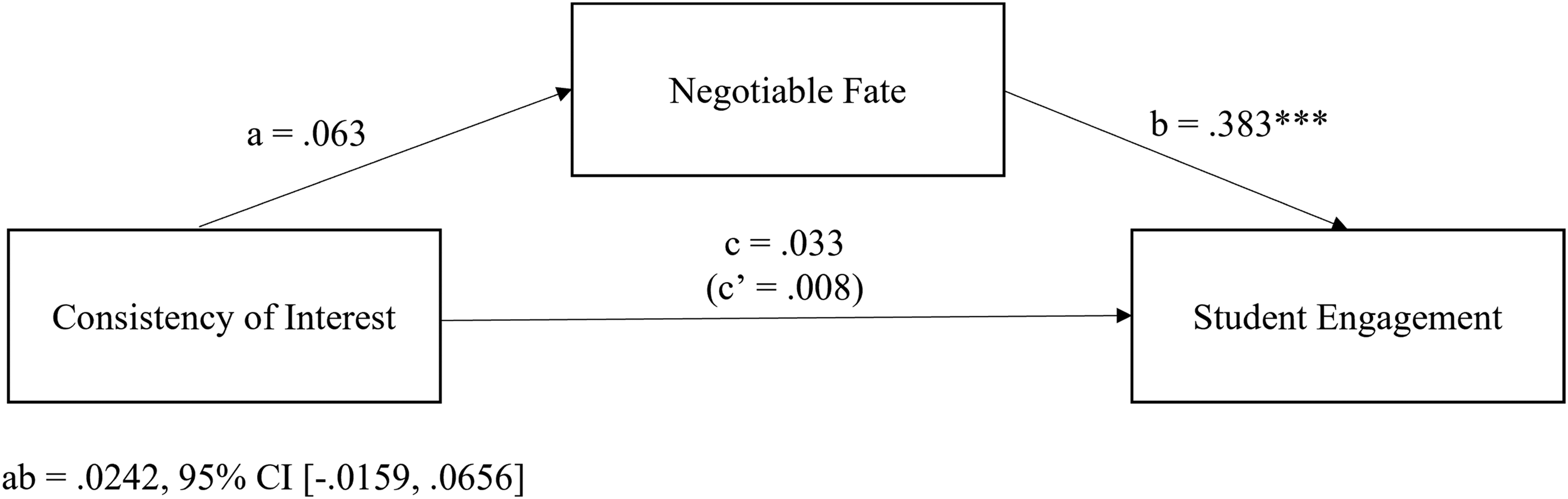
The mediation model among grit-CI, negotiable fate, and student engagement. Note: * p < .05, ** p < .01, *** p < .001.
Mediation estimates (Grit)

Note: Lower Limit Confidence Interval (LLCI) and Upper Limit Confidence Interval (ULCI).
Mediation estimates (Grit-PE)
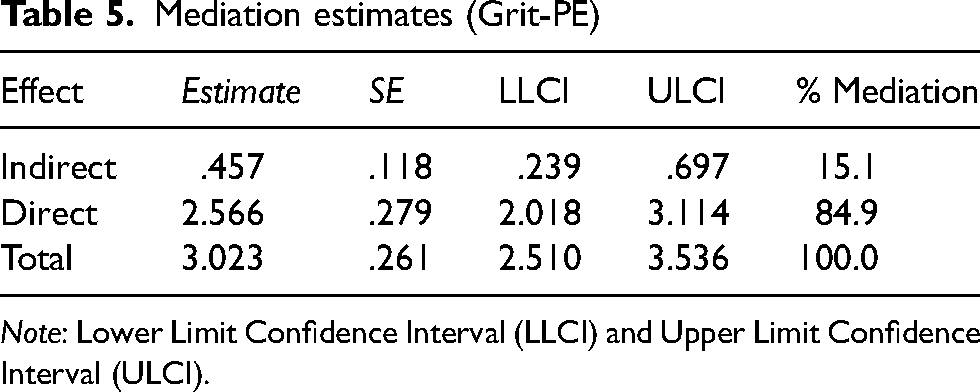
Note: Lower Limit Confidence Interval (LLCI) and Upper Limit Confidence Interval (ULCI).
Path estimates

Discussion
Grit and engagement
Consistent with our predictions, the results found that grit could predict student engagement. The results revealed a similar relationship during the pandemic, reflecting that grit may be a consistent personality trait for predicting student engagement (Datu, 2017) and aligned with previous research that grittier students tend to be more intrinsically driven (Datu et al., 2018). Furthermore, there was an indirect effect of negotiable fate in this relationship. In other words, a grittier student would adopt a higher belief in a negotiable fate, which predicts his or her higher level of student engagement. However, the subsequent analysis revealed that only the path of perseverance of efforts (PE) contributed to the significant result.
In contrast, the path of consistency of interest (CI) did not reveal statistically significant results in the mediation model. This inconsistent result echoed the previous findings that the predictive power is only contained in the perseverance of efforts (Datu et al., 2016b; Fosnacht et al., 2019); even the overall grit score seems to reveal a statistical significance in the relationship (Hodge et al., 2018). Notably, four components of student engagement were tested, and significant results were revealed in the model (see appendix A to H), suggesting grit and grit-PE could be conducive for behavioral, cognitive, social, and affective student engagement, with the mediating role of negotiable fate.
Aligned with our predictions and past evidence, perseverance of effort would most strongly correlate with constructs related to motivation and engagement (Credé et al., 2017). As students are persistent in the pandemic period, they might seek different methods to continue their learning, echoing our findings that negotiable fate acts as the mediator. Students with higher perseverance of efforts (PE) would tend to navigate with socioecology or environmental constraints during the pandemic (Au et al., 2011), such as utilizing their available resources (Au et al., 2017) and using technological devices for communication. The perseverance may transform into a belief, enabling students to hold hope with a positive affect (Hill et al., 2014; Raphiphatthana & Jose, 2021). In turn, students work around the obstacles toward goal commitment (Tang et al., 2019) by managing fate in various ways. These practices allow students to engage with academic work cognitively, socially, affectively, and behaviorally.
On the other hand, the nonsignificant results in the path of consistency of interest (CI) could be explained for two reasons. First, this sub-factor may be more predictive in time- and environment-related outcomes. For instance, consistency of interests was positively related to time and environment management and negatively associated with procrastination (Wolters & Hussain, 2015). It may reflect that individuals tend to spend more time on enjoyable academic activities. In our study, once the constraints appeared, spending more time did not necessarily inspire students to reinterpret the situation and actively cope with the constraints posed by fate (Au et al., 2012; Au & Savani, 2019). Individuals’ time management and procrastination may be insufficient for students to alter their mindsets or stay engaged. Another possible reason would be the weak and negligible predictive power of the items used in measuring the consistency of interest (CI). This predictive issue has been identified in previous empirical research (Fosnacht et al., 2019; Tang et al., 2022). Our study provides more evidence in probing the negligible predictive power of the items. Further research may reexamine the grit conceptual framework and enhance the CI subscales’ psychometric properties. For example, whether the consistency of interest should be a sub-factor of grit or the items should be significantly modified.
Negotiable fate in educational context
To our knowledge, the present study is one of the first few studies applying the concept of negotiable fate to examine student engagement in the higher education context. The results demonstrated a positive association among grit, grit-PE, negotiable fate, and student engagement. Previous research found that negotiable fate would result in cognitive impacts (Au et al., 2011), such as decreased repetitive thoughts, increased conviction that personal actions contributed to the event, increased acceptance and positive reinterpretation of the event, and an increase in how meaningful the event was as an active coping strategy (Au et al., 2012; Au & Savani, 2019). Aligned with the prediction, this study found that negotiable fate is positively associated with student engagement and mediated the relationship between grit-PE and student engagement. The relationship showed that students who negotiate with fate would find themselves with better academic engagement.
The predictive power of negotiable fate to engagement matched our prediction based on literature, such as possessing the ability to achieve and having a sense of control (Munns & Woodward, 2006) and fulfilling students’ need for autonomy and need satisfaction (Jang et al., 2016). Students can exercise personal agency to ultimately determine the outcomes within the boundaries of the constraints (Au & Savani, 2019). For example, for students who tend to negotiate with fate, their initial intention to conduct active coping behavior has been heightened as they understand the tasks well (Mazeres et al., 2019), encouraging them to conduct quality active coping behaviors. Such practices could help predict better student engagement in learning. Besides, negotiable fate is positively associated with all four aspects of engagement. In short, the fate control, lack of a sense of helplessness, and agentic characteristics could be relevant to learning, socialization, cognition, and emotional engagement. The claim of sustaining positive views of self and remaining proactive in coping (Au et al., 2012) could inspire students to be engaged with any possibilities and chances that they could create and identify during a pandemic or other difficult situation.
Practical significance
As grit is considered a personality trait, which is believed to be more difficult to change, educational practitioners could do more work to examine how to improve the level of negotiating fate for students. Earlier research (Au et al., 2011) attempted to adopt culture priming (Study 2) and recall experiences in which students worked with fate to attain their goals (Study 3) to activate the belief in negotiable fate for European-Americans. The students reported a higher level of negotiable fate after such practices. Another study discussed the possibility of engendering negotiable fate beliefs in executives in the business sector (Au et al., 2017). These researchers highlighted the potential benefit of efforts to engender a negotiable fate and found that the effects would be more salient when the environment is dynamic. Training executives to hold a joint causality model can help executives make the best use of existing resources rather than accepting a fixed outcome in contexts of constraints and uncertainty (Au et al., 2012, 2017). Such experiments probe specific methods to engender a negotiable fate for students to face constraints and uncertainty.
Besides, personal agency is closely associated with the notion that a person could do otherwise (CDO) as individuals could obtain another outcome by performing other actions (Kulakova et al., 2017), resembling the activation process of negotiable fate. When students face constraints and uncertainty, teachers may have an obligation to increase individuals’ personal agency to reinforce the idea of a negotiable fate. For example, teachers could encourage students to be involved in more practice exercises because exercises could enhance self-control, defer gratification, and result in better personal agency (Sofis et al., 2017). Moreover, mindfulness meditation could help students reduce self-judgment (Leary et al., 2007) and allow a more flexible mind to cope with stress and constraints with our own personal agency. Such proactive actions would remind students of the importance of negotiating with fate via a personal agency, yielding positive engagement.
Limitations and future directions
The present study was conducted during the period of the COVID-19 pandemic, and further research should be conducted in other contexts to validate this model. Negotiating fate involves the concept of fate, but not many events could be as significant as COVID-19. The effect of negotiable fate on other variables could be specific to the pandemic. There could be variations in the responses for students if it involves another event in their fate, for example, a medical condition affecting a student's learning. To fully explore the effect of negotiable fate with other variables in higher education, future research could examine other events involving fate, such as family background, to reexamine the generalizability of this mediation model.
Second, there could be disagreement in the definitions of student engagement. In this study, the four-component student engagement model was adopted. However, different types of student engagement, such as agentic engagement, have not been covered in the present study. Although there is no consensus on the components of student engagement, our study would limit the four components only without measuring a broader spectrum of other components of student engagement. Besides, the four factors have been combined in one variable, and the effect for each component may be inconspicuous. Future research may conduct a multilevel analysis to thoroughly study how negotiable fate and grit are related to the components of student engagement for a better understanding.
Conclusion
Although the COVID-19 pandemic poses many challenges and constraints that require our adjustment in the learning experience, it also serves as an opportunity to understand how student engagement is associated with grit and negotiable fate during this unprecedented event. To our knowledge, this is one of the first studies to apply the concept of negotiable fate to examine the relationship between grit and student engagement in a higher education setting. Our study suggested a mediation model that could understand student engagement, especially in the face of constraints in learning (during the COVID-19 pandemic). This study provides further empirical evidence in the two sub-factors of grit and student engagement. The mediating role of negotiable fate sheds light on the pathway to achieving student engagement. The findings provide insights for educators in higher education on the importance of grit and negotiable fate. Nurturing negotiable fate when facing challenging moments would be important to increase a sense of personal agency and to combat unavoidable fates in students’ learning in future endeavors.
Supplemental Material
sj-docx-1-pac-10.1177_18344909231171728 - Supplemental material for Why are students with a higher level of grit more engaging in learning? The mediation effect of negotiable fate on the grit-student engagement relationship in higher education during COVID-19
Supplemental material, sj-docx-1-pac-10.1177_18344909231171728 for Why are students with a higher level of grit more engaging in learning? The mediation effect of negotiable fate on the grit-student engagement relationship in higher education during COVID-19 by Oscar K.T. Yau and Tse-Mei Shu in Journal of Pacific Rim Psychology
Footnotes
Declaration of conflicting interests
The author(s) declared no potential conflicts of interest with respect to the research, authorship, and/or publication of this article.
Funding
This work was supported by the funding provided by the Department of Psychology at The Chinese University of Hong Kong.

Supplemental material
Supplemental material for this article is available online.
Appendix A: The mediation model among grit,negotiable fate,and academic engagement
Note: * p < .05, ** p < .01, *** p < .001.
Appendix B: The mediation model among grit,negotiable fate,and cognitive engagement
Note: * p < .05, ** p < .01, *** p < .001.
Appendix C: The mediation model among grit,negotiable fate,and affective engagement
Note: * p < .05, ** p < .01, *** p < .001.
Appendix D: The mediation model among grit,negotiable fate,and social engagement
Note: * p < .05, ** p < .01, *** p < .001.
Appendix E: The mediation model among Grit-PE,negotiable fate,and academic engagement
Note: * p < .05, ** p < .01, *** p < .001.
Appendix F: The mediation model among Grit-PE,negotiable fate,and cognitive engagement
Note: * p < .05, ** p < .01, *** p < .001.
Appendix G: The mediation model among Grit-PE,negotiable fate,and affective engagement
Note: * p < .05, ** p < .01, *** p < .001.
Appendix H: The mediation model among Grit-PE,negotiable fate,and social engagement
Note: * p < .05, ** p < .01, *** p < .001.
References
Supplementary Material
Please find the following supplemental material available below.
For Open Access articles published under a Creative Commons License, all supplemental material carries the same license as the article it is associated with.
For non-Open Access articles published, all supplemental material carries a non-exclusive license, and permission requests for re-use of supplemental material or any part of supplemental material shall be sent directly to the copyright owner as specified in the copyright notice associated with the article.
