




Abstract
To examine the impact of environmental uncertainty on individuals’ intertemporal choices and the moderating effect of implicit personality theory, two studies were conducted. Study 1 investigated the moderating role of implicit personality theory in the influence of environmental uncertainty on intertemporal choice using questionnaires. Study 2 examined whether priming incremental personality theory could change entity theorists’ intertemporal preference in an uncertain environment. The results showed that implicit personality theory plays a moderating role in the influence of environmental uncertainty on intertemporal choice. For entity theorists, the delay discounting rate was positively correlated with environmental uncertainty. In contrast, for incremental theorists, the delay discounting rate was not significantly correlated with environmental uncertainty. After priming incremental personality theory, entity theorists’ delay discounting decreased significantly. Thus, we conclude that incremental personality theory buffers the effect of environmental uncertainty on intertemporal choice.
The sudden outbreak of COVID-19 has had an unprecedented impact on the whole of society. Because of its high infectivity, it has caused serious damage to social order, public resources, and human beings, presenting a threat to lives (Behar-Zusman et al., 2020; Jin et al., 2021). Thus, environmental uncertainty has become a new normal in the world.
Environmental uncertainty refers to the harshness and unpredictability of the environment (Mittal & Griskevicius, 2014). Environmental harshness is defined as the rate at which external factors cause disability and death at each age among population (Ellis et al., 2009). Environmental unpredictability is defined as the rates at which environmental harshness vary over time and space (Ellis et al., 2009). Specifically, temporal variability is the unpredictability of mortality and disability over time (e.g., it is hard to predict the end time of COVID-19), and spatial variability is the geographical unpredictability of mortality and disability (e.g., it is hard to predict where COVID-19 will break out) (Ellis et al., 2009).
Intertemporal choice refers to decisions involving tradeoffs among costs and benefits occurring at different times (Frederick et al., 2002). In intertemporal choices, people are usually asked to make a series of choices between a smaller-sooner (SS) reward and a larger-later (LL) reward, such as spending money now or saving it to spend later, and taking a job now or getting an education and having a chance at a better job later. Most people tend to prefer an immediate payoff against a delayed one with the same amount. This phenomenon is called delay discounting, as the value of the payoff declines as its fulfillment is delayed into the future (Frederick et al., 2002). Delay discounting refers to the reduction in the present value of a future reward as the delay to that reward increases (Kirby et al., 1999). It is noteworthy that a higher delay discounting rate indicates that individuals prefer smaller-sooner rewards, which is a sign of being shortsighted and impulsive (Kirby et al., 1999; Kirby, 1997; Richards et al., 1999). Intertemporal choices can affect one's health, wealth, and happiness. For example, a high delay discounting rate in intertemporal choice is positively correlated with many negative behaviors, such as overeating (Davis et al., 2010), health-damaging behavior (Melanko & Larkin, 2013), and pathological gambling behavior (Petry & Madden, 2010). It not only affects one's health, wealth, and happiness, but may also, as Adam Smith first recognized, determine the economic prosperity of nations. Strong links have been found between the country's GDP and the predisposition of its inhabitants to look forward (Preis et al., 2012). Thus, it is important to examine whether environmental uncertainty influences intertemporal choices and, if so, how to mitigate this impact of environmental uncertainty on intertemporal choices.
Previous research showed that environmental uncertainty has an important impact on individuals’ behavior and decision-making. Xiao et al. (2020) conducted a multi-wave diary study to explore impulsive buying behavior under the uncertainty situation generated by COVID-19, which found that daily perceived uncertainty promoted daily impulsive buying. Griskevicius et al. (2013) investigated people's responses to resource scarcity and found that people who grew up in lower socioeconomic status (SES) environments are more impulsive, and conversely, people who grew up in higher SES environments are less impulsive. Geng et al. (2022) found that after the outbreak of COVID-19, Chinese university students’ delay discounting of intertemporal choice increased significantly compared to its levels before the outbreak of COVID-19.
The uncertainty implied by delay is the fundamental, if not the only, reason for delay discounting (Sozou, 1998; Epper et al., 2011). John Rae once suggested that the uncertainty of one's life situation plays a crucial role in time preference (Rae, 1834). People rate the delayed rewards as increasingly uncertain with longer delays (Patak & Reynolds, 2007). Researchers further suggested that delay discounting is related to the uncertainty of future rewards (Fehr, 2002). When choosing uncertain delayed rewards (e.g., choosing between $100 today and a 50% chance of $300 after six months), individuals prefer immediate rewards over uncertain future rewards (Hardisty & Pfeffer, 2017; Kidd et al., 2013). Thus, the environmental uncertainty may lead people to make shortsighted decisions, that is, prefer smaller, sooner rewards, in intertemporal choices.
Previous literature showed that people's implicit theories activate most strongly during times of difficulty or stress (Hong et al., 1999; Zhang et al., 2020). Implicit theories refer to the two different assumptions people may make about the malleability of personal attributes. Entity theory refers to the belief that a highly valued personal attribute is a fixed, nonmalleable trait-like entity. Incremental theory refers to the belief that the attribute is a malleable quality that can be changed and developed (Dweck et al., 1995a; Hong et al., 1999). These implicit theories of personality—entity and incremental—can influence perceptions of events and social environment, thereby changing behaviors (Dweck et al., 1995a; Levy et al., 1999). Entity theorists believe that the attributes of person are fixed and non-malleable. They tend to make broad generalizations and offer static, unchanging cognitive explanations for events (Levy et al., 1999). However, individuals who hold to more incremental views of personality tend to believe that the attributes of others are malleable and flexible. They are more likely to opt for a flexible and developmental cognitive explanation for events (Levy et al., 1999). An entity- as opposed to incremental theory orients an individual to focus on different goals. Entity theorists tend to orient more toward performance goals. In contrast, incremental theorists tend to orient more toward learning goals (Hong et al., 1999). As such, when faced with failures or difficulties, incremental theorists may be more mastery-oriented, looking for ways to improve their performance. However, entity theorists may be vulnerable to helpless responses. Zhang et al. (2020) found that during the COVID-19 pandemic, those who endorse an incremental theory report better and earlier pandemic-related preparedness, and that those who have an entity theory feel more vulnerable. Huang et al., (this issue) found that believing that meaning in life is changeable (the growth mindset of meaning in life) is related to a higher tolerance of uncertainty, which in turn predicts lower depression and a higher purpose in life. In sum, incremental theorists are more likely to be mastery-oriented, while entity theorists are more likely to be helpless. In the face of uncertainty or stress, entity theorists do not demonstrate the desire for improvement or mastery since their fundamental orientation is one of immutability. In other words, entity theorists believe that effort and mastery cannot alter their essential state. In contrast, incremental theorists show more mastery-oriented behavioral adjustments. In other words, incremental theorists believe that they could find ways to get through difficulties. In the face of difficulties, incremental theorists would then be more likely than entity theorists to exert effort to get through the difficulties, for instance, of learning new skills. Hence, incremental theorists believe that they can get through difficult times via self-improvement and protect themselves from environmental uncertainty, which may lead them to make less shortsighted choices in intertemporal choices than entity theorists. Therefore, incremental theorists’ intertemporal choices would be less likely than those of entity theorists to be influenced by environmental uncertainty, that is, less shortsighted in intertemporal choices.
Thus, we predict that implicit theory of personality plays a moderating role in the influence of environmental uncertainty on intertemporal choice. Incremental theorists’ intertemporal choice will be less influenced by environmental uncertainty and the delay discounting rate will be lower than that of entity theorists, that is, more farsighted. This research contributes by demonstrating that having a growth mindset (i.e., incremental personality theory) can mitigate the effect of environmental uncertainty on delay discounting. These findings also have important implications for theory and future research, including the role of growth mindsets in people's adapting behavior in an uncertain environment.
We conducted two studies to test the above hypotheses. In Study 1, the relationship between environmental uncertainty, implicit personality theory, and intertemporal choices was measured through questionnaires. In Study 2, based on Study 1, we selected those entity theorists and primed their incremental personality theory by asking them to read a news article presenting persuasive evidence for incremental theory to explore whether it is possible to increase their farsightedness.
Study 1
Materials and methods
Participants
Six hundred sixty-nine participants were recruited through the Sojump platform (an online questionnaire collection platform in China). Among the participants, 256 were male (38.3%) and 413 were female (61.7%). Their average age was 29.02 ± 8.19. Among the participants, 50 (7.5%) had a high school degree and below, 127 (19.0%) had a junior college degree, 395 (59.0%) had a bachelor's degree, and 97 (14.5%) had a postgraduate degree. There were 427 adults with work experience (63.8%) and 242 students without work experience (36.2%).
Environmental uncertainty
Environmental uncertainty was measured using the uncertainty index developed by Mittal and Griskevicius (2014), which includes three items: “Today's world is more unpredictable than before”; “Today's world is tougher than before”; and “Today's world is harsher than before.” Participants indicated their responses using a scale ranging from 1 (not at all) to 7 (definitely). The internal consistency reliability coefficient was α = 0.80.
Implicit theory
Implicit theories were measured using McConnell's (2001) implicit theory questionnaire, which includes five items. For example, “People can do different things, but the important parts of who they are can't really be changed.” Previous studies showed that the eleven-point scale produces data that are essentially the same as that produced by the five-point scale in terms of mean, after allowing for the five-point scale to be re-scaled for comparability. However, the eleven-point scale produced data with more variance than the five-point scale (Dawes, 2002). Therefore, to make participants’ answering the scale easier, we changed McConnell (2001)'s nine-point scale to a five-point scale. Participants indicated their responses using a scale ranging from 1 (strongly disagree) to 5 (strongly agree). The average of the responses to the five items was computed as the index of implicit theory, with higher scores indicating a higher tendency toward entity theory. The internal consistency reliability coefficient was α = 0.68.
Intertemporal choice
Intertemporal choice was measured by Wang and Dvorak's (2010) monetary choice task. Participants were asked to make seven choices between a smaller reward tomorrow or a larger reward after a delay (ranging between 4 to 939 days), such as, “Would you prefer ¥180 tomorrow or ¥ 390 in 183 days?” Indifference between a smaller, earlier reward (tomorrow) and a larger, later reward (future) indicates the following hyperbolic discount parameter k (Kirby & Santiesteban, 2003; Wilson & Daly, 2004): k = (future $ − tomorrow $) / ((delay (in days) × tomorrow $) − (future $)). The k-values of the seven choices range from 0.000159 to 0.411765. Choices over such a range reveal where one begins to prefer larger-later rewards (LL) (Wang & Dvorak, 2010; Wang et al., 2019). For example, individuals chose smaller-sooner rewards (SS) in the first four choices and began to choose LL in the fifth choice, which suggested that there was a reference switch between the fourth choice and the fifth choice. The geometric mean of the fourth choice's k-value and the fifth choice's k-value was taken as the delay discounting rate and then was normalized using natural log transformation because raw k values tend to be skewed.
Results
Common method biases
Common method variance (CMV) refers to the overlap in variance between two variables because of the type of measurement instrument used rather than representing a true relationship between the underlying constructs (Teo, 2011). The bias induced by CMV is called common method bias (CMB) (Tang & Wen, 2020). CMB is usually performed using Harman's Single-Factor Test. The procedure consists of loading all observed variables in a study into an exploratory factor analysis and then examining the unrotated factor solution to ascertain how many factors are necessary to account for the majority of the variance present in the collected data. The logic of the test is that, if a substantial amount of CMV is present in the sample, one factor will account for a majority of the variance among the variables. Harman's Single-Factor Test is conducted by examining the results of an exploratory factor analysis and checking whether the first extracted factor explains more than 50% of the variance (Aguirre-Urreta & Hu, 2019).
In the present research, we used Harman's Single-Factor Test to check the CMB. The results showed that there were five factors with eigenvalues greater than 1 and the first factor explained 22.68% of the variance, which did not exceed 40%. Therefore, this study did not have a significant CMB.
The moderation effect of implicit personality theory
To test the moderation effect of implicit personality theory, hierarchical regression analysis was used. According to Wen et al. (2005), when both the independent variable and the moderating variable are continuous variables, the two variables should be centered first. Therefore, environmental uncertainty and implicit personality theory were centered first. Centered environmental uncertainty and implicit personality theory were used to predict the delay discounting rate in Model 1. Environmental uncertainty, implicit personality theory, and the interaction of environmental uncertainty and implicit personality theory were used to predict the delay discounting rate in Model 2. Regression results (Table 1) showed that the interaction between environmental uncertainty and implicit personality theory significantly predicted the delay discounting rate (β = 0.08, p = 0.045).
Implicit personality theory moderated by the impact of environmental uncertainty on intertemporal choice

Note: Higher scores of the implicit personality theory indicated the stronger endorsement of entity personality theory.
*p <.05, ** p <.01, *** p <.001.
Simple slope test results (see Figure 1) showed that for entity theorists (one standard deviation above the mean), the delay discounting rate was positively related to environmental uncertainty (β = 0.36, t = 3.70, p < 0.001, 95% CI = [0.17, 0.55]). That is, as environmental uncertainty increased, entity theorists preferred SS rewards more. In contrast, for incremental theorists (one standard deviation below the mean), the delay discounting rate was not related to environmental uncertainty (β = 0.14, t = 1.58, p = 0.114, 95%CI = [−0.03, 0.30]). That is, incremental theorists’ delay discounting rates were dissociated from environmental uncertainty.

Interaction between environmental uncertainty and implicit personality theory.
Discussion
The results of Study 1 showed that implicit personality theory played a moderating role in the relationship between environmental uncertainty and intertemporal choice. For entity theorists, the delay discounting rate was positively correlated with environmental uncertainty. In contrast, for incremental theorists, the delay discounting rate was not correlated with environmental uncertainty. The results suggested that, compared with incremental theorists, entity theorists are more prone to prefer shortsighted rewards under environmental uncertainty. In other words, incremental theory attenuates the strength of the negative association of environmental uncertainty with delay discounting of intertemporal choices. These results supported our hypothesis. As noted, entity theorists, who believe in a static world, expect more certainty than incremental theorists, who hold a more dynamic and complex worldview (Dweck et al., 1995a). Thus, when faced with environmental uncertainty, entity theorists who believe that effort cannot change the environment show helpless behaviors and prefer immediate outcomes in intertemporal choice, which are choices with more certainty (Dweck et al., 1995b).
The results of Study 1 showed that entity theorists are more shortsighted when making intertemporal choices under environmental uncertainty, while incremental theorists’ intertemporal choices are not related to environmental uncertainty. Based on this, if we changed entity theorists’ mindsets to an incremental theory of personality, they would be less influenced by environmental uncertainty and become farsighted in intertemporal choices. We examined the intervention effect of priming incremental personality theory on entity theorists’ intertemporal choices in Study 2.
Study 2
Materials and methods
Participants
The participants were 304 undergraduate students. One hundred forty-eight entity theorists were selected as participants and completed this study (96 females, 52 males; mean age = 22.14 years, SD = 3.85). Excluding the data of participants without switching points in intertemporal choices, valid data from 135 participants were included in the analysis. All participants gave their written informed consent prior to the study.
Experimental design
Considering that Study 1 found that entity theorists were more shortsighted when making intertemporal choices under environmental uncertainty, while incremental theorists’ intertemporal choices were more farsighted in environmental uncertainty, Study 2 aimed to explore whether entity theorists’ intertemporal choices could be improved within an uncertainty environment by priming their incremental theories. Therefore, Study 2 only selected entity theorists as participants within uncertain environments and took a 2 (priming incremental personality theory vs. control condition) × 2 (pre-test vs. post-test) design.
Procedure
The procedure was showed in Figure 2. Step 1: Selection of entity theorists. All participants completed the implicit personality questionnaire as in Study 1. Participants whose score was greater than the mean of implicit personality theory (M = 3.51) were classified as entity theorists, and those whose score was smaller than the mean were classified as incremental theorists. The selected entity theorists joined the priming study.
Step 2: Environmental uncertainty priming. An article titled “Post-pandemic: An uncertain world,” which introduced economic uncertainty, epidemic instability, and turbulent international relations, was used to prime participants’perceived environmental uncertainty. The article was written in the style of a People’s Daily news article, which is an authoritative and influential newspaper in China.
To test the priming effect, another 127 participants were randomly assigned to one of the following two conditions, that is, an environmental uncertainty condition and a control condition. In the environmental uncertainty condition, participants read the news article about environmental uncertainty. In the control condition, participants read an article about an asteroid belt. The control article introduces the origin, form, and rotational cycle of the asteroid belt. Then, all the participants finished the environmental uncertainty questionnaire used in Study 1. An independent-sample t-test showed that environmental uncertainty scores in uncertainty conditions (M = 5.28, SD = 1.11) were significantly higher than those in the control conditions (M = 4.14, SD = 1.34), t (125) = 5.24, p = 0.001, 95%CI = [0.71, 1.57], Cohen's d = 0.93. In short, the environmental uncertainty priming was successful.
Step 3: Pre-test of intertemporal choice before the incremental personality theory manipulation. Participants in the main study completed the intertemporal choice task used in Study 1 before receiving the incremental theory of personality manipulation.
Step 4: Incremental personality theory manipulation. Participants were randomly assigned to one of two experimental conditions. Schumann and Dweck's (2014) materials were used to prime the incremental theory. In the incremental personality theory condition, participants were asked to read an article titled “Personality characteristics can be developed and cultivated,” which presented scientific evidence that personality characteristics were changeable and could be influenced over time. In the control condition, participants read an article titled “The memory of fish is exactly long.”
As a manipulation check, participants were asked to complete the implicit personality theory questionnaire again. The implicit personality theory score in the incremental condition (M = 3.67, SD = 0.67) was significantly lower than the implicit personality theory score for the control condition after priming (M = 4.16, SD = 0.53), t (133) = −4.56, p < 0.001, 95%CI = [−0.69, −0.27], Cohen's d = −0.82. The results showed that the incremental theory manipulation was successful.
Step 5: Post-test of intertemporal choice. Participants completed the same intertemporal choice task again after receiving the implicit theory manipulation.
Results
First, in the pre-test of intertemporal choice, there was no significant difference in the delay discounting rate between the incremental priming condition (M = −3.14, SD = 2.24) and the control condition (M = −3.51, SD = 2.58), t (133) = 0.90, p = 0.368, 95%CI = [0−.45, 1.20], Cohen’s d = −0.15.
To test the effect of priming incremental personality of theory on intertemporal choices, we conducted a repeated-measures ANOVA, with incremental personality theory (priming vs. control condition) as the between-subjects factor, and the intertemporal choice (pre-test vs. post-test) as the within-subjects factor. The results showed the main effects of implicit personality theory and intertemporal choice were not significant. As predicted, there was a significant interaction between implicit personality theory and intertemporal choice, F (1, 133) = 7.99, p = 0.005, η2 = 0.06.
As depicted in Figure 3, simple effect analysis showed that following incremental theory of personality priming, delay discounting of post-test (M = −3.86, SD = 2.09) was significantly lower than that of pre-test of intertemporal choices (M = −3.14, SD = 2.24), t (72) = 4.41, p < 0.001, 95%CI = [0.39, 1.04], Cohen’s d = 0.53. In contrast, in control conditions, there was no difference between the delay discounting of pre-test of intertemporal choices (M = −3.51, SD = 2.58) and that of post-test (M = −3.30, SD = 2.53), t (61) = −0.73, p = 0.469, 95%CI = [−0.39, 0.83], Cohen’s d = −0.09.
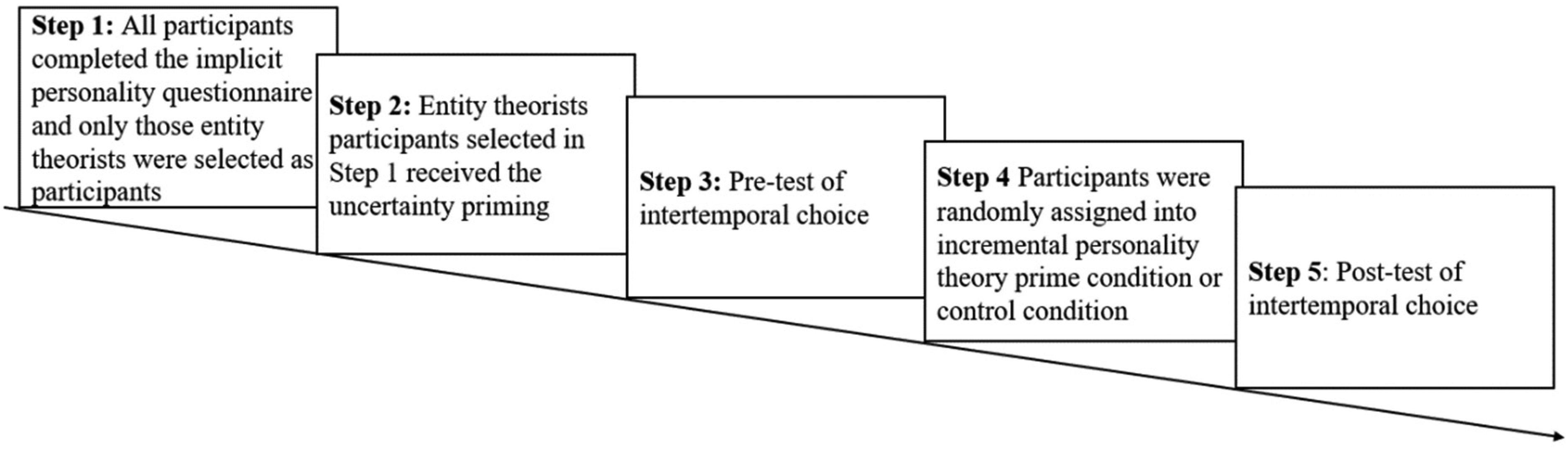
The procedure of Study 2.
Discussion
Study 2 found that priming incremental theory could promote entity theorists’farsighted decisions under environmental uncertainty. This result supported our hypothesis. Following incremental theory priming, the delay discounting rate of intertemporal choices of entity theorists was significantly reduced. This result suggested that we can promote entity theorists’intertemporal choices by experimentally inducing an incremental personality theory.
General discussion
The results of Study 1 and Study 2 showed that implicit personality theory plays a moderating role in the influence of environmental uncertainty on intertemporal choice. Specifically, entity theorists are more shortsighted (i.e., preferred SS rewards) in an uncertain environment, while incremental theorists were less susceptible to environmental uncertainty when they make intertemporal choice. The present research suggested that the incremental theory of personality mitigates the effect of environmental uncertainty on intertemporal choice. Incremental theorists believe that personal traits are dynamic and can change over time and through effort (Plaks et al., 2005). Hence, they believe that they can get through difficult times via self-improvement and protect themselves from environmental uncertainty, which leads them to make farsighted choices in intertemporal decision making. On the contrary, entity theorists hold that personality traits cannot be changed easily. They believe that the negative effects of environmental uncertainty are inevitable and can only adapt to the environment by making shortsighted choices.
Adaptive intelligence plays a key role in coping with environmental changes. Adaptive intelligence exists in the interaction between people, tasks, and situations, and differs from the conventional concept of intelligence (Sternberg, 2021). Sternberg (2019) proposed that adaptive intelligence requires individuals to change themselves to fit their environment and even reshape their environment to fit themselves and create new environments. It suggests that when the environment changes, people may adopt two strategies to deal with the new environment: adjusting their preferences or changing the environment (Fogarty & Kandler, 2020). According to adaptive intelligence theory, the adaptability of a behavioral strategy depends on its environment, and a behavior that is adaptable in one situation may not be adaptable in another (Sternberg, 2019). It can be inferred that implicit personality theory may be an important factor impacting the adaptive intelligence of individuals under environmental uncertainty, and the incremental personality theory promotes farsighted choices under environmental uncertainty.
The current environment is very uncertain, especially after the pandemic of COVID-19. The present research showed that the incremental theory of personality mitigates the effect of environmental uncertainty on intertemporal choice. Incremental theorists are more likely to adopt a mastery-orientation to manage uncertainly, whereas entity theorists are more likely to adopt a helpless response to environmental uncertainty. Therefore, the present research suggested that Asians could benefit from having the growth mindset under the uncertainty environment.
Limitations
There were some shortcomings in the present research. First, in Study 2, we changed the implicit theory of personality by priming the incremental theory of those entity theorists in the laboratory, and the priming effect may last for only a short period. Other intervention methods need to be used to create more endurable effects. In addition, Study 2 only took entity theorists as participants without examining the effect of priming incremental theory on those individuals with incremental theory. Second, we explored the moderating role of implicit personality theory in the influence of environmental uncertainty on intertemporal choice. Although we found that incremental theory can promote individuals’farsighted decision-making under environmental uncertainty, the mediating mechanism was not explored. Therefore, the mediators in the influences of environmental uncertainty on intertemporal choices should be explored in the future.
Conclusion
In conclusion, implicit personality theory plays a moderating role in the influence of environmental uncertainty on intertemporal choice. For entity theorists, the delay discounting rate is positively correlated with environmental uncertainty. In contrast, for incremental theorists, the delay discounting rate is not significantly correlated with environmental uncertainty. The incremental theory of personality attenuates the effect of environmental uncertainty on intertemporal choices.

The effect of priming incremental personality theory on intertemporal choice.
Footnotes

Declaration of conflicting interests
The author(s) declared no potential conflicts of interest with respect to the research, authorship, and/or publication of this article.
Funding
The author(s) disclosed receipt of the following financial support for the research, authorship, and/or publication of this article: This work was supported by the Science and Technology Support Plan for Youth Innovation of Universities in Shandong Province, National Natural Science Foundation of China, the Ministry of Education of Humanities and Social Science project (grant number 2019RWF001, 71971104, 19YJA190002).
Appendix of Study 2
The Personality and Development Research Laboratory (PDRL) at Harvard University has carried out a study on the development and change of personality characteristics. For more than 25 years, the PDRL has been following over 800 individuals. The researchers have been collecting elaborate data on them since childhood, including school records, many observations at home and in the laboratory, and in-depth interviews with the individuals, their family members, and close friends.
In a recent article published in the Journal of Personality Research, Dr. Daniel Lawrence, the director of PDRL, reported the findings of their research. Dr. Lawrence concluded that “personality characteristics are changeable and can be influenced over time. In fact, personality characteristics are basically a bundle of possibilities that wait to be developed and cultivated.” The results show that personality characteristics are not a fixed entity. He said that, “For more than 25 years, very few people's overall personality stayed the same as it was at the beginning of the study. At almost any time in a person's life his or her personality characteristics can be shaped.”
Actually, the conclusion that personality characteristics can be changed was reached a long time ago. In 1935 Richard Clark Cabot conducted a study on whether personality characteristics change with life-changing experiences. The participants were 720 youngsters from working-class families in a densely populated area of eastern Massachusetts. They entered the program at ages ranging from 18 to 26 and then continued in it for an average of ten years. Most of them had changed their personality characteristics, especially among the 260 participants who had life-changing experiences.
Why? As Dr. Lawrence explains, “In everyone's life there are those people or moments that really make an impression on them—it is these moments, whether large or small, that begin the process of personality transformation. At almost any time in a person's life his or her personality characteristics can be shaped. No one's character is hard like a rock that cannot be changed.”
Based on the research described above, it can be concluded that personality characteristics can be developed and cultivated.
We often hear that “fish have a memory of only seven seconds. In seven seconds, it won't remember what happened, and everything will be a new beginning.” So how long can their memories last?
In 1965, scientists from America did research on goldfish's memory. The researchers started by emitting a bright light from one end of the tank, followed by an electric shock stimulus to the goldfish at that end. This was repeated several times, and soon the goldfish remembered the “light-shock” stimulation cycle. When the light came out again, the goldfish would quickly flee to the other side of the tank. The researchers found that the goldfish could remember the “light-avoidance” behavior pattern for up to a month.
Apart from goldfish, researchers found similar results on zebrafish through the stimulation of “light-food.” In addition, subsequent scientists have also observed that reared fish are able to retain memories of feeding stimuli for up to several years.
Actually, you can observe ornamental fish in a water pond carefully in situ. Once someone comes over, they will swim quickly, spit bubbles, and try to get food, which is also a memory stimulated by food.
Research results published in Nature Communications subverted people's understanding. Dr. Oscar Ortega-Recalde from the University of Auckland found through a study of zebrafish that the epigenetic memory of zebrafish can be continuously passed on to offspring by preserving DNA methylation. In short, the memory of fish can be passed on to the next generation, or even later generations.
Why? Epigenetics is a hereditary chemical modification under the condition of unchanged genetic material DNA, which mainly includes DNA methylation modification, histone modification, and so on. If these modifications occur in gametes, they will be passed on to offspring. In a study of zebrafish, researchers found that DNA methylation events in zebrafish can be passed on to the next generation, or even later generations. That is to say, in fish (at least zebrafish) it seems that memory can be transmitted to offspring by transmitting DNA methylation, which may help zebrafish better adapt to changes in the environment.
Recently, the more infectious and pathogenic mutation of the new coronavirus is replacing the original strain, leading to increased outbreaks in Europe and elsewhere. The increase in infections has in turn contributed to the accelerated mutation of the virus. The intensified virus mutation and the epidemic situation have the tendency to enter a vicious circle, and bring new uncertainty to global epidemic prevention.
As of April this year, there have been at least 5,000 kinds of new coronavirus variants, many of which are more infectious and pathogenic than the earlier variants. These new variants may reduce the effectiveness of some vaccines. Variants are difficult to detect by traditional methods. These have raised widespread concern. According to a study published online by Nature, the risk of death associated with the B.1.1.7 variant has increased by 61% compared to conventional strains. In addition, the mutation may lead to an “immune escape” of the virus.
Taken together, it is too early to draw any conclusions about the outbreak. There is much uncertainty about both the vaccine and the new coronavirus.
Uncertainty about the situation of the current global epidemic remains strong, and various types of derivative risks brought about by the epidemic shock continue to come to the fore, bringing uncertainty to the global economic recovery. Structural imbalances that constrain the resumption of growth in the world economy have been highlighted. The factors supporting economic recovery remain unstable and unbalanced, and the long-standing structural contradictions in the world economy under the impact of the epidemic have been further highlighted, with the income gap widening across countries, leading to unstable potential economic growth rates. Emerging economies and developing countries have been particularly hard-hit, and the World Bank believes that the average investment growth rate over the next decade is unpredictable.
Uncertainty about the development environment has increased. More than 50% of emerging economies and developing countries have a lower per capita income than five years ago due to the impact of the epidemic, and about 100 million people worldwide have returned to extreme poverty, affecting the attainability of the United Nations 2030 sustainable development goals.
The differential impact of the epidemic on countries and the effectiveness of their response will accelerate changes in the hard and soft power of countries. The epidemic has also exposed more divisions and contradictions between countries. At no other time in history has the response to an infectious disease been so heavily politicized.
The influx of refugees in recent years, as well as Britain's exit from the European Union, has exacerbated conflicts within the EU and doubts about its future. In this epidemic, the EU has shown itself to be unprepared in the face of crisis, especially when hard-hit countries such as Italy have asked for aid. The epidemic is a profound reflection of the changing world landscape in the face of an endless stream of global challenges.
Under the chain effects of globalization, the shocks in question are rapidly transmitted due to the close linkages between industries, between finance and the real economy, between micro and macro, and between economies, resulting in a multilayered and all-encompassing economic and social shock.
The epidemic has hit every aspect of human health, economic growth, social development, and international relations, making our social environment increasingly unpredictable—a comprehensive and integrated challenge.
New York Times columnist Thomas Friedman said that the epidemic has divided the world into a “pre-epidemic era” and a “post-epidemic era,” in which the world will undergo massive changes in values. Kissinger also said that the epidemic had changed the established order of the world and that it was impossible to return to the pre-epidemic international order.