




Abstract
Literature has shown that temporal focus (TF) is closely related to mental health, and both of them are associated with meaning in life (MIL). Nevertheless, few studies have investigated the functional role of MIL in the relationship between TF and mental health, especially in the context of COVID-19. The present study aims to explore the mediating role of MIL between different categories of TF (i.e., past, present, and future TF) and mental health. A two-wave longitudinal survey was conducted among 538 Chinese participants aged between 22 and 70 (M ± SD = 35.07 ± 8.82). TF was assessed at Time 1, while MIL, anxiety, and life satisfaction were measured at Time 2. The results of SEM showed that past TF negatively predicted MIL, while present and future TF positively predicted MIL. In addition, MIL mediated the relationship between TF and mental health indicators (anxiety and life satisfaction). Specifically, past TF demonstrated a negative indirect effect on life satisfaction by reducing MIL, while present and future TF had a positive indirect effect on life satisfaction by strengthening MIL. In contrast, past TF demonstrated a positive indirect effect on anxiety by reducing MIL, while present and future TF had a negative indirect effect on anxiety by strengthening MIL. Therefore, the present results supported the positive roles of present and future TF in promoting MIL and mental health during the COVID-19 pandemic. For the MIL intervention during the pandemic, the present findings suggested that compared to recalling the past, more attention should be paid to living in the present and hoping for the future.
Introduction
The outbreak of the COVID-19 pandemic has affected people's daily life around the world, in both physical and psychological aspects. Numerous studies have revealed the impact of the pandemic on individuals’ mental health, for instance, causing anxiety and depression symptoms (Lai et al., 2020), and reducing life satisfaction (Karatas & Tagay, 2021). In addition, due to the disruption of daily routines and feelings of uncertainty caused by the COVID-19 pandemic (Usman et al., 2021), individuals’ temporal focus (TF) is also affected (Bodecka et al., 2021). Considering that TF is closely related to mental health (Shipp & Aeon, 2019; Stolarski et al., 2020), the present study intended to explore the association of TF with mental health in the context of the COVID-19 pandemic. TF is closely associated with mental time travel, which is defined as the capacity that individuals mentally project themselves backward in time to re-live, or forward to pre-live, events (Suddendorf & Corballis, 2007). Furthermore, individual differences of mental time travel can be reflected on their levels of TF (Ye et al., 2014). Based on the notion that mental time travel is an important antecedent of meaning in life (MIL; King & Hicks, 2021), this study aimed to examine the association of TF with MIL as well as the mediating role of MIL between TF and mental health.
Temporal focus and mental health
TF refers to the degree to which individuals focus their attention on their past experiences, present events, and future expectations (Shipp et al., 2009). Therefore, TF can be divided into three categories—past, present, and future TF (Shipp & Aeon, 2019; Shipp et al., 2009)—and reflects the degree to which people integrate their perceptions of past, present, and future into their thoughts and behaviors (Shipp et al., 2009). According to Shipp and Aeon (2019), different categories of TF have varied effects on mental health.
Mental health reflects a state of mental well-being that can enable people to manage their stress in life, to use their abilities to their fullest potential, and to contribute to their communities. It is an integral part of health and well-being and more than the absence of mental disorders (World Health Organization, 2022). Therefore, both positive and negative indicators are needed to assess the level of mental health. Similar to Zapata (2022) and Hu et al. (2014), in the present study, life satisfaction and anxiety were used as two indicators of mental health. Regarding past TF, research shows that it is usually positively associated with mental health issues. According to Shipp and Aeon (2019), past TF is somewhat maladaptive since it is usually positively associated with emotional distress. For instance, the previous research found that focusing on the past was linked with higher anxiety (Diaconu-Gherasim & Mardari, 2021; McKay et al., 2017) and lower self-esteem (Mello et al., 2022). Loose et al. (2022) also found that past focus negatively predicted psychological distress during the COVID-19 pandemic. A possible reason is that focusing more on the past would impede the pursuit of future goals (Loose et al., 2022; Shipp et al., 2009). Moreover, when individuals focus too much on the past, they are more likely to ruminate about negative experiences, thus feeling regret or guilt towards the past, especially in traumatic situations (Holman & Silver, 1998; Lyons et al., 2014). Therefore, we hypothesize that past TF could positively predict anxiety (H1a) and negatively predict life satisfaction (H1b).
As for present TF, although it is found to be positively associated with risky behaviors such as risky driving (Măirean & Diaconu-Gherasim, 2021) and smoking (Nan & Qin, 2018), it is also positively related to life satisfaction (Chishima et al., 2017) and negatively related to anxiety (Finan et al., 2020). Focusing on the present is always related to the life attitude of “seize the day,” including fulfilling one's desires and enjoying pleasure in the current moment (Tseferidi et al., 2017), thus promoting mental health. In the context of the COVID-19 pandemic, Bodecka et al. (2021) found that people who focused on their current pleasure perceived less stress, and they proposed that present TF could promote emotion-centered coping against negative outcomes caused by the pandemic. Moreover, an intervention study that examined the impact of time orientation on well-being during the COVID-19 lockdown found that, compared to participants in the past-orientation condition, focusing on the present was more effective for promoting well-being (Dennis et al., 2022). Therefore, we hypothesize that present TF would negatively predict anxiety (H2a) and positively predict life satisfaction (H2b).
Regarding future TF, increasing research suggests that future TF is positively related to mental health. Previous research found that future TF is associated with a higher sense of hope (Miao et al., 2021) and a better physical health state (Konowalczyk et al., 2019). Therefore, individuals with high future TF tend to perceive higher life satisfaction (Olivera-Figueroa et al., 2022). Miloyan et al. (2016) further pointed out that future TF is a potential treatment for anxiety among older adults. In addition, Li and Lyu (2021) found that future TF, which could strengthen hope and optimism toward the future, is beneficial in reducing depression during the COVID-19 pandemic. Taken together, we hypothesize that future TF would negatively predict anxiety (H3a) and positively predict life satisfaction (H3b).
The effect of temporal focus on meaning in life
MIL is a central motivation of human beings (King & Hicks, 2021). A frequently used definition of MIL indicates that MIL refers to individuals’ understanding of their life experiences accompanied by a sense of purpose, which is theoretically important to mental and physical health (Steger et al., 2006, 2009). Specifically, Steger et al. (2006) divided MIL into two dimensions, presence of meaning and search for meaning. According to a meta-analysis (Li et al., 2021), presence of meaning, rather than research of meaning, had a robust relationship with subjective well-being. Therefore, the current study focused on the influence of presence of meaning to mental health. MIL is a core part of well-being and is closely associated with mental health (King & Hicks, 2021; O’Connor et al., 2021). A meta-analysis of 147 studies revealed that MIL is positively related to subjective well-being (Li et al., 2021). During the COVID-19 pandemic, MIL was also found to be a protective factor for maintaining life satisfaction and hope (Karatas & Tagay, 2021), and reducing anxiety (Trzebiński et al., 2020). According to Trzebiński et al. (2020), the COVID-19 pandemic leads to reflections about MIL, which further stops individuals from thinking about threatening events, thus maintaining mental health. Therefore, we hypothesize that in the context of the COVID-19 pandemic, MIL is negatively related to anxiety (H4a) and positively related to life satisfaction (H4b).
According to King and Hicks (2021), mental time travel is an important source of MIL. Mental imagery of the past and future could enhance the connections between the present and distal selves, strengthen self-continuity and coherence, and thus promote MIL (for review, see King & Hicks, 2021). Empirical research has also revealed the association between TF and MIL (King & Hicks, 2021; Sedikides & Wildschut, 2018). Specifically, different categories of TF might contribute to MIL with a specific mechanism. Regarding past TF, nostalgic memories are related to the core of self, and inherently meaningfulness. It also helps to maintain the feelings of meaningfulness and the function of meaning-making (Sedikides & Wildschut, 2018). For future TF, it is inherently linked with goals and important events, and thinking about the future can guide individuals to reflect on their whole life and make them feel meaningful (Kim et al., 2019). By contrast, present TF receives less attention compared with past and future TF.
For past TF, a cross-sectional study among high school students found that past TF was positively related to MIL in the context of COVID-19 (Zheng & Wang, 2021). In addition, studies on nostalgia indicate that past TF plays a role in meaning-making, since memory of the past could boost different components of MIL, thus leading to the feeling that life is meaningful (Sedikides & Wildschut, 2018). As for the COVID-19 pandemic, it is regarded as a threat to MIL (Trzebiński et al., 2020). Since the outbreak of the pandemic, “lockdown” measures have been implemented in many countries around the world, such as curfews, gathering restrictions, isolation at home (including attending work, school, etc.), restriction of movement of citizens to essentials, travel restrictions (Woc-Colburn & Godinez, 2022), all of which lead to changes in people's daily activities (Woc-Colburn & Godinez, 2022). According to Heintzelman and King (2019), daily routine is one of the important sources of MIL. Therefore, we suppose that the pandemic is a threat to people's feelings of MIL. In addition, research showed that during the COVID-19 lockdowns, people experienced emptiness and sadness for the loss of their daily life, which would also lead to a loss of MIL (De Jong et al., 2020). As people focus on past TF, it could facilitate meaning-making, thus obtaining MIL. Therefore, we hypothesize that, during the COVID-19 pandemic, past TF would be positively related to MIL (H5).
With regard to future TF, several cross-sectional studies in the context of COVID-19 found that future TF is positively associated with MIL (Baikeli et al., 2021; Hicks et al., 2012; Zheng & Wang, 2021). Future TF is always full of important things that are linked together by meaning or purpose (Baumeister et al. 2016), thus people may feel meaningful when thinking about the future (Baumeister & von Hippel, 2020). Considering that purpose, which is future-oriented in nature, is an important component of MIL, it is unsurprising that future TF potentially promotes MIL (King & Hicks, 2021). Therefore, we hypothesize that in the context of the COVID-19 pandemic, future TF could positively predict MIL (H6).
Previous research on the relationship between TF and MIL is mostly restricted to past and future TF, and only a few studies are concerned with present TF. For instance, both Zheng and Wang (2021) and Bubić and Erceg (2018) revealed a negative association between present TF and MIL. People living in the present prefer immediate pleasure over long-term reward in the future (Nan & Qin, 2018), which might harm the significance of life purpose (Bubić & Erceg, 2018) and impact the feelings of MIL. Therefore, we hypothesize that present TF would negatively predict MIL in the context of COVID-19 (H7).
Meaning in life as a mediator between temporal focus and mental health
Consistent with King and Hicks’s (2021) notion that mental time travel is an antecedent of MIL, the General Conceptual Model of Time Perspective proposed that TF could be regarded as a time frame that assigns individuals’ personal and social experiences to different categories (past TF, present TF, and future TF), which prompts individuals to form the sense of coherence/order, goals, and meaning (Zimbardo & Boyd, 1999). According to the World Health Organization (2022), mental health means a state of mental well-being that can enable people to manage their stress in life, to use their abilities to their fullest potential, and to contribute to their communities. Early study proposed that mental health consists of four important dimensions: life satisfaction, positive affect, anxiety, and depression (Headey et al., 1993). In addition, several previous studies also used life satisfaction and anxiety as indexes of mental health (Hu et al., 2014; Zapata, 2022). Evram and Çakici Eş (2020) summarized previous studies and proposed a theoretical model of existential anxiety, which suggested that MIL can prompt well-being by increasing life satisfaction and decreasing anxiety. MIL plays an important role in maintaining mental health (Trzebiński et al., 2020; Yu et al., 2022). Therefore, we supposed that MIL would be positively related to life satisfaction and negatively related to anxiety. Thus, we propose that MIL might explain the impact of TF on mental health. Thus, we hypothesize that MIL could mediate the relationship between TF and mental health (H8).
A preliminary study among older adults revealed the mediating role of sense of coherence (a component of MIL) between different TFs and mental health (Wiesmann et al., 2018). However, due to their cross-sectional design and focus on merely one component of MIL, longitudinal design is needed to provide further support for the mediating role of MIL. It is so particularly in the context of the COVID-19 pandemic, which greatly impacts individuals’ levels of TF, MIL, and mental health (Dennis et al., 2022; Miao et al., 2021; Yu et al., 2022). It remains to be examined whether the indirect effect of TF on mental health via MIL could be extended to other groups.
The present study
The present study aimed to investigate the relationship between TF and mental health in the context of the COVID-19 pandemic. Moreover, the mediating role of MIL will be examined to explain the underlying mechanism. The hypothesized model is shown in Figure 1. Specifically, a two-wave longitudinal design was used to examine the longitudinal associations of TF with MIL and mental health.

The hypothesized mediational model relating temporal focus to mental health. Note: MIL = meaning in life; H1a, H2a, and H3a refer to the relationships between anxiety and past, present, and future TF, respectively. H1b, H2b, and H3b refer to the relationships between life satisfaction and past, present, and future TF, respectively. H5, H6, and H7 refer to the relationships between MIL and past, future, and present TF, respectively. (+) and (−) represent positive and negative associations between variables, respectively.
Methods
Participants and procedure
Data were collected among Chinese adults through the professional survey platform Wenjuanxing (https://www.wjx.cn). The first survey was conducted in August 2020 at Time 1 (T1). One month later (T2), the link to the second survey was sent to those who completed the T1 survey. We inserted two filler items in both surveys to exclude careless or insufficient effort responding. The numbers of participants who provided valid data were 659 at T1 and 539 at T2. Data were matched with the participants’ usernames on Wenjuanxing. Finally, 538 participants (53.2% females) were included in the final analyses. Their ages ranged between 22 and 70 years old (M = 35.07; SD = 8.82). This study was approved by the Institutional Review Board of the co-first author. All the participants gave online informed consent before filling in the T1 survey and received 3 yuan (about $0.43) for the completion of each survey.
Materials
Temporal focus
TF was assessed at T1, using the Chinese version of the Temporal Focus Scale (Liu & Zhang, 2016; Shipp et al., 2009). This 12-item scale consists of three subscales, including past TF (e.g., “I think about things from my past”), present TF (e.g., “I live my life in the present”), and future TF (e.g., “I focus on my future”), each containing four items. Responses were given on a 7-point scale ranging from 1 (“never”) to 7 (“constantly”). In the present study, Cronbach's alphas for past, present, and future TF were 0.73, 0.63, and 0.75, respectively.
Meaning in life
MIL was assessed at T2, using the Presence of Meaning subscale of the Chinese version of the Meaning in Life Questionnaire (Liu & Gan, 2010; Steger et al., 2006). Participants responded to each item (e.g., “My life has a clear sense of purpose”) on a 7-point Likert scale ranging from 1 (strongly disagree) to 7 (strongly agree), with higher scores indicating higher levels of MIL. In this study, Cronbach's alpha was 0.87.
Anxiety
Anxiety was assessed at T2 with the 6-item Short State Anxiety Inventory (SSAI, Marteau & Bekker, 1992; Tian et al., 2018). Participants responded to the items on a 7-point Likert scale ranging from 1 (not at all) to 7 (very much). Three items for positive emotional states were reversely coded. In this study, Cronbach's alpha was 0.86.
Life satisfaction
Life satisfaction was assessed at T2 using the Chinese version of Satisfaction with Life Scale (Diener et al., 1985; Xiong & Xu, 2009). Responses were given on a 7-point Likert scale ranging from 1 (strongly disagree) to 7 (strongly agree). Higher scores indicate higher levels of life satisfaction. The Cronbach's alpha in this present study was 0.87.
Statistical analysis
Attrition analyses and descriptive statistics were conducted with SPSS (version 25.0). Structural equation modeling (SEM) was conducted with Mplus (version 8.3) to test the hypothesized model. To simplify the model measurement, item parceling was used for the study variables (Rhemtulla, 2016). The overall model fit was evaluated with indices of χ2/df, which was recommended from 2 to 5 (Hooper et al., 2008), p-value, root-mean-square error of approximation (RMSEA; <0.06), standardized root-mean-square residual (SRMR; <0.08), comparative fit index (CFI; >0.95) and the Tucker–Lewis Index (TLI; >0.95; Hu & Bentler, 1999). In addition, the maximum-likelihood estimation was used for the evaluation of model parameters and the standard non-parametric bootstrapping procedure (Manski, 1996) was used to generate 2,000 bootstrap samples for the calculation of the 95% confidence intervals (CI) of the indirect effect. The mediation effect is significant if the 95% CI does not include 0.
Results
Attrition analyses
Attrition analyses were conducted to examine the differences between the final sample (n = 538) and those who dropped out (n = 121). No significant differences were found for gender (χ2(1) = 2.55, p = .110), education level (t(657) = −0.43, p = .670), past TF (t(657) = 0.48, p = .631), present TF (t(657) = −1.88, p = .061), or future TF (t(657) = −0.91, p = .363). However, the final sample (Mage = 35.07 ± 8.82) was older than the dropped-out group (Mage = 33.21 ± 8.60), t(657) = 2.10, p = .036, Cohen's d = 0.21.
Descriptive statistics
Table 1 displays the means, standard deviations, and correlations of the study variables. Regarding the relationship between TF and MIL, present TF (r = .21, p < .001) and future TF (r = .31, p < .001) were positively correlated with MIL, while past TF did not show a significant correlation with MIL. Moreover, past TF was positively correlated with anxiety (r = .09, p = .028), but was not significantly associated with life satisfaction. Both present TF and future TF were positively correlated with life satisfaction (rpresent = .26, rfuture = .21, ps < .001), while negatively correlated with anxiety (rpresent = −.20, rfuture = −.15, ps < .001). As for the demographic variables, considering that gender, age, and education level were significantly associated with some of the study variables, they were included as covariates in the following analyses (see details in https://osf.io/87rhm/).
Descriptive statistics and correlations between variables (N = 538).

Note: Alpha coefficients are presented in the diagonal. MIL = meaning in life; PTF = past temporal focus; PreTF = present temporal focus; FTF = future temporal focus; LS = life satisfaction; *p < .05; **p < .01; Gender: 1 = Male, 2 = Female; Education: 1 = high school, 2 = college, 3 = bachelor's, 4 = master's or doctorate.
Hypothesis testing
First, we constructed a CFA model to assess the measurement model, which included all the study variables. Results showed that the model fit was acceptable (χ2 = 237.49, df = 75, p < .001, RMSEA = 0.063, CFI = 0.96, TLI = 0.95, SRMR = 0.03). Furthermore, SEM was used to test the hypothesized mediational model, with different categories of TF as the independent variables, MIL as the mediator, and anxiety and life satisfaction as the dependent variables (Figure 2). Results showed that the model fit the data well (χ2 = 281.64, df = 102, p < .001, RMSEA = 0.057, CFI = 0.96, TLI = 0.94, SRMR = 0.03).

Relationships between temporal focus, meaning in life, and mental health indicators (anxiety and life satisfaction) (controlling for gender, age, and education). Note: TF = temporal focus, MIL = meaning in life, LS = life satisfaction. Pathway coefficients displayed in the figure are standardized coefficients. *p < .05, **p < .01, ***p < .001. The dotted line represents a non-significant relationship.
For the relationship between TF and anxiety, despite the significant correlations between all three categories of TF and anxiety, when taking all the study variables into the model, only past TF could significantly predict anxiety (β = 0.12, SE = 0.06, p = .035). Therefore, H1a was supported, but H2a and H3a were not supported. For the relationship between TF and life satisfaction, only present TF could significantly predict life satisfaction (β = 0.12, SE = 0.05, p = .023). Therefore, H2b was supported, but H1b and H3b were not supported.
For the association between MIL and mental health, results showed that MIL positively predicted life satisfaction (β = 0.68, SE = 0.05, p < .001) and negatively predicted anxiety (β = −0.68, SE = 0.05, p < .001). Thus, both H4a and H4b were supported.
For the association between TF and MIL, results showed that past TF negatively predicted MIL (β = −0.21, SE = 0.06, p = .001), while present (β = 0.29, SE = 0.06, p < .001) and future TF (β = 0.44, SE = 0.07, p < .001) positively predicted MIL. Therefore, H6 was supported, but H5 and H7 were not supported.
Moreover, the mediating role of MIL between TF and mental health was examined. Results in Table 2 show that MIL mediated the associations between different categories of TF and mental health. Regarding anxiety, present (B = −0.41, SE = 0.10, p < .001, 95%CI [−0.610, −0.241]) and future TF (B = −0.36, SE = 0.08, p < .001, 95%CI [−0.536, −0.214]) had a negative indirect effect on anxiety via MIL, while past TF demonstrated a positive indirect effect on anxiety via MIL (B = 0.20, SE = 0.06, p = .002, 95%CI [0.082, 0.330]). In addition, for life satisfaction, present (B = 0.46, SE = 0.10, p < .001, 95%CI [0.279, 0.663]) and future TF (B = 0.40, SE = 0.09, p < .001, 95%CI [0.246, 0.591]) demonstrated a positive indirect effect on life satisfaction through MIL, while past TF had a negative indirect effect on life satisfaction (B = −0.23, SE = 0.07, p = .001, 95%CI [−0.368, −0.092]). Thus, H8 was supported.
Indirect effects of temporal focus on mental health via meaning in life.
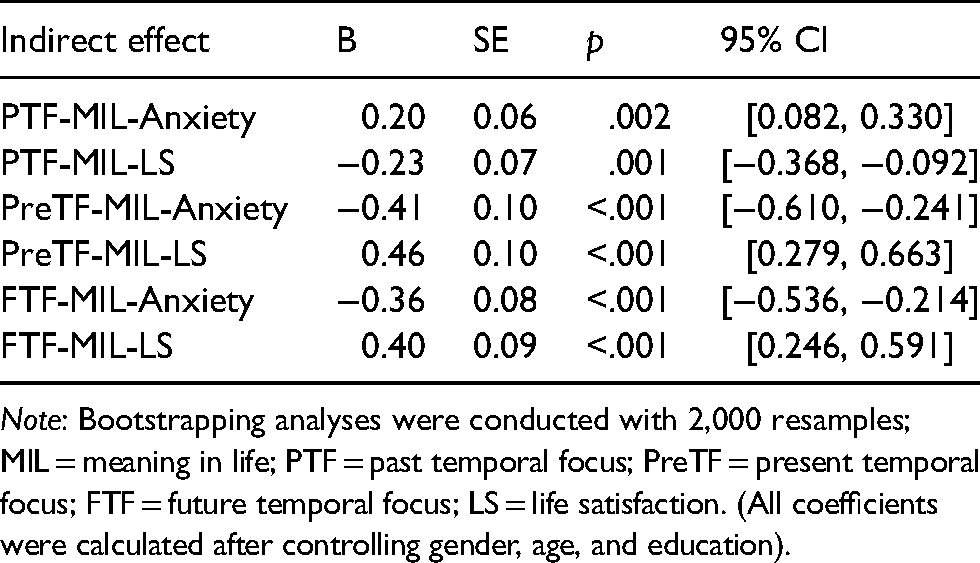
Note: Bootstrapping analyses were conducted with 2,000 resamples; MIL = meaning in life; PTF = past temporal focus; PreTF = present temporal focus; FTF = future temporal focus; LS = life satisfaction. (All coefficients were calculated after controlling gender, age, and education).
Discussion
The present study examined the relationships between TF, MIL, anxiety, and life satisfaction during the COVID-19 pandemic. Results found that past TF was negatively associated with MIL, whereas present and future TF positively predicted MIL. Furthermore, MIL mediated the relationships between TF and mental health, with past TF having a negative indirect effect on mental health and present and future TF having positive indirect effects on mental health. Therefore, the present findings highlighted the adaptive functions of focusing on the present and future during the COVID-19 pandemic, which facilitates the attainment of MIL and promotes mental health.
Relationships between different categories of temporal focus and meaning in life during the COVID-19 pandemic
Contrary to our hypothesis, when taking all three categories of TF into the model, the present findings showed that during the pandemic, past TF negatively predicted MIL while present TF positively predicted MIL. Two reasons might explain the negative effect of past TF on MIL. First, due to the impact caused by the pandemic (e.g., lockdown, unemployment, limited social contacts), recalling the past would cause comparisons between the past, normal lifestyle, and the current “abnormal” situations, thus generating negative affect (e.g., disappointment, feelings of loss). Furthermore, these feelings would undermine feelings of overall MIL. Even for nostalgia, which usually plays a positive role in improving mental health (Newman et al., 2020), Dennis et al. (2022) found that it could no longer enhance well-being during lockdown. They supposed that the uncertainty of quarantine duration and pervasive influence of lockdown would impair the effect of nostalgia on MIL. Second, according to Zheng and Wang (2021), MIL was positively associated with the past–positive subscale of the Zimbardo Time Perspective Inventory, while negatively associated with past–negative subscale, suggesting that the valence of past TF should be taken into consideration. More research is needed to further examine whether focusing on positive and negative past experiences would have different effects on feelings of MIL, especially in a large-scale stressful context such as the pandemic.
The positive association between present TF and MIL was also inconsistent with our hypothesis. The present results suggest that living in the present might be helpful for meaning-making during the pandemic, strengthening the sense of MIL. Focusing on the present is linked with enjoying the present and seizing pleasure in the current moment (Tseferidi et al., 2017). Considering that positive affect is an important source of MIL (King & Hicks, 2021), it is possible that present TF could promote MIL through an increase in positive affect. Especially during the COVID-19 pandemic, focusing on the present moment and finding something good for people themselves from their current life might be helpful in buffering the impact caused by the pandemic (Dennis et al., 2022). Furthermore, daily routines were considered an important source of MIL (Heintzelman & King, 2019), and focusing on the present situation was seen to help with the re-establishment of destroyed daily routines, which may be helpful in improving individuals’ MIL during COVID-19. Future studies using an experimental design are needed to further verify the causal relationship between present TF and MIL.
In addition, we found that future TF positively predicted MIL, which is consistent with previous studies. For example, Waytz et al. (2015) suggested that future-orientated mental simulations could promote MIL, suggesting that the people who think more about the future would perceive that life is meaningful. Focusing on the future can guide people to find more possibilities for their future and form a more positive self (Shipp & Aeon, 2019), promote feelings of hope (Miao et al., 2021), and enhance the salience of future goals, all of which are essential for the attainment of MIL.
Relationships between different categories of temporal focus and mental health during the COVID-19 pandemic
Although correlation analysis revealed that each category of TF was significantly associated with mental health, when taking MIL and three categories of TF simultaneously into the model, the direct associations between TF and mental health turned non-significant. The only exceptions were the associations between past TF and anxiety as well as that between present TF and life satisfaction.
In addition to the findings that past TF had a negative effect on MIL, further analyses revealed that past TF also demonstrated an indirect negative effect on mental health, through the mediating role of MIL. During the pandemic, focusing on the past would undermine MIL, which further increases anxiety and decreases life satisfaction.
Contrary results were found for present TF and future TF. They were consistent with Dennis et al.'s (2022) study that found that present- and future-orientated interventions were more effective in promoting well-being. The present study found that both present and future TF had a positive indirect effect on mental health. Both of them could promote MIL and then relieve anxiety and increase life satisfaction. According to Bodecka et al. (2021), during the COVID-19 pandemic, focusing on the current situation enables individuals to find a way for coping with challenges, thus decreasing stress. Alternatively, focusing on future TF could also facilitate mental health because future-oriented individuals could shift their focus from the present to the future. Therefore, they are more likely to hold an optimistic and hopeful attitude toward the future, which could promote MIL, thus maintaining mental health during the pandemic (Li & Lyu, 2021).
Taken together, the findings of the mediational role of MIL between TF and mental health provided empirical support for the General Conceptual Model of Time Perspective (Zimbardo & Boyd, 1999), which highlighted the impact of TF on the sense of meaning and provided a framework to understanding the associations between TF and mental health.
Limitations and suggestions
There were several limitations in the present study. First, although a longitudinal design was used, it was correlational in nature, and future studies should use experimental or interventional design to provide support for the causal relationships between study variables. Second, according to Steger et al. (2006), MIL contains the presence of MIL and search for MIL. Considering that the present study only examined the presence of MIL, further research is needed to explore whether different categories of TF have distinct impacts on the search for meaning. In addition, Martela and Steger (2022) have developed a three-dimensional MIL scale, which assessed three major components of MIL: coherence, purpose, and significance. Further research is necessary to explore whether different categories of TF are differently associated with different components of MIL. Third, the reliability of present TF was lower than 0.70 in the current study, and also lower than that of past and future TF. We referred to Shipp et al.'s (2009) study and found that the reliability of present TF was lower than the other two subscales as well (αpast = 0.88, αpresent = 0.78, and αfuture = 0.86). Therefore, to improve the repeatability of the present findings, future research should consider using a different measurement for TF, for instance, the Zimbardo Time Perspective Inventory Items (Zimbardo & Boyd, 1999, 2015). Finally, previous studies suggested that affective valences can affect individuals’ TF (Zimbardo & Boyd, 1999). Thus, future studies should explore whether TF with different valences differ in their associations with MIL and mental health. In addition, given that the balance of different TFs may play a critical role in mental health (Webster et al., 2021), TF balance should be taken into consideration in future research.
Implications
Theoretically, the present findings provided evidence for the protective roles of present and future TF on MIL and mental health under large-scale public health events such as the COVID-19 pandemic. The findings also further highlighted the mediating role of MIL. In addition, the predictive roles of TF on MIL provided support for Zimbardo and Boyd's (1999) general conceptual model of TP.
Moreover, our study provides a novel perspective of improving life satisfaction and reducing anxiety during the COVID-19 pandemic. Our findings suggested that focusing on the present situation and future expectations rather than on past experiences is beneficial for the perception of MIL and the maintenance of mental health during the COVID-19 pandemic. Future interventions should take present and future TF into consideration.
Conclusion
The present study revealed indirect associations of past, present, and future TF with anxiety and life satisfaction via the mediating role of MIL. In the context of the COVID-19 pandemic, present and future TF demonstrated positive relationships with MIL and mental health, but the other way around for past TF. These findings suggest that during the pandemic, finding meaning from present situations and future expectations is beneficial to mental health.
Footnotes
Declaration of conflicting interests
The author(s) declared no potential conflicts of interest with respect to the research, authorship, and/or publication of this article.
Funding
The author(s) disclosed receipt of the following financial support for the research, authorship, and/or publication of this article: This work was supported by the National Social Science Foundation of China (grant number 22CSH046).
Research data
The datasets and code used in the current study are available from the corresponding author on reasonable request.
