




Abstract
Growth mindset has shown its unique potential in countering the growing prevalence of mental distress in the general population. However, the role culture plays in this process remains somewhat unanswered. In the current prospective study, we tested if early growth mindset of Chinese university students predicts less mental distress later, and how cultural values (i.e., individualism–collectivism, traditionality–modernity) affect the process. We found that growth mindset was prospectively predictive of mental conditions, and the positive effect of growth mindset was more salient among students endorsing lower collectivistic and higher modern cultural values. Our findings added evidence to the potential benefits of growth mindsets in an Asian context and highlighted the role of cultural values.
The global challenge of worsening mental health conditions has attracted the attention of the public and academia. According to a report by World Health Organization (2017), an estimated 4.4% and 3.6% of the general population suffer from depressive and anxiety disorders, respectively. The issue is even more pressing with the ongoing COVID-19 pandemic and its ensuing quarantine policy around the globe, as the disease poses both physiological and psychological challenges. Recent meta-analyses, for example, have shown that around 30% of the general population have experienced some symptoms of mental distress during the pandemic (e.g., de Sousa Júnior et al., 2021; Salari et al., 2020; Xiong et al., 2020).
As a potential tool for buffering ongoing global mental health challenges, growth mindset, among other approaches, is drawing the attention of psychologists. Having first made its way into psychological science in the 1970s, growth mindset, sometimes termed incremental (as opposed to entity) implicit theory, has received much attention in the last few decades (Yeager & Dweck, 2020). Generally defined as a belief that general or specific (e.g., intelligence, personality, socio-economic status) human attributes are malleable and could be improved over time, high levels of growth mindset have been proven predictive of several desirable outcomes, such as better academic and occupational performance (Caniëls et al., 2018; Costa & Faria, 2018; Han & Stieha, 2020), better mental health conditions (Burnette et al., 2020; Schleider et al., 2015; Tamir et al., 2007), and higher levels of well-being (Ortiz Alvarado et al., 2019; Perkins et al., 2021; Zhao et al., 2021).
Early research has mostly focused on the relationship between growth mindset and academic performance, but researchers have also begun to cast their attention to growth mindset as a potential toolkit against psychological distress, especially considering the growing prevalence of mental health conditions like depression (Lim et al., 2018) and anxiety (Fehm et al., 2008) around the world. There are several reasons to believe that higher levels of growth mindset could be beneficial for mental health. First, individuals with more of a growth mindset are more likely to attribute personal failures to their lack of effort, and thus stay more optimistic and progressive rather than helpless or frustrated in the face of challenges (Govorova et al., 2020). Second, higher levels of growth mindset would prompt people to actively and adaptively cope with problems (e.g., seeking help from others), which could prevent or reduce psychological problems (Schleider et al., 2015). Third, people with a more growth-oriented mindset are more likely to possess high treatment values, meaning they would see their mental issues as more temporary and treatable (Burnette et al., 2020).
Indeed, studies to date that resort to growth mindset as a construct to boost psychological well-being or buffer mental distress have mostly yielded positive results. These studies could be broadly divided into two categories. The first focus on the relationship between growth mindset and mental condition indicators. Using a cross-sectional design and employing participants from an American university, for example, De Castella et al. (2013) found that implicit theories of students’ own emotions (i.e., personal beliefs of whether their own emotions are malleable or not) were linked to their psychological well-being (see also King & dela Rosa, 2019). Schroder and colleagues (2015) found that growth mindset on attributes like intelligence, anxiety, and emotion predicted psychological well-being among American university students. In a similar vein, Ortiz Alvarado et al. (2019) found evidence that a growth mindset of intelligence was associated with students’ well-being in a Mexican context.
Other studies that fall into this category adopted prospective or longitudinal designs. Tamir et al. (2007), for example, examined the relationship between an implicit theory of emotion and adjustment both before and after entering college among American students. They found that students holding a growth (vs. fixed) mindset before entering college applied more emotion-regulation strategies, and had lower levels of depressive symptoms and fewer social adjustment problems later. De France and Hollenstein (2021) found that, in a Canadian context, higher levels of adolescents’ growth mindset predicted fewer depressive symptoms six months later. Romero et al. (2014) found that, among American students, believing that emotion could be controlled predicted higher levels of well-being during the three years of middle school, especially if they started their middle school years with lower levels of mental conditions. Among a group of freshmen in an American university, Schroder et al. (2019) also found that a growth mindset of anxiety was predictive of mental health conditions across five weeks (see also Ford et al., 2018). Such patterns were further confirmed by a recent meta-analysis by Burnette et al. (2020) in which they found that growth mindset was beneficial for psychological well-being (see also Schleider et al., 2015).
The second category of studies, although somewhat limited in numbers, applied intervention programs featuring growth mindset. Schleider and Weisz (2016) found that American adolescents experiencing anxiety or depression symptoms benefited from a single session of growth mindset intervention, in that they perceived more sense of control, and recovered more quickly from lab-induced social stress. They conducted a follow-up measurement nine months later and found that the effects persisted (d = .29∼.60) for both parent- and self-reported levels of depression and anxiety (see also Schleider et al., 2019; Schleider & Weisz, 2018). Similarly, Perkins et al. (2021) found that, among a group of students from the United Kingdom, a half-hour intervention program was enough to trigger positive changes in self-compassion, anxiety, and depression measurable in an eight-week follow-up.
Growth mindset has shown its unique potential in buffering mental illness. Nonetheless, it should be noted that, compared to studies focusing on the relationship between growth mindset and academic performance (e.g., Yeager et al., 2019), these studies somewhat fall short of generalizability, especially if we take the cross-cultural perspective into account. As far as we were concerned, studies on the relationship between growth mindset and mental health were mostly conducted in WEIRD (i.e., Western, educated, industrialized, rich, and democratic) countries (Henrich et al., 2010), and not enough attention has been paid to the non-Western population. Some empirical studies focusing on the effect of growth mindset on academic performance have already found significant cross-cultural or within-culture differences. Bernardo et al. (2021) reviewed data from PISA, a large-scale study conducted in more than 30 countries that included more than 270,000 students, and found that sociocultural factors could affect the relationship between growth mindset and academic performance (reading, mathematics, science), in that the relationship is weaker in societies with higher beliefs that behaviors and outcomes may vary across different situations. Costa and Faria (2018), for example, through their meta-analysis found that the relationship between growth mindset and academic performance is dependent on cultural context. Existing studies have mostly found that disadvantaged students (e.g., lower SES or academic performance to begin with) benefit more from a higher level of growth mindset. Yeager et al. (2016), for example, reported improved results of intervention programs for students with lower academic achievement (see also Claro et al., 2016; Paunesku et al., 2015). However, some research highlighting within-culture differences has not reported expected results. Corradi et al. (2019), for example, found that students with a minority cultural background (i.e., immigration), in contrast with their majority peers, displayed a negative relationship between growth mindset and academic performance.
When it comes to Asian context, Asian populations are known to have lower average levels of growth mindset than their Western counterparts (Sun et al., 2021). Li and Bates (2019), for example, conducted a study among Chinese children aged 9 to 13, and found that: (a) growth mindset manipulation was ineffective in improving resistance against failures, and (b) growth mindset levels were unrelated to academic performance. On the other hand, however, several studies conducted with Chinese participants reported positive results. Zeng et al. (2016), for example, found that growth mindset could enhance psychological well-being and school engagement by increasing resilience. Chen and Wong (2015) found that growth mindset on intelligence was positively related with students’ academic performance. Recently, Lee and her associate (this issue) found that Hong Kong teachers with a higher growth mindset were better at adapting to new job requirements, namely online teaching during the COVID-19 pandemic. These mixed results of previous studies require further clarification, especially if we take the perspective of mental health problems in Asian countries like China (e.g., Huang et al., 2019; Qin et al., 2018; 2022) into account.
Other than the difference of growth mindset baselines, there were reasons to believe that cultural values might play a role in the process of protective values of growth mindset against mental distress. First, socio-ecological perspectives propose that cultural values are adaptations of ecological environment (Oishi, 2014). A mismatch between one's individual and their group cultural values (i.e., cultural mismatch), therefore, may yield negative psychological results. Wu and colleagues (2018a), for example, found that people of high collectivism reported higher levels of well-being in less urbanized provinces in China. In other words, personal values congruent with cultural values (e.g., higher levels traditionality and collectivism in China) could be expected to have adaptive and beneficial values toward mental health, possibly attenuating the positive effect of growth mindset on mental health conditions.
In all, the exact effectiveness and boundary conditions of growth mindset as a tool against mental health distress remain somewhat unanswered, in that (a) not enough studies have been conducted in Asian contexts, especially if we take the possible role of cultural values play into account, and (b) existing research of the relationship between growth mindset and academic performance has shown heterogeneous and cultural-dependent results, suggesting that it might also be the case for growth mindset and mental distress.
Overview of current research
The current research attempts to provide preliminary work on the growth mindset as a potential tool for buffering mental health challenges, while also taking the role of cultural values into account. Adopting a prospective design, we tested if the beneficial effect of growth mindset on mental health chronologically exists, and how cultural values might play a role in the relationship. Specifically, we aim to answer these two questions: (a) Could early growth mindset prospectively predict later mental health among Chinese students? and (b) If so, what role do cultural values play in the process? To answer these questions, we conducted a two-wave time-lagged study among Chinese university students, testing their levels of growth mindset, cultural values, and mental health conditions at the start and end of semester. In regard to cultural values, we examined the values of individualism–collectivism and traditionality–modernity, which were of great significance in cultural psychology under social change perspectives (Cai et al., 2019; Greenfield, 2016; Lu, 2008; Yang, 2003). In particular, we treated collectivism–individualism and traditionality–modernity as independent constructs for the following reasons. First, previous research indicated a weak relationship between individualism and collectivism, and between traditionality and modernity (e.g., Taras et al., 2014; Vargas & Kemmelmeier, 2013; Zhao et al., 2019). Second, specified examination could support the divergent functions of individualism–collectivism and traditionality–modernity (e.g., Lin et al., 2017; Wu et al., 2018b).
Method
We received ethical approval from Chengdu University. We report only the subset of measures (see below) relevant to our theoretical objectives (and thus analyzed). The raw data, analysis code, and research materials are available on OSF (https://osf.io/g2kw6/?view_only=be5e44f512ba4e39843ffb70400841d1). We did not preregister this study.
Participants and procedure
We tested students at Chengdu University, Sichuan, China twice during their spring semester in 2021. At T1 (between February 22 and March 5), we assessed 1800 students (517 men, age in years: Range = 15–25, Mage = 19.57, SDage = 0.82) from various majors, including engineering, liberal art, social science, and business. At T2 (at the end of the semester, approximately four months after T1), we retested 1284 students (310 men; attrition rate = 28.67%, see Figure 1 for procedure). At T1, we assessed participants with growth mindset and cultural values (individualism–collectivism) as well as demographic information (i.e., gender, age, and economic status 1 ). At T2, we assessed participants with mental health issues (depression, anxiety, and stress) and various cultural values (traditionality–modernity). We found no evidence for selective attrition. Participants who completed versus did not complete the T2 assessment did not differ significantly on T1 growth mindset, t (1798) = −0.519, p = .604, or any other T1 assessments, ts(1798) < = |1.926|, ps > .05.

Illustration of assessment procedure.
Measures
Growth mindset
We employed the 6-item Growth Mindset Scale (Dweck, 1999) to assess growth mindset’s impact on intelligence (e.g., “You have a certain amount of intelligence, and you can’t really do much to change it”; “Your intelligence is something about you that you can’t change very much”). Participants indicated their level of agreement with each statement on a 6-point rating scale (1 = strongly disagree, 6 = strongly agree). Three items for fixed mindset were reversely coded. A higher score indicates a higher endorsement of growth mindset.
Individualism and collectivism
We adopted the Individualism and Collectivism Scale (Triandis & Gelfand, 1998) to assess the endorsement of individualism and collectivism. The scale consists of sixteen items, with eight items measuring individualism (e.g., “I’d rather depend on myself than others”) and the other eight items measuring collectivism (e.g., “If a coworker gets a prize, I would feel proud”). Participants indicated to what degree they agree with each item statement on a 7-point rating scale (1 = strongly disagree, 7 = strongly agree). A higher score indicates a higher endorsement of individualism and collectivism, respectively.
Traditionality and modernity
In addition to individualism–collectivism, we also applied an emic perspective in measuring cultural values. We used the Scale of Chinese Individual Traditionality/Modernity (Kao & Lu, 2006) to assess the endorsement of traditionality and modernity values. Among them, 15 items measure traditionality values (i.e., submission to authority, filial piety and ancestral worship, conservatism and endurance, fatalism and defensiveness, male dominance) and the other 15 measure modernity values (i.e., egalitarianism and open-mindedness, social isolation and self-reliance, optimism and assertiveness, affective hedonism, sex equality). Participants indicated their degree of agreement with each statement on a 7-point rating scale (1 = strongly disagree, 7 = strongly agree). A higher score indicates a higher endorsement of traditional and modern values, respectively.
Mental health
We used the 21-item Depression Anxiety Stress Scales (DASS-21; Lovibond & Lovibond, 1995) to assess mental health. The scale listed twenty-one negative emotional symptoms falling into three categories: depression (e.g., “I felt that life was meaningless”), anxiety (e.g., “I felt scared without any good reason”), and stress (e.g., “I was intolerant of anything that kept me from getting on with what I was doing”). Participants rated the extent to which they have experienced each symptom over the past week on a 4-point scale (0 = Did not apply to me at all, 3 = Applied to me very much or most of the time). A higher score indicates higher level of depression, anxiety, and stress, respectively.
Results
Table 1 presents the means and correlations of our main variables. T1 growth mindset was negatively correlated with T2 mental health indicators (rs from −.17 to −.21, ps < .001). For cultural values, T1 growth mindset was positively correlated with collectivism (r = .21, p < .001), and negatively correlated with individualism (r = −.08, p = .001) and modernity (r = −.07, p = .013), yet not significantly correlated with traditionality (r = .01, p = .778).
Means, standard deviations, internal consistency, and correlation matrix of measures on growth mindset, well-being, and cultural variables.

Note: growth mindset, growth mindset; reliability coefficients are shown in bold along the diagonal of the table.
p < .05. ∗∗p < .01. ∗∗∗p < .001.
The predictive power of growth mindset on mental health
We conducted a series of hierarchal linear regressions to test whether growth mindset at the beginning of a semester predicted mental health four months later. We set the T2 mental health indicators (depression, anxiety, and stress, respectively) as dependent variables, and added T1 growth mindset and demographic variables (i.e., gender, age, and economic status) as predictors. The results (see Table 2 for details) showed that, after controlling for demographic variables, T1 growth mindset was negatively associated with T2 depression, b = −0.57, se = 0.08, 95% CI = [−0.71, −0.42], β = -0.21, p < .001. Similarly, T1 growth mindset also negatively correlated with T2 stress, b = −0.60, se = 0.10, 95% CI = [−0.79, −0.40], β = −0.17, p < .001. Furthermore, higher T1 growth mindset was predictive of lower levels of anxiety at T2, b = −0.52, se = 0.08, 95% CI = [−0.69, −0.36], β = -0.17, p < .001. All these findings suggested that endorsement of growth mindset contributes to better mental health chronologically.
The prospective effect of growth mindset on latter mental health.
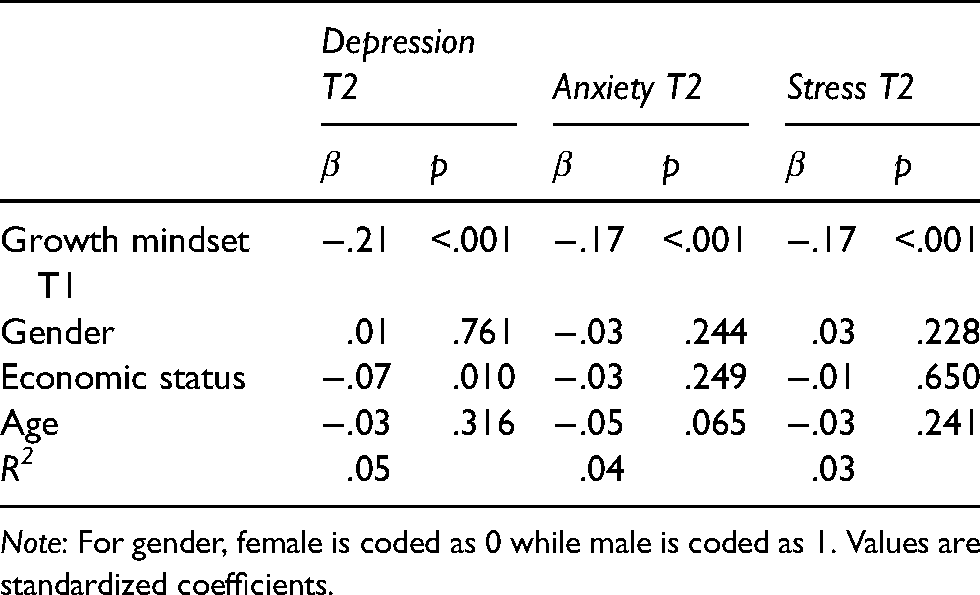
Note: For gender, female is coded as 0 while male is coded as 1. Values are standardized coefficients.
The moderation effect of collectivism in between growth mindset and mental health
To test how the endorsement of collectivism and individualism influences the effect of growth mindset on mental health, we added the cultural values of individualism, collectivism, and their interactions with T1 growth mindset into the regression model. Collectivism negatively predicted T2 mental distress (depression: b = −0.76, se = 0.10, 95% CI = [−0.95, −0.57], β = -0.21, p <.001; anxiety: b = −0.70, se = 0.11, 95% CI = [−0.92, −0.48], β = −0.18, p <.001; stress: b = −0.91, se = 0.13, 95% CI = [−1.17, −0.65], β = −0.19, p <.001, see Table 3 for details), while individualism positively predicted mental distress (depression: b = 0.19, se = 0.10, 95% CI = [0.00,0.38], β = 0.05, p = .046; anxiety: b = 0.43, se = 0.11, 95% CI = [0.21,0.65], β = 0.11, p <.001; stress: b = 0.91, se = 0.13, 95% CI = [0.66,1.17], β = 0.19, p <.001).
The moderating effect of individualism and collectivism on growth mindset to mental health.

Note: Values are standardized coefficients. Both the predictor and moderator were centered.
After controlling for T1 individualism and collectivism, the T1 growth mindset still significantly predicted T2 mental health (depression: b = −0.44, se = 0.08, 95% CI = [−0.59, −0.29], β = −0.16, p <.001; anxiety: b = −0.37, se = 0.09, 95% CI = [−0.54, −0.20], β = −0.12, p <.001; stress: b = −0.37, se = 0.10, 95% CI = [−0.57, −0.17], β = −0.10, p <.001, see Table 3 for details). However, we only found a slight moderation effect of collectivism on depression, indicated by the significant interaction, b = 0.29, se = 0.08, 95% CI = [0.13,0.46], β = 0.09, p = .001. And further simple slope analysis 2 showed that the negative effect of T1 growth mindset on T2 depression was stronger for those with lower (b = −0.70, se = 0.10, 95% CI = [−0.90, −0.50], p <.001) than those with higher levels of collectivism (b = −0.26, se = 0.09, 95% CI = [−0.44, −0.09], p = .004, see Figure 2). These results suggested that students with a higher endorsement of collectivism benefited less in terms of mental health from holding a growth mindset chronologically. None of the other interactions was found to be significant (see Table 3 for details).

The moderation effect of collectivism on the relationship between T1 growth mindset and T2 depression.
The moderation effect of modernity in between growth mindset and mental health
Using similar analysis, we tested how the endorsement of traditionality–modernity values influenced the effect of growth mindset on mental health by adding the traditionality–modernity cultural values as well as their interaction with T1 growth mindset into the regression model. After controlling for T2 traditionality and modernity, T1 growth mindset still significantly predicted T2 mental health (depression: b = −0.48, se = 0.08, 95% CI = [−0.63, −0.33], β = −0.18, p <.001; anxiety: b = −0.45, se = 0.09, 95% CI = [−0.62, −0.28], β = −0.15, p <.001; stress: b = −0.53, se = 0.10, 95% CI = [−0.73, −0.33], β = −0.15, p <.001, see Table 4 for details). Modernity positively predicted T2 mental health conditions (depression: b = 0.52, se = 0.12, 95% CI = [0.29,0.76], β = 0.12, p <.001; anxiety: b = 0.55, se = 0.14, 95% CI = [0.28,0.82], β = 0.11, p <.001; stress: b = 0.57, se = 0.16, 95% CI = [0.25,0.90], β = 0.10, p <.001), with traditionality predicting them less significantly (depression: b = 0.23, se = 0.10, 95% CI = [0.04,0.42], β = 0.07, p = .018; anxiety: b = 0.16, se = 0.11, 95% CI = [−0.18,0.25], β = 0.04, p = .149; stress: b = 0.23, se = 0.13, 95% CI = [−0.03,0.49], β = 0.05, p = .086).
The moderating effect of tradition and modernity on growth mindset to mental health.

Note: Values are standardized coefficients. Both the predictor and moderator were centered.
After controlling for traditionality and modernity, the modernity × growth mindset interactions were significant (depression: b = -0.49, se = 0.12, 95% CI = [−0.73, −0.25], β = −0.11, p <.001; anxiety: b = −0.41, se = 0.14, 95% CI = [−0.67, −0.14], β = −0.08, p = .003; stress: b = −0.35, se = 0.16, 95% CI = [−0.67, −0.03], β = −0.06, p = .031, see Table 4 for details). However, the values of traditionality show no sign of moderating effects in relationships between growth mindset and any indicators of mental health. Simple slope analysis showed that the T1 growth mindset was negatively predictive of T2 mental health problems for those with higher endorsement of modernity (depression: b = −0.79, se = 0.09, 95% CI = [−0.97, −0.61], p <.001; anxiety: b = −0.72, se =0.11, 95% CI = [−0.93, −0.51], p <.001; stress: b = −0.74, se = 0.13, 95% CI = [−0.98, −0.50], p <.001) while growth mindset has a smaller effect on those with lower modernity endorsement (depression: b = −0.23, se = 0.11, 95% CI = [−0.45, −0.01], p = .041; anxiety: b = −0.26, se = 0.13, 95% CI = [−0.50, −0.01], p = .043;stress: b = −0.33, se = 0.15, 95% CI = [−0.63, −0.04], p = .027), suggesting that students with higher endorsement of modernity values benefited more from holding growth mindset on mental health in the long run (Figure 3).

The moderation effect of modernity on the relationship between T1 growth mindset and T2 depression.
Discussion
Accumulating evidence has suggested that growth mindset has a buffering effect against the growing prevalence of mental distress among Westerners (Burnette et al., 2020; Schleider et al., 2015; Schroder et al., 2019). To test if this possibility also applies in an Asian context, we conducted a prospective study measuring the relationship between growth mindset and mental health among Chinese students, paying special attention to cultural values. In accordance with research done among Western participants, our results found that a high level of growth mindset at T1 is positively and prospectively predictive of better mental conditions (i.e., lower levels of depression, anxiety, and stress) at T2 (four months later). Further moderation analysis found that cultural values, as measured by individualism–collectivism and traditionality–modernity, also play a role in the process: students holding low collectivistic and high modern cultural values benefit more from possessing high levels of growth mindset. Nonetheless, it should also be noted that the level of collectivism at T1 was negatively correlated with the level of psychological distress at T2, suggesting that students endorsing collectivistic values have better mental conditions to begin with.
These results suggest a potential beneficial effect of growth mindset on mental health, as has been found among Western contexts (Burnette et al., 2020; Schleider et al., 2015), also exists in China, thus confirming the protective effects of growth mindset on psychological well-being in an Asian context. This finding provides evidence of how growth mindset works on mental health among non-Westerners, and deepens the understanding of growth mindset theory. Moreover, we found that such protective effects were contingent on cultural values, in that students holding less collectivistic and more modern values benefited more from possessing high levels of growth mindset. A possible explanation of the interaction is that students with low collectivistic and high modern values would put more emphasis on self-reliance rather than connection with others, rendering growth mindset, a cognition that has more to do with self, more important and effective in reducing mental distress. However, it should also be noted that cultural values of individualism–collectivism and traditionality–modernity may coexist, as suggested by our correlation analysis and previous studies (e.g., Chen, 2015; Hamamura, 2018; Yang, 2003).
We also found that the level of collectivism is positively correlated with follow-up measures for mental health conditions. Several reasons might explain the finding. Culture-mismatch theory (Fulmer et al., 2010; King & dela Rosa, 2019), for example, proposes that people whose cultural values match those of their environment would have better mental health conditions. Therefore, students endorsing collectivistic values would be better off in terms of mental health conditions. Collectivism has also been associated with more social support and a higher tendency to actively seek psychological help, both of which are beneficial for psychological well-being (Burnette et al., 2020). Help-seeking behavior, on the other hand, is culture-dependent. Tata and Leong (1994), for example, found that the level of individualism was negatively connected with the attitude of seeking professional psychological help among Chinese students. Thus, it could be expected that, by resorting to others for help, Chinese with high endorsement of collectivism might have better mental health conditions. Previous research has also revealed the adaptability of collectivism from the perspective of cultural ecology (e.g., Fincher et al., 2008; Hamamura & Park, 2010). These studies highlighted the role the ecological environment plays in shaping cultural values and thus the adaptivity of cultural values to their ecological environments.
The current study is preliminary in nature and limitations exist. The major concern is that the spectrum of measurement falls short of broadness and consistency. For example, considering the overall stability of personal values (Bardi et al., 2014), we only included the measurement of traditionality–modernity on T2 instead of T1. Future research could (a) increase the time span and frequency of measurement, thereby drawing more convincing research conclusions; and (b) examine more related variables, such as an implicit theory of emotions and mental illness, to increase the understanding of the relationship between growth thinking and mental health. The effect of growth mindset on different mental condition indicators was also heterogeneous, which requires further explanation. Also, we only measured growth mindset and mental health indicators once, thus this might confound the prospective influence of the growth mindset on mental health with an autoregressive effect of mental health (Rogosa, 1980). Further work with longitudinal design and repeated measures of growth mindset and mental health is need to clarify causal influences. Finally, it should also be noted that growth mindset should not be treated as a solution to ongoing mental health challenges. As suggested by Destin et al. (2019), the root of the gap itself, whether academic or mental, more likely stems from general social inequality. The effect of growth mindset itself on mental health is practically limited, as suggested by the small effect size in current research and previous meta-analysis (Burnette et al., 2020).
Coda
In sum, using a prospective design, the current study confirmed that, in accord with previous studies done with WEIRD populations, for Chinese students, possessing a growth mindset is also predictive of consequent desirable outcomes. More specifically, we found that Chinese university students endorsing growth mindset enjoy higher levels of mental health, especially for those holding low collectivistic or high modern cultural values. Thus, the potential of growth mindset as a tool against mental distress in a Chinese context is confirmed, although the effect is small and contingent on cultural values as well.
Footnotes
Research materials and data availability statement

Declaration of conflicting interests
The author(s) declared no potential conflicts of interest with respect to the research, authorship, and/or publication of this article.
Funding
The author(s) disclosed receipt of the following financial support for the research, authorship, and/or publication of this article: This research was funded by Sichuan Provincial Department of Education (grant number 2021SXJP023), National Natural Science Foundation of China (grant number 71901072), and Natural Science Foundation of Zhejiang Province (grant number LQ22G010008).