




Abstract
The current study aims to investigate the mediating effect of perceived control over the future and the moderating effect of empathy on the association between stressful experiences and PTSD symptoms among college students in China in response to COVID-19. A sample of 1,225 college students (70.69% were female, M age = 20.22 years, SD = 2.02) were recruited using web-based surveys at wave 1 (W1) and wave 2 (W2) longitudinally. Results showed that COVID-19-related stressful experiences were significantly associated with PTSD symptoms. Perceived control over the future partially mediated the relationship between these two variables (indirect effect size = 0.09, p < 0.01). Empathy significantly moderated the path from perceived control over the future to PTSD symptoms, suggesting that the association was stronger for individuals with higher levels of empathy. Findings suggest a protective effect of perceived control over the future on college students’ PTSD symptoms during the COVID-19 pandemic. Such a protective effect was intensified by empathy. Future intervention to manage PTSD symptoms should be tailored to positive future expectations and empathy.
Keywords
Introduction
The coronavirus disease 2019 (COVID-19) outbreak has led to numerous significant strains to the world. While great efforts have been made to control the pandemic, health professionals have emphasized the importance of addressing the negative impacts of this public health emergency on psychological well-being (Bao et al., 2020). Regarding previous infectious diseases (e.g., severe acute respiratory syndrome [SARS]), pandemic literature found the detrimental influences of disease-related stressors (e.g., daily disturbance due to SARS) on psychological health (Lau et al., 2016; Lee et al., 2018). Inspired by disease-related stressors research, COVID-19 literature has identified a variety of stressors derived from the initial stage of the COVID-19 pandemic, such as erroneous news reports and health misinformation, a severe shortage of personal protective equipment and healthcare resources (WHO, 2020), the lockdown of cities and regions, and substantial isolation from social networks (e.g., the social distancing order and mandatory quarantine) (Bao et al., 2020). Not surprisingly, these COVID-19-related stressors have been positively associated with psychological problems (Shigemura et al., 2020). Particularly, posttraumatic stress disorder (PTSD) could be a long-term psycho-behavioral concern when people encounter public crisis (Mak et al., 2010). Existing literature has revealed strong associations of PTSD with various detrimental health outcomes, including psychiatric symptoms, substance use, physical health problems, and suicide ideation (Garfin et al., 2018; Krysinska & Lester, 2010). Given the influences of PTSD, several studies have investigated PTSD symptoms among individuals exposed to COVID-19 in China (Chen et al., 2021; Li et al., 2021). However, most of these studies employed cross-sectional data and focused on clinical samples or front-line healthcare workers, with limited studies being conducted among non-clinical populations. Li and colleagues compared the vicarious traumatization in the general public and front-line nurses, and found that the vicarious traumatization scores for the general public were significantly higher than those of medical team members (Li et al., 2020). In addition, existing evidence has revealed that Chinese young adults (aged 18 to 35 years) were more likely to develop psychological symptoms during the COVID-19 pandemic than older adults (Huang & Zhao, 2020). Particularly, students (aged 12–21 years) reported a higher level of PTSD symptoms than other age groups during the early stages of the COVID-19 pandemic because they were exposed to additional stressors such as prolonged school closure, transformation to online classes, and uncertainty about examinations (Wang et al., 2020). Thus, it is critical to examine PTSD symptoms and understand how stressful experiences may affect PTSD in the context of the COVID-19 pandemic among college students.
Conservation of Resources (COR) theory may offer a framework to understand the psychological mechanism underlying stress responses during the pandemic. COR theory depicts how individuals experience or cope with stress, and why individuals eventually develop distress symptoms (Hobfoll, 1989). Based on this theory, to cope with stress, people are motivated to obtain, build, protect, and maintain resources that they value. These resources can be objective (e.g., adequate food or time for sleep, family stability, etc.) or psychological (e.g., hope, social connections, etc.). In the face of emergent life events, the availability of these resources would become limited, and individuals would perceive insufficient control of the resources or the loss of these resources. This would trigger a high level of stress-arousal response, which in turn would develop traumatic stress symptoms, such as PTSD (Hobfoll, 2001). Notably, at the beginning of the COVID-19 pandemic, Chinese young adults faced a variety of emergent and uncontrollable stressors, such as prolonged school closure, the rapid transformation to online classes, and uncertainty about examinations (Wang et al., 2020), but limited resources were available for them to manage these stressors (Achdut & Refaeli, 2020; Losada-Baltar et al., 2021). Without perceiving sufficient resources, in line with COR theory, the exposure to these stressors in the early pandemic could be associated with the high risk for distress symptoms in Chinese college students, including PTSD symptoms.
The influence of COVID-19 related stressors on PTSD would occur indirectly through the role of perceived control over the future. Perceived control over the future refers to the degree to which people believe that the future events are controllable and that they are capable to cope with future events, and this can be dependent on the resource availability (Frazier, 2003; Li & Zhu, 2022). Extant stress literature in college students shows that the loss of objective and psychological resources under a stressful situation may lead to high levels of passivity and helplessness for life (Zhou & Yao, 2020), which undermines their perceived control over the future. It is worth noting that the reduction of perceived control over the future could negatively influence stress responses and psychological health outcomes in young people. Existing studies revealed that the reduction of perceived control over the future was associated with the decrease of motivation to find the workable pathways towards goals in youths (Zhang et al., 2009). In turn, a low level of perceived control over the future was associated with a poor psychological adjustment because it might prevent individuals from engaging in self-care behaviors (e.g., keep safe and healthy), which may increase the risk for psychological problems (e.g., PTSD symptoms) (Frazier, 2003; Frazier et al., 2011). Taking COR theory together with the findings of perceived control over the future, it is plausible that, given the limited resource availability, exposure to COVID-19-related stressors would be negatively associated with perceived control over the future, and, in turn, this would be associated with PTSD symptoms. That is, perceived control over the future may play a mediating role on the link between COVID-19-related stressful experiences and PTSD symptoms among young adults.
In addition to personal cognitive factors (i.e., perceived control over the future), it is worth noting that the relationship between COVID-19 stressors and PTSD may vary depending on emotional factors, such as empathy (Chen et al., 2015; Westman et al., 2013). The crossover model of COR theory postulates an emotional mechanism, suggesting that affects or distress states are transmitted via empathy between individuals who share common stressors (Chen et al., 2015). In other words, in the context of the COVID-19 pandemic, individuals who have greater empathy may experience higher levels of distress. Empathy, as an essential affective attribute for psychosocial functioning, refers to the trait to experience and understand vicarious emotions when others are distressed (Batson et al., 2007; Wright et al., 2018). The core denominator of empathy, affective element, refers to feelings of sympathy, compassion, tenderness, and distress or sadness towards people who suffer from trauma or are in need (Batson et al., 2007; de Waal, 2008). Although affective empathy may not be directly activated by stress, it allows individuals to experience concern for others and compassionate responses to the emotional states of others who encounter similar stressors (Oswald, 2002), which could intensify the stress influences on personal psychological health. Indeed, previous research indicated that, after combat, soldiers who have higher levels of empathy would experience greater stress arousal in combat and be more likely to develop PTSD symptoms compared to those with lower levels of empathy (Elliot, 2006). Similar findings were also found among inpatient adolescents (Gambin & Sharp, 2018a, 2018b). In the context of the pandemic, it is possible that the stress influences on psychological distress would be higher among college students who exhibited a higher level of empathy, suggesting a moderation role of empathy in the link between COVID-19 stressors and PTSD symptoms.
Empathy may also play a role in the association between perceived control over the future and psychological health outcomes, but the influence could be promotive. Although it would intensify the stress responses, empathy would also evoke individuals’ altruistic motivation to provide help, comfort others’ sufferings, and engage in volunteering, enhancing intimate bonds with others (Batson, 2014; Goetz et al., 2010; Jiang et al., 2021; Shiota et al., 2006). Such a prosocial reaction would be beneficial to emotional health (e.g., positive emotion enhancement, posttraumatic growth, and reduction of the risk for psychiatric symptoms) (Hu et al., 2021), and this positive impact would become salient when an individual has a high level of perceived control over the future (Batson, 1987; Chernyak-Hai & Halabi, 2018). Existing literature showed that individuals with high perceived control over the future were likely to exhibit various positive psychological qualities, such as hopefulness and optimism, that were determinants of prosocial behaviors (Minton et al., 2021). Considering the promotive influence of empathy in altruistic motivation, individuals with high perceived control over the future jointly with high empathy may be likely to benefit from prosocial reactions, which could reduce the risk of PTSD development. Following this logic, empathy would moderate the association between perceived control over the future and PTSD symptoms among college students in response to the COVID-19 pandemic.
Taken together, the association among COVID-19-related stressors, empathy, perceived control over the future, and PTSD symptoms in Chinese college students would occur through a moderated mediation fashion. That is, perceived control over the future mediates the linkage between COVID-19-related stressors and PTSD symptoms, while empathy moderates two linkages in this mediation, including the link between COVID-19-related stressors and PTSD symptoms and the link between perceived control over the future and PTSD symptoms. Examining this moderated mediation model is important, because it may improve our understanding about how stressful experiences predict posttraumatic response in response to COVID-19. The results of this theory-guided model could inform intervention for young adults in the face of emergent public health stressors. However, most extant research on posttraumatic response to the COVID-19 pandemic is based on cross-sectional data. A test of the model using longitudinal data is warranted given the implied temporal ordering in a mediation relationship (Goldsmith et al., 2018). Therefore, it is worth investigating the moderated mediation model using longitudinal data.
Accordingly, guided by COR theory, the current study aimed to investigate the mediating role of perceived control over the future and the moderating role of empathy on the relationship between COVID-19-related stressor exposure and PTSD symptoms among Chinese college students using two-wave data collected at the early phase of the pandemic. To examine such moderated mediation relationships, we postulated a hypothesized model (see Figure 1). In particular, we hypothesized that (1) COVID-19-related stressful experiences would be significantly associated with PTSD symptoms; (2) perceived control over the future would mediate the relationship between stressful experiences and PTSD symptoms; (3) empathy would moderate the effect of stressful experiences on PTSD symptoms; (4) empathy would moderate the association between perceived control over the future and PTSD symptoms (Figure 1).
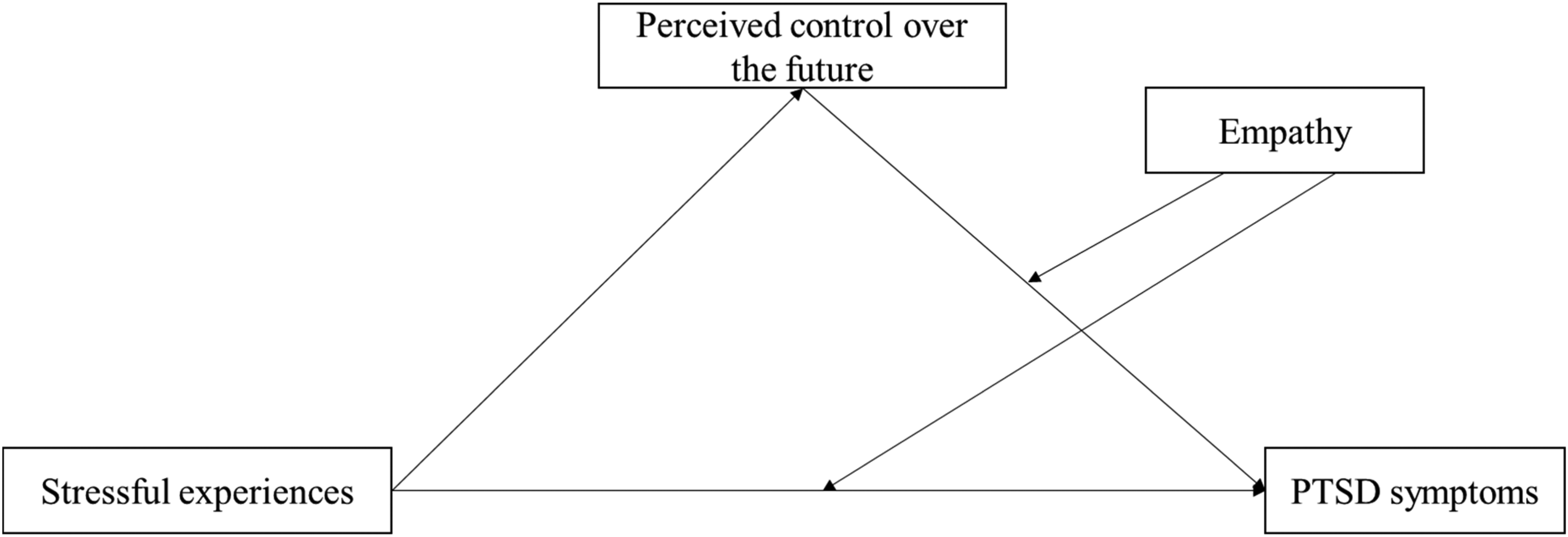
Conceptual model.
Methods
Sample and procedure
College students from mainland China were recruited during the outbreak of COVID-19 by a convenient sampling approach. Two waves of longitudinal data were collected through January to April, 2020, during the first wave of the pandemic in China (Leung et al., 2020). Wave 1 (W1) took place between January 31 and February 11, 2020, which was considered as the initial period of the COVID-19 epidemic (NHCC, 2020). And wave 2 (W2) took place between March 20 and April 4, 2020, when the pandemic was suppressed in China. A well-known Chinese online survey platform named SO JUMP was used to collect the data (Wang et al., 2015). To improve the sample representativeness, we recruited participants from different regions across geographical locations (i.e., Northern, Central, and Southern China). The regions can be divided into three groups according to the severity of the outbreak of COVID-19 (i.e., low, moderate, and high severity) at the time of the survey. The faculty members in psychology departments of colleges from these regions were contacted to release the invitation link of SO JUMP to their students. In order to recruit more participants, snowball sampling was also applied. Students may share the link to their peers online. The participants who took part in W1 and were willing to participate in W2 were contacted via email two months after the baseline survey. Data were collected within seven days after the invitations were sent at both waves. The inclusion criteria were college students (1) who enrolled in universities currently; (2) who were staying in the epidemic areas of mainland, China; and (3) were willing to participate in the program. Respondents were excluded if they (1) had already graduated or self-identified as prospective college students or (2) showed regularity in responses (e.g., incomplete or meaningless responses). Prior to the surveys, online informed consent was obtained. At the end of the survey, participants received some instructive advice regarding mental health management during the crisis. A total of 1,954 students were enrolled in the current study at W1, and 729 participants were excluded for invalid or completely missing data. As a result, the final sample included in the current analysis consists of 1,225 college students (Mage = 20.22, SD = 2.02) (Table 1). The response rate at T2 was 62.7%. Ethics approval was obtained from the Institutional Review Board of the Faculty of Psychology, Beijing Normal University (BNU; Figure 2).

The mediational analysis of perceived control over the future in the relationship between COVID-19-related stressful experiences and PTSD symptoms. Note: demographic variables were controlled for in the model, including age, gender, students’ major, and participants’ current residential area.
Demographics characteristics of the study sample (n = 1225).
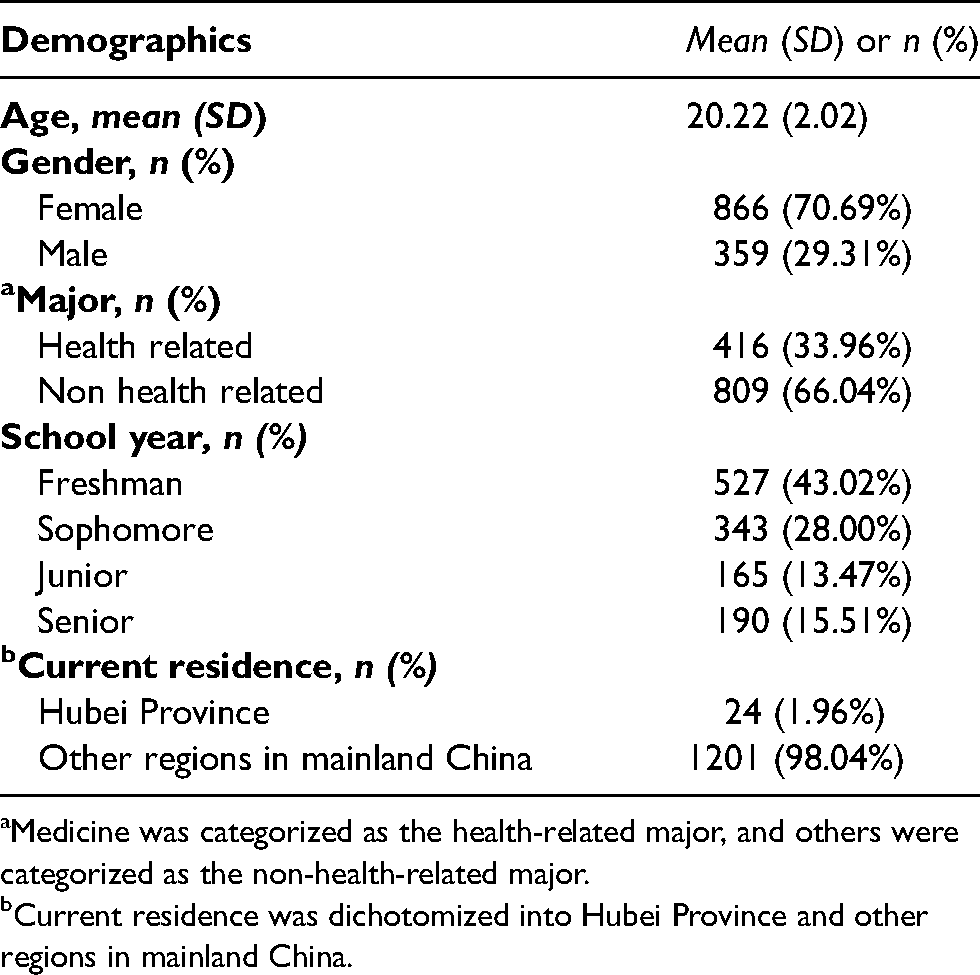
Medicine was categorized as the health-related major, and others were categorized as the non-health-related major.
Current residence was dichotomized into Hubei Province and other regions in mainland China.
Measures
Demographic characteristics
Age, gender, students’ major (e.g., health-related or others), and current residential area (whether in Hubei Province or other regions in mainland China). The demographic variables at W1 were used for analysis in this study.
COVID-19-related stressful experiences (W1)
Nine items adapted from the checklist of SARS-related stressors (Main et al., 2011) were used to assess the COVID-19-related stressful experiences in survey at W1. Students responded 1 (yes) or 0 (no) to these items, such as “feel upset or irritable because of the COVID-19-related news” and “disrupt the work or study plans.” Participants indicated whether each event occurred during the past month. The total number of events endorsed across all categories was computed. The range of score was from 0 to 9, with higher scores representing an accumulative exposure to more COVID-19-related stressors. Our previous study showed that this scale had good structural validity for Chinese college students (Tam et al., 2021).
Empathy (W1)
Participants’ empathy was measured by asking their responses to the five adjectives reflecting empathic concern (worried, concerned, empathic, compassionate, moved) on a 5-point Likert-type scale (1 = does not at all describe how I feel, 5 = describes how I feel extremely well) at W1. These items were adapted from previous studies, and the reliability coefficient ranged from 0.74∼0.78 (Oswald, 2002; Sun et al., 2011). The range of score was from 5 to 25, with higher scores indicating higher levels of empathy. Internal reliability for the items was strong (Cronbach’s α = .91).
Perceived control over the future (W1)
Perceived control over the future was measured using a 3-item scale adapted from the positive future outlook scale (Whitaker et al., 2000). Participants were asked to identify whether they have feelings of control as to what will happen in the future, whether they have great faith in the future, and whether their future is what they make of it. Responses ranged from 1 (not at all) to 4 (very much). The sum score of the 3 items were calculated to assess the levels of perceived control over the future. The range of score was from 3 to 12. Higher scores indicated a greater level of perceived control over the future. The scale also showed adequate internal consistency (α = .92; Figure 3).

Empathy moderated the association between perceived control over the future and PTSD symptoms.
Posttraumatic stress disorder symptoms (W2)
The 15-item Impact of Events Scale (IES) (Horowitz et al., 1979) was used to assess PTSD symptoms during the COVID-19 outbreak at W2. Participants were asked to rate on a 4-point Likert scale the extent to which each item described the frequency of PTSD experience and symptoms during the previous two weeks (e.g., “I had trouble falling asleep or staying asleep, because of pictures or thoughts about it that came into my mind” and “Pictures about it popped into my mind”). Higher scores indicated greater levels of PTSD symptoms. The IES has been widely used and has demonstrated good reliability and validity (Chernoff, 2007; Sikkema et al., 2007). In the present study, the internal consistency was excellent (α = .95).
Statistical analysis
Statistical analyses were performed using SPSS 22.0 and Mplus 7.1 (Muthén & Muthén, 2012). First, descriptive statistics and correlation analyses were performed among COVID-19-related stressful experiences, empathy, perceived control over the future, and PTSD symptoms. Second, a mediation model was established to examine the potential mediating role of perceived control over the future on the relationship between stressful experiences and PTSD symptoms, controlling for covariates (e.g., age, gender, students’ major, and participants’ current residential area). Third, a moderated mediation model analysis was conducted to examine whether empathy could moderate the direct path from stressful experience to PTSD symptoms as well as the path from perceived control over the future to PTSD symptoms. To avoid collinearity, stressful experience, perceived control over the future, and empathy were centered before conducting the moderated and mediation analysis. Bootstrapping was used to examine the significance of the mediating and moderating effects (Preacher & Hayes, 2008). Using 5,000 bootstrap samples, 95% confidence intervals (CI) were estimated. Conditional indirect effects from stressful experiences and PTSD symptoms through perceived control over the future by different levels (mean–standard deviation [SD], mean, mean + SD) of empathy were reported.
Chi-square (χ2) value was suggested to not be an ideal index for evaluating model fit with a large sample size (Meyers et al., 2013). To adjust this influence, χ2/df were used, and a model with χ2/df less than 3.0 would be considered as having good model fit. Additionally, other indices were used to evaluate the model fit, including Comparative Fit Index (CFI), Root Mean Square Error of Approximation (RMSEA), and Standardized Root Mean Square Residual (SRMR). The general cut-offs for accepting a model are equal to or greater than 0.90 for CFI, and less than 0.08 for RMSEA and SRMR (Muthén & Muthén, 2012). Simple slope tests were used to compare the hypothesized associations as a function of empathy.
To examine structural validity, we employed confirmatory factor analysis (CFA) on the study measures (i.e., COVID-19-related stressful experiences, perceived control over the future, empathy, and PTSD symptoms). The CFA model for one measure (e.g., empathy) was set to test a one-factor latent structure loaded by its items. Results suggested that the CFA models showed great fitness to data (CFIs = .96–1.00, TLIs = .90–1.00, RMSEAs = .00–.08), suggesting that the scales in the current study had generally good structural validity.
Results
Preliminary analysis
Among the sample, 866 of them were females (mean = 20.22 years of age, SD = 2.02). Nearly a quarter (33.96%, 416/1,225) of the participants were in medical-related majors. Particularly, there were 1.96% (24/1,225) of the students who were in Hubei Province, the province that was considered as the epicenter of the COVID-19 outbreak in China.
Descriptive statistics and bivariate associations among variables that were included in the model are presented in Table 2. Stressful experiences at W1 were positively and significantly correlated with PTSD symptoms at W2 (r = .10, p <.001), whereas it was negatively and significantly associated with perceived control over the future at W1 (r = −.13, p <.001). Empathy was significantly and positively associated with perceived control over the future at W1 (r = .32, p <.001). Perceived control over the future at W1 was negatively and significantly associated with PTSD symptoms at W2 (r = −.15, p <.001).
Testing for the mediation effect of perceived control over the future
Path analysis was used to examine whether perceived control over the future at W1 could mediate the relationship between stressful experiences (W1) and PTSD symptoms (W2). After controlling for covariates (e.g., age, gender, students’ major, and current residence), results suggested an excellent model fit, with χ2/df = 1.93, CFI = .97, RMSEA = .03, and SRMR = .02. Stressful experiences were negatively associated with perceived control over the future (β = −.12, p <.001) whilst positively associated with PTSD symptoms (β = .08, p = .01). The path from perceived control over the future to PTSD symptoms was also significant (β = −.13, p <.001), with higher levels of perceived control over the future predicting lower levels of PTSD symptoms. The results from bootstrapping showed that the indirect effect from stressful experiences to PTSD symptoms via perceived control over the future was significant, with standardized indirect effect of .09 (95% confidence interval [CI] = [.041, .162]). Therefore, results suggested that perceived control over the future partially mediated the association between stressful experiences and PTSD.
Testing for the moderated mediation model
After centering the variables and adjusting covariates in the model, a mediation model of stressful experiences, perceived control over the future, and PTSD symptoms was performed and the moderating effects of empathy on the relationships between these variables were examined. The model fitness was good (χ2/df = 1.85, CFI = .97, RMSEA = .03, and SRMR = .02).
As shown in Table 3, stressful experiences were negatively associated with perceived control over the future (β = −.11, p < .001), which, in turn, was negatively associated with PTSD symptoms (β = −.17, p < .001). Stressful experiences were positively associated with PTSD symptoms (β = .08, p = .01). The interaction of perceived control over the future and empathy was statistically significant (β = −.07, p = .03) while the interaction of stressful experiences and empathy was not significant (β = .00, p = 0.99). Empathy was significantly and positively associated with PTSD (β = .07, p = .02).
Descriptive statistics and correlations of measured variables.

Note: * p < .05, ** p < .01, *** p < .001. SD : Standard Deviation
Path coefficients in moderated mediation model.

Note: N = 1,225, PTSD symptoms : posttraumatic stress disorder symptoms; B: estimate; S.E.: Standard Error; β: standardized estimate; C.I.: Confidence interval. Demographic variables were controlled for in the model, including age, gender, students’ major, and participants’ current residential area.
Results of mediation analysis showed that all conditional indirect effects from stressful experiences to PTSD symptoms through perceived control over the future were statistically significant. At different levels of empathy (mean–SD, mean, mean + SD), perceived control over the future consistently mediated the relationship between stressful experiences and PTSD symptoms (see Table 2).
Simple slope tests indicated that the association between perceived control over the future and PTSD symptoms was stronger for participants with high levels of empathy (Bsimple = −1.31, SE = .21, p < .001) than those with low levels of empathy (Bsimple = −.73, SE = .18, p < .001).
Discussion
Based on the COR theoretical framework, this study used a longitudinal design to timely capture the PTSD symptoms in response to COVID-19 among a large sample of Chinese college students. To the best of our knowledge, this is among the first of longitudinal studies examining the mechanism of COVID-19-related stressful experiences on PTSD symptoms during the early stages of the COVID-19 pandemic. The current study indicated that stressful experiences at W1 were significantly associated with PTSD symptoms at W2, and such a relationship could be mediated by perceived control over the future. Specifically, the mediating effect of perceived control over the future was stronger for individuals who exhibited higher levels of empathy. The current study applied the COR theory to explain the development of PTSD symptoms among Chinese college students in response to stress experiences related to COVID-19. Findings provided an in-depth understanding of the negative impacts of stressful experiences on PTSD symptoms in the context of COVID-19, and this could inform psychological distress prevention interventions for emergent crises.
The present study suggested that COVID-19-related stressful experiences could contribute to PTSD symptoms. The strong association between COVID-19-related stressful experiences and PTSD symptoms reflects that this crisis has brought obviously psychological impacts on college students. It was consistent with previous research that revealed that COVID-19-related stress might bring severe psychological symptoms to the public (Wang et al., 2020). Particularly, young adults were at a high risk to develop severe PTSD symptoms following the COVID-19 outbreak because of the serious damage of life beliefs and economic hardship (Sun & Zhou, 2022; Tang et al., 2020). It is worth noting that the posttraumatic stress symptoms caused by COVID-19 pandemic may last for a long time. For example, a nine-month longitudinal investigation suggested that the prevalence of PTSD symptoms varied from 11% to 13% during three COVID-19 waves, and that 23% of participants exhibited clinical PTSD symptoms during the nine months (Somma et al., 2021). In addition, a longitudinal study indicated that although PTSD symptoms generally declined throughout the six months after the outbreak of COVID-19, the prevalence of it remained relatively high among Chinese college students(Chi et al., 2021). Hence, our findings implied that psychological aspects of COVID-19 merit high attention and intervention measures for PTSD symptoms appear to be critical specifically in the early stages of the outbreak of infectious diseases.
In addition, this study found a significant mediating effect of perceived control over the future on the relationship between stressful experiences and students’ PTSD symptoms. The results supported the COR theory and added to growing literature on psychological influences of the COVID-19 pandemic, revealing the role of perceived control over the future in the underlying mechanism between traumatic events and acute psychological responses. Perceived control over the future was related to hope, expectations for the future, and feelings of mastery over their own situation (Larsen & Fitzgerald, 2011). During the COVID-19 pandemic, young adults faced various stressors, such as prolonged school closure, transformation to online classes, uncertainty regarding their academic future, and social isolation during home quarantine (Yang et al., 2021; Zhan et al., 2021). These pervasive traumatic events will lead to additional psychological burdens and loss of supportive resources, which could threaten young adults’ sense of control over the future, and in turn elevate severe psychological responses (i.e., PTSD symptoms). The results of the current study were in line with previous research suggesting that perceived control over the future played a key role in explaining the path between stress and psychological responses in vulnerable populations (Larsen & Fitzgerald, 2011). Therefore, the present study extends the previous research by focusing on the potential mediating mechanism of cognitive domain of future orientation (i.e., perceived control over the future) in the association between COVID-19-related stressful events and psychological responses (i.e., PTSD symptoms).
The current study also explored the moderating effect of empathy on the direct/indirect relationship between stressful experiences and PTSD symptoms via perceived control of the future. On one hand, although our results showed that empathy at W1 was positively directly associated with PTSD symptoms at W2, the moderating effect of empathy on the direct relationship between stressful experiences (W1) and PTSD symptoms (W2) was not significant. This indicated that the detrimental effect of COVID-19-related stress on PTSD symptoms was about the same for college students regardless of the levels of empathy. On the other hand, we found that individuals with higher levels of empathy and perceived control over the future were less likely to experience PTSD symptoms after exposure to COVID-19-related stressful events two months later. The findings indicated that perceived control over the future interacted with empathy to buffer the detrimental impact of stressful experiences on PTSD symptoms. From a long-term perspective, empathetic feelings and emotional connectedness with health professionals, patients, and their families in severe epidemic areas (e.g., Hubei Province) promote the assessments of other people’s situations and develop motivations to posttraumatic growth (Siem & Stuermer, 2012). Individuals with higher levels of empathy may be more likely to exhibit prosocial behaviors (e.g., considering the others’ state of need, establishing positive interpersonal attitudes, and providing help to others). These prosocial reactions with others may facilitate strong cohesions in social groups. Strong social cohesions would reinforce individuals’ confidence over their future and develop positive coping strategies, which would reduce acute psychological responses (Batson, 2014; Zhou et al., 2019). Accordingly, empathy and perceived control over the future are interactive, and these two factors would work together to reduce psychosomatic symptoms among college students during the COVID-19 outbreak in China. It is implied that the psychological intervention should be tailored to empower young adults with more resources, such as positive coping strategies and social support, to enhance the protective effect of perceived control over the future, and such intervention should also highlight the importance of empathy training.
Taken together, our findings suggested that empathy may be a risky strength that would have immediate negative effects on psychological responses but positive effects on psychological well-being in the long term during emergency public crises, such as the COVID-19 outbreak. From a theoretical perspective, the current study supported the COR theory that those with greater resources were more capable of orchestrating resource gain (i.e., maintenance of high perceived control over the future), which in turn decreases the psychological response after exposure to stressful events. In order to improve young adults’ levels of mental health, more efforts on intrapersonal and interpersonal resources promotion may be needed in the psychotherapy targeting PTSD symptoms. Especially, early psychological interventions focusing on development of empathy skills, such as understanding and accepting others’ emotions, and online peer support group sessions sharing traumatic experiences and feelings may be valuable for individuals to reduce psychological responses, such as PTSD symptoms.
Limitations and implications
Although this study contributed valuable insight into the longitudinal relationship between COVID-19-related stressful experiences and PTSD symptoms, and the role of perceived control of future and empathy in this relationship, there were several methodological limitations that need to be acknowledged. First, the participants were recruited using a convenience sampling approach, and the sample was overrepresented by women (approximately 70.69%), which indicates that our findings would be subject to selection bias on gender. However, it is worth noting that we recruited a large sample from over 20 universities, which were located in different regions of China. Such a large sample from across different regions may partially improve the external validity of our findings. Future study would benefit from using a randomized sampling approach. Second, given that some study variables were not included in both waves due to the space limits of the online survey, therefore our findings could not infer causality. Future research will benefit from utilizing a multiple-wave longitudinal design. Third, self-reported measures were used in this study, and self-reported bias (e.g., social desirability) may exist. Data from multiple sources (e.g., peers and parents) are preferred to avoid same-method measurement errors.
Despite these limitations, this study has important implications. Guided by the COR theory, the current study presented the chronic psychological symptoms and underling mechanism in response to the COVID-19 pandemic. Identifying the key factors that may lead to severe psychological responses is of significant value to decrease mental health problems during emerging public health crises. The present study illustrated the importance of developing efficient and effective psychological assistance that increased the resources possessed by young adults for positively coping with the traumatic stressors they encountered. For instance, mental health educators or psychologists should maintain/improve their efforts in identifying individuals suffering from chronic psychological responses during the COVID-19 pandemic and provide them with emergent psychological crisis preventions (Liu et al., 2020). Furthermore, resilience-based abilities and resources should be included as important components of interventions, particularly encouraging individuals to realize and express their concern about the coronavirus and people who are experiencing traumatic events. It is also important to help the individuals to be optimistic and plan for their future, foster a positive sense of control, and improve their confidence about the future.
Footnotes
Declaration of conflicting interests
The author(s) declared no potential conflicts of interest with respect to the research, authorship, and/or publication of this article.
Funding
The author(s) disclosed receipt of the following financial support for the research, authorship, and/or publication of this article: this work was supported by the Zhejiang Philosophy and Social Science Foundation, National Natural Science Foundation of China (grant number 22NDQN281YB, 32071076).
