




Abstract
It will be helpful for older people to maintain good mental health by improving their marital satisfaction. The present study investigates how the elements of marital satisfaction among older couples are related to each other and reveal the key elements. Four hundred ninety-four older people participated in the study. Marital satisfaction was assessed by the 10-item marital satisfaction subscale of the ENRICH scale. Network analysis was adopted to estimate the network structure of these 10 items and the strength centrality of each item was calculated. The results showed that all edges in the final network were positive. Four edges with the strongest regularized partial correlations appeared between “leisure activities and spending time together” and “emotional expression”; “personality and habits” and “communication and understanding”; “economic status and the manner of determining economic affairs” and “relationship with relatives and friends”; and “make decisions and resolve conflict” and “emotional expression.” In addition, “emotional expression” had the highest node strength value in the network. “Communication and understanding” and “views are consistent” had the second and third highest node strength values, respectively. “Views are consistent” was more central in males than females and was the second central node in male networks. In conclusion, the present study offers a new perspective to deepen the understanding about the internal structure of marital satisfaction among older couples via network analysis. The results might provide potential targets of intervention for social workers or family therapists to greatly improve marital satisfaction among older couples.
Keywords
Introduction
Marital satisfaction refers to an individual's attitudes and views on spouses and marital relationships (Hamilton, 1929), which is considered to be a key factor in marital quality (Li & Fung, 2011) and an important path that affects marital outcomes (Karney & Bradbury, 1995). Chapman and Guven (2016) point out that the subjective well-being of individuals is affected by marital satisfaction, and people with poor marital satisfaction are less happy than unmarried people. In addition, as the world's population is getting older, mental health problems among older people are gradually increasing (Heine et al., 2019; McDonough & Allen, 2019; Peterson & Ralston, 2019). It is important to not only improve quality of life but also to maintain good mental health for older people's happiness (Kamp Dush et al., 2008). The famous Grant study shows that intimacy is the most important ingredient for happiness (Vaillant, 2012) and the most intimate and lasting is the marital relationship among intimate relationships (Levenson et al., 1993). However, according to socioemotional selectivity theory, older people will be more affected by the quality of intimate relationships, especially when they perceive their lifetime to be limited (Carstensen, 1995; Carstensen et al., 2003, 1995). Therefore, one of the ways to promote older people's happiness and maintain their mental health is to improve their marital satisfaction.
There are a large number of studies on marital satisfaction among older people, which are inspiring for improving their marital satisfaction. For example, many studies have shown that some factors, such as family coping strategies (Murphy et al., 2015), health problems (Korporaal et al., 2013), marital interaction (Schmitt et al., 2007), social support (Polenick et al., 2017), and sexual satisfaction (Guo & Huang, 2005) have close relationships with marital satisfaction in older people. In addition, there may be gender differences. For instance, the link between marital satisfaction and social support is stronger for women than men (Acitelli & Antonucci, 1994), and when men perceive difficulties in their marriage, it might have a more sizeable and salient effect on their marital satisfaction (Boerner et al., 2014). The results of these studies showed that social workers or family therapists could help older couples improve their marital satisfaction by providing some effective family coping and communication strategies or social support, and so on, and they could also act differently based on gender differences.
Generally, in the above studies, researchers used total score of some scale (e.g., the marital satisfaction subscale of the Evaluation and Nurturing Relationship Issues, Communication and Happiness; ENRICH), which included many items that evaluate some attitudes and views on spouses and marital relationships, to measure the marital satisfaction among older couples. In this way, all the attitudes and views (i.e., items) were combined into a scale by factor analysis. Specifically, the attitudes and views were combined into a scale on account of the correlation coefficient (the principle of factor analysis), and they are regarded as equivalent latent variables, as a result, a total score could be got by adding them up. However, marital satisfaction may be a complex construct, the attitudes and views may not be equivalent, and this construct might itself have internal structural features. For example, the attitude and view may interact with each other (i.e., the interactivity), and some attitude or view may be crucial for the marital satisfaction (i.e., there is one central element). In fact, similar assumptions have been confirmed in an increasing number of studies, such as decision-making competence (Peng et al., 2020), resilience (Briganti & Linkowski, 2020), well-being (Stochl et al., 2019), stigma (Wei et al., 2020), burnout (Wu et al., 2021), intolerance of uncertainty (Bottesi et al., 2020), and dark personality traits (Marcus et al., 2018). All of these studies have investigated the construct's internal structure and central elements, which adopted a new and promising approach, namely network analysis. It is of great significance for improving our understanding of the construct, and it is a great inspiration to the related intervention (Borsboom & Cramer, 2013; Elliott et al., 2020), that is, the intervention based on the research finding may be more effective. However, there is no study applying network analysis to investigate the internal structure of marital satisfaction among older couples at present.
According to network theory, psychological constructs may be viewed as a complex system of causally coupled variables rather than isolated traits. In line of this view, marital satisfaction does not necessarily act as a latent factor that generates reflective indicators (i.e., items of the scale), but it may emerge from the putatively causal interaction among specific attitudes or views on spouses and marital relationships. In other words, as compared to factor analysis that investigates which observable elements (i.e., items) are likely to cluster due to the presence of a latent factor, network analysis sheds light on how different elements are theoretically directed (i.e., inhibiting or reinforcing) to one another (Bansal et al., 2020). It is worth mentioning that, although factor analysis and network analysis are statistically equivalent, they propose contrasting data-generating mechanisms, which lead to substantially different interpretations of the statistical models (van Bork et al., 2021). From a latent factor standpoint, the presence of an older person’s marital satisfaction actively generates a variety of attitudes or views on spouses and marital relationships, which are independent from one another, in that they are epiphenomena of the same cause (i.e., latent marital satisfaction). From a network analysis standpoint, an older person might initially like the spouse's personality and habits and, consequently, be satisfied with their responsibilities, communication, and emotional expression. These helpful attitudes and views could drive satisfaction with the way older couples make decisions and resolve conflicts, or the division of responsibilities in dealing with children's problems, and so on. Similarly, older people may be satisfied with how they manage their leisure activities and the time they spend together and, consequently, positively reinforce the positive attitudes and views on other aspects of their marital lives. That is, attitudes and views on spouses and marital relationships strongly influence one another and eventually lead to marital satisfaction. In short, network analysis does not necessarily depend on the definitions of latent variables, or namely, it is not based on the hypothesis that the observed variables are related due to their sharing a common latent variable. Instead, network analysis is purely based on the modeling of the observed variables.
In network analysis, the observational variables are regarded as nodes, and the between-node edges are regarded as the correlations between observational variables. Under the drive of data, a network composed of nodes and edges can visualize the associations among variables (Borsboom, 2008). In addition, a weighted association network (e.g., the mainstream Gaussian graphical model) not only considers whether there is association between nodes, but also considers whether the between-node association is strong or weak (Drton & Perlman, 2007). That is, in psychology research, due to the presence of numerous nodes, “false” correlations easily exist: if two nodes are both correlated with a third node, even these two nodes are not directly related, they may still be analyzed as a “significant correlation” statistically (Pourahmadi, 2011). To avoid the misguidance, Pourahmadi (2011) used the partial correlation coefficient in network analysis to more accurately reflect the real between-node associations. Partial correlation networks that have also been called Gaussian graphical models (GGMs) could offer routes to accurately explore the between-node associations (Borsboom & Cramer, 2013; Epskamp & Fried, 2018). Furthermore, network analysis allows one to assess the importance of each variable in the network by providing some centrality indices. A node with high centrality may play an important role in activating or maintaining a network as well as providing potential targets for related intervention. This view has received support from clinical studies, for example, Elliott et al. (2020) found that the central nodes within the symptom network of anorexia nervosa at baseline were strongly related to prognostic utility (i.e., post-treatment outcomes and clinical impairment). Following this line of reasoning, the network approach is especially attractive for researchers to identify the most “centrality” item of marital satisfaction among older couples and thereby develop effective interventions.
In summary, network analysis could offer a new way to gain further knowledge about the internal structure of marital satisfaction among older couples, by primarily focusing on single items of the marital satisfaction scale (i.e., nodes) and the link between them (i.e., edges), network analysis could answer three specific questions as follows: (1) the specific associations between the marital satisfaction scale items (i.e., network structure); (2) which item is the most connected of the network (i.e., node centrality); (3) whether the network characteristics (i.e., network structure and node centrality) of marital satisfaction varies in older female and male groups (i.e., network comparison).
Methods
Participants
The data sourced the first batch of paired data from a study on the stability of attachment in Chinese older couples, which was granted by the Chinese Ministry of Education Humanities and Social Sciences. Four hundred ninety-four older people (247 couples) participated in the project and came from the communities of Haidian District, Beijing. They were 68.19 ± 5.45 years old on average and married for 42.49 ± 7.09 years on average. They had 1.83 ± 0.81 children, and the monthly household income was 5000∼8000 RMB. Their average education levels were high school and above.
Measurement
The marital satisfaction subscale of the ENRICH was applied. It was designed by Schaefer and Olson (1981). At present, this subscale has been commonly used (Naghiyaee et al., 2014; Shareh & Sani, 2019; Yoshany et al., 2017; Zarei et al., 2019). It includes 10 items. The total score on the 10 items is used as a measure of marital satisfaction. This subscale's Chinese version was revised by Li (1999) and includes 10 items too, such as “I am satisfied with the way we make decisions and resolve conflicts” (Table 1). Each item has a 5-point score ranging from 1 (strongly disagree) to 5 (strongly agree). The internal consistency was good (α = .83).
The results of each item's descriptive statistics.

Design and procedure
We received approval from the Haidian District Government first before starting the project. Then, the government helped us contact the communities, and the communities arranged the study in neighborhood committees. Finally, the researcher visited the subject's home to fill out a one-on-one questionnaire in a separate and soundproofed room. The researcher read aloud the items one by one, and the subjects answered successively. If the subjects did not understand an item or did not hear clearly, the researcher provided some explanation or repeated it. The subjects were invited to sign one informed consent form before the questionnaire.
Network analysis
In the present network, nodes represent the items on the marital satisfaction subscale of the ENRICH, and edges represent the associations between any two items. Gaussian graphical models were used to estimate the networks (Epskamp et al., 2018b; Lauritzen & Wermuth, 1989). Therefore, the edges in the network depict partial correlations between each pair of items after controlling statistically for all other items in the network (Epskamp & Fried, 2018). The nonparametric Spearman rho correlation matrices were used as input to estimate the GGMs (Epskamp & Fried, 2018). In addition, the present study applied a graphical least absolute shrinkage and selection operator (LASSO) algorithm to regularize the GGMs (Epskamp & Fried, 2018). This algorithm shrinks all edges and sets small edges to zero to obtain sparse networks that are easier to interpret and more stable (Friedman et al., 2008). We set the hyperparameter to 0.5 to balance the sensitivity and specificity of identifying true edges (Foygel & Drton, 2010). The layout of the network was based on the Fruchterman–Reingold algorithm, which locates nodes with stronger connections near the center of the network and nodes with weaker connections near the periphery of the network (Fruchterman & Reingold, 1991). Blue edges in the network depict positive partial correlations, whereas red edges depict negative partial correlations. The thicker the edges are, the stronger the partial correlations between the nodes. As a reviewer's suggestion, we also constructed a Bayesian network for marital satisfaction among older couples. Bayesian networks are probabilistic graphical models that represent conditional independence associations among variables as a directed acyclic graph (DAG; Briganti et al., 2022). The analysis process and code are consistent with previous studies (for more details see Blanchard et al., 2021; Heeren et al., 2021).
The strength centrality, which sums up the absolute value of the edge weights connected to a node and is the most reliable centrality index, was used to assess and quantify the importance of each node in the present network (Bringmann et al., 2019). The higher the strength value is, the greater the relative importance of the node in the network. We conducted network estimation and visualization and centrality analysis using the R package qgraph (Epskamp et al., 2012). Moreover, the predictability of each node was calculated by running the R package mgm (Haslbeck & Fried, 2017). Predictability is defined as the variance of a node that is explained by all its neighboring nodes. This absolute measure characterizes the controllability (or determination) of a node: the higher predictability a node has, the more we can control it by its neighboring nodes in the network (Haslbeck & Fried, 2017).
We used the R package bootnet to examine the robustness of the present network (Epskamp et al., 2018a). First, we constructed 95% confidence intervals (CIs) using a nonparametric bootstrap approach with 2,000 samples to evaluate the accuracy of edge weights. Second, we calculated the correlation stability (CS) coefficient using a case-dropping bootstrap approach with 2,000 samples to evaluate the stability of node strengths. This coefficient should not be below 0.25 and preferably should be above 0.5 (Epskamp et al., 2018a). Third, we performed bootstrapped difference tests with 2,000 samples for edge weights and node strengths to determine whether two edge weights or two node strengths differ significantly from one another.
Finally, we used the R package NetworkComparisonTest to compare whether gender differences existed in marital satisfaction network (permutations = 1,000). Specifically, we compared global strength (summed edge weights of the networks), edge weight, node strength of marital satisfaction network in male and female older couples. Since we had no a priori hypotheses about differences in edges, corrections for multiple comparisons were not used when testing them in the present exploratory setting (van Borkulo et al., 2022).
Results
Results of descriptive statistics
The results of descriptive statistics for each item in the marital satisfaction subscale of the ENRICH are shown in Table 1. In addition, the nonparametric Spearman rho correlation matrix among the items is shown in Table S1 (see Supplementary Materials).
Network structure
As can be seen in the final network (Figure 1), several characteristics were immediately obvious. First, 36 (80.0%) out of the 45 possible edges were nonzero, and they were all positively correlated with each other. Second, four edges with the strongest regularized partial correlations appeared between MS6 “leisure activities and spending time together” and MS7 “emotional expression” (r = 0.33); MS1 “personality and habits” and MS3 “communication and understanding” (r = 0.30); MS5 “economic status and the manner of determining economic affair” and MS9 “relationship with relatives and friends” (r = 0.24); and MS4 “make decisions and resolve conflict” and MS7 “emotional expression” (r = 0.22). Third, the mean node predictability ranges from 0.23 to 0.50, with an average value of 0.34. This finding indicates that 34% of the variance in a node is explained by its neighboring nodes on average. MS7 had the highest predictability, which means that MS7 shares 50% of the variance with its neighboring nodes. MS9 had the lowest predictability, which means that MS9 shares 23% of the variance with its neighboring nodes. The values of predictability are shown in Table 1. In the Bayesian network, DAG showed that MS7 “emotional expression” arises at the top of the DAG, directly influencing the other marital satisfaction items (more details see Figure S1 and Table S2 in Supplementary Materials).

The network structure of marital satisfaction among older couples. Note: The blue edge represents positive correlation, red edge represents negative correlation. The thickness of the edge reflects the magnitude of the correlation. The ring around the node depicts its predictability.
Node centrality
The node strengths (z-scores) are shown in Figure 2 and Table 1. MS7 “emotional expression” had the highest strength value, which suggested that MS7 was the most connected node in the network from a statistical perspective. MS3 “communication and understanding” and MS10 “views are consistent” had the second and third highest node strength values, respectively. In addition, MS1 “personality and habits” had the lowest strength value, which suggested that MS1 was the least connected node in the network from a statistical perspective.

Z-scored node strength of each item in the marital satisfaction network.
The robustness of network
The CI of edge weights derived from 2,000 bootstrap samples is shown in Figure 3. This relatively small CI means that the estimation of edge weights was accurate. The CS coefficient of node strengths was 0.67 (see Figure 4). This value means that the estimation of node strengths was adequately stable.

The accuracy of edge weights. Note: The red line depicts the sample edge weights and the gray bar depicts the bootstrapped confidence interval.
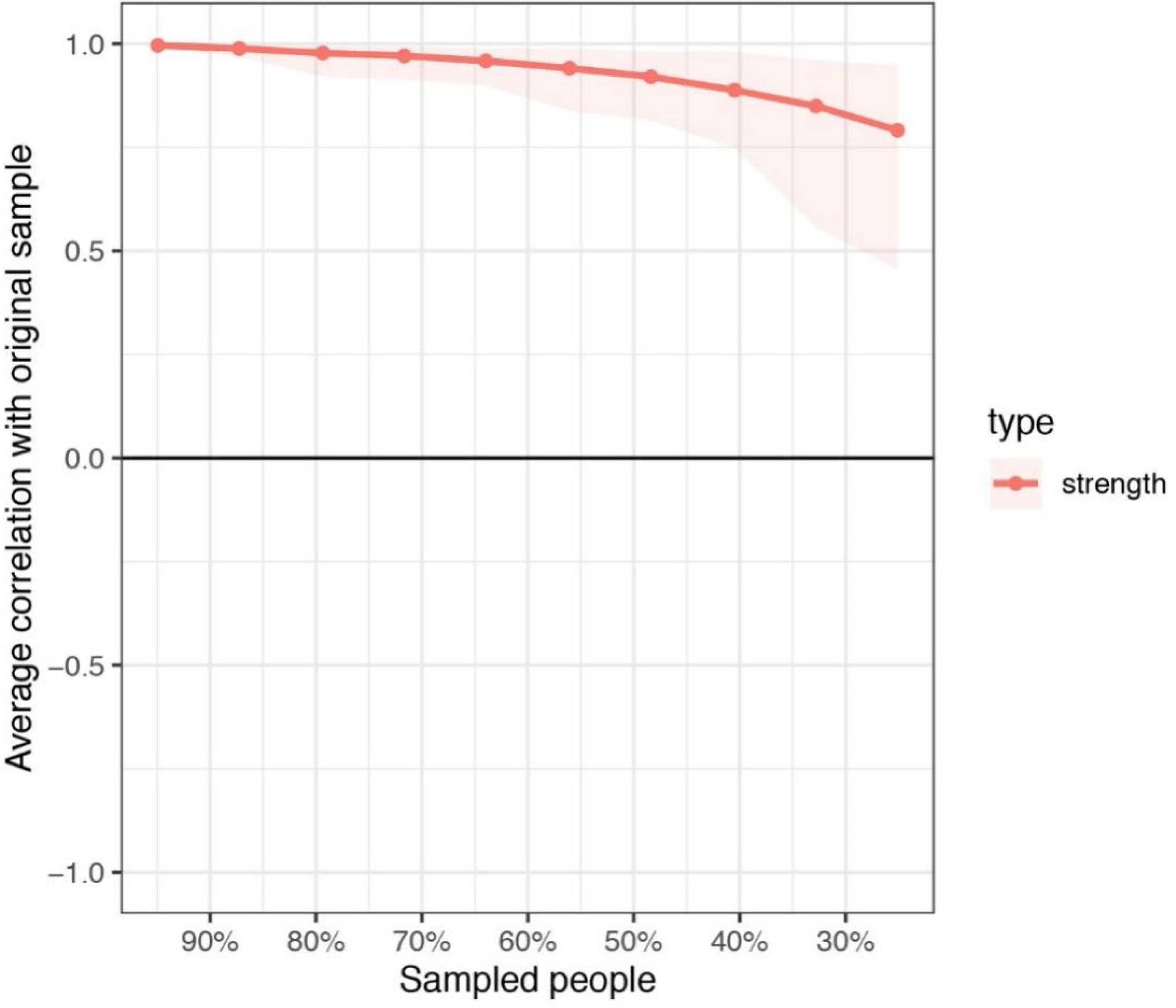
Strengths stability. Note: The red line represents the average correlation between strength in the original sample and subsamples, with the red area representing the 2.5th quantile to the 97.5th quantile.
The bootstrapped difference tests for edge weights and node strengths both showed significant differences among edge weights and node strengths in the present network, and the proportion of the differences ranged from small to moderate (see Figures S2 and S3 in Supplementary Materials). There were significant differences between the strength of MS7 “emotional expression” and the strengths of all the other items.
Network comparisons
As for network global strength, we did not find significant gender differences (Global strength [S] = 0.003, male = 4.136, female = 4.139.48, p = 0.99). There was significant difference between the genders only in one edge (i.e., MS2 “responsibilities” and MS6 “leisure activities and spending time together,” p = 0.04) and this edge was positive in the female network but not connected in the male network. In addition, two nodes’ strength existed in gender differences: MS2 “responsibilities” was more central in the female network than the male; MS10 “views are consistent” was more central in the male network than the female and was the second central node in the male network (see Figure S4 in Supplementary Materials). However, the most central node MS7 “emotional expression” did not have gender difference. That is, MS7 “emotional expression” had the highest strength in both male and female networks (see Figure S4 in Supplementary Materials).
Discussion
For several decades, the issue about the quality of marital relations has been an important, intensely explored field in social sciences, including psychology. However, a large number of researches have focused mainly on couples in early and middle adulthood. Consequently, there exists a considerable research blind spot when it comes to marital satisfaction in people aged 60 to 75. There are numerous reasons to explore the factors that contribute to happiness in marriage among older couples. First, the world's population is getting older. Experts estimate that by 2030 elderly people will make up to 30% of the global population. Thus, it can be expected that the number of married couples aged more than 60 will increase. Second, marital satisfaction is an important contributor to psychological well-being. This applies also to elderly couples. There is an extensive body of research whose results indicate a strong correlation between the quality of a relationship, the perceived quality of life, happiness, and psychological and physical health in the elderly. Third, according to lifespan psychology, late adulthood is a period of substantial changes in the psychological life of humans. This fact implies the necessity to develop a dedicated psychological approach towards this age group, where the typical factors determining their marital satisfaction should be investigated and elaborated upon.
The present study adopts network analysis to investigate the internal network structure of the 10 items (i.e., attitudes and views on spouses and marital relationships) of the marital satisfaction subscale of ENRICH and calculate the strength centrality for each item, which aims to explore the associations among the items and identify the central item determining older couples’ marital satisfaction. In addition, it investigates the gender differences in marital satisfaction network by network comparison test.
Internal structure of marital satisfaction among older couples
The present study showed that all nodes in the network of marital satisfaction were positively associated. That means that the specific attitudes and views of older couples’ marital satisfaction are complexly correlated with each other in its internal structure. First, the results of the edge weights showed that MS6 “leisure activities and spending time together” and MS7 “emotional expression” were the most closely related. That is, when the score on MS6 was high, the score on MS7 was high. This association might indicate that if older couples are satisfied with their emotional expression, they are happy with how they manage their leisure activities and the time they spend together, or vice versa, or the two elements interact with each other. Actually, a previous study has revealed that leisure plays a positive role in marital life (Sharaievska et al., 2013). Leisure strengthened couples’ marriages and provided opportunities for healthy communication and spending quality time together (Johnson et al., 2006). Second, close associations were also found between MS1 “personality and habits” and MS3 “communication and understanding.” It might mean that spouses’ personality and habits might be the basis for communication and understanding each other. As Wang et al. (2018) noted, being similar in personality may be a benefit to older couples’ marriages. Third, the possible reason for the close association between MS5 “economic status and the manner of determining economic affairs” and MS9 “relationship with relatives and friends” may be that economic affairs usually involve relatives and friends for Chinese older couples. Finally, the close association between MS4 “make decisions and resolve conflict” and MS7 “emotional expression” is basically consistent with previous studies (Du Plooy & de Beer, 2018; Schmitt et al., 2007). It might indicate that if older people express more positive emotion in making decisions and resolving conflict, they are happier.
Central element of marital satisfaction among older couples
Node strength centrality may play an important role in finding items that activate or maintain networks as well as providing potential targets for intervention (Ren et al., 2021). Therefore, one main purpose of the present study was to identify the central node (i.e., item) in the network of the marital satisfaction subscale, which might be helpful for social work researchers or family therapists to improve older couples’ marital satisfaction effectively. Although it is feasible to intervene in any item of marital satisfaction for improving marital satisfaction, when social workers or family therapists want to achieve the maximum effect, they should consider the item with the highest centrality. This is because, according to network analysis theory, the activation of the item with highest centrality is more likely to propagate activation to the whole network through general connections with other items. The result showed that the item MS7 “emotional expression” has the highest centrality (i.e., most central), which indicates this item plays the most important role in activating and maintaining the marital satisfaction network. In addition, the DAG of marital satisfaction among older couples also showed that MS7 “emotional expression” has the highest predictive (and potentially causal) priority (more details see Figure S1 and Table S2 in Supplementary Materials). In short, both results complement each other and validate the importance of MS7 in the network. Therefore, for social work researchers or family therapists, related interventions targeting “emotional expression” may maximize the overall level of marital satisfaction in older couples.
According to the socioemotional selectivity theory, as older people perceive their lifetime to be limited, life goals shift from expansive goals to emotionally meaningful goals (Carstensen & DeLiema, 2018). Their positive emotion behavior also increases and negative emotion behavior decreases with age (Verstaen et al., 2020). Intimate partners provide benefits beyond emotionally meaningful interactions (Carstensen et al., 2003). Spending time with their partner may offer a sense of continuity in one's life or provide comfort during difficult times (Carstensen et al., 2003). In addition, the above characteristics of older people may also be related to their emotional regulation. Studies have shown that older people in many cultures are skilled in emotion regulation (Gross et al., 1997) and the reappraisal strategy is used more as people age (John & Gross, 2004) and focus more on positive rather than negative stimuli (Carstensen & Mikels, 2005). However, East Asian (e.g., Chinese) culture encourages emotional suppression to preserve interpersonal harmony (Lu et al., 2018), a suppression strategy that may also be effective for Chinese older people (Yeung & Fung, 2012). In other words, the emotion regulation strategies of Chinese older people may be more abundant, which may prompt their emotional expression in marriage more reasonably (e.g., the suppression strategy may make them not express negative emotions excessively and freely) for satisfying with the marriage. Therefore, it was not surprising to find that MS7 “I am satisfied with the emotional expression between us” was the most central node in the marital satisfaction network. Actually, previous research has also shown the importance of emotion in marital satisfaction (Ingoldsby et al., 2005). However, previous study has used traditional statistical methods (i.e., regression analysis and structural equation modeling analysis) based on a latent variable model, while the present study used network analysis, which is completely driven by the data and has proven the previous study from a new perspective. These studies are complementary and make the conclusion more reliable.
In addition, the present study found that MS3 “communication and understanding” and MS10 “views are consistent” have the second and third highest node strength values in the network, respectively. This finding shows that marital interactions are second in importance for older couples. Similarly, it means that social work researchers or family therapists could also intervene in the “communication and understanding” and “views are consistent” to improve older people's marital satisfaction besides targeting “emotional expression.” In other words, although it would not be to the maximum effect, older couple's marital satisfaction could also be improved to some extent by targeting “communication and understanding” or “views are consistent.”
Gender differences in marital satisfaction network
The network comparison between genders found that there were few differences in the network structure, and MS7 “emotional expression” remains the most central node in both groups’ network.
However, for elderly females, the edge between MS2 “responsibilities” and MS6 “leisure activities and spending time together” was positive in the female network but not connected in the male network. That might mean that the clearer the division of household responsibilities, the more elderly women enjoy the leisure activities and time spent together with their husbands, or vice versa, or the two elements interact with each other. In addition, the node of MS2 in the female network was more central than that of the male. This result showed that for elderly women, the importance of the division of family responsibilities might be slightly stronger in married life. For elderly males, the node MS10 “views are consistent” was stronger than for females and was the second most important central node, which suggested the role of consistency of views is more important for male marital satisfaction. In other words, the elderly male's marital satisfaction could also be improved greatly by targeting MS10 besides MS7. Actually, studies have shown that males’ marital happiness could be promoted by their wives’ communion-oriented practices, because that may enhance emotional intimacy and caregiving (Kiecolt-Glaser & Newton, 2001). Moreover, the concept of “head of the family” is ingrained in Chinese older men, meaning their views play a key role in the family and are not allowed to be questioned, otherwise they may be not satisfied with their marriage.
Limitation
There are some limitations in the present study. First, the present study is based on cross-sectional data and uses an exploratory statistical tool (i.e., network analysis). As cross-sectional data, it is impossible to determine the causal relationships among these items, because there are many possibilities, such as the central items activating other items, or the other items activating the central items, or items activating each other. Second, the resulting network structure and related indicators (such as the strength centrality and predictability of each item) here investigated between-subject effects on a group level. This means that within a single individual, the network structure and related indicators may not be replicated in the same way. Third, we analyzed only the items on the marital satisfaction subscale of the ENRICH. As the results are dependent on the items, the results may vary in different scales. Finally, it is worth mentioning that the results from Chinese older people may not be applicable to those in other nations or cultures. For example, Chinese people are implicative (Wang & Cui, 2007), so couples may easily be satisfied with each other’s emotional expression, while Western culture is direct (Wang & Cui, 2007). The element playing a central role in the marital satisfaction network may be another variable. Further research could be carried out in the future.
Conclusion
The present study offers a new perspective to deepen our understanding about the internal structure of marital satisfaction among older couples via network analysis. The network structure indicates that the specific attitudes and views of marital satisfaction are complexly associated with each other. “Emotional expression” is the most central node in the whole network. “Communication and understanding” and “views are consistent” are the second and third central nodes in the whole network, and the latter of these is the second central node in males’ marital satisfaction network. These results might provide potential targets of intervention for social work researchers or family therapists to greatly improve marital satisfaction among older couples.
Supplemental Material
sj-docx-1-pac-10.1177_18344909221117257 - Supplemental material for A network perspective on marital satisfaction among older couples
Supplemental material, sj-docx-1-pac-10.1177_18344909221117257 for A network perspective on marital satisfaction among older couples by Fengzhan Li, Lei Ren, Xiuchao Wang, Yinchuan Jin, Qun Yang and Dahua Wang in Journal of Pacific Rim Psychology
Footnotes
Code and data availability statement
The code and the data that support the findings of this study are available from the corresponding author or the first author upon reasonable request. This study was not pre-registered.
Declaration of conflicting interests
The author(s) declared no potential conflicts of interest with respect to the research, authorship, and/or publication of this article.
Funding
The author(s) disclosed receipt of the following financial support for the research, authorship, and/or publication of this article: This work was supported by the Chinese Ministry of Education Humanities and Social Sciences (grant number 13JJD190001).

Supplemental material
Supplemental material for this article is available online.
References
Supplementary Material
Please find the following supplemental material available below.
For Open Access articles published under a Creative Commons License, all supplemental material carries the same license as the article it is associated with.
For non-Open Access articles published, all supplemental material carries a non-exclusive license, and permission requests for re-use of supplemental material or any part of supplemental material shall be sent directly to the copyright owner as specified in the copyright notice associated with the article.
