




Abstract
The sudden outbreak of COVID-19 has exerted a tremendous impact on the psyche of people around the world, especially adolescents. In order to provide a valuable theoretical basis for effective measures to prevent psychological problems in adolescents during public health emergencies in the future, this study examined the mediating effect of coping style (CS, including positive coping style (PCS) and negative coping style (NCS)) and the moderating effect of emotional management ability (EMA) on the relationship between the psychological stress response (PSR) and aggression (AGG) in adolescents during the COVID-19 epidemic in China. The Buss–Warren Aggression Questionnaire, Simplified Coping Style Questionnaire, and Emotion Management Questionnaire were employed to investigate the mental health of Chinese adolescents from April 10–20 (Time point 1, T1) and May 20–30 (Time point 2, T2), 2020. A total of 1,931 adolescents (aged 10–25 years, M = 19.18 years, 51.4% male) were examined at T1 and 334 adolescents (aged 11–25 years, M = 19.97 years, 48.7% male) were reinvestigated at T2. Overall, 17.6% of the participants at T1 and 16.8% at T2 reported obvious PSR activation. NCS partly mediated the relationship between the PSR and AGG, and the indirect effect was moderated by EMA reported at T2. There were regional differences in the moderated mediation model in low-risk areas at T1. The moderated effects of EMA at T1 and T2 were opposite. Specifically, high EMA resulted in a stronger relationship between NCS and AGG at T1, whereas high EMA resulted in a weaker relationship between NCS and AGG at T2. Psychological reactions resulting from sudden public health events may trigger AGG in younger individuals. However, EMA may have a buffering effect on the onset of AGG. This research expands our understanding of the development of AGG in adolescents during the pandemic.
Introduction
Since December 2019, countries around the world have been severely affected by COVID-19 (coronavirus disease-19). As of January 22, 2022, the cumulative number of global infections was 340,543,962; the cumulative number of deaths was 5,570,163; and for some countries, the number of infections and deaths was continuing to rise (WHO, 2022). While the Chinese government kept the first known outbreak of COVID-19 under control with strict quarantine measures in China, lifestyle changes and a narrow scope of acceptable activities have led to psychological issues in many Chinese people. A web-based survey on the mental health of Chinese residents during the COVID-19 pandemic suggests that 33.2% of individuals experienced an acute stress response, 53.5% showed significant symptoms of depression, and 44.6% showed symptoms of anxiety (Liu et al., 2020).
For adolescents, this impact may be even greater in lockdown. Steinberg (2011) and Sawyer et al. (2018) suggested that the age range considered to be adolescence be extended from 13–18 years to 10–25 years. This extended time frame is more in line with modern adolescents’ physiological development and social roles, and is more closely aligned with the public understanding of this life stage. Therefore, in this study, adolescents were defined as students aged 10–25 years.
Long periods of home isolation create many problems for adolescents, such as reduced social interaction, increased possibility of parent–child conflict, difficulties in schoolwork, substantial changes to daily routine, reduced physical exercise, and increased use of electronic devices. These problems may make students more susceptible to the psychological challenges of the pandemic (Marques de Miranda et al., 2020). For instance, a comparison of stress responses between students and employees during the epidemic found that students had higher levels of stress, anxiety, and depression than employees (Zhu et al., 2020). Developmental motivations and hormonal changes make students, especially minor students, highly attuned to peer groups, making it challenging to isolate at home (Zhang et al., 2020).
Unlike a typical traumatic event, a pandemic lasts much longer, exerting a lingering impact on the population. Several theories and studies have shown that psychological reactions after experiencing a stressful event can further induce individuals to externalize more severe problem behaviors. The transactional theory of stress and coping (Lazarus & Folkman, 1984) suggests that when individuals are under stress, psychological stress can change their internal stability. If the stress is too intense or too long-lasting, it is very harmful to their psychological and behavioral development and may lead to more severe internalizing and externalizing problems, such as a decrease of the prosocial behavior (Lan & Wang, 2020) or an increase in the frequency of aggressive behavior (AGG). Numerous studies have confirmed that severe psychological stress during the epidemic led to intensified family conflict and increased intra-family aggression, such as violence in intimate relationships (Agüero, 2020; Mazza et al., 2020) and child abuse (Brown et al., 2020; Cluver et al., 2020). While existing studies focused on child abuse by the caregiver in the family and violence in intimate relationships, there is less research on the impact of the epidemic on adolescents’ aggression. Hence, it is essential to explore the impact of the pandemic on students’ aggression in order to better prevent and address this aggressive behavior.
The psychological stress response (PSR) is the physiological, psychological, and behavioral response that occurs after an individual determines that they are unable to appropriately cope with their perception and evaluation of threats and challenges from harmful stimuli. The PSR is a comprehensive response to changes in both the internal and external environment (Lazarus & Folkman, 1984). Empirical research has found significant relationships between the intensity of AGG and an individual’s psychological symptoms, post-traumatic stress, and ability to cope with stress (Hamerlynck et al., 2008). Confirming the mediating and moderating mechanisms of AGG could be critical to advance our understanding of AGG in younger individuals, allowing for the development of more effective interventions. Thus, the current study tested a conceptual model with coping style (CS) as the mediator and emotion management ability (EMA) as the moderator in the relationship between PSR and AGG.
CS is the set of behaviors or reactions exhibited by an individual to relieve stress after experiencing a stressful event, and can be divided into positive coping style (PCS) and negative coping style (NCS; Lin & Yeh, 2014). CS is an important mediating factor in the process of the PSR and results from the interaction between an individual’s internal stabilizing factors and environmental factors. These internal factors can include an individual’s cognitive ability, emotional state, and personality characteristics (Thomas et al., 2011). PSR is closely related to, and can predict, CS (Yung et al., 2013). Findings suggest that individuals who experience traumatic events, such as school violence, are more likely to adopt NCSs within their environment in the future (Scarpa & Haden, 2006). It has been found that problem-centered coping is more oriented toward positive coping associated with controllable behavioral outcomes, whereas emotion-oriented coping is more oriented toward negative coping associated with uncontrollable behavioral outcomes, such as AGG (Compas et al., 1988; Scarpa & Haden, 2006; Sun et al., 2019; Whitman & Gottdiener, 2015). During the COVID-19 pandemic, a study of Hubei residents on the relationship between coping strategies and cyberbullying showed that individuals’ negative coping strategies positively predicted the occurrence of cyberbullying (Yang, 2021). Therefore, it is possible that PSR will predict students’ AGG through the mediation of CS.
However, investigations into the relationship between CSs and AGG have produced inconsistent results, with some studies linking the occurrence of AGG to the use of NCSs (Whitman & Gottdiener, 2015), while other studies suggest otherwise (Apter et al., 1989). We suspect that the relationship may be moderated by EMA. Hence, the current study introduced EMA as a moderating variable.
EMA is the ability to correctly identify one’s own and other individual’s emotions, and purposefully guide, adjust, and control one’s own emotions, ultimately allowing for healthy emotional development (Downey et al., 2010). From the perspective of functionalist emotion theory, regulation of emotions is an adaptive function that contributes significantly to social functioning and psychological well-being (Aldao et al., 2010; Eisenberg et al., 2000). Some studies demonstrate that children and adolescents with better emotion management ability show less aggressive behavior (Röll et al., 2012). A review of emotional intelligence and AGG indicated a significant negative correlation between EMA and AGG (Downey et al., 2010). Some studies suggest that many moderating variables (e.g., conscientiousness and emotional instability) could be at play in the relationship between CS and AGG (Kokkinos et al., 2013). It is therefore plausible that EMA acts as a protective factor in the relationships among CS, PSR, and AGG.
In this study, we utilized a moderated mediation model with data from a large sample of Chinese adolescents to characterize the relationships between PSR, CS, EMA, and AGG. Based on previous research, we put forward three hypotheses: (1) PSR will be positively related to AGG; (2) CS will mediate the association between PSR and AGG; and (3) EMA will moderate the mediation model, such that a higher level of EMA will mitigate the relationship between CS, PSR and AGG.
Materials and methods
Participants and procedure
We conducted two tests using an online survey to assess the mental health problems of students from April 10–20 (T1) and May 20–30 (T2), 2020. Our snowball sampling strategy focused on recruiting students living in mainland China. All respondents completed the questionnaire through the Wenjuanxing platform (https://www.wjx.cn/). The questionnaire was distributed using the WeChat (Wexin) social media site. Links to the questionnaire were forwarded by classmates and teachers to shared WeChat postings and in individual and group messages and in this manner allowed us to expand the sample. Each accessed IP address was allowed to respond only once. The completion time for each questionnaire was automatically monitored by the network. After removing the data of participants with invalid questionnaires, 1,931 participants were included at T1. Of these, 420 participants were willing to be involved in the second investigation and provided contact information. Valid questionnaires were collected from 334 of these participants at T2. Informed consent was obtained via a link at the beginning of the questionnaire from students whose age was over 18. As for the minors, we invited their parents to provide informed consent using the link in the questionnaire. The protocol was approved by the Institutional Research and Ethics Committee of South China Normal University (SCNU-PSY-2020-1-059) in accordance with the 1964 Helsinki Declaration and its later amendments or comparable ethical standards.
Exclusion criteria included the following: (1) total time to complete the questionnaire of less than 100 s; (2) inconsistent answers on the two polygraph questions; (3) age less than 10 or greater than 25 years old. After the exclusions, the remaining number of valid questionnaires at T1 and T2 was 1,931 and 334, respectively. During data collection, the infection rate of COVID-19 was similar in all provinces, except Hubei. We divided the participants into high-risk (Hubei) and low-risk areas.
Self-report measures
The Chinese version of the 20-item self-report questionnaire (SRQ-20) was used to assess PSR. This measure was included in the Disaster Psychological Crisis Intervention Training Manual and has relatively high validity for measurement of mental health (Chen et al., 2009). The SRQ-20 measures an individual’s psychological response to crisis events, including measures of depression or anxiety and contains 20 items (such as: “Do you feel nervous, tense or worried?” or “Do you find it difficult to enjoy your daily activities?”). Participants rated each item on a 2-point scale ranging from 0 = no to 1 = yes, with higher total scores indicating higher psychological stress response. A total score greater than 8 indicates the existence of an obvious PSR. The 20 items in the present study exhibited a Cronbach’s alpha of 0.92 in both T1 and T2.
Aggressive behavior was assessed using the Chinese version of the 34-item Buss–Warren Aggression Questionnaire (BWAQ-RC; Maxwell & Jonathan, 2007), which is one of the most widely used evaluation tools for this construct. The measure contains the five facets of aggression: physical (8 items; e.g., “I may hit someone if he or she provokes me”), verbal (5 items; e.g., “I can’t help arguing with others when others disagree with me”), indirect aggression (6 items; e.g., “Sometimes I spread gossip about people I don’t like”), hostility (8 items; e.g., “Sometimes, I feel that life is unfair to me”), and anger (7 items; e.g., “Sometimes I get angry for no reason at all”). Responses were made on a 5-point Likert scale, ranging from 1 = not at all like me to 5 = completely like me, with higher total scores indicating higher levels of aggression. The BWAQ-RC has shown strong internal consistency and convergent validity (Maxwell & Jonathan, 2007). In the current study, this scale had a Cronbach’s alpha value of 0.97 in both T1 and T2.
The 20-item Simply Coping Style Questionnaire (SCSQ) revised by Xie (1998) was used to assess individual coping strategies, including both positive coping style (PCS, the first twelve items; e.g., “Try to see the good side of things”) and negative coping style (NCS, the 13th to 20th items; e.g., “Relieving worries by smoking, drinking, taking drugs, and eating”). Items were rated on a 4-point scale, ranging from 0 = not adopted to 3 = frequently adopted. In this study, the Cronbach’s alpha values for the two subscales in T1 and T2 were 0.94 and 0.90, respectively.
We extracted the subscale measuring EMA from the emotion intelligence scale, as other studies (Zhang et al., 2019). The subscale included 4 items (e.g., “When I feel stressed out, I don’t know how to de-stress”), which was used to measure whether the individual could control, recognize, express, and regulate negative emotion. The participants rated each item on a 4-point scale ranging from 1 = always to 4 = never, with higher total scores indicating higher levels of EMA. In this study, the Cronbach’s alpha values for the subscale in T1 and T2 were 0.85 and 0.84, respectively.
Data analysis
We first computed descriptive analyses by examining the bivariate correlations between all study variables in SPSS 20. Second, we followed MacKinnon’s (2008) four-step procedure to establish a mediation effect. Third, we examined whether the mediation process was moderated by EMA. The analyses of moderated mediation at T1 were constructed using the Hayes (2013) PROCESS macro (Model 15). Fourth, the moderating effect of areas on the mediation model was also conducted by the PROCESS macro (Wen & Ye, 2014). Finally, we tested the moderated mediation at T2 using the same method.
Additionally, a bootstrapping procedure with 5,000 iterations was used to examine the significance of all the effects to obtain robust standard errors for parameter estimation (Hayes, 2013). A 95% bias-corrected (BC) confidence interval (95% CI) for each of these effects was produced. Confidence intervals that did not contain zero indicated the effects were significant. All continuous variables were standardized (Z-scores) and the interaction terms were computed from these standardized scores.
Results
Common method bias test
This study was procedurally controlled to some extent by the fact that it was an anonymous survey, some items were reverse-scored (e.g., “I’m a quiet person” in the BWAQ), and a Harman single factor test for common method bias on the collected data was performed. Additionally, we performed factor analysis of all items on the four questionnaires (KMO = 0.98, Bartlett = 981189.00, df = 3003, p < .001). Without rotation, a total of 9 factors with characteristic roots greater than 1 were extracted, revealing 60.29% of the variance and 26.64% of the variance (less than 40%) explained by the first factor. These results indicate no serious common method bias, and therefore no further control was performed in subsequent analyses.
Descriptive analyses
Socio-demographic characteristics of the sample at T1 and T2 are shown in Table 1. In the T1 sample, the mean age of the participants was 19.18 years (SD = 3.43, range = 10–25 years). Sex was approximately equally distributed, with 51.40% males and 48.60% females. Overall, there were 2% primary school students, 36.3% junior high school, 14.1% high school, and 47.60% undergraduates, with 17.80% being from the high-risk COVID-19 area (Hubei). In the T2 sample, sex was approximately equally distributed, with 48.2% males and 51.8% females. Overall, 0.9% of students were primary school students, 6.9% were junior high school students, 16.8% were high school students, and 75.4% were undergraduates, with 16.8% of students from the high-risk COVID-19 area (Hubei).
Sociodemographic characteristics of the sample

Approximately 17.6% (n = 339) of participants reported obvious PSR at T1, with students in the high-risk area (31.8%) being more likely than those in low-risk areas (14.5%) to report obvious PSR (χ2 = 58.29, df = 1, p < .05). ANOVA results showed that there were intergroup differences in gender (F(1, 1929) = 38.176, p < .001), grade (F(1, 1929) = 27.850, p < .001), and area (F(1, 1929) = 52.746, p < .001) in AGG. Multiple comparison analysis showed that males, undergraduates, and the sample living in a high-risk COVID-19 area had higher levels of AGG (p < 0.05). Meanwhile, 16.8% (n = 56) of the participants reported obvious PSR at T2, with students in the high-risk area (28.6%) being more likely than those in low-risk areas (15.5%) to report obvious PSR (χ2 = 5.50, df = 1, p < .05). ANOVA results also showed that there were Intergroup differences in gender (F(1, 332) = 14.161, p < .001), grade (F(1, 332) = 15.435, p < .001), and area (F(1, 332) = 7.908, p < .01) in AGG in T2. Due to these differences, we controlled for gender, area, and grade in subsequent model testing.
Paired sample t tests were performed to compare measures from T1 and T2 for the subjects who participated in both the T1 and T2 studies. The results showed no difference in PSR (tT1−T2 = − 0.587, p = .558), but EMA (tT1−T2 = 2.559, p < .05), AGG (tT1−T2 = 2.628, p < .01), and NCS (tT1−T2 = 9.417, p < .001) decreased significantly in T2.
Descriptive statistics, including means, standard deviations, skewness, and kurtosis for all variables, as well as the bivariate correlations between these variables are presented in Table 2. PSR was positively correlated with AGG and NCS, but was negatively correlated with EMA and PCS. AGG was positively related to NCS, but was negatively related to EMA. EMA was positively related to PCS. One of the conditions for building a mediated model with adjustment is the existence of correlation between the variables (Wen & Ye, 2014). However, the correlation between PCS and AGG was not significant. In subsequent analyses, we focused on the mediation effect of NCS.
Bivariate correlations between and descriptive statistics of study variables
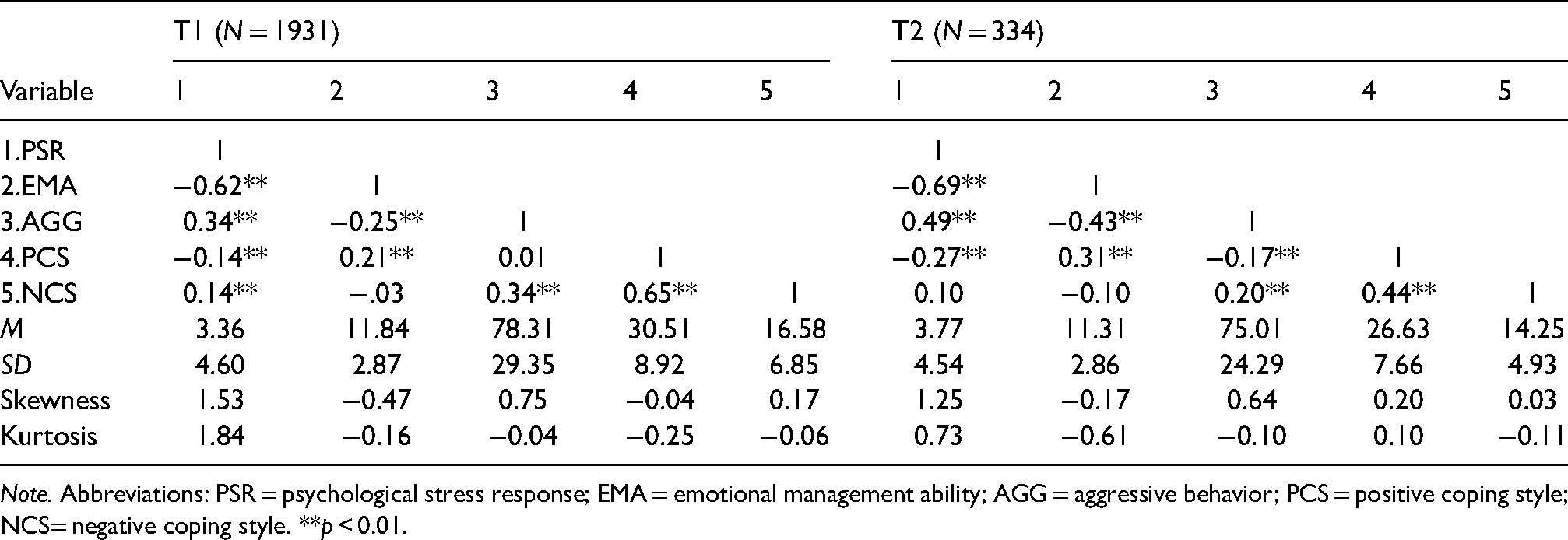
Note. Abbreviations: PSR = psychological stress response; EMA = emotional management ability; AGG = aggressive behavior; PCS = positive coping style; NCS= negative coping style. **p < 0.01.
The mediation effect of NCS
To test the mediation effect of NCS between PSR and AGG, Model 4 in the PROCESS macro was used with NCS as a mediator of the effects of PSR on AGG. We found that PSR had a positive effect on NCS (β = 0.088, p < .001, 95% CI: 0.050 0.124). NCS was positively related to AGG (β = 0.382, p < 0.001, 95% CI: 0.311 0.450). The indirect effect of PSR on AGG via NCS was significant (β = 0.034, p < .001, 95% CI: 0.019, 0.049). There were two paths by which PSR affected AGG (Table 3). First, PSR affected AGG directly, with the direct effect accounting for 88.63% of the total effect. Second, PSR affected AGG indirectly through NCS, with the indirect effect accounting for 11.36% of the total effect.
Mediation effect size for NCS in the relationship between PSR and AGG

Note. Abbreviations: PSR = psychological stress response; AGG = aggressive behavior; PCS = positive coping style; NCS = negative coping style.
The moderated mediation model
We tested the moderated mediation model with the latent interaction of EMA and NCS (Figure 1). PSR still had a positive effect on NCS (β = 0.088, p < .001), while NCS was positively related to AGG (β = 0.359, p < .001). PSR had a partially indirect effect on AGG through NCS. Moreover, the interaction of NCS and EMA had a significant predictive effect on AGG (β = 0.069, p < .001), indicating that the predictive effect of NCS on AGG is regulated by EMA. Further simple slope analysis (Figure 2) results showed that NCS had a weaker positive association with AGG when EMA was low (M −1 SD; simple slope = 0.229, p < .001) compared to when EMA was high (M + 1 SD; simple slope = 0.336, p < .001). The conditional indirect effect of PSR on AGG through NCS for different EMA levels is tabulated in Table 4. A weaker indirect effect of NCS was seen with low EMA (β = 0.026, 95% CI = 0.014, 0.038) than with high EMA (β = 0.038, 95% CI = 0.021, 0.055). These results verified the moderated mediation effect of EMA on the relationship between PSR and AGG via NCS.

Moderated mediation effect of NCS in T1 sample. Paths of the control variables are omitted for clarity. * p < 0.05, **p < 0.01).
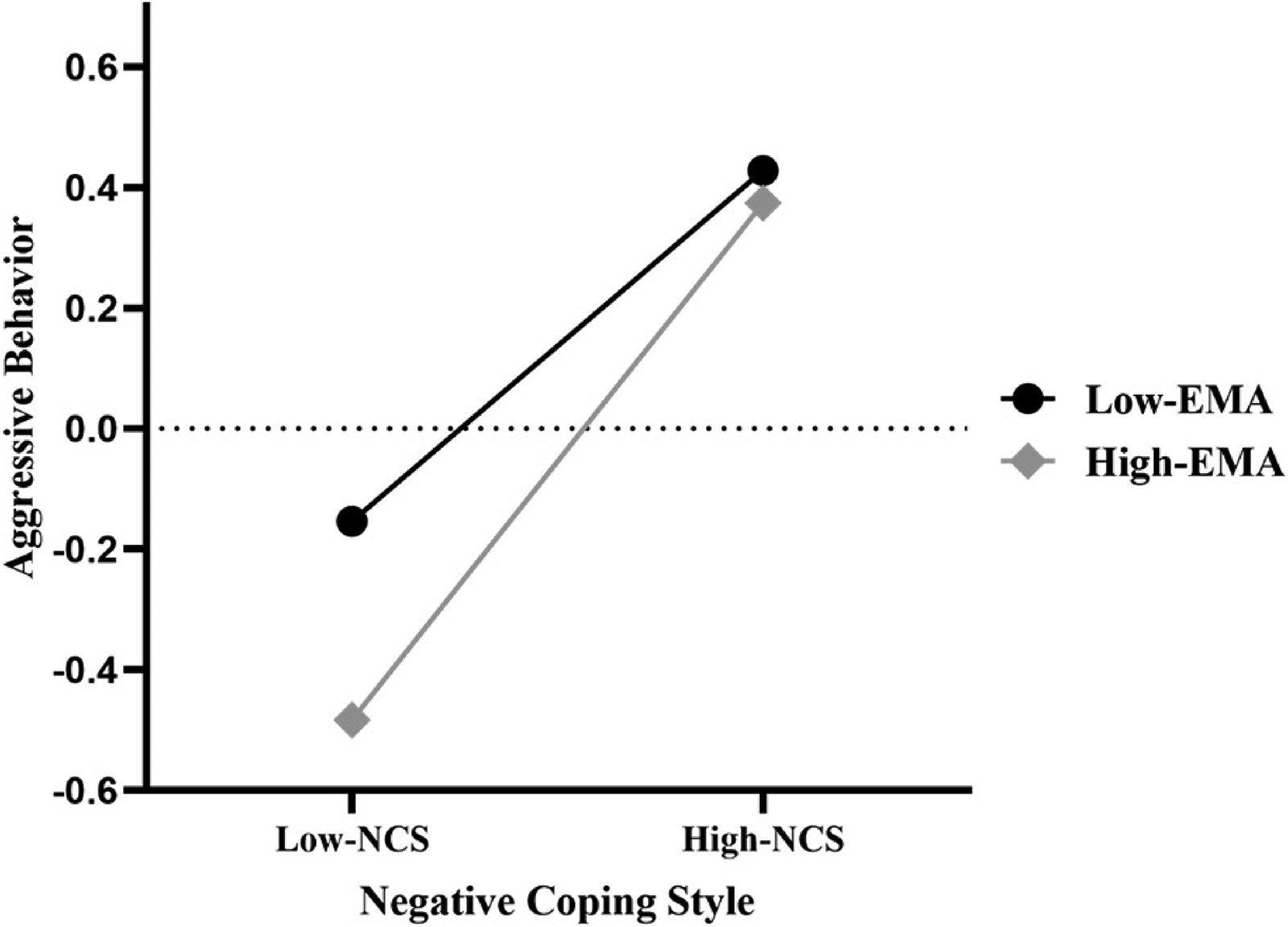
Aggressive behavior as a function of negative coping style and EMA at T1. Functions are graphed for two levels of emotional management ability: 1 SD above the mean and 1 SD below the mean. Notes: PSR = Psychological Stress Response, AGG = Aggressive behavior, NCS = Negative Coping Style, EMA = Emotional management ability.
Conditional indirect effect of PSR on AGG through NCS for different EMA levels

Note. Abbreviations: PSR = psychological stress response; EMA = emotional management ability; AGG = aggressive behavior; PCS = positive coping style; NCS = negative coping style.
Area difference testing of the moderated mediation model
The previous results show there was a significant area difference on AGG and PSR in T1. Therefore, the moderated mediation model was tested in the high-risk area (n = 343) and the low-risk areas (n = 1588) separately (Table 5). PSR had no predictive effect on NCS for the participants in the high-risk area (β = 0.039, p > .05), therefore, the mediated effect was not significant. However, PSR had still a significant predictive effect on NCS (β = 0.105, p < .001) while NCS was positively related to AGG (β = 0.311, p < .001) in the low-risk areas. These results indicated that the indirect effect of PSR on AGG through NCS was remarkable. Moreover, the interaction of NCS and EMA had a significant predictive effect on AGG (β = 0.046, p < .05), indicating that the predictive effect of NCS on AGG is regulated by EMA. According to Wen’s procedure of moderated mediation effects (Wen & Ye, 2014), 95% bias-corrected (BC) confidence intervals (CI) of these effects did not include zero (Table 6), which demonstrated that the moderated mediation effect was significant in the low-risk area. We also performed moderated mediation analyses using age, gender, and grade as moderators, and compared the moderated mediation model within gender groups and grade groups. These analyses are reported in the Supplementary materials.
Area difference testing of the moderated mediation model at T1

Note. Standardized regression coefficients are reported. Abbreviations: PSR = psychological stress response; NCS = negative coping style; EMA = emotional management ability. Paths of the control variables are omitted for clarity.
Testing the moderated mediating effect of PSR on AGG in T2 sample

Note. Standardized regression coefficients are reported. Abbreviations: PSR = psychological stress response; NCS = negative coping style; EMA = emotional management ability.
A simple slope analysis illustrated (Figure 3) that NCS exhibited a weaker positive association with AGG when EMA was low (M −1 SD; simple slope = 0.264, p < .001) compared to when EMA was high (M + 1 SD; simple slope = 0.355, p < .001). In other words, with improvement of EMA, the mediating effect of NCS between PSR and AGG gradually increases.
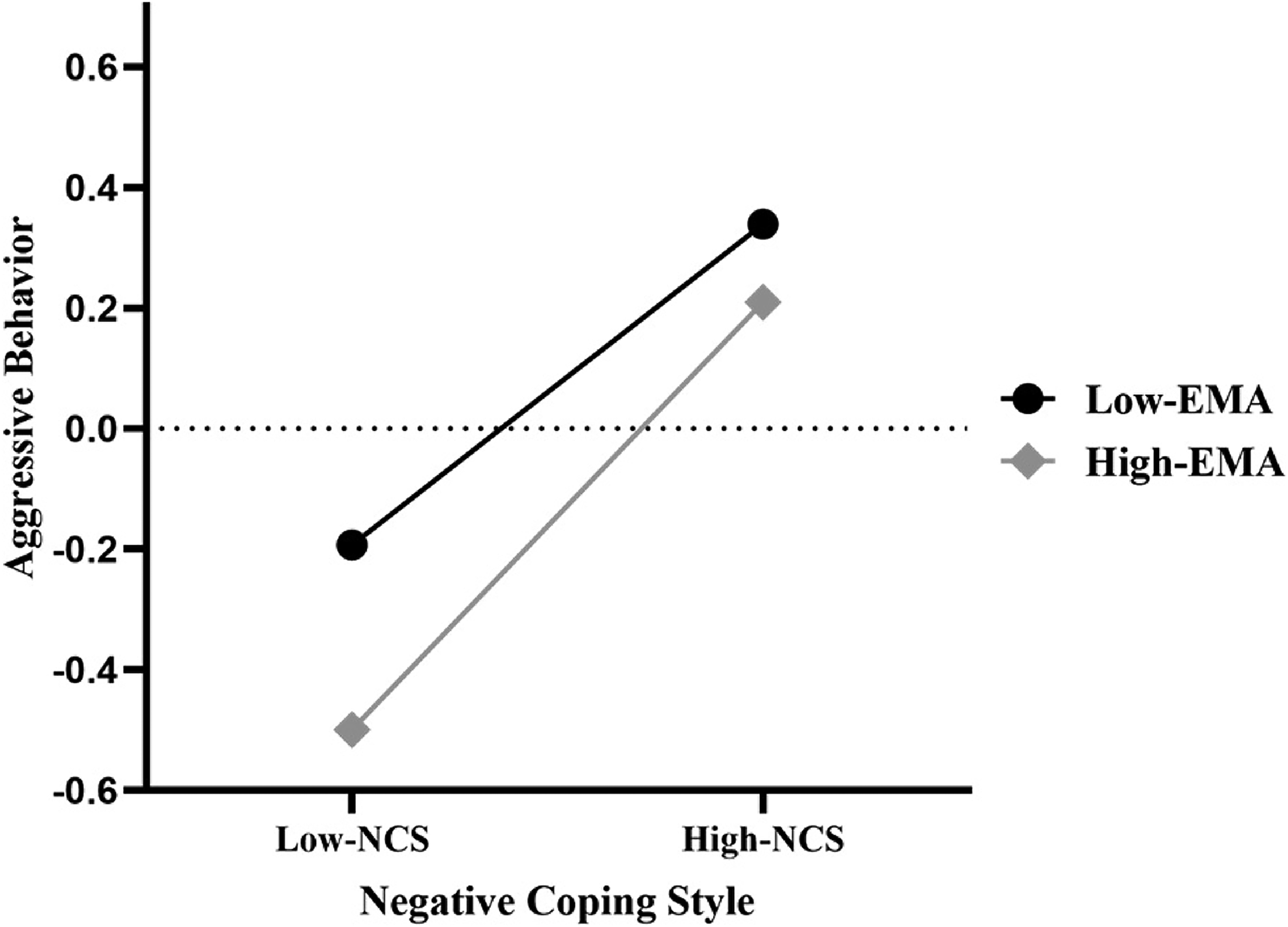
Moderating effect of EMA on the relationship between PSR and AGG for those in the low-risk COVID-19 area at T1.
The moderated mediation model in the T2 sample
We also tested the moderated mediation model in T2 sample. The results showed that PSR still had a significant predictive effect on NCS (β = 0.115, p < .05) while NCS was positively related to AGG (β = 0.219, p < .001). According to Wen’s procedure for moderated mediation effects (Wen & Ye, 2014), 95% bias-corrected (BC) confidence intervals (CI) of these effects did not include zero (Table 7), which demonstrated that the moderated mediation effect was significant in the T2 sample (Figure 4). For adolescents with low EMA, the indirect effect had a protective impact on AGG (β = 0.033, Boot 95% CI: 0.001, 0.068). For those with high EMA, PSR had no obvious effect on AGG through NCS (β = 0.018, Boot 95% CI: −0.000, 0.050). A simple slope analysis showed that NCS had a weaker positive association with AGG when EMA was low (M −1 SD; simple slope = 0.328, p < .001) than when EMA was high (M + 1 SD; simple slope = 0.624, p < .001; Figure 5). Consequently, with an increasing level of EMA, the mediating role of NCS in PSR and AGG tended to gradually decrease.

Moderated mediation effect of NCS in T1 sample. Note. Paths of the control variables are omitted for clarity. * p < 0.05, **p < 0.01, ***p < 0.001.

Aggressive behavior as a function of negative coping style and emotional management ability at T2. Functions are graphed for two levels of emotional management ability: 1 SD above the mean and 1 SD below the mean. Notes: EMA = Emotional management ability.
Conditional indirect effect of PSR on AGG through NCS for different EMA levels in T2 sample

Note. Abbreviations: PSR = psychological stress response; EMA = emotional management ability; AGG = aggressive behavior; PCS = positive coping style; NCS = negative coping style.
Discussion
Since decreasing the levels of risk factors and increasing the levels of protective factors are two essential strategies to prevent AGG (Scott et al., 2018), we sought to test a moderated mediation model of AGG with two risk factors (i.e., PSR and NCS) and one protective factor (i.e., EMA) in a large sample of Chinese students. The results supported our hypotheses. Specifically, (1) PSR was positively related to AGG; (2) NCS partially mediated the relationship between PSR and AGG; (3) EMA moderated the direct path and the second stage of the mediating relationship, with a stronger association at T1, but a weaker association at T2 for students with higher EMA; and (4) there were regional differences in the roles played by NCSs and EMA in the relationship between PSR and AGG in the population studied.
Overall, 17.6% of the participants reported obvious PSR in the T1 sample. Such prevalence of PSR is lower than that reported in other studies during the epidemic (mainly in depression and anxiety), specifically the 31.3% reported by Zhou et al. (2020), and the 38.8% reported by Chi et al. (2020). A possible explanation for these differences is the timing of sampling; the previous two studies completed their measurements in February and March 2020, when the epidemic was at its worst in China, and epidemic control measures were at their most stringent. Hence, individuals’ lives, as well as their psychological and emotional well-being, were the most affected. However, a similar proportion (17.5%) of the sample reported obvious PSR in the T2 sample, which was inconsistent with expectations that the rate would decline from T1 to T2. A possible reason for this is that, although the domestic epidemic had improved, most schools had not resumed in-person classes, and students still were required to attend school online and to study at home. Studies show that prolonged social isolation can lead to psychological problems in adolescents (Pahl et al., 2021).
Second, we found that, consistent with previous studies, high PSR was associated with high levels of AGG in the two measurements used (Estrada-Martínez et al., 2012). Some researchers have found that students with higher levels of PSR are more likely to experience negative emotions and intense psychological distress for an extended duration, which may induce problem behaviors in some individuals (Hamerlynck et al., 2008).
The results of the current study also found that the association between PSR and AGG was partially mediated by NCS, which is partially consistent with the Psychological Stress System Model. According to this theory, the physical and psychological consequences of psychological stress are influenced by the interaction of an individual’s internal resources (e.g., coping style, personality) and external resources (Jiang, 2006). An individual’s cognitive ability, as well as their behavior, will change dramatically when they are in the state of stress. Cognitive stress theory states that when individuals perceive the uncertainty and uncontrollability of a situation, they are more likely to react negatively to external changes than to adopt NCSs (Ursin & Eriksen, 2004).
Although the epidemic in China was effectively controlled in April and May 2020, and businesses resumed in-person work, many students were still unable to resume normal in-person education. For students, uncertainty about the future, coupled with prolonged home study, limited range of activities, and a lack of face-to-face interpersonal interaction, may have led to negative responses and reactions. In the long run, NCSs could increase experiences of negative emotion (Brown et al., 2005) and lead to further maladaptive behaviors, such as AGG (Whitman & Gottdiener, 2015). Hence, it is important for parents and educators to identify and correct students’ NCSs and help them to create more adaptive coping strategies in their daily lives.
The results of the current study also found that the association between PSR and AGG was partially moderated by EMA, which is consistent with previous studies (Aebi et al., 2017; Miles et al., 2016). Emotionally dysregulated individuals are more likely to engage in aggressive behavior after experiencing stressful events. Therefore, improving emotion regulation skills may be useful to mitigate the effects of COVID-19 on teenagers’ aggression.
Additionally, an important contribution of the current study is that we demonstrated that the effect of mediation of NCS was moderated by EMA. However, the predictive effects of NCS on AGG as moderated by EMA were opposite in the two tests. The NCS and EMA interaction terms demonstrated a positive predictive effect on AGG in T1, which is inconsistent with previous investigations that EMA moderated the relationship between risk factors and AGG (Carlo et al., 2012); while the results of T2 align with previous research. The results of T1 could be explained by the fact that individuals with high EMA are prone to release their emotions by via external methods, such as sports. One study shows that social support can migrate the effects of PTSD on antisocial behavior (Wang et al., 2020). However, during the first test period, students had a restricted range of activities, possibly resulting in a decrease in social support and difficulty regulating their emotions through externalization in a timely manner and were more likely to show their emotions through aggressive behavior. The second survey was taken in late May 2020, when the domestic epidemic had improved, most schools had set a time for return to in-person classes, and schools and teachers were actively preparing to return to school. Individuals with higher emotional management skills were more likely to adopt adaptive emotion regulation strategies (Roberton et al., 2012), which mitigated the effects of NCS on AGG.
Finally, this study found that the model of moderated mediation did not hold true in individuals from the high-risk area. One possible reason for this is that the sample size from Hubei was very small, which may have affected the significance of the results. Alternatively, according to the ripple effect, the closer to the epicenter of the event, the higher the perception of risk and negative emotions toward the event (Kasperson et al., 1988). The epidemic, which first broke out in Hubei province, was more severe and had a greater psychological impact on individuals there than in other regions.
Although this study is the first to investigate the mechanisms of the effects of psychological stress on AGG in adolescents during the COVID-19 epidemic, there are still some limitations. First, the number of subjects from the high outbreak area was too small to explain the effects of psychological stress during the outbreak. Future studies should examine associations between different kinds of PSR and AGG. Second, there may be bias present when performing cross-sectional analyses of mediation processes. Recent articles have begun to consider the explicit role of time in studying mediation processes and calls for longitudinal approaches to mediation (Maxwell & Cole, 2007). The lack of continuous tracking data in this study makes it difficult to make direct causal inferences. Hence, future studies should apply continuous tracking or other experimental designs to confirm the causal assumptions in this study. Third, while we controlled age and school level in data analysis, the participants included elementary, middle, high school, and university students, all of whom possess different psychological characteristics. Therefore, future research should examine these groups separately.
Conclusion
The present study confirmed that psychological stress was positively related to aggression in adolescents during the Covid-19 epidemic. NCS was shown to be a mediator between psychological stress and aggression. In addition, EMA moderated the direct path and the second stage of the mediating relationship, with a stronger association at T1, but a weaker association at T2 for adolescents with higher EMA. Finally, there were regional differences in the role played by NCSs and EMA in the relationship between PSR and AGG in the population studied. To minimize the adverse effect of PSR on AGG in adolescents during crises like the pandemic, interventions are needed with the aim of raising EMA and coping skills in adolescents.
Supplemental Material
sj-docx-1-pac-10.1177_18344909221102579 - Supplemental material for Impacts of the psychological stress response on aggression in adolescents during the COVID-19 epidemic in China
Supplemental material, sj-docx-1-pac-10.1177_18344909221102579 for Impacts of the psychological stress response on aggression in adolescents during the COVID-19 epidemic in China by Zhen Wei, Yan Hu, Jiayi Xiao, Ruotong Wang, Qianchu Huang, Ziwen Peng, Gangqiang Hou and Qi Chen in Journal of Pacific Rim Psychology
Footnotes
Declaration of conflicting interests
The author(s) declared no potential conflicts of interest with respect to the research, authorship, and/or publication of this article.
Funding
The author(s) disclosed receipt of the following financial support for the research, authorship, and/or publication of this article: This work was supported by the National Natural Science Foundation of China (grant number 31900770).
Supplemental material
Supplemental material for this article is available online.
References
Supplementary Material
Please find the following supplemental material available below.
For Open Access articles published under a Creative Commons License, all supplemental material carries the same license as the article it is associated with.
For non-Open Access articles published, all supplemental material carries a non-exclusive license, and permission requests for re-use of supplemental material or any part of supplemental material shall be sent directly to the copyright owner as specified in the copyright notice associated with the article.
