



Abstract
The present investigation explored Chinese people's attitudes toward the social practice of going “through the back door” or zouhoumen. Zouhoumen is an informal approach to achieve one’s goal through personal connections (called guanxi). We propose that Chinese people distinguish between different acts of zouhoumen and propose at least two types that differ in terms of social cognitive aspects, and that the two types evoke different perceptions of fairness that shape attitudes towards zouhoumen. Two experiments (total N = 414) provided evidence for the differentiation between facilitative zouhoumen and expropriative zouhoumen and also explore the role of type of guanxi in attitudes towards the two types of zouhoumen. Both experiments indicated that facilitative zouhoumen was less unacceptable than expropriative zouhoumen, but there were no marked differences in attitudes between zouhoumen involving expressive or instrumental guanxi. The results support a more nuanced theoretical account of a pervasive social phenomenon in Chinese society that we assume is adaptive responses to features of Chinese historical socioeconomic context.
The popular short novel, Ground covered with chicken feathers (一地鸡毛) by Liu Zhenyun, depicts daily life in the rapidly changing Chinese society of the late twentieth century through the experiences of the main character Xiao Lin. In one part of Xiao Lin’s story, his wife wanted to transfer jobs as her work unit was too far from their home. The couple tried to apply to transfer to several other work units but they were rejected every time. Then … … Xiao Lin thought of a work unit only 40 minutes away from their home by subway. The head of human resources was the classmate of Xiao Lin’s leader, Lao Zhang. Xiao Lin had helped Lao Zhang in moving, and Lao Zhang liked him. After Lao Zhang called his classmate, Xiao Lin went to the new unit to ask for help. Not surprisingly, the head of human resources agreed to arrange for a job for Xiao Lin’s wife. (translated from Chinese by the authors)
The excerpt from the story describes what Chinese people refer to as zouhoumen (走後門, literally, through the back door), where Xiao Lin used his guanxi (關係, literally, personal connection) to find his wife a new job. In the Contemporary Chinese dictionary (Chinese Academy of Social Sciences, 2002), zouhoumen is explained as getting things done through pulling or securing advantages through influence. Some scholars refer to zouhoumen as a form of corrupt and unethical practice (see e.g., Guo, 2010; Liu, 2007), but others have a more benign view and see zouhoumen as a necessary means of getting things done (Chen & Chen, 2004; 2003). Although through-the-back-door transactions are not unique to Chinese societies, in this study, we propose that zouhoumen can be socially constructed in at least two ways by Chinese people, and that there are cultural norms and values that influence how people in China perceive these two ways of viewing zouhoumen. In two studies, we show that Chinese people’s attitudes towards zouhoumen vary based on the specific aspects of these two constructions of zouhoumen that influence the norms of fairness that influence their attitudes related to zouhoumen.
Defining and characterizing zouhoumen
The phrase “through the back door” refers to getting things done in a secret and indirect way, hidden from the view of people, implying that there is something underhanded or illicit about it. As access through the back door is likely obtained through influence, such practices may be seen as corrupt or even illegal. In China, zouhoumen is typically referred to as an informal, unofficial but effective approach to achieve one’s goal through personal connections which is called guanxi in Chinese society (Chen & Gao, 2017). The definition implies that zouhoumen is a behavior that uses guanxi, and as such, zouhoumen is a form of guanxi practice and is an expression of guanxi. From this definition, we can begin seeing how aspects of the meaning “through the back door” involve concepts and norms that might be specific to Chinese culture and society.
There are not many scholarly articles that focus on zouhoumen, but in the studies that mention zouhoumen, different types of examples of the practice are referred to. For example, conducting zouhoumen has been referred to in the process of getting a library card (Wu, 1993), which seems to be a rather innocuous matter. But zouhoumen has also been referred to when parents want to send their children to good schools that have limited places for admission (Xia, 2010). In business, zouhoumen is conducted for purchasing goods that are otherwise not sold to the general public and for getting product approval for procurement of a company (Dunfee & Warren, 2001). Zouhoumen is also used by some when they enter a part-time postgraduate degree program and obtaining a PhD through their connections with some faculty members (Gu, 2016). Others describe zouhoumen being conducted in government organizations, like to move into a good and cheap public elderly care institution without queuing (Zhang et al., 2017), obtaining residence permits from the government (Hanser, 2004), or getting jobs or positions in government work units (O’Dwyer, 2006). What is common among these examples is that the goal is achieved by getting through the prescribed processes or rules with the intercession of an individual connected with the organization. Some scholars clearly refer to zouhoumen as a corrupt (Kriz, 2010; Subramanian et al., 2014) or an unhealthy and immoral practice (Liu, 2007); but others consider it as occurring in a gray area (Guo, 2010) and as not necessarily illegal because it typically does not involve money (King, 1991).
Writing about Chinese society during the Cultural Revolution, Butterfield (1982) mentioned zouhoumen as operating within this social context: In China, (they said), the bureaucracy is so clumsy and rigid that there are constant shortages of food, housing, and consumer goods … the masses, the ordinary people, must be more inventive. To survive, they have created a nation-wide system of informal exchange; more than a black market, it is a second, or countereconomy, that exists in tandem with the regular state-planned economy and helps it function. Chinese call it “taking the back door,” “zou-hou-men.” (p. 92)
As such, practices of zouhoumen should be viewed primarily as a form of cultural adaptation within a shortage economy, with its fixed rules and structures that are perceived as being ungainly, with too many people waiting to avail of limited goods and services (Sands, 1990). Because China’s economy has transformed, the practice of zouhoumen has become less pervasive and has been replaced by many other varied forms of corruption (Hao & Johnston, 1995), but it still persists. But even as we view zouhoumen as having social functionality, we propose that Chinese people still distinguish among different practices that involve zouhoumen within this social context, and their attitudes towards specific instances of zouhoumen vary based on the features of the act in context. Referring to the different scholarly and other fictional writings that refer to zouhoumen (see preceding paragraph), we noted a range of social exchange transactions described as zouhoumen. Much of the exchange transactions described tend to be characterized as involving corruption or illegal acts (e.g., getting approval for a prohibited product procurement), but there were also many references that involved what seem to be innocuous everyday transactions (e.g., obtaining a library card). We attempted to differentiate such acts of zouhoumen and propose that there are two broad types of zouhoumen practices that differ mainly in terms of the main underlying motivation: facilitative zouhoumen and expropriative zouhoumen.
Facilitative zouhoumen
One of the common perceptions about some of the formal or official processes in China is that they are inefficient and ungainly, and that they add to the day-to-day difficulties that Chinese people experience and have to cope with. In this regard, facilitative zouhoumen refers to practices that people use to expedite the procedures and/or to obtain limited but necessary resources by using guanxi. The motive of facilitative zouhoumen is either avoiding tiresome and inefficient official procedures and/or keeping an untroubled life with minimal disturbances, given that daily life is already difficult. As such, facilitative zouhoumen does not disrupt the rules and processes too much; the person conducting zouhoumen would have gotten the desired outcome anyway, but through zouhoumen this outcome was obtained faster and with less difficulty. The conduct of facilitative zouhoumen does not require the intervention of a person with a position of power, and the facilitation can be undertaken relatively easily as long as one finds the right person in the network.
The “facilitative” aspect of this form of zouhoumen goes beyond the literal facilitation of the process for the person involved; more than that, this type of zouhoumen could also facilitate social harmony and stability in day-to-day living among Chinese people. Sands (1990) mentioned that in the shortage economy era, ordinary people obtained consumer goods to live by conducting zouhoumen. Zouhoumen helped the regular state-planned economy function and made up for the missing market mechanism. For example, before reform and opening-up, ordinary people had to use the limited tickets distributed by the government to purchase goods. A family of five had cloth-tickets for ten pieces of cloth and rice-ticket for five kilograms of rice per month. But people did not need new cloth every month, and rice was necessary for survival and five kilograms of rice a month was not enough for a family of five. In such case, people often conducted zouhoumen with the person who sold the rice, asking him to accept cloth-tickets for the purchase of rice. Because the state-planned economy was rigid, people can only purchase goods following the tickets as prescribed by government; but by conducting zouhoumen people could get what they really need, and make things work within an imperfect but rigid system (Sands, 1990).
Expropriative zouhoumen
In contrast, the goal of expropriative zouhoumen goes beyond just making things work within an imperfect system; instead the goal is to take advantage of weaknesses of the system for huge personal gain and/or to avoid legal punishments. Expropriative zouhoumen does not involve using guanxi to ease the difficulties in day-to-day existence; instead, guanxi is used to exploit the weaknesses in the system to expropriate resources or benefits that are intended to be allocated by some legal and official process. As such, expropriative zouhoumen might cross the boundaries of legality. Because the goals of this type of zouhoumen are more transgressive, power becomes an important element in the interaction; where the person granting the favor is someone who has enough clout to enable the transaction.
Related to this point, Bedford (2011) argued that the backdoor guanxi process like zouhoumen would include at least one of the parties’ personal gains or “accruals that are not part of the formal or sanctioned structure of organizational operations such as commission” (p. 153). In her opinion, the process related to exchange of power or status for personal benefits such as money. Guo (2010) argued that behaviors like zouhoumen defined gray areas in relation to corruption. It blurred the boundaries between the public sphere and private sphere and increased the society’s tolerance level of corruption. This expropriative form of zouhoumen is likely to be considered as the seedbed of corruption and bribery, especially for the scholars who equate it to corruption (Kriz, 2010; Subramanian et al., 2014), and it is the type of zouhoumen that was described as illegal zouhoumen in previous studies (Wang & Bernardo, 2017).
We summarize the key distinctions between the two types of zouhoumen in Table 1. We do not assume that the boundaries between these two types are clearly marked, and indeed, it is possible that different acts of zouhoumen combine features of both. But we propose this classification as a first attempt to elucidate how Chinese people might cognitively represent and evaluate different acts of zouhoumen. We further propose that people’s attitudes towards the two types of zouhoumen would differ based on the distinctions.
Distinct characteristics of the two types of zouhoumen.

Types of guanxi and zouhoumen
As mentioned earlier, zouhoumen is a form of guanxi practice and is an expression of guanxi. However, scholars have defined different types of guanxi based on the type of relationships involved, and we propose that people’s attitudes towards acts of zouhoumen would also be influenced by the type of guanxi. Hwang (1987) distinguished guanxi into expressive, mixed, and instrumental types based on the affinity of the relationships. Parties in each guanxi type follow different rules during the interactions, as we briefly discuss below.
Expressive guanxi is long-term and steady, and primarily exists among family members and close friends. It provides the feelings of “affection, warmth, safety, and attachment” (Hwang, 1987, p. 949) among the parties involved; loyalty and obligations to the expressive guanxi members are expected and praised in society. The interpersonal relations in expressive guanxi obey the need rule which means “every member should do his best to satisfy the other party’s need” (Hwang, 2012, p. 90). In contrast, instrumental guanxi is temporary and unstable, and primarily exists among relevant strangers, such as doctors and patients in the hospital, sales and customers in the mall, and other people in some transactional relationships. People construct instrumental guanxi mainly for its utility; there is no affection among the parties. Interactions among members of instrumental guanxi follow the equity rule which refers to resource distribution according to one’s contributions. Mixed guanxi is somewhere in the middle of expressive and instrumental guanxi. The parties in this type may have both expressive and instrumental components. It exists among acquaintances, such as regular friends, kin, classmates, colleagues, neighbors, and so on. Interactions among members of mixed guanxi obey renqing (人情, affect and favor) rule. Renqing is the affect shared by people that motivates them to do favors for each other; as a variant of the equality rule, it is bound with ideas of obligation and reciprocity (Hwang, 1987).
We propose that attitudes towards zouhoumen would also be influenced by the type of guanxi involved, as the different relational rules in the different types of guanxi change the motives of the act of zouhoumen. In the current study, we contrast expressive guanxi and instrumental guanxi and their relationships to zouhoumen. The need rule operates among family and close friends in expressive guanxi, and zouhoumen between actors with expressive guanxi can be viewed as indicating affection and doing what is best for family and intimate friends. This could be construed as following the principle of favoring the intimate, which is a principle of Confucian ethics for ordinary people (Hwang, 2018). As these are valued norms in Chinese society, zouhoumen among parties with expressive guanxi might be viewed as less unfair compared to that among parties with instrumental guanxi. In the latter, zouhoumen does not express affection; it is primarily a transaction where parties involved settle on equitable benefits they derive from zouhoumen. The transactional nature of zouhoumen among parties with instrumental guanxi highlights the self-serving dimensions of zouhoumen, which could make things more unfair for some people.
The current studies
We report two studies that inquire into people’s attitudes toward the two types of zouhoumen. The studies use vignettes involving acts that involve either facilitative or expropriative zouhoumen, but none of the vignettes explicitly mention “zouhoumen.” In both studies, the vignettes were also varied in terms of whether the parties involved had expressive or instrumental guanxi. We expected that participants would rate acts of zouhoumen as generally unacceptable, but that the degree of unacceptability would vary across type of zouhoumen (facilitative vs. expropriative) and across type of guanxi (expressive vs. instrumental). The specific hypotheses are discussed in each of the study sections below.
Study 1
In this study, we look into Chinese participants’ attitudes towards two forms of zouhoumen by asking them to indicate whether they think that different scenarios that describe acts of zouhoumen are acceptable or not. In addition to looking at the effect of the type of zouhoumen (facilitative vs. expropriative), we also inquire into the effect of the type of guanxi among the actors in the zouhoumen (expressive vs. instrumental). A 2 × 2 completely repeated factorial design was used; each participant read four vignettes of zouhoumen scenarios that varied in terms of type of zouhoumen and type of guanxi. Type of zouhoumen was manipulated in terms of the features described in Table 1, and different scenarios representing facilitative and expropriative zouhoumen were chosen by pilot testing several scenarios to ensure that actions are considered zouhoumen. Type of guanxi was manipulated by changing the relationship of the actors in the scenarios. Two sets of vignettes that partially counterbalanced the specific vignette story to the different factorial combinations were developed; participants were randomly assigned to one of the two sets.
Following the theoretical premises developed in the introduction, we expected that participants would generally rate all the zouhoumen vignettes as low in acceptability. But the important hypotheses are as follows: H1.1: Facilitative zouhoumen will be more acceptable than expropriative zouhoumen. H1.2: Zouhoumen involving expressive guanxi will be more acceptable than involving instrumental guanxi.
Method
Participants
The sample comprised of 289 undergraduate students (197 females) from a public university in China. Ages ranged from 17 to 23 years old (M = 18.85, SD = 0.96). They were recruited from different departments in the university and were shown an informed consent form with information on the nature and procedures of the study. Only those who signed the informed consent form were given the research questionnaire. Each participant who completed the questionnaire received a payment of 10 RMB (approximately 1.5 USD).
Measures
Acceptability of zouhoumen
Four hypothetical scenarios were used to assess the acceptability of zouhoumen. Two scenarios depicted facilitative zouhoumen and two depicted expropriative zouhoumen (see Supplementary Table 1 for the scenarios for each type), but the term “zouhoumen” was never mentioned in the scenarios. The scenarios for the two types of zouhoumen were differentiated with reference to the type of goal and motive (Table 1). Each of the four scenarios also had two versions that differed in terms of the type of guanxi between the actors in the act of zouhoumen. For expressive guanxi the actors were relatives, and for instrumental guanxi, the actors were not related but were associated through some work network that requires reciprocity (see Supplementary Table 1 for examples of the two types of guanxi). After each story, participants were asked “Do you think [actor]’s behavior is acceptable?” Participants responded using scales from 1 (totally unacceptable) to 6 (totally acceptable) to express their attitudes toward zouhoumen.
Two sets of four scenarios were created, with each set having a different combination of zouhoumen type and guanxi type. The combination and sequence of the scenarios was partially counterbalanced across the sets. The sets also contained other scenarios that did not involve zouhoumen but responses to these filler scenarios were not analyzed. Participants were randomly assigned to one of the two sets.
Social desirability
The 11-item short version of the Marlowe–Crowne Social Desirability Scale (Reynolds, 1982) was used to assess participants’ tendency to responding in a socially desirable manner (α = .61). The social desirability scores were not correlated with reported acceptance of either facilitative zouhoumen (r = .01, p = .879) or expropriative zouhoumen (r = −.09, p = .134).
Results and discussion
To test the hypotheses, the data were analyzed using a 2 × 2 repeated-measures ANCOVA with type of zouhoumen and type of guanxi as within-subjects variables and social desirability as covariate. First, socially desirable responding was not a significant predictor of attitudes, F(1, 287) = 0.65, p = .422, nor did it have any significant interaction effects with the independent variables. But more importantly, the ANCOVA results indicated a main effect of type of zouhoumen. As hypothesized, facilitative zouhoumen (M = 3.70, SD = 1.12) was significantly more acceptable than expropriative zouhoumen (M = 2.70, SD = 1.06), F(1, 287) = 12.78, p < .001,
These results provide support for our proposal that people distinguish between different types of zouhoumen and that their attitudes toward these types also vary. Expropriative zouhoumen was much more unacceptable than facilitative zouhoumen. Unexpectedly, there was no evidence that attitudes towards zouhoumen were influenced by the type of guanxi ties among the actors. It may suggest that these cultural norms that relate to more instrumental justice norms are not that relevant in judgments of fairness of zouhoumen, but it may also be that our manipulation of guanxi type was not effective. We also acknowledge that the findings were based on a single measure of attitudes towards zouhoumen, one that might not be fully reflective of judgments related to zouhoumen. Moreover, these judgments were made by university students who may have limited knowledge and experience of how zouhoumen is transacted in Chinese society. We address these limitations in a replication that includes a manipulation check of guanxi type, that improves on the dependent measures, and that involves working adults recruited from a community sample.
Study 2
We used the same experimental design as Study 1 to explore the effects of type of zouhoumen and type of guanxi on Chinese participants’ attitudes toward zouhoumen. But we recruited adult participants from the community, who presumably have more social experience and thoughts regarding zouhoumen. Given the unexpected nonsignificant effect related to the manipulation of guanxi type, we also decided to add a manipulation check, which asked about the closeness, duration, and stability of the actors’ relationship in each scenario. Finally, to address the limitations of using just a single question to measure attitude towards zouhoumen, we added questions about the zouhoumen scenarios to probe more facets of the attitudes towards zouhoumen. One set of questions asked the participants to make warmth-related judgments of the actors involved the scenario (e.g., deceitful, good natured), and one question asked the participants to indicate their general feelings regarding the actors using a commonly used thermometer scale. Aside from being a measure of the affective dimension of attitudes towards zouhoumen, these particular measures should allow for a more specific examination of the effects of type of guanxi. That is, if expressive guanxi is assumed to be an expression of affection and attachment, the actors of zouhoumen with expressive guanxi should be perceived as being higher in warmth compared to those with instrumental guanxi. In addition, we also included a question that more closely referred to their sense of fairness about the scenarios and the question inquired about their perceptions of how reasonable the actions were, and we also asked the likelihood that they themselves would engage in similar behavior.
With the various attitude dimensions measured, we extend the two previous hypotheses as follows: H2.1: Compared to expropriative zouhoumen, participants will judge facilitative zouhoumen as more acceptable and more reasonable, will rate the actors in facilitative zouhoumen more warmly/positively, and indicate that they are more likely to engage in facilitative zouhoumen; and H2.2: Compared to zouhoumen involving actors with instrumental guanxi, participants will judge zouhoumen involving expressive guanxi as more acceptable and more reasonable, will rate actors with expressive guanxi more warmly/positively, and will indicate that they are more likely to engage in zouhoumen if the scenario involves expressive guanxi.
Method
Participants
Participants were 125 adults (56 women) recruited from communities from Mainland China, with at least one year working experience. Ages ranged from 22 to 54 years old (M = 31.90, SD = 5.82). Working experience ranged from 1.5 to 31.0 years (M = 9.30, SD = 5.87). Data were collected by a professional data-collection company in Mainland China (WenJuanXing).
Measures
The four hypothetical scenarios and the social desirability scale used in Study 1 were also used. The social desirability scale (α = .80) scores were correlated with some attitude measures related to facilitative zouhoumen: acceptability (r = −.27, p = .003), reasonableness (r = −.22, p = .014), general warmth (r = −.19, p = .039), behavioral intention (r = −.27, p = .002), and to expropriative zouhoumen: behavioral intention (r = −.23, p = .012).
Manipulation check for guanxi type
After each scenario, participants were asked three questions about how they felt about the closeness, duration, and stability of the relation between the actors in zouhoumen. Participants responded using scales from 1 (very distant/totally temporary/very unstable) to 6 (very intimate/totally long-term/very stable).
Additional questions about attitudes towards zouhoumen
After the same question on acceptability of zouhoumen as in Study 1, the participants were asked, “Do you think [actor]’s behavior is reasonable?” and answered from 1 (totally not) to 6 (totally yes). Then the participants were asked to rate the actors on four adjectives, two indicating high warmth (honest, good natured), and two indicating low warmth (unreliable, deceitful), in a scale from 1 (definitely not) to 6 (definitely). The last two questions used a temperature scale to ask for a general judgment of warmth: “On a scale of 0 (very cold) to 100 (very warm), describe how you feel about [actor]?”, and behavioral intentions: “On a scale of 0 (never) to 100 (definitely), how likely are you to engage in same behavior as [actor] if you are in a similar situation?”
Results and discussion
We first tested the manipulation check by comparing the participants’ ratings of the relationships between the actors in the two guanxi-type scenarios. The results of paired-samples t-tests indicate that participants perceptions of the relationships were consistent with the guanx-type manipulations. The relation between actors in scenario involving expressive guanxi was considered closer [expressive: M = 5.54, SD = .60, instrumental: M = 4.22, SD = .84, t(124) = 16.20, p < .001, Cohen’s d = 1.46], longer in duration [expressive: M = 5.43, SD = .63, instrumental: M = 3.84, SD = .98, t(124) = 15.71, p < .001, Cohen’s d = 1.40], and more stable [expressive: M = 5.40, SD = .66, instrumental: M = 3.83, SD = .96, t(124) = 16.49, p < .001, Cohen’s d = 1.47] than those in scenarios that involved instrumental guanxi.
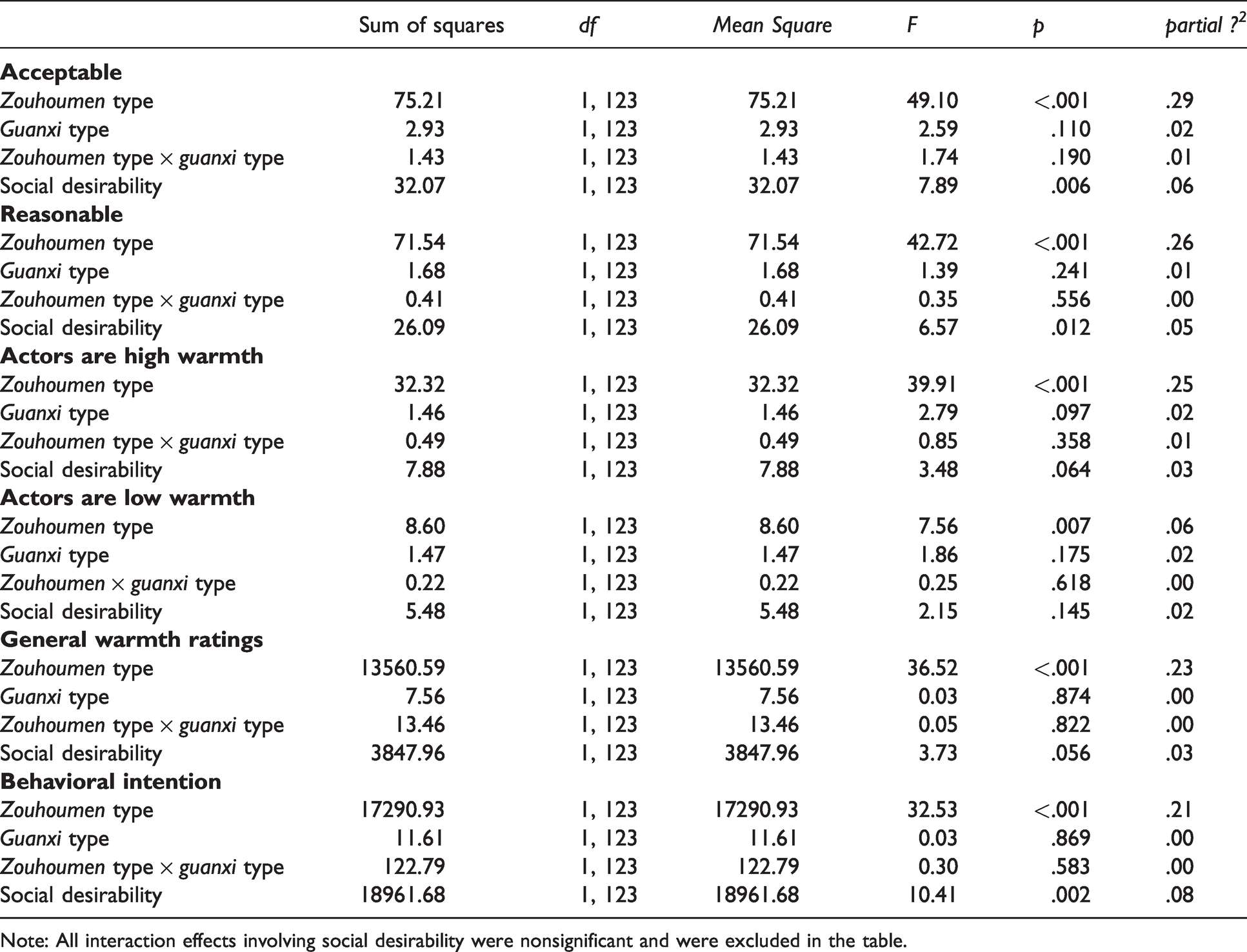
The means (and SDs) for the attitude measures are summarized in Table 2. To test the hypotheses, a series of 2 × 2 repeated-measures ANCOVA with type of zouhoumen and type of guanxi as within-subjects variables and socially desirable responding as covariate were conducted. The ANCOVA results are summarized in Table 3. We note that socially desirable responding had a significant relationship with ratings of acceptability, reasonableness, and behavior intentions, but not in the other warmth-related measures.
Descriptive statistics for different measures of attitudes towards zouhoumen in Study 2.

Facil/Exp = facilitative zouhoumen × expressive guanxi; Facil/Ins = facilitative zouhoumen × instrumental guanxi; Expro/Exp = expropriative zouhoumen × expressive guanxi; Expro/Ins= expropriative zouhoumen × instrumental guanxi.
Study 2 main results of two-way completely repeated ANCOVA with measures of attitudes towards zouhoumen as dependent variables and social desirability as covariate.
Note: All interaction effects involving social desirability were nonsignificant and were excluded in the table.
The main ANCOVA results support the main hypotheses regarding zouhoumen type. Facilitative zouhoumen was seen as more acceptable and reasonable than expropriative zouhoumen. Also as hypothesized, actors who conducted facilitative zouhoumen were rated as showing more high warmth traits, less of the low warmth traits, and higher general warmth scores than those who conducted expropriative zouhoumen. The participants were also more likely to report that they might engage in behaviors similar to facilitative zouhoumen compared to expropriative zouhoumen. However, as in Study 1, the hypotheses related to the main effects of type of guanxi were not supported by the data. As shown in Table 3, none of the main effects of type of guanxi was statistically significant. All the interaction effects between type of zouhoumen and type of guanxi were nonsignificant. Even in the affective measures of attitudes, no significant effects related to type of guanxi were observed; thus, zouhoumen actors with expressive guanxi were not perceived as having higher warmth, contrary to the hypothesis, but consistent with the findings in Study 1.
These results from working adults provide further evidence for our proposal regarding the differences in attitudes related to two types of zouhoumen, with more diverse measures of attitudes related to zouhoumen. In contrast, the results suggest that the role of type of guanxi might not be important in the participants attitudes related to zouhoumen. The main effect was nonsignificant in Study 2 also, even as the manipulation checks indicate that the participants were picking up on the guanxi differences.
General discussion
The present investigation was conducted to study a phenomenon that is observed in many parts of the world, using a sociocultural lens of how it is experienced in Chinese society. Two studies used experiments to examine the effects of type of guanxi on the attitudes toward the two types of zouhoumen. The results suggested that facilitative zouhoumen was more acceptable (or less unacceptable) than expropriative zouhoumen; but there was no evidence for the role of the guanxi type in attitudes toward zouhoumen.
The major theoretical proposal of the study is the distinction between two types of zouhoumen—facilitative and expropriative zouhoumen—based on their goals, motivations, and processes, and how people’s reactions related to perceived unfairness and their attitudes toward the two types would vary accordingly. There was strong support for the different attitudes toward the two types, with moderate effect sizes for the main effect of type of zouhoumen in both studies and using varied attitude measures in Study 2. We do not claim that all forms of zouhoumen neatly fit into these two types. As we mentioned in the introduction, we propose these two types as a first step toward distinguishing among the different ways by which Chinese people may be constructing or representing these actions in their own understanding. It may be that specific acts that may be labeled zouhoumen may actually mix characteristics of the two types, so the boundary between the two types is not rigid. It is also quite possible that there are other aspects and other types of zouhoumen that we did not consider; future research in this direction is going to be essential to further clarify how Chinese people view this phenomenon. Nevertheless, the characteristics of the two types imply different social functions for Chinese society. For example, as an instrument to solve the problems in daily life rather than a dishonest way to steal the resources, people may feel less unfairness with facilitative zouhoumen. As Chinese society is still rapidly changing, with the social rules and structures constantly evolving, facilitative zouhoumen may function like a social lubricant to make up for what people might perceive as weakness in the inefficient and stereotyped institutions and insufficient public resources. If Chinese people continue to perceive their society as such, it seems unlikely that facilitative zouhoumen will disappear. But interestingly in both studies, participants did not view facilitative zouhoumen as highly acceptable; as noted earlier, the scores suggest that is more accurate to say that the results indicate that facilitative zouhoumen is less unacceptable. Perhaps, this indicates that Chinese people see their social institutions as becoming more dependable, efficient, and stable, and as such, there might be less a need for this social lubricant. This speculative point could be tested in future studies that inquire into how individuals perceive the efficiency and reliability of their social services and institutions. These studies could directly test whether perceptions of social institutions influence the perceived acceptability of facilitative zouhoumen.
Our proposed theoretical distinction between facilitative and expropriative zouhoumen was derived form an attempt to understand how Chinese people might construct the meaning of different acts of zouhoumen in their interpersonal and social interactions within the realities of their historical and contemporary social institutions and processes. Even as we attempted to apply a sociocultural lens in deriving this distinction, the two types of zouhoumen were differentiated in terms of the underlying social psychological processes (see Table 1). We acknowledge that more indigenous cultural psychological approaches could be applied to understand zouhoumen and its variations, consistent with propositions of the cultural-inclusive theory that uses multiple philosophical paradigms to elucidate on the construct (Hwang, 2015; 2019). Future research could adopt this approach to characterize the psychological mechanism based on indigenous cultural understanding, but our present study is framed mainly with reference to more conventional social psychological constructs informed by some consideration of the sociocultural contexts of zouhoumen.
We further attempted to consider the sociocultural dimensions of attitudes towards zouhoumen by proposing that these attitudes would be moderated by the type of guanxi between the zouhoumen actors, assuming that the different rules that guide different guanxi types would mitigate possible negative perceptions related to engaging in zouhoumen. However, the combined results suggest that the type of guanxi was not relevant in the acceptability of zouhoumen. One possible reason for this could be associated with Shiah and Hwang’s (2014) proposal that Chinese people had unconditional positive duty, which refers to the duty that individuals had to do without any exception. It might be that doing small favors in zouhoumen acts is seen as forms of unconditional positive duty for Chinese people, and as such, is not moderated by the type of guanxi between the actors. The problem with this interpretation is that if it were true, there should be positive attitudes related to zouhoumen overall, but that is certainly not the case across the two studies.
We considered other explanations for why the effects of guanxi type were not verified. One possible explanation may relate to how responsiveness to guanxi type might by strongly associated with social desirability bias, which we included as a covariate in the two studies. Research on the cultural aspects of socially desirable responding suggest that it may reflect an adaptive response strategy in social contexts where strong cultural norms exist regarding some issue (Johnson & Van de Vijver, 2003; Ross & Mirowsky, 1984). As such, social desirability bias in responding might be indicating the individual’s recognition and observance of these cultural norms, particularly of moral norms (Bou Malham & Saucier, 2016). In as much as the type of guanxi indicates Confucian ethical norms for ordinary people (Hwang, 2018), it is possible that social desirability in responding might be related to the degree to which Chinese individuals recognize and abide by guanxi norms; that is, social desirability might be also expressing the individual’s signals of cultural normativity of guanxi type differences. We considered this possibility by conducting supplementary analysis for the two studies, which involved excluding social desirability as a covariate. The results of these analysis can be seen in Supplementary Table 2, which shows that there was a statistically significant main effect of guanxi type in all dependent variables measuring attitudes towards zouhoumen in both Study 1 and Study 2. This pattern of results is consistent with the notion that there is overlap between socially desirable responding and responses to effects of different types of guanxi, but it does not conclusively indicate that attitudes towards zouhoumen are affected by perceived guanxi between the actors. What it suggests is that there is probably a complex relationship between these two constructs that needs to be teased out. But there might also be some theoretical value in considering that the influence of guanxi constructs in Chinese people’s attitudes is related to the degree to which individuals consider it to be culturally normative, and this possibility should be explored in future research.
On the other hand, the effects observed in relation to the type of zouhoumen were significant even when social desirability was a covariate in the analysis, and there were also no significant interaction effects between zouhoumen type and social desirability. As such, the effect may not necessarily be related to cultural normativity. Indeed, it is possible that the differences in attitudes towards facilitative and expropriative zouhoumen may derive from basic human tendencies to react to perceived unfairness. Deontic justice theories assume that humans have an evolved and innate sense of fairness as a moral obligation (Cropanzano et al., 2003; Folger, 2012). Deontic justice theory proposes a motivated cognitive psychological process that involves individuals feeling a sense of moral unease or deontic state (Folger, 2012) whenever they witness unfair treatment of others. Chinese individuals’ attitudes towards specific acts of zouhoumen might be primarily based on the deontic state aroused by their constructions of facilitative and expropriative zouhoumen as they experience these in Chinese society. If so, this might also explain why the different rules related to different types of guanxi might not have had a significant effect; that is, the judgments of fairness may have involved a more basic set of deontic rules, and not rules dependent on guanxi ties. This theoretical speculation could be directly tested in future studies that inquire more specifically on the specific deontic processes and states.
We identified the facilitative and expropriative types of zouhoumen based on accounts in different Chinese studies, but if the arousal of deontic states is a basic evolved human capacity (Folger, 2012), it is not unlikely that related effects might also be found in other societies. There might be exemplars of both types of through-the-back-door transactions in different societies, and this point could be investigated cross-culturally involving vignettes similar to those used in the study adapted to different cultural contexts. This distinction between facilitative and expropriative zouhoumen could inform cross-cultural discussions of whether through-the-back-door transactions are defined as corruption. An earlier study of attitudes towards illegal zouhoumen (Wang & Bernardo, 2017) actually referred to acts similar to expropriative zouhoumen in the current study. Although corruption has always been a difficult concept to define especially if one considers the experience in different cultures (Rose, 2018), there are key dimensions to definitions of corruption that seem to be related to the distinctions facilitative and expropriative zouhoumen and the deontic states they evoke. For one, there is consensus that corruption involves actions of public officials who violate or abuse the norms of their office for private gain, with private referring to oneself, one’s family, or other private clique, and in so doing harms the interest of the public (Philp, 2006). Others emphasize the violation of the principle of impartiality in “access to the political process and the allocation of rights and resources” (Kurer, 2005, p. 223). Considering such definitions, expropriative zouhoumen is likely to be perceived as being corrupt because of the intervention of persons in authority. Facilitative zouhoumen may also involve less powerful actors who are nevertheless in a position to violate the impartiality principle, but the private benefits may not be seen as being substantial and the harm to public interest may be substantial. Future cross-cultural research could inquire into whether facilitative and expropriative forms of through-the-back-door transactions will be seen as corrupt.
As we highlight how the results of our study may relate to other important topics like judgments of fairness and corruption, we also acknowledge the shortcomings of the current investigation. For one, Study 1 used a single indicator of attitudes towards zouhoumen; but we addressed this limitation in Study 2 where we used several measures related to the participants’ attitudes towards zouhoumen and the actors involved in zouhoumen. A more important limitation is that the studies used a limited range of zouhoumen scenarios (only two scenarios were used to depict each type of zouhoumen), and more critically, the differences attributed to the type of zouhoumen may be influenced by the differences in the content of the scenario and not just the type of zouhoumen. Ideally, the content of the scenarios should be similar across the two types of zouhoumen, but this was not easy because the scenarios had to depict the goals, motives, and processes of each type of zouhoumen, and the story had to be credible. Future research could address this methodological concern with the careful construction of new scenarios.
The limitations notwithstanding, the present investigation on the Chinese people’s attitudes toward the concept of zouhoumen provides strong evidence for the differentiation between two different types of zouhoumen. Most scholarly writings that refer to zouhoumen tend to assume that this phenomenon is a social problem associated with corruption. In this study, zouhoumen was scrutinized from the perspective of how the acts fit within social processes in a fast-changing Chinese society, and the results show that there can be a more nuanced view of how Chinese people understand and perceive acts of zouhoumen.
Supplemental Material
sj-pdf-1-pac-10.1177_1834490921993291 - Supplemental material for Exploring Chinese people’s attitudes towards “going through the backdoor”
Supplemental material, sj-pdf-1-pac-10.1177_1834490921993291 for Exploring Chinese people’s attitudes towards “going through the backdoor” by Tulips Yiwen Wang and Allan B. I. Bernardo in Journal of Pacific Rim Psychology
Footnotes
Declaration of Conflicting Interests
The authors declared no potential conflicts of interest with respect to the research, authorship, and/or publication of this article.
Funding
The authors disclosed receipt of the following financial support for the research, authorship, and/or publication of this article: This research was supported by two grants to the second author from the University of Macau (Project Numbers: MYRG2014 -00099-FSS and MYRG2017 -00076-FSS).
Supplemental Material
Supplemental material for this article is available online
References
Supplementary Material
Please find the following supplemental material available below.
For Open Access articles published under a Creative Commons License, all supplemental material carries the same license as the article it is associated with.
For non-Open Access articles published, all supplemental material carries a non-exclusive license, and permission requests for re-use of supplemental material or any part of supplemental material shall be sent directly to the copyright owner as specified in the copyright notice associated with the article.
