




Abstract
In two post-conflict societies (Serbia and Cyprus), the authors investigated how people cope with in-group historical transgression when heroes and villains relevant for their collective identity are made salient in it. The authors set the events in foundational periods for Serbian (Experiment 1) and Greek Cypriot (Experiment 2) ethnic identity—that is, historical representations of the Battle of Kosovo (1389) and the Liberation Struggle (1955–1959), respectively. In both experiments, a between-subjects design was used to manipulate group membership (in-group or out-group) and representation of the salient character (hero, villain, or neutral) in fictitious but historically plausible accounts of transgressions. In Experiment 1 (N = 225), the participants showed more moral disengagement in the case of in-group historical transgressions than in the case of identical transgressions by an out-group, while the in-group hero was rejected less than all the other historical characters. Social identification based on in-group superiority moderated both observed effects in such a manner that they were more pronounced for participants perceiving their ethnic group as superior. In Experiment 2 (N = 136), historical transgression involving the in-group hero provoked the most moral disengagement and the least rejection of the group deviant. In-group superiority and in-group importance as distinct modes of social identification moderated these effects in such a way that they were more pronounced for high-identifying individuals. Taken together, the experiments show that the in-group hero, as a highly valued ethnic symbol, is exempt from the black sheep effect and the sanctions of critically attached group members. The authors discuss the implications of in-group heroes for political and educational communication.
Keywords
At first glance, it seems counterintuitive that a person would feel guilty or defensive about an atrocity in which they were not involved or for which they were not even alive at the time it happened. However, studies have shown that people are prone to feel guilt (e.g., Doosje et al., 1998) or, even more often, to reduce their own group’s culpability (e.g., Roccas et al., 2006) in response to the immoral historical acts of their ethnic groups. Defensive strategies are not unique to individuals—groups or even societies as a whole tend to reshape or silence problematic episodes of the past in establishing an official history. With this goal, after the violent dissolution of Yugoslavia, the majority of its successor states passed a set of decrees formalizing their version of the conflict as the official one (Koren, 2011). Institutionalizing group-serving versions of history can continue to feed the sociopsychological foundation of conflict, thus stimulating divisions and preventing reconciliation (see Bar-Tal, 2007). If a problematic past deed is such that it challenges established images of historical heroes and villains, it may be especially threatening. Responses to such threats can be radical: recently, a Croatian television show that critically evaluated the “father of the nation” was suspended and the participants were put under police surveillance due to death threats, while the debate about it continued in parliament (Penić et al., 2016).
With this in mind, we set out to investigate how people cope with a historical transgression by their ethnic group and, specifically, how they do so if the heroes and villains who are important for the collective narrative are made salient in it. We set our studies in Serbia and Cyprus, using foundational historical events of the Serbian and Greek Cypriot ethnic groups—the Battle of Kosovo (1389) and the Liberation Struggle (1955–1959). We draw on collective remembrance of group heroes and villains related to these events. Although the overall design of the two studies was the same, the Serbian narrative was set in the Middle Ages and the Greek Cypriot narrative in the 20th century; the exact transgression was adapted to the context and the time frame. This enabled us to compare the effects of challenging distant and institutionalized memories with challenging more recent memories that might still be in the process of institutionalization.
Historical Representations of Group Heroes and Villains
Although the sociopsychological literature recognizes the importance of group heroes and villains for collective memories and identities (e.g., Liu & Hilton, 2005; Reicher & Hopkins, 2001), there is no consensus in the scientific community about the definition of these constructs. For instance, it remains unclear how a group’s hero or villain differs from other group members and how they differ from one another. To get some notion of the defining aspects of group heroes and villains, we can turn to the much more theorized concept of the group leader (Bass & Riggio, 2006; Hogg, 2001), as it also marks group members with disproportionate social influence, and the majority of group heroes and villains were usually leaders of a sort. Drawing from the social identity approach to leadership (Reicher et al., 2016), we can posit several opposing features of heroes and villains. First, they are perceived as representing the core group characteristics that enable distinctiveness from other groups. While a hero is a prototypical example of a group’s valued qualities, a villain is a prototypical example of a group’s rejected characteristics. Second, a hero is perceived as acting in the group’s interests, whereas a villain is seen as acting in its personal interest or even in the interests of the out-group. Third, a hero does not just act in the group’s interests but also contributes to the group, transforming its norms and values into lived realities, while a villain inflicts real or symbolic damage on the group.
As social representations of the past, heroes and villains are established retroactively contingent on group-serving motivations (e.g., Reicher & Hopkins, 2001) or changing social relations (e.g., Schwartz, 1997). At the same time, they have clear moral implications as part of collective narratives (László, 2008; Wertsch, 1997). For instance, in the Serbian historical narrative, the myth of Vuk Branković as a villain was not created during his lifetime but in the 16th century by the Serbian Orthodox Church. The metaphor of Vuk was later used as a symbol to divert group members from converting to Islam, which was deemed an act of treason (Đerić, 2005).
Taking a social-representations approach to history, we can sketch out two broad functions that heroes and villains have concerning social identities (see Figueiredo et al., 2017; Hanke et al., 2015). First, they can be descriptive in the sense that they provide the content of social identities: “Who we are (not).” Second, they can be prescriptive—that is, they can provide models for behavior and inspire actions: “How we should (not) act” (for a review, see Levinson, 2009). In both of these functions, abstract in-group values and norms are objectified (Moscovici, 1984) via exciting and identifiable figures in memorable stories. This socially constructed and identity-relevant nature of heroes and villains furnishes political elites with an opportunity to use their historical representations in assuring legitimization and social mobilization in line with their agenda (Liu & Hilton, 2005). As an illustration, the Israeli hero Yosef Trumpeldor and his martyr death in a clash with Arabs served both as an embodiment of emergent Jewish-Israeli identity and as a moral lesson that legitimized conflicting relations between the future state of Israel and surrounding Arab states (Zerubavel, 1994).
Even though there is agreement about the importance of heroes and villains in personifying social identities, it is often supported by anecdotal data and there have been few systematic empirical studies. Two notable exceptions are the studies by Giner-Sorolla et al. (2021) and Hanke et al. (2015). In the former, the authors identified heroes and villains of World War II, showing both continuity and differences between nations. Their primary focus was on the perception of collectivities as either heroes or villains; Hanke et al. (2015), on the other hand, focused on individual historical characters. They compared the universality of representations of heroes and villains from world history across different contexts, and observed greater consensus in the evaluations of heroes in comparison to villains. Moreover, controversial historical figures such as Mao Zedong, Saddam Hussein, and Lenin were evaluated very differently in their in-group and out-group contexts. The authors reported on this fact but did not address the psychological functionality of these historical figures for a specific social identity. Bearing in mind that in our studies we situated heroes and villains in a historical transgression, we argue that their presence will, respectively, aggravate or alleviate the identity concerns that group members experience. Consequently, people should cope differently with the in-group’s past harms depending on which group symbol is made salient.
Defensive Responses to In-Group Historical Transgressions
If one’s own group committed an atrocity in the past, it transgressed standards of morality, which is one of the most important dimensions in intergroup comparisons (Leach et al., 2007). Thus, this past event constitutes an identity threat and, as a consequence, undermines the group’s value (Branscombe et al., 1999; Tajfel & Turner, 1979). One possible reaction to this is a group-based emotion of collective guilt (Doosje et al., 1998; Dresler-Hawke & Liu, 2006). Although collective guilt is an aversive experience for individuals, it can facilitate support for reparations and the development of more inclusive identities (Branscombe & Doosje, 2004). However, Castano and Giner-Sorolla (2006) argued that collective guilt is rare in practice, in part because people employ defensive strategies to protect their positive social identity. A solid empirical background demonstrates that, instead of recognizing the immorality of the deed and feeling guilt in the name of the group, individuals faced with an in-group’s historical transgressions turn to various group-enhancing cognitions in trying to legitimize or silence these past atrocities (e.g., Bilali, 2012; Marques et al., 2006; Peetz et al., 2010).
If, in a description of a group atrocity, a specific group member (historical villain or hero) is made visible, there are two potential lines of defensive strategies. At a group level, a positive social identity could be protected by reconstructing transgression in a way that it does not seem immoral or is even perceived as moral. In this case, Bandura’s (1999) work on moral disengagement is especially relevant because he proposed a set of strategies for each point of the moral self-censure process in which disengagement can occur: (a) action itself, (b) agency of action, (c) effects of action, and (d) victim of action. Although Bandura initially intended to describe processes operating at the personal level, he acknowledged their potential in driving group behavior and even becoming institutionalized societal practices. For instance, Leidner et al. (2010) showed how in-group but not out-group past harms can lead to emotional minimization and dehumanization as moral disengagement strategies, which in turn decrease demands for justice. Thus, we propose that people will rely on moral disengagement strategies in the case of in-group but not out-group historical transgression, motivated by identity concerns. At a group-member level, a positive social identity could be preserved by denigrating and rejecting the salient in-group deviant, as is observed in the “black sheep effect” (Marques & Paez, 1994; Marques et al., 1988). This phenomenon occurs when an in-group member acts against valued group norms, threatening the legitimacy of the group’s positive image. In this case, in-group transgressors are derogated more than out-group transgressors, as villainous exceptions to the high moral standing of the in-group.
In the scenarios we employed, both the group and the historical figure were salient. Hence, people could blame and denigrate only the salient character to prevent the transgression affecting the image of the group as a whole. However, the black sheep effect is not equally likely to occur if a transgressor is an in-group hero or villain (Pinto et al., 2010). One can assume that transgressions of members central for social identity (heroes) have greater repercussions for the positive distinctiveness of the group, and thus should be particularly derogated, whereas transgressions of members who have not lived up to the group standards in the past (villains) are less threatening for social identity, and therefore should be evaluated more leniently. Alternatively, however, the special status of a hero could lead to them being less harshly evaluated than a villain for the same act. The centrality of heroes for social identity goes beyond any ordinary group member, as they are sources of its positive distinctiveness (see Reicher & Hopkins, 2001). Insofar as heroes symbolize the group, by this account villains should more likely serve as the group’s “black sheep.”
Individual Differences in Proneness to Use Defensive Strategies
People differ in their inclination to use defensive strategies in reaction to the in-group’s problematic history, with social identification put forward as an important moderator. Research has shown that in-group glorification, but not in-group attachment, relates to more usage of defensive strategies (Roccas et al., 2006). Glorification is perceiving the in-group as better than other groups (superiority) and submitting to group symbols and leaders (deference), while attachment builds on seeing the group as a significant part of self-definition (importance) and aspiring to contribute to its welfare (commitment; Roccas et al., 2008). Following Roccas et al.’s (2008) further differentiation of attachment and glorification, Bilali (2012) indicated that in-group superiority as an evaluative component of glorification and in-group importance as a cognitive-affective component of attachment are the most relevant aspects of social identification in coping with historical transgressions. Therefore, people who base their social identification exclusively on the superiority of the in-group over out-groups should be especially motivated to protect such a glorified group image, dismissing any criticism. On the other hand, those basing their social identification exclusively on the importance of the in-group in their self-definition are deemed as critically attached, and therefore should be more open to questioning the group’s past deeds (Bilali, 2012; Roccas et al., 2004, 2006). That is why we aimed to test if these different modes and levels of social identification would moderate people’s defensive responses to historical transgression by the in-group’s heroes and villains.
The Present Study
The main goal of the present research was to explore how people cope with an in-group’s historical transgression when figures relevant for the collective narrative (Serbian and Greek Cypriot, respectively) are highlighted in it. We manipulated group membership (in-group or out-group) and representation of the salient character (hero, villain, or neutral) within a fictitious but detailed and historically plausible account of a group transgression. While the story was framed as a group transgression with the intent of triggering general group processes, we simultaneously made the historical figure salient by making them the only group member mentioned by name. We tested if such an event evoked an identity threat, comparing the experimental groups on the use of defensive strategies (moral disengagement and the black sheep effect). The second goal was to investigate if these group differences were moderated by the perception of in-group superiority (Experiments 1 and 2) and in-group importance (Experiment 2) as modes of social identification. Finally, we compared the results obtained in the two contexts with respect to differences in their representations of history (distant and living historical memories).
We tested two lines of hypothesis. The first was derived from the general process of in-group–out-group differentiation due to identity threat, as postulated by social identity theory (see Branscombe et al., 1999; Tajfel & Turner, 1979); motivated by a threat to the positive group image, people would rely on defensive strategies in the case of in-group but not out-group historical transgression. The second was based on the same general processes but also took into account historical representations of the group’s heroes and villains (see Liu & Hilton, 2005; Reicher & Hopkins, 2001). According to this view, historical ethnic symbols are constitutive of ethnic identity, thus information that challenges their reputation is processed in a biased way—that is, people will be particularly protective toward the transgression with the salient hero but dismissive toward the one with the salient villain.
Moral Disengagement
As identity threat is experienced only with regard to in-group behavior (Branscombe et al., 1999), moral disengagement should be used least in the case of out-group transgression (O), while between in-group transgressions—hero (H), villain (V), and neutral character (N)—there should not be any differences (Hypothesis 1a: O < V = N = H). The absence of differences in the case of in-group transgressions is expected since the historical transgression was framed as a group event, not an individual endeavor (Tajfel & Turner, 1979). However, if we take into account the special treatment of group heroes and villains, the least moral disengagement can again be expected in the case of out-group transgression, but there should also be differences between in-group transgressions (Hypothesis 1b: O < V < N < H). Following this line of thinking, we can assume that even though transgression was framed as related to the group, historical representations of salient characters should still influence the perception of the transgression. More precisely, the hero will further facilitate identity threat and moral disengagement, while the villain will decrease identity concerns and moral disengagement.
Rejection of a Group Deviant
Following the black sheep effect and its proposition that in-group members’ immoral acts threaten a positive group image (Marques et al., 1988), we assumed that there would be less rejection of the out-group deviant compared to all the in-group deviants. Among the in-group deviants, the ethnic hero would be rejected the most, while the villain would be rejected the least (Hypothesis 2a: O < V < N < H), as members who are central for social identity should pose the greatest threat, unlike peripheral members (Pinto et al., 2010). On the other hand, if heroes do have a special status in defining ethnic identity, an in-group hero will be rejected the least, while an in-group villain will be rejected the most (Hypothesis 2b: H < O < N < V). As ethnic heroes embody values to which group members should aspire, rejecting them may be perceived as rejecting the group itself (Penić et al., 2016); ethnic villains, on the other hand, personify repugnant values, thus rejecting them is the group norm (Đerić, 2005).
Moderating Role of Social Identification
In Experiment 1, we predicted that people perceiving their group as superior to other groups would be more prone to use moral disengagement (Hypothesis 3a; Bilali, 2012; Roccas et al., 2006). In addition, we expected that the effects observed in the rejection of a group deviant would be more pronounced in people who scored higher on in-group superiority (Hypothesis 4a; Marques et al., 1998). On top of in-group superiority, in Experiment 2, we added in-group importance as a more benevolent dimension of social identification, predicting their differential effect on moral disengagement (Hypothesis 3b) and rejection of a group deviant (Hypothesis 4b). In both hypotheses of Experiment 2, we assumed that superiority would lead to more in-group-favoring appraisals, whereas importance would lead to more critical interpretation of the transgression (Bilali, 2012; Roccas et al., 2004).
Experiment 1
To test the relationship between group transgressions and defensive strategies, we chose characters from a Kosovo myth as one of the foundational historical narratives of Serbian ethnic identity (e.g., Đerić, 2005; Kalić, 2001; Zirojević, 1996). In the Battle of Kosovo (1389), the numerically inferior Serbian forces, to their detriment, tried to stop the advance of the Ottoman Turks into Europe. For our study, we only used representations of Lazar Hrebeljanović and Vuk Branković (Đerić, 2005). Lazar, a hero who chose “the kingdom of heaven rather than the kingdom of earth,” was, in subsequent centuries, canonized by the Serbian Orthodox Church and celebrated in folk poetry. Vuk, as a villain, withdrew his army, “causing Serbian defeat,” and was thus labeled a traitor in collective remembering.
Method
Sample
Using a snowballing technique, we recruited 225 participants who identified as ethnic Serbs. Their ages ranged from 15 to 59 (M = 29.57, SD = 11.11), while 56.9% of the sample were men. Power analysis revealed that we would need at least 128–180 participants to detect a medium-sized effect (f = 0.25–0.30). Following the recommendation for transparency, we report the exclusions for each analysis (Simmons et al., 2012). 1
Design
We used a between-subjects design with two experimental and two control groups, where the participants were randomly assigned to one of the versions of the text: (a) in-group transgression with the salient hero, Lazar Hrebeljanović (Experimental Group 1); (b) in-group transgression with the salient villain, Vuk Branković (Experimental Group 2); (c) in-group transgression with the salient neutral/fictitious character, Vlatko Jablanović (Control Group 1, which was a reference point concerning the representation of the salient figure); and (d) out-group transgression with the salient neutral/fictitious character, Janoš Matijaž (Control Group 2, which was a reference point concerning the groupness of the transgression). We initially considered a balanced design with out-group villain and hero conditions. However, we decided to purposely omit them because, situated in another group context, their representation might have been very different—they might not have been familiar to the reader or they might not have held the expected connotations. As, for example, Mao Zedong and Osama Bin Laden were evaluated differently in in-group and out-group contexts (Hanke et al., 2015), it is similarly unwarranted to assume that a Hungarian hero or villain would retain the same status for the Serbian participants.
Procedure
A questionnaire was posted on an online platform. After giving their informed consent, the participants answered questions about in-group superiority and representations of historical figures. To secure ethnic identity salience, we then primed perceived collective continuity (Sani et al., 2007; for a similar procedure, see Smeekes & Verkuyten, 2013). This was followed by a text depicting a fictional account of Serbians/Hungarians killing and pillaging Vlachs after what should have been a joint meeting against a common threat some years before the Battle of Kosovo (a complete English translation is available at the Open Science Framework repository). 2 Although the transgression was fictitious, we made it plausible by adapting it to the historical accounts of the 14th century. In addition, a Byzantine chronicler was chosen to report the details of the atrocity, and the author of the text itself was affiliated with a reputable research institution (Institute for Byzantine Studies). The text was designed to visually resemble an excerpt from a historical book.
After reading the text, the participants were asked to name the perpetrator, victim, and salient character. If they gave at least one wrong answer, they were excluded from the subsequent analyses. Finally, we assessed the participants’ moral disengagement and rejection of a group deviant. They were then individually debriefed.
Measures
In-Group Superiority
A four-item version of the scale was used, adapted for the Serbian context from Roccas et al. (2008). On a 7-point Likert scale, the respondents assessed to what degree the in-group was perceived as superior to out-groups (α = .76; e.g., “In comparison to other peoples, Serbians are very moral”).
Representation of Historical Figures
The participants estimated the positive contribution of several historical figures to Serbian history on an 11-point scale ranging from 1 (completely negative contribution) to 11 (completely positive contribution).
Moral Disengagement
Starting from Bandura’s (1999; Bandura et al., 1996) previous work, we measured each of the moral disengagement strategies with two items on a 7-point scale ranging from 1 (completely disagree) to 7 (completely agree). These strategies were grouped into four clusters: Redefinition of the deed (α = .88; e.g., “The described deed of the Serbians/Hungarians is less severe when compared to the cruelties that surrounding ethnic groups practiced”); Redefinition of responsibility (α = .88; e.g., “Serbians/Hungarians cannot bear full responsibility for the described deed because such behavior was common for the medieval period”); Redefinition of consequences (α = .73; e.g., “The chronicler and survived Vlach have probably exaggerated the gravity of event”); and Redefinition of the victim (α = .80; e.g., “Vlachs seemed more like a wild tribe than civilized people, so there was no other way of dealing with them”). The internal consistency of the whole scale (α = .92, ωt = 0.94, ωh = 0.83; see Dunn et al., 2014; Zinbarg et al., 2005) allowed us to use the average score as a measure of moral disengagement.
Rejection of a Group Deviant
This measure was indicative of the black sheep effect (Marques et al., 1988). It consisted of items assessing attribution of guilt to a group deviant on a 7-point scale (e.g., “Vuk Branković is the most responsible for this event, as he imposed his influence on other noblemen”) and items assessing negative evaluation of the group deviant—that is, how well each of the six traits depicted character on a 7-point scale (α = .81). 3
Results
Representations of Hero and Villain
When tested against the midpoint of the scale, the representation of Lazar (M = 9.32) was very positive, t(224) = 28.14, p < .001, 95% CI [3.09, 3.56], d = 1.88. Vuk, even though he should be a villain, was also positively represented, M = 7.03, t(224) = 6.13, p < .001, 95% CI [0.70, 1.36], d = 0.41. However, as expected, Lazar was more positively represented than Vuk, t(224) = 11.96, p < .001, 95% CI [1.92, 2.68], d = 1.06. Additionally, the representation of Vuk (SD = 2.51) was more variable than the representation of Lazar (SD = 1.77).
Moral Disengagement
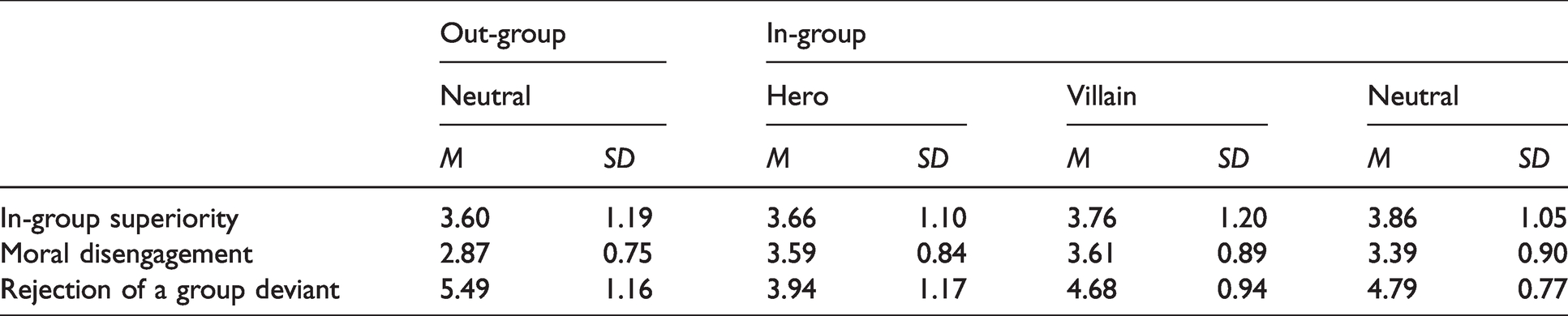
To test the differences between in-group (hero, villain, neutral) and out-group historical transgressions following from our hypotheses (Hypothesis 1a: O < V = N = H; Hypothesis 1b: O < V < N < H), we conducted between-subjects one-way analysis of variance (ANOVA). The main effect of the manipulation was significant, F(3, 218) = 9.22, p < .001, η2 = .11 (see Table 1). Post hoc tests revealed the differences between out-group and in-group transgressions—that is, the participants used less moral disengagement in the case of out-group transgression (M = 2.87, SD = 0.75) than in any of the three in-group transgressions: the hero Lazar, M = 3.59, SD = 0.84, p < .001, 95% CI [−1.17, −0.27], η2 = .08; the villain Vuk, M = 3.61, SD = 0.89, p < .001, 95% CI [−1.19, −0.29], η2 = .09; and the neutral Vlatko, M = 3.39, SD = 0.90, p = .02, 95% CI [−0.98, −0.06], η2 = .04. As predicted (Hypothesis 1a), there were no significant differences in the use of moral disengagement between in-group transgressions (p values >.05). To provide a more straightforward test of the hypotheses, we repeated the same analysis subsampling participants in transgressions with Vuk and Lazar, retaining only the ones with clear negative representations of Vuk and positive representations of Lazar, respectively. However, the pattern of differences did not change.
Means and Standard Deviations of Moderator and Dependent Variables for Each Historical Transgression.
Using moderation analysis (Hayes, 2018), we tested if the perception of in-group superiority moderated the use of moral disengagement strategies in the case of in-group transgressions (Hypothesis 3a). In addition, since it is more robust to outliers and non-normality than ordinary least squares regression (Anderson & Schumacker, 2003; Wilcox, 2012), we also conducted MM-estimators regression using the “robustbase” R package (Koller & Stahel, 2017). We report all of the discrepancies between the two in the text. The moderation analysis revealed a significant transgression manipulation x superiority interaction, ΔR = .04, F(3, 217) = 4.71, p = .003 (Figure 1). We then proceeded to examine the nature of the interaction through simple slopes analyses. In line with Hypothesis 3a, for each of the in-group transgressions, the participants who scored higher on in-group superiority were more prone to moral disengagement—from the hero Lazar (β = 0.58, p < .001); the villain Vuk (β = 0.58, p < .001); and the neutral Vlatko (β = 0.62, p < .001). In the case of out-group transgression, there was no difference in moral disengagement between the participants scoring low and high on in-group superiority (β = 0.13, p = .23).

Moral Disengagement as a Function of Historical Transgressions and In-group Superiority.
Rejection of a Group Deviant
We conducted a one-way ANOVA to test the hypotheses about the pattern of differences in the rejection of the group deviant between historical transgressions (Hypothesis 2a: O < V < N < H; Hypothesis 2b: H < O < N < V). The ANOVA yielded a significant main effect, F(3, 213) = 21.08, p < .001, η2 = .23. Furthermore, post hoc tests demonstrated that out-group Janoš (M = 5.49, SD = 1.16) was rejected more than in-group neutral Vlatko (M = 4.79, SD = 0.77, p = .002, 95% CI [0.20, 1.21], η2 = .05) and villain Vuk (M = 4.68, SD = 0.94, p = .001, 95% CI [0.27, 1.36], η2 = .06), between whom there was no difference, p = .99, 95% CI [−0.33, 0.56]. The in-group hero Lazar (M = 3.94, SD = 1.17) was the least rejected figure, less than both Vuk (p = .003, 95% CI [−1.28, −0.19], η2 = .05) and Vlatko (p < .001, 95% CI [−1.35, −0.34], η2 = .07). Following the same logic as with moral disengagement, we subsampled the participants with clear villain Vuk–hero Lazar representations. Repeating the ANOVA showed that the difference between the in-group villain Vuk (M = 5.15, SD = 0.81) and the out-group Janoš (M = 5.49, SD = 1.16) was not significant any more (p = .80, 95% CI [−1.18, 0.50], η2 = .004), while the hero Lazar was still the least harshly evaluated historical figure (M = 3.83, SD = 1.13).
We proceeded to test if and how in-group superiority moderated rejection of a historical figure for different transgressions (Hypothesis 4a). Although transgression manipulation x superiority interaction was not significant, ΔR = .02, F(3, 217) = 1.95, p = .12, higher in-group superiority predicted less rejection of the hero Lazar (β = −0.51, p < .001) and neutral Vlatko (β = −0.34, p < .006) (Figure 2). However, there was no difference between high and low in-group superiority for the villain Vuk (β = −0.17, p = .10), contrary to Hypothesis 4a.

Rejection of the Group Deviant as a Function of Historical Transgressions and In-group Superiority.
Discussion
Representations of Hero and Villain
As Lazar was a hero of a myth that is foundational for Serbian ethnic identity, his representation was expectedly very positive. What is more, it was hegemonic—that is, the participants consensually shared it (in line with Moscovici, 1988). In spite of his villainous role in the Kosovo myth, Vuk was positively represented as well. However, in Moscovici’s (1988) terminology, his representation could be labeled as polemical, considering a higher polarization among the participants. This may be a consequence of the demystification process in Serbian society regarding the historical character of Vuk, started by historiography in the past century (Ćirković, 1990, cited in Zirojević, 1996). The positive representation of Vuk constrained the testing of our hypothesis concerning the effect of a negative ethnic symbol.
Moral Disengagement
In line with our hypotheses, we observed that the participants were more prone to strategies of legitimizing violence in the case of the in-group than the out-group, even when an atrocity was the same. Regarding in-group transgressions, our findings supported Hypothesis 1a, since the participants used moral disengagement to the same extent regardless of the character involved. Although we observed the privileged position of group symbols, it seems that it was still the information about the group committing the atrocity that was dominantly driving the participants’ responses.
Our prediction about the moderating role of in-group superiority as a mode of social identification was confirmed in all of the in-group transgressions: a group of participants perceiving the in-group as superior to other groups used moral disengagement more than the participants who were less prone to glorifying (for a similar trend in the context of perceived collective continuity, see Maoulida et al., 2021).
Rejection of a Group Deviant
Regarding the rejection of the group deviant, we obtained mixed results. In both Hypothesis 2a and Hypothesis 2b, we predicted the black sheep effect—that is, in-group deviants would be rejected more than out-group deviants. In contrast, we observed classic in-group favoritism (e.g., Tajfel et al., 1971)—that is, all in-group deviants were evaluated more positively than the out-group deviants. Regarding reactions to in-group deviancy, Otten and Gordijn (2014) argued that striving for positive in-group distinctiveness renders both lenient and harsh strategies plausible, but we have to discern circumstances under one and not the other will occur. Thus, rejecting the characters of the historical period that is foundational for ethnic identity may be a less functional strategy than classic in-group favoritism. Similarly, when we explored the moderation by in-group superiority, we did not observe the expected black sheep effect but a trend toward in-group favoritism. This finding is in line with the study of Roccas et al. (2004), in which higher in-group glorification predicted leniency toward in-group perpetrators, while in-group attachment predicted the black sheep effect.
Our results clearly supported the expected unique position of Lazar as a highly valued ethnic symbol, since he was the most positively evaluated character, despite his immoral deeds (Hypothesis 2b). Additionally, the participants with a glorifying image of the in-group were especially reluctant to reject him (Hypothesis 4a), unlike the villain and out-group historical character. Even though we could not test expectations about the in-group villain on the whole sample, analysis of a subsample of the participants with a negative representation of Vuk did not detect a difference between the out-group member and the in-group villain.
The results of Experiment 1 informed the second study, in which we conceptually replicated the research design from Experiment 1 but introduced several important changes. First, we explored whether the results obtained would hold if the event was set in a different social context and in the more recent past. We used living historical representations, since it is more difficult to relegate such memories to “ancient” history, which is a subtle strategy for mitigating identity threat (Peetz et al., 2010). Thus, we set the study in a more recent historical representations of a Greek Cypriot ethnic group. Second, we wanted to find out if critically attached group members would be reluctant to use defensive strategies in the case of transgression with an in-group hero. This is why, in the second study, we measured both in-group superiority and importance. We expected that in-group superiority would predict more moral disengagement and the classic in-group favoritism of a group deviant, while in-group importance would predict less moral disengagement and the black sheep effect. Third, the fact that we did not observe differences between in-group transgressions (hero vs. villain) could be due to the formulation of the questions in the moral disengagement scale, which only mentioned the group. To make both the group and the character salient, we changed the form of the items in the moral disengagement scale from “[group]” to “[character] and [group].” Lastly, in Experiment 2, we used an in-group villain who was, according to our pilot study, uniquely negatively represented in the participants’ collective remembering.
Experiment 2
For this study, we opted for the period of the Liberation Struggle, which ended colonial British rule (1955–1959) and, as such, is foundational for the Greek Cypriot community (e.g., Ker-Lindsay, 2011). We chose two characters as the hero (GC-H) and the villain (GC-V) based on their role in this historical period and a pilot test carried out on a sample of Greek Cypriots. Their names were not made public on the advice of our local partners, due to the recency of the events described in the scenario. The hero’s readiness to die rather than surrender made him a widely commemorated ethnic symbol (Toumazis, 2017). On the contrary, the villain, although he had an active role in the 1955–1959 struggle, is mostly remembered for his involvement in an unsuccessful coup d’état against the elected president, Makarios, which led to the division of the island that continues to the present day (Ker-Lindsay, 2011; Papadakis, 2008).
Method
Sample and Procedure
The sampling method, online platform, and treatment of outliers were the same as in Experiment 1. The sample consisted of 136 participants identifying as Greek Cypriots. Their ages ranged from 18 to 73 (M = 30.14, SD = 11.79), while 64.7% of the sample were female. Informed by Experiment 1, the sensitivity analysis showed that with this sample size we could identify a medium-sized effect (f = 0.29). The fictional historical transgression depicted a Greek Cypriot/Turkish Cypriot bombing attack during the Liberation Struggle that resulted in Cypriot Roma casualties (a full English translation is available at the Open Science Framework repository). To secure the authenticity of the historical transgression, we relied on newspaper articles from the 1955–1964 period. The procedure and research design paralleled Experiment 1. After the participants had answered questions on scales assessing their social identification and representations of historical figures, they were randomly assigned to one of four conditions: (a) in-group transgression with the salient hero, GC-H; (b) in-group transgression with the salient villain, GC-V; (c) in-group transgression with the salient neutral/fictitious character, Kostas Ioannou; and (d) out-group transgression with the salient neutral/fictitious character, Mehmet Açık. 4
Measures
The scales measuring in-group superiority (α = .87), representations of historical figures, moral disengagement (α = .93), and rejection of a group deviant (α = .86) were the same as in Experiment 1 but adapted to the Greek Cypriot ethnic context. The only new measure was the 4-item in-group importance (Roccas et al., 2008), where the participants assessed on a 7-point Likert scale to what extent the ethnic group was central for their self-concept (α = .89; e.g., “Belonging to Greek Cypriots is an important part of my identity”).
Results
Representations of Hero and Villain
When tested against the midpoint of the scale, representation of GC-H (M = 8.87, SD = 2.27) was, as expected, very positive, t(133) = 14.68, p < .001, 95% CI [2.49, 3.26], d = 1.27, while representation of GC-V (M = 3.79, SD = 2.61) was negative, t(108) = −8.86, p < .001, 95% CI [−2.71, −1.72], d = 0.85.
Moral Disengagement
We ran a one-way ANOVA to test the differences between different versions of transgressions with regard to moral disengagement (Hypothesis 1a: O < V = N = H; Hypothesis 1b: O < V < N < H). The omnibus test yielded a significant difference, F(3, 131) = 4.85, p = .003, η2 = .10 (see Table 2). Differing from Experiment 1 but supporting Hypothesis 1b, we observed differences between in-group transgressions. More precisely, the participants used the most moral disengagement in the transgression with the salient hero (M = 3.57, SD = 1.08), significantly more than in transgressions with the other two in-group characters—the neutral Ioannou, M = 2.85, SD = 1.02, p = .02, 95% CI [0.09, 1.35], η2 = .06, and the villain GC-V, M = 2.76, SD = 0.93, p = .004, 95% CI [0.18, 1.44], η2 = .08. The difference from the out-group Açık (M = 3.01, SD = 0.77) was, however, only marginally significant, p = .09, 95% CI [−0.05, 1.15], η2 = .04. In contrast to Experiment 1, there were no differences between the other two in-group transgressions and the out-group transgression. To test the hero–villain effect in a more straightforward manner, we repeated the same analysis using subsamples of the participants with only positive representations of GC-H and negative representations of GC-V in their respective experimental groups. The group exposed to the transgression with the hero again had the highest moral disengagement score (M = 3.87, SD = 0.89), significantly more than the out-group transgression, p = .001, 95% CI [0.28, 1.44], η2 = .11.
Means and Standard Deviations of Moderators and Dependent Variables for Each Historical Transgression.

We proceeded to test the hypothesis about the moderating role of two modes of social identification (Hypothesis 3b). First, we ran the analysis with in-group superiority as a moderator while controlling for in-group importance. The transgression manipulation x superiority interaction was significant, ΔR = .05, F(3, 127) = 3.67, p = .01 (Figure 3). As in Experiment 1, the participants with a superior in-group image used more moral disengagement in transgressions with the hero (β = 0.70, p < .001) and the neutral Ioannou (β = 0.62, p < .001), while such a relationship was absent in the case of out-group transgressions (β = 0.17, p = .23). In-group superiority was not predictive of higher moral disengagement in the transgressions with the salient villain (β = 0.22, p = .11), contrary to Experiment 1. 5 The interaction was significant, even when we tested in-group importance as a moderator while controlling for superiority, ΔR = .09, F(3, 127) = 6.29, p = .001 (Figure 3). As with superiority, in-group importance was a significant predictor in transgressions with the hero (β = 0.43, p = .001) and the neutral Ioannou (β = 0.45, p = .003), but not in the transgressions with the villain (β = −0.09, p = .59) and the out-group Açık (β = −0.19, p = .17).

Moral Disengagement as a Function of Historical Transgressions and In-group Superiority/In-group Importance.
Rejection of a Group Deviant
Using a one-way ANOVA, we tested differences in the rejection of a group deviant between the historical transgressions (Hypothesis 2a: O < V < N < H; Hypothesis 2b: H < O < N < V). The ANOVA yielded a significant main effect, F(3, 131) = 34.68, p < .001, η2 = .44. As predicted by Hypothesis 2b and demonstrated in Experiment 1, the in-group hero was the least rejected historical figure. The participants rejected the hero (M = 3.45, SD = 1.01) less than the neutral Ioannou (M = 5.06, SD = 0.80, p < .001, 95% CI [−2.18, −1.04], η2 = .24), the villain (M = 5.22, SD = 0.81, p < .001, 95% CI [−2.33, −1.21], η2 = .30), and the out-group Açık (M = 5.24, SD = 0.78, p < .001, 95% CI [−2.33, −1.25], η2 = .33). Contrary to our expectations, there were no differences between the other two in-group characters and the out-group character (p values > .90). When we repeated the analysis on subsamples with clear positive–negative representations of the characters, we observed the same pattern of differences, only the effect size increased (η2 = .52).
Testing the moderation of social identification (Hypothesis 4b), we first used in-group superiority as a moderator while controlling for in-group importance. The moderation analysis revealed a significant interaction, ΔR = .10, F(3, 127) = 8.04, p < .001 (Figure 4). Participants who had a superior image of the in-group rejected the hero less (β = −0.52, p = .001) and the out-group Açık more (β = 0.34, p = .008), while there were no differences for the villain (β = 0.02, p = .84) and the in-group Ioannou (β = −0.21, p = .14). The treatment of the in-group hero and villain was similar to Experiment 1. Testing the moderation of in-group importance while controlling for superiority yielded a significant interaction as well, ΔR = .12, F(3, 127) = 11, p < .001 (Figure 4). We observed the same patterns as in the moderation by superiority analyses—people who were attached more critically to the in-group rejected the hero less (β = −0.58, p < .001) and the out-group Açık more (β = 0.32, p = .01), while there were no differences for the neutral Ioannou (β = 0.02, p = .87) and the villain (β = 0.10, p = .52).

Rejection of the Group Deviant as a Function of Historical Transgressions and In-group Superiority/In-group Importance.
Discussion
Moral Disengagement
In line with the special meaning of an in-group hero (Hypothesis 1b), we observed that people were especially susceptible to moral disengagement strategies when the in-group’s historical atrocity involved such a member. Unlike in Experiment 1, people did not use defensive strategies more for the in-group atrocities involving a neutral member or a villain compared with the out-group historical transgressions. This might be due to the methodological change we introduced—namely, in the moral disengagement items of Experiment 1 only the group was salient, whereas in Experiment 2 we made both the character and the group salient. Consequently, it appears that when both the character and the group are salient, the historical representation of the character dominantly frames people’s perception of an atrocity. Additionally, the lack of in-group favoring intergroup differentiation may be contextually bound. Specifically, identity positioning in Cyprus is diverse, giving rise to different definitions of Greek Cypriot–Turkish Cypriot relations (Psaltis, 2011). For example, highly Cypriocentric social identification is a form of superordinate identity that is more inclusive of Turkish Cypriots and in direct opposition to ethnonationalism, unlike highly Hellenocentric identification, which is exactly the opposite. The fact that our sample was skewed toward a highly educated left-wing population, together with the recent rise in Cypriocentric views (Psaltis & Cakal, 2016), might have constrained the intergroup differentiation.
We replicated the moderating role of in-group superiority from Experiment 1 for transgressions with the hero and the neutral Ioannou. People who perceived their ethnic group as superior employed more moral disengagement strategies. Contrary to Experiment 1, such an effect was absent for the transgression with the villain, although robust regression reported that the effect was present. One should remember, however, that the “villain” in Experiment 1 was positively represented, whilst in Experiment 2 he was clearly negatively represented. We obtained the same pattern of results when inspecting the moderating role of in-group importance. Even though these findings were expected in the case of in-group superiority, such proneness to moral disengagement was unexpected for in-group importance, as a more critical attachment to the group (Bilali, 2012; Roccas et al., 2006). This may suggest that group transgressions from foundational historical periods for ethnic identities demand defensive information processing for all those who highly identify with the group. Even if this might be especially true for transgressions including in-group heroes, our results suggest that the presence of in-group villains could reduce or eliminate such in-group favoritism.
Rejection of a Group Deviant
Replicating Experiment 1, the hero was the least rejected historical character. Also, participants with a glorified in-group image were particularly unwilling to negatively evaluate and attribute guilt to the hero. The same was true for participants who perceived the in-group as important for their self-concept. Hence, our findings supported the expectation about the unique position of the in-group hero. Despite being negatively represented in Experiment 2, the villain was not treated differently from the neutral character Ioannou, which was contrary to our expectations.
Even though we included importance as a mode of social identification related to more critical reactions toward group deviants (Roccas et al, 2004), the black sheep effect did not occur. In contrast, both in-group superiority and in-group importance predicted leniency toward the hero and harsher reactions toward the out-group Açık. Thus, further supporting our reasoning from Experiment 1, rejecting characters of a historical period that is constitutional for the ethnic group may not be a functional strategy of retaining positive social identity, especially for highly identifying individuals.
General Discussion
In the two studies, we demonstrated that people are reluctant to attribute guilt to and denigrate ethnic heroes, even in the case where they were apparently involved in atrocities. On the contrary, people will choose interpretations that legitimize and relativize historical transgressions involving ethnic heroes. On the other hand, ethnic villains were not treated worse than neutral group members. While in Experiment 1 we observed more moral disengagement strategies in the case of in-group historical transgressions, in Experiment 2 we noted the absence of such a difference in two out of the three in-group experimental conditions, acknowledging how in-group favoritism can be potentially constrained by the context. Furthermore, the respondents who strongly identified with the ethnic group were especially prone to use defensive strategies in the case of in-group transgressions and avoid harsh reactions to in-group deviants. While high-identifiers were mostly not more “protective” in the case of a transgressive ethnic villain, across both studies the ethnic hero was the only historical character who consistently provoked defensive reactions in high-identifying individuals.
Special Role of Heroes for Ethnic Groups
Exemption from the Black Sheep Effect and Critical Attachment
Our findings show that challenging a hero’s image provokes defensive reactions in group members, as ethnic heroes fulfil the descriptive and prescriptive functions that historical representations have for establishing ethnic identity (Liu & Hilton, 2005; Reicher & Hopkins, 2001). They demonstrate that a hero is exempt from the black sheep effect—rejecting in-group deviants more than out-group deviants (e.g., Branscombe et al., 1993; Castano et al., 2002; Marques & Paez, 1994; Marques et al., 1988)—even though some authors have argued that the effect will be greatest if deviants are central members of the in-group since they pose the greatest threat to positive in-group distinctiveness (Pinto et al., 2010). However, if an ethnic hero is a source of positive in-group distinctiveness, rejecting the hero may imply rejecting the ethnic group itself (see Penić et al., 2016); thus, the black sheep effect loses its functionality. Further supporting our reasoning, the effects were even stronger in people who perceived that the hero had positively contributed to the group in the past. Additionally, the ethnic hero was exempt from the black sheep effect in the case of people who based their social identification on in-group importance, rather than in-group superiority. Therefore, even those high-identifiers who ought to be a group’s “critical voice” (Bilali, 2012; Roccas et al., 2004, 2006) will tend to legitimize and relativize immoral deeds if an ethnic hero is involved.
Comparison of Distant and Living Historical Memories in Post-Conflict Societies
Although the representations of history from the Serbian context were more distant and institutionalized in comparison to the Greek Cypriot context, we observed the privileged treatment of the ethnic hero in both. Notwithstanding this, the effects were somewhat stronger for the Greek Cypriot hero, who can be considered a living memory since some of his acquaintances may still be alive. This is in line with the finding that in-group past harms are more threatening for social identity if they are perceived as closer in time (Peetz et al., 2010). These differences between distant and living historical memories might be greater since we primed perceived collective continuity, which is related to focusing on a group’s past (Peetz & Wohl, 2018). Thus, future studies should also take into account collective temporal orientation as a relevant moderator in a single design.
(Mis)use of Heroes
If heroes are of paramount importance for establishing ethnic identity, it makes them a potent means of mass social mobilization. Unfortunately, heroes are all too often used to gain political power or propagate intergroup strife. Reicher and Hopkins (2001), for example, demonstrated how Scottish political elites utilized Sir William Wallace and King Robert the Bruce to define Scottish identity in accordance with their agenda. During the war with Iran, the Iraqi regime tried to equate Saddam Hussein with Sa’d ibn Abi Waqas, a hero from the Qadisiyah battle from Arab history, and even produced a high-budget movie linking the two (Zemzemi, 1986). Similarly, heroes from the Battle of Kosovo were invoked in Serbian public discourse preceding the violent dissolution of Yugoslavia to mobilize ethnic in-groups and “inoculate” against treachery (Zirojević, 1996). As Liu and Hilton (2005, pp. 539–540) observed: “a great advantage of history for politicians is that most of the participants in it are dead, and while immortal as symbols, can speak only through the tongues of present-day interpreters.” By showing a bias in the interpretation of their past deeds, our results support the special status of group heroes. In post-conflict societies, this can be further exacerbated by typical black-and-white historical narratives (Paulson, 2015; Psaltis, Carretero, & Čehajić-Clancy, 2017; Psaltis, Franc, Smeekes, et al., 2017). To counter this one-sidedness, Carretero (2017) suggested investing educational efforts in developing a more complex understanding of these historical characters and the way they came to be—for example, developing awareness of historical invention and the selection of heroes, as well as contextualizing their deeds.
One must, however, bear in mind that the power of heroes can also be employed for prosocial purposes—for example, by raising awareness of their deeds and traits with the aim of bettering intergroup relations or fostering reconciliation. One can also think of the reverse path—finding heroes among those who helped out-group members during times of conflict. Stories of these heroic helpers have been demonstrated to foster readiness for intergroup contact and reconciliatory beliefs (Bilewicz & Jaworska, 2013; Čehajić-Clancy & Bilewicz, 2017).
Limitations and Future Directions
Our two experiments were designed to compare how the same identity processes of the sociopsychological subject manifested in two cultural contexts; the differences between the two were, however, not only contextual, but also methodological. Thus, future studies should disentangle these differences and further prove the robustness of the results. Second, to test the moderating role for different types of social identification, we statistically controlled for in-group superiority while inspecting the moderation role of in-group importance, and vice versa. For more rigorous inferences about critically attached group members, experimental manipulation of different modes of social identification could be more informative (e.g., following the procedure from Roccas et al., 2006). Third, one can argue that the special treatment which heroes received could have been due not to their heroic status, but to the fact that they were perceived as leaders and thus granted a “transgression credit”—that is, received less harsh reactions than all the other in-group and out-group transgressors (Abrams et al., 2013; for the reverse effect in severe transgressions, see Karelaia & Keck, 2013). Although, in our study, the ethnic hero could have been perceived as a leader since he was the only salient character in the atrocity, the same was true for the other historical figures we presented to the participants, but they were not treated in the same way. The two roles could be separated more clearly in future studies, and the severity of the transgression could be experimentally varied while observing the effects on the judgment of the actors. Lastly, the stability of our findings regarding the in-group hero might be limited to post-conflict societies, in which cultural continuity between the past and the present is especially cultivated. Our hypothesis should therefore be further tested in contexts that have not been burdened with recent violence.
Concluding Remarks
When, at the end of the 19th century, Serbian historiography began to debunk the mythical details regarding the heroes and villains of the Battle of Kosovo, it encountered strong resistance from people who argued that doubting tradition undermines the national spirit. As a notable contemporary claimed: “Kill someone’s past and you endanger their future” (Zirojević, 1996, p. 224). In our study, we have demonstrated how such protection of ethnic heroes operates and how important they are for a group. This fact places responsibility on societies to carefully choose which values they will propagate through the celebration of group heroes. Similarly to Liu and Sibley (2009), we argue that although historical representations—for example, of ethnic heroes and villains—could constrain which political and educational actions are feasible, the political and educational agenda may equally redefine simplistic narratives of the past that obstruct the reconciliation process.
Footnotes
Acknowledgments
We thank all our friends from Cyprus, Greece, Serbia, and beyond who selflessly helped with the survey’s distribution and translation.
Declaration of Conflicting Interests
The author(s) declared no potential conflicts of interest with respect to the research, authorship, and/or publication of this article.
Funding
The author(s) received no financial support for the research, authorship, and/or publication of this article.
