




Abstract
The benefits of mindfulness are widely recognized, and it has received increasing research attention. Recently, researchers have extended the concept and practice of mindfulness to the parent–child relationship and proposed the construct of mindful parenting, that is, parenting with mindfulness. However, mindful parenting is a relatively new concept in the field of family studies, and the contents, psychometrically robust measures, outcomes, and cultivation methods of mindful parenting warrant in-depth exploration. This article presents a systematic review of mindful parenting. We first conceptualized mindful parenting by consolidating the existence of this construct. Then, we summarized various measurements to assess this construct, and reviewed theoretical models and empirical research on the roles of mindful parenting. We also illustrated the ways to enhance mindful parenting and provided current evidence regarding these methods. Further, we discussed the limitations in this field and proposed future research directions.
A review of mindful parenting: theory, measurement, correlates, and improvement
Researchers and clinicians have recently been giving an increasing amount of attention to mindfulness, a construct that derives from Buddhist philosophy. The most commonly cited definition of mindfulness comes from Kabat-Zinn (2003), who defines mindfulness as “the awareness that emerges through paying attention, on purpose, in the present moment, and nonjudgmentally to the unfolding of experience moment by moment” (p. 145). Several prominent researchers on mindfulness have provided their understandings of this construct. For example, Bishop et al. (2004) proposed a two-component model of mindfulness, incorporating (1) self-regulation of attention and awareness, and (2) curiosity, openness, and acceptance toward one’s ongoing experiences. Baer et al. (2006) identified five dimensions of mindfulness, including observing, describing, acting with awareness, nonjudging of inner experience, and nonreactivity to inner experience. Grossman (2010) proposed that mindfulness is a multifaceted construct that involves cognitive, attitudinal, affective, social, and ethical dimensions (Grossman, 2010). Although mindfulness has been described in several ways, empirical research has consistently indicated that mindful individuals tend to have more positive emotions, greater emotion regulation capacity, and more social connectedness, also that they are satisfied in interpersonal relationships and less likely to suffer psychological and behavioral problems (Brown et al., 2007; Keng et al., 2011). Moreover, Research on mindfulness-based interventions has indicated that people showed significant improvements in cognition (e.g., clarity of perception, working memory, and cognitive control) and emotion (e.g., emotion regulation and positive emotions) after the interventions (Baer, 2014).
In addition to exploring the personal benefits of mindfulness, researchers have also extended the concepts and practices of mindfulness to social contexts, such as parent–child relationships. Mindful parenting is a typical extension of mindfulness from intrapersonal trait to interpersonal relationships, specifically referring to parenting children with mindfulness. Given that a growing body of literature on mindful parenting has been assessed and applied, a review that synthesizes current literature is needed to highlight substantive contributions of mindful parenting and to identify important future directions. Thus, here we aim to systematically review the theories, measurements, correlates, and outcomes of mindful parenting. Overall, the review has five main sections to address the following questions: (1) What is the conceptualization of mindful parenting based on a consolidation of definitions and understandings? (2) How do we assess mindful parenting and what are the psychometric properties of these measurements? (3) What is the impact of mindful parenting on family and children, both theoretically and empirically? (4) How might mindful parenting be promoted? (5) What are the limitations of extant literature and how do they shed light on future research?
Conceptualizations of mindful parenting
The concept of mindful parenting describes the mindfulness-based processes towards parents, children, as well as family relationships. Kabat-Zinn and Kabat-Zinn (1997) first extended the concept of mindfulness from intrapersonal relationships to interpersonal relationships (e.g., parent–child relationships) and proposed the concept of mindful parenting, which is defined as a practical, creative, and growing process. In this process, parents pay attention to one’s child and parenting in a particular way, namely, conscious, in the present moment, and nonjudgmental parenting (Bögels & Restifo, 2014; Kabat-Zinn & Kabat-Zinn, 1997). Kabat-Zinn and Kabat-Zinn (1997) suggested that mindful parenting may consist of three elements: sovereignty (i.e., recognition and encouragement of children’s inner-selves), empathy (i.e., attempt to understand children’s thoughts and think from the perspective of children), and acceptance (i.e., full acceptance of children’s inner-selves, feelings, thoughts, and views).
Duncan et al. (2009a) illustrated the connotation of mindful parenting more comprehensively based on the integration of Kabat-Zinn and Kabat-Zinn’s (1997) view and the current empirical research of mindfulness. They proposed that mindful parenting includes five elements: (1) listening with full attention, that is, parents pay close attention to the current parenting experience and listen to their children with full attention, including paying attention to their children’s speech content, voice tone, facial expression, and body language; (2) nonjudgmental acceptance of self and child, that is, parents understand and accept their own and their children’s behavior, parent–child relationship, and current parenting experience, so that their cognition and behavior are not affected by automatic thinking and subconscious bias; (3) emotional awareness of self and child, that is, parents can identify their own and children’s emotions, so that they can respond appropriately with awareness, rather than automatically or blindly; (4) self-regulation in the parenting relationship, that is, parents control their emotional responses in a balanced state, especially in the face of negative emotions, in parenting activities; and (5) compassion for self and child, that is, parents acknowledge their efforts in parenting behaviors, avoiding excessive self-criticism, and comfort and support their children in distress (Duncan et al., 2009a).
Although Duncan et al.’s (2009a) interpretation of mindful parenting is recognized by many scholars, some researchers have discussed their understandings of mindful parenting from other perspectives (Chen et al., 2017; Coatsworth et al., 2010). For example, Chen et al.(2017) posited that mindful parenting should consist of two processes, namely, the intrapersonal process and the interpersonal process. The intrapersonal process (i.e., parent-oriented process) reflects parents’ awareness of themselves, including awareness of their own emotions and self-compassion. The interpersonal process (i.e., child-oriented process and parent–child interaction-oriented process) reflects parents’ awareness of their children and the parent–child relationship in parenting activities, including listening with full attention to children, practicing nonjudgmental acceptance of children, having awareness of children’s emotions, and showing compassion for children, as well as reducing parents’ automatic responses, maintaining awareness, and being nonjudgmental in the parenting relationship.
According to the literature, it seems that mindful parenting consists of five elements (i.e., awareness, attention, nonjudgement acceptance, compassion, and self-regulation) across three orientations (i.e., parent orientation, child orientation, and parent–child interaction orientation) and three aspects (i.e., cognitive, emotional, and behavioral). Therefore, in order to compose various understandings of mindful parenting to a comprehensive definition, we propose a comprehensive definition of mindful parenting as “a parenting process in which parents do their best to give awareness, attention, nonjudgmental acceptance, and compassion, with high quality of self-regulation, to themselves and to their children in their moment-to-moment interaction.” The five elements covering three orientations and manifested in three aspects thus are (1) having greater awareness of cognition, emotions, and behaviors of parents and their children, as well as parent–child interactions; (2) paying more attention to cognition, emotions, and behaviors of parents and their children, as well as parent–child interactions; (3) displaying nonjudgmental acceptance of cognition, emotions, and behaviors of parents and their children, as well as parent–child interactions, whether pleasant or unpleasant; (4) providing compassion for parents and their children in distress; and (5) showing self-regulation of parents’ own cognition, emotions, and behaviors in parent–child interactions. This combination of mindful parenting is also supported by empirical research which verified each path from different perspectives (this evidence is elaborated in the section The theoretical models and empirical research on the roles of mindful parenting below).
Measures of mindful parenting
In addition to elaborating upon the meaning of mindful parenting, it is also important to scientifically measure the structure and contents of mindful parenting. To date, assessments of mindful parenting have included parent-report measures (i.e., parents report their mindful parenting behaviors), child-report measures (i.e., children report their perceived parents’ mindful parenting behaviors), and behavioral observation (i.e., mindful parenting is assessed through observational coding of parent–child interactions). The psychometric properties of the measures are varied but acceptable.
Parent-report measures
Most of the previous studies use the parent-report method to measure mindful parenting. The Interpersonal Mindfulness in Parenting Scale (IMPS) developed by Duncan et al. (2009a) is the most widely used scale. At first, the IMPS (IMP-8/10) of Duncan (2007) consisted of eight or ten items across three dimensions: Awareness & Present-Centered Attention, Nonjudgment, and Nonreactivity. The coefficients of internal consistency of the subscales ranged from .45 to .66, and the coefficient of total score is .72. Later, Duncan et al. (2009a) extended the IMPS to 31 items (IMPS-31) across five dimensions corresponding to her five-element theory of mindful parenting, that is, Listening with Full Attention, Nonjudgmental Acceptance of Self and Children, Emotional Awareness of Self and Children, Self-Regulation in Parenting Relationship, and Compassion for Self and Children.
The IMPS-31 has been revised and applied in many countries for families with children at various developmental stages, that is, infancy, preschool and school-aged childhood, and adolescence. The Dutch version of the IMPS has 29 items and five dimensions, that is, Listening with Full Attention, Compassion for Child, Nonjudgmental Acceptance of Parental Functioning, Emotional Nonreactivity in Parenting, Emotional Awareness of Child, and Emotional Awareness of Self (de Bruin et al., 2014). The internal consistency based on 29 items was good (α = .89 for total score). The Portuguese version of the IMPS has 29 items and five dimensions, that is, Listening with Full Attention, Compassion for the Child, Nonjudgmental Acceptance of Parental Functioning, Self-regulation in Parenting, and Emotional Awareness of the Child (Moreira & Canavarro, 2017). The Portuguese version of the IMPS also showed excellent psychometric properties. The coefficients of internal consistency of the subscales ranged from .70 to .86, and the coefficient of the total score is .93. The Korean version of the IMPS has 18 items and six dimensions, that is, Nonjudgmental Acceptance of Parental Functioning, Emotional Self-Regulation, Compassion for the Child, Listening with Full Attention, Noticing Child’s Feelings, and Insight into Effect of Mood (Kim et al., 2019). The short version of Korean IMPS showed acceptable-to-good reliabilities that ranged from .58 to .78. There are two Chinese versions of the IMPS: the version for Hong Kong has 23 items and four dimensions, that is, Compassion for the Child, Nonjudgmental Acceptance in Parenting, Emotional Awareness in Parenting, and Listening with Full Attention (Lo et al., 2018). The internal consistency based on 23 items was .85 and the internal consistencies of four subscales ranged from .70 to .84; the version for mainland China has 24 items and four dimensions, that is, Interacting with Full Attention, Compassion and Acceptance, Self-regulation in Parenting, and Emotional Awareness of the Child (Pan et al., 2019). The internal consistency of this measure was excellent (α = .90), and those of four subscales ranged from .71 to .83. Additionally, Laurent et al. (2017) also revised the infant version of the IMPS, which has 27 items and five dimensions, that is, Listening with Full Attention, Nonjudgmental Acceptance of Self and Children, Emotional Awareness of Self and Children, Self-Regulation in Parenting Relationship, and Compassion for Self and Child. The internal consistency was good (α = .81).
In addition to the IMPS, McCaffrey et al. (2017) and Jones et al. (2014) developed the Mindfulness in Parenting Questionnaire (MIPQ) and the Bangor Mindful Parenting Scale (BMPS), respectively. The MIPQ (McCaffrey et al., 2017) is for children aged 2–16, consisting of 28 items and two dimensions, namely, Mindfulness Discipline and Being in the Moment with the Child. This scale has been translated and revised into a Turkish version (Gördesli et al., 2018) and a Chinese version (Wu et al., 2019), which also consist of the original 28 items and two dimensions. However, the MIPQ has not been widely used because it was mainly created by experts’ brainstorming and lacked theoretical support regarding mindful parenting. In contrast, Jones et al. (2014) developed a 15-item BMPS based on the theoretical framework of the Five Facets Theory of Mindfulness (Bear et al., 2006). This scale thus divides mindful parenting into five dimensions: Observing, Describing, Acting with Awareness, Nonjudging of Inner Experience, and Nonreactivity to Inner Experience. However, since mindfulness and mindful parenting are actually two concepts, the BMPS has also not been widely used.
Child-report measures
Lippold et al. (2015) used the child-report method to measure mothers’ mindful parenting behaviors perceived by adolescents in a study exploring mindful parenting and mother–adolescent communication. The scale used in Lippold et al. (2015)’s study was revised from the original IMPS-31 and contains 19 items, assessing adolescent perceptions of their parents based on the following dimensions: Listens with Full Attention, Exhibits Emotional Awareness in Parenting, Shows Self-Regulation, and Displays Nonjudgmental Acceptance and Compassion. The internal consistency for this scale was good (α = .89). Since parenting behaviors reported by parents may be different from those perceived by children (De Los Reyes et al., 2103), researchers have recently called for more child-report measures of mindful parenting (e.g., Lippold et al., 2015; Liu et al., 2019). However, to date, there has not been much progress in this regard.
Behavioral observation
Geier (2012) utilized the observational coding to measure mindful parenting and developed a set of mindful parenting observation systems, namely, the Mindful Parenting Observation Scales (MPOS). Three main sources inform the development of this observation system: the theoretical literature; expert opinions of researchers and scholars in the fields of parenting, mindfulness science, and mindful parenting; and strategic systematic viewing of parent–child interactions. This observation system consists of 18 behavioral rating scales in total, 17 of which (e.g., attentive listening, openness, emotional waiting, and defensive) are designed to evaluate the five dimensions of mindful parenting (i.e., Listening with Full Attention, Nonjudgmental Acceptance of Self and Children, Emotional Awareness of Self and Children, Self-Regulation in Parenting Relationship, and Compassion for Self and Children), and one of which is designed to evaluate adolescents’ emotional performance (e.g., emotional intensity and expression). Using this system, Geier (2012) found that youth whose mothers rated higher in mindful parenting have better peer pressure resistance skills, fewer externalizing problems, and a lower rate of initiating use of various illicit substances. Although Geier’s (2012) study provided preliminary evidence for the utility of the MPOS as a reliable and valid observational instrument of mindful parenting, the coding systems of the MPOS scale is complexity.
The theoretical models and empirical research on the roles of mindful parenting
Several researchers have explored the benefits of mindful parenting, both theoretically and empirically. Evidence has supported that mindful parenting was positively correlated with parents, children, and family relationships.
Theoretical models on the roles of mindful parenting
Duncan et al. (2009a) discussed the implications of mindful parenting on parent, parent–child relationships, and child development (see Figure 1). They suggested that mindful parenting can first improve the quality of parenting and parental well-being, and then promote parents to adopt reasonable child management practices (e.g., consistent discipline, monitoring, and use of inductive reasoning) and establish positive parent–child interactions. These positive parent–child relationships ultimately increase positive outcomes and decrease negative outcomes for children. Regarding the mechanism of these effects, Duncan et al. (2009a) posited that (1) high-quality attention and listening can increase children’s willingness to self-expose in front of their parents, promote parents’ understanding of their children, meet the needs of children in a timely manner, and establish positive emotional connections between parents and children; (2) nonjudgmental acceptance can help parents eliminate their automatic thinking, abandon unrealistic views and expectations, formulate parenting rules that conform to their children’s development, and enhance parents’ understanding of themselves, their children, and their relationships; (3) awareness and recognition of emotions can help parents recognize their own and children’s emotional development process, provide opportunities to avoid identifying with their own emotions, and reduce their overreacting emotional response; (4) self-regulation allows parents to control their emotional response in balance, so that they can choose a reasonable coping style, emotional expression, and parenting strategy; (5) through compassion, parents can not only provide their children with understanding and comfort but also reduce their own blame and pressure in the process of parenting. Overall, these processes can ultimately promote parents’ mental health, appropriate parenting styles, positive parent–child relationships, and children’s positive development.

Duncan’s (2009a) theoretical model of mindful parenting’s effects.
Additionally, Bögels et al. (2010) proposed a theoretical model illustrating the roles of mindful parenting. They explored whether and how mindful parenting intervention promotes parenting skills and parent–child relationships among children with mental disorders. According to Bögels et al. (2010), mindful parenting intervention mainly affects parenting skills and parent–child relationships by improving parents’ attention level, so that parents can reduce negative parenting and increase positive parenting (see Figure 2). The progress of parents’ attention is manifested in six possible mechanisms, and through these mechanisms, mindful parenting may bring about changes in parenting and parent–child relationships: (1) reducing parental stress and resulting parental reactivity; (2) decreasing parental preoccupation resulting from parental and/or child psychopathology; (3) breaking the cycle of intergenerational transmission of dysfunctional parenting schemas and habits; (4) improving parental executive functioning in impulsive parents; (5) increasing self-nourishing attention; and (6) enhancing marital functioning and co-parenting.
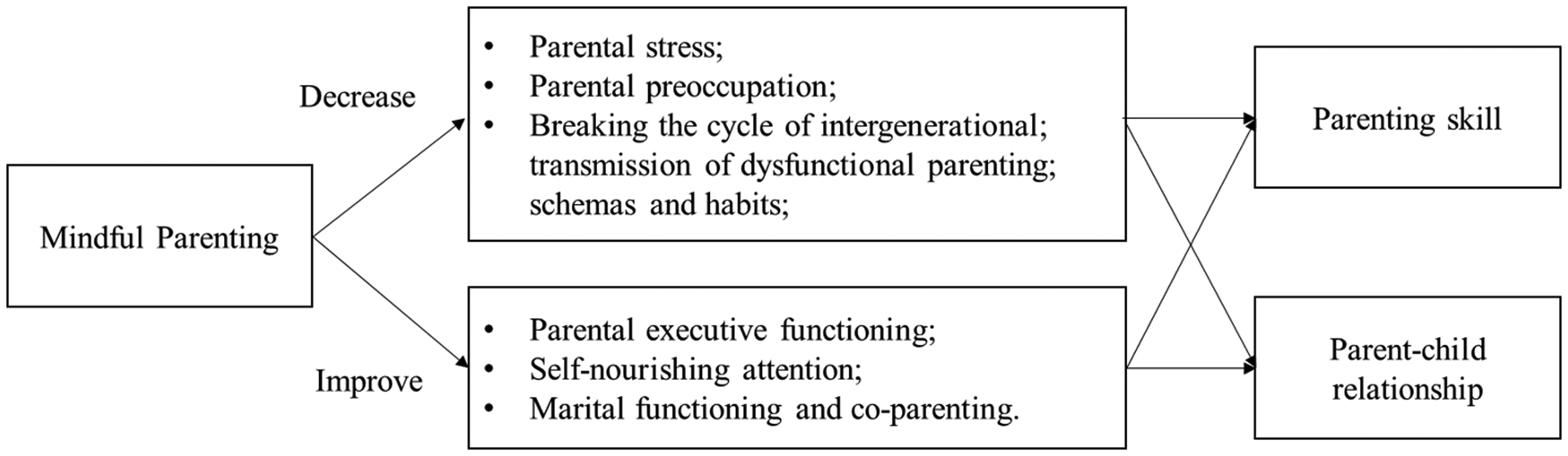
Bögels et al.’s (2010) theoretical model of mindful parenting’s effects.
Because mindful parenting is rooted in the science of mindfulness, Townshend (2016) noted that the key processes of mindful parenting should be similar to those of mindfulness. Therefore, Townshend (2016) proposed a “Mindful Parenting Processes Model” (see Figure 3), which summarizes key purported change processes underpinning mindful parenting. She suggested that mindful parenting plays an important role in one’s Intention, Attitude, Attention, Emotion, and Attachment. Townshend (2016) stated that these five processes are reflected in both the intrapersonal process of parents and the interpersonal process of parent–child interaction. For instance, the Attunement aspect of the Emotion part refers to the focusing of attention on the mind of another, encompassing intentionality and emotional awareness; the Attention to Variability aspect of the Attention part is the active creative process of making novel distinctions about objects in one’s awareness; the Reperceiving aspect of the Intention part is the process of shifting perspective. These processes and changes in one’s mental health can ultimately benefit parents and their relationships with children.

Townshend’s (2016) mindful parenting processes model.
As suggested by Townshend (2016), mindful parenting includes not only the intrapersonal process of parents but also the interpersonal process of parent–child interaction. Although Duncan et al. (2009a) and Bögels et al. (2010) explained how mindful parenting impacts on parents, children, and parent–child relationships, they have not distinguished those two intrapersonal and interpersonal processes. Based on previous studies and their understanding of mindful parenting, Chen et al. (2017) proposed a theoretical model of mindful parenting’s effects (see Figure 4). They suggested that the intrapersonal process (parent-oriented process) in mindful parenting may have a direct effect on parents (e.g., parents’ physical, mental health, and parenting stress) and an indirect effect on parent–child relationships (e.g., parenting styles and parent-child emotions) through parent-related consequences; additionally, the interpersonal process (including child-oriented process and parent–child interaction-oriented process) in mindful parenting may have a direct effect on parent–child relationships and an indirect effect on child development or family function through parent–child relationships.

Chen’s (2017) theoretical model of mindful parenting’s effects.

Mindful parenting effects model.
Figure 4 Chen’s (2017) theoretical model of mindful parenting’s effects
Empirical research on the roles of mindful parenting
There are two branches in the empirical studies of mindful parenting effects: one is to study correlations or outcomes of mindful parenting; the other is to develop and test the effect of mindful parenting interventions. In terms of correlations or outcomes of mindful parenting, researchers have tested the relationships between mindful parenting and different types of outcomes by using different measurement tools, research designs, and samples (see Table 1). In general, these outcome variables can be divided into three categories: parent-related outcomes, child-related outcomes, and outcomes related to parenting and parent–child relationship.
Empirical research examining correlations or outcomes of mindful parenting.

Note. “–” = negative association, “+” = positive association, “0” = nonsignificant association
The roles of mindful parenting on parents
Previous studies have found that mindful parenting is negatively associated with parents’ depression and anxiety symptoms (Beer et al., 2013; de Bruin et al., 2014; Corthorn & Milicic, 2016; Duncan, 2007; Geurtzen et al., 2015; Medeiros et al., 2016; Moreira & Canavarro, 2017; Pan et al., 2019; Tak et al., 2015), parenting stress (Beer et al., 2013; Corthorn & Milicic, 2016; Lo et al., 2018; Moreira & Canavarro, 2017; Moreira & Canavarro, 2018), life stress (Moreira & Canavarro, 2017), critical ruminative thinking (Moreira & Canavarro, 2018), and insecure attachment (Moreira & Canavarro, 2015), whereas mindful parenting is found to be positively associated with parents’ optimistic trait (de Bruin et al., 2014), mindfulness (Corthorn & Milicic, 2016; Duncan, 2007; Laurent et al., 2017; Lo et al., 2018; Pan et al., 2019; Parent et al., 2016), mental health (de Bruin et al., 2014; Duncan, 2007), self-compassion (Moreira & Canavarro, 2017), emotional expression (Turpyn & Chaplin, 2016), and social relations (de Bruin et al., 2014). For example, in Laurent et al. (2017)’s longitudinal study with 73 mother–infant dyads, researchers using a combination method of a questionnaire survey, behavioral observation, and physiological analysis have found that mindful parenting reported by the mothers at infants’ 3 months of age predicted mothers’ higher cortisol recovery slopes and lower infant cortisol levels at infants’ 6 months of age. Medeiros et al. (2016)’s study with 243 families that included children and adolescents has shown that mindful parenting is not only negatively correlated with parents’ own emotional distress (i.e., depressive symptoms and anxiety) but also negatively correlated with their partners’ emotional distress. Moreover, in a qualitative study using a semi-structured phone interview, Ma and Sui (2016) have found that a mindful parenting program seems to enhance parents’ emotion regulation as well as their levels of compassion.
The roles of mindful parenting on parenting and parent–child relationships
Mindful parenting has been found to be positively correlated with positive parenting styles (e.g., support, warmth, consistency, autonomy, positive response, and authoritative parenting) (Duncan et al., 2015; Geurtzen et al., 2015; Han et al., 2021; McCaffrey et al., 2017; Pan et al., 2019; Parent et al., 2015, 2016; Wang et al., 2018) and negatively correlated with negative parenting styles (e.g., lax control, psychological control, hostility, and authoritarian parenting) (de Bruin et al., 2014; Duncan, 2007; Duncan et al., 2015; McCaffrey et al., 2017; Pan et al., 2019; Parent et al., 2015, 2016). In addition, mindful parenting has also been found to be positively correlated with high-quality parent–child relationships, such as parent–child positive emotions (Chen et al., 2018; Duncan, 2007; Lippold et al., 2015; Moreira et al., 2018; Turpyn & Chaplin, 2016) and positive parent–child interactions (Duncan et al., 2015; Turpyn & Chaplin, 2016). For example, Parent et al. (2015) found that mindful parenting was negatively associated with negative parenting practices across families with children at different developmental stages, that is, preschool children, school-aged children, and adolescents. Longitudinal studies have also found that mindful parenting significantly predicted mothers’ overcontrol and mother–child relationship quality eight weeks later (Lippold et al., 2015), parents’ positive emotional socialization four months later (McKee et al., 2018), and parent–youth communication one year later (Lippold et al., 2019). Similar results have also been found in a series of qualitative studies (Alhusen et al., 2017; Haydicky et al., 2017). For instance, from an in-depth interview, Alhusen and colleagues (2017) have concluded that American parents who are more mindful seemed to have more connectedness and better relationship quality with their children. All studies mentioned above have been conducted mostly in Western cultures and obtained consistent results, that mindful parenting is beneficial for parent–child relationships and positive parenting practice, as well as reducing negative parenting behaviors. However, one study explored in China has found that mindful parenting was indeed positively associated with positive parenting practices (e.g., warmth and supportiveness), but there was no significant correlation between mindful parenting and negative parenting practices (e.g., hostility and physical control). This discrepancy may suggest that for Chinese parents, mindful parenting might be more effective on parents’ positive behaviors rather than negative behaviors (Han et al., 2021).
The roles of mindful parenting on child development
There are many inconsistencies in the relationships between mindful parenting and child developmental outcomes. On the one hand, most studies (quantitative and qualitative studies) showed that mindfulness is positively correlated with children’s positive outcomes and negatively correlated with children’s negative outcomes. For example, mindful parenting is found to be negatively correlated with children’s and adolescents’ internalizing problems and externalizing problems in both community and clinical (e.g. autism) samples (Alhusen et al., 2017; Beer et al., 2013; Duncan, 2007; Geier, 2012; Han et al., 2021; Lo et al., 2018; Parent et al., 2015). Other research has also indicated that mindful parenting is negatively correlated with children’s and adolescents’ substance abuse (Geier, 2012; Turpyn & Chaplin, 2016), depression and anxiety symptoms (Geurtzen et al., 2015; Zhao, 2018), and maladaptive social preferences (e.g., shyness and social indifference; Chen et al., 2018). Additionally, mindful parenting has also been found to be positively associated with adolescents’ goal setting (Duncan, 2007), trait mindfulness (McCaffrey et al., 2017; Moreira et al., 2018), self-compassion (Moreira et al., 2018), self-esteem (Zhao, 2018), and physical and mental health (Medeiros et al., 2016; Moreira et al., 2018). The associations between mindful parenting and child outcomes were largely consistent in Chinese cultural contexts (e.g., Han et al., 2021; Zhao, 2018). However, some researchers did not find any significant relationship between mindful parenting and child development outcomes. For example, Duncan (2007), Han et al. (2021), and Tak et al. (2015) found that there was no significant correlation between mindful parenting and adolescents’ internalizing problems. Geier (2012) even found that there was a significant positive correlation between self-report and observed maternal mindful parenting and adolescent internalizing problems.
A proposed comprehensive model on the roles of mindful parenting
A number of researchers have advanced theoretical models on the roles of mindful parenting, and much empirical research has partially supported these hypotheses. Based on current research, we propose a new theoretical model on the roles of mindful parenting (Figure 5) from a more comprehensive perspective. When parents integrate attention, awareness, acceptance, compassion, and self-regulation into their daily parent–child interactions, they can improve their own health level (e.g., Cheung et al., 2019; Evan et al., 2020), enhance their parenting quality (e.g., Han et al., 2021; McCaffrey et al., 2017), form a positive family relationship and atmosphere (e.g., Lo et al., 2018; Park et al., 2020), and ultimately improve positive outcomes and reduce negative outcomes of their children’s development (e.g., Moreira et al., 2021; Yan et al., 2021). However, due to research being at the nascent stage of development, our understanding of the roles of mindful parenting is incomplete, and our model should be tested and adjusted to a more accurate and nuanced level.
Cultivating mindful parenting
Researchers and practitioners have cultivated parents’ mindful parenting directly through mindful parenting programs. There are diverse forms of mindful parenting interventions. However, all these mindful parenting interventions broadly help parents learn to apply the mindfulness skills to themselves and/or to their experience of parenting their children. Specifically, some mindful parenting programs aim to enhance parents’ mindfulness and reduce their stress. These programs include Mindfulness-Based Stress Reduction (MBSR; Kabat-Zinn, 1990), Mindfulness-Based Cognitive Therapy (MBCT; Segal et al., 2002), Mindful Awareness for Parenting Stress (MAPS; Neece, 2013), Mindful Families Stress Reduction (MFSR; Felver & Tipsord, 2011), Parents Under Pressure (PUP; Dawe & Harnett, 2007), Support, Honor, Inspire, Nurture, Evolve (SHINE; Alhusen et al., 2017), and Social, Emotional, and Academic Competence for Children and Parents (SEACAP; Lengua et al., 2018). Some mindful parenting interventions combine mindfulness with existing family intervention programs, such as the Mindfulness-Enhanced Strengthening Families Program (MSFP; Duncan, et al., 2009b) and Mindfulness-Based Positive Behavior Support Training (MBPBS; Singh et al., 2014). These interventions aim to improve parenting practices, parenting–child relationships, and child developmental outcomes. However, other programs aim to develop new family intervention programs that mainly enhance mindful parenting. These programs include Mindful Parenting Program (MPP; Altmaier & Maloney, 2007), Mindful Parenting Program (MPP; Bögels & Restifo, 2014), and Mindful Parenting (MP; Ma & Siu, 2016). Research regarding the effects of these mindful parenting interventions has found that both community and clinical samples have benefited from these interventions. We mainly review the latter two branches of mindful parenting interventions in the current study.
The effects of MSFP, however, should be examined further. For instance, one study found a significant improvement in mothers’ mindfulness after the intervention (Coatsworth et al., 2010), whereas another study found no significant improvement in mothers’ mindfulness (Coatsworth et al., 2015). Additionally, the effects of MSFP may be influenced by gender differences: one study found that fathers’ awareness of children’s emotions improved after the intervention, whereas mothers did not (Coatsworth et al., 2015). Moreover, Coatsworth and colleagues(2010, 2015) have compared the effects of SFP and MSFP, and the results have shown similar effects of SFP and MSFP in improving parenting skills and children outcomes. Thus, whether mindful parenting has a unique impact on parenting skills and children outcomes is still unclear (Chen et al., 2017; Kil & Antonacci, 2020).
Research has shown that after training, aggressive disruptive behaviors of children and adolescents with autism spectrum disorder decreased, and their compliance with parental requests increased (e.g., Singh et al., 2014, 2020). Furthermore, mothers’ stress levels also showed a significant reduction, and enhanced mother–child interactions were evidenced after receiving training in MBPBS (e.g., Singh et al., 2014, 2019, 2020). The MBPBS program is noteworthy in showing the roles of mindful parenting to spillover or cascade to children who were not provided training in mindfulness-based practices.
However, there is no significant effect of this intervention on reducing parental stress and improving the parent–child relationship (Altmaier & Maloney, 2007). The brevity of the program might be a possible explanation for the lack of effectiveness because parents may have difficulties in applying the skills learned from the courses into homework practices (Bögels et al., 2010).
This program, as one of the most widely utilized mindful parenting interventions, has been found to be effective in improving parents’ mindfulness and mindful parenting, as well as reducing children’s behavioral problems (e.g., externalized problems and internalized problems) and parenting stress (e.g., Bögels et al., 2008, Meppelink et al., 2016; van der Oord, Bögels, & Peijnenburg, 2012; van de Weijer-Bergsma, Formsma, de Bruin, & Bögels, 2012;). For instance, parents of adolescents suffering from externalizing disorders (ADHD, oppositional-defiant or conduct disorder, and autism spectrum disorder) reported large improvements in the parent–child relationship after an eight-week Mindful Parenting Program (Bögels et al., 2008). Notably, a recent intervention study using both clinical and nonclinical samples indicated that the Mindful Parenting Program was a feasible and acceptable training program for parents to reduce parental stress and over-reactivity and enhance parents’ mindful parenting, well-being, and partner relationships (Potharst et al., 2021). Additionally, both nonclinical and clinical children’s psychological well-being and behavioral functioning were also found to be enhanced following the intervention, and the effects persisted in the follow-up after eight weeks.
Limitations and future directions
This systematic review aimed to synthesize the definitions, theories, measures, and current evidence on the effectiveness of mindful parenting research and intervention programs. The findings of the review indicate that mindful parenting may be beneficial to parents, children, and family atmosphere. Given that mindful parenting is a relatively new area of research and practice, it has a number of limitations. First, researchers have begun to use multiple methods of measuring parenting behavior to obtain more comprehensive parenting information. These various measures may include parent-report, child-report, and observational coding methods. Though these methods have also been used to assess mindful parenting, the measurement of mindful parenting is still limited by the lack of validated parent/child-report measures and efficient observational coding systems.
On the one hand, since mindful parenting is heavily intrapersonal, using the parent-report method can effectively capture mindful parenting. However, the most widely used scale, that is, IMPS, has insufficient reliability for its subscales and has different constructs for different versions. For instance, in one of the Chinese versions of the IMPS (Pan et al., 2019), researchers deleted most of the items regarding parents’ self-compassion. Although researchers noted that parents’ self-compassion may not be a component of mindful parenting in Chinese culture (Pan et al., 2019), it is still hard to understand why there are differences between the Western and Chinese samples in terms of the understanding of mindful parenting. It is unclear whether the contents of mindful parenting differ among cultures or whether the items of the IMPS cannot capture the self-compassion aspect of Chinese parents. Also in some Chinese studies, researchers use different versions of the IMPS (Han et al., 2021; Lo et al., 2018; Wang et al., 2018), and some of these scales have not undergone a rigorous revision process. Given that multicultural awareness and accurate assessment of mindful parenting is an important consideration in the field of clinical psychology, psychometric properties and measurement invariance of the mindful parenting measures need to be further explored under the different cultural contexts.
On the other hand, the self-report method is inevitably influenced by recall bias, social desirability, and current cognitive and emotional states, but objective measures, such as observational coding, may help us capture actual parent–child interactions. However, the existing coding system of mindful parenting (i.e., MPOS; Geier, 2012) is relatively time-consuming and hard to use in research. Therefore, developing validated and efficient coding systems for mindful parenting is also an important future issue.
Second, results of the relationship between mindful parenting and child development are inconsistency. For example, although some researchers have found negative correlations between mindful parenting and children’s negative outcomes (e.g., Beer et al., 2013; Duncan, 2007; Parent et al., 2015), others have found no significant relationship and or even a significant positive correlation between mother’s mindful parenting and adolescent internalizing problems (Geier, 2012; Han et al., 2021). Regarding these nonsignificant and positive associations, researchers believe this may be because mindful parenting is positively related to excessive sensitivity (Geier, 2012). Such oversensitivity may lead to children’s behavioral problems. Thus, does mindful parenting overlap with parents’ oversensitivity and overprotection? Does mindful parenting have a negative impact on children’s development? These are important questions that need to be researched. This effort may help us better understand and enrich the current theoretical models of mindful parenting.
Third, there is also a nascent literature that examines the potential effects of mindful parenting by employing methodologies other than correlational analysis (including longitudinal design and experience sampling method). These methods can help us determine the directionality of the relationships between mindful parenting and its outcomes. For instance, according to the current theories (e.g., Family System Theory; Cox & Paley, 2003), in family psychology there may be bidirectional relationships between parenting and child development; thus, a cross-lag model using longitudinal designs can help us explore whether there are also bidirectional relationships between mindful parenting and its outcomes. Additionally, longitudinal data across several years can also help us explore whether the levels of mindful parenting change according to child age (e.g., the trajectory of mindful parenting).
Fourth, limitations on mindful parenting interventions also warrant consideration. For instance, intervention effects have not been examined in certain studies due to the brevity of the training because it may make parents feel unable to keep up the practice after the courses (Altmaier & Maloney, 2007; Bögels et al., 2010). Thus, the length of the course and the effectiveness of the home practice should be considered and examined in the research. Additionally, the majority of the existing programs tend to be group-based, and a few studies are available in a one-to-one format. One-to-one interventions have been validated in some studies (Singh et al., 2019, 2020) despite the cost of time and labor. Thus, different forms of interventions should be considered in future studies according to the participants’ characteristics. Furthermore, research on mindful parenting interventions is mainly with clinical samples rather than community samples (e.g., Bögels et al., 2010). Future research on mindful parenting programs is thus encouraged to focus on the nonclinical context and to assess the efficacy of these programs in nonclinical samples. Moreover, the effectiveness of mindful parenting programs should be investigated by comparing with traditional parenting programs in order to identify whether there are unique contributions to mindful parenting programs. Finally, most of the previous studies on mindful parenting intervention were conducted in Western societies; therefore, more research conducted in the Eastern cultural context is encouraged.
Footnotes
Declaration of conflicting interests
The author(s) declared no potential conflicts of interest with respect to the research, authorship, and/or publication of this article.
Funding
The author(s) received no financial support for the research, authorship, and/or publication of this article.
