




Abstract
In this article, the authors present new results and discuss Finnish living historical memory in the 2010s. The data was collected as part of an international online survey in 2018–2019. The authors analyze the responses of 303 Finns who were asked to list three of the most influential events in Finnish history that had occurred in their lifetime or in the lifetime of someone they knew or had known. Cluster analysis is used to gain insight into the heterogeneous set of events that the respondents recalled. Finnish membership of the European Union (1995), recent global upheavals (e.g., 9/11), and historically more distant wars (1939–1944) characterize living historical memory. Five clusters—internationalizing nation, threatened nation, surviving nation, in favor of the European Union, and against the European Union—were discovered. Standpoints with regard to the European Union divide the respondent group. Political party preference and the level of identification with the world as a whole are related to cluster membership. Despite the differences in the level of identification and political orientation, the study shows a relatively homogeneous way of remembering events of the last century.
Introduction
Collective memory in its different forms has been the focus of social psychological analysis in recent years (Hirst & Manier, 2008; Liu & Hilton, 2005; Szpunar & Szpunar, 2016). This interest is motivated by the notion that collectively shared representations of the past are connected with other fundamental social psychological processes such as social identity (Bouchat & Rimé, 2018; Wang, 2018), social representations (Hakoköngäs & Sakki, 2016; Wagoner, 2015), and intergroup relations (Bikmen, 2013; Psaltis, 2016).
There are at least two main ways of categorizing different forms of collective memory. Assmann (1995, 2010) makes a distinction between cultural and communicative memory, in which the former refers to institutionalized or “official” remembering taking place, for example, in public commemorations or history education in schools (see Sakki, 2016). The latter refers to memories transmitted and shaped in everyday communication between group members and is thus characterized by its informal nature (see Horsti, 2017). The other distinction differentiates between lived and historical memories (e.g., Hirst & Manier, 2002; Moran, 2004). Lived memories refer to events that have taken place in relatively recent history. Historical memories, on the other hand, refer to more distant events that occurred beyond living memory.
While historical memory typically contains general events and narratives of the past, living memory also includes personal and autobiographical elements (e.g., Muller et al., 2018). Lived memories may characterize the memory of a certain generation (Torsti, 2012) or they may be intergenerational, connecting people of different ages (Svob et al., 2016). While historical memories may last centuries, Rimé et al. (2015) have estimated the length of living memory to be around 80–100 years.
Different modes of remembering are interconnected. When time passes, lived memories become historical, and communicative memories may become cultural if they are successfully integrated into the cultural canon of institutionalized memories (e.g., Psaltis, 2016.). Micro and macro levels of collective remembering are connected, as the official ways of remembering influence communicative and lived memories, but the informal modes of remembering may also have an effect on formal memories (Sakki & Hakoköngäs, 2020). Heinrich and Weyland (2016) argue that research has often neglected the grassroots forms of remembering and the role of living memory. To bridge the gap between top-down and bottom-up approaches to collective remembering, Liu et al. (in press) have suggested the analysis of living historical memories—in other words, the widely shared historical events mediated by personal experiences and the media.
In the present study, we employ the concept of living historical memory in the Finnish context. To provide some background, Finland is a Nordic country and has been a member of the European Union since 1995. Finland became independent in 1917, before which it was part of the Russian Empire for over a century and under Swedish rule for over five centuries. In 2020, the population of Finland was 5.5 million. Finnish collective memories have been studied previously among young adults (Ahonen, 1998) and based on a representative population sample (Torsti, 2012).
According to Torsti (2012), various key events characterize the memories of different Finnish generations. World War II (the generation born in 1930–1944), the era of President Kekkonen (1945–1958), the Cold War (1954–1974), and European Union membership and the recession (1975–1984), as well as globalization and global terrorism (1985–1994), were identified as playing a central role in the historical memories shared by different living generations (Torsti, 2012, p. 67). Furthermore, for the preselected list of 21 events, Finns consider the education system, Finnish wars, equal voting rights, Finland’s European Union membership, and the welfare state to be the most important issues in national history (Torsti, 2012, p. 100). Ahonen (1998, p. 130) has concluded that the memories of a given generation in Finland seem relatively homogeneous, and personal or local features are reflected rather in terms of the weight given to certain events.
These previous studies provide a starting point for investigating Finnish living historical memories in the 2020s, as well as for observing the dynamics of memory in the 2010s by comparing the events recalled to studies conducted a decade and a quarter of a century ago. Halbwachs (1980) emphasized that remembering is a dynamic process including selective recalling and forgetting. In line with Hirst et al.’s (2018) suggestion, the present study focuses on living historical memories, giving due importance to the role of individuals as active reminiscers. To our knowledge, the present study is also the first to use cluster analysis to study the structure and varieties of living historical memory at the group level. We aim to deepen the understanding of Finnish living historical memories and set a point of reference for future studies by exploring the connection between the different versions of memory and several demographic variables, the level of identification, and whether the participants see society’s current status quo as fair.
More specifically, we ask the following questions: (1) Which historical events constitute the living historical memory of Finns? (2) How are the recalled historical events located on the historical continuum? (3) Which events are grouped together in the living historical memory of the respondents? (4) Are gender, age, educational level, political orientation, system justification, and different levels of identification (with the local community, Finns, and the world as a whole) related to historical event cluster membership?
Data and Methods
The material for the present study consists of part of the Finnish component of the cross-cultural Digital Influence II Survey, led by Professor James Liu from Massey University. The data was gathered in 42 countries between December 2018 and January 2019 through a Harris panel curated by the international polling firm Nielsen. The participants were stratified by age, gender, and income. They were invited by email or were given access to the survey link through the local panel provider’s portal. Altogether, 530 respondents filled in the Finnish questionnaire. To ensure data quality, straight-line responses (where all the items were answered using the same option on the Likert-style response scale, even when the scale presented items with radically different meanings) and/or responses provided too swiftly (in 16 minutes or less) were excluded from the sample (for more details, see Liu et al., in press). Altogether, 71 respondents were excluded from the sample in this phase.
In the next phase, a few respondents were excluded from the data on the basis of the way they had answered the question about living historical memory, the focus of this article. Living historical memory was probed by the following open-ended question: “Please name a maximum of three historical events, occurring during the lifetime of people you know (or have known), that have had the greatest impact on your country.” The participants were asked to write the events, together with their evaluation thereof, on a 7-point scale ranging from very negative to very positive. All of the responses were analyzed. Those answers were eliminated that were primarily related to the personal history of the participant (e.g., “My son was born”) with no dateable and placeable historical events, periods, or figures with a special connection to their country. After excluding those respondents who had only listed unique personal events, 303 respondents remained.
As a whole, the questionnaire included questions—for example, regarding gender, education, and political party preference—and various scales—for example, the short version of the system justification scale (Kay & Jost, 2003; for details, see Liu et al., in press). The first and second authors of this article translated the online questionnaire from English to Finnish using Brislin’s (1980) committee method.
All of the respondents of this study (N = 303) were Finnish speakers; 164 (54.1%) were female and 139 (45.9%) were male. The age range (n = 301) was 16–67 (M = 40.8, SD = 13.3). Education was assessed by asking the participants the following question: “What is the highest level of education you have completed?” The participants (N = 303) represented different educational backgrounds. The highest levels of education the respondents had completed ranged from elementary school (7.6%) to middle school (17.8%), high school (30.7%), college (5.9%), a Bachelor’s degree (22.1%), and graduate school or above (15.8%).
The respondents (n = 138) indicated their political orientation by stating which party they would vote for if the elections were being held at that time (“If a national election was being conducted now, what political party would you vote for?”). Their political orientation was distributed as follows: Green League (24.6%), National Coalition Party (18.8%), Left Alliance (18.1%), Finns Party (15.2%), Social Democratic Party of Finland (10.1%), Centre Party (5.1%), Christian Democrats (3.6%), Swedish People’s Party of Finland (2.9%), and Movement Now (1.4%).
In this study, we also used the participants’ responses to scales on system justification and questions on various identifications. System justification was measured by asking the participants to grade to what extent they agreed or disagreed with the following statements on a 7-point scale (1 = disagree completely to 7 = agree completely): “In general, I find society to be fair”; “In general, the Finnish political system operates as it should”; “Everyone in my country has a fair shot at wealth and happiness”; and “Finnish society is set up so that people usually get what they deserve.” A composite variable was calculated by taking the mean of the above-mentioned questions (M = 3.66, SD = 1.39), and the scale produced a good reliability (α = .86). Identification was measured by asking to what extent the participants agreed or disagreed with the following statements on a 7-point scale (1 = disagree completely to 7 = agree completely): “I identify with my local community” (M = 4.57, SD = 1.33); “I identify with my nationality” (M = 5.44, SD = 1.32); and “I identify with the world as a whole” (M = 4.55, SD = 1.37).
For the analysis of the contents of the living historical memory, different formulations of what was clearly the same historical event (e.g., “terrorist attack in New York City” and “World Trade Center attack”) were merged into one event category (e.g., “9/11 terrorist attack”). All the events with four mentions or less were merged into the category “Other” and were excluded from further analysis. Next, the valences of the events were scrutinized. Even though none of the events were evaluated by all of the respondents in the same way, the evaluations were clearly divided only with respect to the European Union (M = 4.25, SD = 1.70). The European Union responses were divided into two categories: positive and negative. The answers with the number indicating a neutral stance (4) or no stance were combined with the higher-frequency category (in this case positive). After merging the different formulations of the same event and dividing the European Union into positive and negative, 29 different events remained. Their frequency varied from 5 to 101.
To answer the third and fourth research questions, only those respondents who had produced two or three historical memories were included in the cluster analysis. This remaining sample consisted of 248 respondents. A two-step cluster analysis was conducted with SPSS 26. The two-step clustering approach was justified by the fact that the data was binary. After comparing different cluster solutions, only those events whose input prediction showed that they affected the cluster solution were included in the analysis. The 12 most frequently mentioned events were included.
Two- and three-cluster solutions were considered “poor” by the measure of quality of the two-step clustering approach, so different four-, five- and six-cluster solutions were considered and the most interpretable solution was selected. Due to the sparseness of the data, it was not considered reasonable to analyze solutions with more clusters. The measures and various scaling procedures used for data in the numerous clustering procedures suggested in the literature are the reason why analysts’ experience and understanding play a major role in comparing different solutions and choosing the most explanatory among them. Further results that gave new insight into the heterogeneity of the groups identified were considered the most valuable.
Results
To answer the first and second research questions—that is, which historical events constitute the living historical memory of Finns and how these historical events are organized chronologically—29 historical events with a frequency of 5 or more were taken into account. The Winter War and the Continuation War were the most frequently mentioned events (mentioned 101 times altogether). The others were: the European Union (positive; 77); independence (48); World War II (47); the euro (44); the 1990s recession (36); the fall of the Soviet Union (35); the European Union (negative; 31); President Halonen (25); the 1995 Ice Hockey World Championship (22); refugees (21); the 9/11 terrorist attack (19); the Civil War (15); President Kekkonen (14); President Niinistö (14); the Internet (14); Nokia (14); the Chernobyl nuclear accident (14); the school shootings in 2000s (14); the fall of the Berlin Wall (13); the sinking of the MS Estonia (11); President Trump (11); the 2010s recession (10); the gender-neutral marriage law (10); the Turku terrorist attack (9); winning the Eurovision Song Contest (9); the Helsinki Olympic Games (8); the 2004 tsunami (5); and President Koivisto (5). Chronologically, the aforementioned events related most often to the 1990s (9 events, 282 mentions) and the 1940s (2 events, 148 mentions). The chronological location and the frequency of the mentions are depicted in Figure 1 (President Kekkonen, who served from 1956 until 1982, was placed in the 1970s).

Chronological Location of the Events (N = 29) and the Frequency of Mentions per Decade.
To answer the third research question—that is, which events are grouped together in the living historical memory of the respondents—a two-step cluster analysis was conducted. The solution quality was measured by the silhouette, and across the solutions the silhouette measure was at most “fair.” In the four-cluster solutions, it was difficult to draw a distinction between the clusters. A five-cluster solution was found to be the most interpretable among the numerous solutions considered. The clusters were named on the basis of an interpretation of the meaning of their contents. The chosen five-cluster solution of the participants is presented in Table 1.
Five-Cluster Solution in the Two-Step Cluster Analysis.
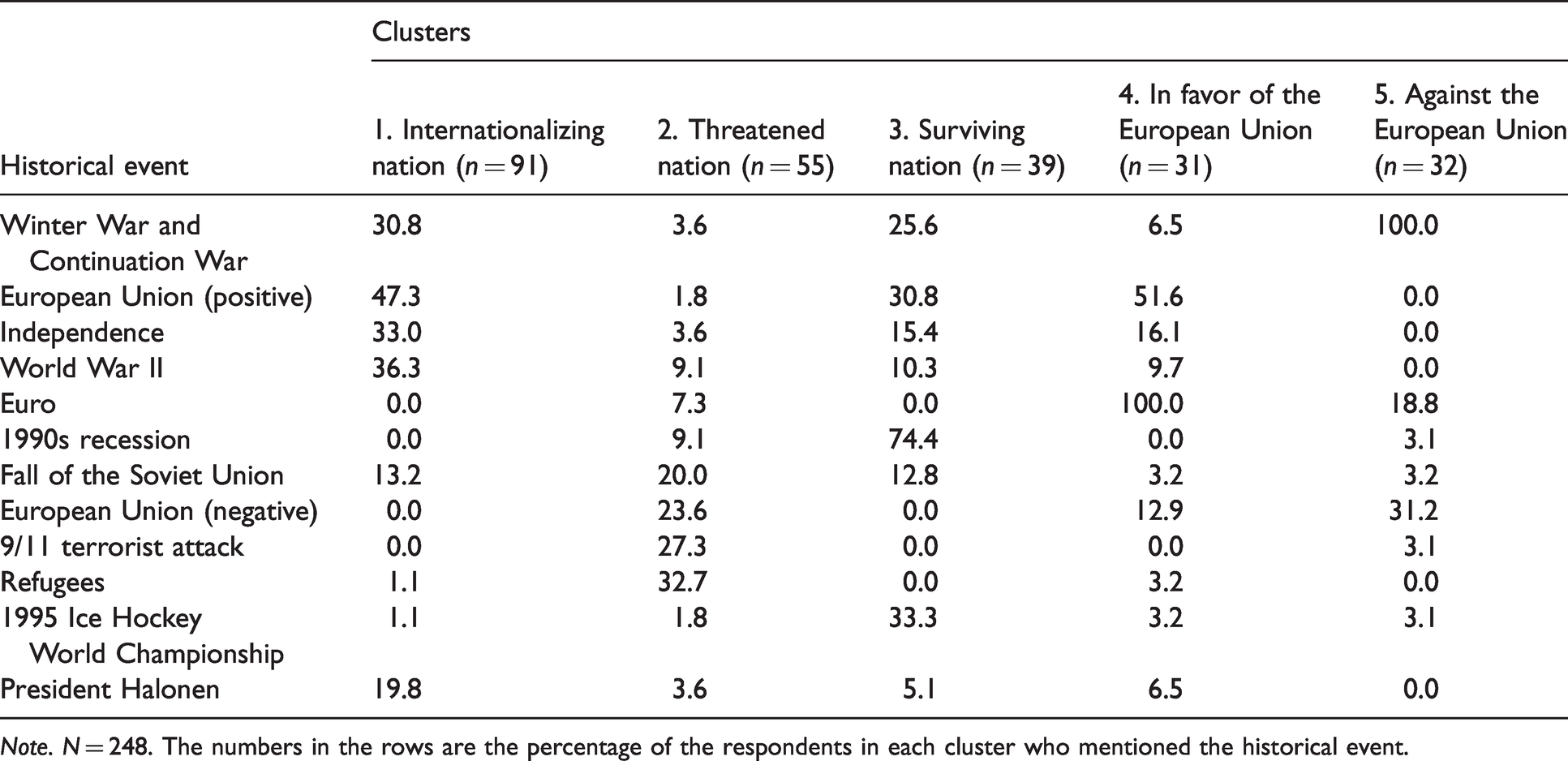
Note. N = 248. The numbers in the rows are the percentage of the respondents in each cluster who mentioned the historical event.
In Cluster 1 (internationalizing nation), the major contents comprise a chronological set of events from the wars in 1940s to events of the 1990s and 2000s and positive evaluation of the European Union, while other events play a minor role. In Cluster 2 (threatened nation), two events—the 9/11 terrorist attacks and refugees—which took place in the 2000s and 2010s, as well as negative evaluation of the European Union, constitute the major contents. In Cluster 3 (surviving nation), the 1990s recession, the fall of the Soviet Union, and the Finnish Ice Hockey Championship, as well as positive evaluation of the European Union, play a central role. In Cluster 4 (in favor of the European Union), the euro and positive evaluation of the European Union, as well as independence, constitute the major contents. Finally, in Cluster 5 (against the European Union), the Finnish wars, the euro, and negative evaluation of the European Union characterize the cluster.
To answer the fourth research question—that is, whether gender, age, educational level, political orientation, system justification, and different levels of identification (with one’s own community, nation, and the world as a whole) are related to historical event cluster membership—the χ2 test and analysis of variance (ANOVA) were used. Frequency distributions (with percentages) of respondents across clusters according to gender, age, education, and party preference, and means and standard deviations of identification with the world as a whole, are presented in Table 2. Only parties which received 15 or more mentions (the Green League, National Coalition Party, Left Alliance, and Finns Party) were included in the analysis.
Frequency Distributions (With Percentages) of Respondents Across Clusters According to Gender, Age, Education, and Party Preference, and Means and Standard Deviations of Identification With the World as a Whole.

Note. N = 247–248, except for party preference, where N = 89.
aBasic = elementary school; Upper secondary = high school and vocational education; Higher = applied university and university education to doctorate.
Measured by the χ2 test, cluster membership, and the following background variables, gender χ2(4, N = 248) = 5.57, p = .234, age χ2(8, N = 247) = 7.47, p = .487, and education χ2(8, N = 248) = 8.14, p = .420, were independent, and only party preference χ2(12, N = 84) = 28.05, p = .005, was dependent.
In the ANOVA, the difference in system justification, F(4, 247) = 1.26, p = .285, η2 = .020, identification with the local community, F(4, 247) = 1.02, p = .397, η2 = .017, and identification with Finns, F(4, 247) = 0.54, p = .708, η2 = .009, were not significant, but the difference in identification with the world as a whole was F(4, 247) = 2.51, p = .042, η2 = .041. Post hoc test (Tukey's HSD) showed that Cluster 1 differed from Cluster 2 (p = .025). Identification with the world as a whole was higher in Cluster 1 (M = 4.92, SD = 1.21) than in Cluster 2 (M = 4.24, SD = 1.44). Regarding political orientation, those preferring the Left Alliance were located relatively more often in Cluster 1, the National Coalition Party in Clusters 1 and 3, the Green League in Clusters 1 and 2, and the Finns Party in Cluster 2.
Discussion
In the present study, Finnish living historical memory in the 2010s reveals an emphasis on events occurring in the 1990s and 1940s. The results correspond with Rimé et al.’s (2015) estimation of the length of living memory being around 80–100 years. The results also demonstrate how more recent events in the living historical memory are more varied and described in a more nuanced manner (in terms of specific events and persons; 9 events and 282 mentions located in the 1990s), while as the time gap increases, the memories merge together and simplify as general categories (e.g., World War II; 2 events and 148 mentions located in the 1940s). At the level of the contents of the nominations, the recent events mentioned (e.g., the fall of the Soviet Union, the European Union, and the Internet) correspond with the events evaluated as important by Finns a decade ago (Torsti, 2012, p. 67), suggesting that living historical memories are relatively stable at the group level, although it remains open to debate whether they are more stable than momentary at the individual level (see Liu et al., in press). Also, certain contents of the Finnish living historical memories in the 2010s, such as the 9/11 terrorist attacks and the World Wars, are part of the living historical memories shared in most westerns societies (Liu et al., in press). On the other hand, the heterogeneous nature of the more recent events mentioned may indicate that Finns’ freely recalled narratives of collective history have become less consistent since the 1990s, when the memory was still characterized by relative homogeneity (see Ahonen, 1998).
The cluster analysis shows groups of respondents and, more specifically, the particular historical events they mentioned. Thus, the groups show which kinds of events tend to appear together. The European Union constitutes the most distinctive event with regard to the number of mentions (106 in total) and also because it most clearly separates the opinions of the participants. The divisive nature of the European Union in living memory is prominent among the contents of all the clusters, but especially Cluster 4 (in favor of the European Union) and Cluster 5 (against the European Union). This finding is in line with research showing that European Union membership strictly divided Finns in the 1990s, and the membership question was connected at that time, for example, to the competing interpretations of national history (Moisio, 2008). The present study indicates that the European Union has retained this divisive character, which also seems to be connected to interpretations of more distant national history, as the Finnish wars featured in all the clusters.
However, the finding that cluster membership and demographics such as gender, age, or education were not probabilistically dependent indicates that there are no drastic differences in the tendency of Finns to recall historically meaningful events. This suggests that, in Finland, women and men, different age groups, and people with different educational backgrounds share a social milieu where historical events are discussed and the importance of them is evaluated (see Ahonen, 1998, p. 130). Even though the mediascape and the ways of disseminating and receiving information have diversified since the 1990s, this does not seem to have had a visible effect on living historical memories—the role of the public comprehensive school in the “homogenization” of living historical memories is likely an important factor. Partially, this finding may be also due to the fact that the oldest and youngest Finnish generations were not part of the study. On the other hand, contrary to Torsti’s (2012) study, even the older age groups in our study do not form generations sharing certain specific memories.
Only political orientation (party preference) and global identification (identification with the world as a whole) were shown to be dependent with cluster membership. In both cases, Cluster 1 (internationalizing nation) and Cluster 2 (threatened nation) played a major role in distinguishing the respondents. In Cluster 1, the higher mean for global identification could be interpreted to imply a more global perspective also toward the past, while the lower mean in Cluster 2 could be explained with an opposite interpretation. The difference between the two clusters indicates that despite the homogeneous nature of Finnish living historical memory in general, certain groups of events may serve different identification purposes and reflect a different orientation toward internationalizing. Regarding political orientation, those preferring the Finns Party were located relatively more often in Cluster 2 than in the other clusters, while those preferring the other parties (but especially the Left Alliance) were located relatively more often in Cluster 1. The nationalist anti-immigration agenda of the Finns Party (Sakki & Martikainen, 2020) may explain this difference.
As a limitation of the data, it needs to be mentioned that people who were born before 1951 were not included in the sample. Also, although the political orientation of the sample was varied, there was a tendency toward Green League and Left Alliance supporters and, in general, the sample size for political orientation was small. In addition, the data consisted of Finnish-speaking Finns, not any old or new Finnish minorities, whose living historical memories may differ from the sample under analysis here. These groups should be included in future studies of living historical memories.
Conclusions
The observation of Finnish living historical memories shows a relatively homogeneous way of remembering the events of the last century. Finnish membership of the European Union is a key event characterizing the difference in the memories. Political party preference and the level of identification with the world as a whole were related to cluster membership, providing topics to be explored in more detail in future studies. Cluster analysis turned out to be a promising tool for analyzing the structure of the diverse responses. Being a descriptive method that can deal with a large number of responses offered freely by respondents, it can provide new insights on the material to be analyzed. At the same time, when interpreting the results, the role of the researchers, in selecting the cluster solution to be analyzed further, must be remembered.
The data on living historical memories obtained through the Digital Influence II Survey has been analyzed in several studies by using latent class analysis. Common to these studies (Bou Zeineddine & Qumseya, 2020; Li et al., 2020; Vincze et al., in press) is the finding of a two-class structure characterizing living historical memory. In the present study, a different type of analysis was employed. The main aim was to find respondent clusters that had meaningful interpretations and, moreover, produced a fair measure for the quality of the solution. However, it should be noted that even though we ended up with a five-cluster solution, our findings still reflect a similar tendency toward the two-class structure in the above-mentioned studies that used latent class analysis as their methodological approach.
The study forms a base to analyze more closely the relationship between official and grassroots forms of memories in Finland. Hakoköngäs and Sakki (2016) have shown that the events of the 1990s and 2000s are not yet part of official Finnish history narratives. Future studies will show which of the memories identified in the present study will be integrated into cultural and historical memories. The way in which the divisive memory of European Union membership is handled in this process—that is, which version (negative, positive, or both) is included in the cultural canon—may shed light on the interconnection between living and cultural memories.
It should be noted that the data was collected at a historically meaningful point in time, as 2017 was the 100-year anniversary of Finnish independence and 2018 marked the centenary of the Finnish Civil War. In these years, history was actively discussed in society, and one might have expected this to be reflected in the responses. Independence was, in fact, distinctively present in the historical events, but the number of mentions of the Civil War was low considering what an important part of history it was deemed to be in previous studies (Ahonen, 1998; Torsti, 2012).
Because of its low frequency, the Civil War was not included in the present cluster analysis. The omission of the Civil War in the participants’ responses may simply reflect the nature of living memory, where events that are older than 100 years (Rimé et al., 2015) start to shift “out of reach” and possibly constitute historical memory (with respect to the Civil War, see Hakoköngäs et al., 2020). This notion, however, also leads us to evaluate the meaning of the more frequently mentioned but historically even more distant event of independence in the responses. It is possible to interpret that “independence” does not just refer to the year in question (1917) but also to the process of independence—for example, in relation to internationalization (Cluster 1) or European Union membership (Clusters 4 and 5). The analysis of this question requires further research.
Footnotes
Declaration of Conflicting Interests
The authors declared no potential conflicts of interest with respect to the research, authorship, and/or publication of this article.
Funding
The author(s) disclosed receipt of the following financial support for the research, authorship, and/or publication of this article: The analyzed data set was obtained as part of the Asian Office of Aerospace Research and Development grant no. FA2386-15-1-0003 to James H. Liu.
