




Abstract
People employ automatic inferential processing when confronting pragmatically implied claims in advertising. However, whether comprehension and memorization of pragmatic implications differ between young and older adults is unclear. In the present study, we used eye-tracking technology to investigate online cognitive processes during reading of misleading advertisements. We found an interaction between age and advertising content, manifested as our older participants generated higher misleading rates in health-related than in health-irrelevant products, whereas this content-bias did not appear in their younger counterparts. Eye movement data further showed that the older adults spent more time processing critical claims for the health-related products than for the health-irrelevant products. Moreover, the correlations between fixation duration on pragmatic implications and misleading rates showed opposite trends in the two groups. The eye-tracking evidence novelly suggests that young and older adults may adopt different information processing strategies to comprehend pragmatic implications in advertising: More reading possibly enhances young adults’ gist memory whereas it facilitates older adults’ verbatim memory instead.
Introduction
Elderly financial abuse is considered to be the “crime of the 21st century”, as it has tremendous impact on the elderly both financially and mentally. Two recent meta-analyses indicated that 5.4% of cognitively normal and community-dwelling older adults were victims of financial fraud or scams each year in the United States (Burnes et al., 2017), and the annual financial loss among victims of elderly financial abuse was at a multibillion-dollar level (Roberto & Teaster, 2011).
Consumer financial fraud is one that is often at the heart of other forms of financial crimes. It includes, but is not limited to, misrepresentation of facts and deliberate intent to deceive with the promise of goods, services, or other benefits that in fact do not exist (Titus, Heinzelmann, & Boyle, 1995). Thus, consumers’ cognitive process of advertising plays an important role to mediate between the content of advertising and consumers’ comprehension of it. Previous laboratory experiments have demonstrated that consumers are likely to perceive pragmatically implied information in advertising as a fact (Harris, 1977; Hastak & Mazis, 2011; Zheng, Van Osselaer, & Alba, 2016). The prototypic paradigm begins with a learning phrase of a series of advertisements, then in the test phase, participants are required to judge whether statements are consistent with what they have just learned. A misleading scenario is defined as when participants judge pragmatically implied statements as being directly asserted in the advertisements. For example, when an original pragmatic implication “Your waist will love the Chocotrim snack” is believed as a directly asserted statement “The Chocotrim snack will not increase your waistline”, participants have been misled (Gaeth & Heath, 1987). Participants’ automatic inference processing has been demonstrated to induce a high misleading rate in this paradigm.
There are reasons to predict that older adults would be more susceptible to pragmatic inferences than their younger counterparts. First, previous studies on false memory have shown that older adults are misled more often, and have higher false alarm rates, than young adults in eyewitness testimony paradigm (LaVoie, Mertz, & Richmond, 2007; Roediger III & Geraci, 2007), in Deese-Roediger-McDermott (DRM) paradigm (Dehon & Brédart, 2004; Dennis, Kim, & Cabeza, 2008; Pansuwan et al., 2020) and in pragmatic inference paradigm (McDermott & Chan, 2006). Second, this age-related susceptibility to pragmatic inference could be modulated by the content of advertisement. Older adults are more misled by advertising of health-related products than young adults, as they use more health-care products and accordingly visit health-care providers more frequently (Graycar & James, 2001; Johnson, 2004; Reisig & Holtfreter, 2013). In the year of 2019 alone, Chinese customers spent $34 billion on health-care products, among which the population of 54 years old and above are the absolute main force (Li & Wang, 2018). Older adults with health declines are easily tricked into purchasing worthless remedies and cures. Pragmatic inferences in deceptive health-related advertising may cause inaccurate beliefs, which are defined as the most prevalent frauds targeting older adults (Smith, 2000). They may make inferences that go beyond the information contained in advertising claims. When these inferences do not match reality, deception occurs.
Previous research on misleading advertising has been mainly based on survey or simple keyboard reactions (Harris, 1983; Hastak & Mazis, 2011; Smith, 2000; Valencia-Laver & Light, 2000), which may have limitations to infer moment-to-moment cognitive processes. In contrast, eye-tracking technology allows nonintrusive measurement of reading in relatively natural tasks and provides researchers a powerful tool to understand underlying cognitive processes at a high temporal resolution. In the past decades, psychological researchers have achieved a widely accepted understanding that fixation duration, the amount of time readers spend on an object or on a word, reflects online cognitive processes (see Kliegl, Nuthmann, & Engbert, 2006; Rayner, 1998, for reviews). In the present study, we aimed to use the eye-tracking technology to investigate online cognitive processes during the reading of pragmatic information in advertising.
In sum, previous studies have demonstrated that participants spontaneously employ automatic inferential processing when they read pragmatically implied claims. However, whether misleading rate differs between older and young adults and how visual attention is distributed across different areas in advertisement remain to be explored. Considering the special nature of health-care products for older adults and its large share in the market, we also manipulated the content of advertising, that is, health-related and health-irrelevant products.
Method
Participants
Twenty young adults (aged 18–24) and 20 older adults (aged 60–78) were recruited for the present study. The sample size and its effectiveness were determined following previous studies on related topics (Gaeth & Heath, 1987; Kircanski, Notthoff, Deliema, Samanez-Larkin, & Gotlib, 2018). Young adults were students from Southwest University, and older adults were recruited from local communities nearby the university. Participants reported normal or corrected-to-normal vision. None of them reported known history of neurological diseases or psychiatric conditions. The mini-mental state examination (MMSE; Folstein, Folstein, & McHugh, 1975) was used to screen for potential cognitive impairments, and the older adults scored at least 26. The demographic and neuropsychological characteristics of each group are shown in Table 1.
Characteristics of the participants.

Note. CESD, the center for epidemiologic studies depression scale; BIS, the Barratt impulsiveness scale; SSRS, the social support rating scale; ITS, the interpersonal trust scale; MMSE, the mini mental state examination. n.a., not available.
Design and procedure
We designed and administered a modified version of misleading advertising paradigm (Gaeth & Heath, 1987), which was conducted in two phases: a study phase and a test phase. In the study phase, the participants were instructed to view and memorize information in an advertisement in two slides. In the first slide, a product image, including product name, price, applicable situation, and main function, was presented for 5000 ms. In order to increase the ecological validity, all the product images were designed to imitate the typesetting of real advertising. In the second slide, a textual description of the product, including pharmaceutical composition, manufacturing processes and main function of the product, was presented for 15000 ms.
For each advertisement, the description concerning the pharmacodynamic main function of the product was submitted to a dichotomized manipulation of directness. For example, a direct description of the product’s main function is “treatment for rheumatoid arthritis” (i.e., asserted fact), whereas its indirect version is “the secret of easy days in rainy weather” (i.e., pragmatic implication). Other information provided in both the image and the textual slide of the advertisement, such as price, composition and manufacturing processes, remained identical across the two conditions to achieve a within-item design. Moreover, we also included a manipulation of product type (health relatedness), including health-related products, like liquid calcium, fish oil, and grape seed lozenge, and health-irrelevant products, like shower gel, toilet cleaner, and air freshener. In conclusion, the three factors described above (i.e., age, directness, and health relatedness) led to a 2 × 2×2 design, using 20 participants and 20 items (i.e., advertisements) for each experimental condition. An example of advertisement is shown in Fig.1a.

Flow chart of experiment procedure. (a) In the study phase, the participants were first presented with an image of a product, and then a textual description. Areas of interests (AOIs) are highlighted with blue squares. (b) Four questions for each advertisement.
In the test phase, the participants were asked to judge whether the currently presented information was consistent with the information that they had just learned during the study phase, by pressing three buttons for “consistent”, “inconsistent”, and “unrecognizable”, respectively. There were 4 questions in total for each advertisement. Questions 1 and 2, regarded to the noncritical information (i.e., pharmaceutical composition and manufacturing processes) in the textual slide, were used to assess the participants’ general memory. Half items were learned and half items were new foils. Importantly, question 3 was about the critical claim (i.e., the main function of the product) and only the direct description of each product was exhibited. Thus, if the main function had been directly asserted, the correct answer would be “consistent”. However, if the main function had been indirectly implied, the correct answer would be “inconsistent”. When the participants learned the indirect version of advertisement (e.g., “the secret of easy days in rainy weather”) but judged it as “consistent” with direct description of a product’s main function (e.g., “treatment for rheumatoid arthritis”), we defined this as a misleading response. The fourth question was about the willingness to purchase on a 7-point Likert scale, where “1” represented the least willing to buy the product and “7” represented the most willing. These four questions were presented in four slides separately, and the test was self-paced (Fig.1b).
Apparatus
Eye-movements were recorded using an EyeLink-1000 system running at 1000 Hz. Subjects were seated comfortably with a chin rest and a forehead rest at a distance of 70 cm from a 19-inch monitor (resolution, 1024-by-768 pixels; frame rate, 85 Hz). All recordings and calibrations were done monocularly based on the right eye and viewing was binocular. Before the experiment, subjects were calibrated with a nine-point grid (errors<.5°). An extra calibration was initiated when there was a drift from the fixation point presented prior to each trial.
Data analysis
For the analyses of behavioral data, a 2 health relatedness (health-related, health-irrelevant) × 2 age group (young, old) repeated-measure ANOVA was conducted on the error rate of the noncritical claims and the misleading rate of the critical claims, with age group as a between-subject factor and health relatedness as a within-subject factor. According to the signal detection theory, the error rate for noncritical claims was calculated as the percentage of missed and false alarm items. For the critical claims, the misleading rate was calculated as the percentage of false alarm (i.e., the direct claim in indirect condition incorrectly identified as consistent) in all the error (i.e., missed and false alarm) and “unrecognizable” items. Of note, misleading responses occurred only when the participants identified the new direct critical claims as consistent in the indirect condition. However, responses that the old direct critical claims were identified as inconsistent in the direct condition were considered to be inaccurate. Moreover, a 2 health relatedness (health-related, health-irrelevant) × 2 directness (direct, indirect) × 2 age group (young, old) repeated-measure ANOVA was conducted on purchase intention, with health relatedness and directness as within-subject variables and age group as a between-subject variable. Finally, we examined the correlation between misleading rate and purchase intention, and the correlation between misleading rate and eye-movement in young and older adults, respectively. Statistical analyses were performed using SPSS Version 22.0.
For the analyses of eye-movement data during the reading of the image and the text slides, two areas of interest (AOIs) were respectively defined including the critical description about the pharmacodynamic main function of the product (Fig.1a). Estimates were based on linear mixed models (LMMs), with varying intercepts estimated for participants and items, as well as varying slopes for participants using the lmer function of the lme4 package (version: 1.1–21; Bates, Maechler, Bolker, & Walker, 2015) in the R environment. We additionally reported p-values obtained from the lmerTest package (version: 3.1–0; Kuznetsova, Brockhoff, & Christensen, 2017). Total fixation duration (i.e., sum of all fixations on an AOI) was log-transformed before entering the models as the dependent variable.
Results
The memory performance for non-critical claims
General memory performance was measured by using the responses to the non-critical claims, that is, Questions 1 and 2 in the test phase. We found a significant main effect of age [F(1, 38) = 20.556, p < 0.001, η2partial = 0.351], with the older adults having a higher error rate (M = 0.35, SD = 0.11) relative to their younger counterparts (M = 0.23, SD = 0.09). No other main effects or interactions were found significant, which indicated that young adults had better memory performance than older adults in general, regardless of the content of the product (i.e., health relatedness).
The misleading rate for critical claim
We found a significant main effect of health relatedness [F(1, 38) = 28.460, p < 0.001, η2partial = 0.428], with a higher misleading rate for the health-irrelevant products (M = 0.85, SD = 0.21) than for the health-related products (M = 0.63, SD = 0.23). Although the main effect of age was not significant [F(1, 38) = 0.942, p = 0.338, η2partial = 0.024], there was an interaction between age and health relatedness [F(1, 38) = 4.730, p = 0.036, η2partial = 0.111]. Simple effect analysis showed that although marginal significant, the older adults had a relatively higher misleading rate (M = 0.56, SD = 0.21) than the young adults (M = 0.70, SD = 0.23; t(28) = −1.993, p = 0.054, 95%CI −0.281∼0.002) for the health-related products, whereas the young (M = 0.87, SD = 0.14) and the older adults (M = 0.83, SD = 0.24; t(38) = 0.620, p = 0.539, 95%CI −0.087∼0.164) had comparable misleading rates for the health-irrelevant products (Fig.2a).
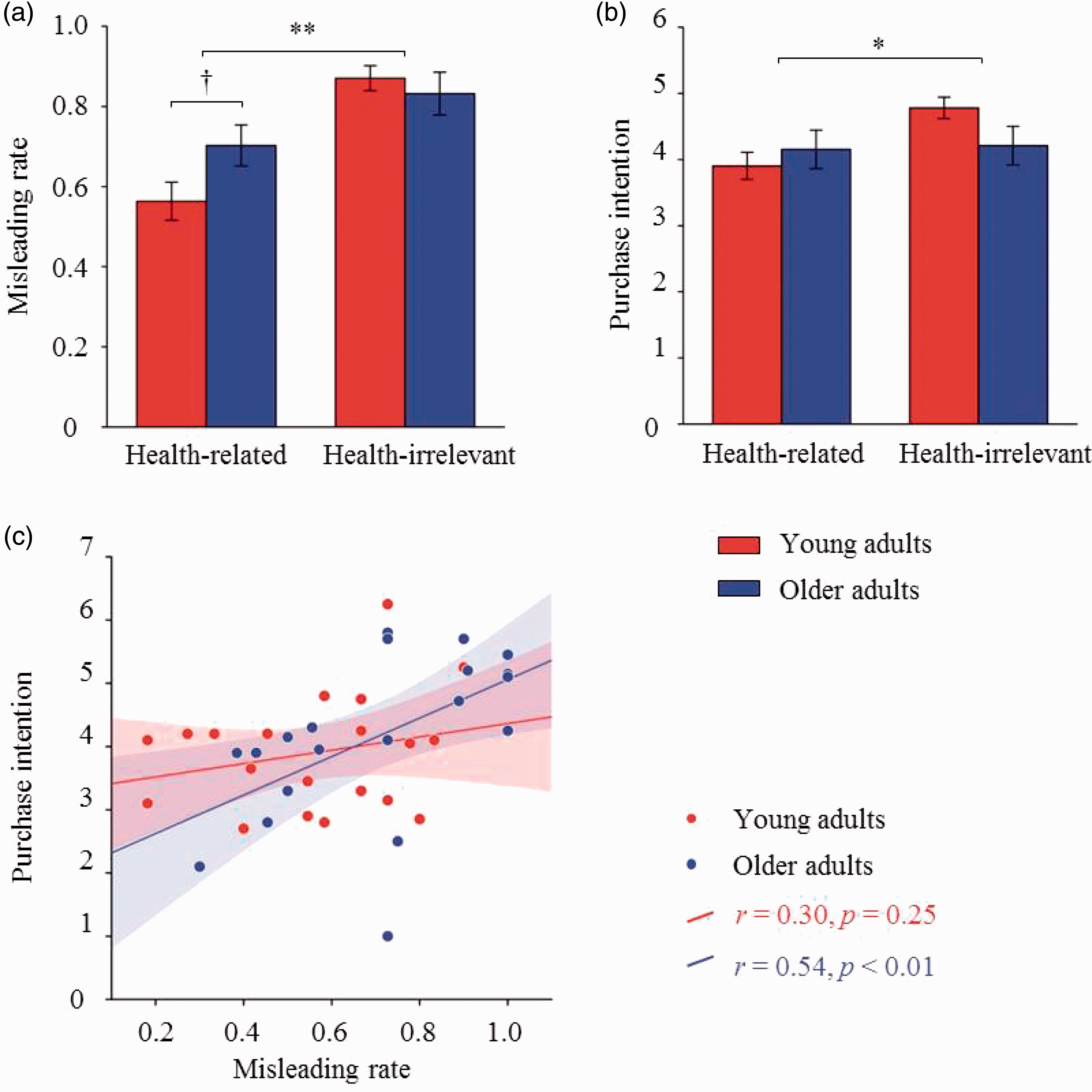
The behavioral results. The interaction between age and health relatedness in (a) misleading rate and (b) purchase intention. (c) The correlations between misleading rate and purchase intention of the health-related products. **p < 0.01, *p < 0.05, †p < 0.1
The purchase intention
We found significant main effects of health relatedness [F(1, 38) = 11.446, p = 0.002, η2partial = 0.231] and directness [F(1, 38) = 17.430, p < 0.001, η2partial = 0.314], indicating that the participants were more willing to purchase the health-irrelevant products and the products with direct assertions. Moreover, we found an interaction between age and health relatedness [F(1, 38) = 8.824, p = 0.005, η2partial = 0.188]. Simple effect analysis showed that although not significant, the older adults (M = 4.15, SD = 1.30) were more willing to purchase the health-related products than the young adults (M = 3.90, SD = 0.92), whereas this age-related difference reversed in the health-irrelevant products, manifested as the young adults (M = 4.78, SD = 0.72) had more purchase intention than the older adults (M = 4.21, SD = 1.30; Fig.2b).
The correlation between misleading rate and purchase intention
As shown in Fig.2c, the older adults who had a higher misleading rate were more likely to purchase the health-related products (r(18) = 0.536, p = 0.015), while this correlation was not significant in the young adults (r(18) = 0.245, p = 0.297). We did not find significant correlations between misleading rate and purchase intention for the health-irrelevant products in either of the groups.
Eye-movement data
A fixation heat map was shown in Fig. 3a. During the reading of the advertisements, the young adults spent more time reading the critical claims than the older adults (b = −0.495, SE = 0.101, t = −4.89, p < .01). A significant interaction between age and health relatedness (Fig. 3b; b = −0.277, SE = 0.090, t = −3.09, p < .01) showed that, the old adults spent more time on the health-related products than on the health-irrelevant products (b = −0.252, SE = 0.109, t = −2.30, p < .05), whereas there was no such a difference for the young adults (b = 0.025, SE = 0.065, t = 0.38, p = .71). During the reading of the textual descriptions, the participants spent longer time on the AOI when the description was indirect than when it was direct (b = 0.111, SE = 0.055, t = 2.04, p = .05). All other effects were not significant.

The eye movement results. (a) Fixation heat map. (b) Visualization of the interaction between age group and health relatedness. Regression lines are based on partial-effect estimates of LMM for fixation durations, generated using the remef package (version 0.6.10; Hohenstein & Kliegl, 2015) and the ggplot2 package (version 2.1.0; Wickham, 2009). The correlations between misleading rate and AOI reading time (c) in the image slide and (d) in the textual slide, for the indirect claim condition.
Individual differences showed that the association between total reading time on the AOI and misleading rate exhibited opposite directions between the young and the older adults. Specifically, the young adults with longer reading time on the indirect claim in the image slide had higher misleading rates (r = 0.55, p < 0.05; Fig.3c), whereas the older adults with shorter reading time on the indirect claim in the textual slide had higher misleading rates (r = −0.71, p < 0.001; Fig.3d). Of note, the correlation between eye-movement data and misleading rate was only found in the health-related products but not in the health-irrelevant products.
Discussion
In the present study, we used eye-tracking technology to investigate online cognitive processes during reading of advertisements among young and older adults. Three major conclusions can be drawn from the results obtained in the present study. First, the older adults were not more deficient than the young adults in processing pragmatically implicated information, as both age groups showed equivalent misleading rates. Second, we found an interaction between age and health-relatedness on comprehension and memorization of implicated information. The health-relatedness effect was significant only in the older adults, who showed higher misleading rates in the health-related products than in the health-irrelevant products, whereas the effect was not significant in the young adults. Finally, consistent with behavior results, eye-movement data confirmed the interaction between age and health-relatedness, showing that the older adults spent more time processing the critical claims for the health-related products than for the health-irrelevant products. Most interestingly, the correlations between fixation duration on the pragmatic implications and misleading rate showed opposite trends in the different age groups. In particular, longer fixations led to higher misleading rates for the young adults, but to lower misleading rates for the older adults. Taken together, these findings are in agreement with existing literature showing no overall age differences in comprehension and memorization for implicated information; however, the content of advertising (i.e., health relatedness) played an important role. The eye-tracking evidence novelly revealed that the young and the older adults may have adopted different information processing strategies to comprehend the pragmatic implications in advertising.
In the present study, we found that there were no overall age differences but an interaction between age and health-relatedness on misleading rate, which indicated that the age-related changes on pragmatic implication process may not be due to the older adults’ general cognitive decline but a bias in attention allocation induced by their motivation. Our finding is in line with some previous literature which showed that young and older adults produced equivalent amounts of false alarms to the implied information (Gaeth & Heath, 1987; Guillory & Geraci, 2010; Rebok, Montaglione, & Bendlin, 1988). Of note, this automatic inferential process was moderated by the content of adverting, which implies the importance of motivation. On the one hand, older adults are often more motivated to attend to health-related information. Such a bias may reflect a strategic allocation of cognitive resources, rather than any fundamental limitation in their general cognitive ability. On the other hand, the exaggerated and positively oriented implication in health-related advertising may evoke positive emotion in older adults specifically, as it satisfies their pursuits for health.
One advantage of the present study over previous research is that our eye-movement data provided indices for online cognitive processes. Our study revealed divergent mechanisms underlying young and older adults’ processing of advertisement: For the young adults, the more reading of the pragmatic implication, the more likely they took it as an asserted fact, whereas for the older adults, longer reading time led to lower misleading rates. Possibly, for young adults, more reading might facilitate memory consolidation through the extraction of the common gist, linking to semantically related information. This would serve to enhance the activation of the unstudied asserted facts, resulting in an increase in the misleading rate. However, older adults are known to employ a more “risky” reading strategy to infer the identities of words based on prior context and only partial word information (Kliegl, Grabner, Rolfs, & Engbert, 2004; Rayner, Reichle, Stroud, Williams, & Pollatsek, 2006). Consequentially, older readers rely more on their anticipation to speed up their oculomotor and reading activities. In the meanwhile, such a strategy also leads to misidentification of information (Warrington, White, & Paterson, 2016). Given such a background, the older adults’ longer reading time likely enhanced their encoding of the contextual details and thus reduced their misleading rate.
The findings of this study should be considered with some limitations. First, this is an exploratory research with a relatively small sample size. The critical findings are to be replicated from a larger sample of participants covering a wider range of age. Second, as a common limitation of lab experiments with respect to ecological validity, although we adopted these advertising materials from real world, the experimental setting somewhat deviated from daily life. Thus, we are cautious when generalizing the findings to real life events. Finally, some additional variables, such as cognitive ability and social-economic status, could provide further insights into the processing of pragmatic implications in advertising across the lifespan.
Conclusion
In general, the older adults showed a preserved cognitive ability for comprehension and memorization of pragmatic implications in the present study. However, they were more vulnerable to fraud in advertisement of health-related products, presumably due to their motivation. Most importantly, eye-movement revealed that young and older adults may use different processing strategies when encountering pragmatic implications in advertising: More reading can possibly enhance young adults’ gist memory whereas it facilitates older adults’ verbatim memory instead. These findings have some practical implications in real life. Increasing exposure time of pragmatic implications may protect older adults from fraud advertisements. Further investigations on the relationship between eye-movement and misleading advertising are needed to find potential ways to train older adults, in order to decrease their susceptibilities to misleading advertising.
Footnotes

Declaration of Conflicting Interests
The authors declared no potential conflicts of interest with respect to the research, authorship, and/or publication of this article.
Funding
The author disclosed receipt of the following financial support for the research, authorship, and/or publication of this article: This work was supported by the National Natural Science Foundation of China (31971007, 71942004, and 61961160705), the Ministry of Education of Humanities and Social Science Project (17YJA190015), and the CAS Key Laboratory of Mental Health, Institute of Psychology (KLMH2019K02).