




Abstract
This study examined the link between residential mobility and interpersonal trust building. Study 1 revealed a negative association between residential mobility and trust by measuring personal residential-mobility history. Study 2 demonstrated that participants who were momentarily primed with mobility showed a lower investment than participants in the control group in a trust game. The results of Study 3 showed that need for closure moderated the link between residential mobility and trust-building intention. Specifically, lower need-for-closure people had a significantly lower trust tendency in the mobility group than in the stable group. These findings illuminate the underlying influence of need for closure in the link between residential mobility and trust.
Introduction
Due to the frequency of residential moving and great changes in people’s personal networks resulting from economic development and globalization, the association between residential mobility and interpersonal trust building should be given more attention. As a key socio-ecological factor, residential mobility has been investigated by sociologists and other social scientists over the last decade at both the individual and societal levels (Choi & Oishi, 2020; Oishi, 2010). Previous studies show that residential mobility plays important roles in shaping self-concepts, relationships with others and groups, and social-networking strategies (Li, Li, & Li, 2019; Lun et al., 2012; Oishi et al., 2013). However, there is little research that focuses on how residential mobility affects trust building; in particular, the mechanisms underlying the relationship are still unclear. Additionally, most studies have focused on this issue at the societal level, and not for individuals—for example, interpersonal trust and other feelings such as anxiety or loneliness (Jokela, 2009). The present study aimed to examine the relationship from an individual perspective while exploring the psychological mechanism between residential mobility and trust building through experimental studies. We expect that the results will enrich our understanding of residential-mobility influences and the individual differences between them.
Residential Mobility and Trust
Residential mobility refers to the number of times an individual has moved during a certain period of time or expects to move in the future (Oishi, 2010). Studies show that moving to a new residence can have sweeping effects on people’s emotions, motivations, and even mental health, such as anxiety, excitement, and loneliness (Oishi & Talhelm, 2012; Stokols et al., 1983). How, then, does residential mobility affect interpersonal trust? Definitions of trust often emphasize that risk or uncertainty accompanies trusting another person (Thielmann & Hilbig, 2015). In deciding to trust others, both people’s beliefs and their attitudes toward uncertainty matter because it is uncertain whether their trust will be reciprocated (Li, Turmunkh, & Wakker, 2019). We assume that there is a negative relationship between residential mobility and trust building for several reasons.
First, residential mobility is associated with an increased importance of the personal self but a decreased importance of the collective self (Oishi et al., 2007). This is to say that people who have moved frequently have no stable sources of self-definition. Because residential mobility pertains to self-concept, a personal history of residential mobility encourages the formation of more shallow social bonds and lower investment in maintaining existing social ties (Lun et al., 2012; Oishi et al., 2013).
Second, according to uncertainty–identity theory, self-uncertainty matters when the self is involved (Hogg, 2007). Building on uncertainty–identity theory, the uncomfortable feeling of uncertainty emerges when important aspects of the self are threatened (Hogg, 2000). Studies have argued that self-uncertainty destroys trust to some extent (Pfattheicher & Böhm, 2018). To avoid the threat of self-uncertainty on the self, individuals are motivated to reduce such self-uncertainty and make the world around them more predictable, such as by decreasing their trust intention toward others. There are potential negative consequences of self-uncertainty for social interactions that require trust in other persons or everyday interpersonal interactions.
Buchan et al. (2002) provide some indirect evidence which demonstrates that levels of cooperation are higher among neighbors than among strangers. Additionally, residents of mobile communities prefer groups that demand less commitment (Oishi et al., 2015). People calculate their own economic interests when making trust decisions in a strange environment (Chaudhuri et al., 2002). This calculation in a strange context suggests that people may exercise caution when trusting others due to an assessment of high risk in the mobility context. We raised the first hypothesis that residential mobility may decrease trust-building intention.
Trust is a key point of interpersonal interaction that occurs as a complex phenomenon influenced by individual, interpersonal, and situational factors. Previous studies have shown that gender (Buchan et al., 2008), age (Sutter & Kocher, 2007), income (Elgar & Aitken, 2011), and other demographic variables can affect trust building. We use these as control variables in the present study.
The Moderating Role of Need for Closure
As mentioned above, definitions of trust often emphasize that risk or uncertainty accompanies trusting another person. This fact raises the question of how individual differences in handling such uncertainty affect individuals’ trust of others. Acar-Burkay et al. (2014) argue that individuals’ level of trust in others is a function of their cognitive-motivational differences in managing ambiguity and uncertainty. These differences are captured by individuals’ varying levels of need for closure (NFC), which refers to a chronic or temporary tendency to avoid or feel the need to resolve uncertainty and ambiguity (Kruglanski & Webster, 1996). Although NFC is a concept that has a high correlation with trust, there are few studies that have examined the relationship between the two, especially in the mobility context.
In the present study, we posit that NFC as a personality trait moderates the impact of residential mobility on trust building, such that its impact is more pronounced for high NFC individuals than for low NFC individuals. NFC has potential consequences for the perception of others. Acar-Burkay et al. (2014) have shown that high NFC individuals attempt to arrive at a quick and firm trust judgment, while low NFC individuals are more likely to show flexibility when new information becomes available and will adapt their trust judgments to it. In a stable, familiar context, there is less new information available, and trust is also stable. In a mobility context (ambiguous situation), people with high NFC may tend to avoid trusting others to avoid the implied acceptance of uncertainty. Additionally, social identity theory assumes that group membership constitutes a significant source of self-esteem because it is an important component of self-identity (Tajfel, 1986). An in-group performs a function of uncertainty reduction (Shah et al., 1998). Shah et al. (1998) have demonstrated that high NFC individuals show a higher level of in-group identification and out-group derogation. This implies that high NFC individuals have difficulty in identifying new groups and trusting them compared to low NFC individuals. We raised the second hypothesis that NFC plays a moderate role between residential mobility and trust building.
As previous studies have stated, trust can be a trait (Rotter, 1967) or a behavior (Wieselquist et al., 1999). The present study measured trust by using both a scale and scenarios. Study 1 was a correlational study, which measured trust using a scale. For Study 2, we manipulated mobility and measured trust by an investment game (behavior). Further, we manipulated mobility and NFC. We measured trust by a prisoner’s dilemma matrix as indicator of trust behavior at last.
Study 1: Residential Mobility and Trust (Correlational Study)
Method
Participants
An internet-based survey was conducted among Chinese adults in August 2018. Three hundred and eighty-two participants were invited to complete a questionnaire through a survey company (Sojump). Three participants were deleted after we collected the data because they did not complete all of the questionnaire. In the final analysis, there were 379 participants between the ages of 19 and 56, with a mean age of 31.33 (SD = 0.31). Of the participants, 137 (36%) were male and 242 were female (64%). The participants’ education level was as follows: 12 (3.17%) had not completed primary school; 84 (22.16%) had completed secondary school; 42 (11.08%) were technical secondary school graduates; 104 (27.44%) had fulfilled the requirements for junior college; and a majority of the remaining 137 (36.15%) had obtained an undergraduate or higher degree. Our sample included 192 (50.66%) married, 184 (48.55%) single, and 3 (0.8%) divorced participants.
Procedure
To assess residential mobility, we used the method from a previous study (Oishi et al., 2007). The participants were asked to indicate the location where they were born. We also asked them to list any places they had moved to and the age at which they had moved. We recorded the number of times they had moved up until the time they filled out the questionnaire. Moves before the age of 5 were not counted because, according to previous studies, children younger than this age are unlikely to have formed enduring peer relationships (Oishi et al., 2007). Then, all of the participants completed an Interpersonal Trust Scale (Rotter, 1967). The 25-item trust scale used in the present study had responses rated on a 5-point scale ranging from 1 (strongly disagree) to 6 (strongly agree). A sample item was: “Most salesmen are honest in describing their products.” The Cronbach’s α for the scale was 0.82. We also measured some control variables, including income, marriage status, and social status.
Results
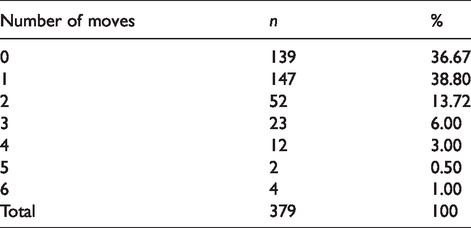
The number of moves ranged from 0 to 6 (M = 0.92, SD = 1.72). Most people had moved at least once (see Table 1).
Descriptive Statistics of the Participants.
To explore our hypothesis, we conducted a scatter plot analysis and a regression analysis. The results demonstrated that there was a negative linear correlation between the number of moves and general trust, r = −0.27, p < .01. Further, we carried out a regression analysis to explore how mobility affected trust after we had controlled gender, age, income, marital status, and social status. The results showed that mobility still had a significant effect on trust, β = −0.24, t(377) = 2.52, p < .01 (see Table 2).
Regression Analysis of Number of Moves onTrust.

Note. Gender was coded as 0 for female and 1 for male. Marital status was coded as 0 for divorced, 1 for single, and 2 for married. *p<.05; **p <.01
This study provided preliminary evidence for our hypothesis that residential mobility has a negative association with interpersonal trust, even after controlling several variables. However, as this was a correlational study, we could not obtain a causal outcome. A second study was conducted to further duplicate the results from study1.
Study 2: Residential Mobility and Trust (Experimental Study)
Study 1 demonstrated the link between residential mobility and general trust at psychological levels of analysis. The major weakness of the first study was that it was a correlational study. In Study 2, to obtain a causal direction, we manipulated residential mobility using a scenario and trust through an investment game.
Method
Participants
The participants were 102 students who had been randomly recruited from several universities in Beijing (67 female, 35 male) in November 2019. The mean age of the participants was 21.8 (SD = 1.54). They were randomly assigned to a residential mobility, stable, or control group as a between-subjects factorial design. All of the participants were told at the beginning of the study that they would each receive ¥20 (approximately $3) for their participation in the study and that more money could be earned by completing decision tasks.
Experimental Design and Procedure
The study used a between-subjects factorial design. The participants were randomly assigned to three different conditions (mobility, stable, or control) on coming into the laboratory. They were seated in front of a desktop computer in a separate room and completed all the tasks on the computer. The manipulation of the independent variables stage took 10 minutes. Immediately after the manipulation, the participants were asked to make decisions in a trust game. Finally, they were requested to answer several demographic questions in relation to their age, gender, and grade (grade means the participants are freshman, sophomore, junior, senior), and were then thanked and debriefed.
With regard to the manipulation of the independent variables, we asked the participants to complete a writing task in which we manipulated their residential mobility, and stable mindset (Oishi et al., 2012). We also added a control group as a baseline group to manipulate participants’ daily life mindset. The residential mobility group had the following instructions: Imagine you get a new job that you have been desiring for a long while. The job involves moving to a different place every other year. Now you have at least 10 minutes to put yourself in this situation and write down your opinions and feelings on the blank paper.
The stable group read the following instructions: Imagine you get a new job that you have been desiring for a long while. The job involves living in one area for at least the next 10 years. Now you have at least 10 minutes to put yourself in this situation and write down your opinions and feelings on the blank paper.
And the daily life group were asked to: Imagine how you spent your weekend recently. Like a day out or preparing for an exam or anything that happens in your life. Now you have at least 10 minutes to put yourself in this situation and write down your opinions and feelings on the blank paper.
The participants had to write down their opinions using the following guidelines:
Describe what the lifestyle would be like in as much detail as possible. What feelings do you have when you think about that lifestyle? Please write down the merits, or not, of such a lifestyle. What do you think would be the effect of that lifestyle on your interpersonal relationships (kinds of friends, living environment, sense of security, etc.)?
Measurement of Trust
A trust game (or “invest game”; see Berg et al., 1995) was used to measure the individuals’ trust. We told all of the participants that they had been randomly assigned to the role of an investor (as Player 1). We assigned each participant a total of ¥10 as capital. Player 1 could give any amount of their money (from ¥0 to ¥10) to Player 2. After receiving the money, Player 2 could then return any amount of the money they had received from the investor. The simple rules of this game were as follows: any amount of money sent from the investor to the receiver would be tripled, whereas the amount of money returned by the receiver to the investor would not be tripled. For example, Player 2 would receive ¥30 if Player 1 invested all of their ¥10. If Player 2 returned ¥15 to Player 1, then both players would get ¥15. The participants believed that Player 2 understood the rules fully, although there was no Player 2 in the game. The amount of money invested by Player 1 was an indicator of trust. The amount of money given indicated the participant’s proclivity toward trusting behavior (Kugler et al., 2007). To motivate all of the participants to play the game seriously, they were informed that, at the end of the experiment, an unspecified amount of money would be randomly awarded to them. The money was the actual amount they could potentially earn during the game plus the ¥20 they received for participating.
The participants then completed a paper-and-pencil questionnaire to answer some questions on demographics, such as age and gender.
Results
We first examined whether the amount of money the participants invested was different across genders and the places where they were born. The results showed that there was no gender difference, t(101) = 1.29, p = .34, and no difference in birthplace, F(2, 99) = 0.23, p = .27. Thus, we did not include these variables in the following analyses (see Figure 1)..
Furthermore, we conducted a one-factor analysis of variance (ANOVA), with the amount of money invested as the dependent variable and residential mobility as the independent variable. The homogeneity of variance test showed that the data were suitable for ANOVA, F(2, 99) = 1.26, p = .34. The results of the ANOVA showed that there was a significant main effect, F(2, 99) = 5.24, p < .01. The simple effects test showed that the mean amount of money invested by the participants in the stable group was ¥4.04 (SD = 1.13), whereas, for the control group, it was ¥3.63 (SD = 0.79), t(67) = 2.46, p < .01, d = 0.43. We also found that the mean investment of the participants in the mobility group was ¥3.14 (SD = 1.01), which was significantly lower than the participants in the control group, t(65) = 3.44, p < .01, d = 0.54. These results demonstrated that the participants who were primed with mobility showed a lower trust tendency than the participants in the stable group, which supported our first hypothesis.
On the basis of Study 1, this experiment demonstrated that residential mobility decreased the trust tendency. Just as frequent moving had a significant negative influence on trust, the participants who were momentarily primed with mobility showed a much lower score in their investment amount. This confirmed our assumption and gave a causal effect between the two.
Study 3: Residential Mobility and Trust (Moderator Role of NFC)
We obtained correlational results from Study 1 and causal results from Study 2. To further duplicate the results and explore the moderator role of NFC, we conducted a third study.
Method
Participants
One hundred and twenty-seven participants (83 female, 44 male), who were recruited from universities, were included in Study 3. They were randomly assigned to a 2 (mobility vs. stable) × 2 (high NFC vs. low NFC) between-subjects factorial design. We paid them ¥20 for taking part in the experiment. Their age range was 19 to 24 (M = 21.2, SD = 2.13).
Procedure
The study included two parts. First, we surveyed 192 individuals to choose participants with a higher NFC trait by using a brief 15-item NFC scale (Roets & Hiel, 2011). We chose 62 higher NFC (+1 SD) and 65 lower NFC (−1 SD) individuals. These 127 participants were randomly assigned to two different conditions (mobility or stable) on their arrival at the laboratory. The participants were seated in front of a desktop computer in a separate room and completed all the tasks on the computer. The manipulation of the independent variables stage took 10 minutes. Immediately after the manipulation, the participants in both groups (mobility and stable) were asked to make decisions in a trust game. Finally, they were asked to answer several demographic questions in relation to their age, gender, and grade, before being thanked and debriefed.
Measurements
A brief 15-item revised NFC scale (Webster & Kruglanski, 1994) was used to measure each individual’s NFC (Roets & Hiel, 2011). The participants rated their responses on a 5-point Likert scale ranging from 1 (strongly disagree) to 5 (strongly agree). Sample items were: “I don’t like situations that are uncertain” and “I enjoy having a clear and structured mode of life.” The Cronbach’s α was 0.74 in this study.
Manipulation
The manipulation of residential mobility was the same as in Study 2. As a measurement of trust, we used a modified form of the Deutsch prisoner’s dilemma matrix (Macdonald et al., 1972; see Figure 2). The paradigm was to distinguish those who believed that others were malevolent or would take advantage of them from those who generally viewed others as benevolent. The instructions for the game were as follows:
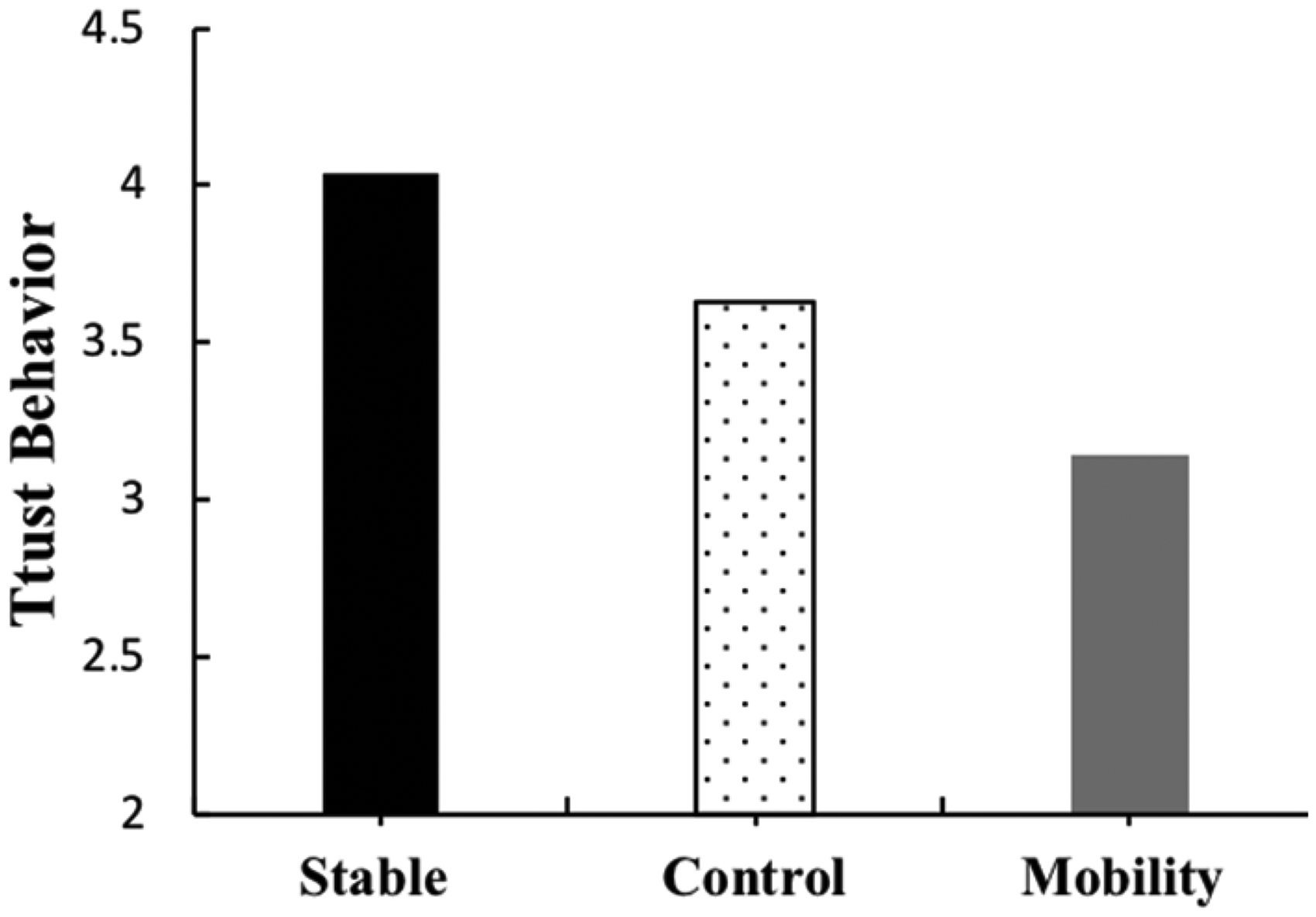
Trust Behavior Between the Residential Mobility and Stable Groups.
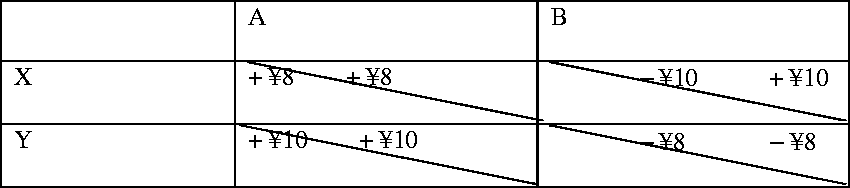
Prisoner’s Dilemma Matrix in Which X and A = Cooperative Choices and Y and B = Competitive Choices.
Below, you have a choice between X and Y. Your partner also has a choice between A and B. The rules of the game are as follows: if you choose X and your partner chooses A, you will each receive ¥8; if you choose X but your partner chooses B, then you will lose ¥10 and your partner will gain ¥10. If you choose Y and your partner chooses A, then you will gain ¥10 and your partner will lose ¥10; finally, if you choose Y and your partner chooses B, then you will both lose ¥8. Remember that you are the first to choose. Before choosing, your partner will be told what your choice is. Think carefully and now proceed to make your choice. Make your choice by placing circles around your responses to the questions, “To what extent will you choose X?” and “To what extent will you choose Y?” A score of 1 indicates you definitely choose Y and a score of 7 indicates you definitely choose X.
A higher likelihood of choosing X meant that the participants were more likely to enact trusting behavior toward their partner. On the contrary, a higher likelihood of choosing Y meant that the participants showed less trusting behavior toward their partner.
To ensure that the participants understood the rules of the game, a practice round was included. They were asked to answer the following questions: “If you choose X and your partner chooses A, how much money will you gain? Moreover, how much money will your partner gain?” Until they gave the correct answers to these questions, the game program did not proceed to the next step, in which the participants played the game with their partner to make final investment decisions. The decision was made by circling their intention in response to the question, “To what extent would you likely choose X or Y?” The more likely they were to choose X, the more likely they were to trust others. To motivate all of the participants to play the game seriously, they were informed that, at the end of the experiment, an unspecified amount of money would be randomly awarded to the participants. The money was the actual amount they could potentially earn during the game plus the ¥20 they received for participating.
Results
To test the effect of mobility and NFC on trust, we performed a 2 (mobility vs. stable) × 2 (higher NFC vs. lower NFC) ANOVA test, with trust tendency as the dependent variable and mobility and NFC as between-subjects independent variables. First, the homogeneity of variance test showed that the data were suitable for ANOVA, F(3, 123) = 1.98, p = .119. The results showed that there was a main effect of mobility, F(1, 123) = 12.29, p < .05, η2 = .10. Additionally, there was a significant main effect of NFC, F(1, 123) = 6.47, p < .05, η2 = .05.
Most importantly, there was an interaction between residential mobility and NFC on trust intention, F(1, 123) = 5.32, p < .05, η2 = .04. Simple effects analysis revealed that people with a low NFC trait had slightly lower trust in the mobility group (M = 4.80, SD = 0.81) than in the stable group (M = 4.97, SD = 0.93), but the difference was not significant, t(60) = −0.76, p = .45. However, for people with high NFC, there was a significantly lower trust tendency (M = 4.11, SD = 0.64) in the mobility group than in the stable group (M = 4.93, SD = 0.77), t(63) = −4.66, p < .01, d = 0.50 (see Figure 3).
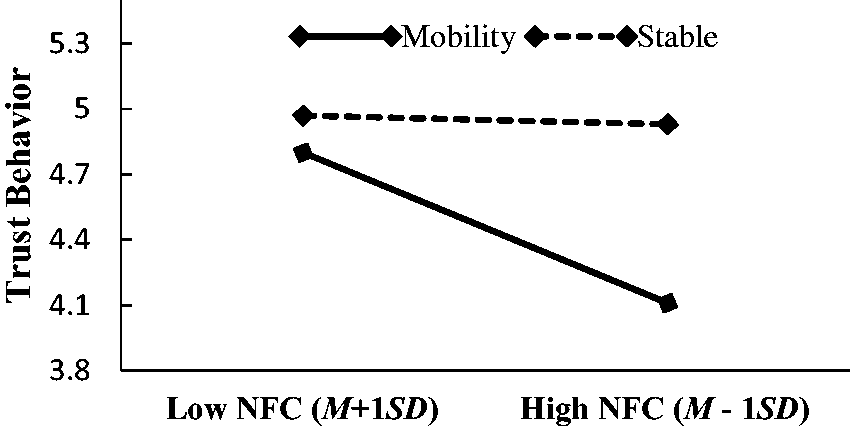
The Moderator Role of NFC Between the Link of Residential Mobility and Trust.
In sum, the results of Study 3 replicate and extend the findings of the previous studies and support our hypothesis that NFC affects the impact of residential mobility on trust. Specifically, by manipulating mobility, this study found that the effect of mobility on trust only occurred when the participants had high NFC. For people who had a low NFC trait, the difference between the mobility and stable groups was not significant.
Discussion
To examine how residential mobility affects trust, we conducted three studies with different paradigms. In Study 1, we carried out a scatter plot and regression and found a negative linear correlation between the number of moves and general trust. In Study 2, we used an experimental study that duplicated the correlation results. By systematically manipulating mobility and stability, we found a causal correlation between the two. In Study 3, we again duplicated the results of the previous two studies, and, furthermore, we showed that NFC moderates the effect of mobility on trust, such that there was a closer association between mobility and trust for people with lower NFC. Our findings essentially overlap with the previous conceptualization of trust as a complexity-reducing tool (Yamagishi et al., 1998). We believe that the results presented here are of considerable interest to a large number of researchers who are concerned with trust building.
Trust is a complex phenomenon. Previous studies have shown that trust can be a state or trait (Rotter, 1967) or a decision behavior (Wieselquist, 1999). In Study 1, we saw trust as a trait and it was measured by a trust scale. The paradigms in both Study 2 and Study 3 supported trust as a decision behavior in a dilemma context. We measured trust from different perspectives to show that the relationship between residential mobility and trust is robust. However, the two paradigms in Study 2 and Study 3 were different. Rotter (1967) defines trust as an expectancy held by an individual or a group that the word, promise, verbal or written statement of another individual or group can be relied upon. This definition suggests that the “trust” involved is contractual in nature, restricted to the interaction of at least two parties on at least two occasions. The first interaction involves a commitment from party A to party B. The second involves the fulfillment or lack of fulfillment of that commitment. The investment game in Study 2 measured this aspect of trust. The prisoner’s dilemma matrix measured trust of a different kind (Deutsch, 1960). This measure seems to distinguish between those who believe that others are malevolent or will take advantage of them (even for relatively small gains) and those who generally view others as benevolent. Persons having an orientation of the former kind may be reluctant to invest money, as the information might be eventually used against them—especially if the other stands to gain even very little by doing so. We also found in Study 3 that there were still significant differences between the four experimental groups, even though the means in the four groups were all above the midpoint.
The results of the studies presented here have implications for both theory and real-life situations. This means that people who have always lived in a mobility context will have both lower contextual trust and general trust. The results have implications for the explanation of trust in China. China has a dual social structure with obvious differences between urban and rural areas. With economic development, rural–urban migration is a new population phenomenon, and mobility has become more frequent in the last 20 years, considering the numbers of migrant workers in cities. Some related theoretical research argues that trust in China is declining and people have experienced a trust crisis in recent years (Xin & Zhou, 2012). The Annual Report on Social Mentality of China shows that distrust is deepening in interpersonal relationships between social groups (Wang & Yang, 2014). We argue that, in a traditional society, people need a long adjustment period to get to know one another, as social mobility is generally low. People mainly interact with in-group members and may focus on maintaining interpersonal harmony and avoiding discomfort in meetings. In traditional cultures, the people interacting are more likely to be in-group members because people often live in a stable context for their entire lives. Over the past several decades, China has undergone tremendous mobility, becoming an integrated social structure, which is believed to have impacted Chinese values and phenomena in Chinese people’s lives. Nevertheless, Zhao et al. (2019) state that calculus-based trust and identification-based trust have different trust patterns in trust building. According to their results, the influence is different in the two types of trust. We propose that residential influences would only have an effect on calculus-based trust, rather than identification-based trust. What is important to emphasize is that the results of the studies presented here are contextual. In countries which have a different context with China, residential mobility might actually lead to more rather than less trusting behavior.
Although this study has meaningful findings, we acknowledge its limitations. First, both the investment game and the prisoner’s dilemma matrix paradigms were single trials. The participants entered single-trial Prisoner’s dilemma game with cooperative choices that yielded greater gains for both interaction partners. Those with a competitive orientation frequently made no cooperative choices, culminating in losses for both partners. This pattern can accurately measure trust behavior in the laboratory (Berg et al., 1995). However, the paradigms also had the limitation that they only examined single-trial interactions between strangers. By not permitting multiple interactions over time between people who share a past or future relationship, it is difficult to generalize the results to everyday interactions and relationships. In addition, previous studies have shown that the single-trial Prisoner’s dilemma game method produces different outcomes than those found when iterative higher stakes games are used (e.g., Fehr & Fischbacher, 2003). However, Kleine et al. (2012) indicate that, without trust, there will be no surplus in the Prisoner’s dilemma game. Johnson and Mislin (2011) document in their meta-analysis that there is a “trust-and-reciprocity” mechanism where higher investment leads to higher back-transfer. The positive correlation between investment and back-transfer has been shown in many experimental studies (Berg et al., 1995; Shore et al., 2018; Zhao et al., 2019).
Second, the present studies were cross-sectional and overlooked the effect of time variation. Previous studies have shown that residential mobility captures the short-term and long-term consequences of moving for individuals. With regard to the short-term consequences, residential moves provoke immediate psychological reactions, such as excitement, anxiety, and loneliness, within interpersonal relationships (Oishi et al., 2012, 2013). In addition to short-term outcomes, mobility has long-term consequences, such as in relation to an individual’s personal life, well-being, feelings of depression, and personality (Jelleyman & Spencer, 2008; Oishi & Schimmack, 2010). For the investment game, the result is surprising from a purely rationalistic viewpoint because an egoistic and rational partner should not transfer any money back, and therefore the first person should not invest in the first place. But the result is not surprising from everyday experience, which tells us that sequential gift exchange is common in social interactions.
Residential mobility has increased in recent decades and countless people have moved to new cities or countries for better jobs or education. The relationship between residential mobility and trust may vary between different individuals, such as those with varying NFC in the present study. However, we also believe that other personality traits have an important effect. Future studies should explore how the personality traits or other characteristics of people influence the relationship between residential mobility and trust building. In addition, NFC can be measured as a stable personality trait and can be rooted in a specific situation. Although we explored the moderating role of NFC, it is still unclear whether there is an alternative mechanism. Is there a mediating effect, for example? Or will people scoring higher on NFC be less likely to move? Or can a priming mindset give rise to situational NFC? Finally, we argue that an individual’s moving intention is very important in studying residential mobility. Future studies should also pay more attention to exploring the role of moving intention in the relationship between residential mobility and trust building.
Footnotes
Declaration of Conflicting Interests
The authors declared no potential conflicts of interest with respect to the research, authorship, and/or publication of this article.
Funding
The author disclosed receipt of the following financial support for the research, authorship, and/or publication of this article: The present study was supported by the Project of the National Social Science Fund of China (No.16CSH043).