




Abstract
In the UK, following the enactment of the Communications Act 2003, amending the Enterprise Act 2002, the assessment of mergers involving broadcaster and/or newspaper enterprises is subject to – alongside the regular competition standard under the ‘substantial lessening of competition’ (SLC) test – a public interest standard. Under this standard, certain media mergers need to be assessed pursuant to the following considerations: media plurality, broadcasting standard objectives and free expression of opinion grounds. While the statute defines these terms ambiguously, it does provide guidance to the Secretary of State, the competition authority and the courts to decide how the statute is intended to be applied consistently. The paper will analyse how the media plurality test has been applied, some of the considerations of the CMA and OFCOM, and in doing so it will touch on the discretion of the decision making stakeholders.
Keywords
Introduction
Many countries have exclusive merger control rules for specific sectors of the economy. The rules vary in terms of sector, scope of intervention, levels of jurisdictional thresholds, and application of tailored substantive tests to assess the transactions in these sectors. At the EU level, for example, Member States are entitled to retain jurisdiction over concentrations that raise legitimate public interest concerns under standards (incl. public security, plurality of the media, prudential rules) that allow their prohibition based on broad criteria different from just competition ones (EUMR, Art. 21 (4)).
The concept of public interest itself varies considerably from one jurisdiction to the other. There is wide diversity of what jurisdictions consider to be public interest, starting from total welfare criteria to competition and non-competition considerations: examples of the latter – besides the above-mentioned public (or national) security, media plurality, and prudential rules – range from national economic interests, including industrial policy, financial stability, and the promotion of R&D, to social objectives, including public health concerns and the protection of jobs, and sustainability, including environmental protection (Budzinski & Stohr, 2019; OECD, 2017).
Media markets are an area in which the notion of public interest has been especially relevant to UK merger control – explicitly since 2003, but in practice for much longer. However, even after the introduction of the Enterprise Act 2002; EA 2002) and of the Communications Act 2003; CA 2003), the applicable statutory provisions fail to illuminate the relevant test beyond some basic guiding principles. The present article aims to provide an overview of the evolution of the decisional practice in the area and to clarify the current scope of the media plurality test.
A debate is underway on whether the media plurality test is still fit for purpose. In particular, the conversation has focused on two issues. First, scholars have investigated whether the rise of online media has changed the media landscape up to a point where an update of the media plurality regulatory toolbox, if not a fundamental redefinition of the very notion of media plurality, might be warranted; and conversely, whether the current regulatory framework for online media is adequate to deal with public interest concerns (Nicoli & Iosifidis, 2023). Besides in the academic literature, these questions have been recently addressed by the sectoral regulator, the Office of Communications (OFCOM), which has recommended to broaden the scope of the media public interest test by introducing a broader category of ‘news creators’ (OFCOM, 2021; § 4.33; OFCOM, 2022). These recommendations are expected to inform future legislative action. Secondly, commentators have asked whether the institutional framework for the assessment of media mergers might leave too much room for discretion on the part of a political organ, the Secretary of State (SoS), thus paving the way for biased decision-making. While the article does not engage directly with said debate, it does include some preliminary remarks on those issues, when relevant to the analysis. Further research will be needed to build on the present contribution and derive its implications for future reform.
Public Interest Concerns and Media Plurality in UK Merger Control
The Evolution of Public Interest Considerations in UK Merger Control
In the UK, prior to the entry into force of the EA 2002, mergers were officially reviewed under the broad public interest test of the Fair Trading Act 1973, which included competition considerations. With the enforcement of EA 2002 in 2003, three significant changes took place. Firstly, the primacy of a competition-based test was made explicit. Secondly, the primary decision-making role for mergers was formally reassigned to the competition authorities. Thirdly, considerations of national security or considerations modified by the Secretary of State through an order that could be taken into account in merger assessment were included in the Act. The scope of this public interest clause has expanded over the years, with the introduction of further criteria pertaining to media ownership and plurality, financial stability and public health emergencies. The SoS can also intervene in a very limited number of cases on public interest grounds where the jurisdictional thresholds are not met. In case of a media merger suspected to raise public interest concerns, following a public interest intervention notice (PIIN), OFCOM should provide a report to the SoS on “the effect of the consideration or considerations concerned on the case” (EA 2002, s. 44A; CMA, 2022, para 16.6).
Considerations specified by s. 58 of EA 2002 currently consist of media plurality, 1 the stability of the UK financial system (inserted in 2008) 2 and as recently as 2020, in the midst of the Covid pandemic, the capability of UK to respond to public health emergencies. 3 Having originally been the only named public interest consideration under the EA 2002, the national security ground was repealed by the National Security and Investment Act 2021 and is now assessed under a standalone investment review regime. 4 Media plurality as a public interest consideration by the CA 2003 and the stability of the financial system has been added by order as a public interest concern during Lloyds/HBOS merger in 2008 (Lloyds TSB plc/HBOS plc, 2008). Finally, the ability of UK to combat and mitigate the effects of public health emergencies was inserted through the Enterprise Act 2002 (Specification of Additional Section 58 Consideration) Order in 2020.
Media Plurality, Broadcasting Standards Objectives and Free Expression of Opinion
EA 2002 specifies three categories of public interest grounds with respect to media mergers: (i) media plurality, (ii) broadcasting standards objectives (BSOs) and (iii) free expression of opinion grounds (FEGs). The specified media plurality concerns under Section 58 are shown in Figure 1. Specified media plurality concerns under Section 58.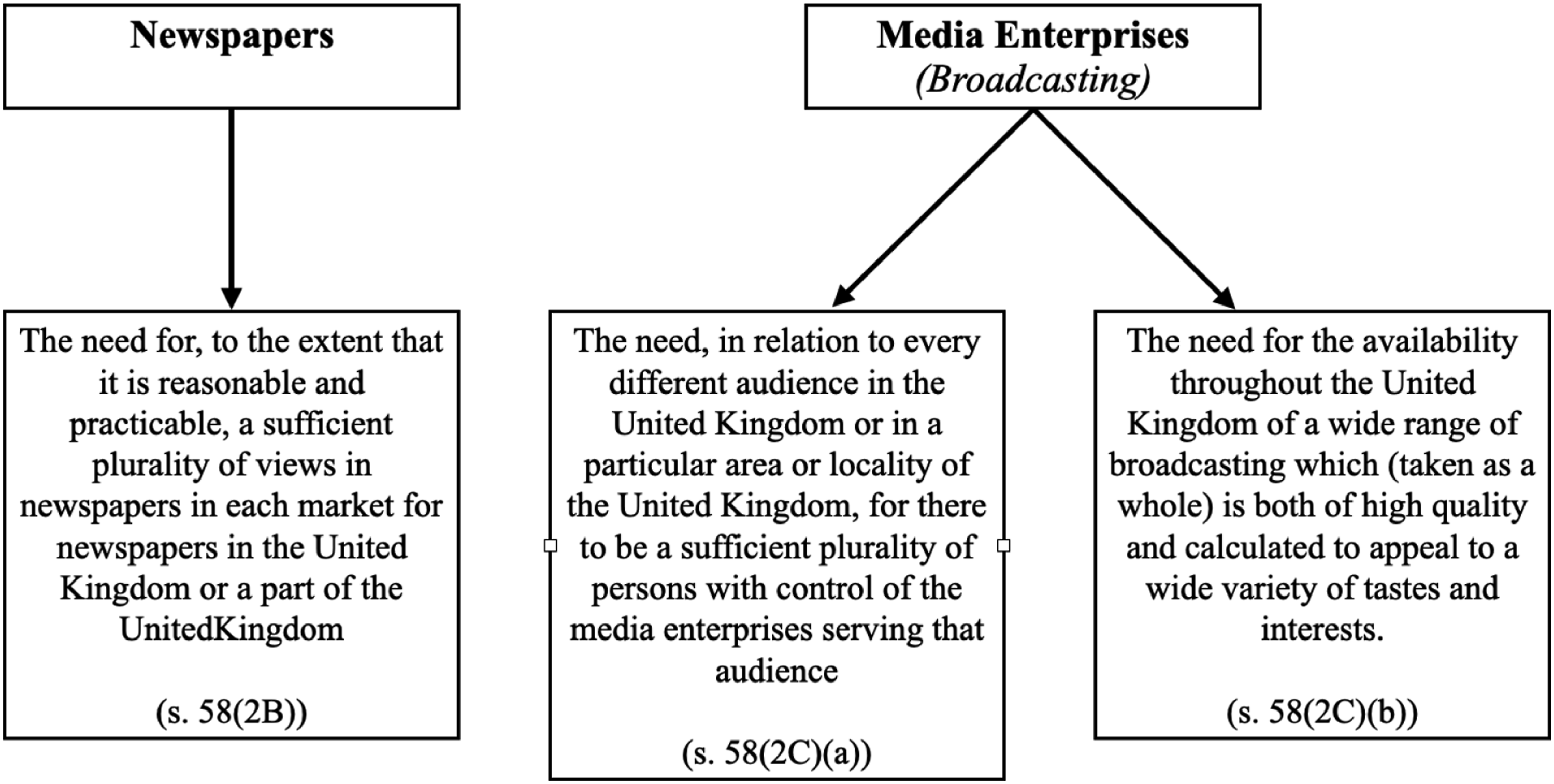
As can be inferred from the diagram, the Act essentially lays down its public interest considerations for only two business models: newspapers and media enterprises (broadcasting). Significantly, though, it does not cover online media enterprises. 5 As will be further explored below, the issue is particularly notable as online platforms become more and more powerful in terms of influencing the public opinion (Flew, 2022; Helberger, 2020).
The EA 2002 does not only deal with media plurality with regard to media mergers. It also tackles the issues of protecting BSOs within broadcasting enterprises and FEGs within newspapers. This is interesting because one would normally expect those to fall under the ongoing regulatory duties of OFCOM, which is also the case. The said specified considerations are shown in Figure 2. Free expression of opinion and broadcasting standards objectives considerations under Section 58.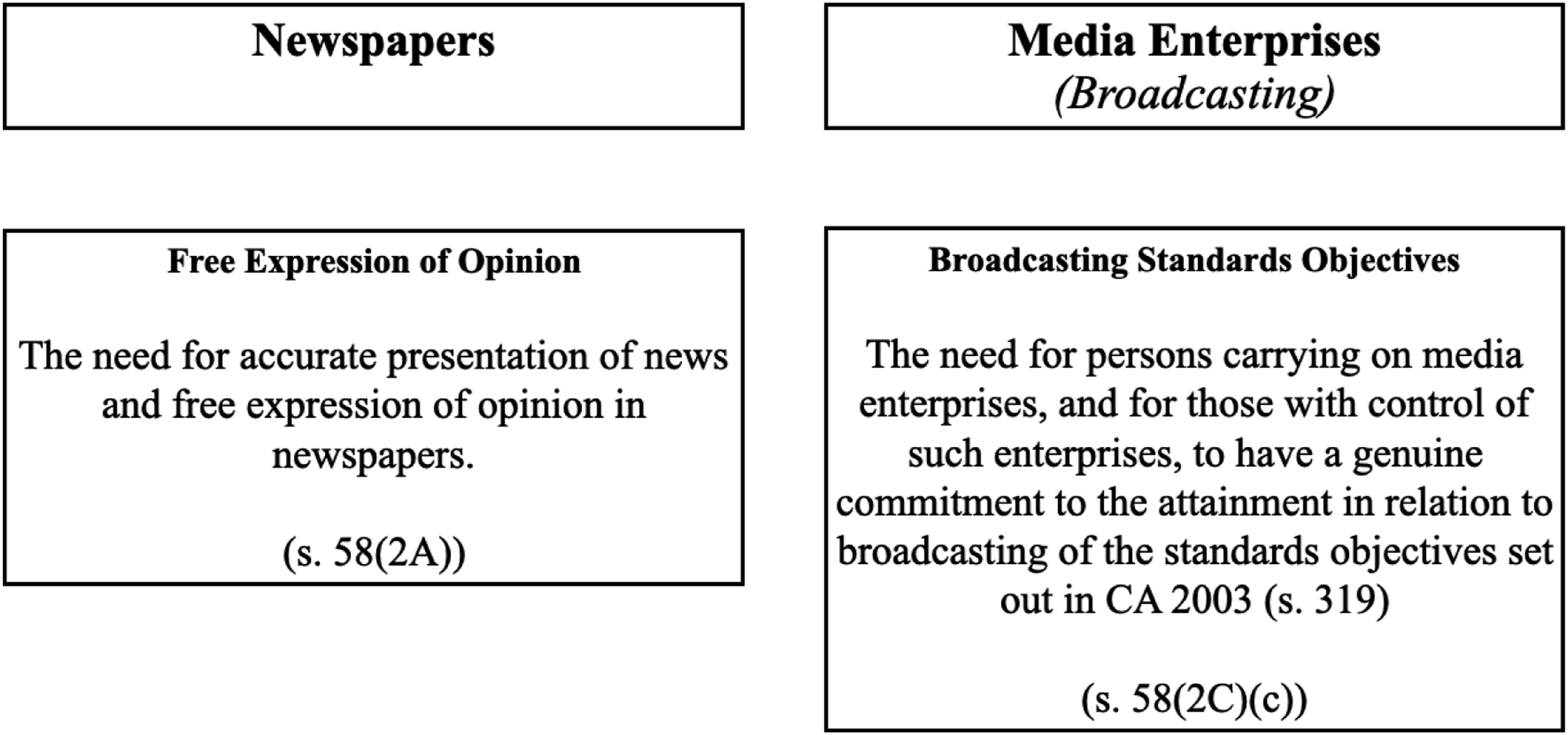
It is important to note that media plurality, FEGs, and BSOs are complementary factors in the sense that all of them serve the objectives of protecting diversity within and amongst media enterprises, preventing too few media owners from exercising too much influence on public opinion and political agenda and ultimately preserving the democratic process. However, the above-said factors are considered separately on a case-by-case basis, as FEGs or BSOs must still be examined even if there is no concentration as a result of a merger and vice versa (DTI, 2004, para 3.5).
We should emphasize though, that even though the Act provides different perspectives that are taken into consideration in mergers involving newspapers and broadcasting media enterprises, Section 58 aspires to the same end goal, preserving the plurality of views that cater for a wide audience. This goal is achieved through different means that include the above-mentioned considerations i.e. ensuring media plurality, (ii) broadcasting standards objectives and (iii) free expression of opinion grounds that are taken into account in the assessment of media mergers.
The Notion of Media Plurality in the UK context
Media plurality is not a pre-defined concept under the EA 2002. The term is mostly described in statutory texts, court decisions, reports and policy papers with reference to its attributes and functions. ‘Plurality’ is simply the state of being “more than one” (Cambridge Dictionary, n.d.). In that sense, it can be said that media pluralism is more than just counting number of media owners; but is also about a variety of other factors which come into play, such as diversity of sources and range of content available to society (European Commission, 2007, p. 5; Peruško, 2013, para 17; Smith & Tambini, 2012, p. 39).
Media plurality assessment in the UK is essentially equivalent to what is meant by ‘media pluralism’ (Arnott, 2010, p. 263). Nevertheless, surprisingly, the distinction between the terminology (namely between ‘pluralism’ and ‘plurality’) has never been a debated topic in the decisions of UK courts and enforcement authorities.
6
Instead, media plurality has been understood as a very broad concept since the enactment of the amendments to the EA 2002 by the CA 2003. For example, Lord McIntosh,
7
during the parliamentary debates of the Communications Bill in 2003, interpreted the term as follows: Plurality is a very subjective notion. It is not susceptible to the same kind of economic analysis as competition issues. It is very much a matter of judgment of what “feels” right. For this Bill, our approach has been to examine each media audience, including cross-media audiences, and to judge the level of plurality that we consider necessary. It is important to recogni[z]e that setting artificial limits on markets can make them economically less efficient. But we need to protect plurality and recogni[z]e that there is a minimum level of plurality below which we must never go (Hansard, 2003, col. 913).
Protecting media plurality is clearly associated with preserving the democratic process (Hansard, 2015, col. 849; see also British Sky Broadcasting Group plc/ITV plc, 2007, para 5.9), including by protecting and promoting diversity within and amongst to ultimately facilitate well-functioning political processes and institutions. 8 In its 2015 Framework, OFCOM stated that “plurality is not a goal in itself, but a means to an end” (OFCOM, 2015, para. 1.1). These points taken together, media plurality in legal context can be defined as the existence of a sufficient number of different types of people who have different beliefs and opinions in control of media enterprises with a view ensuring diversity within and amongst media enterprises and to prevent too much influence of a person on public opinion and political agenda.
The Media Public Interest Test
Control of Media
The question on the definition of control is central to the substantial assessment of plurality as well as to the establishment of jurisdiction on the relevant merger concerned. Drawing from the case-law, it can be said that the ultimate question on control is about finding the person with the ability to at least ‘influence’ the media enterprise concerned. In that regard, concepts of ‘degree of control’ and ‘control exercised and exercisable’ are at the core of the inquiry conducted by the relevant authorities.
‘Degree of control’
Defining the degree of control mainly relates to section 26 of the EA 2002. On jurisdictional grounds, it is not much different from a competition law assessment where the degree of control can vary between material influence and full control. However, as for the substantive assessment, the concept can be quite unique, because internal plurality (see below, § 8) issues are also relevant when deciding on the degree of control. In that regard, the case-law takes into account whether there are reliable internal mechanisms to prevent the owner from influencing the editorial matters.
The issue was at the heart of the debate in the BSkyB/ITV decision (British Sky Broadcasting Group plc/ITV plc, 2007). In that decision, upon taking into consideration the internal plurality aspects, the Competition Commission (CC) had concluded that the proposed merger would not lead to an adverse public interest. However, the decision was challenged by Virgin Media with the claim that internal plurality could not be a factor in a media plurality assessment. The argument was mainly based on section 58A (5) of EA 2002, which is as follows:
“For the purposes of section 58, where two or more media enterprises— (a) would fall to be treated as under common ownership or common control for the purposes of section 26, or (b) are otherwise in the same ownership or under the same control,
They shall be treated (subject to subsection (4)) as all under the control of only one person.”
In that regard, one of the most critical issues in BSkyB/ITV was the question of whether “common ownership” could have been understood as having the same meaning as “control”. The debate was of importance because if common ownership amounted to a position of control for the acquirer, then arguably there would have been no need for investigating internal plurality factors. 9
On that matter, the CC reached the conclusion that section 58A(5) was only applicable to media undertakings other than the merging parties, attributing a particular emphasis to the word “would” (British Sky Broadcasting Group plc/ITV plc, 2007, para. 5.24). However, the Competition Appeal Tribunal (CAT) did not approve the CC’s argument in that regard (British Sky Broadcasting Group Plc v The Competition Commission, 2008, para. 255). The Tribunal asked the following question in its analysis: “If the degree and nature of control exercised over media enterprises can be taken into account when conducting an analysis of the sufficiency of plurality of ownership under subsection 58(2C) (a) then what, if any, purpose does subsection 58A(5) serve?” (British Sky Broadcasting Group Plc v The Competition Commission, 2008, para. 256). The CAT also went further to say that the effect of the aforementioned provision would not limit itself only to an initial headcount of media enterprises but expands to the analysis for sufficiency (British Sky Broadcasting Group Plc v The Competition Commission, 2008, para. 259). That essentially meant that the CC was prevented from conducting a “degree of control” analysis in such cases. The CAT presented three reasons for that conclusion. Firstly, it said, the legislation had a limiting effect (British Sky Broadcasting Group Plc v The Competition Commission, 2008, para. 261). Secondly, it had recourse to legislative process, emphasizing the sensitive nature of plurality and the importance of protecting it (British Sky Broadcasting Group Plc v The Competition Commission, 2008, para. 262). Thirdly, it argued that at least some of the “creeping” increases in influence from one level of control to another would have been hard to catch post-merger (British Sky Broadcasting Group Plc v The Competition Commission, 2008, para. 263).
In the further proceedings, however, the Court of Appeal (CA) did not hold the same opinion. It said that section 58(2C) (a) suggests looking at the actual position of persons in control as it requires an assessment of plurality of persons in the control of relevant enterprises (British Sky Broadcasting Group Plc v The Competition Commission, 2010, para. 82). The court went on to say that because of the 20/20 rule, in the case before it, the real risk of change in the degree of internal plurality short of an increase in the level of control was not clear (British Sky Broadcasting Group Plc v The Competition Commission, 2010, para. 104). Furthermore, the Court said, if such a possibility existed, the CC was entitled to take that into account following the relevant merger situation (British Sky Broadcasting Group Plc v The Competition Commission, 2010, para. 122). Lastly, the CA pointed out that section 58A(5) could not be designed to shut the regulator’s eyes to the reality. It particularly asked the following question in reaching its conclusion: “How much of the real world is excluded by the statutory deeming effect of section 58A(5)?” (British Sky Broadcasting Group Plc v The Competition Commission, 2010, para. 114). In that regard, the court concluded that the effect of the provision is limited to an initial headcount of the media enterprises (British Sky Broadcasting Group Plc v The Competition Commission, 2010, para. 123).
Following up on the CA’s decision, in the Fox/Sky merger, the Competition and Markets Authority (CMA) stated that “merging enterprises cannot argue that the added level of control makes no difference on the basis that there has been no change to the number of media enterprises serving a particular audience” (21st Century Fox, Inc/Sky Plc, 2018, para. 6.15). It also went on to say that a reduction in plurality is not presumed by the reduced number of media enterprises serving to the same audience” (21st Century Fox, Inc/Sky Plc, 2018, para. 6.16). This approach seems sensible because in almost every case, presumably, there would be a reduction in the number of the media enterprises serving the same audience because of the deeming effect of section 58A(5). Therefore, there would be no need for further inquiry in order to establish a reduction of plurality if such a presumption were to be accepted.
On the other hand, taking internal plurality factors into account as a determinative factor in substantive control analysis also seems to dilute its formulation in the EA 2002; Arnott, 2010, p. 253). The Act is more concerned about “ownership”, rather than “editorial independence” across the media enterprises in its provisions relating to media plurality. Furthermore, this interpretation makes more sense since the issues of internal plurality are dealt with under the BSO and FEG provisions of the Act. As Arnott rightly points out, “taken to its extreme, this approach could justify a single controller of all media sources so long as there was ‘internal plurality’” (Arnott, 2010, p. 266). While this is not to say that internal plurality should not be taken into account in the assessment of plurality, it seems sensible not to give prominence to that to allow a merger to proceed. The point is also relevant from the perspective of the nature of regulatory scrutiny. The CMA stated in Fox/Sky that: The fact that the MFT states that, as has been its past practice, it does not intend to exercise control after the Transaction, is not conclusive. We must assess the MFT’s ability, rather than its current declared intentions, to exercise a greater degree of control in the future, bearing in mind that the regulatory scrutiny is now, rather than an ongoing assessment (21st Century Fox, Inc/Sky Plc, 2018, para. 6.31). […] We consider that the statute, as construed by the Court of Appeal in BSkyB/ITV, takes account of the fact that it would not be possible to review the implications for media plurality arising from any such increase in the control actually exercised (as it would not be subject to regulatory scrutiny) (21st Century Fox, Inc/Sky Plc, 2018, para. 6.33).
‘Control exercised and exercisable’
Moving on from the concept of the degree of control to “control exercised and exercisable”, the CMA in Fox/Sky took account of ‘exercised and exercisable control’ in two different stages. Firstly, it carried out an assessment of the actual extent of control exercised and exercisable by the acquiring persons. Secondly, it went through an analysis of “internal plurality” (21st Century Fox, Inc/Sky Plc, 2018, para. 6.26).
In assessing the MFT’s exercised control over Fox, NewsCorp and Sky, the CMA took account of the formal and informal means such as its shareholding, positions held within the company and relationships between directors and the Murdoch family. As for exercisable control, the parties sought to draw attention to Rupert Murdoch’s past conduct and motivations as a determinative factor. However, the CMA stated that ‘exercisable’ essentially meant the “real and likely effect of the Transaction in terms of the MFT’s ability to exercise control’. Therefore, it pointed out that parties’ motivations were not relevant to the assessment. The CMA concluded that ‘on the balance of probabilities’, the determination on how such control was likely to be exercised after the transaction was important for the plurality assessment. It also emphasized that the determination on the likely exercise of control would not necessarily be similar to that of a competition law assessment (21st Century Fox, Inc/Sky Plc, 2018, para. 6.34), which for example would require an incentive to foreclose the market in the event of a vertical merger.
In Fox/Sky, the CMA emphasized that exercisable control does not refer to a “hypothetically exercisable control” (21st Century Fox, Inc/Sky Plc, 2018, para. 6.34). However it does not seem clear from the decision how that would be possible without examining the incentives of the parties post-merger. One possible explanation could be that the CMA does not take into account the incentives of the parties to the relevant transaction, but instead takes into account a reasonable person’s incentives in that regard. This point could be further strengthened by the CMA’s statement in the decision that it took “account of the fact that the level of control currently exercised by the MFT over Sky and Sky News may be less than the level of control that is currently exercisable” (21st Century Fox, Inc/Sky Plc, 2018, para. 6.35).
Relevant Audience and Relevant Content
NRS Social Grading System.
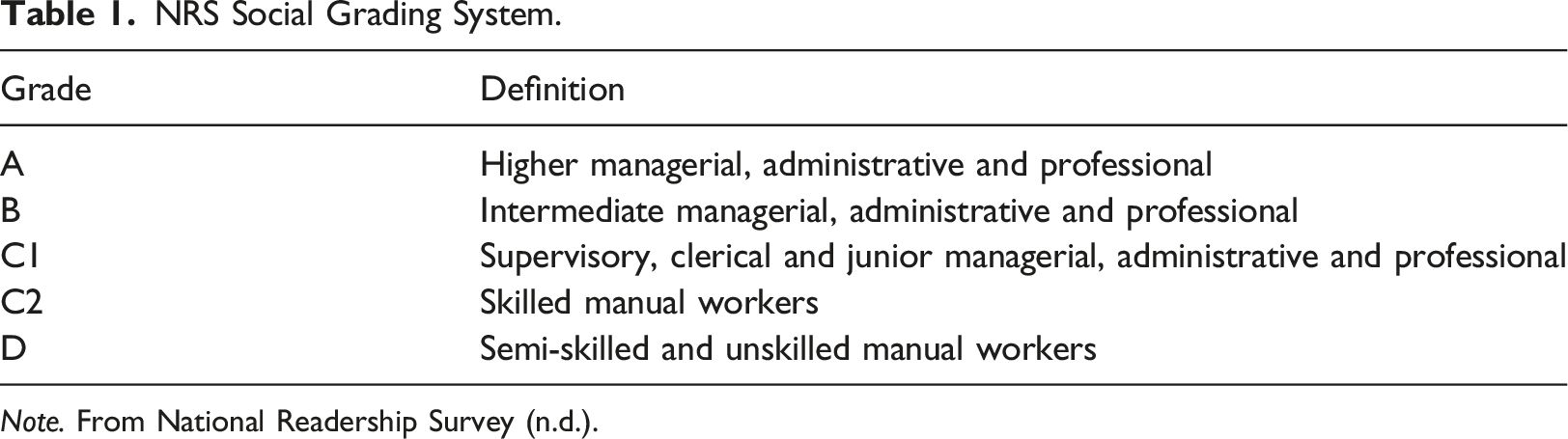
Note. From National Readership Survey (n.d.).
The CC’s analysis on relevant audience was mainly crucial in assessing the relative importance of the merging parties for each of these categories (British Sky Broadcasting Group plc/ITV plc, 2007, para. 5.49). However, as the difference between the percentage of any particular audience and total audience ranged between 4 to 8%, the CC did not find any fundamental difference as regards possibly distinct relevant audiences.
In Fox/Sky, a similar analysis was conducted under the “influence” section (21st Century Fox, Inc/Sky Plc, 2018, fig. 11.6). In doing so, the CMA relied on surveys. It afforded particular focus on a group called the “opinion formers”, described as leaders in their field such as business, politics, media, public sector, charities, academia and beyond (21st Century Fox, Inc/Sky Plc, 2018, para. 11.55). The CMA’s analysis seems fundamentally different from the analysis undertaken by the CC because it places ‘influence’ at its center rather than a social class approach. Indeed, in the age of social media, influencing the social media influencers seems to be one of the best ways to shape public opinion and the political agenda.
In addition to the relevant audience, relevant content also plays a role in measuring plurality. Both in the BSkyB/ITV and Fox/Sky decisions, the concept of plurality was understood as ‘plurality of news’ (British Sky Broadcasting Group plc/ITV plc, 2007, para. 5.32). By way of an analogy to competition law, it can be said that limiting the relevant content to news content serves to define the relevant product market. Taking into consideration the objectives of the Act, that limitation makes sense especially from a practical point of view. In particular, it is understandable that practical constraints exist in measuring and comparing the influence of all kinds of TV shows across a whole range (21st Century Fox, Inc/Sky Plc, 2018, para. 6.47). 10 However, in a progressive manner, it is advisable to take into account a broader set of both news and non-news data since there is not a clear-cut distinction between these types of content with respect to their influence on relevant audiences.
Theories of Harm
In Fox/Sky, the CMA developed for the first time two different theories of harm resulting from the reduction of plurality (21st Century Fox, Inc/Sky Plc, 2018, para. 6.47). It stated firstly that the first potential effect of the reduction of plurality was “that the Transaction reduce [d] the diversity of viewpoints available to and consumed by members of the public.” (‘Editorial Alignment Risk’; 21st Century Fox, Inc/Sky Plc, 2018, para. 6.48). Secondly, the CMA considered that a potential harm as result of merger could be that the MFT would have “too much influence over public opinion and the political agenda” (‘Excessive Influence Risk’; 21st Century Fox, Inc/Sky Plc, 2018, para. 6.51).
The stated theory of harm has a double function. Firstly, it serves to establish a framework for measuring plurality. In other words, contextual external plurality and internal plurality factors are shaped according to the theory of harm. Secondly, it serves to interpret the “sufficiency” of plurality because the theory discloses the substantial value of media plurality. In that regard, while not provided in EA 2002, the stated theories of harm provide a context for the whole discussion on protecting media plurality.
As for the content of the theories of harm, it is apparent that they are closely interlinked. This is mainly because Editorial Alignment Risk is most likely to be translated into Excessive Influence Risk. On this point, the CMA stated in Fox/Sky that: These two potential effects are closely linked. For example, if the Transaction were to increase the MFT’s control over Sky News, this could translate into a reduction in the diversity of viewpoints consumed by the public as a result of the MFT’s increased control of Sky News and its existing control over News Corp Equally, the increased consumption might be expected to increase the ability of the MFT to influence public opinion and the political agenda. Using both of these theories of harm as a basis for framing our analysis, we considered in the round whether the evidence obtained during our Inquiry indicates that the Transaction is likely to lead to a material reduction in the plurality of persons with control of media enterprises (21st Century Fox, Inc/Sky Plc, 2018, paras. 6.53–6.54).
It is apparent from the passage that the CMA considers that an Editorial Alignment Risk might not translate into a reduction in the diversity of viewpoints consumed by the public. This point is in line with the reasoning that protecting media plurality is not only about a simple head-count. Even if Editorial Alignment Risk occurs, there is a possibility that it might not lead to Excessive Influence Risk. Therefore, it might be inferred from the foregoing that these two theories of harm must be material at the same time in order for a media merger to have an adverse public interest effect. However, it remains to be seen whether the CMA will continue to use the same framework in future cases.
Measuring Plurality
In BSkyB/ITV, the CC took the concept of ‘plurality’ as referring to both the range and the number of the persons in control of media enterprises (British Sky Broadcasting Group plc/ITV plc, 2007, para. 5.7). Significantly, as stated above, the CC made a distinction between ‘internal’ and ‘external’ plurality (British Sky Broadcasting Group plc/ITV plc, 2007, para. 5.11). ‘External plurality’ was defined as plurality which could be described by the range of information and views across different media groups, while ‘internal plurality’ was defined as plurality which could be described by the range within individual media groups.
The CC measured plurality of news in three steps. Firstly, it attempted to analyze the existing level of plurality by using certain indicators such as market shares and surveys (British Sky Broadcasting Group plc/ITV plc, 2007, para. 5.45). Secondly, it tried to identify the contribution of the merging parties (as distinct entities) to that level of plurality. In its analysis, the CC gave particular regard to the combined market shares of the parties in the market for ‘television news viewing’ and cross-media ownership. Finally, it accounted for the degree of internal plurality, particularly editorial independence in media enterprises under common ownership (British Sky Broadcasting Group plc/ITV plc, 2007, para. 5.39).
In Fox/Sky, OFCOM’s 2015 Framework was used as the main framework to define substantial quantitative and qualitative criteria. Quantitative criteria was listed as availability, consumption and impact (21st Century Fox, Inc/Sky Plc, 2018, para. 6.57). In its decision, the CMA referred to availability to show “the number of providers at the relevant consumption point.” Consumption was used in reference to the “frequency with which these sources are used and the time spent using them”. Lastly, impact referred to the way the content of the news impacted on the “formation of people’s opinions” (e.g. trust). As stated in Fox/Sky, the problem with quantitative metrics is that they are not sufficient in themselves to establish a theory of harm (21st Century Fox, Inc/Sky Plc, 2018, para. 6.58). The CMA, in that regard, made a distinction between the “contextual factors that provide background to inform the availability, consumption and impact metrics” and “qualitative evidence, being evidence that is relevant to our assessment and is not easily quantifiable” (21st Century Fox, Inc/Sky Plc, 2018, para. 6.63).
The CMA’s detailed analysis on the assessment of diversity in the viewpoints that are available and consumed takes account of availability, reach, consumption and multi-sourcing pre- and post-transaction (21st Century Fox, Inc/Sky Plc, 2018, para. 10.6). As for availability, the CMA decided that there were a significant range of news sources available. However, it also pointed out that merely counting numbers would not give any insight into influence (21st Century Fox, Inc/Sky Plc, 2018, para. 10.14). As for reach, the CMA concluded that Sky reached 9% of the population in the UK. Its primary competitors were the BBC (62%) and ITN (43%). Significantly, the CMA employed a cross-platform reach metric, allowing it to measure the total Fox, News Corp and Sky reach of 31% of the UK population (21st Century Fox, Inc/Sky Plc, 2018, para. 10.25). According to that metric, the combined entity would be the third largest in terms of reach, following the BBC (77%) and ITV (39%) (21st Century Fox, Inc/Sky Plc, 2018, p. 10.5). The CMA defined consumption as “the frequency with which [viewers] access [a particular media source] and the length of time they spend reading or viewing it” (21st Century Fox, Inc/Sky Plc, 2018, para. 10.27). In terms of consumption criteria, the CMA stated that Sky was only slightly less consumed than ITV. The CMA said that it noted “Sky News has been seen by third parties as a positive competitive force in the provision of news” (21st Century Fox, Inc/Sky Plc, 2018, para. 10.31). According to share of reference for consumption criteria, the BBC accounted for 42% of the population, followed by ITN (11%) and Sky (6%) in 2016. Finally, the CMA recognized that multi-sourcing was difficult to measure, but tried to estimate its impact by taking into account both direct access and access through the platforms (21st Century Fox, Inc/Sky Plc, 2018, paras. 10.36, 10.75); this analysis showed that users consumed on average 3.8 retail sources of news and 3.1 wholesale sources of news (21st Century Fox, Inc/Sky Plc, 2018, paras. 10.77–78).
Internal plurality issues were also discussed in much detail for the first time in Fox/Sky. The discussion in the decision provided in-depth information on the content of internal plurality. In its analysis, the CMA firstly discussed a board resolution adopted by Fox that aimed to prevent editorial influence on Sky News by the former (21st Century Fox, Inc/Sky Plc, 2018, para. 8.6). The CMA stated that such a board resolution would be insufficient to prevent a reduction of internal plurality because the resolution could be easily revoked, there were unclear procedures on appointing the Head of Sky News, and the body which would have enforced such rules was inexperienced (21st Century Fox, Inc/Sky Plc, 2018, para. 8.5). In the second place, the CMA looked into the culture of editorial independence in Sky News (21st Century Fox, Inc/Sky Plc, 2018, para. 8.13). The CMA, while acknowledging the existence of such culture, pointed out that as the appointment of the senior staff could be influenced by the MFT, the said culture could be changed over time (21st Century Fox, Inc/Sky Plc, 2018, para. 8.20). Thirdly, the CMA assessed audience expectations and the post-merger entity’s commercial incentives to modify its editorial approach. The parties put forward the idea that a change in editorial matters did not make sense from an economic point of view because customers would switch upon such change (21st Century Fox, Inc/Sky Plc, 2018, para. 8.24).
However, the CMA concluded that influence as such may be subtly exercised in a way that it would not change viewers’ perception of the channel’s impartiality because, it asserted, the channel could attract other viewers following a change in editorial matters (21st Century Fox, Inc/Sky Plc, 2018, para. 8.25). Finally, the CMA considered regulatory restrictions which would preserve internal plurality within the organization. However, it found that protection against editorial alignment was limited as the Broadcasting Code allowed for a significant margin of discretion in editorial matters (21st Century Fox, Inc/Sky Plc, 2018, para. 8.41). The CMA, in particular, underlined the indirect ways of influence on editorial matters (21st Century Fox, Inc/Sky Plc, 2018, para. 8.46).
Sufficiency
As outlined above, it is stated in EA 2002 that there shall be “a sufficient plurality of persons with control of the media enterprises” post-merger for a finding that the proposed merger does not run counter to the public interest. However, the Act does not clearly define what is meant by ‘sufficient’ plurality. In the Fox/Sky case, it was proposed by the parties that a historical benchmark could be used when assessing whether there is sufficient plurality at a given time. The rationale behind the submission was that media plurality had to be existent at the time when the legislation was adopted. However, the CMA rejected that argument on the premise that plurality “assessment needs to be undertaken by reference to the current market and political context, particularly given the developments in media and communications over recent years” (21st Century Fox, Inc/Sky Plc, 2018, para. 6.80). In parallel to that assessment, in its 2012 Report on “Measuring Media Plurality”, OFCOM stated that: it is unrealistic to seek an absolute statutory definition of sufficiency, as the market is dynamic and unpredictable. What is considered sufficient or not will vary with time and needs to be considered in reference to the broad market and political context of the times. Notions of sufficiency today are likely to be somewhat different from those of ten years ago, or ten years hence (21st Century Fox, Inc/Sky Plc, 2018, para. 6.79).
In that regard, it can be said that market structure and existing regulatory frameworks are central to the assessment of sufficiency. As for the market structure, changing roles of TV, newspapers, radio and the Internet are highly relevant. The substantial assessment of plurality is mostly about the availability, reach and influence of these channels. Therefore, it is sound to use these metrics in order to analyze market context. In Fox/Sky, it was reported that TV had been used as a source of news by 69% of the population in 2016 (21st Century Fox, Inc/Sky Plc, 2018, para. 9.7). The figure was slightly higher than about 65% in 2006 (British Sky Broadcasting Group plc/ITV plc, 2007, appendix I, fig. 1). Online media took the second place in 2016 by reaching 48% of the population (21st Century Fox, Inc/Sky Plc, 2018, p. 9.1) up from just above 20% in 2006. In contrast, printed newspaper consumption declined through the years to a level of 29% of the population (21st Century Fox, Inc/Sky Plc, 2018, p. 9.1) from close to 80% in 2006.
Following on these statistics, the rise of online media is particularly note-worthy. One extreme possibility flowing from the mentioned trend could be that the online media could reduce the significance of traditional media platforms in a way that would render public interest scrutiny for traditional media redundant in the future (OFCOM, 2022, A1.3). Whilst the CC did not see that possibility in the ‘foreseeable future’ in 2007 (British Sky Broadcasting Group plc/ITV plc, 2007, para. 5.42), it now seems more likely that online media will be taking over the priority on the public agenda in the near future. On that point, the CMA did not comment on the said possibility, leaving that assessment to be made in future cases.
Setting aside the markets context, it is conceivable that sectoral regulation can safeguard sufficient plurality without further public interest intervention. For example, the 20/20 rule, which is set out in section 350 and schedule 14 of CA 2003, limits the cross-media ownerships to an upper limit of 20%. The rule essentially prohibits a proprietor of a newspaper which has a market share more than 20% to hold more than 20% of the shares of a company which provide broadcasting services and vice versa. The CC, in BSkyB/ITV, held that public interest scrutiny was a supplement for the existing regulatory rules. It held the view that the existence of regulatory rules on media ownership did not negate the application of the public interest criteria (British Sky Broadcasting Group plc/ITV plc, 2007, para. 5.30).
Overall, taking into consideration the market and regulatory context, the CMA’s policy on the legal threshold is reasonable since the media plurality concern was introduced to merger control legislation because competition law rules may not be sufficient to protect it (21st Century Fox, Inc/Sky Plc, 2018, para. 6.70). In Fox/Sky, a mere 3% of the additional reach was seen as sufficient in the presence of two more influential media enterprises (21st Century Fox, Inc/Sky Plc, 2018, para. 10.73). However, it remains to be seen how the CMA will interpret sufficiency in the future cases.
Freedom of Expression Grounds and Broadcasting Standards Objectives
The FEGs were examined for the first time in the Trinity/Shell case by OFCOM (Public interest test for the acquisition by Trinity Mirror plc of publishing assets of Northern and Shell Media Group Limited, 2018, para. 1.12). OFCOM defined freedom of expression as referring to “editor’s ability to determine the position of a newspaper without interference from the proprietor” (Public interest test for the acquisition by Trinity Mirror plc of publishing assets of Northern and Shell Media Group Limited, 2018, para. 5.1). On the other hand, the BSOs consideration was examined in Fox/Sky for the first time by the CMA. The CMA noted in that case that BSOs referred to “the need for a genuine commitment to the broadcasting standards objectives, which are in the nature of general principles, rather than to the detailed rules of the Broadcasting Code (and other broadcasting regulation that gives effect to the broadcasting standards objectives)” (21st Century Fox, Inc/Sky Plc, 2018, para. 13.4).
It must be underlined from the outset that the regulatory landscape for newspapers and broadcasting are quite different. Broadcasting licenses are subject to heavy regulation and ongoing monitoring by OFCOM whereas newspapers mostly remain self-regulated (Public interest test for the proposed acquisition of Sky plc by Twenty-First Century Fox, Inc, para. 5.3.1). In that respect, an FEGs assessment is much more relaxed than a BSOs evaluation. For example, OFCOM states in that regard that the editor’s ability to determine the position of a newspaper without interference from the proprietor does not mean that a newspaper cannot change its view (Public interest test for the acquisition by Trinity Mirror plc of publishing assets of Northern and Shell Media Group Limited, 2018, para. 5.1). Holding the same premise true for a BSOs assessment would be quite extreme as BSOs are more vigilant in that regard.
Attainment of the BSO is closely related to the notion of “compliance by design” (21st Century Fox, Inc/Sky Plc, 2018, para. 13.25). In that regard, the CMA is interested in the evidence relating to compliance mechanisms (e.g. policies) rather than a mere positive compliance record when assessing BSOs (21st Century Fox, Inc/Sky Plc, 2018, para. 13.22). Taking into consideration the risk-based approach in the evaluation of BSOs, the CMA’s perspective is reasonable. Comparably, similar assessment criteria are relevant in some other areas which involve a risk-based evaluation (e.g. GDPR).
BSOs are also different from OFCOM’s “Fit and Proper Person” (FPP) test. FPP is set out in the Section 3 of the Broadcasting Act 1996 (“BA 1996”). The test is relevant when determining whether a person is qualified to hold a broadcasting license. In determining the conditions for the FPP, OFCOM has a broad discretionary margin. These conditions, however, may overlap with that of Broadcasting Considerations, as OFCOM takes into account “any relevant misconduct of those who manage and control the licensee” (OFCOM, 2012). In that regard, as occurred in Fox/BSkyB merger, these two investigations might go hand in hand in one process.
It is also important to underline that FPP and Broadcasting Standards have different legal characteristics. Firstly, FPP relates to an assessment of whether a person qualifies for obtaining a broadcasting license, while Broadcasting Standards are the criteria for public interest assessment of proposed merger activity. In that regard, secondly, whereas failing FPP leads to the annulment of the broadcasting license, failure to meet Broadcasting Standards could lead to a prohibition of a proposed merger, but not necessarily to the annulment of the relevant license. Thirdly, the threshold for determining that a person is not fit and proper is a particularly high one (OFCOM, 2017b, p. 1). Forthly, OFCOM, in addition to FPP, also took into account the broadcast compliance records of parties in order to determine whether “merged entity would lack a genuine commitment to the attainment of broadcasting standards” (OFCOM, 2017a, p. 5). Therefore, it can be inferred that the net for the Broadcasting Standards test is wider in scope.
Assessment of BSOs and FEGs remain highly subjective and controversial for two reasons. First of all, there is still a limited guidance on what constitutes a compliance by design. Therefore, it is hard to predict the determining factors in each case by the parties to an acquisition. Secondly, the Authorities have a broad margin in construing the criteria on a case-by-case basis. In that regard, parties have little room for arguing against the regulator’s approach. Besides those, BSOs and FEGs are closely related to internal plurality assessment. Authorities reaching to a different conclusion on internal plurality issues and BSOs/FEGs would be somewhat contradictory. Therefore, the spill-over effect must also be taken into account.
Concluding Remarks
Pursuant to the approach to transactions raising media plurality concerns standard, as encapsulated in the Enterprise Act 2002, certain media mergers need to be assessed pursuant to the following considerations: media plurality, broadcasting standard objectives and free expression of opinion grounds. The article provided an overview of the evolution of the decisional practice and clarified the current scope of the media plurality test. Media plurality grounds do not necessitate a balancing exercise (White, 2017) which is welcome as the balancing act of competition concerns and media plurality is not a straightforward task. 11 The institutional setting of the media plurality and the broader public interest regime provided in the Enterprise Act is not without criticisms. A concern arises as to whether the CMA’s role in public interest regime contradicts its statutory duty to promote competition (Lyons et al., 2016, p. 11). However, it must be emphasized that the CMA does not make the final decision on the media plurality considerations. It is for the Secretary of the State to balance the various public interests at stake.
There are also opposing views that argue that the appointment of the CMA to assess media plurality as a public interest would create a certain amount of consistency and continuity (Reader, 2016, p. 45), thereby alleviating concerns of unpredictability in decision making to a degree. The involvement and significant contribution of OFCOM in the assessment of transactions raising media plurality concerns adds to the much needed accuracy of the assessment of such transactions. However, predictability is still imperfect because of the involvement of the Secretary of State as the decision maker (Reader, 2015, p. 105). Moreover, the lack of extensive precedents on media plurality mitigates the required degree of consistency that would be very welcome for the legal and business community.
Footnotes
Acknowledgments
The author would like to express his gratitude to Dhvani Shah for her excellent research assistance.
Declaration of Conflicting Interests
The author(s) declared no potential conflicts of interest with respect to the research, authorship, and/or publication of this article.
Funding
The author(s) received no financial support for the research, authorship, and/or publication of this article.
