




Abstract
This article analyses the European Commission’s attitude vis-à-vis labour migration and brain drain in the Western Balkans. It uses Croatia’s post–EU accession experience as a focal point. Grappling with elevated migration rates and a decline in natality, the Western Balkan countries are an interesting region in terms of demographic change. Examining how much attention the Commission pays to brain drain, the article notes an increase since 2019; yet this focus appears disproportionately limited considering the potential repercussions for economic growth and social welfare in the countries experiencing it. The Commission’s predominantly negative view of brain drain emphasises that it is the nations affected that are responsible for avoiding it, thereby confirming that it is caused by a skills mismatch. The article recommends integrating brain-drain prevention measures into the enlargement process, and encourages the Commission to improve its focus on the matter in its annual candidate and potential candidate country progress reports.
Introduction
Labour migration and brain drain have been an issue in the Western Balkans for many years. Since Croatia became an official EU member state in 2013, the country has experienced an exodus of people, which in turn has caused a demographic shift (Taylor 2021). Croatia’s accession made it easier for Croatians to make their way to other EU member states, and the country has since been struggling with high migration rates and a sliding natality (Ströhm 2023, 14). It is estimated that 10% of Croatia’s population has emigrated over the past decade (AP 2022; Ströhm 2023, 14–15), making it the country experiencing the most significant brain drain within the EU (The Global Economy 2023). Taking this into account, it seems likely that the current (potential) candidate member states of the Western Balkans (hereafter ‘WB6’: Albania, Bosnia and Herzegovina, Kosovo, Montenegro, North Macedonia and Serbia) could face similar effects after their accession. The Western Balkans have already experienced mass displacements since the end of the Communist/socialist era and the break-up of Yugoslavia, and despite the fact that this massive migration from the region is still taking place and familiar to politicians, it remains under investigated by migration scholars (King and Oruc 2019, 2).
What causes brain drain to happen and how it can best be solved are up for debate. According to Hasselbach (2019), who has researched the causes of intra-European brain drain in the existing member states, there are two narratives within the EU. The first is the solidarity narrative: brain drain occurs from the periphery to the core of the EU because of structural and macroeconomic differences between richer and poorer countries. By making direct investments in the periphery and ensuring workers’ rights are secured at the EU level, this form of brain drain can be reduced. The second is the skills narrative, where skills mismatches are seen as the root cause of brain drain. Countries that have good vocational and educational training systems also have low levels of unemployment. To reduce high unemployment in certain countries, these systems need to be fixed, and workers should be encouraged to train or retrain to gain the skills needed by employers. Hasselbach’s research shows that, in European thinking today, including within the European Commission, the latter narrative predominates.
The Commission (2023b) continues to promote ambitious and sustainable policy on legal migration to the EU. Through the Students and Researchers Directive, the recast Blue Card Directive and Talent Partnerships, the EU aims to attract high-skilled workers from non-EU countries through simplified procedures. Marjan Icoski (2022, 15), a researcher for the German Marshall Fund, acknowledges that the prime responsibility for tackling brain drain lies with the WB6. However, he argues that the EU’s current migration policy lacks an acknowledgment of the Union’s pull factors, and that the growing migration to the EU should also be managed by the destination countries. Allison Carragher (2021), a former visiting scholar at Carnegie Europe, even goes as far as calling the EU a dishonest broker, and argues that there is a need to share the burden of finding a solution. Since the EU and certain member states are further liberalising their labour markets, their accountability for the brain drain problem should also increase (Icoski 2022, 15).
As the Commission is the sole EU body capable of proposing new legislation, this article aims to analyse the relationship between EU enlargement and brain drain from the perspective of the Commission, and how this differs for each Western Balkan state. 1 It therefore builds on the country-specific progress reports published by the Commission’s Directorate-General for Neighbourhood and Enlargement Negotiations to illustrate the Commission’s stance on the subject. For each country, the starting point for document selection is the year that its application was approved. 2 It should be noted that these progress reports can best be understood as summaries of the negotiation talks. Analysing these documents may mean that discussions during the accession talks or in other official correspondence is overlooked. Nevertheless, they provide a good indication of the Commission’s attitude towards brain drain in the region.
Brain drain as an overlooked challenge?
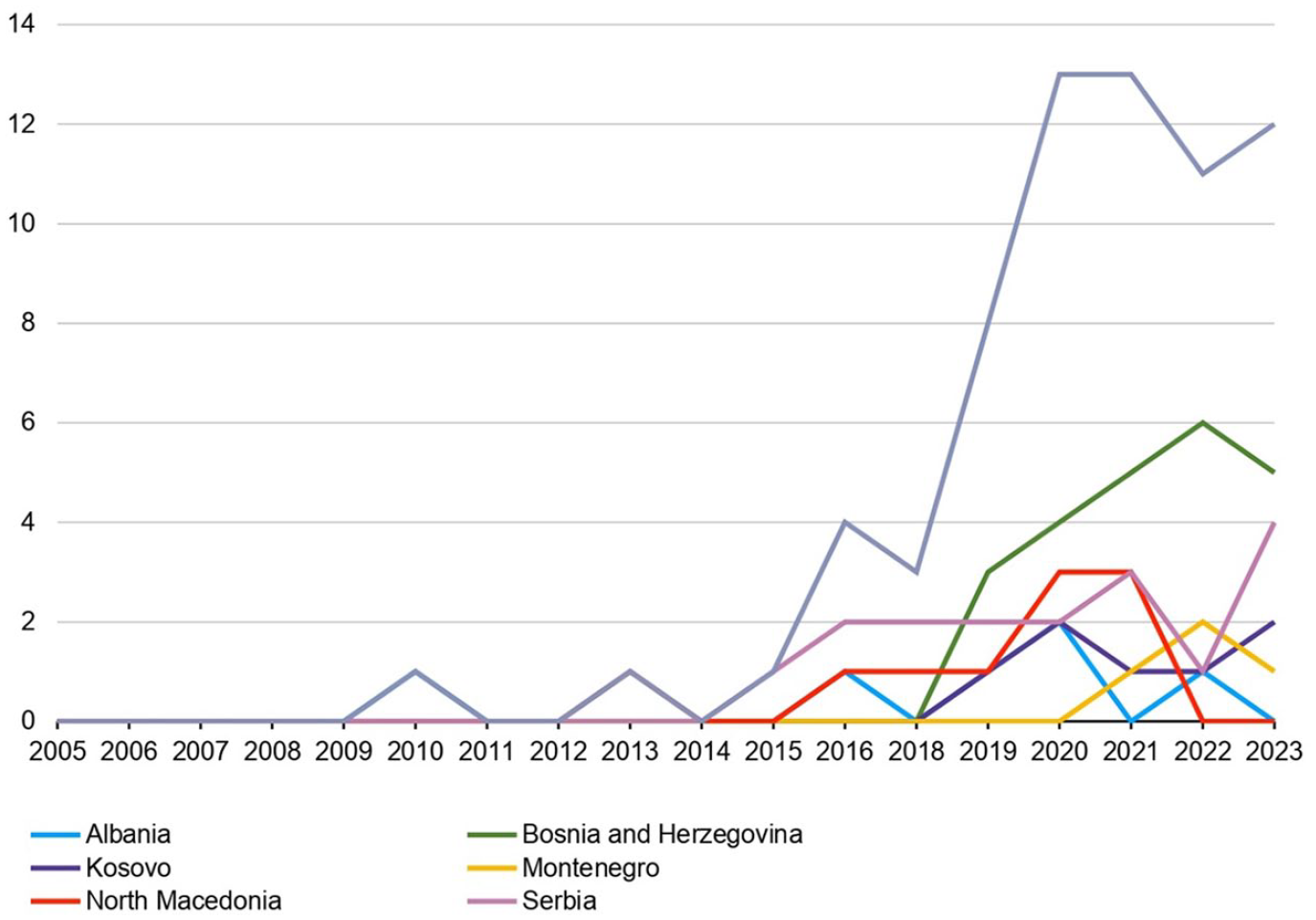
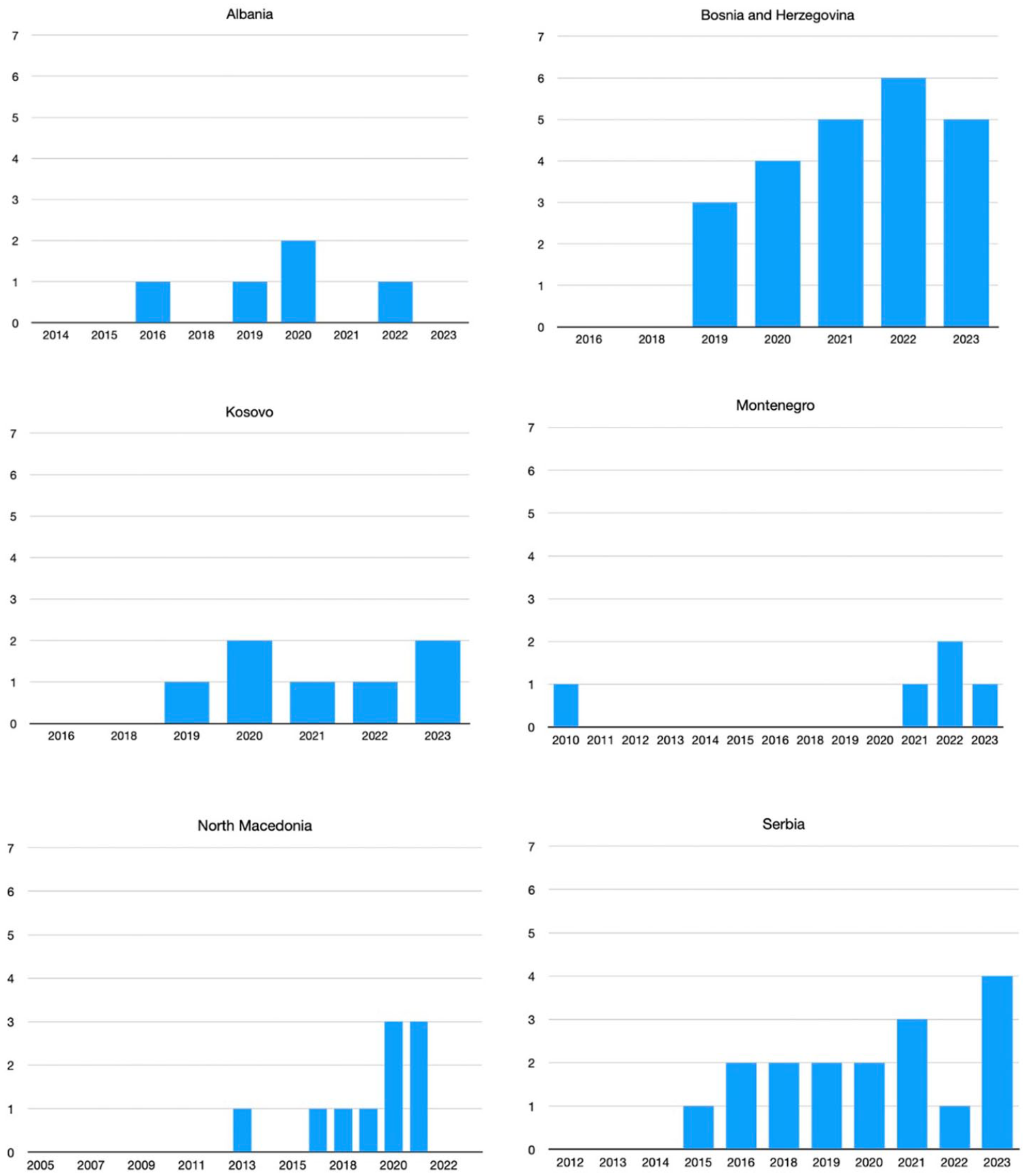
The Commission considers the issue of brain drain in discussions with all the WB6 countries, albeit to differing degrees. At first glance, it is noticeable that the amount of attention paid to this matter overall has increased since 2019. However, considering the pressing consequences brain drain could have for the region in terms of economic growth and social welfare (as indicated by the Commission in its reports), the attention paid to it thus far still seems to be inadequate.
Contrary to expectations, the amount of attention paid by the Commission to the issue of brain drain does not necessarily increase as countries progress further through the enlargement process. In fact, the opposite can even be observed, as the greatest consideration of the matter can be found in the reports for Bosnia and Herzegovina, even though the country has only very recently received official candidate status. Instead, the amount of attention paid seems to be influenced by other factors, such as the continuous increase in the length of the progress reports and possibly even evolving discussions among scholars about the Western Balkans (Jansen 2022). Another factor that might have provided an incentive for the increase in attention paid to the subject starting in 2020 is the Covid-19 pandemic, especially with regard to shortages of qualified health care workers. Interestingly, it seems that Croatia’s accession in 2013 did not directly spark a debate about skilled emigration in the progress reports.
Brain drain mentions sensu lato per Western Balkan state.
National versus European solutions
While there are slight variations across the WB6 with regard to the amount of attention paid to brain drain, the sectors most affected by it and its underlying causes, it can be concluded that, overall, the Commission has a negative attitude to the issue. Despite EU countries largely being the ones to profit from the emigration flows out of the Western Balkans, the Commission refers to brain drain as a challenge and an issue that the Western Balkan states suffer from. There have been occasional acknowledgments of its positive effects in the cases of Albania and Kosovo, particularly relating to the diaspora’s financial inflows and human capital. However, since these mentions remain limited, they do not significantly revise the Commission’s overall perspective. It is worth noting that the Commission takes a relatively passive role, largely by staying aloof from the issue. Rather, the Commission expects the (potential) candidate member states themselves to tackle brain drain and find appropriate solutions.
Moreover, it can even be established that the Commission sees high-skilled emigration predominantly as an outcome of national push factors, and discounts European rapprochement, or pull factors, as being a primary influence. This is perhaps best illustrated in the case of Bosnia and Herzegovina, where it was explicitly mentioned that a majority of the Bosnians that had emigrated had done so on their own initiative and not because of bilateral agreements with specific member states. This statement is particularly indicative of the Commission’s perspective: it directly implies national responsibility for brain drain, while rejecting the idea that its member states should be held in any way accountable. The Commission’s primary concern with high-skilled emigration is that it hinders potential growth and delays the structural transformation of the economy in these countries, which in turn is seen as negatively affecting labour productivity and competitiveness. The emigration of the highly educated is thus ultimately seen as a threat to meeting the accession criteria, while further anticipation of the effects beyond enlargement are not seen as a priority within the progress reports. So far the Commission’s initial focus has revolved around misalignments between educational outcomes and labour market needs. These contribute to high levels of (youth) unemployment, which is seen as an incentive for emigration. These findings confirm Hasselbach’s (2019) skills narrative.
What needs to be done?
Much like national approaches to the prevention of high-skilled emigration, brain drain in the Commission’s progress reports is not seen as a separate issue, but rather as a factor that coexists alongside high rates of (youth) unemployment, and as an element that affects research capacities and exacerbates skills shortages in certain sectors. Only once has the Commission called for an integrated approach (European Commission 2020, 55), touching upon multiple policy fields, to prevent high-skilled emigration. Keeping the national policy recommendations made by Icoski (2022, 14–15) and Hornstein Tomić and Taylor (2018) in mind, the Commission could consider incorporating brain-drain prevention as a key aspect of the enlargement process. High-skilled emigration from the WB6 has increased especially since Croatia’s accession in 2013. By paying more attention to brain drain in its progress reports, the Commission could encourage the (potential) candidate member states in the Western Balkans to prioritise the issue in their national policies. This could be particularly helpful as brain circulation policies could then be advocated.
It seems, however, that there is an increasing focus on brain drain within the EU. This can be seen, for instance, in the report by Commission Vice-President Dubravka Šuica that was presented in autumn 2023 (European Commission 2023a). As the Commission currently does not seem to be anticipating the effects of skilled emigration after enlargement, it remains to be seen what the EU will do in the future. Academic research could certainly play a role in putting this crucial aspect of demographic change closer to the top of the European agenda.
Footnotes
Notes
Author biographies