



Abstract
This article addresses the labour market challenges faced by adults with low formal qualifications. While low-level formal qualifications are usually associated with a lower skill level, it is crucial to recognise the large heterogeneity of skills within the group of low-qualified individuals in all countries. Although better skills enhance the job opportunities of low-qualified workers, their lack of formal qualifications limits their job prospects, even if they are as skilled as more highly qualified workers. Their placement in low-skilled jobs has implications for their participation in further training. Limited access to adult training is primarily caused by employment in these low-skilled jobs rather than by differences in cognitive skills or motivation to learn. Policies should, therefore, focus on strategies that improve training opportunities in the workplace, and employers should consider modifying hiring methods to place greater weight on actual skills in addition to formal qualifications. Both approaches would, economically speaking, enable the utilisation of the existing skill potential of low-qualified adults and, socially, enhance the employment prospects of this group.
Introduction
Although the share of low-qualified adults who have not completed upper-secondary education decreased from 28.8% in 2013 to 24.9% in 2022, this group still represents a quarter of the working-age population (aged 15–64) living in the EU27 (Eurostat 2023a). Low-qualified adults are one of the most vulnerable groups in the labour market. They are at high risk of being unemployed or being excluded from the labour market altogether, or of ending up in low-paying jobs. According to the latest Eurostat data (Q3, 2023), the EU27 working-age unemployment rate among this group was 11.6%, compared to only 5.6% for those with upper-secondary or post-secondary non-tertiary education (Eurostat 2023b).
In a series of research articles, summarised below, we used data from the first cycle of PIAAC, the OECD Programme for the International Assessment of Adult Competencies, to better understand how a lack of skills and formal qualifications and unequal training opportunities contribute to these labour market risks. The first cycle of PIAAC, sometimes referred to as ‘Adult PISA’, was conducted in almost 40 countries (20 of them from the EU) between 2012 and 2017.
Low-qualified workers are not always less skilled
Having low formal qualifications is usually associated with having low levels of competence and skill, but our research shows that this is not always the case. In several studies we examined how the level of formal qualifications relates to individuals’ literacy and numeracy skills (Heisig 2018; Heisig and Solga 2015). We found that, on average, low-qualified adults do indeed tend to have a lower skill level than more highly qualified adults, creating a ‘skill gap’. However, we also observed that people with similar formal qualifications, including those in the low-qualified group, can differ widely in their actual literacy and numeracy skills. This more or less holds for all the countries we have studied and means that quite a number of low-qualified workers have a similar or higher skill level than workers with higher qualifications (see Figure 1).
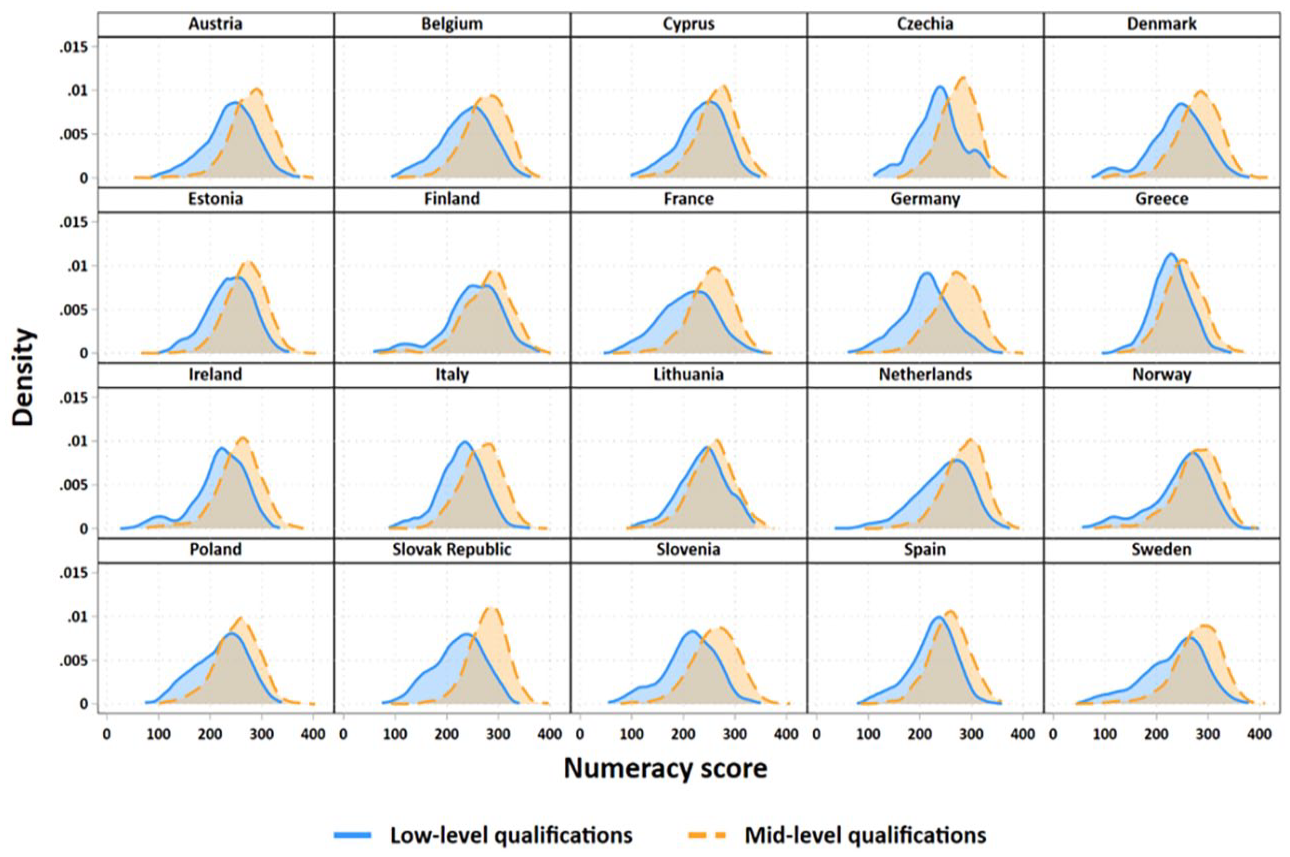
Distribution of numeracy skills among 25–54 year-olds in 20 European countries.
Furthermore, both the size of the skill gap and the variability of skills within the low-qualified group differ a lot between countries. Education systems seem to be an important cause of these differences. In countries where students are sorted into different types of secondary schools (tracked systems), there is a larger skill gap between low- and higher-qualified adults. However, there is also less variety of skills among low-qualified adults in these countries—meaning that low-qualified workers are less likely to have the same level of skill proficiency than higher-qualified workers (see e.g. Germany and Czechia in Figure 1). In countries such as Germany, where tracking is combined with strong vocational education and training, the negative impact of sorting (tracking) on general skills is somewhat reduced.
First lesson learned. Low-qualified workers are not always less skilled, and the strength of the link between formal qualifications and skills varies between countries. The latter implies that countries differ in the skill transparency of formal qualifications—that is, whether actual skills are reflected in formal qualifications and thus whether formal qualifications give a clear signal about individuals’ actual skills. Formal qualifications are more informative (transparent) about a person’s actual skills in places where the skill gap between low- and higher-qualified adults is large and where differences in skills among low-qualified workers are smaller (meaning they have a similar skill level).
Formal qualifications shape job opportunities, even after accounting for literacy and maths skills
We also looked into whether these variations between countries can help explain why low-qualified adults face different challenges in the labour market in different countries (Heisig et al. 2019). It turns out that having more skills is important: in all countries, low-qualified workers with better literacy and maths skills fare better than less competent low-qualified workers. They are more likely to be employed in skilled jobs and less likely to end up in low-skilled jobs with low wages and high job insecurity.
At the same time, formal qualifications continue to matter. That is, those with lower formal qualifications work in less attractive jobs than those with higher qualifications, even if they have similar skills.
Another interesting finding of this study is that this disadvantage of having low formal qualifications is particularly large in countries where the skill transparency of qualifications is high. A likely explanation is that employers pay greater attention to formal qualifications in their decision-making (e.g. when conducting an initial screening of job applicants).
Formal qualifications (or a lack thereof) thus shape labour market outcomes even after accounting for differences in fundamental skills—particularly, but not only, in countries where the skill transparency of formal qualifications is high. However, as educational qualifications only imperfectly reflect the skills that people have (see the first lesson above), this means that countries are not fully utilising the skills that low-qualified workers actually have.
Second lesson learned. Better skills matter for the job prospects of low-qualified workers. In all countries, however, low formal qualifications reduce job opportunities, even if low-qualified workers are as skilled as higher-qualified workers. There is, therefore, room for improvement in recognising and utilising the actual skills of low-qualified workers.
The limited participation of low-qualified workers in further training primarily stems from their inferior job placements
In the light of these research findings, a straightforward policy recommendation to tackle the challenges low-qualified workers face in the labour market would be to provide them with additional adult training. As the world of work undergoes the digital transformation, with ongoing changes to work tasks, equipment and processes, adult training is becoming increasingly important. However, our research highlights that low-qualified workers’ access to training remains limited in all countries (Hornberg et al. 2023). This inequality in training persists despite considerable policy interest and efforts to equalise access to training.
We compared the participation of low-qualified workers in job-related non-formal training (NFT)—the dominant form of adult education and training—with that of those who have completed upper-secondary education (without further study). NFT activities are learning activities intended to improve job-related skills, usually organised by a training provider, and commonly delivered through courses, seminars and workshops. They do not lead to formally recognised qualifications but may be certified. They are usually financed, wholly or partly, by the employer.
Our key finding is that differences in literacy and numeracy skills play only a minor role in explaining the lower NFT participation of low-qualified workers, and that differences in individuals’ motivation to learn plays no role at all. Instead, the main barriers to participation appear to be located within the workplace: low-qualified workers are less likely to participate in training because of their various job tasks and occupational positions, and because they are more likely to work part-time and in smaller companies. Moreover, institutional differences between countries seem to play a role, too: strong trade unions are associated with less training inequality, while high skill transparency in educational qualifications (see above) is associated with greater inequality.
Additionally, although the political discourse often emphasises the importance of skill development for the future of European labour markets, companies too often view the training of employees as a cost rather than an investment. This perception results in a lack of training investment, partnerships and cooperation, as well as insufficient knowledge of the skills-development landscape (Erola et al. 2023).
To identify promising approaches to reducing training inequalities, we recently conducted an insightful discussion with experts in training and employment policies as part of the EU-funded Mapping Inequalities Through the Life Course project. Key recommendations, summarised in a recent policy brief (Erola et al. 2023), included fostering cooperation between education and training providers and encouraging the greater involvement of public authorities and sectoral associations. The group also explored ways of promoting training opportunities outside companies, recognising that, in many cases, there is no wage increase after training and that training participation depends on an individual’s capacity to devote extra time (on top of work and caring responsibilities). The suggestions revolved around the use of small and flexible course formats to enable individuals to create tailored learning experiences that meet their needs (Erola et al. 2023).
Third lesson learned. Participation in job-related NFT by low-qualified workers remains limited. Workplace characteristics, rather than cognitive skills and motivation, appear to be the primary reasons for this participation deficit. It is therefore essential that policymakers and employers view employee training as an investment, not a cost.
Conclusions
The relationship between the workplace and training, as discussed earlier, often creates a vicious circle: low-qualified workers are more likely to have jobs with fewer chances for participating in adult training, which further perpetuates their limited employment opportunities. This situation also raises concerns about responsibility. The fact that low-qualified workers’ motivation to learn does not account for their low participation in training strongly suggests that placing the entire responsibility for training participation on individuals is not a sustainable solution for European labour markets (Erola et al. 2023).
Our main message is that skill development is not enough if workers’ actual skills are not recognised by employers. Thus, policies aiming to increase the involvement of low-qualified workers in training should concentrate on the workplace and the human resource strategies of companies.
The fact that the absence of formal qualifications significantly impacts the job prospects of low-qualified workers, sometimes even more than their actual skills, does not mean that investing in the training of low-qualified adults does not pay off; quite the opposite. Education systems play a crucial role in skill development both early on and later in life, and research has consistently revealed that children and adults from lower socio-economic backgrounds face disadvantages in terms of gaining both skills and educational qualifications (Heisig et al. 2020; Heiskala et al. 2021). Thus, while it is well known that returns on investment in human capital tend to be higher at younger rather than older ages (Heckman 2008), it remains crucial to address both aspects: to promote equity and efficiency in skill-acquisition opportunities during the early stages of education and to encourage participation in training later in life.
Policies aiming to reduce inequalities in children’s education should prioritise high-quality early childhood education and foster inclusive school systems that customise education to the needs of pupils. When addressing adult training, policies should focus on overcoming barriers to training related to job and company characteristics. As mentioned earlier, policies should aim to enhance collaboration between education and training providers, and encourage greater participation from public agencies and sectoral associations. Additionally, an OECD report highlights that management often acts as a gatekeeper to training opportunities within companies (OECD 2021). When it comes to the latter, promising measures include reducing training costs, for example, through subsidies; providing information on expected productivity returns; and promoting collective agreements in workplaces with limited incentive or infrastructure for training, such as smaller companies (Hornberg et al. 2023).
Lastly, from an economic standpoint, employers should explore ways to alter hiring practices to avoid discrimination in favour of formal qualifications and put greater weight on an individual’s actual skills. This approach would, economically speaking, allow the utilisation of the existing skills potential of low-qualified adults and, socially, enhance the employment prospects of this group. This is why it is also important to be precise in terms of language regarding who you are talking about: people with low formal qualifications or people with a low skill level, since the two are not always the same. Being precise in language can help prevent misunderstandings and combat unfair judgements.
Footnotes
Author biographies
© David Ausserhofer
© Martina Sander
© David Ausserhofer