




Abstract
The Covid-19 pandemic, as well as climatic and energy constraints, have heavily impacted Europe’s tourism and culture industries, which account for 4% to 5% of Europe’s gross domestic product. Some European regions have been hit harder than others, as the tourism and travel sectors represent 9% of the gross domestic product in the south. Administrations and companies need to develop a new strategy to anticipate future imbalances and inspire new standards around the world, standards that involve less high-tech hardware, fewer carbon-intensive projects, less worldwide marketing, and a greater focus on the European middle class and its desire for eco-tourism.
Introduction
When in poor spirits the modern tourist often (if not always) perceives the tourist next to him as an anomaly—an aberration even. Tourists have complained about their fellow travellers ever since the hobby became fashionable in the eighteenth century. ‘Birds of passage’, Goethe called them, proud of his long months of residence near Rome’s Piazza del Popolo (Goethe 1817, 144, author’s translation).
Today it seems that climate change and the increase in the prices of natural gas and oil have answered the wishes of our ill-tempered traveller: tourism as we know it looks set to become the luxury of a privileged class once again, as in Goethe’s pre–fossil fuel time. Countries such as Italy, Spain and Greece are dependent on this sector and especially on the global middle class that feeds it. To put Europe on the right track, saving jobs and traditions along the way, these countries’ governments and companies need to anticipate the travelling realities of 2030 and 2040.
In accordance with this fundamental concern, this article is divided into three sections. The first provides a rough overview of what the tourism and culture industries have to face. The second section dives into current European policies on this area. And Section 3 suggests policy solutions.
Post-Covid mental shifts
In today’s France, talking about the tourism industry feels like speaking about an old relative: the country drew in 90 million international tourists in 2019, much in the manner of our own grandmother reaching 90 years old herself. Oh, the battles to reach that number, not all elegant, but that does not matter in either case. In 2019, France was hoping for 10 million more—like grandchildren pushing their elders to reach 100, more out of fear of the unknown than out of genuine care.
But with Covid-19 in the equation, France’s visitors from abroad dropped to 35 million in 2020, with the number rising to nearly 50 million in 2021 (Le Parisien 2021)—just over half of the pre-Covid total. Close to 4% of France’s gross domestic product (GDP) has been directly impacted. On a European scale, the shock has been even more significant. Having played host to 745 million non-European tourists in 2019, the continent attracted a mere 287 million in 2021 (Statista 2022)—a bit more than a third of where things stood before the pandemic. With nearly 10% of its GDP and up to 5%–6% of total employment linked to the tourism and travel industries, Southern Europe is particularly affected by these developments (see Table 1 below, left columns).
Key statistics on the tourism industry in the EU.
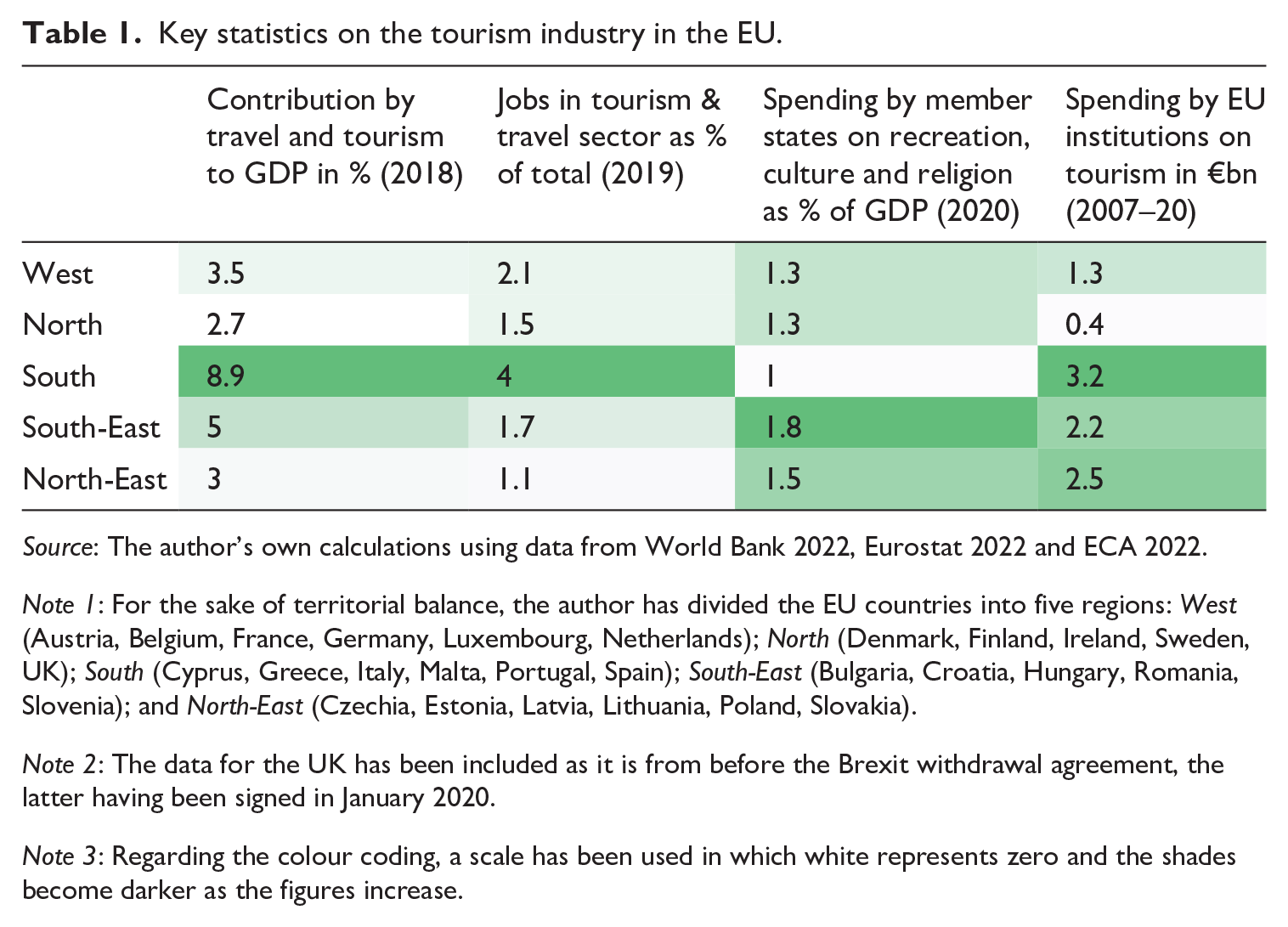
Source: The author’s own calculations using data from World Bank 2022, Eurostat 2022 and ECA 2022.
Note 1: For the sake of territorial balance, the author has divided the EU countries into five regions: West (Austria, Belgium, France, Germany, Luxembourg, Netherlands); North (Denmark, Finland, Ireland, Sweden, UK); South (Cyprus, Greece, Italy, Malta, Portugal, Spain); South-East (Bulgaria, Croatia, Hungary, Romania, Slovenia); and North-East (Czechia, Estonia, Latvia, Lithuania, Poland, Slovakia).
Note 2: The data for the UK has been included as it is from before the Brexit withdrawal agreement, the latter having been signed in January 2020.
Note 3: Regarding the colour coding, a scale has been used in which white represents zero and the shades become darker as the figures increase.
Several tourism experts predict ‘a return to normalcy’ as early as 2024, pointing out that 1.8 billion people were part of the travelling middle class in 2009 as opposed to possibly 5 billion in 2030 (Brunel 2021). So there’s nothing much to worry about, right?
Well, even if these optimistic projections should prove true in the very near future, they do not seem to take into account the medium-term clouds: the rise in temperatures induced by CO2 emissions, the depletion of oil and gas resources and the inflation resulting largely from this depletion—bearing in mind that fuel purchases represent a third of flight costs (Shift Project 2021). There are hopes of reducing CO2 emissions drastically (United Nations 2015), talks devoted to imposing a carbon tax on all flights and forecasts that energy flows for culture and travel may become rationed, with both ranking behind, in order of necessity, education, health, security, defence, industry and households. Taking all of these factors into account, one arrives at the conclusion that round-trip tickets to Shanghai will no longer cost €450, with a 20 kg luggage allowance included (the price this author once paid in antediluvian times).
For consumers these developments are not merely of a matter of intellectual interest. For they touch the heart of citizens: parents and students, among others. Instead of long-distance flights to exotic islands, many Europeans are now opting for, among other things, ‘staycations’ (travelling near your home for holidays), ‘workations’ (working remotely, usually from a sunnier location, and for several months) or cheaper countryside stays for families, closer to nature and fresh air (Welcome City Lab 2021). Corporate Zoom calls that replace flights booked for two-hour meetings on another continent are just one solution amongst many.
In France this means that internal tourism (the French holidaying in France) has partially compensated for the loss of foreign tourists, especially along the coasts and in mountainous areas—the latter reporting bookings representing 80%–95% of pre-Covid totals (Dangerfield and Mainguené 2021). But large urban centres and luxury hotels continue to suffer in the wake of the pandemic, due to the nature of their clientele: richer foreign tourists, frequently from the upper classes and often on business trips. Hence the following question: are the days of Scarlett Johansson and Bill Murray in the film Lost in Translation (2003) already over? Barely two decades on, meeting a stranger on a bank of a quietly meandering river while camping somewhere in your country’s heartland is becoming more realistic than drowning your sorrows in a five-star hotel on the other side of the world.
Europe’s budgetary dilemma
The main hurdle to adapting policies to this new situation is that today’s policymakers belong to the Lost in Translation generation. Most are aware of climatic and energy constraints, but their habits are still marked by a certain joy in consumption inherited from the sweet American-led 1990s—’la douceur de vivre des années 90’, we would say in French.
This may explain two rather contradictory statements in the EU’s 2022 annual budget. Let us first listen to this tech-heavy lament: if tourism ‘SMEs do not adapt to digitisation, many will go out of business.’ ‘. . . [S]olutions should include booking systems taking into account social distancing, artificial intelligence (AI) solutions managing crowds, and disinfection robots to clean quickly public spaces’ (EU 2022, 1413).
Later in the same document, the reader encounters this reminder about Europe’s softer touch: we should ‘promote worldwide a European approach to innovation rooted in arts/culture and values. Such a culture/art-driven approach linking innovation, digital and the arts into local ecosystems of innovation in selected regions outside Europe will help promote a European approach to innovation as an alternative to US and Chinese approaches’ (EU 2022).
Public tenders and grants from both the member states and the EU institutions reflect the gap between these two philosophies: either funds go to futuristic robots, Virtual Reality immersive headsets, Augmented Reality mobile apps that enhance physical locations, and so on; or they are oriented towards rural eco-tourism, cross-border or rural–urban mobility and heritage protection projects (EU 2022 and Welcome City Lab 2021). The former set of items gets approximately 70% of all budget streams and makes Europe more competitive in the near term; the latter makes Europe more sustainable in the long run but yet only receives limited bureaucratic attention.
The reason may be that even the most liberal-minded projects seem incapable of integrating concerns related to the climate. A study financed by the European Commission to garner recommendations from cultural actors (Voices of Culture 2022) advocates ‘easier travel and preferential treatment for global cultural sector workers in the Global South’ and ‘technology [that] can make language less of a barrier . . .’. The bottom line: more kerosene-fuelled flights between Africa and Europe, and more electricity-hungry items on order. Paradoxically, old-school heritage ideas—such as the restorations and excavations of Pompeii—today appear more reasonable (some would say ‘trendier’) than the once-hailed multicultural ventures.
We find the same confusion within tourism-related datasets themselves. After days of searching for figures that could be used to make comparisons between the member states, the only ones we found pertained specifically to spending on culture (see Table 1, third column). Eerily, they show that the southern member states spend little on this sector (1% of GDP) despite the multi-secular hype around heritage in that region. But beware: budget lines related to mobility, infrastructure or public support for people active in tourism are missing, at least in the data that is publically accessible.
At the EU level (ESPON 2019), budget lines allocated for tourism and cultural projects are even more intertwined, as the dispersal of funds is divided between Horizon Europe grants, Cohesion spending, social support, regional support and agricultural budgets. Three EU budget headings (out of seven) and at least six directorate generals share the responsibility for what, in the end, is a rather paltry sum: a little more than €2 billion from 2007 to 2020, or 0.5% of the EU’s total expenditures (see Table 1, right column).
Fortunately, quantitative surveys produced by the European Court of Auditors (ECA 2020) and the European Spatial Planning Observation Network (ESPON 2020) reveal that, when all of the EU’s specialised funding efforts are added up, Brussels has allocated most of its cultural and tourism support to countries and regions in dire need of it. Accordingly, southern Europe has received particular attention—Greece, Italy, Portugal and Spain. Table 1 above confirms the strong correlation between the EU’s geographic priorities and the economic weight of the different countries’ travel and tourism activities. The shift in Cohesion allocations to the south of Europe in the EU’s 2021–7 multiannual budget confirms this dynamic (EPRC 2019). We may tentatively conclude from the above that the EU has learned to adapt to geographic realities. Policy-wise, it has not yet found itself.
Policy proposals for 2023 and beyond
In 2007 the Lisbon Treaty recognised that the EU can ‘complement’ the member states in the tourism sector. Moreover, the treaty was followed by an EU framework Communication in 2010 (European Commission 2010). The message was that, for the first time, Brussels should make tourism a priority as this sector faces intense changes and needs both guidance and support. Agreeing with this prioritisation and with the principle that the member states and regions should maintain control over all travel and culture expenditures, this author believes that the EU institutions may usefully contribute in three ways:
In the next European mid-term budget review, in 2023, put less emphasis on digital equipment and more on sustainable mobility, cross-border projects and rural tourism. The 2021–7 budget decreased the ‘Connecting Europe Facility – Transport’ line by 8% compared its 2014–20 counterpart (EPRS 2018), despite the growing desire of Europeans to travel by rail or by active mobility means (cycling and walking). Brussels should not miss the chance to become a driving force in this area.
Support a 2021 resolution by the European Parliament to set up a ‘European Agency for Tourism’ in the next European budget. There is a need for new thinking and more inter-institutional synergies. This European agency could coordinate all budgetary actions—by the regions, member states and Brussels. More importantly, it could act as a reliable forecast-sharing platform and promote best practices, such as the new concept of ‘extended leave’ (e.g. two to three months every three years) that would provide employees more leeway, more time, to reach their destinations and return without using carbon-emitting transportation.
Promote the ‘Europe brand’ within Europe instead of pursuing the Asian or American middle classes, who may not be able to afford the plane tickets to the extent many expect, even in the near term. ‘Creative Europe’ funds should be used to encourage shorter-distance holidays to off-the-beaten-track areas on our own continent. This would be in line with the numerous efforts being made by EU cities to deal with overtourism in crowded ‘Instagrammable’ centres. A European approach to tourism could be both fair and fruitful, replacing global tourists with a more planet-friendly European-based tourism but also with customers who return to the same places and stay for longer periods.
Conclusion
By launching the Industrial Revolution and global trade routes, Europe defined today’s modernity—including modes of travelling. At a time when we are experiencing the perverse effects of this same modernity, can the Old Continent inspire once again but in the opposite, decelerating direction?
Europeans clearly have the appetite and the imagination for it. While Hollywood actors Scarlett Johansson and Bill Murray cannot do much anymore, might not Goethe’s tourism philosophy help out once again? Listen to him one more time as he continues his journey, becoming aware of what walking and horse riding through Italy for a year means to him: Chained body and soul to the north of Europe, I had to undertake this long solitary journey to start a new life. To be born again. My desire to see this country had been ripe for too long. Here I am now in Rome and quiet, and as far as I can see, tranquilised for my whole life; all these treasures will serve as guides and encouragements from now on . . . (Goethe, 1817, 203, author’s translation).
Footnotes
Author biography