




Abstract
Located on the eastern flank of the EU, the Central and Eastern European (CEE) countries have a specific perception of risks and threats and hence unique views on how to guarantee their security. This is particularly relevant with regard to their attitudes towards Russia. As members of both the EU and NATO, the CEE countries are in favour of stronger EU–NATO cooperation in security and the non-duplication of these organisations’ efforts. Some of the countries see NATO as the key guarantor of their security. For several reasons, CEE countries have serious deficits in their defence capabilities and rely heavily on collective ones.
Keywords
Introduction
The EU’s much-awaited Strategic Compass will be adopted in March 2022. Its goals are to provide the EU with a tool for risk assessment, to outline the EU’s ambitions in coping with challenges and threats, and to harmonise the development and procurement of military and civilian capabilities. Each of these elements is essential for the EU to realise its ambition to be a security provider.
Ten Central and Eastern European (CEE) countries joined the EU in 2004 and 2007, 1 having made enormous efforts and reforms to overcome the heritage of decades of authoritarian Communist rule. Despite several geographical, historical and cultural similarities, there are significant differences among the CEE countries, both in terms of how they define and assess security risks and threats, and their views on how to address them. This article aims to analyse what the CEE countries see as the main risks to their security and the challenges they face in building defence capabilities, as well as drawing conclusions from this analysis for the EU’s Strategic Compass. The article argues that the Strategic Compass must pay due attention to the individual member states’ concerns and unique positions in terms of threat assessments and capabilities.
Risk and threat assessments in CEE
The cornerstone of any security system is risk assessment, as it is on this basis that it can be decided how to meet and address risks and the proper formats for cooperation and partnership can be identified. This is relevant for the EU and its desire to build a European security identity. Failure to adopt a common approach and a unified risk assessment could hamper the creation of a consensus on the Strategic Compass, or leave it as a document without added value. Achieving a common assessment of the types of risks, as well as their degree, will certainly not be an easy task as ‘there is as yet no common approach to how member state governments understand threats to the EU’s security’ (Fiott 2020, 2).
According Nicole Koenig (2020, 2), The divergence in threat perceptions among member states is a central weakness of the [Common Security and Defence Policy]. Some worry about Russian aggression in the East while others are far more concerned about the consequences of state fragility in the South. Still others focus on relatively new security challenges such as climate change, cyber-attacks and disinformation. These differences have important implications for the EU’s role as a security provider. They shape national preferences regarding policies, capabilities and alliances.
The analysis of the strategic documents and papers of individual EU member states undertaken by Daniel Fiott (2020, 6) shows that countries identify a wide range of security risks and threats. This list includes terrorism, radicalisation, cyber-threats, hybrid threats, organised crime, weapons of mass destruction, conflicts in different regions, migration, climate change, Russia, demographic issues, North Korea, frozen conflicts, the militarisation of space and more.
As can be seen from the comparison of these papers, some of the risks are commonly identified, while there is divergence in the assessment of other threats. There are also differences in the level of acuteness of the identified risks and threats. As pointed out by Fiott, ‘Comparing national strategies may also allow us to observe whether there is a common threat perception in the EU or whether such a perception can amount to a common “strategic culture”’ (Fiott 2020, 2). And a common strategic culture, according to High Representative/Vice-President of the European Commission Josep Borrell (2020), ‘means understanding the world in the same way’.
It is of crucial importance for the success of the Strategic Compass that all countries come to a common understanding of current and future risks and threats, and to this end it is necessary to better understand the concerns of each country. Bearing in mind the diverging views on security issues seen in Fiott’s analysis, this could easily be described as an arduous task. The CEE countries identify many different risks and threats, but what differs most is their varying assessments of Russia as a risk to their security (Fiott 2020, 6). Taking into account the current state of relations between the West and Russia, and the growing tension there, I will pay special attention to the threat analyses related to Russia, as this is a key issue for the Strategic Compass.
It is to be emphasised that the assessment of Russia divides not only the CEE countries but all countries across Europe. A Pew Research poll from 2020 concluded that In Western Europe, a median of only 31% see Russia favorably, including 12% of Swedes, 23% of Dutch respondents and 26% of Britons. CEE citizens are more divided. Majorities in Slovakia (60%) and Bulgaria (73%) see Russia favorably – the most positive ratings the country gets globally. Majorities in Lithuania, Poland, the Czech Republic and Ukraine say the opposite. Notably, only 34% of people in the Czech Republic have a positive view of Russia, compared with six-in-ten in Slovakia, a wide divergence among nations that used to form a single Soviet republic. (Huang and Cha 2020)
Adopting a common European assessment of the risk which Russia poses to the EU and individual countries will therefore almost certainly prove a challenge.
Analysts from the RAND Corporation, an American think tank, also share the assessment that perceptions of Russia differ significantly and that ‘NATO’s western and southern members do not see as immediate a threat from Russia’ (Pezard et al. 2017, 5). However, while these countries do not assess Russia as a substantial risk to their security, on the other pole are those countries in close proximity to Russia, which perceive it as an ‘existential threat’ (Pezard et al. 2017, 5).
Even though the CEE countries are all geographically close to Russia, their assessments of the country differ substantially. According to a study by GLOBSEC, a Slovakia-based think tank, countries from CEE and the Western Balkans can be separated into three different groups based on their attitudes towards Russia. The first group consists of the EU countries of Bulgaria and Slovakia, plus Serbia and Montenegro. These countries have a positive attitude towards Russia and have developed relations in historical, political, cultural and other spheres, and Russia is seen as a strategic partner. Many of the citizens of these countries even believe that NATO and the West antagonise Russia. The second group comprises countries neutral to Russia, such as Hungary, Czechia and North Macedonia, where attitudes towards Russia are marked by pragmatism and, to some extent, sympathy. The third group are countries that are sceptical of Russia, where the majority of people see it as a threat. These are Poland and Romania, countries with a negative historical experience of Russia (Milo 2021). Although GLOBSEC’s research does not cover Lithuania, Latvia and Estonia, these three countries should undoubtedly be added to the last group. It is worth mentioning, that despite different attitudes towards Russia, all CEE countries adhered to the EU’s common approach to Russia by agreeing to EU sanctions following the annexation of Crimea in 2014 and calling for Russia to respect Ukraine’s sovereignty.
It is important to understand the causes of these divergent views of Russia, that is, the factors and drivers that influence perceptions of Russia. According to the RAND analysts, ‘a critical factor influencing European perceptions of the military threat posed by Russia appears to be geographical proximity to Russia’ (Pezard et al. 2017, 5).
While important, geographical proximity is not the only factor that shapes the attitude of CEE countries towards Russia. For example, although Bulgaria borders Russia through the Black Sea, the majority of Bulgarians view Russia very favorably. One of the reasons for this is the historical ties between the countries. According to Dr Dimitar Bechev (2018), Russia has many elements of influence over Bulgaria and its citizens, including Bulgaria’s almost total dependency on Russian energy supplies, the close relations of the Bulgarian and Russian Orthodox Churches, and the ties of some Bulgarian political and economic elites with Russian individuals and organisations. Russia uses all these points of leverage to sustain its positive image in Bulgaria.
In this manner a combination of factors besides geography, such as history, cultural ties, economic factors, political and other relations, hybrid warfare campaigns and openly pro-Russian propaganda, influence the image of Moscow in the CEE countries.
Obviously, threat assessments vary not only between the CEE countries, but across Europe. The practical question for the EU—and in particular for the Strategic Compass—is how to reach a common threat assessment. In this regard I share the opinion of Nicole Koenig (2020, 4) that, ‘[r]ather than depicting the lowest common denominator, the analysis should reflect and acknowledge different member state perspectives’. Looking simply for the lowest common denominator could endanger European unity and credibility. The Strategic Compass should address the most pressing security concerns of each member state or it will simply remain a piece of paper with no practical significance.
Establishing a common definition of the risks is only the first challenge which the Strategic Compass faces. The second key issue is how to respond to the identified risks and threats. The CEE countries are again strongly divided.
As we have seen above, Poland, Romania, Lithuania, Latvia and Estonia assess the risk posed by Russian as an existential threat, so their first and main priority is to guarantee a credible defence, including conventional territorial defence. From this point of view, for these countries NATO offers the key approach to tackling this risk, while EU efforts and policies are seen as only complementary.
As Marcin Terlikowski (2021, 73), from the Polish Institute of International Affairs, points out, [M]embership in NATO and the transatlantic bond will still be perceived in Poland as the key means of deterrence and defense against Russia. This will, in turn, continue to define Polish approach to defense cooperation and strategic partnerships in general. What will remain priority for Poland will be military cooperation projects, run within the framework of NATO, and—perhaps in the first place—the implementation of the ambitious agenda of bilateral cooperation with the US, based on troops rotating to Poland and the infrastructure investments. European defense projects, like the EU’s Permanent Structured Cooperation (PESCO) will remain a lower priority, as will bilateral collaboration with European NATO Allies.
The positions of the Baltic countries and Romania are similar, as can be seen from a country-by-country analysis carried out by the European Council on Foreign Relations. The authors emphasise that, ‘Lithuanian officials perceive [European Strategic Autonomy] as a pragmatic tool for Europe’s neighbourhood, but never as a substitute for NATO. They see the United States as a key partner in defending their country against Russia’ (Franke and Varma 2019, 60).
From this perspective, the five countries of Poland, Romania, Lithuania, Latvia and Estonia are not only sceptical of the EU’s ability to address the challenges emanating from Russia, but could also be expected to oppose any action to reduce NATO’s role in defence at the expense of a greater role for the EU. The rest of the CEE countries, which have a different view of the Russian risk, do not oppose an enhanced role for the EU in security and defence, as long as this does not lead to the duplication of efforts and capabilities, and hence more expenditure, as discussed below.
Therefore, it is important for the EU to define its role in the security of its member states. For the CEE countries the key question is will the EU take on responsibility for defence, including territorial defence, and develop the necessary capabilities? The latter is unlikely. As noted by Thierry Tardy, ‘twenty years of [Common Security and Defence Policy] have largely failed to position the EU as a credible defence actor, and there is little evidence that any EU member state seriously wants to pursue that goal’ (Tardy 2021, 2). And according to Mr Borrell (2021), ‘The EU does not aim to be a military power in traditional terms, but we do need to be better able to defend ourselves’. If the EU shows no ambition or political will to be a credible defence actor, the CEE countries will be sceptical of the Union’s ability to cope with the Russian threat and will see NATO as ‘the central defence guarantor’ (Tardy 2021, 2).
Of course, Russia presents multiple risks to Europe. According to the NATO Supreme Allied Command Transformation (2021, 6) assessment, ‘Russia will use a suite of military and non-military hybrid warfare tools, including disinformation campaigns, influence operations, economic sanctions, diplomatic pressure and energy supply cuts, to guard against any potential external threat and undermine Western democracies’. If NATO is considered the prime responder to classical military threats, looking for solutions to other risks and threats opens up the possibility of enhanced NATO–EU cooperation, which will require the right balance of roles to be found.
Regardless of the balance, the Strategic Compass should address the EU’s role in European defence. There are three reasons for this. The first is that the EU has to show solidarity with all its members and adhere to Article 42(7) of the Treaty on European Union, the mutual aid and assistance clause. The second reason is because the US, a key NATO ally, due to the shift of its strategic focus to Asia, may become engaged in a conflict that would not allow it to come to the aid of European Allies, or at least not immediately. Third and finally, there are EU member states that are not covered by NATO’s collective defence clause. The roles of the EU and NATO in European security and defence, as well as NATO–EU relations, should therefore undoubtedly be addressed in the Strategic Compass and in NATO’s new strategic concept. Within this context it is a positive that the two processes are running in parallel.
Capability development: challenges for CEE
The processes of risk assessment, defining the level of ambition and capability development should be synchronised. Finding the balance among these three processes will be of key importance for European security and defence. Undoubtedly, building up the necessary capabilities, both military and civilian, will require time and resources, and will be challenging.
One of the main challenges to European capabilities will be overcoming the approach to development that is based on national priorities and views, which to a high degree is influenced by national risk and threat assessments. As mentioned in the 2020 Coordinated Annual Review on Defence report of the European Defence Agency: The prime reference for participating Member States’ (pMS) future defence plans continues to be national defence interest, based on different perceptions of the security environment, historical background, specific regional security environment and threats as well as risks to national security. This determines national defence spending, the size and shape of national capability profiles and defence related activities, including the approach towards defence cooperation and the openness towards the European defence initiatives. (European Defence Agency 2020, 2)
From the perspective of the development of European capabilities, the CEE countries have some similarities with each other, but also some differences. Understanding the unique positions of these countries will contribute to making better decisions at the European level.
The CEE countries differ in terms of population, economic power, size and the structure of their armed forces, among many other factors. Table 1 below shows some of the parameters related to their military capabilities.
National defence expenditure in CEE.
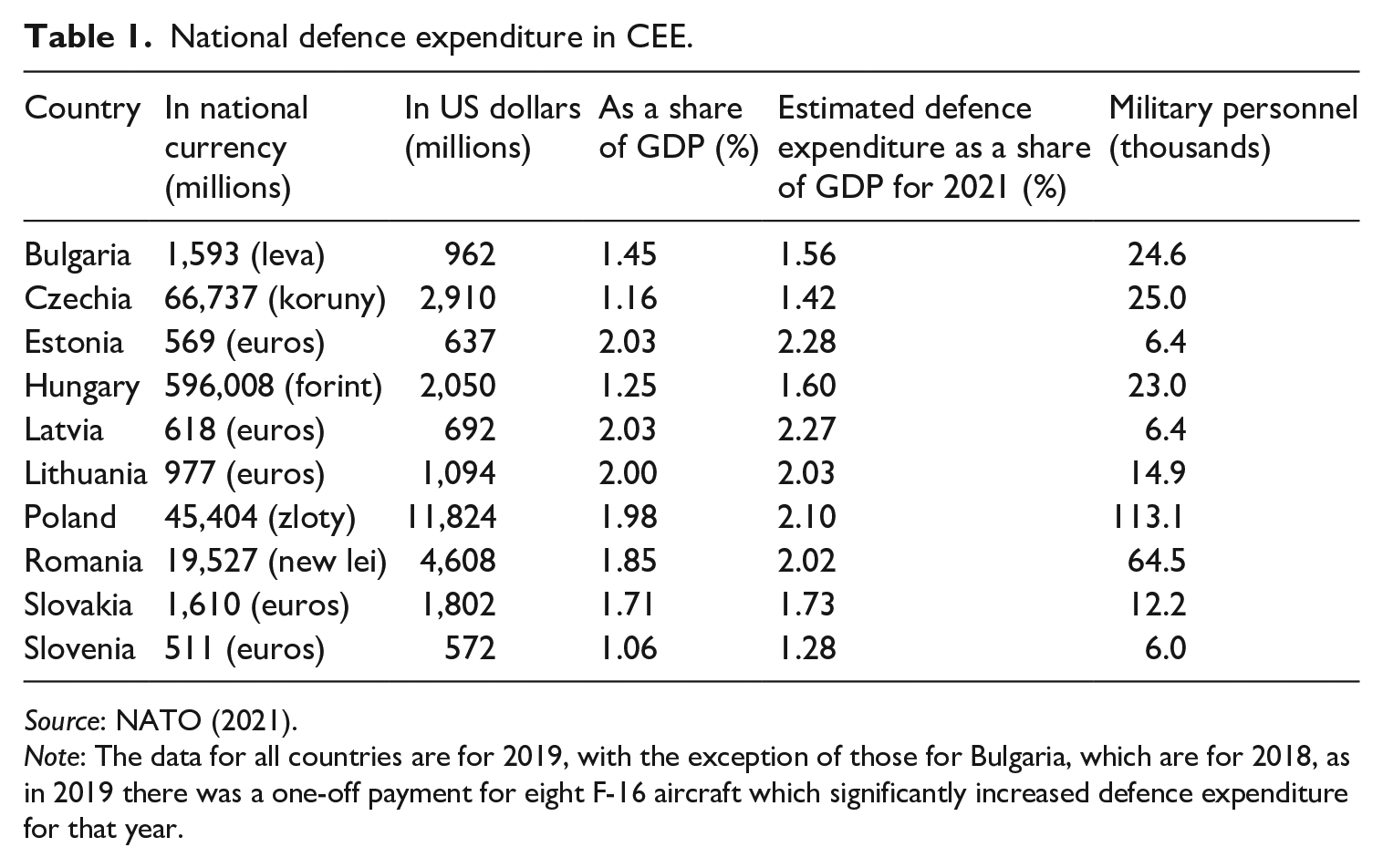
Source: NATO (2021).
Note: The data for all countries are for 2019, with the exception of those for Bulgaria, which are for 2018, as in 2019 there was a one-off payment for eight F-16 aircraft which significantly increased defence expenditure for that year.
Based on the number of servicemen, we can say that, with the exception of Poland, the countries on the EU’s eastern flank do not have large armies, meaning they do not possess significant military potential. This also means that they lack key capabilities, especially when it comes to territorial defence, or carrying out missions and operations on national territories or abroad. For this reason these countries rely on NATO capabilities to fill in the gaps. The clearest example of this is the deployment since the beginning of 2022 of fighter jets from the US, Spain, Belgium and the Netherlands, among others, to Bulgaria, Romania and Poland to enhance the NATO Air Policing mission amid tensions with Russia. The Baltic countries rely entirely on the Allies’ fighters for policing their airspace.
While the CEE countries have done a lot to transform their defence systems to meet NATO and EU standards, much of the critical military infrastructure and armaments are from the time of their participation in the Warsaw Pact and are morally and/or physically obsolete. Currently all the CEE countries are implementing ambitious military modernisation programmes, but a lot of time and resources will be needed to achieve full compatibility with their NATO and EU allies.
A key factor in building new capabilities is national defence budgets. As can be seen from the table, only those CEE countries which identify Russia as a threat to their sovereignty allocate 2% of GDP (or close to it) to defence. The other countries’ allocations are below this threshold but are gradually increasing. Bulgaria plans to reach the 2% pledge by 2024 according to official national documentation (Bulgaria, Ministry of Defence 2017).
If we look more closely at the defence budgets, we can see that the real volume of defence expenditure, whether in the national currency or in US dollars, is relatively low (columns 2 and 3 of the table). If added together, the total defence expenditure of all CEE countries in 2019 was $27,151 million, which is similar to the defence expenditure of Italy ($23,559 million) and almost half the defence expenditure of Germany ($52,549 million) (NATO 2021). Total EU defence spending in 2019 totalled €186 billion (European Defence Agency 2021), meaning that the expenditure of the CEE countries comprised less than 13% of this.
The next problem relates to the structure of defence budgets. The 2020 Annual Report on the State of Defence of the Republic of Bulgaria shows that the Ministry of Defence spends 62.5% (1,150 million leva) on personnel, 18.3% (338 million leva) on maintenance and 19.2% (354 million leva) on capital expenditures (Bulgaria, Ministry of Defence 2020). If converted from the national currency into euros, however, this equates to just €181 million on new equipment, which is extremely insufficient to modernise the armed forces.
Similar to Bulgaria, about 60% of the Polish defence budget is allocated to personnel expenditure (Głowacki 2021). Despite this, Poland allocates a relatively large amount for modernisation and new equipment due to its relatively larger defence budget. Romania also has serious ambitions in the sphere of defence innovation and acquisition. According to Janes, Romanian capital expenditure ‘increased to RON8.6 billion [approximately €1.74 billion] in 2022 and official projections suggest it will reach RON14 billion [approximately €2.83 billion] by 2025. As a percentage of the budget, this is a move from 15% in 2015 to 32% in 2022 and is projected to reach 41% in 2025, exceeding the 20% NATO target’ (Popescu 2021).
Despite all the efforts of the CEE countries to modernise their defence capabilities, it is still going to take a lot more resources and time. All the CEE countries are united behind the idea that the guiding principle in capacity building is synchronisation with NATO’s capability-building process, not the EU planning process. For countries such as Poland, Romania, Lithuania, Latvia and Estonia, this is because they see NATO and the US as the key guarantors of their sovereignty and territorial integrity. The other countries—Bulgaria, Czechia, Hungary and Slovenia—fear that building separate European defence capabilities will require additional defence investments, and they want to avoid the duplication of capabilities between NATO and the EU. As Ulrike Franke and Tara Varma point out, the countries that form CEE would like to see ‘efforts to develop European Strategic Autonomy as compatible with NATO, so long as Europe avoids delinking, duplicating, or discriminating’ (Franke and Varma 2019, 74).
Despite their willingness to reach 2% of GDP spending on defence, due to their relatively low defence expenditure and the structure of their defence budgets, the CEE countries will experience difficulties building defence capabilities, especially in terms of the acquisition of sophisticated new military equipment.
A separate issue is to what extent the CEE countries can contribute to European capacity building. In most of the CEE countries the military production base, if one exists at all, was built years ago to meet the needs of the former Soviet Union and the Warsaw Pact. Despite significant investments in recent years to launch the production of defence products that meet NATO and EU standards, the military–industrial complex in CEE generally remains at a different technological level, which makes closer integration with Western European defence production and procurement processes impossible. The differences in the defence production bases could be an obstacle to the realisation of one of the main goals of the European Defence Industrial Development Programme, namely ‘to foster cooperation between undertakings and Member States, in the development of defence products or technologies’ (European Commission n. d.).
This leads to a difficult question: will the CEE countries become part of the European Defence Industrial Base, and hence be part of the development and production of defence capabilities for the EU and NATO, or will the countries from different parts of Europe become divided into ‘producers’ and ‘buyers’? At the 2019 NATO summit, Bulgarian President Rumen Radev raised this issue and called on the Allies ‘to look for mechanisms to ensure that the Alliance does not become an alliance between producers and buyers of defence products, but rather an alliance between partners that jointly develop defence capabilities through the integration of research and joint production’ (Bulgaria, President of the Republic 2022).
It is important to address this question in the Strategic Compass and other relevant EU documents and policies in order to guarantee the geographical balance of the common European defence market. I share the opinion of the contributors to a Centre for European Policy Studies article, that to guarantee geographical balance in the nascent single market for defence and lessen concerns in Central and Eastern Europe about undermining NATO’s collective security blanket, the Commission should consider financial support the eastern and south-eastern flanks. The aim should also be to encourage partnerships between these countries’ local defence and technological industrial bases, and the expertise of multinational corporations in Western Europe. (Blockmans and Macchiarini Crosson 2020)
While defence capability building must be addressed in the EU Strategic Compass, it also needs to be addressed through the prism of the role of partners, mainly the US. Since the turn of the century many of the CEE countries have acquired high-tech defence products from the US, not only to increase their defence capabilities but also to attract American investment, demonstrate the importance of the transatlantic relationship, and underline the role of the American factor in their defence and security.
Conclusion
As we can see, the CEE countries seriously differ in their assessments of the risks to their security and hence in their approaches to addressing them. Several of the countries assess the Russian risk as an existential threat and rely mainly on NATO and the US to deal with it.
The development of defence capabilities in the CEE countries is primarily seen as a NATO-led process, with European defence planning viewed as complementary. For the CEE countries, European defence initiatives should reinforce NATO, rather than provide an alternative or create duplication.
The eastern flank of the EU will remain underdeveloped in terms of defence capabilities, despite the willingness and efforts of the CEE countries to invest in their armed forces. Thus these countries will continue to rely on collective capabilities, especially for territorial defence.
Cooperation between the CEE member states and Western European member states in the development and production of high-tech defence products is very difficult due to differences in the defence production bases. It is important to create the conditions for the CEE countries to participate in various European projects by making common funds available.
Footnotes
Notes
Author biography