




Abstract
The MED Programme is part of the EU Regional Policy and operates in the framework of the European Territorial Cooperation objective. In 2014, the MED Programme approved 14 thematic projects specifically targeted on maritime context with two of them addressing marine renewable energy and renewable energy in coastal areas: Bluene and Enercoast. These projects aim at contributing to the deployment of marine renewable energy technologies in the Mediterranean by gathering data, developing mapping activities, identifying policy gaps and addressing other obstacles hindering transnational cooperation potential. The objective of this article is to analyse the delivered results and outputs of these projects against the identified challenges and roadmap defined by the European Commission. Results were evaluated under a transferability and continuation approach applied to the period 2014–2020. This article also identifies and suggests ways in which transnational cooperation would enhance obtained results towards a higher implementation of marine renewable energy in the Mediterranean.
Introduction
The Interreg MED Programme is part of the European Territorial Cooperation (ETC) objective of the EU Regional Policy. The main purpose of the programme is to contribute to the long-term development of the Mediterranean area and to strengthen transnational cooperation among peoples of 57 regions in 10 different EU member states and 3 candidate countries (MED Programme, 2015a).
In 2013, the MED Programme launched its eighth and last call for project proposals of the period 2007–2013. The objective of this call was to facilitate an adequate response to the maritime development priorities of the Mediterranean by addressing several key challenges such as ‘maritime innovation and economic development’, ‘environment protection’, ‘transport and accessibility’ and ‘governance and policy response’ (MED Programme, 2013). After evaluation process, 14 transnational projects were approved being Bluene 1 and Enercoast 2 the two projects specifically tackling marine renewable energy (MRE) and renewable energy in coastal areas. Selected projects and beneficiary partners assumed not only the mission to address key maritime challenges in the Mediterranean area but also to set up the bases for the continuation of activities over the period 2014–2020.
Concerning MRE, 3 its theoretical potential for electricity production is estimated from 20,000 to 80,000 TWh representing between 100% and 400% of the current global demand of electricity (International Energy Agency (IEA), 2013). Besides its huge potential, other advantages attributed to MRE are as follows: contribution to energy independency from indigenous resources, CO2 emission free power, complement to other onshore renewable sources (International Renewable Energy Agency (IRENA), 2014) and employment creation, estimated in 20,000 jobs throughout the supply chain of the marine energy sector by 2030 (Ocean Energy Europe, 2013).
In Europe, although MRE technologies are still in the Research and Development (R&D) phase, wave and tidal energy could provide up to 100 GW of installed capacity by 2050 (European Commission (EC), 2014c). In terms of resources, the Atlantic arc is the most favourable area for ocean energy but the Mediterranean also counts on potential for MRE implementation (EC, 2014b).
Therefore, given the existing challenges and the magnitude of the untapped MRE potential, the aim of this article is to analyse the contributions of ETC to the deployment of MRE in the Mediterranean. For this purpose, the experience of the MED Programme throughout the Bluene and Enercoast projects was studied by comparing their obtained results against the defined EU roadmap and the actions needed to overcome the existing burdens for MRE deployment in Mediterranean. The added value of this work lies on a joint analysis of two different projects including their results relevance and their continuation potential in the programming period 2014–2020, as well as their usefulness for European policy decision-making.
Methodological framework
The methodological approach of this work is based on three steps: first, identification of key challenges and roadmaps for MRE deployment based on a thorough literature review; second, an analysis of results achieved by Bluene and Enercoast projects, as well as their potential to contribute to overcome existing hurdles and thus stimulate the deployment of MRE in Mediterranean; and third, the identification of links between results of analysed projects with current European strategy of reference for blue energy. Finally, based on the findings from these two evaluations, conclusions suggest how European Transnational Cooperation can enhance MRE implementation in the Mediterranean.
Key challenges, barriers and roadmap for MRE
Compared to other forms of renewable energy, most of the MRE potential remains untapped because of the various barriers that persist. For this situation to change, there is a need to better understand the complex hurdles to ocean energy technology deployment and to engage international community and various stakeholders to work together aiming at enabling conditions to unleash its potential. Accordingly, various institutions have done remarkable efforts to identify and document what are the most immediate barriers (technical, administrative and regulatory), as well as required actions to overcome them (see for instance policy priorities in IRENA (2014) and IEA (2013)).
In the European Union context, the Directorate General for Maritime Affairs and Fisheries (DG MARE) has carried out an impact assessment of policy options for MRE deployment and identified as main challenges: (a) the need to strengthening the EU’s transmission grid infrastructure, (b) high technology costs and difficult access to finance, (c) integration of MRE in maritime spatial planning (MSP), (d) simplifying licensing procedures, (e) better exchange of information on the environmental impacts and (f) assuring grant and revenue support (EC, 2014a). DG MARE has also initiated an action plan in order to help unblock the potential of ocean energy for the coming years (see Table 1).
Measures proposed by EU Commission to help unlock the potential of ocean energy.
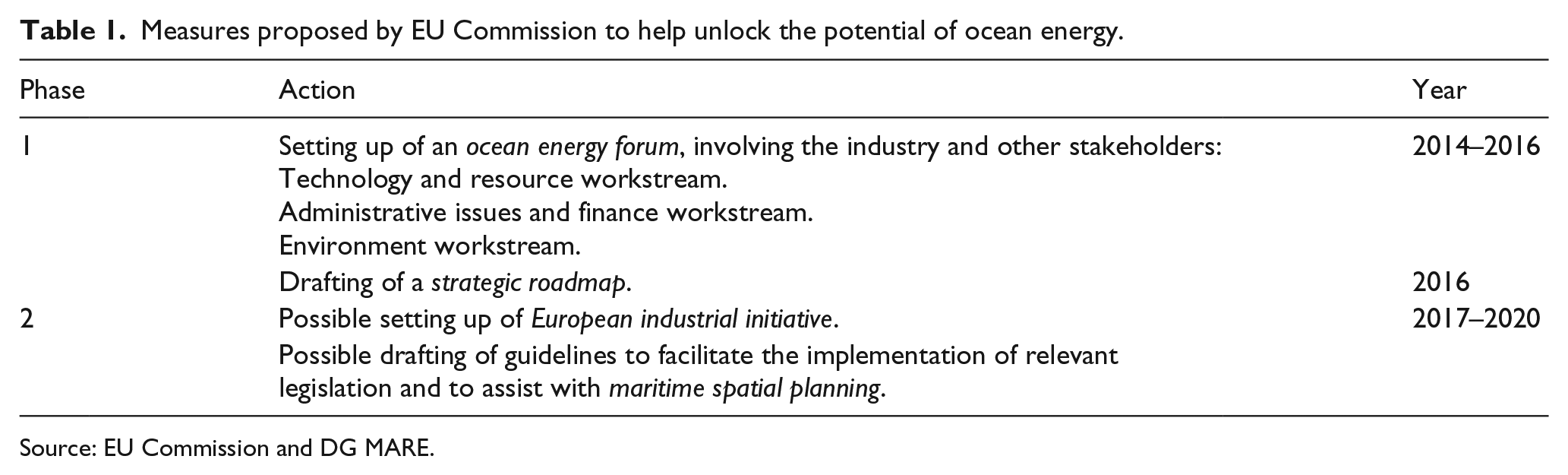
Source: EU Commission and DG MARE.
ETC as driver of blue energy in the Mediterranean: the case of Bluene and Enercoast projects
ETC is a key objective of the EU Cohesion Policy and allows partners of different regions and countries to identify and implement good practices, develop joint approaches and define methodologies around common challenges in key issues such as among others, innovation, governance and sustainable energy. Bluene and Enercoast projects were co-financed by the ETC MED Programme and addressed blue energy in the Mediterranean from different angles (see Table 2).
Main outputs of projects Bluene and Enercoast.
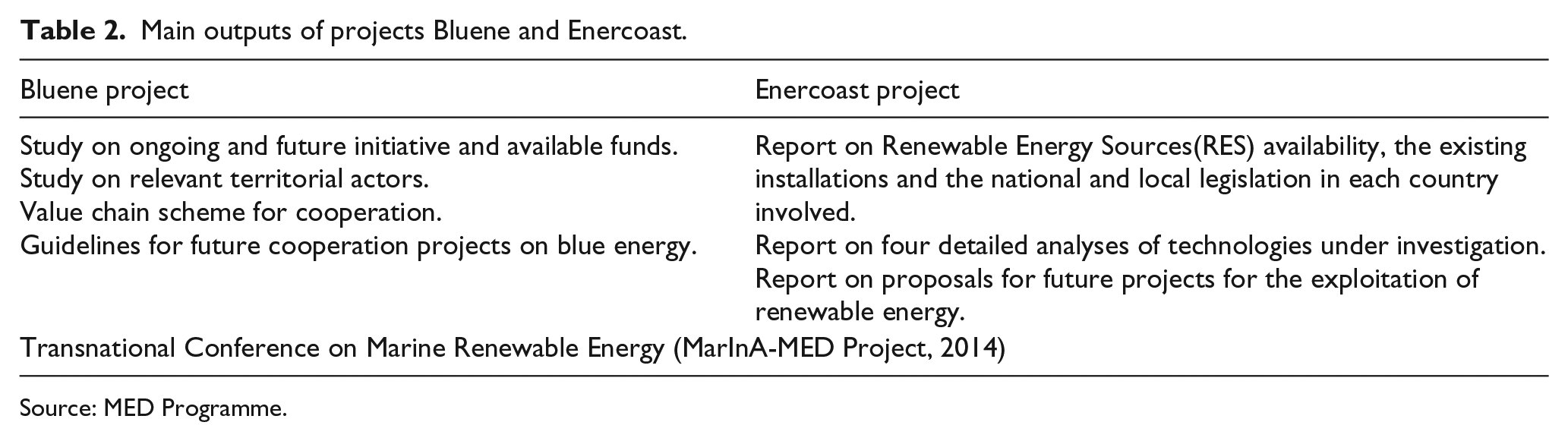
Source: MED Programme.
Both analysed projects delivered outputs which correspond to the first phase of a classic ETC project: studying. 4 Therefore, the type of deliverables obtained by Bluene and Enercoast correspond exclusively to processes of gathering information and elaborating data necessary to implement further and complementary actions. Within the new architecture of the MED Programme for the period 2014–2020, these complementary actions can be concretised in the way of testing (e.g. pilot plants and demonstration), capitalising (replication, transferability and dissemination) and governance approaches (evidence for policy improvement, higher investments triggered and MSP) (MED Programme, 2015b).
Taking stock of progress: how to capitalise on delivered outputs and achieved results?
Bluene and Enercoast projects achieved key results and obtained relevant information necessary to support the MRE use and promotion. Under a capitalisation approach, future projects and initiatives addressing blue energy in the Mediterranean should improve what was achieved or to create new and innovative solutions based on already acquired experiences.
Improving what exists could, for instance, imply enriching and/or keep feeding the obtained databases gathering information on (a) MRE existent technologies; (b) international conferences on research, policy and cooperation issues; (c) legislation frameworks of reference; and (d) existent projects already co-financed by European and national funding.
New and innovative solutions may involve designing strategies to address identified key priorities for MRE deployment in Mediterranean (see Figure 1) such as improving financing and developing knowledge on MSP and integrated coastal zone management (ICZM) (Bluene Project, 2015).
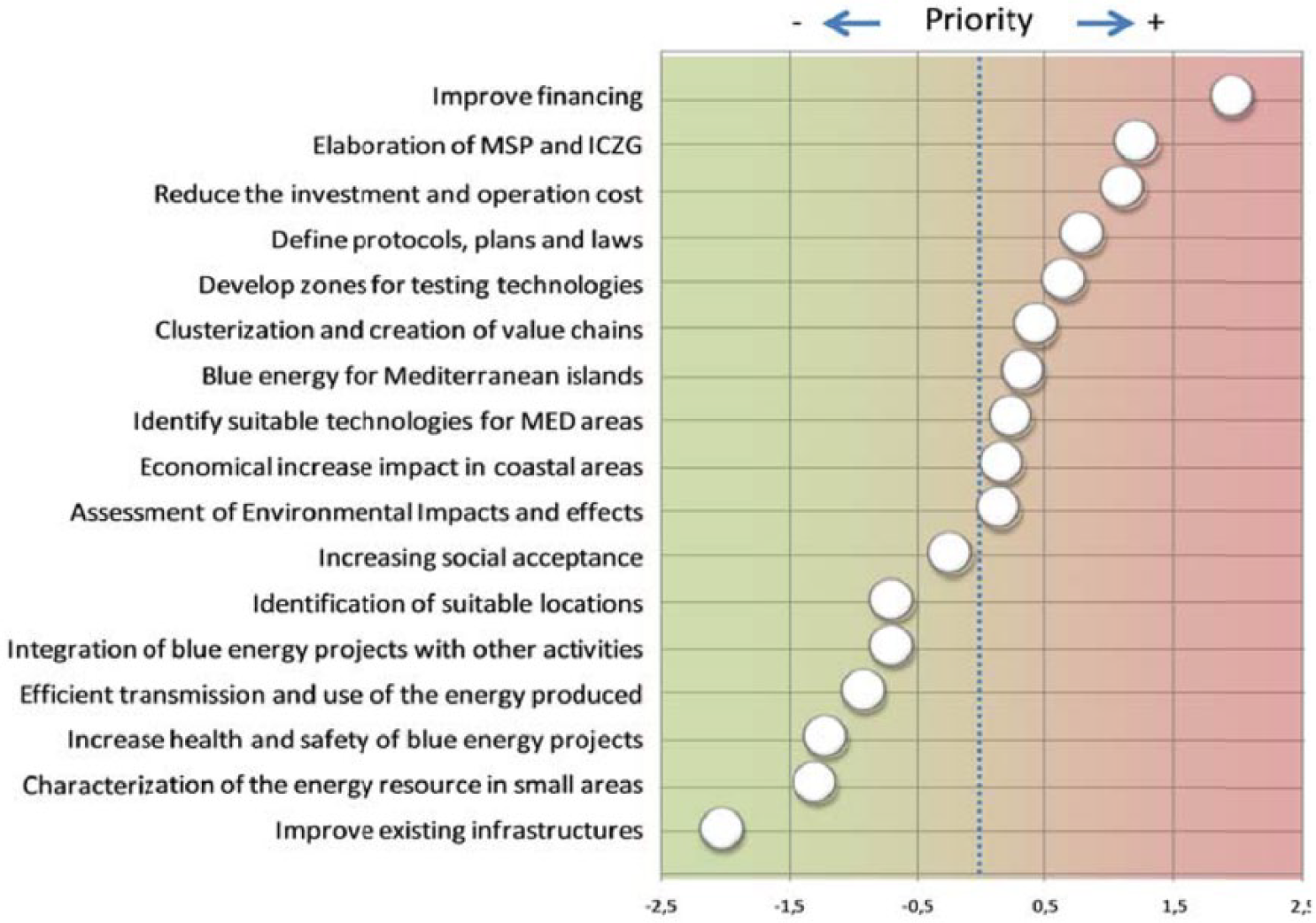
Key priorities of marine renewable energy in the Mediterranean.
Linking achieved results to European action plan for blue energy
As indicated in section ‘Key challenges, barriers and roadmap for MRE’, the EC throughout its Directorate for Maritime affairs and Fisheries is developing action plan for stimulating deployment of blue energy. The plan is currently in its first phase with the implementation of the ocean forum discussions which will support the design of a blue energy roadmap expected for 2016.
As the forum is open to all type of stakeholders and actors addressing blue energy, Enercoast and Bluene projects provide specific elements of analysis for MRE support in the Mediterranean sea. The key messages of both projects are summarised as follows according to the three established workstreams of reference.
Technology and resource workstream
Offshore wind industry is mature enough to expand in the Mediterranean sea, like in Northern Europe. Current and tidal turbines are also developed, but they are not suitable for areas characterised by low current/tidal velocities existent in the Mediterranean sea. As a very general approach to the issue, the more favourable places for blue energy investments are the gulfs of Lions in France, the Messina straight in Italy and the coastal areas of Aegean and Ionian seas.
The two most important actors to facilitate MRE deployment in the Mediterranean are governments, and industry and technology sectors. Governors should implement stable and reasonable legislation to guarantee appropriated frameworks as well as promote the efficient use of available resources (human, technical and natural). At the same time, industry and technology actors provide expertise and enable testing process of new technologies adapted to Mediterranean conditions. Actions from other actors (e.g. research, non-governmental organisations (NGOs) and media) can also play an important role in the progress of blue energy projects.
Clusters are very appropriate vehicles for the promotion of blue energy and increase of the competitiveness of the involved industries. Moreover, synergies between public and private actors should be established as a way to access more stable funding opportunities. In addition, the different analyses undertaken have shown serious gaps in relation to the potential of energy sources, the diffusion of energy plants and the lack of cost-benefit analyses.
Administrative issues and finance workstream
In the Mediterranean, there exist several funding channels to support research, technical and promotional activities related to blue energy. In the period 2014–2020, several EU programmes will allocate investments to promote MRE through research and innovation (e.g. Horizon 2020 Programme), environment (LIFE Programme) and cooperation (Interreg Programmes). However, a key challenge remains in the capitalisation of already co-financed initiatives so as to build upon existent results.
The renewable energy sector (onshore) provides legal and administrative experience for the deployment of MRE technologies. Lessons learnt should be integrated as key reference in new blue paths for instance by adapting related policies, integrating actors and discovering synergies from a technical and administrative point of view.
The involvement of the private sector and of all other involved stakeholders (local and regional institutions, governments, universities and economic associations) is essential to overcome the technical and non-technical barriers that jeopardise the effective diffusion of MRE.
Environment workstream
MSP and ICZM should be addressed first as a way to unblock MRE in the Mediterranean. The integration of blue energy projects with other activities (aquaculture, desalinisation and tourism) should be addressed within a holistic approach. Blue energy chain needs to be further analysed in order to design strategies to fulfil identified gaps in the Mediterranean sea.
The definition of protocols, plans and laws for the implementation and installation of blue energy projects should be done according to available resources and in coherence with the protection of the environment. The particular promotion of MRE on key territories such as islands could imply additional benefits to local communities while improving social acceptance.
Awareness raising activities, associated tools and communication strategies should be improved to demonstrate concrete benefits to several types of stakeholders ranging from end-users to policy makers.
Adapted roadmap for the Mediterranean driven by cooperation
The analysed state of the art of MRE in the Mediterranean area indicates substantial differences with respect to developments and characteristics of other European seas (e.g. Atlantic and Baltic). Accordingly, European policies addressing blue energy should consider specific regional challenges in order to effectively facilitate MRE support.
The Transnational MED Programme through Bluene and Enercoast projects has identified key action lines to overcome barriers for blue energy projects in coming years. These action lines represent the common vision of stakeholders engaged in related cooperation processes and therefore should be considered in the design of future blue strategies adapted for the Mediterranean:
Identification of suitable locations for new blue energy technologies;
Clusterisation and creation of value chains;
Elaboration of MSP and ICZM;
Efficient transmission of the energy produced;
Increase health and safety of blue energy projects;
Improve financing for the development of blue energy projects;
Develop zones for testing technologies;
Assessment of environmental impacts and effects of blue energy technologies.
Conclusion
ETC is a strategic instrument of the EU Cohesion Policy able to address regional challenges such as the deployment of MRE in the Mediterranean. The MED Programme projects Bluene and Enercoast have delivered useful outputs highlighting the barriers and priorities to be addressed and suggested key cooperation frameworks to give continuity to what has been achieved.
The capitalisation approach and new projects’ architecture developed by the MED Programme will facilitate the continuation of further steps towards supplementary phases (e.g. testing) over the period 2014–2020. Moreover, synergies are also possible (and expected) with other initiatives, projects and funding channels of reference in the Mediterranean identified by analysed projects.
Projects’ results were obtained in a crucial moment where EU strategy on blue energy is being built. Accordingly, ETC results can be used as significant input for policy-making process not only at sub-national, national or regional level but also at European scale. Nevertheless, an adapted MRE roadmap for the Mediterranean should include ETC as a driving force able to compile and share visions of several actors, as well as a way to enhance political and industry coordination.
Footnotes
Funding
The author(s) received no financial support for the research, authorship and/or publication of this article.