




Abstract
Background:
Given the widespread prevalence of breast cancer as a global malignancy, there is a compelling need to delve into its risk determinants.
Objective:
This study aims to investigate the potential relationship between indicators of left-handedness and breast cancer, employing systematic review, meta-analysis, and Mendelian randomization methods.
Design:
Systematic review and meta-analysis.
Methods:
The systematic review and meta-analysis, encompassing case-control and cohort designs, conducted a database search on June 17, 2022, utilizing Medline and Embase. For Mendelian randomization analysis, the exposure variable, left-handedness, was sourced from the UK Biobank. Data for breast cancer outcomes were obtained from two cohorts: the Breast Cancer Association Consortium and the Finnish Biobank (Finngen).
Results:
Eight studies were included in the meta-analysis to investigate the correlation between left-handedness and breast cancer in females. The analysis of cohort studies revealed a hazard ratio (HR) of 1.21 (95% confidence interval (CI): 1.01–1.45), whereas case-control studies showed an odds ratio of 0.81 (95% CI: 0.52–1.26). Subgroup analysis indicated an elevated HR in premenopausal left-handed women. However, Mendelian randomization did not confirm a significant association.
Conclusion:
Our findings suggest a potential correlation between left-handedness and breast cancer, particularly in premenopausal women. However, due to limited studies and unclear supporting theories, definitive conclusions are premature.
Plain language summary
Breast cancer is a common disease worldwide, and it’s important to understand what might increase the risk of developing it. This study looked at whether being left-handed could be linked to a higher chance of getting breast cancer. To investigate this, we reviewed multiple studies and combined their results. We also used a special method called Mendelian randomization to analyze genetic data. This study included eight studies, with some showing a slightly higher risk of breast cancer in left-handed women, especially before menopause. However, other studies did not find a significant link. The genetic analysis did not confirm a strong connection between left-handedness and breast cancer. In conclusion, there might be a connection between left-handedness and breast cancer, particularly in younger women, but more research is needed to be sure.
Introduction
Breast cancer stands as one of the most pervasive malignancies on a global scale, witnessing the diagnosis of around 2.26 million cases in the year 2020. 1 Within the United States, breast cancer constituted 29% of all cancer incidences among women. Notably, this cancer, which claims the highest proportion of cases among women universally, also holds the unfortunate distinction of being the foremost cause of cancer-related fatalities. 2 Across the globe, breast cancer accounted for 689,996 deaths, presenting an age-adjusted mortality rate of 13.6 per 100,000 individuals. 1 Given its intricate nature shaped by a synergy of genetic and environmental constituents, breast cancer emerges as a multifaceted affliction.
The emergence of left-handedness is a product of the interplay between genetic, environmental, and prenatal factors. While the precise mechanisms remain incompletely elucidated, genetic influences are likely to shape the occurrence of left-handedness, and prenatal hormonal exposure within the uterine environment could contribute as well. Moreover, variations in brain structure and functional organization may exert an impact on left-handed tendencies, alongside environmental factors like social and cultural pressures. Amidst these diverse hypotheses, extant research proposes a link between exposure to estrogens such as diethylstilbestrol (DES) during fetal development and the manifestation of left-handedness.3,4
There have been conflicting claims about the association between left-handedness and breast cancer.5,6 A hypothesis has been proposed suggesting that left-handedness may arise from exposure to sex hormones in utero. 7 An additional study has put forth the notion that exposure to sex hormones within the uterine environment might serve as a risk factor for breast cancer. 8 While certain studies acknowledge this discord and engage in exploration, 9 the current landscape lacks a comprehensive meta-analysis examining the interplay of left-handedness and breast cancer risk. Considering this gap, our study aims to bridge the divide by conducting a meta-analysis of pertinent epidemiological data, seeking to elucidate the correlation between left-handedness and breast cancer.
Materials and methods
Selection criteria
We meticulously curated papers that specifically investigated the relationship between left-handedness and the risk of breast cancer. Our selection encompassed cohort and case-control studies, without imposing restrictions on follow-up duration or subjects’ age. We considered only female breast cancer patients.
Search strategy
We conducted a search in Medline and Embase for all records published up to June 17, 2022. We employed MeSH terms (e.g., functional laterality, breast neoplasm) along with PubMed Entry terms related to laterality and breast cancer. To broaden our search scope, we incorporated the following terms in constructing our search strategies. The final search strategy is shown in Supplemental Table 1. Our search was confined to titles and abstracts of studies, without language restrictions.
Selection process
Two authors (E.G. and C.Y.) evaluated the titles and abstracts of each article, as conducted by the corresponding authors during the database search. During the full-text review, the inclusion of each article was determined upon consensus agreement by two authors (E.G. and C.Y.). The final selection of articles for meta-analysis was made following a discussion between the two authors, informed by a comprehensive assessment of the full-text content.
Data extraction
Publication data extraction occurred in the initial phase of the selection process, encompassing title, abstract, journal name, author name(s), publication year, publication type, and study design information. Throughout the comprehensive screening phase, the data extraction process continued to gather details from the included studies, encompassing additional factors such as study design, geographical region, duration of follow-up, age, left-handedness definition, supporting theory, and adjusted variables.
Summary measures
Due to the distinct attributes of cohort studies and case-control studies, their outcomes were separately derived. For cohort studies, adjusted hazard ratios (HRs), which measure time-to-event endpoints for the risk of breast cancer, were calculated. In case-control studies, crude odds ratios (ORs) were calculated based on the binary variable indicating whether breast cancer developed. The analyses were performed using RevMan 5.4.1.
Statistical analyses
The data were presented using crude ORs and adjusted HRs with a 95% confidence interval (CI).10,11 The I2 statistics classification introduced by Higgins et al. was employed to assess heterogeneity. 12 The random effects method was employed to account for heterogeneity between studies. 13 Subgroup analyses were conducted for the laterality of breast cancer and for pre/postmenopausal subjects. The outcomes related to the laterality of breast cancer were derived from case-control studies, whereas the outcomes for pre/postmenopausal status were extracted from cohort studies.
Risk of bias assessment
To assess the risk of bias in the included studies, we used the ROBINS-I tools. 14 It assesses the reliability of study results by identifying potential biases across several domains, categorizing them as “Low,” “Moderate,” “Serious,” “Critical,” or “No information,” and providing an overall judgment on the study’s risk of bias. Two authors (E.G. and C.Y.) independently evaluated the risk of bias, and any disagreements were resolved through discussions with the entire author team.
Mendelian randomization
Study design
This study employs a Mendelian randomization (MR) approach to explore the potential causal relationship between left-handedness and the incidence of breast cancer. We conducted a two-sample MR analysis, using left-handedness as the exposure variable and breast cancer as the outcome variable. Our research, grounded entirely in existing publications and open public databases, did not require further ethical approval or consent.
Data resources
The summary data for left-handedness as the exposure variable was sourced from the UK Biobank (UKBB), curated by Neale’s lab, with 32,442 cases and 304,688 controls. For the outcome variable of breast cancer, data came from the Breast Cancer Association Consortium (BCAC), which includes combined data from Oncoarray, Collaborative Oncological Gene-environment study (iCOGS), and 11 genome-wide association studies (GWAS), involving European females, with 122,977 cases and 105,974 controls. 15 In addition, data from the Finnish Biobank (Finngen) were utilized, involving 10,569 cases and 84,772 controls of European ancestry.
Selection of instrumental variables
We identified single nucleotide polymorphisms (SNPs) significantly associated with left-handedness, using a genome-wide significance level of p< 5 × 10⁻⁸ to obtain an appropriate number of SNPs for subsequent analysis. 16 These SNPs were subjected to a linkage disequilibrium (LD) clumping process to ensure their independence. The clumping threshold was set at an r2 value greater than 0.001 with a distance criterion of 10,000 kilobases. SNPs that met these criteria were then used as instrumental variables in the subsequent MR analysis. Palindromic SNPs were excluded in cases of ambiguous strand alignment. If an SNP was not present in the outcome summary data, we employed the LDlink (https://ldlink.nci.nih.gov/) API10 to find alternative proxy SNPs, ensuring they had a LD value of at least r2 = 0.8.
Statistical analysis
MR analyses were performed using R package version 4.2.2 (R Foundation for Statistical Computing, Vienna, Austria), utilizing TwoSampleMR, 17 and MR-PRESSO packages. 18 The effect of left-handedness on breast cancer risk was initially calculated using the Wald ratio method, involving the division of SNP effect on left-handedness by the SNP-breast cancer association statistics, each with its standard error. Then, the primary MR method employed was the inverse-variance weighted (IVW) model, combining ratio estimates for each exposure to yield an overall estimate. IVW estimates could be biased if not all variants are valid or if unbalanced pleiotropy exists. 19 To address these issues, we implemented the weighted median method, which pooled individual estimates if less than half of the instrumental SNPs were invalid 20 ; MR-Egger regression, which identified horizontal pleiotropic effects with p for intercept <0.05 and provided a causal estimate corrected for unbalanced pleiotropy. 21 In addition, MR-PRESSO, which examined outlier SNPs for potential pleiotropy through a global test computed both a raw estimate and an outlier-adjusted estimate. 18 For outcomes that were binary, all causal estimates were converted into OR.
Results
Study selection
A total of 85 records were initially identified through the search strategy, with 36 non-article records and 3 non-human records being excluded. Following the assessment of titles and abstracts, 22 papers emerged as suitable candidates. Subsequently, a full-text review led to the selection of seven papers for inclusion. Papers were excluded due to reasons such as irrelevance to our topic, lack of breast cancer patients, unretrieved records, and unavailability of information. Additionally, two papers retrieved through citation searches were eligible for inclusion. Ultimately, eight distinct papers were chosen for analysis.5,6,22–27 A visual depiction of this process can be found in Figure 1, represented as a PRISMA flow diagram.

PRISMA flowchart of study selection.
Characteristics of studies
Our study included a total of three cohort studies and five case-control studies. The sample sizes across studies ranged from 1426 to 39,691 participants. Most theories supporting the correlation between left-handedness and breast cancer emphasize intrauterine sex hormone exposure as a contributing factor. The characteristics of the studies included in the analysis were presented in Table 1.
Characteristics of included studies.

NS, not specified.
Overall results between left-handedness and breast cancer: cohort studies
The HR of breast cancer associated with left-handedness, compared to right-handedness, as analyzed from the pooled data in two cohort studies was 1.21 (95% CI: 1.01–1.45, I2 = 0%, p = 0.04) (Figure 2).

Forest plot of the hazard ratio between left-handedness and breast cancer.
Overall results between Left-handedness and breast cancer: case-control studies
The OR of breast cancer associated with left-handedness, compared to right-handedness, as analyzed from the pooled data in four case-control studies was 0.81 (95% CI: 0.52–1.26, I2 = 80%, p = 0.35) (Figure 3).

Forest plot of the odds ratio between left-handedness and breast cancer.
Subgroup analysis
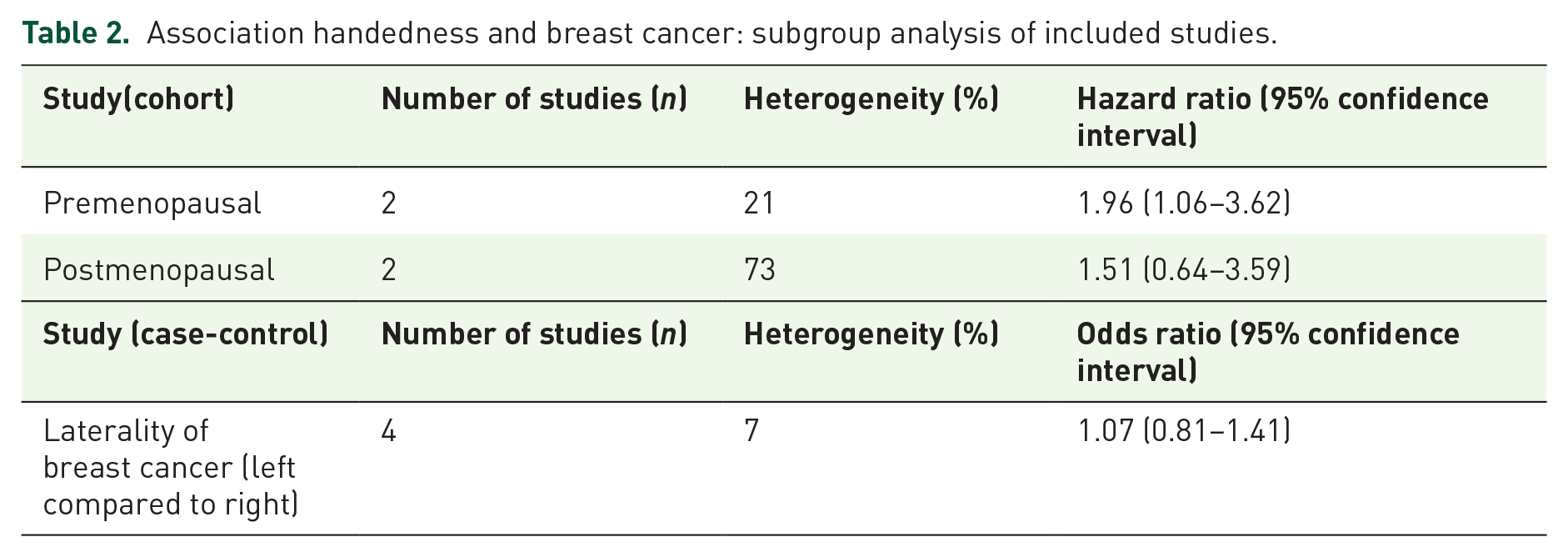
The results of subgroup analysis are presented in Table 2. Combining the results of four case-control studies, the results revealed that among left-handed women, the OR for left breast cancer compared to right breast cancer was 1.07 (95% CI: 0.83–1.38, I2 = 7%, p = 0.63). Pooling the results from two cohort studies, the analysis indicated a HR of 1.96 (95% CI: 1.06–3.62, I2 = 21%, p = 0.03) for breast cancer in premenopausal left-handed women, and an HR of 1.51 (95% CI: 0.64–3.59, I2 = 73%, p = 0.35) in postmenopausal left-handed women.
Association handedness and breast cancer: subgroup analysis of included studies.
Risk of bias within studies
Out of the eight studies, two were rated as “moderate,” five as “serious,” and one as “critical.” A detailed assessment of the risk of bias for each included study is provided in Supplemental Table 2.
Mendelian randomization
In the MR analysis evaluating the association between left-handedness and breast cancer, 19 SNPs were identified as instrumental variables with a significance level of p < 5 × 10⁻⁶ (Supplemental Table 3). The primary analysis using the IVW method showed an OR for the BCAC of 3.15 (95% CI: 0.61–16.39) with a p-value of 0.17 and for the Finngen cohort an OR of 0.73 (95% CI: 0.16–3.44) with a p-value of 0.69, indicating no significant association (Table 3). The weighted median analysis yielded an OR of 1.27 (95% CI: 0.34–4.75) with a p-value of 0.73 for BCAC and 0.69 (95% CI: 0.08–6.08) with a p-value of 0.74 for Finngen. The MR-PRESSO global test indicated potential pleiotropy in the BCAC with a p-value of less than 0.001, whereas no such pleiotropy was suggested in the Finngen cohort with a p-value of 0.47, and the MR-Egger intercept demonstrated no pleiotropy in either cohort with p-values of 0.42 for BCAC and 0.67 for Finngen (Supplemental Table 4).
Mendelian randomization analyses of association of left-handedness with breast cancer.

BCAC, Breast Cancer Association Consortium; IVW, inverse-variance weighted; SNP, single nucleotide polymorphism.
Discussion
Motivated by a curiosity surrounding the developmental intricacies of left-handedness and a recognition of the paramount importance of comprehending breast cancer risk factors, we undertook a systematic review and meta-analysis to scrutinize the potential correlation between left-handedness and breast cancer. Findings from two cohort studies suggested a proclivity for individuals with left-handed dominance to exhibit an elevated HR for breast cancer compared to their right-handed counterparts. However, the analysis of four case-control studies revealed no significant disparity in the OR for breast cancer between individuals with left-handed dominance and those with right-handed dominance. Furthermore, the application of MR methods in two cohorts underscored that the risk of breast cancer showed no noteworthy difference between those with left-handed dominance and their right-handed counterparts.
Based on the hypothesis suggesting a potential biological mechanism, wherein prenatal exposure to DES in the uterine environment may induce brain asymmetry and result in left-handedness, as indicated by previous studies,3,4 we regarded left-handedness as a potential risk factor. Additionally, considering other research that highlights an elevated prevalence of breast cancer with increased exposure to sex hormones in utero, 28 we also considered left-handedness as an indicator of prenatal hormone exposure for breast cancer. The plausible biological mechanism suggests that the mammary gland may develop differently in the presence of excess estrogens than under normal conditions, with these differences potentially manifesting at various times during postnatal life, particularly after the onset of puberty. 29 Additionally, the impact of in utero estrogen exposure on breast cancer development involves epigenetic changes including DNA methylation, histone modifications, and microRNAs. 29 However, whether intrauterine exposure to estrogens is associated with left-handedness remains unclear. Stoyanov and Nikolova (2011) assert that intrauterine estrogen exposure may not be linked to left-handedness; instead, intrauterine testosterone levels may play a role. 9 Further research is crucial to clarify whether intrauterine exposure to estrogen or testosterone is indeed related to left-handedness. Additionally, considering the potential genetic implications of intrauterine estrogen exposure, exploring this aspect using advanced genetic research techniques may yield valuable insights.
Our study yielded an HR of 1.36 (95% CI 1.04–1.78) from two cohort studies and an OR of 0.68 (95% CI 0.38–1.24) from four case-control studies. Interestingly, while cohort studies indicate an increased risk of breast cancer among left-handers, case-control studies have not observed a similar risk increase. Possible reasons for this inconsistency may include differences in study design, sample sizes, or potential biases specific to each study type. Cohort studies, with their extended follow-up periods and reduced susceptibility to biases such as selection and recall biases, are generally considered to provide a higher level of evidence compared to case-control studies, suggesting a potential association. 30 However, generalizing the findings from cohort studies remains challenging due to the limited number of studies and the lack of significant MR results in our analysis.
An exploration of breast cancer occurrence patterns between the left and right breasts in relation to left-handedness and right-handedness revealed an OR of 1.12 (95% CI 0.86–1.45).6,25,26 Notably, no significant difference in the laterality of breast cancer was observed between individuals with left-handedness and those with right-handedness.
We examined the relationship between left-handedness and breast cancer based on menopausal status in two studies.5,22 The association between left-handedness and breast cancer in premenopausal women, drawn from two cohort studies, was 1.96 (95% CI: 1.06–3.62). For postmenopausal women, the HRs from the same cohort studies were 1.51 (95% CI: 0.64–3.59). Established risk factors for breast cancer, such as early age of menarche, late age of menopause, and obesity, are well-documented, 31 highlighting that higher lifetime exposure to estrogen is linked with an increased breast cancer risk. 32 A recent study highlighted that premenopausal women face a higher risk of breast cancer compared to postmenopausal women of the same age. 31 Our present investigation aligns with this finding, indicating an increased risk of breast cancer in premenopausal women. However, it is essential to note that some studies have failed to establish a clear link between estrogen exposure and breast cancer.33,34 The limited number of studies included in our research poses challenges in generalizing and interpreting the results. Further research is imperative to delve into this topic more comprehensively.
Limitations
There are several limitations in this study. As the studies included in the meta-analysis are observational, they merely present the correlation between left-handedness and breast cancer, precluding clear inferences about causation. Additionally, the limited number of studies in the database, which allowed for the inclusion of only eight papers, results in a small sample size of participants, providing a weaker level of evidence. The definition of left-handedness varied slightly across studies; for instance, Olsson et al. defined left-handedness as a preference for using the left hand when writing, 6 while Titus-Ernstoff et al. assessed handedness through telephone interviews. 25 Notably, all included studies focused on female breast cancer, precluding the application of findings to male breast cancer patients in this study. Considering that the participants in the MR analysis were exclusively European, the results may have limited applicability to populations with diverse racial backgrounds.
Conclusion
Based on the meta-analysis, our findings imply a potential correlation between left-handedness and breast cancer, with premenopausal left-handed women showing an elevated risk of breast cancer. However, as this study is exploratory, aiming to uncover potential correlations, the limited number of studies and the lack of a clear supporting theory make it premature to draw definitive conclusions. Future research should focus on conducting large-scale cohort studies with diverse populations across various countries and substantial sample sizes to provide a more reliable assessment of the relationship between left-handedness and breast cancer risk. While the findings suggest a potential association between left-handedness and an increased risk of breast cancer, no specific preventative measures are currently recommended for left-handed individuals. However, it remains essential for left-handed people, as for all individuals, to adhere to general breast cancer prevention guidelines. These include maintaining a healthy lifestyle with a balanced diet, engaging in regular physical activity, avoiding tobacco, and limiting alcohol intake. In addition, regular screenings and self-examinations are critical components of early detection. Although left-handedness may emerge as a possible risk factor, further research is needed to understand the mechanisms behind this association.
Supplemental Material
sj-docx-1-tam-10.1177_17588359241305096 – Supplemental material for Exploring the handedness-breast cancer nexus: a comprehensive analysis via systematic review, meta-analysis, and Mendelian randomization
Supplemental material, sj-docx-1-tam-10.1177_17588359241305096 for Exploring the handedness-breast cancer nexus: a comprehensive analysis via systematic review, meta-analysis, and Mendelian randomization by Chi Young Oh, Eugene Kim, Kihun Kim, Hyeoncheol Oh, Jung-Pil Yoon, Tae Sik Goh, Eunjeong Son, Dai Sik Ko and Yun Hak Kim in Therapeutic Advances in Medical Oncology
Supplemental Material
sj-docx-2-tam-10.1177_17588359241305096 – Supplemental material for Exploring the handedness-breast cancer nexus: a comprehensive analysis via systematic review, meta-analysis, and Mendelian randomization
Supplemental material, sj-docx-2-tam-10.1177_17588359241305096 for Exploring the handedness-breast cancer nexus: a comprehensive analysis via systematic review, meta-analysis, and Mendelian randomization by Chi Young Oh, Eugene Kim, Kihun Kim, Hyeoncheol Oh, Jung-Pil Yoon, Tae Sik Goh, Eunjeong Son, Dai Sik Ko and Yun Hak Kim in Therapeutic Advances in Medical Oncology
Footnotes

References
Supplementary Material
Please find the following supplemental material available below.
For Open Access articles published under a Creative Commons License, all supplemental material carries the same license as the article it is associated with.
For non-Open Access articles published, all supplemental material carries a non-exclusive license, and permission requests for re-use of supplemental material or any part of supplemental material shall be sent directly to the copyright owner as specified in the copyright notice associated with the article.
