



Abstract
Previous studies of overwintering migratory birds in neotropical environments have found that species co-occur in the same habitats despite high diet overlap. Hence, discovering subtle diet differences within habitats can help explain patterns in bird species diversity. The Yucatan Peninsula in Mexico is an important region for overwintering migratory birds, but little is known about how habitat differences in food resources contribute to bird diversity. To address the knowledge gap, we compared the degree of overlap in the diet of all terrestrial migratory birds within and between mangrove and tropical dry forests on the Yucatan Peninsula’s northern coast. We collected data on the consumption of food items through direct observation of birds feeding on four transects in each habitat every week (12 weeks) during the non-breeding season (i.e., overwinter, December-February). We recorded 19 species, 15 species in mangrove and 15 species in forest, with 11 of those found in both habitats. In both habitats, diet overlap was high. However, species present only in the tropical dry forest had less overlap than species occurring in both habitats, indicating that diet specialization might restrict the range of habitats that a species can occupy. On the other hand, species present only in the mangrove had similar diet overlap to species present in both habitats. The diet variation that did exist was greater within than between habitats possibly due to intraspecific diet differences among different geographic locations. Although small, within-habitat diet differences might be key to allowing species to coexist locally in the Yucatan, thus supporting studies demonstrating a similar mechanism in other neotropical regions. More generally, the information we provide on bird diet can be used to discover whether threats like anthropogenic development precipitate species loss via altering the resource base upon which birds rely.
Keywords
Introduction
During the non-breeding season, migratory bird species occupy and exploit food resources in the same habitats. 1 How they do so is uncertain: for species to coexist, there must be niche differences, which often implies a degree of diet differentiation.1-4 However, recent work on migratory passerine species during winter found coexistence despite high diet overlap 2 possibly due to diffuse competition whereby species share the most attractive or easy-to-catch resources, but are uniquely adapted to exploit other, more difficult-to-catch resources.3,4 The diffuse competition hypothesis is informed by studies from just a few regions (Caribbean islands1,2,5) and habitats (mangrove, 2 tropical forests, 5 coffee plantations 1 ) and solely from the Parulidae family. Therefore, to discover the generality of the hypothesis and learn how species coexist at the same overwintering site, it is necessary to expand studies of overwinter diet overlap to a broader suite of species and ecosystems. Moreover, linking diet to coexistence informs what might happen to bird diversity if climate and landscape change should alter the abundance and composition of food resources available in wintering areas. For example, in coastal regions, sea level rise is expected to reduce the amount of habitat 6 and change food webs, 7 but the consequences to the migratory bird community have not been explored.
The winter diet of migratory passerines can include different types of invertebrates, such as ants, beetles, spiders, grasshoppers, dragonflies, caterpillars, and thrips, as well as different fruits and seeds.1-5,8,9 Each type of food has different benefits: invertebrates have a high proportion of protein, which promotes the growth and regeneration of muscle mass 10 ; additionally, some types of invertebrates, such as those with an aquatic larval phase, provide fatty acids key for chick development.11-13 Meanwhile fruits are rich in glucose and fatty acids, which provide energy for long-distance migratory flights. 14 While birds do not need to fuel migratory flight over winter, some species still consume a substantial amount of fruit. 9 Hence, partial frugivory of some species could be sufficient to compensate for overlapping consumption of similar invertebrates. Consequently, in habitats with both invertebrates and fruit present, diet overlap may be high. Meanwhile, where only invertebrates are present, species may need to be more specialized, reducing interspecific diet overlap. However, such dietary specialization may limit habitat occupancy: species that occupy more than one habitat can do so because their diet is general enough that they can exploit the unique resources of each habitat. In comparison, species that are only present in one habitat may consume only the resources unique to that habitat.
The Yucatan Peninsula of Mexico offers the opportunity to compare the diet and resources available to terrestrial migratory birds during winter in a region critical to sustaining hemispheric migratory bird diversity. 15 As the northern coast of the Yucatan lies where the overwater crossing of the Gulf of Mexico is at its shortest, many individuals rely on local habitats before and after making the overwater crossing prior, during, and subsequent to migration.16,17 The main coastal habitats - mangrove and tropical dry forest - have a marked difference in available resources. In mangroves invertebrates are available throughout the year due to constant water availability18-20 but plant diversity is low due to flooding and salt water.21-23 On the other hand, the tropical dry forest has a greater diversity of plant species, 24 potentially offering a greater number of fruits. However, during the dry season plants lose their leaves and soil moisture and environmental humidity are drastically reduced, which can reduce invertebrate abundance.25,26 Due to the differences in invertebrate and fruit availability between mangrove and forest, we expect: 1) lower interspecific diet overlap in the mangrove than the forest; 2) lower diet overlap between than within habitats, indicating a convergence in diet based on each habitat’s resources; and 3) lower diet overlap for species present in only one habitat than species present in both habitats.
Materials and methods
For this study we define migratory birds as species that move between nearctic breeding grounds and neotropical non-breeding grounds. While migration is a trait present in many bird orders, after filtering our data (see below), all but one of our study species were Passeriformes (the exception was the Piciform Sphyrapicus varius). We collected data on food consumption in four sites on the northern coast of the state of Yucatan, Mexico: Chuburná Puerto, Progreso, Dzemul and Telchac Puerto (Figure 1). At each site, we delimited transects 500 meters long by 25 meters on each side, placing one transect in the mangrove and another in adjacent tropical dry forest, meaning there were eight transects in total, four transects for each habitat, that is, one for mangrove and another for tropical dry forest in each site. The study sites were separated by at least 8 km. Within study sites, the distance between habitats was at least 6 km. The transects were all placed in large patches of their respective vegetation type, with little to no anthropogenic development. Study area on the north coast of the Yucatan Peninsula. The pins further north or near the coast at each site correspond to the mangrove, while the pins further south correspond to the tropical dry forest. Each letter corresponds to a site and a habitat. (Google n.d.
56
).
On each transect, one observer (AEC) recorded by direct observation the food resources consumed by migratory birds over two hours, including invertebrates and fruits. To identify invertebrates, we used different identification guides,27–30 and iNaturalist 31 though we could only identify some resources to genus or family (Supplemental Table S1). To identify plants, we used the guide Arboles del Mundo Maya 32 and we consulted the digital herbarium of the Centro de Investigación Científica de Yucatán 33 and iNaturalist. 31 To assist in identification, photographic records were taken when there was an opportunity. The observer has seven years of experience identifying and collecting data on local birds. However, he used Sal a Pajarear Yucatán 34 and the Merlin Bird ID application 35 to confirm visual identification. Furthermore, the observer carried out a pilot study during the six months prior to data collection to learn how to identify food items and record consumption events. During the pilot study, the observer delimited the transects with a GPS to ensure that the same area was always visited throughout the field work. We recorded data from 6:00 am to 11:00 am when birds are most active foraging for food. We visited each transect once per week from December 2021 to February 2022 (12 visits per transect). During each visit, each transect was walked for two hours. With the help of 10x42 binoculars, the observer registered foraging birds at a distance of no more than 10 m from the transect. Each foraging individual was observed for no more than four minutes. Likewise, if another individual of any species was observed feeding at another time on the same day, the data was added to the previous record. The final dataset consisted of the identity and number of food items consumed by each bird species on each transect each day and the frequency of their consumption per day. We did not study fall (August-November) and spring (February-April) because migratory movement between habitats causes daily variability in bird community composition, making it difficult to characterize species diet in each habitat. We did not collect data on invertebrate or fruit availability, nor did we record foraging substrate. We alternated the start time of our surveys among habitats: one week we began in the mangrove and the following week we began in the tropical dry forest.
Data analysis
Habitat differences in interspecific diet overlap (prediction 1)
With data on each species' diet, we used non-metric multidimensional scaling (NMDS) to explore interspecific diet overlap, constructing separate ordinations for mangrove and tropical dry forest habitats. For each NMDS, we used the Bray-Curtis dissimilarity metric, permuted 1000 ordinations until reaching a solution, and interpreted the first two dimensions of species dissimilarity.36,37 We used the metaMDS function from the vegan package36,37 in R. 38 We used each study site as an independent replicate, meaning we summed the abundance of each food item that each species consumed over the sampling weeks. We eliminated data from species that only had one observation during the entire winter, to avoid sampling bias of rare species for which only a small part of the diet could be characterized. Additionally, we removed data that did not allow the NMDS to converge on a solution; we carried out the NMDS to identify and remove extreme data points and then reran the NMDS until a solution was found. The species we had to exclude were Hooded Warbler (Setophaga citrina), Magnolia Warbler (Setophaga magnolia), and Palm Warbler (Setophaga palmarum), and only for the tropical dry forest NMDS. To measure the fit of the model we used the stress value output by the metaMDS function. Lower stress indicates a better fit with a value less than 0.2 considered to be a good fit. To visualize and interpret differences in resource consumption among species within each habitat, we plotted 95% confidence ellipses around each bird species, calculated from the standard deviation of the weighted average of the diet centroid.38,39 Non-overlapping ellipses are interpreted as a significant difference in diets.
Diet overlap between and within habitats (prediction 2)
We carried out two permutational multivariate analyses of variance (PERMANOVA) under the null hypothesis that the distance between each habitat’s centroid and the centroid of all the data does not exceed the distance between each species and the habitat centroid. 39 We carried out separate PERMANOVAs for species present in one habitat and for species present in both habitats. We permuted the data 1000 times, randomly shuffling the diets among habitats. We rejected the null hypothesis at p < 0.05, meaning our data are not consistent with a hypothesis that diet variation is equal between and within habitats; the F and R2 values indicate the proportion of total diet variation explained by habitat. Additionally, we calculated ω2, which estimates the proportion of explained variance adjusted to the degrees of freedom.
The data used for the PERMANOVAs were the total number of instances a resource was consumed by each bird species across all weeks for each habitat and site; that is, the total winter diet was constructed for each species for the each of the four mangrove sites and the four tropical dry forest sites. For the analysis, habitat was the independent variable with each species and site considered a sampling unit; each species had between two and four sites with resource consumption data. We ran the PERMANOVAs using the adonis2 function from the vegan package36,37 in R40, we calculated ω2 with the MicEco package. 40
To compare the extent of interspecific diet variation between habitats, we calculated the homogeneity of variance, for species present in one habitat and for species present in both habitats. We used a PERMANOVA to partition total diet dispersion into between and within habitat components; we used the betadisper and permutest functions of the vegan package36,37 in R. 38
Diet overlap for species present in one vs both habitats (prediction 3)
To evaluate whether species present in only one habitat have lower diet overlap than species found in both habitats, we compared observed interspecific niche overlap to niche overlap calculated from null models using the function “niche_null_model” and the RA3 algorithm in the EcoSimR package
41
in R.
38
The algorithm shuffles food resources among species to create random communities but conserves the resource breadth of each species. We permuted 1000 random communities in each habitat for species present in one habitat and species present in both habitats. We calculated diet overlap with the Pianka index
42
with the following equation:

Results
Across all sites, habitats, and sampling dates, we recorded a total of 19 migratory bird species (after removing five species we observed only once). In the mangrove, we recorded 15 species belonging to one order (Passeriformes), three families and seven genera; four species were only found in the mangrove. We recorded the birds consuming 47 different food items of which 39 were invertebrates and eight were fruits. In the tropical dry forest, we recorded 15 species from two orders, four families and seven genera; four species were only found in the tropical dry forest. We recorded the birds consuming 52 different food items consisting of 33 invertebrate taxa and 19 different fruits (Supplemental Table S1).
Habitat differences in interspecific diet overlap (prediction 1)
In the mangrove, the NMDS fit the observed distances between the samples well, obtaining a stress of 0.11. We found high dietary overlap among all bird species (Figure 2A), with diets consisting mostly of invertebrates (Figure 2B). For the tropical dry forest, the NMDS had a stress of 0.061, indicating a good fit of the distances between the samples. We found moderate diet overlap among all bird species and only one species that presented a diet totally different from the others (Figure 3A). The Yellow-rumped Warbler (Setophaga coronata) had a broad diet that overlapped with almost all other species in both habitats. If we were to remove the Yellow-rumped Warbler from the NMDS results figure, then the diet differences among the remaining species would be more noticeable (Figures 2A, 3A; Table 1). In both habitats, birds consumed more invertebrates than fruits, though fruits made up a higher proportion of total consumed resources in the forest than in the mangrove (Figure 3B). In general, there is a greater abundance and diversity of fruiting species in the tropical dry forest than the mangrove.21–24,44 A) Non-metric multidimensional scaling for all species present in the mangrove with 95% confidence interval ellipses drawn around each species’ centroid (based on weighted averages). The solid lines show the species present only in the mangrove and the dotted lines the species present in the mangrove and the tropical dry forest. Each ellipse has its own label with the name of the bird species. B) The same non-metric multidimensional scaling but showing resources consumed by the migratory birds, with animals in black and fruits in grey. The arrows represent each bird species. A) Non-metric multidimensional scaling for all species present in the tropical dry forest with 95% confidence interval ellipses drawn around each species’ centroid (based on weighted averages). The solid lines show the species present only in the tropical dry forest and the dotted lines the species present in the mangrove and the tropical dry forest. Each ellipse has its own label with the name of the bird species. B) The same non-metric multidimensional scaling but showing resources consumed by the migratory birds, with animals in black and fruits in grey. The arrows represent each bird species. Note that we had to remove three species – Hooded Warbler (Setophaga citrina), Magnolia Warbler (Setophaga magnolia), and Palm Warbler (Setophaga palmarum) - from the analysis because their extreme positions in the ordination space prevented the NMDS from arriving at a solution. Observed versus simulated diet overlap, calculated as the Pianka index, for species present in one habitat and species present in both habitats
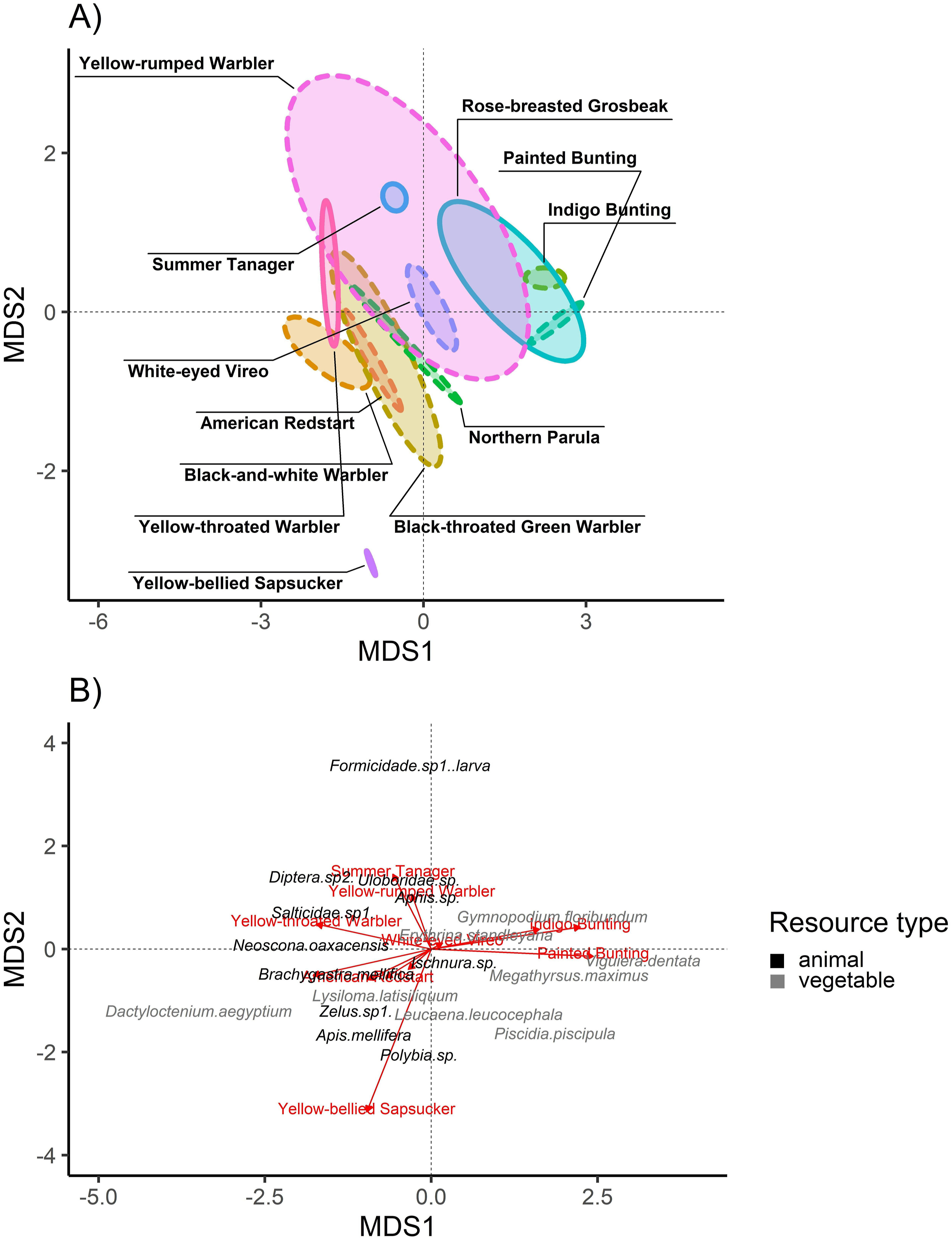

In both habitats and for species occupying one or both habitats, diet overlap was significantly higher than expected by chance (Table 1). The one exception was for the group of species that only occur in tropical dry forest that had significantly lower diet overlap than the simulated null communities (Table 1).
Diet overlap between and within habitats (prediction 2)
PERMANOVA results comparing diet overlap between and within habitats for species present in one habitat and species present in both habitats.


The location of each species’ diet in each site and habitat in multivariate space. The ovals are 95% confidence interval ellipses for each habitat, the mangrove represented by black solid lines and dots, and the forest by grey dotted lines and triangles. (A) Species present in only one habitat. (B) Species present in both habitats. Ge.tr: Common Yellowthroat (Geothlypis trichas), Or.pe: Tennessee Warbler (Oreothlypis peregrina), Pa.no: Northern Waterthrush (Parkesia noveboracensis), Ph.lu: Rose-breasted Grosbeak (Pheucticus ludovicianus), Pi.ru: Summer Tanager (Piranga rubra), Se.do: Yellow-throated Warbler (Setophaga dominica), Se.pe: Yellow Warbler (Setophaga petechia), Sp.va: Yellow-bellied Sapsucker (Sphyrapicus varius), Mn.va: Black-and-white Warbler (Mniotilta varia), Se.am: Northern Parula (Setophaga americana), Se.co: Yellow-rumped Warbler (Setophaga coronata), Se.pa: Palm Warbler (Setophaga palmarum), Se.ru: American Redstart (Setophaga ruticilla), Se.vi: Black-throated Green Warbler (Setophaga virens), Vi.gr: White-eyed Vireo (Vireo griseus), Se.ma: Magnolia Warbler (Setophaga magnolia), Pa.cy: Indigo Bunting (Passerina cyanea), Se.ci: Hooded Warbler (Setophaga citrina), Pa.ci: Painted Bunting (Passerina ciris). Each letter in parentheses indicates the site to which the corresponding species’ diet belongs: C: Chuburna, D: Dzemul, P: Progreso, T: Telchac.
Homogeneity of variance test results comparing within habitat dispersion of species diets between mangrove and tropical dry forest for species present in one habitat and for species present in both habitats.

Diet overlap for species present in one vs both habitats (prediction 3)
We found that the dispersion of diets – as indicated by the average distance between the diet centroid of each species and the overall diet in each habitat – was lower in the mangrove than the tropical dry forest and especially for species present only in the mangrove (Figure 5). For the tropical dry forest, diet dispersion was similar for species present only in the forest and for species found in both habitats (Figure 5). The average (± 95% confidence interval) distance between a species’ diet centroid and the overall habitat centroid for (A) species present in one habitat and (B) species present in both habitats.
Discussion
We evaluated three predictions about habitat differences in interspecific diet overlap for overwintering migratory passerines in the north coast of the Yucatan Peninsula. First, we expected lower overlap in the mangrove than the tropical dry forest because the presence of fruits of different plant species in the forest could offset shared consumption of the same invertebrate species. However, we found higher diet overlap in the mangrove. Second, we expected diets to be more similar within than between habitats because of habitat differences in food resources. However, we found greater differences in diets within than between habitats. Third, we expected that species only occupying one habitat would have less diet overlap than species occupying both habitats, a prediction that held for the tropical dry forest but not the mangrove.
High diet overlap in the mangrove could arise because resources there are not limiting, as we had assumed. In fact, we found a similar number of prey resources in the bird diet in the mangrove as the forest (47 vs 48). In mangrove, standing water and humidity cause dead trunks to rot, providing food for carpenter ants (Camponotus sp.) and termites (Nasutitermes sp.) and dampening fluctuations in their numbers.19,45,46 If population stability extends to all mangrove invertebrates, then resource diversity may be constant throughout the winter, obviating the need for birds to partition their diet niches. We also expected low overlap because of an absence of fruit in the mangrove. However, our assumption was incorrect: 14 % of the birds in mangrove consumed fruit, compared to 26 % of the species in the forest. Likewise, only a few more bird species foraging in the mangrove were purely insectivorous (46 %) compared to species foraging in the forest (40 %).
In the forest, food resources may vary temporally more than in the mangrove. Without the presence of standing water, food availability can decline from the end of the rainy season in October. 26 Migratory birds can minimize interspecific competition for limiting resources by dividing feeding substrates and vegetation strata, that is, the vertical arrangement of vegetation layers (grasses, shrubs, understory and canopy), rather than species of prey.2,3,47 For example, both the American Redstart (Setophaga ruticilla) and Black-and-white Warbler (Mniotitla varia) consumed the same ants (Acromyrmex sp.) and spiders (Salticidae, Tetragnnathidae), but we observed the former foraging on branches and the latter foraging near trunks. However, because the same prey species may occur on different substrates, coexistence may still require some diet partitioning; 2 we observed redstarts and Black-and-white Warblers consuming different beetles (Coccinellidae) and butterfly larvae (Geometridae). Unlike invertebrates, fruits of different species may occur only in certain strata. Hence when frugivores are specialized in foraging in different strata they also consume different food items. We observed the Rose-breasted Grosbeak (Pheucticus ludovicianus) foraging in the upper stratum and the Indigo Bunting (Passerina cyanea) in the lower stratum, which corresponded to different fruit in the diet: gumbo-limbo (Bursera simaruba) vs. guinea grass (Megathyrsus maximus).
Despite high interspecific diet overlap within the mangrove and tropical dry forest habitats, the variation in diets within habitats exceeded the variation between habitats. The high within-habitat diet diversity could reflect the microhabitat diversity that characterizes the mangroves and forests of the Yucatan. In the mangrove, for example, the Common Yellowthroat (Geothlypis trichas) and the Northern Waterthrush (Parkesia noveboracensis) foraged near open water, while all other species foraged almost exclusively on branches. In addition, each habitat consists of four study sites separated by up to 60 km, which could lead to considerable differences in available prey. For example, only 2% of a habitat’s prey resources were present at all four sites. However, some notable habitat differences in diet were found: only 11 % of the Black-and-white Warbler diet was shared between mangrove and forest while the American Redstart diet was completely different between the two habitats.
The species only present in the tropical dry forest had lower diet overlap than the species present in both habitats indicating potential morphological and behavioral adaptations to the forest.4,8,48,49 For example, the Rose-breasted Grosbeak’s beak allows it to consume hard fruits, which are common in the forest but not the mangrove. The Summer Tanager (Piranga rubra) can trap bees and wasps, resources common in the forest due to the diversity of flowering plants. In contrast, diet overlap for species only found in the mangrove was similar to species present in both habitats, likely because all species were from the Parulidae family that have thin beaks that allow them to catch and feed on the small invertebrates found in both habitats such as ants, caterpillars, and spiders.
Our results support the hypothesis of diffuse competition previously used to explain coexistence among migratory birds in the Caribbean islands.3,4,49 We found high diet overlap due to shared consumption of relatively easy-to-find and handle invertebrates such as ants, caterpillars, and spiders. At the same time, each species’ diet included exclusive resources that required behavioral (e.g., aerial foraging on butterflies and damselflies) and morphological (e.g., fruit consumption) specializations. Furthermore, diet specialization could extend to individuals within species as per the niche variation hypothesis, 50 which proposes that species with broad diets at the population level are more likely to have individuals with specialized diets.
Understanding coexistence mechanisms provides information on how interspecific interactions mediate the effects of environmental variation on body condition, which is especially important in overwintering migratory birds because habitat selection is not driven by reproduction. 51 The maintenance of body condition depends on food resources 52 and has repercussions in other stages of the annual cycle.53,54 Given that our results from the Yucatan Peninsula coincide with patterns observed elsewhere in the Neotropics, diffuse competition may be a general coexistence mechanism for this group of species. Additionally, this coexistence mechanism is apparently maintained in different habitats, which can help understand why there is a high diversity of migratory species that coexist during the winter in the Yucatan Peninsula. Importantly, for the Yucatan Peninsula and other areas along the Gulf of Mexico coast, threats to migratory birds have been identified, such as urban and tourism development and the proliferation of communications and wind energy infrastructure. 55 Therefore, beyond knowing why species may coexist, our study provides information on the resources specific to different birds, which can help define realistic conservation priorities for migratory birds in the region.
Although we obtained important information on diet, only one observer collected data, which limited the number of sites we could visit and foraging events we could observe. Having more people may have allowed us to measure food availability and quantify a broader foraging niche, i.e., one that includes diet but also foraging substrates and strata. Our study could be complemented by carrying out a complete characterization of the diet of migratory birds by obtaining stomach contents of the species or metabarcoding fecal samples. In addition, resident species could be added to the analysis, to check whether the mechanism of diffuse competition acts on all groups of species or is only restricted to migratory species. Finally, to get a better sense of the threats to bird diversity, we could take advantage of local gradients of anthropogenic development to test whether urbanization simplifies vegetation structure and diminishes food abundance and diversity such that competitive exclusion does occur and diminishes patch level species richness.
Supplemental Material
Supplemental Material - Diet overlap of overwintering migratory birds on the northern coast of the Yucatan Peninsula
Supplemental Material for Diet overlap of overwintering migratory birds on the northern coast of the Yucatan Peninsula by Aldo Echeverría-Caro, Juan Manuel Dupuy-Rada, Víctor Parra-Tabla, and Richard Evan Feldman in Avian Biology Research
Footnotes
Acknowledgements
We thank Xiomara Gálvez, director of Komchen de los Pajaros A.C, for facilitating access to their property.
Declaration of conflicting interests
The author(s) declared no potential conflicts of interest with respect to the research, authorship, and/or publication of this article.
Funding
The author(s) disclosed receipt of the following financial support for the research, authorship, and/or publication of this article: Aldo Echeverría-Caro was supported by a scholarship from Mexico’s Consejo Nacional de Humanidades, Ciencias y Tecnologías.

Data availability statement
All data and scripts used in the study will be made publicly available via Data Dryad
Supplemental Material
Supplemental material for this article is available online.
References
Supplementary Material
Please find the following supplemental material available below.
For Open Access articles published under a Creative Commons License, all supplemental material carries the same license as the article it is associated with.
For non-Open Access articles published, all supplemental material carries a non-exclusive license, and permission requests for re-use of supplemental material or any part of supplemental material shall be sent directly to the copyright owner as specified in the copyright notice associated with the article.
