



Abstract
Competency frameworks play an important role in strengthening workforce capacity for promoting population health and wellbeing. However, competencies need to be periodically reviewed and revised to maintain their relevance to changing practice and contexts. This paper reports on the process of reviewing and updating the International Union for Health Promotion and Education (IUHPE) Core Competencies for Health Promotion. A multistage process was employed, which involved conducting a scoping review of the literature on health promotion competencies (2012–2022), based on which suggested revisions to the IUHPE Core Competency statements were made. An online consultation was then undertaken with the health promotion community, as represented by practitioners and members registered with the IUHPE Accreditation System, to consider the updated Revised Draft Framework with proposed changes. There was a high level of consensus concerning the proposed changes among respondents, based on which a revised version of the Competency Framework was produced. This was then forwarded to the IUHPE Global Accreditation System Management Committee and Executive Board for approval. The findings from this updating process are discussed and the implications for future developments are considered.
Introduction
A competent health promotion workforce is critical to the future growth and development of global health promotion. Competency frameworks that outline the necessary knowledge, skills and abilities for effective health promotion practice are critical to workforce development and capacity building. Competencies help inform the development of academic education and in-service training programmes and provide the basis for quality assurance mechanisms such as the accreditation of practitioners and professional education programmes.
The International Union for Health Promotion and Education (IUHPE) Core Competencies Framework for Health Promotion outlines competency-based quality assurance for global health promotion practice, education and training. Originally developed as the core element of a European Union (EU) funded project, the CompHP Competencies Framework for Health Promotion (1) delineated the specific body of skills, knowledge and expertise distinctive to health promotion with the aim of unifying and strengthening health promotion workforce capacity. The robust multistage process used in developing the competencies ensured that they were informed by the views of health promotion practitioners, academics and policymakers. It built on then current health promotion theory and policy, as well as the competency frameworks in health promotion and related areas globally (2). The CompHP Competencies Framework was adopted as the basis for the development and operationalisation of an IUHPE Accreditation System (3). In 2016 the competencies were renamed as the ‘IUHPE Core Competencies’ as part of a rebranding exercise associated with the expansion of the IUHPE Accreditation System to the global level.
Since their publication, the competencies have been used across a variety of countries, settings and contexts and have been reported to have a positive impact on health promotion practice, education and training (4–6). In particular, the IUHPE Core Competencies have been utilised, together with the associated IUHPE Professional Standards, as the assessment criteria for the global IUHPE Health Promotion Accreditation System (3,7).
However, it is noted in the competencies literature (1,8,9), that competency frameworks should be periodically reviewed and revised to maintain their relevance to changing practice contexts. At the time of their publication it was, therefore, acknowledged that, while the IUHPE competencies had been ratified by a wide-ranging consultation, they would need to be updated as experience with them accumulated and the field of health promotion evolved (1,2). In addition, feedback from the health promotion community, reported both in response to research (4–6) and at meetings and conferences, highlighted the need to update the competencies to ensure their continued relevance to current health promotion practice. For example, among the issues raised were the need to strengthen reference to the ecological determinants of health, planetary health and wellbeing, cultural competency and sensitivity, structural inequity, sustainability goals and digital health.
In 2024, 13 years after their initial publication, a review and update of the IUHPE competencies was undertaken to ensure their relevance and responsiveness to the changing socio-political and practice contexts within which they are implemented. The updating process sought to recontextualise the competencies in relation to current health promotion developments including: recent health promotion and wellbeing charters and declarations promulgated at global levels, for example, IUHPE position statements and strategic documents (e.g. International Union for Health Promotion and Education (10–13)), World Health Organization (WHO) charters (14–16), international goals relevant to health promotion such as the United Nations (UN) Sustainable Development Goals (SDGs) (17) and new and revised competency frameworks and standards in health promotion (18) and related areas of public health (19,20).
The updating process was informed by the methods used to update competency frameworks in other related areas (21–24), thus ensuring an efficient and inclusive process. The objective of this paper is to report on the 2024 refreshed IUHPE health promotion competency framework.
Methods
The overall approach to updating the competencies was guided by a scoping review and documentary analysis, as adopted by Allen and Palermo (21), and a consultation with members of the health promotion community. The process comprised three main stages:
Stage 1. A scoping review and analysis of the literature retrieved relevant studies, position statements and documents pertaining to the updating of health promotion competencies. This exercise informed the Revised Draft Framework Version 1.
Stage 2. Consensus building including an online consultation with the health promotion community and analysis of the results, with findings informing the development of Revised Draft Framework Version 2.
Stage 3. Ratification and Dissemination by the Global Accreditation System Management Committee and Executive Board of IUHPE.
Stage 1: Literature review
A literature search of electronic database Ovid MEDLINE, Google Scholar and review of key websites was carried out between 27 June and 11 July 2023 to retrieve relevant studies, position statements and documents pertaining to the updating of health promotion competencies.
Sources and search strategy
Utilising pre-defined concept searches, Ovid MEDLINE was selected for its reliable broad base of health journals, while Google Scholar and the websites of the WHO, IUHPE and the UN were searched to capture relevant grey literature and recent documents and position statements relevant to health promotion.
Eligibility criteria
Studies and documents were deemed eligible for inclusion if they were published after 2011 and were relevant to updating health promotion competencies, in particular competencies addressing structural inequities, sustainable development, culture, digital health and planetary health. This date was selected to capture evidence published after the initial 2011 literature review, which informed the original development of the IUHPE competencies published in 2012. Only studies and documents published in the English language were included.
Study selection
Searches on Ovid MEDLINE yielded a total of 674 peer-reviewed journal articles for review, which were exported to the Rayyan online tool for deduplication. After title and abstract screening, a total of 193 studies/documents were identified for full-text review by the main researcher (PH) with input from the other research team members (BBK and MB). Following full-text review, 36 studies/documents remained for data extraction. The flow chart in Figure 1 illustrates the search and screening process employed.
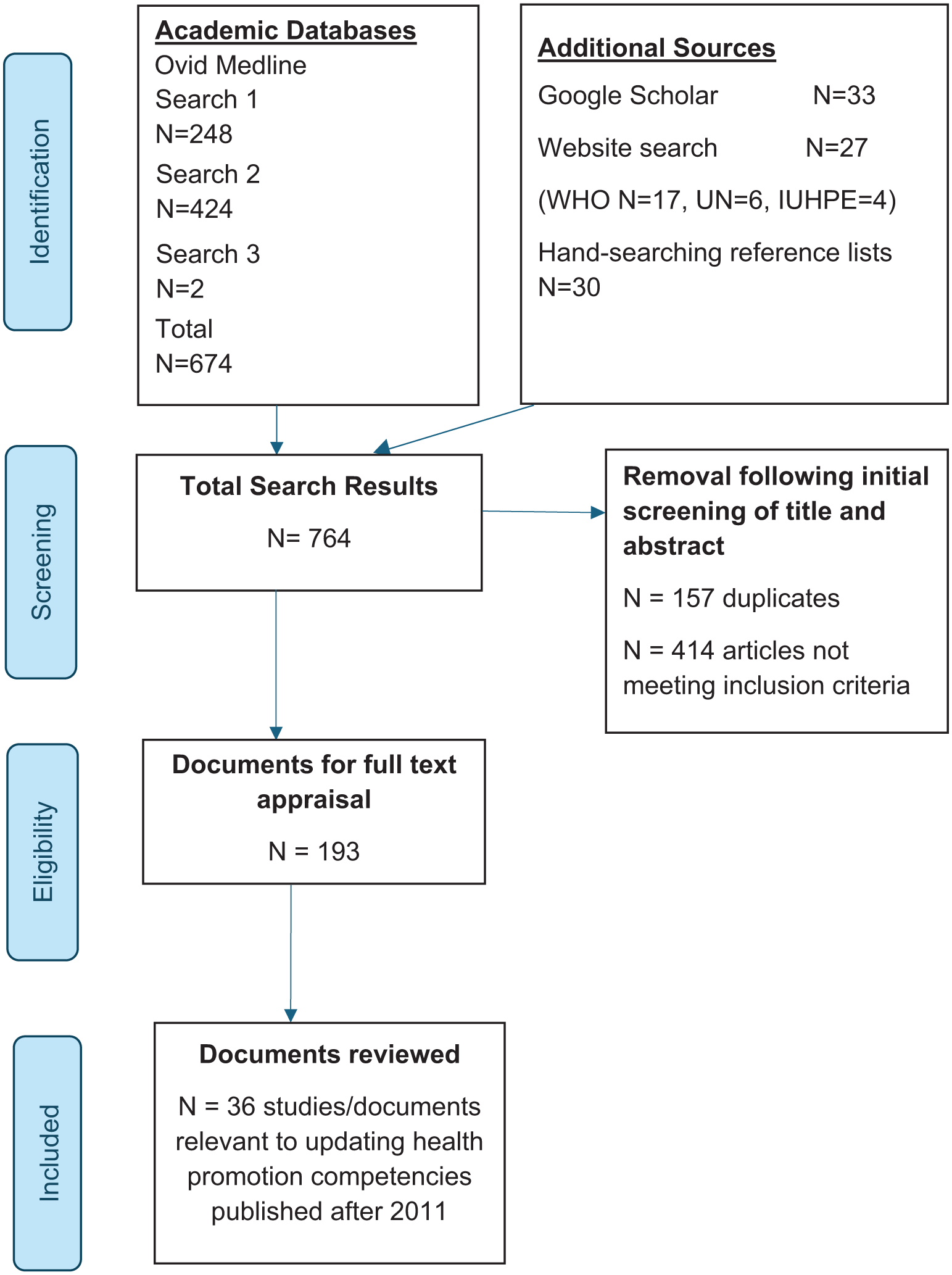
Flow chart representing the search and screening process.
Data extraction
Studies/documents were grouped according to their relevance to specific areas (see Results for groupings). The data were then extracted using charts in Microsoft Excel.
Data analysis
Data were analysed to identify key areas of difference, gaps, omissions, new terminology, et cetera, and were mapped as a guide to updating the competencies. Based on these findings, a revised Draft 1 of the updated competency framework was developed.
Stage 2: consensus building
The Revised Draft Framework Version 1 was subject to an internal review by the IUHPE Executive Board at a meeting in September 2023. Following this, an online questionnaire was compiled to consult with the health promotion community. The survey was first piloted with representatives (N = 5) from health promotion practice, policy and academia in different countries to ensure readability and comprehensibility, and the final version was then compiled as an online survey. The Revised Draft Framework Version 1 and the online survey were then sent to 59 Accredited Course Leads, including assessors and Board members, and 193 Practitioners registered on the IUHPE Accreditation System. The survey took place between January and March 2024.
Survey questions
The survey comprised three main sections:
Section 1 asked respondents if they accepted the proposed changes to the Introduction section of the competency framework or to suggest alternative changes if appropriate.
Section 2 asked respondents whether they accepted changes to the domain competency statements or suggested modifications and/or any other comments.
Section 3 invited respondents to rate the proposed changes to the competency framework overall and to rate their agreement with whether the framework adequately reflects contemporary health promotion practice in general. Open-ended comments on the proposed changes or the updating process were also invited.
Data analysis
Analysis of the quantitative data collected was descriptive, comprising summaries of the findings using a combination of description and discussion of the results. The qualitative data gleaned from respondents’ comments underwent thematic analysis (25).
Stage 3: ratification and dissemination
The final stage involved a final review of Revised Draft Framework Version 2 by the IUHPE Global Accreditation System Management Committee and IUHPE Executive Board, followed by formal ratification.
Full details of the methods, including the questionnaire and the resulting data, can be found in a report by Battel-Kirk, Dempsey, Harte and Barry (26).
Results
Stage 1: scoping review of literature
A total of 36 documents published between 2012 and 2022 were included for documentary analysis. They included peer-reviewed journal articles, position statements and declarations by relevant bodies (e.g. IUHPE, WHO, EU and UN and other agencies), and existing competency frameworks that have been implemented globally. The selected documents pertained to seven main themes: sustainability; planetary health; health and digital literacy; gender; cultural competency; structural inequity; global health.
Data relevant to updating the IUHPE competencies were extracted from final documents and tabulated in Microsoft Excel. By analysing the data extracted, potential new competency statements or edits to existing ones were drafted by three reviewers (PH, BBK and MB). In cases where it was felt that issues were adequately addressed in the existing competencies, for example, respecting gender and cultural diversity, no changes were deemed necessary. Revised Draft Framework Version 1 can be found in Supplementary Material File 1 online.
Stage 2: consensus building
Some 59 Accredited Course Leads, including assessors and Board members, and 193 Practitioners registered on the Accreditation System were sent the updated Revised Draft Framework Version 1 and invited to complete an online questionnaire. The questionnaire sought to elicit respondents’ views concerning changes to the Introduction section, each specific proposed change to the statements (highlighted in bold) in the Revised Draft Framework Version 1, and the updating process more broadly. Some 41 online surveys were completed (N = 41); 19 were from Accredited Course Leads (n = 19) and 22 from Practitioners registered on the Accreditation System (n = 22), representing a response rate of 33% and 11.4% respectively.
Overall, respondents considered the updating process both timely and comprehensive and rated the proposed changes to the competency framework as either ‘very good’ or ‘good’. All respondents, apart from one from each category (Practitioners and Course Leads), either ‘agreed’ or ‘strongly agreed’ that the updated framework adequately reflects contemporary health promotion practice. The need to reference the importance of systems-thinking and co-design in local health promotion action, alongside the commercial determinants of health, was highlighted by some respondents. Respondents also suggested updating the IUHPE competencies graphic to a more contemporary design and replacing ‘Needs Assessment’ with the broader term ‘Assessment’ to allow for ‘broad and positive assessment of assets and resources as well as deficit’. Overall, 70–80% of respondents were in agreement with the specific changes highlighted. Suggestions were also made regarding specific wording and phrasings and specific examples are illustrated below.
Example 1 ‘Ethical Values’. Regarding the addition of the phrasing highlighted in bold to the following statement: ‘Being accountable for the quality of one’s own practice and taking responsibility for Example 2 ‘Advocate for Health’. In relation to the changes to Competency 2.4: a health promotion practitioner is able to: ‘Advocate across sectors for the development of policies, guidelines and procedures which Example 3 ‘Mediate through Partnership’. Regarding the addition of new Competency 3.5: ‘Work in collaboration with key stakeholders to build resilient communities, ensuring that the health and well-being of the most vulnerable is protected and promoted’, 81.82% of Practitioners and 83.33% of Course Leads accepted the changes as presented. Suggested edits included replacing ‘resilient’ with ‘healthy communities’, ‘ensuring’ with ‘. . .with a focus on protecting and promoting the health and well-being of the most vulnerable’, ‘vulnerable’ with ‘priority communities’ and ‘protected and promoted’ to ‘promoted and protected’. Example 4 ‘Communication’. In relation to the changes to Competency 4.3: a health promotion practitioner is able to: ‘Use culturally appropriate communication methods Example 5 ‘Planning’. Question 12 related to the addition of the word ‘diverse’ to Competency 7.1: a health promotion practitioner is able to: ‘Mobilise, support and engage the participation of
Three reviewers (PH, BBK and MB) reviewed respondents’ comments and relevant changes were incorporated to produce Revised Draft Framework Version 2 (see Supplementary File 2). Given the level of consensus, the Version 2 of the Framework was forwarded to the IUHPE Accreditation Committee for their review.
Stage 3: ratification and dissemination
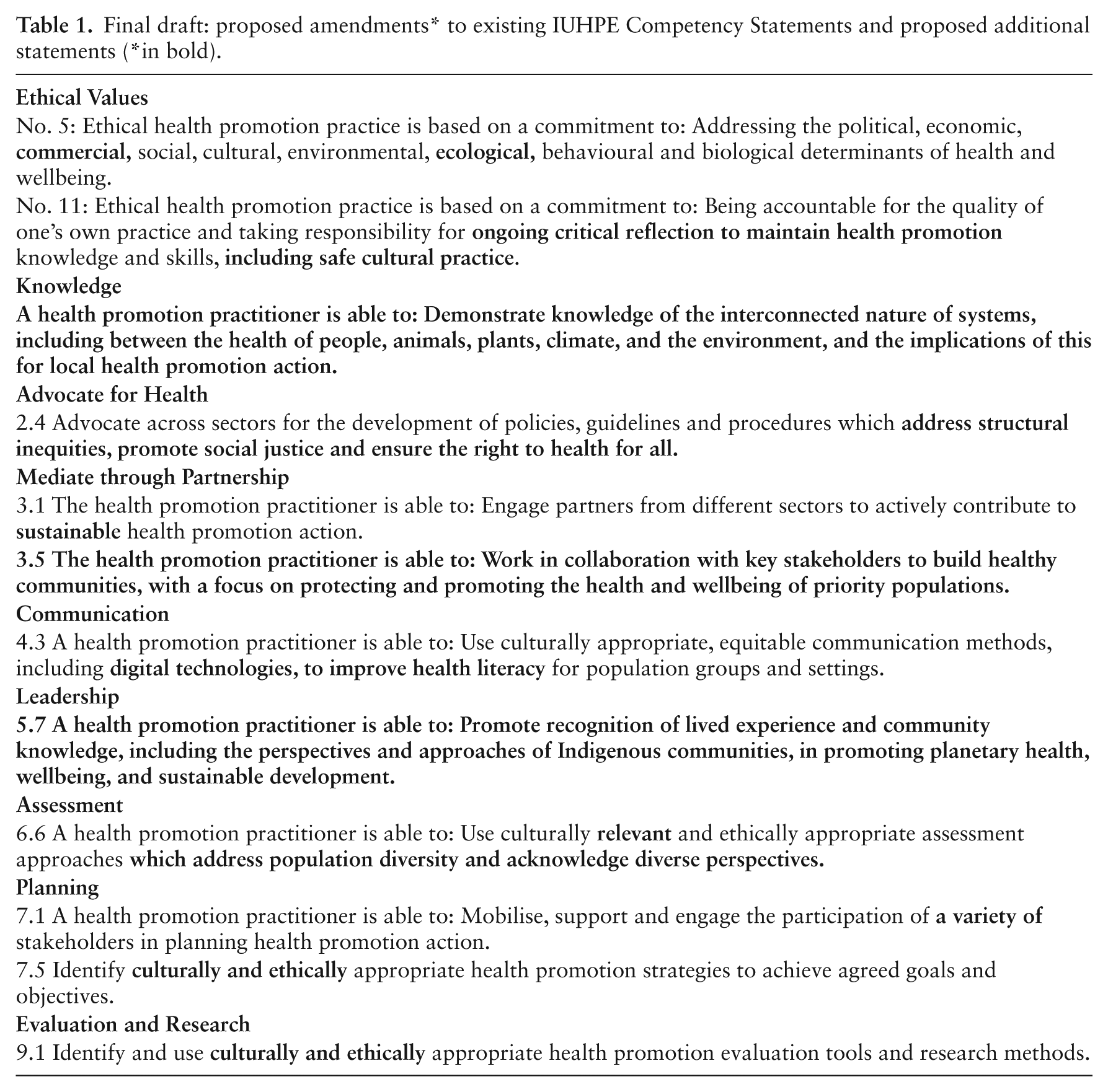
Following on from the IUHPE meeting at the 12th European Conference on Health Promotion, the Executive Board approved the Revised Draft Framework Version 2. On this basis, the short version of the Framework document was revised to produce the final draft in Table 1 below.
Final draft: proposed amendments* to existing IUHPE Competency Statements and proposed additional statements (*in bold).
Discussion
This research outlines the process of updating the IUHPE Core Competencies for Health Promotion, based on the findings from a scoping review of the literature and an online consultation with members of the IUHPE health promotion community. The findings, which included responses from health promotion practitioners and course leaders registered with the IUHPE Accreditation System, indicate a high level of consensus concerning the proposed changes, which were endorsed by the majority of respondents (70–80%). These findings indicate that the revised competencies are perceived as being reflective of contemporary health promotion practice, including more explicit reference to planetary health and wellbeing, cultural and population diversity, structural inequities, sustainability and digitalisation. Additional suggestions concerning specific phrasing were also incorporated into the final version. The fundamental elements of the original core competencies have been retained but with the addition of a small but significant number of changes to the core competency statements. The revisions made meet the requirement that competency statements should be written in clear language, be reasonable in number, and that frameworks should be easily understood and user-friendly (27).
Complex health challenges including planetary health, structural health inequities, cultural diversity, digitalisation and sustainability must be addressed, reflected and integrated into health promotion competencies. The revisions made to the IUHPE Core Competencies Framework for Health Promotion endeavour to incorporate health promotion-specific knowledge, skills and ethical values that will guide practice, education and training in addressing these complex issues. The revised competencies reflect contemporary health promotion developments and aim to ensure that practitioners have the right mix of skills and knowledge to address current and emerging challenges to population health and wellbeing.
The updated competency framework acknowledges the complexity of current health issues and the revised statements underscore the need for those involved in health promotion to consider the interdependency of systems and stakeholders (20,28). The key role of systems-thinking in identifying and addressing health challenges is highlighted, as well as ensuring that the structural determinants of health are addressed in health promotion action. Acknowledging the need to ‘ensure that all learners acquire the competences, such as knowledge and skills needed to promote sustainable development’ ((17); Target 4.7 of SDG 4), the updated framework also emphasises the need for practitioners to consider planetary health and sustainability in local health promotion action, including addressing the ecological determinants of health. The revisions embrace a One Health approach through recognising the interdependence of humans, animals and the environment (28) and the importance of recognising diverse community knowledge and perspectives, including the voices of priority groups and Indigenous people. This echoes the guidance of other key international competency frameworks and guides (11,18,29–31). The role of digital technologies in health promotion communication is also included, underscoring its potential role in knowledge sharing and increasing population health literacy (15). The inclusion of the word ‘equitable’ underscores the need to consider and mitigate the potential negative impacts of digital use, such as isolation and increased inequity. Finally, adding reference to the importance of ‘ongoing critical reflection to maintain health promotion knowledge and skills’ to Ethical Values addresses a competence gap identified by Tretheway et al. (32).
Strengths and limitations
The robust scoping review together with the positive responses received from the IUHPE health promotion community to the final competency framework document suggests that the updating process reflects contemporary health promotion developments and meets current users’ needs. However, the purposive sampling employed and low response rate to the consultation, which is not untypical of online surveys, does limit the generalisability of the findings. A more robust consultation over a longer period would have also sought the views of non-IUHPE members to garner a broader range of perspectives. Therefore, the findings are limited. This is due primarily to the unfunded nature of the process, which necessitated a shorter timeframe and smaller scale consultation than would be possible in a more representative larger scale exercise, such as a Delphi study, as was employed in the original core competency development process. That said, the thorough scoping review process that informed the competency changes and the high level of consensus among IUHPE health promotion respondents indicate that the revised competencies are endorsed as being more reflective of contemporary health promotion practice and contexts, thereby providing a sound basis for the current accreditation process.
The updated competencies provide the basis for a common understanding of what is required for good health promotion practice in the current context. Health promotion-specific competencies are designed to ensure that health promotion specialists have the right mix of knowledge and skills to address current and emerging health challenges and to build on foundational competencies and acquire additional expertise in the field. The changes made to the core competency framework will also need to be carried through to revisions in the related IUHPE Professional Standards and the IUHPE Global Accreditation System, together with updating documentation and information for applicants before the updated version can be used as the basis for accreditation.
Planning for future development and updating of academic and practice training courses will also need to take cognisance of these updated competencies. Health promotion practitioners and academic courses applying or re-applying for accreditation within the IUHPE Global Accreditation System will be required to demonstrate how they address the revised competencies in their practice and course curricula respectively.
In terms of research, there is continuing need to monitor and evaluate the uptake and implementation of the core competencies and the resources required in undertaking these endeavours within differing systems and contexts. Future research could also usefully focus on distinguishing between competencies required for core health promotion health roles versus those for more specialised roles at different levels, for example at management and policy levels.
Conclusions
The revised IUHPE Core Competencies provide a basis for guiding current and future health promotion practice, education and training by reflecting changes in the current socio-political and practice contexts within which health promotion is implemented. By recontextualising the competencies in relation to current health promotion policies and strategies globally, the updating process aims to ensure their continued relevance in different settings and contexts. The revision process has also responded to opinions expressed by the health promotion community on the need for the updating of the competencies in specific areas, including strengthening reference to the ecological determinants of health, planetary health and wellbeing, cultural competency and sensitivity, structural inequity, sustainability goals and digital health.
Competency frameworks need to be updated at regular intervals to ensure that they are appropriate for current and future practice and workforce planning. The methods used in this revision process, based on competency updating processes employed by other professional groups, offer an efficient and inclusive model. However, it is recommended that periodic updating of the IUHPE competencies, for example at five yearly intervals, be made a priority and that future revision processes include the widest possible consultation across all regions and settings.
Supplemental Material
sj-docx-1-ped-10.1177_17579759251395062 – Supplemental material for Updating the IUHPE Core Competencies for Health Promotion: a scoping review and consultation with the health promotion community
Supplemental material, sj-docx-1-ped-10.1177_17579759251395062 for Updating the IUHPE Core Competencies for Health Promotion: a scoping review and consultation with the health promotion community by Patricia Harte, Barbara Battel-Kirk and Margaret M. Barry in Global Health Promotion
Supplemental Material
sj-docx-2-ped-10.1177_17579759251395062 – Supplemental material for Updating the IUHPE Core Competencies for Health Promotion: a scoping review and consultation with the health promotion community
Supplemental material, sj-docx-2-ped-10.1177_17579759251395062 for Updating the IUHPE Core Competencies for Health Promotion: a scoping review and consultation with the health promotion community by Patricia Harte, Barbara Battel-Kirk and Margaret M. Barry in Global Health Promotion
Footnotes
Acknowledgements
Dr Liane Comeau, Executive Director of IUHPE; Professor Louise Potvin, President of IUHPE; plus all the respondents to the survey and members of the IUHPE Committee & Executive Board.
Declaration of conflicting interests
The authors have no conflicts of interest to declare.
Funding
The authors received no financial support for the research, authorship, and/or publication of this article.

Supplementary material
Supplementary material for this article is available online.
References
Supplementary Material
Please find the following supplemental material available below.
For Open Access articles published under a Creative Commons License, all supplemental material carries the same license as the article it is associated with.
For non-Open Access articles published, all supplemental material carries a non-exclusive license, and permission requests for re-use of supplemental material or any part of supplemental material shall be sent directly to the copyright owner as specified in the copyright notice associated with the article.
