



Abstract
Health impact assessment (HIA) can magnify the positive impacts of health promotion in practice, but practitioners face many challenges in implementing it, from the difficulties of intersectoral work to a lack of resources. These challenges require flexibility and sometimes involve adapting best practices in health promotion and the typical HIA process. This article presents an agile approach to conducting HIA when the window of opportunity is short, resources are scarce, and the expected value of appraisal is uncertain. Accordingly, this approach prioritizes the recommendations step over the appraisal step, while proposing an iterative and co-constructive process involving a limited number of stakeholders. The approach is exemplified through a case study of an HIA conducted in Québec on a guide promoting green, active and safe transportation networks. We argue that the adapted method can, in certain circumstances, lead to better results than a typical HIA. The article also suggests contextual criteria that allow HIA practitioners to assess whether this approach is suitable for their needs.
Health impact assessment as a foundational and perfectible tool for promoting health
Health impact assessment (HIA) is increasingly recognized as part of a practical approach to health promotion and a pivotal tool for operationalizing the Health in all Policies (HiAP) framework (1–4). HIA has facilitated the integration of health, equity, and community considerations into the decision-making of sectors other than health. It has also reinforced collaboration between these stakeholders, while improving their knowledge of the effects of their work on health and wellbeing (5–10).
Despite its benefits, conducting HIA presents many challenges for practitioners (5,6,8–11):
Lack of resources and inadequate training;
Difficulties inherent to intersectoral work;
Short window of opportunity to influence the project;
Too little information on the project or too much uncertainty;
Decision-makers perceiving HIA as a constraint;
Lengthy, costly, complex or technical processes and products;
Non-alignment of recommendations with the contextual need or decision-makers’ concerns;
Low perceived cost-benefit ratio of conducting an HIA.
These challenges may hinder effective implementation and restrain opportunities for conducting a proper appraisal and making proper recommendations.
HIA can make health promotion research more concrete for decision-makers (2). Addressing these challenges and thus improving the HIA process could enhance the downstream impacts of health promotion research, while also creating new research materials (e.g. measuring the impacts of an HIA on health outcomes) (12).
However, the current scientific literature lacks comprehensive strategies for tackling the above-mentioned challenges in practice (7). The publication of successful case studies and their results has been proposed to make the process more concrete for practitioners and thus facilitate the achievement of contextually adapted HIA (7,11). This article presents a case study from the province of Québec (Canada) that introduces an alternative approach to conducting HIA to address some of the challenges listed above and advance health promotion practice.
Integrating an agile method for conducting an HIA
The proposed approach adapts the agile Scrum project management method, focusing on iterative and collaborative principles (Figure 1) (13,14). Scrum’s flexibility is suitable for projects where client needs are unclear at the start, allowing for continuous development and adjustment. The final product is developed by self-organizing teams in increments called ‘sprints’, starting with planning and ending with a review (retrospectives). Usually, a backlog of features is compiled and maintained by registering features that may be relevant to examine through the process. The client is responsible for deciding which backlog items should be developed in the following sprint. In the context of this HIA process, the backlog consisted of scenarios to be analyzed.
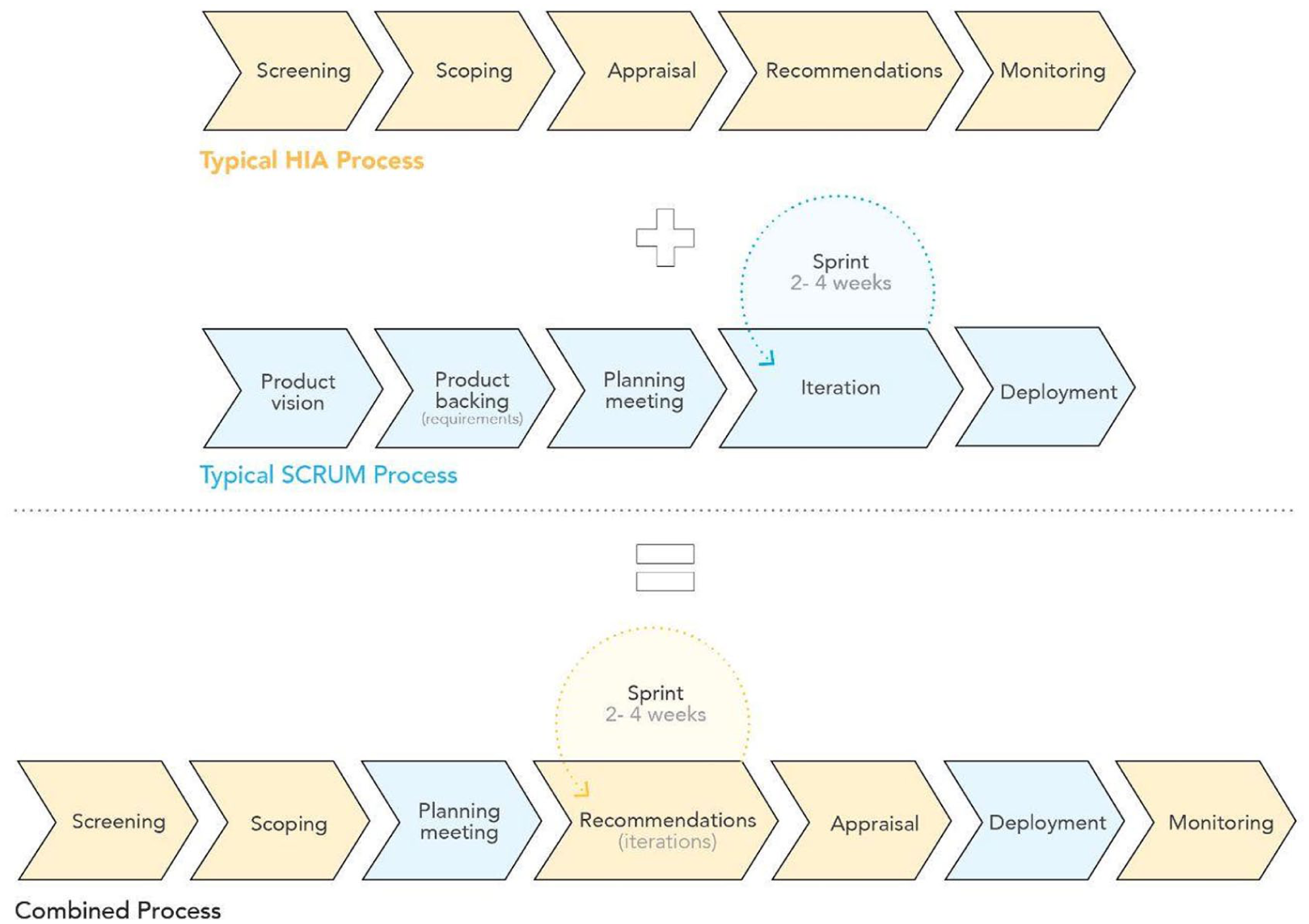
Combination of typical HIA and SCRUM processes.
The adapted HIA process encourages earlier integration into project planning, especially for projects at early stages with minimal planning documents or unclear sites. The process focuses on refining recommendations rather than extensive appraisal, which reduce resource-intensive steps (8,9,15). Two major changes are proposed:
1.
2.
More collaborative work can promote the creation of bonds of trust and thus facilitate acceptance and appropriation of the results (6). This approach could also enhance the relevance, efficiency, and implementation of health-based recommendations, benefiting both the decision-making process and health outcomes.
A case study: the guide ‘Implanter des trames vertes actives et inclusives à l’échelle municipale’ in Québec
Nature Québec is a non-profit organization dedicated to conserving natural environments and promoting the sustainable use of resources in the province of Québec, Canada. The Nature Québec ‘Implanter des trames vertes actives et inclusives à l’échelle municipale’ (Implementing active and inclusive green corridors at the municipal level) guide provides guidelines for urban greening and mobility interventions aimed at helping local governments create green, active, and inclusive networks for local communities (15). The interventions focus on seniors and disadvantaged households. The guide illustrates its potential applications through five green network scenarios in various contexts: secondary streets, collector streets, and green poles.
Nature Québec decided to submit a preliminary version of the guide’s scenarios to an HIA. A researcher specialized in the subject from Université Laval and a small business offering consulting services in HIA teamed up to conduct the assessment. The prospect of conducting an HIA on the guide rather than on a specific project tied to a single population and territory was considered relevant since it would facilitate the integration of public health concerns into urban practice for all users of the guide.
Challenges associated with the typical HIA structure
Although the team was experienced and had repeatedly addressed the health determinants potentially impacted by this guide, the context did not seem conducive to subjecting the project to a typical HIA process, due to the presence of three main challenges:
1.
2.
3.
These issues presented obstacles to conducting an analysis with real added value, since they would likely have led to results that were too vague, uncertain, resource-intensive, untimely, and possibly inapplicable.
Proposed adjustments to the HIA structure
The guide required the application of a new process to overcome those challenges. Therefore, the team decided to test the new HIA process presented in section 2.
The first adjustment involved offering more collaborative and iterative support in conjunction with the progressive development of the guide. To facilitate this, the HIA was divided into four reports: the first three covering preliminary submissions as the guide evolved, while the final report focused on the completed version of the guide. Following each preliminary submission, brief feedback on content and process was encouraged and provided.
The second adjustment was initiated by a request from Nature Québec to prioritize sending the recommendations first so they could improve their measures in a timely manner. The first three reports complied with this request by focusing exclusively on recommendations.
The completion of several previous HIAs allowed the team to benefit from a repertoire of recommendations that can be applied in different contexts. Their transferability had to be assessed based on the information collected during the scoping step (Figure 1). If the measures analyzed were not covered by this repertoire, and if time permitted, it was subsequently possible to carry out additional research on certain specific topics.
These operations facilitated the identification of relevant focal areas for recommendations in the context of a tight schedule, while promoting a focus on the development rather than on the appraisal of the interventions themselves. The preliminary analyses in the first three reports were refined later for the full report. Each preliminary report contained an average of 19 recommendations that were sometimes further elaborated on or clarified during the process. Including those added in the final report, the teams provided a total of 79 recommendations.
This process allowed Nature Québec to benefit from recommendations for each step before the closing of the window of opportunity. They were able to request adjustments from analysts in due course. It also allowed the HIA team to start the evaluation earlier and provided an opportunity for adjustments attributable to feedback from Nature Québec.
Feedback on the process followed
After the final submission of the HIA, a feedback meeting with Nature Québec’s representative established that the process had been much appreciated, particularly the flexibility of the analysts during the process.
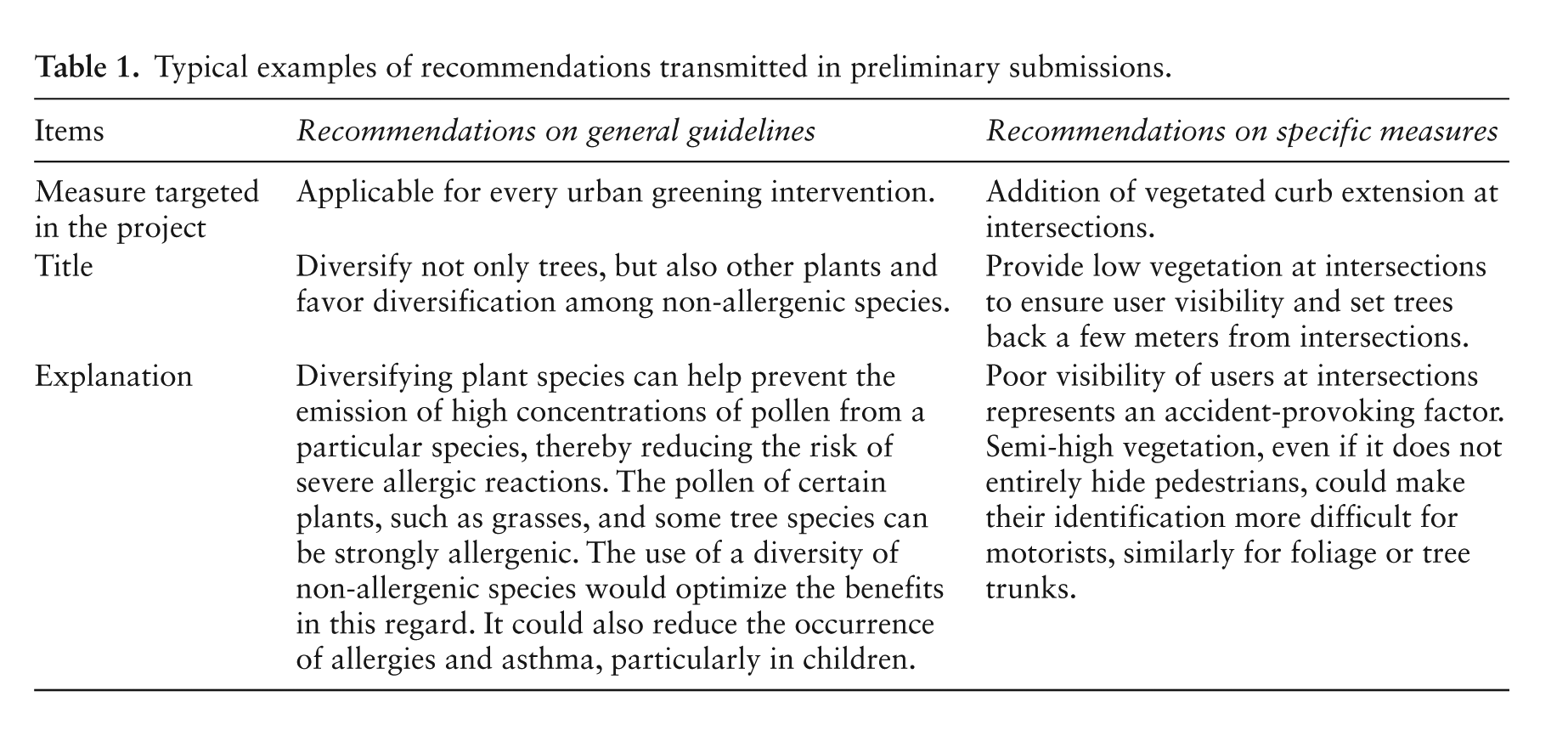
Nature Québec mentioned that 63 of the 79 recommendations provided had been adopted in the guide, which corresponds to an integration rate of almost 80%. The recommendations that were not retained were considered unsuitable for the objectives of the guide because of their level of specificity. Some examples include: ‘Incorporate rainwater capture devices into all street planting areas’ and ‘ensure that rainwater capture devices do not create stagnant water that can breed mosquitoes or bacteria’. Other recommendations were dismissed simply because the targeted interventions in the guide were abandoned in the final version of the guide. The transmitted recommendations and the delayed appraisal enabled Nature Québec to further explore the benefits and feasibility of certain proposed measures while also being provided with scientific support. Two typical examples are presented in Table 1.
Typical examples of recommendations transmitted in preliminary submissions.
Nature Québec nevertheless emphasized that under ideal circumstances a longer timetable would be desirable, and that the involvement of the authors of the HIA in an upstream working session could also have been beneficial.
The overall appreciation of the process as well as the high rate of recommendations considered by Nature Québec encourage reuse of the process. However, it is important to mention that the success of this single case study is not necessarily replicable in all contexts.
Selection criteria and limitations of the method: what does it mean for health promotion?
The suggested method might help to optimize the results of HIAs and health promotion research in certain circumstances, such as those presented above. It shows the necessity of tailoring the method to the context, and sometimes, of straying from certain ‘best practices’, such as citizen engagement and extensive multidisciplinary collaboration. Still, the suggested method borrows some principles from health promotion research, such as methodological pluralism and pragmatism, and shows how they can be applied to HIAs.
Methodological pluralism and pragmatism do not need to come at the cost of simplicity and the need for standardization (7). Pre-established criteria can simplify the process of choosing between different paths during the scoping step. This article has emphasized that the proposed method is advisable only in certain circumstances. Figure 2 shows some criteria to use to decide when its expected value is likely to be higher, and when it is likely to be lower.
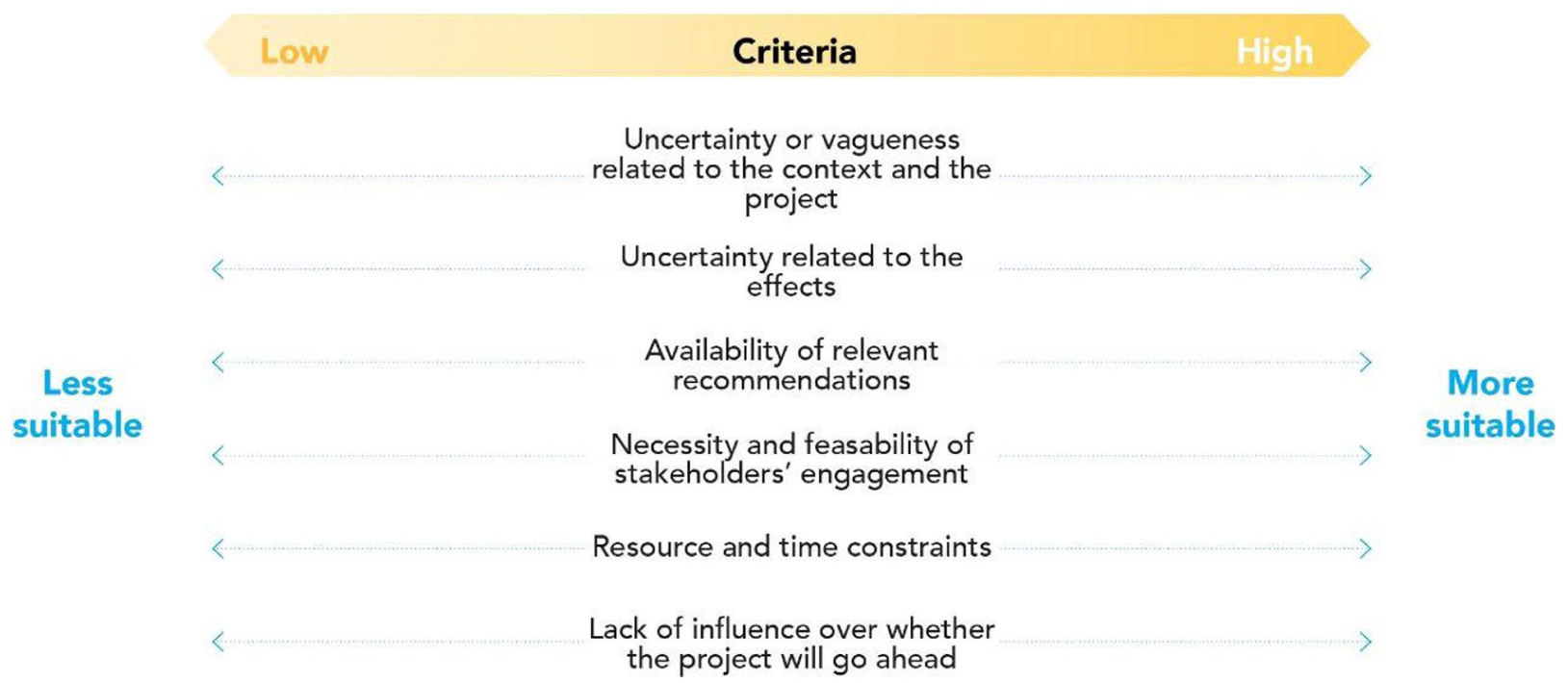
Contextual criteria for deciding during the scoping step whether the suggested HIA method is suitable.
These criteria were derived from experiences implementing HIA in the province of Québec (see section 2). As a rule of thumb, the more uncertain the results of the appraisal may be, and the less possible extensive stakeholders’ engagement is, the higher the expected value of the proposed method is likely to be. The weighing of these criteria will change depending on the context.
The proposed method also has direct implications for health promotion research. Simplifying the HIA process can improve the initial experience of decision-makers and create a more positive attitude towards HIA and health promotion research. This is a crucial factor for HIA dissemination and its wider adoption (4). Decision-makers will also be more prone to consider health impacts and advice from health promotion researchers or practitioners in future decisions (6,9,16). Moreover, having more HIAs and recommendations implemented will mean more material for health promotion research. However, the suggested method can also come with shortcomings:
Perception of a lack of legitimacy or scientific rigour related to changes in the traditional HIA process;
Potential added complexity at the screening and scoping stages due to adding another methodological option;
Lower ease of application or transferability of skills to the new methodology for certain practitioners;
Greater chance of instrumentalization from the decision-maker;
Potential biases from considering fewer stakeholders;
Greater chance of suggesting unsuitable recommendations;
Risk of confusion or cherry-picking if too many recommendations are proposed;
Lower comparability to other HIAs using other methods if an assessment is planned.
HIA practitioners should therefore consider these potential shortcomings when selecting and developing their method, in addition to the contextual factors mentioned in Figure 2.
Conclusion
The proposed approach addresses six of the eight challenges mentioned in section 1: (1) short windows of opportunity for influencing projects; (2) insufficient project information for producing proper appraisal; (3) decision-makers’ perception of HIA as constraining; (4) lengthy, costly and technically complex processes; (5) non-alignment of recommendations with contextual needs; (6) perceived low cost-benefit ratio of conducting an HIA. The lack of resources and training and the inherent difficulties of intersectoral work are not addressed.
The article does not imply that the method presented here should be prioritized. In an ideal world, this kind of method would be unnecessary, but resource scarcity creates a need to prioritize. Without decision-making tools like HIA, the effectiveness of health promotion efforts at influencing policy and practice can be compromised. Our approach can be a relevant tool for the operationalization of HiAP frameworks. Future research can refine this approach and capitalize on its potential.
