




Abstract
Aims:
Receiving or lacking support can be decisive in how children engage in and continue with sports hobbies or physical activity (PA) in general. The topic is timely, since the PA levels of children are currently insufficient. However, children’s own experiences concerning the support they receive are under-researched. The purpose of this study is to explore from whom, to what extent and what kind of support children experience receiving for PA.
Methods:
This mixed-methods study collected empirical data among 11-year-old children, regarding children’s own perceptions of PA by local interviews (n = 36) as the main primary material, complemented with a local survey (n = 114), and national survey (n = 1765) conducted in Finland. In addition, access to the local respondents’ accelerometer measurements conducted in five schools in a city in Southern Finland was utilised to characterise the interviewees in terms of their PA. The various data were gathered in 2021 and 2022.
Results:
According to data from both local and national surveys, children experience receiving support for PA from multiple actors (particularly from parents, teachers, hobby instructors/coaches, friends). Support styles vary from coercive to enabling, encouraging and participatory support. The combination of support from different actors can be reinforcing, remedial or destructive, depending on the type and amount of support and a child’s experiences regarding the support.
Conclusions:
To reinforce positive support experiences and to avoid destructive support combinations, shared responsibility and congruence regarding the provision of support for children’s PA is called for.
Keywords
Background
It’s not like we’re in some world championships. We are children, after all. The discipline needn’t be so hard. (Girl/10,311 steps)
The above quote from our interview data brings forth the paradox of support regarding children’s physical activity (PA). Support is needed, but the types of support vary from autonomous to controlling, and the type of support received tends to affect the outcomes in the short term or long term (1). Gaining understanding of the possibilities to increase children’s level of PA is timely because PA has evident physical and psycho-social health benefits for children and youth (2) and ultimately, for public health (2,3), but the majority of children and adolescents do not reach the internationally agreed PA recommendations (4) and activity levels of children and adolescents keep decreasing (5). Even small changes in PA and sedentary behaviour, especially among those with initially low levels of PA, can make a difference and result in health benefits (6). Therefore, it is important to study how the PA of children can be supported.
Earlier research exists on parent and family influences on children’s PA (2,7,8) and on coach (1), instructor and peer support (9), and the relevance of physical education at schools to public health has been emphasised (3), but the amount of this research is still scarce. In particular, there is a lack of holistic studies on from whom children themselves consider receiving support and on children’s own perceptions of what kind of support they receive or hope to receive. Children’s own perceptions and experiences are central because they are decisive in directing future motivations and behaviour, and since the implications of childhood PA can extend to PA in adulthood (10). The purpose of this study is to explore what kind of support, from whom, and to what extent children experience receiving concerning PA.
Studies on physical activity parenting (PAP) emphasise responsiveness, encouragement, facilitation and logistical support as parental styles and practices that support PA (7,11). Parenting also affects the amount of PA in which children engage through indirect practices, such as screen-time controlling (8,11). Regarding coaching styles, Fenton et al. (1) concluded that autonomous instead of controlling coaching increases children’s moderate-to-vigorous physical activity (MVPA). Individual preferences, peer behaviour and instructor behaviour are highlighted as factors that influence whether and how much children enjoy physical education (9), thus addressing the significant role of schools and the importance of creating an environment where children’s autonomy, competence and relatedness are supported. Perceived acceptance by peers in games and sports and perceived physical competence have been reported as positively related to PA by primary school children (12). However, the lack of holistic studies considering each of these areas in children’s everyday lives leaves unresolved how possible discrepancies between parents’, peers’ and instructors’ behaviour or indifference experienced regarding support may impact children’s PA experiences. Moreover, understanding of children’s own perceptions of these issues is insufficient (7).
This study collects empirical data regarding children’s own perceptions with mixed-methods research: the data were collected by interviews and surveys in Finnish schools. In addition, access to accelerometer data was used to illustrate the interviewees’ PA levels.
The age at which drop-off in PA and drop-out from sports hobbies starts is becoming increasingly lower, and this phenomenon is currently clear beginning from the 11-year-old Finnish children (4,13). Therefore, the research was conducted among fifth-grade pupils (around 11 years old) because receiving support is especially important at turning points at which children are at risk of decreasing PA or dropping out of sports hobbies (in this paper the term hobby refers to hobbies related to PA and sports). Moreover, previous research suggests that intrapersonal and interpersonal constraints lead to dropping out more frequently than structural constraints (14), pointing to the importance of studying the experienced support.
Methods
Mixed methods and prospective approaches are recommended to allow children to explain their sports experiences and motives to drop out (14). The primary data of the study are interviews. In addition, we used local and national survey data, and accelerometer data. The data sets and their roles in this research are presented in Table 1 and described in detail in the section Data and results.
Summary of the mixed-methods data used in the research.
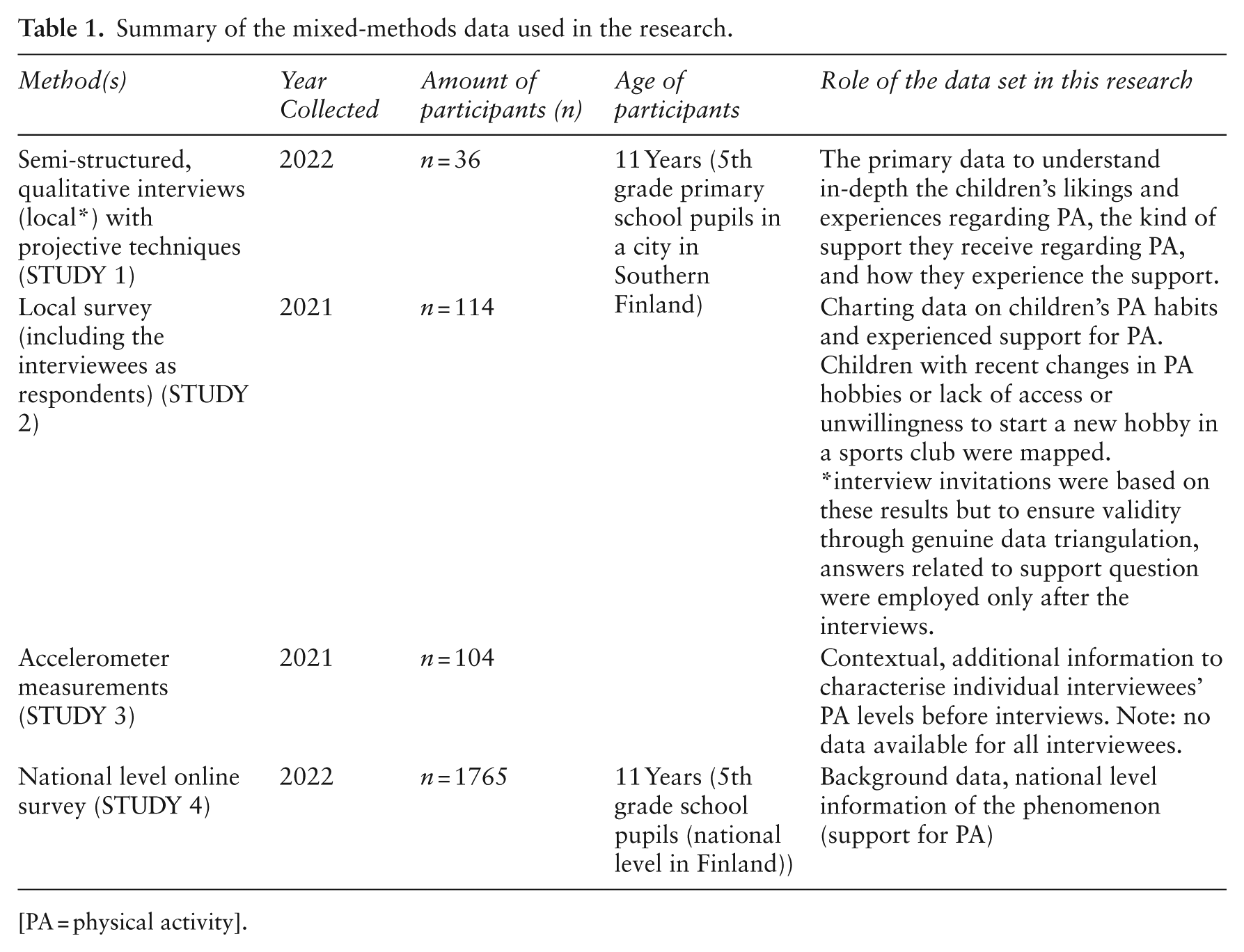
[PA = physical activity].
Approval statements from the ethics committees of the universities were gained for the local and national research [STUDY 1, 2, and 3: Statement 25/2021 from The Ethics Committee for Human Sciences at the University of Turku. STUDY 4: the national LIITU study was approved by the University of Jyväskylä research ethics committee].Informed consent was ensured from the participants’ parents/legal guardians and additionally, from the participants themselves to the interviews, local survey and accelerometer data collection. Further details of these research procedures, ethics and methods are presented also in the Supplemental Appendix, supported by references (5,15 – 20).
The strength in the semi-structured interviews is the chance for children to describe their experiences on their own terms. This is also a potential weakness: the same questions were not posed in the same form for everyone since the interviews were semi-structured and a sensitive approach was used. Furthermore, children’s willingness and ability to extensively verbalise their experiences varied which may impact reliability and validity of the results to some extent.
Data and results
We describe the data and report the results by first presenting the interview data (STUDY 1) and its analysis, describing what kind of support children experience receiving, as this is the study’s primary data. This is followed by a report on the local and national survey results (STUDY 2 AND 4) that generated more general level information concerning the forms of support and the persons from whom children experienced receiving support.
The accelerometer measurements (STUDY 3), which took place right after the participants had completed the local survey, serve as complementary, illustrative information in affiliation with the children’s interview citations. In this study accelerometer data are not analysed quantitatively. They provide contextual information to illustrate individual interviewees’ PA levels before interviews. The invitation to participate in these measurements was addressed to all fifth-graders in the five schools in which the local study was conducted.
Local interviews (STUDY 1)
To learn what kind of support children received and how they experienced the support, we invited 36 children to qualitative interviews from schools where we had conducted the local surveys (see below). We wanted to study in more detail the children’s likings and experiences regarding PA and their experiences regarding the support. We invited children who had reported recent changes in PA (starting a new PA hobby or returning to a previous PA hobby)—or, alternatively, lack of access or unwillingness to start a new PA hobby in a sports club. The semi-structured interviews lasted 25–30 minutes. Projective techniques (15,16,17) in the form of picture cards were used to assist the children to more easily recall or imagine the kinds of sports or activities they liked or disliked, and why. The influence of friends, teachers, coaches and hobby instructors was discussed, and further questions were posed when the children themselves mentioned the influence of these persons.
The transcribed interview data were inductively analysed using NVivo and structured into four aggregate themes using the established Gioia method (18). In practice, we formed upper-level categories from single subcategories (interviewees’ single notions of PA or sports-related support).
The initial data analysis showed that support can be active or passive (encouraging vs. allowing), referring to visible and more latent forms of support. A more detailed analysis of the interview data revealed four types of support: coercive, enabling, encouraging and participatory (Figure 1).
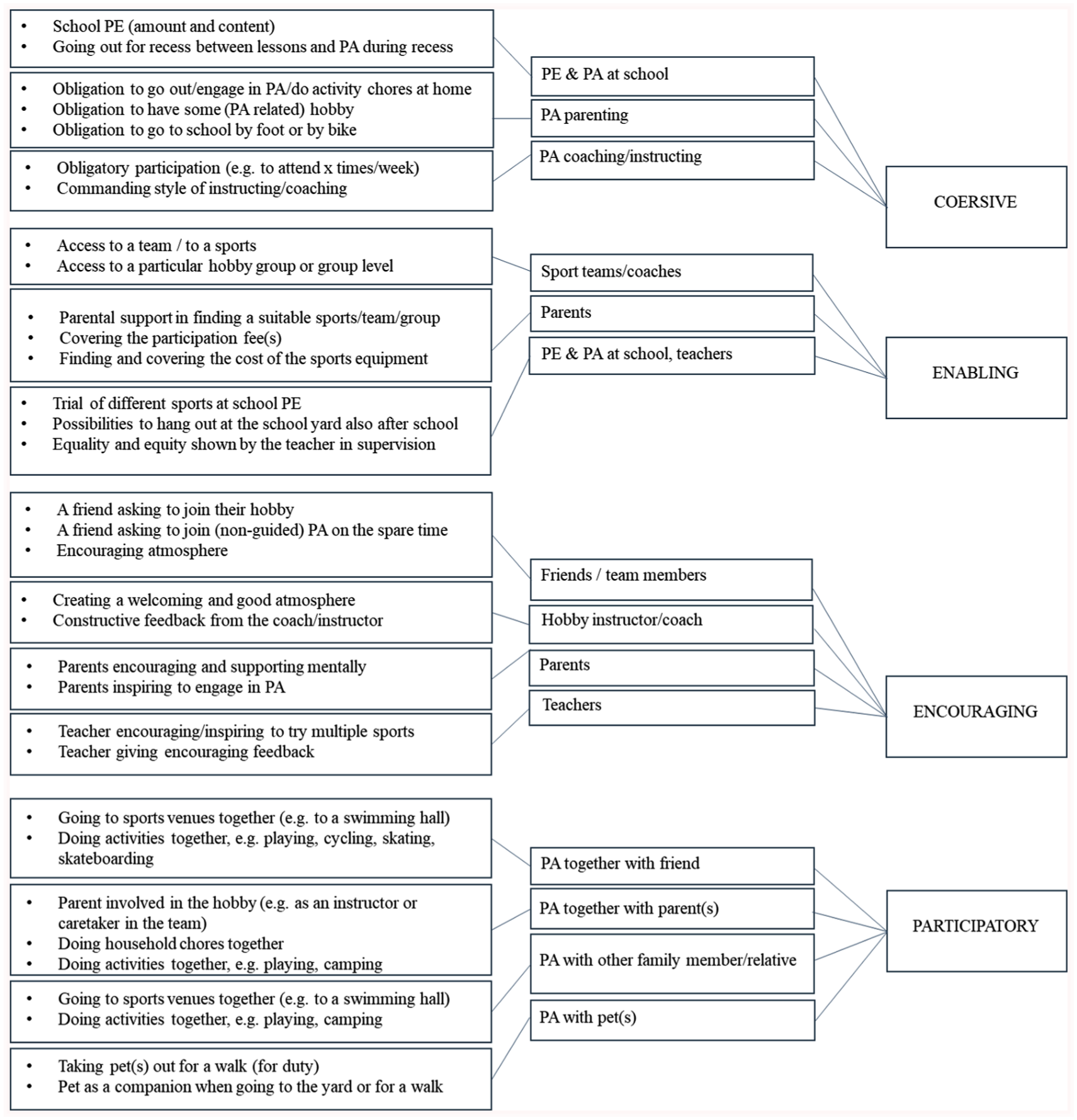
Forms of PA support experienced by interviewed school children.
Support was interpreted from the data, both based on instances where support was received and where it was considered as needed but lacking. There was also variation regarding from whom each type of support was received or considered valuable. Next, we elaborate on these support types with examples and interview quotations. Table 2 presents a summary of exemplary quotes from each support and supporter category.
Exemplary quotes of each support type from the interview data.
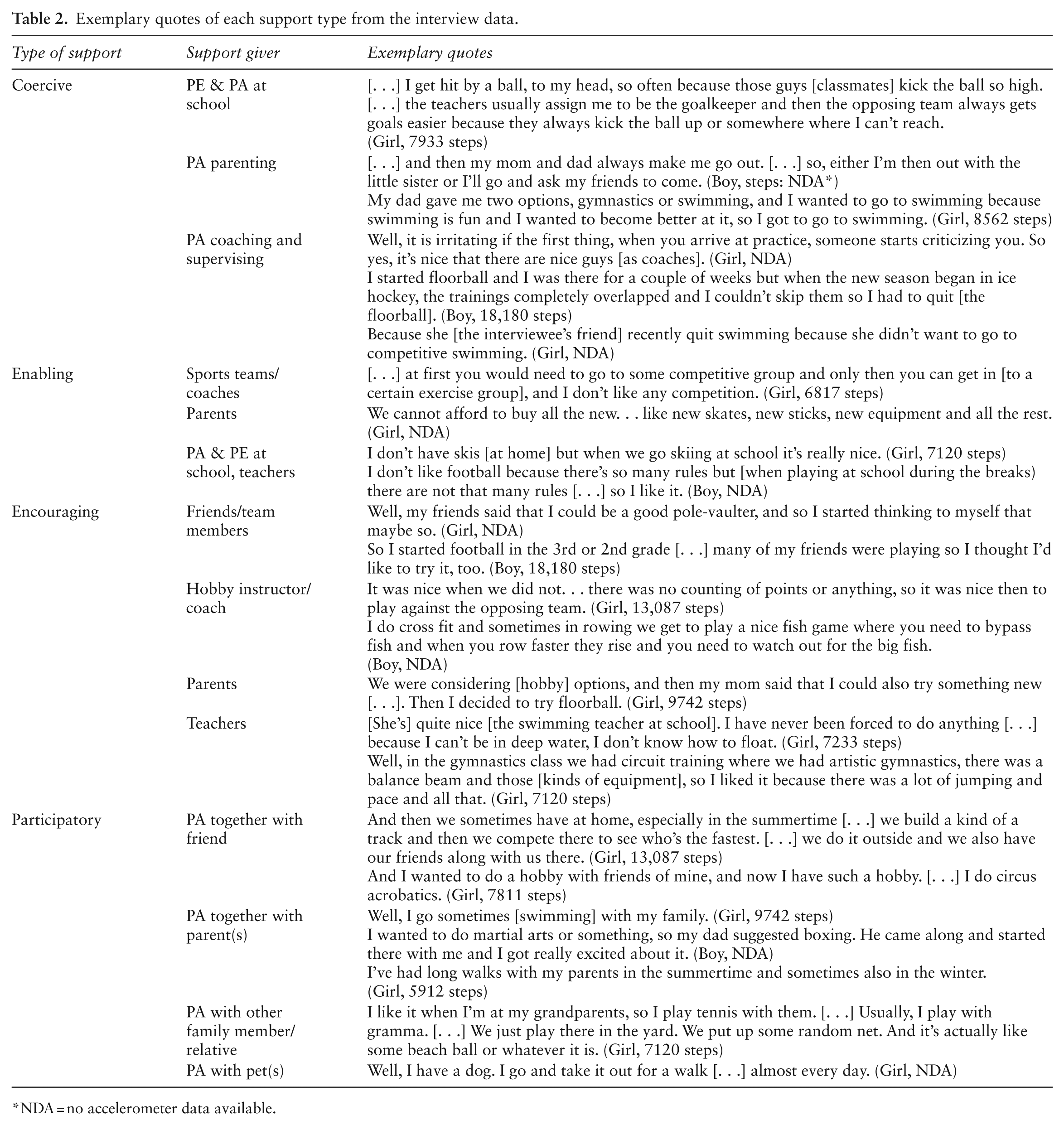
NDA = no accelerometer data available.
– Coercive support
The most demanding type of support is characterised as coercive support since it entails the connotation of having no choice. This does not always necessarily imply a negative tone. At schools, for instance, this refers to the rule of going out to the school yard for break between the lessons or doing certain exercises during PE classes, following the curriculum. In parenting, coerciveness means the obligation to go out or do household chores, to have a hobby or to go to school on foot or by bike. Regarding coaching/supervising the hobbies, coerciveness manifested itself in the form of attendance obligations or as a suppressing or overly demanding coaching style: There was a really irritating instructor who yelled and raged quite a lot, so I didn’t want [to attend] anymore. (Girl/13,087 steps)
– Enabling support
Enabling support on the part of sports teams and/or coaches meant provision of access to the sports club, particular sport or exercising group/level. Parents’ enabling support consisted of assistance in finding the appropriate sports club, sport and group, covering the attendance fees and purchasing the equipment. Physical education (PE) and PE teacher at school enabled participants to become familiar with multiple types of sports, whereas equity enabled the same possibilities for all students. The school environment provided a place for extracurricular activities during or after school (for example, playing in the school yard): . . .and we play tag nearly always between lessons. (Boy, steps: no data available (NDA)). And naturally, if these conditions were lacking, it meant disabling the activities: I feel like all the sports for children of my age are like continuing groups; there are no alternatives for new beginners. (Girl/7,120 steps).
– Encouraging support
The interviewees expressed several ways in which, and from whom, they received encouraging support. In this category, friends and team members also had an essential role; they invited to come along to their hobby or to engage in PA together in their free time, and at best, the team members created an encouraging atmosphere within the sports team: Everyone’s cheering each other, so it makes it a nice atmosphere, unlike over there in gymnastics (Girl/11,771 steps). Instructors and coaches played a key role in creating a welcoming and positive atmosphere and in providing constructive and encouraging feedback. Parents essentially provided mental support and encouragement for their children to engage in PA (e.g. by suggesting they try an alternative, new hobby). PE teachers had a role in encouraging pupils to try new things and skills and supporting them by giving instructions and feedback in a positive tone. Encouragement or the lack of it seemed to mould children’s perceptions of themselves and their abilities in relation to sports and PA in general.
– Participatory support
Participatory support took place when PA was done with someone else, someone close to a child who attended the activity with her/him. This person was often a friend with whom the child participated in activities such as swimming or engaged in playing (e.g. on a playground, football field, in the woods) or just walking around or cycling for fun. Parents supported by participating in the hobby (e.g. as instructors), doing household chores together or by playing or hiking together. Other family members or relatives, such as grandparents, also participated sometimes. In this type of support, the role of pets was also highlighted. The interviewees explained that they like going out with a pet because then they have a companion and a good reason to go out: If I’ve played on PlayStation for a long time and there’s no friend to spend time with, I can go out with the dog, so I get to go outdoors at least, not being inside all the time. (Boy/18,180 steps). Sometimes, though, this activity was experienced as a duty, in which cases it is more representative of a coercive type of PA.
The surveys
– Local survey (STUDY 2)
The interviewees belonged to the above mentioned larger group responding to a survey, which is used here to analyse the level of the support provided by various actors. These local survey data were collected in 2021 on the PA of fifth-graders in five schools in a Southern Finland city (n = 114) (inclusion criteria: fifth-graders in these five schools). We asked two questions regarding support received: 1) ‘To what extent do the following persons encourage and support you in hobbies related to PA and sports?’ and 2) ‘To what extent do the following persons encourage and support you in PA in general?’ The answer scales and results are shown in Figure 2.
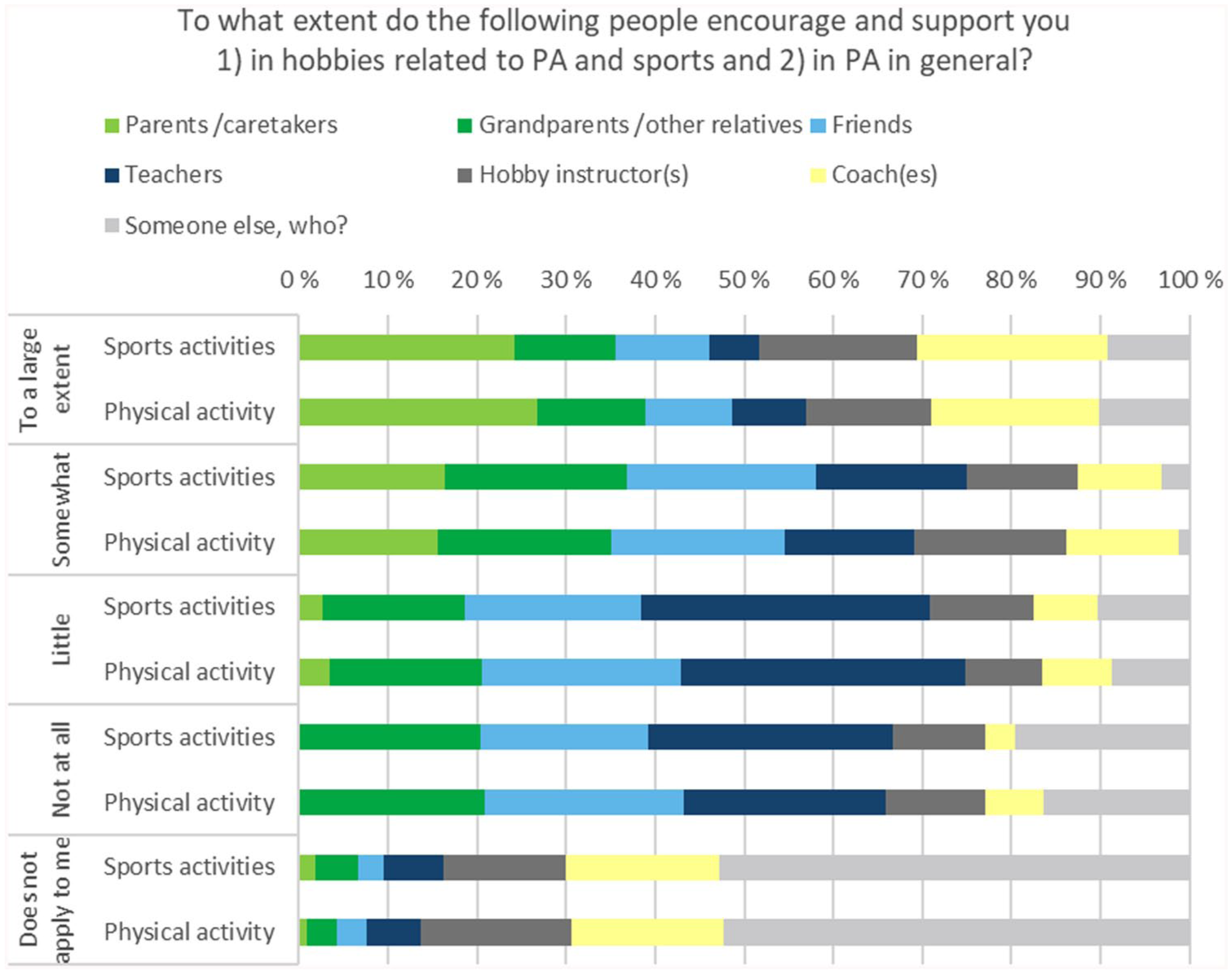
The encouragement and support received by children 1) for sports activities, and 2) for PA in general among 11-year-old children in a city in Southern Finland (n = 114).
As Figure 2 indicates, children experienced receiving most support from their parents in both cases. In addition, children reported receiving support from grandparents, friends, teachers, hobby instructors or coaches. In some individual cases, though, support from a coach in relation to the sports hobby was reported as little or non-existent (9% of answers). Moreover, the reported support received by teachers in relation to sports activities or to PA in general was lower than that of others when using the scale ‘to a large extent’ and had the largest amount of answers in the scale ‘little’ or ‘not at all’.
The answer alternative ‘Someone else, who?’ in both questions 1 and 2 gave respondents the possibility of defining a support giver other than the above-mentioned alternatives. The answers also brought forth the role of pets (dogs and cats) as supporters of PA, which was the case also in the interviews (Figure 1). In addition, neighbours, siblings, sports team members and mates at the (horse) stables were mentioned, indicating how support can be received from actors not necessarily included in typical closed survey answer options.
– National survey (STUDY 4)
Our national level survey gives a more generalised picture of the frequency of PA support and provides a background to the more detailed local studies described above. This online survey concerning children’s PA behaviour was collected for the Finnish school-aged PA study (F-SPA) in Finnish elementary schools in 2022 among pupils aged 7–15 years with electronic surveys (n = 10,074) (13). This was comprehensive research on children’s PA, consisting of several research questions. The pupils filled in the surveys during their school classes where their teachers were present. For this paper, we extracted the survey answers regarding support theme from 11-year-old children (5th graders) (n = 1765) to gain complementary information and to enable partial comparisons between the local and national datasets. These data enabled us to validate whether supporting persons reported by children and the amount and types of support received are similar on the local and national levels.
The survey enquired: ‘Have some of the following persons encouraged or guided you in order to increase your free time PA?’, answer alternatives being PE teacher, Class supervisor, School nurse or doctor, Friend, or Hobby coach/supervisor. The scale was: Never–Seldom–Sometimes–Often–Very often. When combining the answers that reported receiving support Often or Very often, the results per alternative were as follows: Hobby coach/supervisor 37.8%, Friend, 27.9%, School nurse or doctor 20.0%, Class supervisor 17.8%, PE teacher 14.3%.
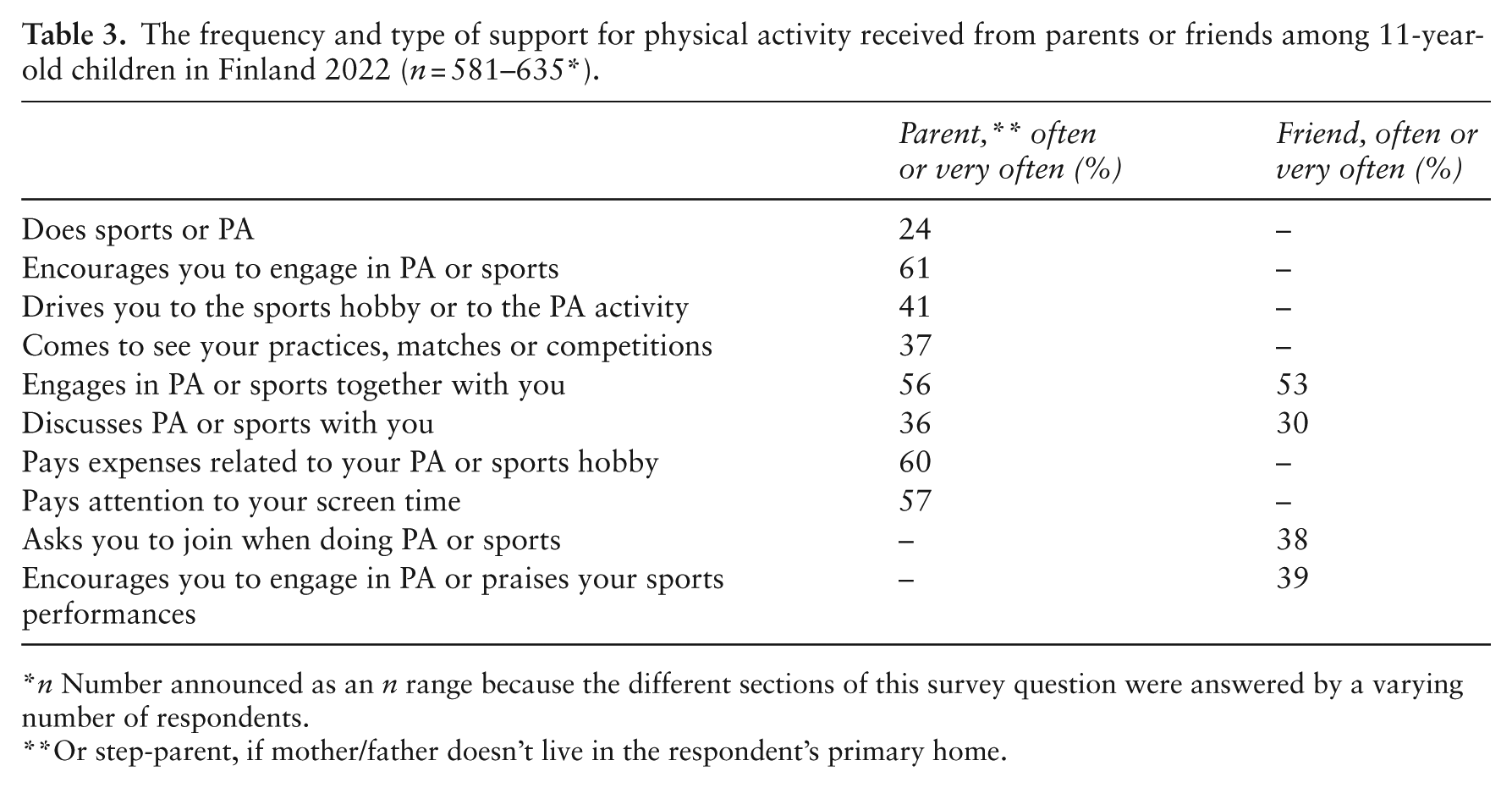
In addition, the survey covered in more detail how often and what kind of support the respondents had received from their mother, father or a friend. The answers to these questions are presented in Table 3, regarding answer alternatives Often and Very often (all results categories: see reference (21)). The ‘Parent’ column combines the average percentages concerning the support received by mothers and fathers.
The frequency and type of support for physical activity received from parents or friends among 11-year-old children in Finland 2022 (n = 581–635*).
n Number announced as an n range because the different sections of this survey question were answered by a varying number of respondents.
Or step-parent, if mother/father doesn’t live in the respondent’s primary home.
The most frequently received forms of support from parents were encouragement for PA, paying expenses, giving a ride to a sports venue or a hobby, and attending PA with the child. As for the friends, the most frequently received forms of support were encouragement and doing PA together or a friend engaging the respondent.
In all, most of the features recognised in the qualitative interview data were highlighted as primary forms of support also in the national survey results – enabling, encouraging and participatory support (paying expenses, cheering, attending the sports events or doing PA together, respectively). The interview data enabled a clearer categorisation of these various support types and additionally brought forth the coercive features of support styles.
The local and national survey results are not directly comparable but the role of teachers warrants attention. The amount of support received by teachers is reported to be rather small in the local survey and the support from PE teachers is the lowest and class supervisor support the second lowest in the national survey.
Discussion
The results indicate that different kinds of support styles for children’s PA co-exist, and they can complement one another, making it possible and even likely that one single individual can give many types of support. This combination can encompass intertwined positive and negative features, and the relationship between these determines how a child experiences the support received. Furthermore, a child can experience a variety of supporting styles received from multiple individuals, which can be similar or discrepant. This also affects the experience – sometimes encouragement accumulates on encouragement and sometimes mixed feelings are generated when, for instance, parents enable and encourage but hobby instructors demand too much too soon. Or one adult (instructor/teacher/parent) can foster the self-confidence of a child that has had poor experiences in some other context, thus repairing consequences from previous experiences. Not only too strict demands but also a lack of support or indifference shown by adults have negative outcomes since they place too much responsibility on a child. This builds ground for our first proposition:
The different kinds of support types can affect children’s self-image in relation to PA. Supporting versus discouraging experiences in childhood can greatly affect choices regarding how much PA a child engages in, especially regarding arranged activities. This leads to our second proposition:
PA recommendations emphasise the general PA of children, which is currently at alarmingly low levels (22,23). This calls for measures at all levels of society to increase the PA of children. Related to this, both the local and the national survey indicated that the support received from teachers related to PA in free time was reported lower than the other actors’ support. This raises the possibility to strengthen the role of teachers and schools in encouraging and inspiring PA in general (24). Nationwide methods such as cycling/walking challenges for pupils or innovative novel methods, such as integrating PA into the classroom to assist learning (25), are needed to support schools in this task.
Research vastly concentrates on the adults’ role in children’s PA. However, the results also highlighted the role of friends and even pets as actors that encourage and inspire engagement in PA. The role of these actors in increasing children’s PA levels warrants further research.
Conclusions
This study showed that children receive support for PA from multiple actors (parents, teachers, coaches/instructors, friends, even pets) but the style of the support varies from coercive to enabling, encouraging and participatory. We propose that the combination of support from different actors can be reinforcing, remedial or destructive, depending on what kind of support and how much is received by the child and how she/he experiences the support. Therefore, it may be insufficient, for instance, if a parent gives support but support from other actors is lacking or if its style is negatively coercive and thus destructive. This calls for shared responsibility and consistency regarding the provision of support for children’s PA. Importantly, from the point of view of global health promotion, this means support for all kinds of PA, not only organised activities.
Supplemental Material
sj-docx-1-ped-10.1177_17579759251387629 – Supplemental material for Multi-actor support received by children for physical activity: hearing children’s voices
Supplemental material, sj-docx-1-ped-10.1177_17579759251387629 for Multi-actor support received by children for physical activity: hearing children’s voices by Henna M. Leino, Ira Ahokas, Leila Hurmerinta, Pauliina Husu, Sami Kokko, Riikka Saarimaa, Birgitta Sandberg, Petri Tapio, Tommi Vasankari, Jari Villberg and Henri Vähä-Ypyä in Global Health Promotion
Footnotes
Declaration of conflicting interests
The author(s) declared no potential conflicts of interest with respect to the research, authorship, and/or publication of this article.
Funding
The authors disclosed receipt of the following financial support for the research, authorship, and/or publication of this article: This work was supported by the Strategic Research Council at the Academy of Finland for the consortium project Healthy Lifestyles to Boost Sustainable Growth [STYLE, project numbers 346606, 346607, 346610, 346611].
ORCID iDs

Supplemental material
Supplemental material for this article is available online.
References
Supplementary Material
Please find the following supplemental material available below.
For Open Access articles published under a Creative Commons License, all supplemental material carries the same license as the article it is associated with.
For non-Open Access articles published, all supplemental material carries a non-exclusive license, and permission requests for re-use of supplemental material or any part of supplemental material shall be sent directly to the copyright owner as specified in the copyright notice associated with the article.
