



Abstract
The application of the settings-based approach to sports clubs requires a context-specific framework to develop and operationalize health promotion interventions. Incorporating top-down and bottom-up perspectives into interventions increases their efficiency, success and sustainability. In 2020, the health promoting sports club (HPSC) model and intervention framework were created, including strategies and intervention components. A subsequent concept mapping study generated 35 statements from sports club stakeholders highlighting their needs when developing health promotion initiatives. This commentary integrates the concept mapping results into the HPSC model and intervention framework. The process added new sports club levels, updated existing and developed new intervention components, then classified them into the framework. The revised HPSC model has seven levels while the revised intervention framework includes 13 strategies and 69 intervention components. This revised HPSC framework provides sports club stakeholders, public health experts and researchers a means to develop and implement targeted health promotion interventions.
Introduction
Settings-based approaches are recognized as a successful way to develop health promotion interventions (1). This approach acknowledges that ‘change is not solely focused on individuals and their health problems, but generated in organizations and communities to ensure the development of environments that support population-wide changes in health-related behavior’ (1). Sports clubs are promising settings for health promotion as they welcome individuals practising sport and those volunteering in various capacities across diverse life stages and socio-economic status (2). Beyond providing opportunities for physical activity, sports clubs can also be settings to foster and support healthy behaviours such as social integration, healthy eating and health literacy (3). Health promotion interventions within sports clubs are limited, as shown in a literature review that identified only three rigorously tested health promotion interventions in sports organizations (4). Furthermore, a systematic mapping review revealed that the settings-based approach was poorly applied in sports clubs (5). To enhance the implementation and evaluation of health promotion interventions in sport settings, the health promoting sports club (HPSC) approach was developed. It includes a model showing internal (Individual, Micro, Meso, Macro) and external (Sports Federations, Second Line Actors) sports club levels with four health determinants: economic, environmental, organizational and social (6). The model highlights how the levels interact to influence the health determinants of stakeholders involved in sports clubs. Further research developed an HPSC intervention framework to aid sports club stakeholders to plan and implement health promotion actions targeting different levels and health determinants within their club. This HPSC framework incorporates 14 broad strategies for intervention development: Communication, Dynamic, Education, Experience, Feasibility, Goals, Mobilization, Monitoring, Motiv-ation, Participative Approach, Partners, Planning, Policies and Resources. Through stakeholder work-shops, specific intervention components were identified within each strategy and labelled using the first three or four letters of the strategy they represent and then numbered. For example, the first intervention component in the communication strategy is labelled COM1 and the fifth intervention component in the feasibility strategy is labelled FEAS5. The numbering system has no relation to temporal implementation nor importance to health promotion. Once defined and labelled, intervention components were classified into the sports club level and health determinant that they best target through group consensus (6). The HPSC framework can be used by sports club stakeholders and public health practitioners to develop, plan and implement health promotion interventions specific to the sports club’s goals.
Solely based on evidence-driven strategies, the original HPSC framework needed to be enriched with perspectives directly from sports club stakeholders (e.g. managers and coaches). Therefore, a concept mapping study was undertaken to identify stakeholders’ needs when implementing health promotion interventions (7). Through this process, stakeholders from sports organizations identified 35 statements that they determined to be both important and feasible in supporting their needs when developing health promotion in sports clubs (7). This commentary outlines how these statements have been integrated into the original HPSC framework to generate a revised HPSC model and intervention framework.
Updating the HPSC model
To update the original HPSC model, previously undefined levels (Individuals, Sports Federations and Second Line Actors) (6) and coordinating health determinants were defined in line with the original HPSC model definitions. To clearly define the Second Line Actors’ level, sports club stakeholders suggested splitting it into ‘Government Authorities’ and ‘Public Health Actors’. The updated HPSC model now consists of seven (four internal and three external) sports club levels (Figure 1).
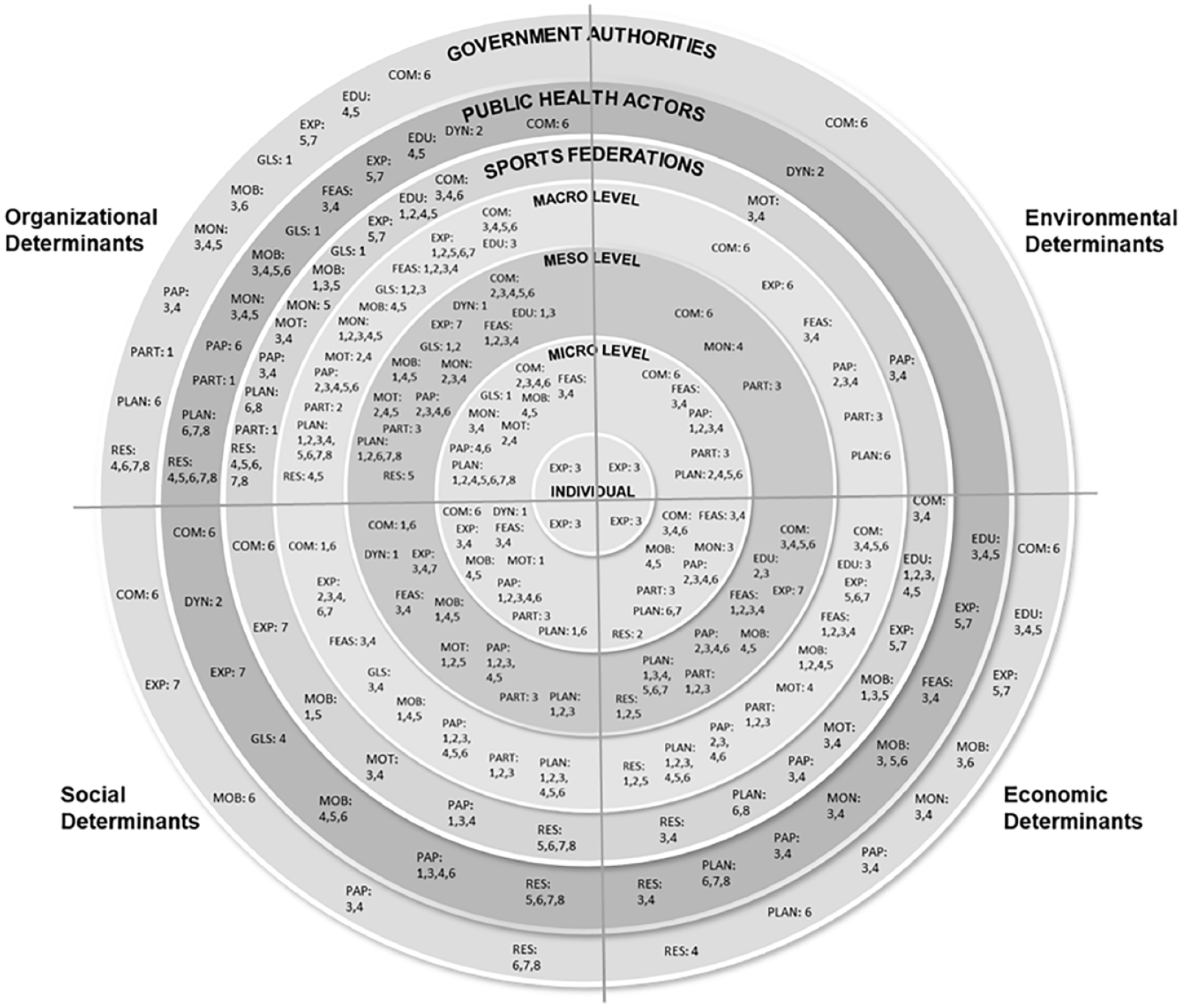
The updated health promoting sports club framework.
Formulating strategies and intervention components
Statements from the concept mapping study (7) were analysed and then compared with the strategies and intervention components from the original framework (6). In response, two strategies and nine intervention components were modified. The ‘Policies’ strategy was removed owing to the focus on policy planning rather than drafting (6); corresponding intervention components were incorporated into the ‘Planning’ strategy and relabelled accordingly. While no new strategies emerged, 14 new intervention components were formulated and labelled, predominantly within the Education, Experience, Mobilization, Participative Approach and Resources strategies (Table 1).
Health promoting sports club strategies and intervention components.
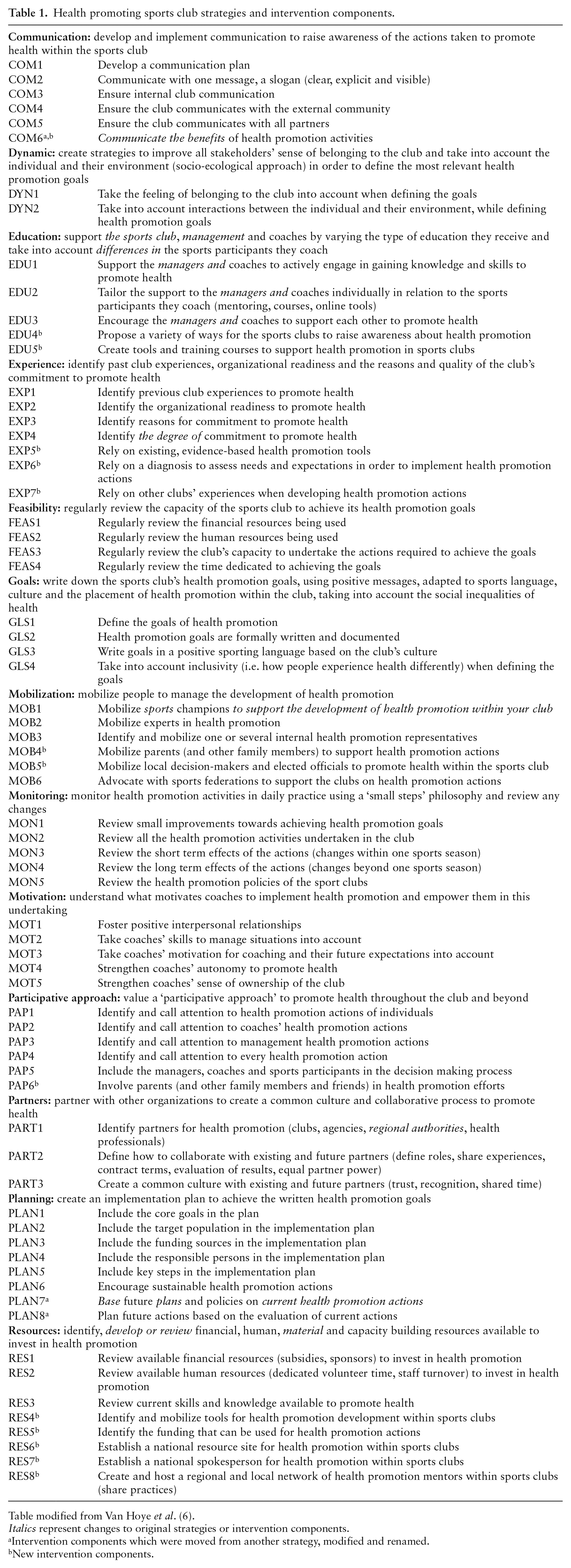
Table modified from Van Hoye et al. (6).
Italics represent changes to original strategies or intervention components.
Intervention components which were moved from another strategy, modified and renamed.
New intervention components.
Framework revision
To integrate these new intervention components into the original HPSC framework, a qualitative one-day seminar with French sports federations (2), public health experts (2) and academics (3) was conducted.
The seminar participants classified 45 intervention components into the HPSC model. This included three intervention components created during the original workshops (GLS1, MOB3, MOT3), four intervention components not meeting original consensus (DYN2, EDU3, FEAS4, RES3) and four modified intervention components requiring reconsideration (COM3–5 and MON5) (6). Additionally, 14 intervention components from the concept mapping study were integrated (EDU4–5, EXP5–7, MOB4–6, PAP6, RES4–8). Finally, 20 intervention components originally classified into the undefined levels were re-classified into the updated levels (EDU1–2, EXP3, DYN2, FEAS3, GLS4, MOB1, MON3–4, MOT3–4, PAP1,3–5, PART1, PLAN6–8, RES3) (Supplemental material File 1 online). This updated HPSC intervention framework now includes 13 strategies with 69 intervention components derived from combining the outcomes of top-down and bottom-up approaches (Figure 1).
Implications for the HPSC framework
When creating health promotion interventions, a participative approach is critical, as it combines stakeholder needs and experiences with scientific evidence to add credibility, feasibility and applicability (3). The revised HPSC model now represents all potential levels impacting sports club stakeholders and provides an improved definition of external actors’ investment and leverage for sports clubs. The additional intervention components included in the updated HPSC framework offer sports clubs more options for advocating and seeking external support when planning health promotion interventions. Previous research supported the inclusion of a Sports Federation and Governmental Authorities level by demonstrating that support from sport federations and state sporting organizations can influence members’ perceptions of health promotion within their club, as well as assisting sports clubs to build organizational capacity for health promotion (8), by providing resources such as funding and education. In addition to the external levels, the updated HPSC model defines how individuals are part of and impacted by the sports club, managers and coaches (9). This commentary describes how top-down and bottom-up approaches have been integrated to provide sports clubs with context-specific and evidence-informed strategies for health promotion intervention planning. Integrating evidence and stakeholder perspectives strengthens the applicability of the HPSC model and intervention framework when planning and implementing interventions targeting multiple levels and health determinants in the sports club setting.
Supplemental Material
sj-xlsx-1-ped-10.1177_17579759231195562 – Supplemental material for A health promoting sports club framework: strategies from the field
Supplemental material, sj-xlsx-1-ped-10.1177_17579759231195562 for A health promoting sports club framework: strategies from the field by Stacey Johnson, Aurélie Van Hoye, Susanna Geidne, Alex Donaldson, Florence Rostan, Fabienne Lemonnier, Benjamin Tezier and Anne Vuillemin in Global Health Promotion
Footnotes
Declaration of conflicting interests
The authors have no conflicts of interest to declare.
Funding
The authors received no financial support for the research, authorship, and/or publication of this article.

Supplemental material
Supplemental material for this article is available online.
References
Supplementary Material
Please find the following supplemental material available below.
For Open Access articles published under a Creative Commons License, all supplemental material carries the same license as the article it is associated with.
For non-Open Access articles published, all supplemental material carries a non-exclusive license, and permission requests for re-use of supplemental material or any part of supplemental material shall be sent directly to the copyright owner as specified in the copyright notice associated with the article.
