




Abstract
University students globally are reportedly living unhealthy lifestyles, challenging universities to develop physical activity (PA) and health promotion (HP) intervention strategies. The current study aimed to review global universities’ physical activity and health promotion activities to inform the PA and HP guidelines for Eswatini university students in the Sub-Saharan region. An electronic search was performed for review articles published between 1996 and 2021, using Cochrane, Google Scholar, PubMed Central, Scopus, and Medline Web of Science databases. The documents reviewed showed that some global universities under investigation follow the health promoting university (HPU) concept influenced by the Ottawa charter (1986). The review articles further showed that implementing the healthy university concept differs due to cultural and contextual differences from one institution to another. The reviews showed the main item areas as smoking control/alcohol and drug abuse, mental health, sexual health, physical activities, healthy eating habits/diet categorized under health promotion. The main PA activities were pedometer activity tracking, measurement of PA using validated questionnaires, sports, games, among other intervention activities. The HPU concept is thus a good starting point that can be promoted and spread to all other universities globally with different charters’ guidance, including the Ottawa charter and the Okanagan charter.
Keywords
Introduction
Globally, university students are reportedly sedentary, leading unhealthy lifestyles (1–3); hence the need to provide physical activity (PA) and health promotion (HP) intervention strategies led to the concept known as health promoting universities (HPUs) in 1996 (1). Although the HPU concept has been adopted by some universities (4), this concept has not been fully explored globally, despite its immense contribution to university students’ health (4–6).
The objectives of a health promoting university are: (a) to promote healthy and sustainable policies and to plan throughout the university; (b) to provide a healthy working environment; (c) to support the personal health and social development of the persons involved; (d) to establish and improve primary health care; (e) to ensure a healthy and sustainable physical environment; (f) to encourage broader academic interest and developments in health promotion; and (g) to develop links with the community (7).
The HPU concept was developed in Western Europe (1996) and influenced by the Ottawa charter (1986) (4). The Ottawa charter was drawn up by the international conference jointly organized by the World Health Organization (WHO), Health and Welfare Canada and the Canadian Public Health Association to achieve health for all by 2000 and beyond (4). Its evolvement has been seen primarily in its influence on the HPU concept and new charters such as the Edmonton charter (2005) and the Okanagan charter (2015).
Several universities in Europe, North America and Asia are part of the HPU network, though other scholars say it lacks coordination (1). The Okanagan charter (8) is seen as an evolvement of both the Ottawa charter and the Edmonton charter. In June 2015, the University of British Columbia co-hosted the International Conference on Health Promoting Universities and Colleges at its Okanagan campus, bringing together participants from 45 countries representing both educational institutions and health organizations, including WHO and UNESCO, who collaborated on the development of the Okanagan Charter: An International Charter for Health Promoting Universities and Colleges. The Okanagan charter has two calls to action for higher education institutions: (a) embed health into all aspects of campus culture, across the administration, operations and educational mandates; and (b) lead health promotion actions and collaboration locally and globally.
Other influential charters in Asia and North America include the Australian University Network (AUN) Health Promotion Framework (2017) (9) and the American College Health Association guidelines (2019) (10). However, other universities, especially in Africa, have not been part of an HPU network, with researchers reporting that health promotion intervention programmes positively influenced university students’ health outcomes in the continent, specifically in Sub-Saharan Africa (11). It is thus imperative that further reviews be performed to enable more universities, especially in the African continent, to adopt and implement the HPU concept with the correct knowledge of the activities expected.
While WHO (12) and the American College of Sports Medicine (ACSM) (13) have published and promoted guidelines for the world to adopt, these have not been specific to the HPU concept. For example, the WHO and ACSM guidelines are aimed at adults aged 18–64 and entail general time frames to be spent on moderate and/or vigorous exercise per week. The WHO and ACSM guidelines were primarily developed to promote physical activity across all age groups to reduce the burden of sedentary-related illnesses. Burdens of sedentary-related illnesses (underlying conditions) now include risk of developing severe COVID-19 complications. Hence, university students can also be at risk of underlying conditions due to their generally limited physical activity and poor eating habits. In this regard, researchers show that university students often find themselves pressured by academic demands, with the structure of lectures making it challenging to maintain an active lifestyle (2). Therefore, the students are at risk of the effects of sedentariness (14).
Effects of sedentary behaviours, including overweight and obesity, are significant drivers of illnesses and chronic diseases (15) and susceptibility to respiratory and vascular diseases such as COVID-19 (16). Globally, the International Obesity Task Force and WHO report that over 1.1 billion adults worldwide are overweight, and 312 million are obese (17). According to WHO (2020) (16), the worldwide prevalence of obesity nearly tripled between 1975 and 2016. A study by Tafireyi and Grace (2) concluded that a high prevalence of overweight and obesity (40.4%) and unhealthy behaviours were prevalent among university students in Eswatini. Physical inactivity and sedentary lifestyles may lead to overweight and obesity (18), indicating the necessity of leading a healthy lifestyle, i.e. engaging in physical activity.
Physical activity has numerous benefits, including reduction of stress and anxiety, boosting of happy chemicals, improvement of self-confidence and self-image, improvement of muscles, bone, strength, and prevention of non-communicable diseases (NCDs), among others (19). In this regard, WHO indicates that overweight and obesity are significant causes of death worldwide, with 2.8 million people dying each year (20). Another 44% die from diabetes, 23% from ischemic heart disease, and between 7 and 41% of certain cancer burdens (20). The irony is that such burdens can be reduced significantly by maintaining a good body fat composition and engaging in moderate physical activities. Lifestyle choices of food behaviours can also be altered to achieve health-related fitness, even at the university level (21), with researchers indicating that physical activity and health promotion activities are essential for university students (2). These, among other issues, have influenced the HPU concept in Europe, North America and Asia, with the same concept untenable yet in Sub-Saharan Africa.
Hence, for university students to improve their PA levels and HP activities to reduce the burden of sedentary-related illnesses, PA and HP guidelines and interventions should be developed. For example, researchers concluded that theory-based, contextually appropriate interventions might increase physical activity among university students in Sub-Saharan Africa (11). A review by Ferreira et al. (22) suggests that it is necessary to publish health promotion intervention results within the university context. However, as the guidelines and/or implementation of HP interventions differ from one continent to the other (5), there is a need to review the reviews of PA and HP interventions conducted in all continents to inform PA and HP guidelines for Eswatini universities and Sub-Saharan Africa to a more considerable extent.
The absence of an HPU network, specifically in Sub-Saharan Africa, has left universities with an ‘individual’ autonomy on health promotion policies and guidelines, with researchers reporting the absence of interventions (2). A study on the association between sedentariness, eating habits and body composition among Eswatini university students recommended developing intervention strategies and guidelines on eating habits and an active lifestyle among university students in Eswatini (2). Hence, the current study aims to ascertain the PA and HP activities included in global universities’ interventions to inform the development of guidelines for the universities in Eswatini. It is also purposed to provide a base for creating similar PA and HP guidelines for Sub-Sahara African universities.
Methods
Criteria for considering reviews for inclusion
Our review included reviews that concentrated on the HPU concept launched in Europe in 1996 and reviews that specified the inclusion criteria. We also considered reviews that highlighted the physical activities and health promotion guidelines for global university students.
Article selection and search criteria
A comprehensive electronic search was performed between 1 January 1996 and 30 October 2021, using PubMed Central, Google Scholar, Cochrane, Scopus, Medline Web of Science databases. The search terms used were: ‘healthy universities’, ‘health-promoting universities’, ‘university students’, and ‘health promotion interventions’. Reference lists in the selected reviews were reviewed to identify more articles for inclusion in our overview. The following filters were used: Abstract, Free full text, Review, Systematic Review.
Inclusion and selection criteria
Two reviewers (CT and CG) independently assessed all titles and abstracts of identified reviews and applied the following five inclusion criteria to determine if the articles warranted further investigations: (a) Were they reviews? (b) Were they published in English? (c) Did they include the HPU concept/PA and HP guidelines specific to global universities? (d) Were they published between 1 January 1996 and 30 October 2021? (e) Were the contents pertinent to the aim of the study? All eligible articles were evaluated by the two independent reviewers, who examined all of the empirical evidence and discussed the discrepancies. A third reviewer settled disagreements between the two reviewers.
Exclusion criteria
‘Non-review articles were excluded from this review.’ Then, reviews that did not focus on the Heath Promoting University (HPU) concept or intervention for university students were excluded.
Data extraction
Two reviewers (CT and CG) independently screened titles and abstracts according to the inclusion criteria. Studies that met the inclusion criteria were evaluated with full text. The data extracted included information on the author(s), year of publication, action areas, quality assessment, outcomes, and main results. Any disagreement that occurred on study inclusion or data extraction between the reviewers was resolved by discussion.
Results
Literature selection
Initially, the authors identified 585 studies using the search criteria reflected in Figure 1. In addition, Mendeley Desktop reference management was used to identify duplication and data management. After removing duplications, checking the eligibility of full-text articles, applying exclusion criteria and screening, eight papers met the inclusion criteria.
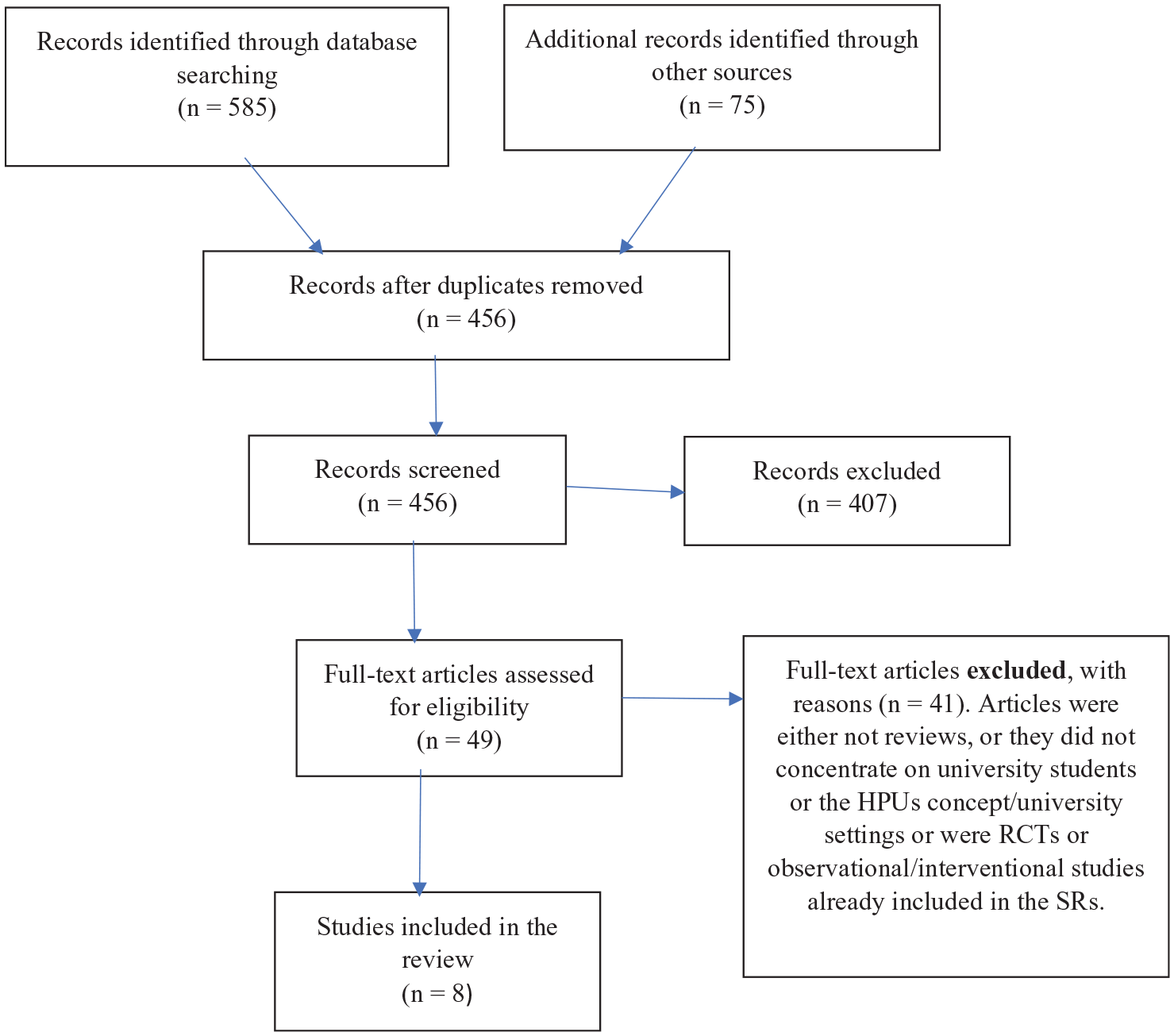
The process of screening and selecting data from the literature for the review.
The eight articles selected comprised seven sytematic reviews (SR) and one integrative review (IR). The characteristcs of the eight reviews are given in the next section.
Study characteristics
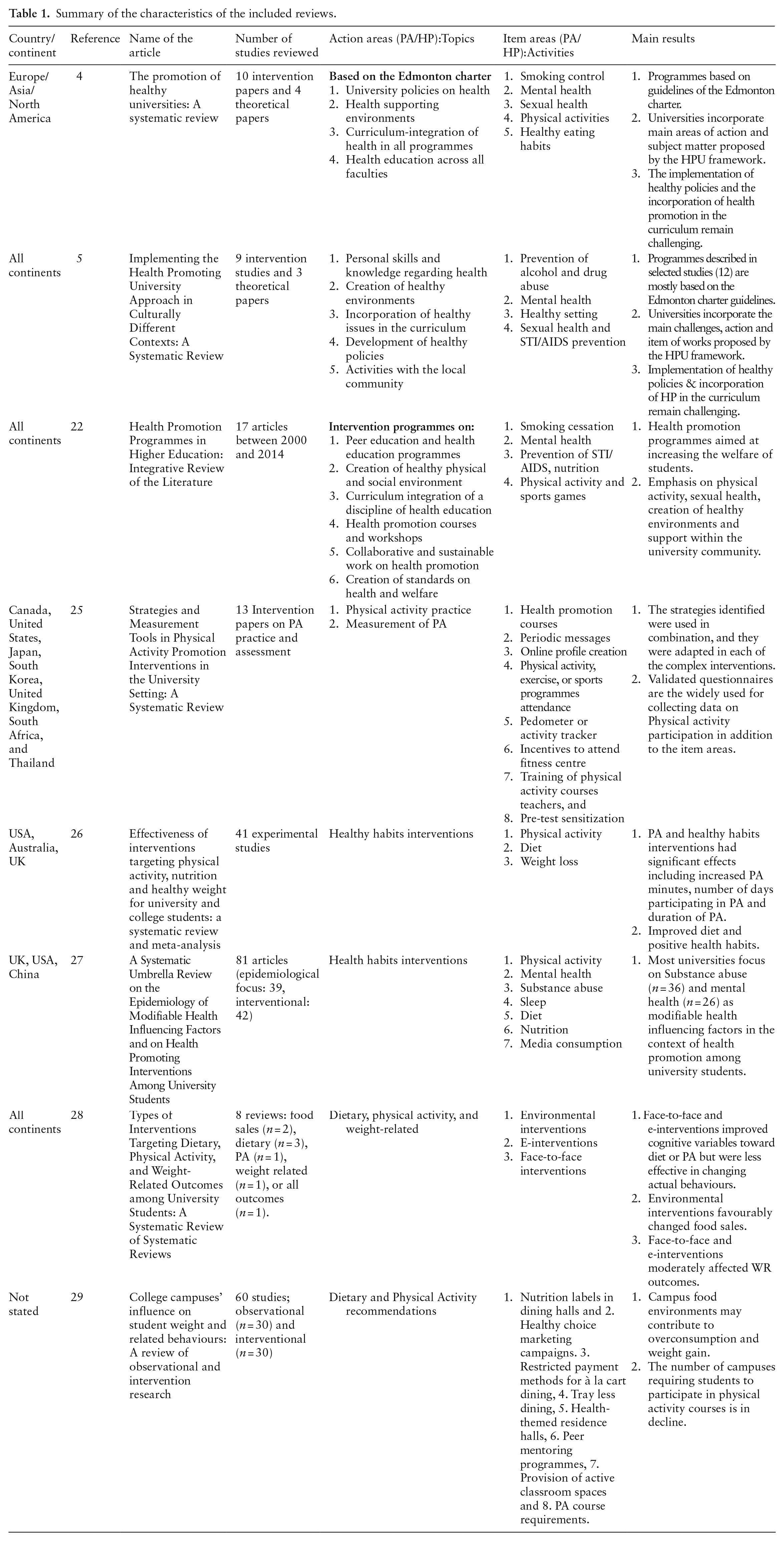
Table 1 shows the study characteristics, i.e. country where the reviews were done, name of the article, number of studies reviewed, action areas for PA and HP, item areas for PA and HP, and the scientific evidence or summary of the results. These reviews included 104 intervention studies for PA and diet, 32 theoretical papers, 41 experimental, 30 observational studies and 39 with an epidemiological focus, making a total of 246 studies. The studies encompassed all global continents. The action areas are the broad areas or topics for PA and HP interventions in global universities, whereas the item areas are the main topics for PA/HP activities in global universities.
Summary of the characteristics of the included reviews.
Summary of results
Three of the eight reviews focused on the HPU concept/healthy universities, whereas five reported intervention programmes universities have used to promote health and well-being among university students. The reviews reported five key item areas (topics) for health promotion: smoking control/alcohol and drug abuse, mental health, sexual health, physical activities, healthy eating habits/diet categorized under health promotion. The majority of reviews embedded physical activities as an area for health promotion. Physical activity is also the most frequent intervention focused on the university students included in the reviews, followed by dietary or eating habits and mental health. PA mainly was done through programmes designed for university students, PA tracker and PA measurements.
Health promotion
The reviews reported health promotion action areas as follows: (a) healthy supportive environments; (b) curriculum integration; (c) health education across all faculties; (d) health promotion policies; and (e) physical activity (4,5,22–27). The implementation of the action areas on health promotion is done differently according to the availability of resources and cultural contexts (4). Reis et al. (5) reported that most universities in their review relied heavily on the HPU approach designed in Western Europe but were at different stages, with the action areas influenced mainly by the Edmonton charter. However, the influence of the charters and the HPU concept was only reported in three reviews (4,5,22). The other five reviews were interested in PA and dietary interventions and not precisely the HPU concept or its implementation (23–27).
Smoking control/alcohol and drug abuse
Four reviews reported smoking control/alcohol and drug abuse (4,5,22,25). The results showed that smoking control, drug and substance abuses are major item areas or health promotion topics. In addition, universities have various ways of implementing smoking control/alcohol and drug abuse, with most studies in the reviews reporting prevention of alcohol and drug abuse and promoting smoke-free spaces (4).
Mental health
Four out of the eight reviews identified mental health as a critical area that universities focus on (4,5,22,25). The reviews reported incorporating mental health activities in the universities’ work items or health topics. Most of the activities aligned to mental health promotion included intervention programmes.
Sexual health
Sexual health was reported in three reviews (4,5,22). The reviews reported that HPU universities focus on sexual health as an item for health promotion. In one review (4), it was reported to prevent STI/AIDS. A review by Ferreira et al. (22) reported that intervention strategies of a 12-week project implemented on university students under investigation increased knowledge and awareness of STI/AIDS.
Physical activities
Seven reviews reported physical activities (5,22–27) as part of item areas for health promotion or intervention programmes. One review reported measurement tools for physical activities (23), further stating that the universities were using pedometers as a physical activity tracker as part of health promotion action areas for university students, also providing incentives for physical activity participation. However, the same review reported that validated questionnaires were the main instrument for PA measurement. Generally, all the reviews stated interventions of PA using various programmes as determined by the university. The most common reported PA activities were pedometer activity tracking, measurement of PA using validated questionnaires, sports and games.
Healthy eating habits/diet
Six reviews reported healthy eating habits/diet (5,23–27), while two reviews (4,27) mentioned healthy settings or environmental interventions. Furthermore, the healthy settings incorporated healthy eating from the university cafeteria and nutrition labels in the dining halls. In addition, campus food environments were reported to be contributing to overconsumption and weight gain (27). One of the reviews stated several interventions, including nutrition labels in dining halls, healthy choice marketing campaigns, restricted payment methods for à la carte dining, trayless dining, and health-themed residence halls (27).
Discussion
This is the first review of published reviews, of which the authors are aware, collating evidence relating to the physical activity and health promotion activities of global university students. Although the eight summarized reviews represent evidence from a relatively small number of reviews, the findings are informative when considering the large number of studies included in the reviews (n = 246). In addition, they give an overview of global university students’ physical activity and health promotion activities that can be applied not only to Eswatini university students but also to Sub-Saharan students. The HPU concept is implemented through PA and HP activities, derived from various health promotion charters (4). The health promotion concept’s main characteristic is to provide a platform for university students to lead a healthy lifestyle and access health promotion services (1).
The various guidelines (8–10) emphasized a setting-based approach to health promotion and the embedding of health promotion in all campus aspects. The reviews aligning with the HPU concept showed that universities implemented the setting-based approach differently (4,5,22). Although the interventions presented a scheme of action areas, including perspectives, settings, standards, goals, and health promotion areas of concentration, the PA and HP activities are being implemented in a localized way by various universities (4). They are divided by the authors of the reviews into two significant areas: action areas and item areas (topics), as presented in Table 1.
Some of the intervention programmes for PA and HP in the HPUs are guided by the Edmonton charter (2005), Ottawa charter (1986) and Okanagan charter (2015) (4,5,22). Adapting the HPU concept to different cultures was highlighted to be essential (4). Implementation of PA and HP activities is possible with full consideration of the Okanagan charter’s two main calls in mind: (a) embed health into all aspects of campus culture across the administration, operations and academic mandates; and (b) lead health promotion action and collaboration locally and globally. The growing number of HPUs in the world is a testimony of the impact of the charters described above (28) in influencing health behaviours among university students.
These two action areas are evident throughout the reviews’ theoretical papers and intervention programmes focusing on the HPU concept (4,5,22). General item areas or activities for inclusion in PA and HP guidelines as evident in the reviews include cessation of smoking, physical activities, healthy eating, sexual health and STI/AIDS prevention. Fifty per cent of reviews show that universities have to ensure that the settings approach is followed to implement PA and HP activities (4,5,22,26). However, the other reviews (23–25,27) did not mention the settings approach; they focused on individual interventions without considering the whole settings approach. Not mentioning the settings approach may imply that not all global universities derive their PA and HP activities and interventions from the HPU concept.
HP activities were consistent across reviews when compared to PA activities. Universities implement PA in so many ways, including PA tracking, PA measurements, sports, games and PA courses. In addition, Heeren et al. (11) confirmed that PA interventions improved university students’ participation in PA activities. However, it can be argued that PA interventions alone may not be effective in improving the health habits of university students, but full consideration of the HPU/healthy universities concept to accommodate campus settings, HP activities and evaluation of intervention programmes may increase effectiveness (4,5,22,28–30). Dooris et al. (30) have asserted: ‘even with Okanagan charter inspiring universities, there are still major challenges in translating the rhetoric of whole systems approach into meaningful action, with large, complex, and culturally diverse organizations.’ However, the same authors confirmed the HPU as a ‘truly global movement in four continents’.
Strengths and limitations
The study relied upon information from eight reviews representing 246 studies: theoretical reviews, experimental (including RCTs), and observational interventions. Information reviewed was thus for the universities included only in the eight reviews, making the findings’ generalizability beyond those universities limited. However, the selection of reviews helped obtain only the most relevant information on the concept, which could have been difficult to obtain, given numerous articles on health promotion and interventions targeting various populations, including university students. The strategy to choose reviews covering so many global universities thus positions this paper, to our knowledge, as the first in Sub-Saharan Africa to focus on the HPU concept or the healthy universities approach. The study’s significance is that it will serve as a reference point for the HPU concept/healthy universities in Eswatini, Sub-Saharan Africa and Africa at large.
Conclusion
This overview of reviews highlighted the limited number of reviews on global university students’ physical activity and health promotion activities. At the same time, only three out of the eight reviews focused on the HPU concept, while the other five focused on interventions programmes for either PA or diet. Universities in the HPU network use the whole systems approach, multi-service collaboration and evaluation process. The primary item areas for health promotion (activities) were smoking control/alcohol and drug abuse, mental health, sexual health, physical activities, healthy eating habits, and alcohol and drug abuse. The main interventions for the HP of university students were reported to be PA, diet and mental health. Additionally, PA was mainly in sports, games, tracking and measurements.
Our study’s results call for the health promotion university concept to be promoted and spread to all other universities globally with the guidance of different charters, including Ottawa, Edmonton and Okanagan, among other localized guidelines. In addition, considering the broader concept of the HPU is essential to create a base for PA and HP activities focusing on university students, using the whole settings approach.
Footnotes
Declaration of conflicting interests
The author(s) declared no potential conflicts of interest with respect to the research, authorship, and/or publication of this article.
Funding
The author(s) received no financial support for the research, authorship, and/or publication of this article.
