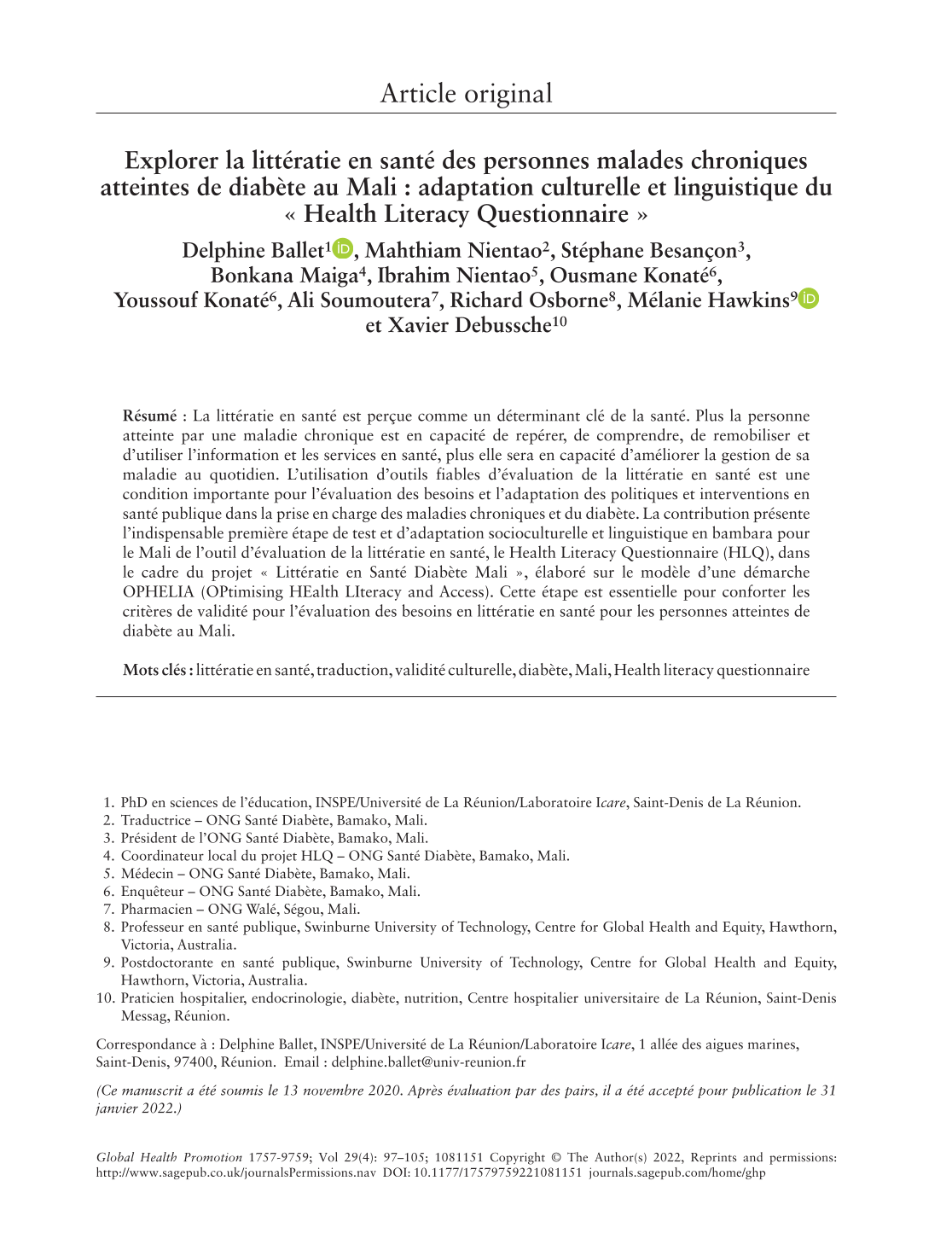
Explorer la littératie en santé des personnes malades chroniques atteintes de diabète au Mali : adaptation culturelle et linguistique du « Health Literacy Questionnaire »
Restricted accessResearch articleFirst published online December, 2022
Explorer la littératie en santé des personnes malades chroniques atteintes de diabète au Mali : adaptation culturelle et linguistique du « Health Literacy Questionnaire »
Balcou-DebusscheM. De l’éducation thérapeutique du patient à la littératie en santé. Problématisation socio-anthropologique d’objets didactiques contextualisés. Paris: Editions des Archives Contemporaines; 2016. 239 p.
2.
BatterhamRWHawkinsMCollinsPABuchbinderROsborneRH. Health literacy: applying current concepts to improve health services and reduce health inequalities. Public Health. 2016; 132: 3–12.
3.
DebusscheXBalcou-DebusscheM. Analyse des profils de littératie en santé chez des personnes diabétiques de type 2: la recherche ERMIES-Ethnosocio Health literacy profiles in type 2 diabetes: the ERMIES-Ethnosocio study. Sante Publique (Paris). 2018; 30(S1): 157–168.
4.
HeijmansMWaverijnGRademakersJvan der VaartRRijkenM. Functional, communicative and critical health literacy of chronic disease patients and their importance for self-management. Patient Educ Couns. 2015; 98: 41–48.
5.
KickbuschIPelikanJMApfelFTsourosAD. Health Literacy: The Solid Facts. World Health Organisation Regional Office for Europe; 2013. 86 p.
6.
DodsonSGoodSOsborneR. Health Literacy Toolkit for Low and Middle-Income Countries: A Series of Information Sheets to Empower Communities and Strengthen Health Systems. New Dehli, India: World Health Organization;2015. 146 p.
7.
DewaltDABerkmanNDSheridanSLohrKNPignoneMP. Literacy and health outcomes: a systematic review of the literature. J Gen Intern Med. 2004; 19: 1228–1239.
8.
BeauchampABatterhamRWDodsonSAstburyBElsworthGRMcPheeC, et al. Systematic development and implementation of interventions to OPtimise Health Literacy and Access (Ophelia). BMC Public Health. 2017; 17: 230.
9.
BakkerMMPutrikPAabyASEDebusscheXMorrisseyJBorgeCR, et al. Acting together – WHO National Health Literacy Demonstration Projects (NHLDPs) address health literacy needs in the European Region. Public Health Panor. 2019; 5: 233–243.
10.
World Health Organization. Global Coordination Mechanism on the Prevention and Control of Noncommunicable Diseases. Considerations for setting up a National Health Literacy Demonstration Project (NHLDP). Melbourne, Australia: World Health Organization; 2017.
11.
OsborneRHBatterhamRWElsworthGRHawkinsMBuchbinderR. The grounded psychometric development and initial validation of the Health Literacy Questionnaire (HLQ). BMC Public Health. 2013; 13: 658.
12.
BuchbinderRBatterhamRElsworthGDionneCEIrvinEOsborneRH. A validity-driven approach to the understanding of the personal and societal burden of low back pain: development of a conceptual and measurement model. Arthritis Res Ther. 2011; 13: R152.
13.
WahlAKHermansenÅOsborneRHLarsenMH. A validation study of the Norwegian version of the Health Literacy Questionnaire: a robust nine-dimension factor model. Scand J Public Health. 2021; 49: 471–478.
14.
DebusscheXLenclumeVBalcou-DebusscheMAlakianDSokolowskyCBalletD, et al. Characterisation of health literacy strengths and weaknesses among people at metabolic and cardiovascular risk: validity testing of the Health Literacy Questionnaire. SAGE Open Med. 2018;6. DOI: 10.1177/2050312118801250.
15.
NolteSOsborneRHDwingerSElsworthGRConradMLRoseM, et al. German translation, cultural adaptation, and validation of the Health Literacy Questionnaire (HLQ). PLoS One. 2017; 12: e0172340.
16.
MaindalHTKayserLNorgaardOBoAElsworthGROsborneRH, et al. Cultural adaptation and validation of the Health Literacy Questionnaire (HLQ): robust nine-dimension Danish language confirmatory factor model. Springerplus. 2016; 5: 1232.
17.
KolarcikPCepovaEMadarasova GeckovaAElsworthGRBatterhamRWOsborneRH. Structural properties and psychometric improvements of the Health Literacy Questionnaire in a Slovak population. Int J Public Health. 2017; 62: 591–604.
18.
SørensenKVan den BrouckeSPelikanJMFullamJDoyleGSlonskaZ, et al. Measuring health literacy in populations: illuminating the design and development process of the European Health Literacy Survey Questionnaire (HLS-EU-Q). BMC Public Health. 2013; 13: 948.
19.
NutbeamD. Health literacy as a public health goal: a challenge for contemporary health education and communication strategies into the 21st century. Health Promot Int. 2000; 15: 259–268.
20.
ChinnD. Critical health literacy: a review and critical analysis. Soc Sci Med. 2011; 73: 60–67.
21.
SamerskiS. Health literacy as a social practice: social and empirical dimensions of knowledge on health and healthcare. Soc Sci Med. 2019; 226: 1–8.
22.
Balcou-DebusscheM. Interroger la littératie en santé en perspective de transformations individuelles et sociales. Analyse de l’évolution de 42 personnes diabétiques sur trois ans. Rech Educ. 2016; 16: 73–86.
BesançonSTraoreS. Diabetes, a public health challenge for Mali. Soins. 2013; 781: 16–19.
25.
DebusscheXBesançonSBalcou-DebusscheMFerdynusCDelisleHHuiartL, et al. Structured peer-led diabetes self-management and support in a low-income country: the ST2EP randomised controlled trial in Mali. PLoS One. 2018; 13: e0191262.
26.
Institut National de la Statistique-Mali. Enquête modulaire et permanente auprès des ménages (EMOP). Rapport d’analyse, premier passage2017.
27.
DrozYSteinerBWeyerF. Le courtier du virtuel: l’accès controversé aux informations médicales en ligne au Mali. Sci Soc Sante. 2010; 28: 89–108.
28.
CanutC. Dynamique plurilingue et imaginaire linguistique au Mali: entre adhésion et résistance au bambara. Lang société. 1996; 78: 55–76.
29.
Chaire pour le développement de la recherche sur la culture d’expression française en Amérique du Nord. Aménagement linguistique du Mali. [Internet]. 2017 [Consultée le 20 mai 2021]. http://www.axl.cefan.ulaval.ca/afrique/mali.htm
DoumbiaSGoeuriotLFauvetM. Quels problèmes pour la recherche d’information médicale au Mali? RJCRI – CORIA. Marseille, France; 2017.
32.
DemestreG. Le bambara véhiculaire du Mali. Faits Lang. 1998; 11–12: 121–127.
33.
Mbodj-PouyeAVan den AvenneC. « C’est bambara et français mélangés » : Analyser des écrits plurilingues à partir du cas de cahiers villageois recueillis au Mali. Lang société. 2007; 120: 99–127.
34.
HawkinsMElsworthGROsborneRH. Application of validity theory and methodology to patient-reported outcome measures (PROMs): building an argument for validity. Qual Life Res. 2018; 27: 1695–1710.
35.
HawkinsMElsworthGROsborneRH. Questionnaire validation practice: a protocol for a systematic descriptive literature review of health literacy assessments. BMJ Open. 2019; 9: e030753.
36.
NguyenTHParkHHanH-RChanKSPaasche-OrlowMKHaunJ, et al. State of the science of health literacy measures: validity implications for minority populations. Patient Educ Couns. 2015; 98: 1492–1512.
37.
HawkinsMChengCElsworthGROsborneRH. Translation method is validity evidence for construct equivalence: analysis of secondary data routinely collected during translations of the Health Literacy Questionnaire (HLQ). BMC Med Res Methodol. 2020; 20: 1–13.
38.
EpsteinJSantoRMGuilleminF. A review of guidelines for cross-cultural adaptation of questionnaires could not bring out a consensus. J Clin Epidemiol. 2015; 68: 435–441.
39.
BeatonDEBombardierCGuilleminFFerrazBF. Guidelines for the process of cross-cultural adaptation of self-report measures. Spine. 2000; 25: 3186–3191.
40.
PrakashVShahSHariohmK. Cross-cultural adaptation of patient-reported outcome measures: a solution or a problem?Ann Phys Rehabil Med. 2019; 62: 174–177.
41.
EpsteinJOsborneRHElsworthGRBeatonDEGuilleminF. Cross-cultural adaptation of the Health Education Impact Questionnaire: experimental study showed expert committee, not back-translation, added value. J Clin Epidemiol. 2015; 68: 360–369.
42.
ElsworthGRBeauchampAOsborneRH. Measuring health literacy in community agencies : a Bayesian study of the factor structure and measurement invariance of the health literacy questionnaire (HLQ). BMC Health Serv Res. 2016; 16: 508.