



Abstract
In 2017, the Institute of Tropical Medicine Pedro Kourí, University of Montreal Public Health Research Institute, and McGill University joined efforts to provide scenarios for scientific exchange and knowledge dissemination about the social science contribution on arboviral research. This commentary describes the scientific collaboration between Cuban and Canadian (Quebec) institutions, illustrating the need and opportunities to facilitate research and effective decision-making processes for arboviral prevention and control, going beyond traditional biomedical aspects. We organized a set of scientific activities within three international events conducted in Cuba between 2017 and 2018. Given the collaborating institutions’ expertise and the knowledge gaps in arboviral research, we selected three main thematic areas: social determinants and equity, community-based interventions and use of evidence for decision-making. The partnership shows that interdisciplinary collaboration and the use and integration of quantitative and qualitative methods from the social sciences is essential to face the current challenges in arbovirus research.
Keywords
Introduction
Arboviruses such as dengue continue to increase globally, with 3.9 billion people at risk of infection in 120 countries (1). An acute re-emergence of arboviruses, including a continued increase of dengue and the introduction of chikungunya and zika, has been observed lately in the Americas region (2). Although research on these arboviruses is dominated by epidemiology and biomedical sciences (1,3,4), a common denominator in both clinical research and evaluation of vector control strategies is the consideration of arboviruses as diseases of poverty (5–7). Thus, the increasing burden of arboviral diseases can, in part, be considered a result of malfunctioning structural social factors related to society, the environment, and the individual (8–10).
There is a growing consensus that methods in the social sciences can enhance global health research, including the understanding of processes influencing vector-borne diseases (2,4,6,7,11). Furthermore, integrating the social sciences into global health research results is useful when the research considers issues about equity, social justice, and community-based interventions (8,12). Although such integration requires cross-cultural and multidisciplinary approaches, very few scenarios highlight the contributions of the social sciences to reduce the research gaps (6,10). Likewise, the added value of integrating methods from the social sciences to improve decision-making on interventions for prevention and control of arboviruses is not always emphasized (6,10,12).
This commentary paper describes a scientific collaboration between Cuban and Canadian (Quebec) institutions. We illustrate the need and opportunities for joint and cross-cultural efforts to facilitate research and effective decision-making process for the prevention and control of arboviral diseases, going beyond the traditional biomedical aspects.
Institutional scientific collaboration
Since 2017, the Institute of Tropical Medicine Pedro Kourí (IPK), the University of Montreal’s Public Health Research Institute (IRSPUM), and McGill University School of Population and Global Health (SPGHMG) have developed a multidisciplinary collaboration that aims to increase the integration of social sciences in arboviral research. The institutional (IPK-IRSPUM-SPGHMG) partnership initiated from previous collaboration between individuals at the abovementioned institutions. Agreement to begin the collaboration started with informal but explicit expressions of willingness to work collaboratively. The activities initiated without any specific source of funding and, therefore, the members developed a work plan to be submitted for funding to different Canadian and Cuban agencies. Given the expertise of the collaborating institutions and previously identified knowledge gaps in our research and the literature on arboviral research (9,10,12–14), we selected three main work thematic areas: social determinants of health and equity, community-based interventions, and knowledge transfer. The objectives of the collaboration were (a) to provide scenarios to highlight the contributions of social sciences into research in global health, and (b) to promote the scientific exchange and knowledge dissemination between researchers from Quebec, Cuba, and the international academic community. Therefore, given the target audience and the opportunity to focus on arboviral research, we selected three international events conducted in Cuba between 2017 and 2018 to answer to our scientific collaboration objectives.
Thematic areas
Social determinants and social epidemiology methods
Worldwide, the heaviest burden of arboviruses is reported in low socioeconomic settings, areas with limited access to potable water, high population density, and where the environmental conditions favor the presence of Aedes mosquitoes (8,9). Despite the incidence of notified diseases being similar across different socioeconomic groups during outbreaks, mortality rates and some severe outcomes are higher among people at the bottom of the socioeconomic distribution during interepidemic periods (8,12).
Our scientific exchange, particularly from the discussion of lessons learned and research gaps throughout the participation in the different scientific activities, allowed the identification of common challenges related to the analysis of social determinants on arboviruses such as: (i) misclassification of the socioeconomic exposure and outcomes due to limitations of reliable socioeconomic measures and limitations on arboviral diagnosis, and (ii) robust evaluation of interventions due to the absence of control groups and non-randomized interventions. Likewise, we identified a lack of integrative work and application of available quantitative or qualitative methods, even within our own institutions.
Social epidemiology favours the integration of social sciences into population health research, and promotes the assessment of poverty, access to health care, and the evaluation of health systems in the context of arboviruses. It also contributes to decreasing the potential for biases and ensures the generation of robust evidence. Therefore, given the strength of the McGill University team on quantitative social epidemiologic methods, we shared a theoretical background (15) and some empirical results (12,16) throughout the activities. As methodological tools to mitigate such challenges, we proposed the use of quasi-experimental designs, propensity score techniques, and models accounting for measurement error in the analysis of health inequalities on arboviruses.
Community-based interventions
Community-based interventions (CBIs) are increasingly seen as opportunities to achieve effective, locally adapted vector control (17). CBIs usually encompass, interventions in which at least one component targets the community. Participation of its members ranges from being merely recipients of technocratic control efforts to being truly empowered. Empowerment, defined as the process through which individuals, groups and communities are provided with decision-making skills to impact their lives, serves as a vehicle for tackling collectively the roots and causes of social inequalities that affect people’s health (18).
Empirical research conducted by IPK and IRSPUM in Cuba and Burkina Faso showed that empowerment is feasible and culturally adaptable. In both settings, empowerment proved to be effective for vector reduction (16,19). Particularly, Cuban studies showed that this approach might not only curb vector infestation but also have an impact on dengue transmission (20). However, social determinants of health were not always taken into consideration in all cases.
Through the IPK-IRSPUM-SPGH collaboration, we identified and reduced important learning needs on social determinants of health and equity, their application to arboviruses, and the link with community participation. This highlights the need for: (i) pooling existing participatory tools to frame empowerment strategies within an equity perspective, for example Reflex-ISS (21) and Comprehensive Participatory Planning and Evaluation (22); and (ii) more systematization of experiences that lead to refining a theory of change for empowerment.
Information for decision-making
An ever-growing body of scientific literature is published every year on arboviruses. However, the integration of the resulting evidence remains somehow limited. Knowledge transfer bridges the gap between research and decision-making, not only with governmental institutions but also within academia. Nonetheless, there is also a need for much better training of researchers and decision-makers in effective tools such as policy dialogues and policy briefs, to contribute to a better uptake and more instrumental use of evidence. Moreover, there is a need to continue and intensify training for public health researchers and to recruit experts with strong quantitative and qualitative social science skills into public health intervention teams. Unfortunately, our academic and public health intervention institutions around the world are not yet sufficiently focused on these goals.
As our experience showed, international collaboration could be a solution to develop these skills through academic exchanges that also allow a better understanding of the role of different contexts in the evolution of the social determinants of arboviruses. The political responses are obviously different from one context to another, and it is through these sustained and tenuous exchanges between scientists and decision-makers that we can collectively better address these scourges. However, skills alone are not sufficient for effective policy interventions. It is also necessary to have sufficient funding, political will, and available partners who are able to work with confidence and mutual respect.
Scientific activities and venues
The IPK-IRSPUM-SPGHMG’s scientific activities and the venues for our collaborative approach are described below and summarized in the Table 1.
Activities conducted as part of IPK-IRSPUM-SPGHMG scientific collaboration, 2017–2018.
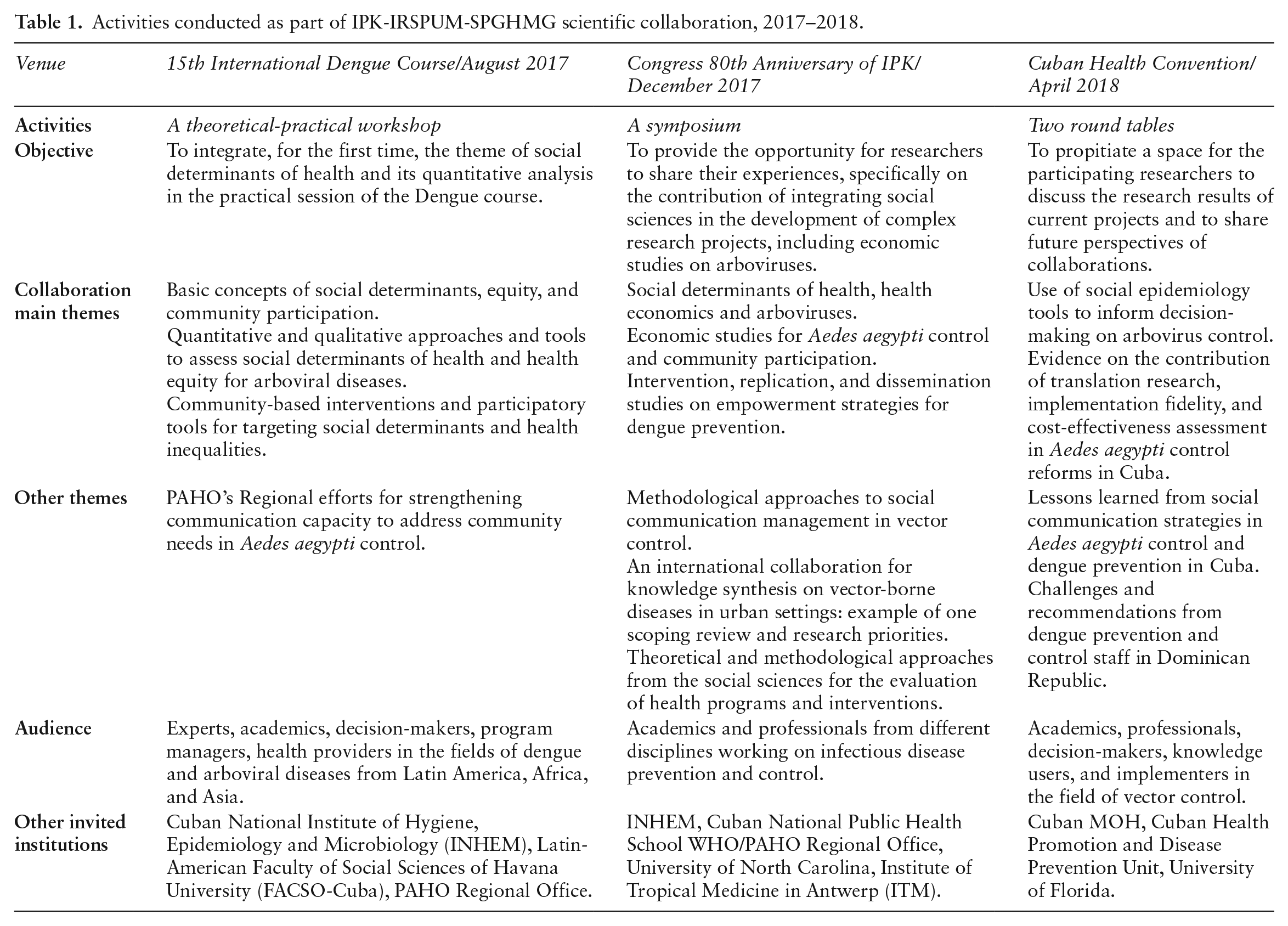
The first activity was the Workshop on social determinants of health, equity and community participation in arboviral diseases conducted within the 15th edition of the International Dengue Course (Havana, Cuba; August 2017). The Dengue course is a biennial capacity-building scenario that provides updates on entomology, epidemiology, and clinical aspects of dengue, chikungunya, and zika to health professionals from Latin America, Africa, and Asia. The theoretical session of the workshop provided different definitions and frameworks. During the practical sessions, the IPK-IRSPUM-SPGH and other invited institutions exchanged tools (22) and proposed the application of methodological approaches (5,15,16) to tackle issues on design and data analysis of arboviral studies with a multidisciplinary group of 30 participants.
Second, we organized the symposium Contributions of the social and behavioural sciences to research in global health as part of the 80th Anniversary of IPK Congress (Havana, Cuba; December 2017). The congress was a forum for more than 300 participants from 20 countries to discuss the epidemiology, diagnosis, prevention, and control of arboviruses, HIV/AIDS, and tuberculosis, among other infectious diseases. The symposium articulated some of IPK-IRSPUM-SPGHMG and WHO/PAHO’s experiences on social determinants, health economics, and arboviruses. The team from IPK presented the results of intervention, replication, and dissemination studies on empowerment strategies for dengue prevention conducted in Cuba (19,23). IRSPUM conducted a pre-congress introductory course on scoping reviews and built on research priorities concerning vector-borne diseases in urban settings that resulted from an international collaboration project for knowledge synthesis (24).
Finally, at the Cuban Health Convention (April 2018), we organized two round tables: Facing arbovirus: lessons learned from social research and How to impact from social science research the decision-making on arboviruses. The Convention, organized by the Cuban Ministry of Health (MOH), was an opportunity to exchange experiences and lessons learned on applied social science beyond biomedical arboviral research. The Ministry of International Relations and Francophonie (MIRF) of Quebec co-funded these activities, which increased the visibility of the IPK-IRSPUM-SPGHMG collaboration in the field and enriched the discussion with external international researchers and decision-makers, allowing us to advocate for more knowledge use by the Cuban National Unit of Vector Control.
Summary of collaborative outcomes
In addition to the oral and poster presentations at the described venues and the scientific manuscripts (including this commentary), the IPK-IRSPUM-SPGHMG collaboration has resulted in several other relevant outcomes.
As a result of our collaboration, the workshop including social epidemiologic methods to assess health inequalities on arboviral diseases, initiated in 2017, has been institutionalized in consecutive versions of the IPK-Dengue and Arboviruses course. This workshop evolved to a theoretical-practical course in the 2019 version of the IPK-Dengue and Arboviruses course, integrating qualitative and quantitative methods of assessment of health inequality and the teaching and exchange of methods for community-based interventions for dengue control. This course is now part of the main training offered by the IPK-Dengue-Arboviruses course to the attendees of this international event (25).
Likewise, to address the identified knowledge gaps on the field of arboviral research, we combined efforts and strengths from each team to develop new and continuing collaborations. The IPK and the IRSPUM initiated a collaboration for assessing the extent and manner to which current literature on arbovirus deals with the components and functioning principles of CBIs. The IPK team initiated a review on acceptability of Aedes aegypti control strategies. Members of the collaboration were co-applicants and obtained a grant from the Canadian Institute of Health Research (CIHR) to conduct a community-based cluster randomized trial for vector control in Brazil. Recently, the team finalized the writing of a protocol for a new project on social communication for arboviruses prevention with gender perspective and intersectionality, for which the team is seeking funding through international non-governmental organizations.
Finally, the team compiled some of the scientific evidence of the contribution of social sciences in implementation science, which was partially obtained through the IPK-IRSPUM-SPGHMG collaboration. This compilation of evidence was recognized with an award by the Cuban Academic of Science in 2019 (26) and, also in 2019, a special issue of the IPK’s Journal was dedicated entirely to articles illustrating the contribution of Social Science Research.
Conclusion
The IPK-IRSPUM-SPGHMG collaboration showed the benefits of studying the role of social determinants and health inequalities, and of conducting robust quantitative and qualitative analyses that can contribute to understanding and successfully intervening on arboviruses. It is here that the use of the social sciences becomes essential and that institutional but also, and above all, interdisciplinary collaboration is relevant to meet this challenge.
Footnotes
Acknowledgements
We would like to acknowledge the following people and organizations for their participation in the scientific exchange activities throughout the IPK-IRSPUM-SPGH collaboration: Linda S. Lloyd and Christian Morales (Pan-American Health Organization—PAHO), Claire Barrington (University of North Carolina—UNC), Patrick Van der Stuyft (Institute of Tropical Medicine in Antwerp—ITM), Helena Chapman (University of Florida), María del Carmen Zabala (Facultad Latinoamericana de Ciencias Sociales de la Universidad de La Habana—FLACSO-Cuba), Adolfo Álvarez (Instituto Nacional de Higiene, Epidemiología y Microbiología—INHEM), Susett Pérez (Unidad de Promoción de Salud y Prevención de Enfermedades—Prosalud), Kate Zinszer (IRSPUM), María Guadalupe Guzmán, Marta Castro and Yisel Hernández (IPK). Mabel Carabali holds a Banting-Best Canadian Graduate Studies Doctoral Scholarship from the Canadian Institutes of Health Research (CIHR). Dennis Pérez holds a Post-doctoral award from the Fonds de Recherche du Québec—Santé (FRQS).
Declaration of conflicting interests
The author(s) declared no potential conflicts of interest with respect to the research, authorship, and/or publication of this article.
Funding
The author(s) disclosed receipt of the following financial support for the research, authorship, and/or publication of this article: This research received partial funding from the Quebec Government. Specifically, the Quebec-Cuba cooperation and the Ministere des Relations Internationales et de la Francophonie (MRIF) provided funds for the participation of Cuban and Quebec researchers on the third phase of the collaboration (Grant: RI000456).
