




Abstract
Background:
‘Dark kitchens’ are an innovative and potentially disruptive addition to the global food environment with potential implications for policy, practice and public health. In the UK, dark kitchens currently represent approximately 15% of all food retailers across the three major online food delivery platforms in England (e.g. Just Eat, Deliveroo, Uber Eats), contributing significantly to the digital food environment. To date, dark kitchens have been poorly defined, under-researched and their wider impact poorly understood.
Aim:
Therefore, the aim of this work was to coproduce a consensus definition of dark kitchens to be used across multiple disciplines.
Methods:
A series of consultations took place with stakeholders including consumers, local authority representatives, academics, dark kitchen employees, and national governing bodies to understand knowledge and currently used definitions of dark kitchens. Mixed-method approaches were used involving questionnaires, interviews, focus groups, and workshops.
Results:
The stakeholder consultation process provided a robust methodology through which a consensus definition of dark kitchens was agreed. Each project group provided a definition which was scribed and annotated to understand the key components of importance within the definitions, while additional and unique components were discussed and debated by the expert working group before being accepted or rejected. In addition, short- and long-term benefits of such a definition were outlined for all stakeholder groups. Following peer-review from local authority, industry and governing body stakeholders, a final definition was produced.
Conclusion:
The adoption of a consensus definition of dark kitchens is pivotal to the cross-sectoral work and understanding of many stakeholder groups. The definition allows for transparency and improved communication between dark kitchen stakeholders and provides the opportunity to drive public health agendas at multiple points within the food system.
Background
So called ‘dark kitchens’ are an innovative international phenomenon and potentially disruptive addition to the global food environment,1,2 although to date they are poorly defined, under researched and poorly understood. 3 The term ‘dark kitchens’ is evolving and is experiencing rapid evolution and interpretation, with room for more nuanced understanding. In the UK, dark kitchens are supported by online food delivery platforms which gained traction during the COVID-19 pandemic, 2 and currently represent approximately 15% of all food retailers across the three major online food delivery platforms in England (e.g., Just Eat, Deliveroo, Uber Eats). 4 The introduction and proliferation of dark kitchens poses both positive and negative implications for policy, practice and public health. Whilst the focus of this article is on the UK, it is intended that the resulting definition and commentary be internationally applicable.
It is acknowledged that the food environment impacts both public health and health inequalities. 5 While dark kitchens offer clear benefits to businesses operating in predominantly urban areas (e.g. industrial estates), with lower overheads than high street retailers, and with potentially wider delivery ranges6,7 – they pose a potential risk to broad public health priorities through the incentivisation of online takeaway food retail, increased availability and greater consumption of high fat, salt or sugar (HFSS) food, increased delivery traffic and noise disturbance, and to the economic vitality of existing high streets.6,8 Of particular concern is the widespread availability of HFSS foods and their frequent consumption, both of which are linked to the development of obesity and non-communicable disease. 9 Takeaway food outlets (‘takeaways’) are a key source of HFSS foods and are well established within the food environment. 10 Greater exposure to takeaways on online food delivery platforms has already been associated with more frequent use of these types of food outlets, 11 with higher density of takeaways and food delivery services linked with greater odds of developing obesity.12–14 Areas of greater socioeconomic deprivation also often have a greater density of takeaways,10,15 which may be contributing to inequalities in diet and health outcomes. Furthermore, there is growing concern that takeaway food consumption has become a habitual behaviour, largely because of the COVID-19 pandemic,16,17 which has strengthened social, cultural and environmental norms that are difficult to change. 18
Broadly, dark kitchens have been described as delivery-only virtual commercial spaces with no customer-facing storefront that predominantly operate via third-party online food delivery platforms.19–22 This incorporates a wide range of business types and sizes, including premises that are transient (e.g. pop-ups) through to large scale dark kitchen operators (e.g. Deliveroo Editions). The food environment is constantly evolving and has changed at a faster pace than regulatory processes, requiring local and national policy to adapt to the dynamism of the food environment. 23 In the UK, food production spaces such as restaurants, cafés and takeaways are regulated and monitored by planning, environmental health and public health departments within local authorities (local authorities are local government organisations responsible for a range of services, including health and social care, education and business support in the UK). However, the variety of descriptions and lack of consensus definition for dark kitchens has led to confusion, mixed practice and lack of regulatory process within and between local authorities. One such example is that the English planning system has no specific land use category for dark kitchens, 24 and, therefore, they can operate under various planning regulations between and within local authorities. Therefore, despite attempts to monitor and manage the changing food environment, planning and environmental health systems are relatively ill-equipped, and systems are not fit for purpose. 25 As a result, dark kitchens are less visible to local authorities than conventional food businesses. 22 Moreover, while traditional takeaways can be regulated by local authorities using spatial planning policy, dark kitchens are not currently subject to such interventions. For example, place-based interventions such as takeaway management zones around schools, which can reduce takeaway proliferation and improve public health,26,27 do not currently affect dark kitchens and may be undermined by their delivery radius. In addition, the visibility of dark kitchens to consumers is also low. 28
There is currently no agreed or precise definition of dark kitchens which may also be referred to as ‘cloud’, ‘ghost’ or ‘virtual’ kitchens. Without a clear definition of what a dark kitchen is, it will not be possible to fully understand their risks to public health. 22 For local authorities who may seek to monitor and regulate dark kitchens, inadequate definition presents a challenge to public health, environmental health, and planning teams, who are also working in a context of increasingly limited resources. In addition, there is little consensus on how dark kitchens are identified and managed in line with relevant legislation, with different practices observed across local authorities. 29 This is compounded by lack of clarity in what dark kitchens are and how they differ from other food businesses. In their recent report, Food Active 30 – a healthy weight programme delivered by the Health Equalities Group and commissioned by local authority public health teams, National Health Service (NHS) organisations, and Public Health England teams at both regional and national level – set out several recommendations for national and local government. This included a recommendation for local authorities to increase awareness of dark kitchens among relevant departments and to explore how existing policies can be applied to them, or be undermined by dark kitchens. 30 The aim of this article is to promote a clearer understanding among local and national government stakeholders of what a dark kitchen is, how they compare to current food outlets, and how they can be better regulated under existing legislation and processes.
Methods
To develop a robust and implementable definition of dark kitchens, we proposed a consensus definition through stakeholder consultation. This consultation took place through multiple strands of research across the UK, funded by the National Institute for Health and Care Research (NIHR) between February and August 2024. The methods for consultations among the projects have been reported in detail elsewhere,31–34 but involved a range of online surveys, questionnaires, face-to-face and online interviews and focus groups with members of the public, those working in local authorities (planning, environmental health and public health teams), those in the dark kitchen industry, and UK academics. During the consultations, stakeholder groups were asked to describe their current knowledge and experience of dark kitchens and provide a definition. After this stakeholder consultation process, lead academic project representatives (LN, JB, TB, JS, HM & AL) from all four projects took part in a series of expert working group consensus definition workshops hosted in person (n = 1) and online (n = 2). The aim of the workshops was to generate ideas and build consensus regarding the definition of dark kitchens. The expert working group members consisted of academics from the following disciplines: nutrition (n = 5), food industry and food safety (n = 3), epidemiology (n = 1), public health (n = 2), business and marketing (n = 1). Each project group provided a definition which was scribed and annotated to understand the key components of importance within the definitions. Where there was consensus across the teams of components of importance, they were agreed upon, while additional and unique components were discussed and debated before being accepted or rejected. Appropriate wording which was relevant to all audiences was also considered and a draft definition was produced. A final session was used to confirm the definition, with set theoretical challenges such as, ‘is a dark kitchen different from meals on wheels’ to help understand the unique components of importance and to ‘test’ the definition in real-world examples. The definition was then sent out to external representatives from industry, local authority and national governing bodies for review. The team communicated by e-mail to tweak and finalise the definition based on external peer-review feedback.
Results and Discussion
Our consensus definition is shown in Figure 1. As part of this process of reaching agreement, we considered and agreed on types of businesses that do not qualify as dark kitchens (shown in Figure 2). We agreed that restaurants and takeaways who deliver food directly from their in-house menus where there is a customer ordering point, home delivery services such as ‘meals on wheels’ that provide food tailored to vulnerable groups or that require a regular subscription, and home bakers or caterers where ordering is required in advance and/or who deliver their produce directly to consumers, should not be considered to be dark kitchens. Similarly to Hakim et al., 35 we found a number of dark kitchen types which we considered in the formation of the definition. We recognised two specific dark kitchen sub-types: ‘ghost kitchens’ which are non-customer-facing commercial kitchens of single independent operators, clusters of single businesses or multi-franchises operating from one building without a high-street store front or in-person ordering; and ‘shadow kitchens’ which are virtual brands which operate within existing high-street food outlets but sell different delivery-focussed menus. Customers can visit the physical food outlet location but will not be able to see, or order from the virtual brand’s menu. However, naming the sub-types was not the priority of this group and others use the terms interchangeably6,36 validating the need for a consensus definition. The final definition was sent out for final stakeholder review (including members of the public, local authority employees, national governing board members, dark kitchen representatives) and was amended based on comments received to incorporate the word ‘primarily’ rather than ‘mainly’ for additional clarity.
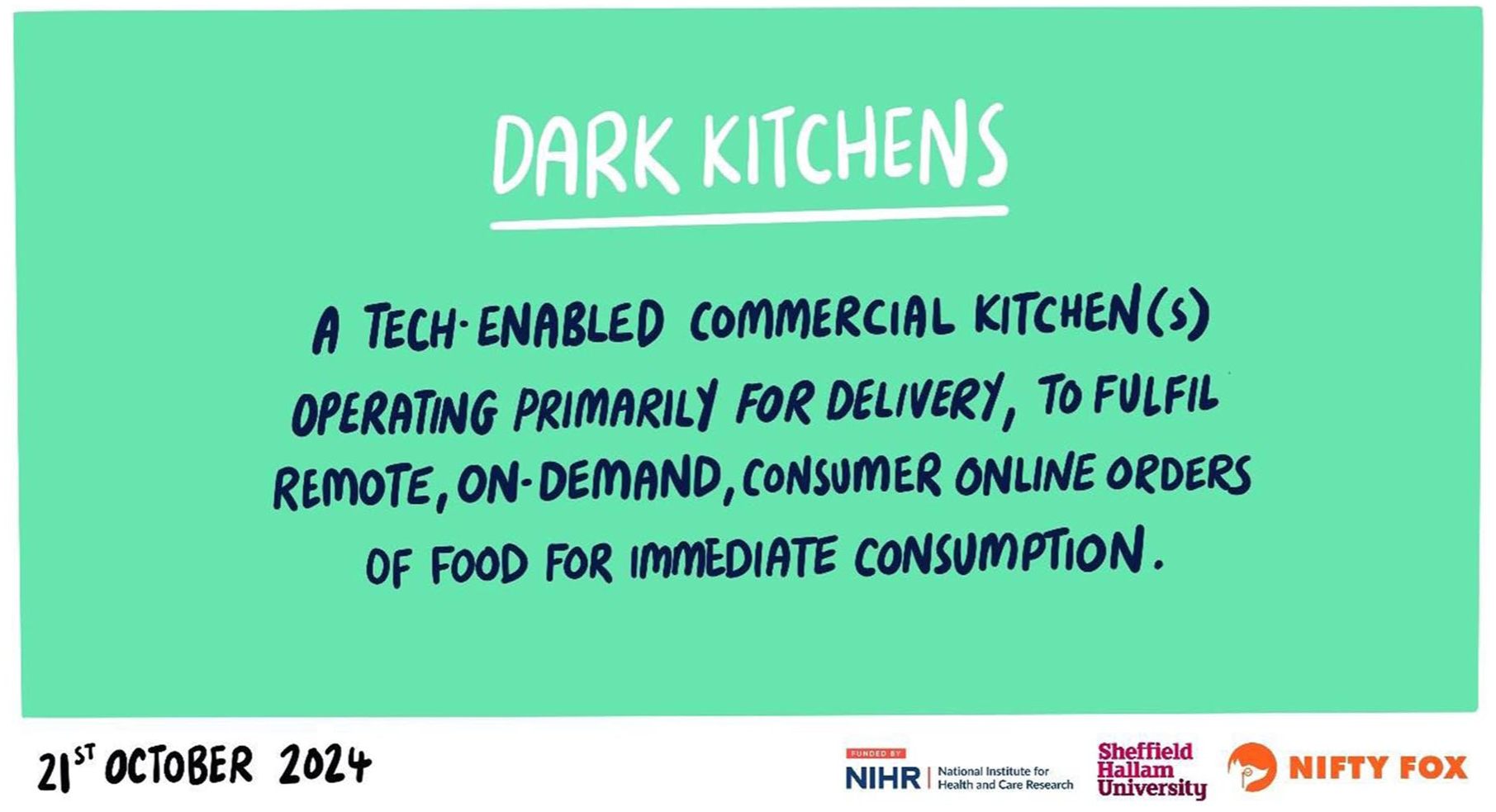
The agreed consensus definition of dark kitchens from stakeholder workshops
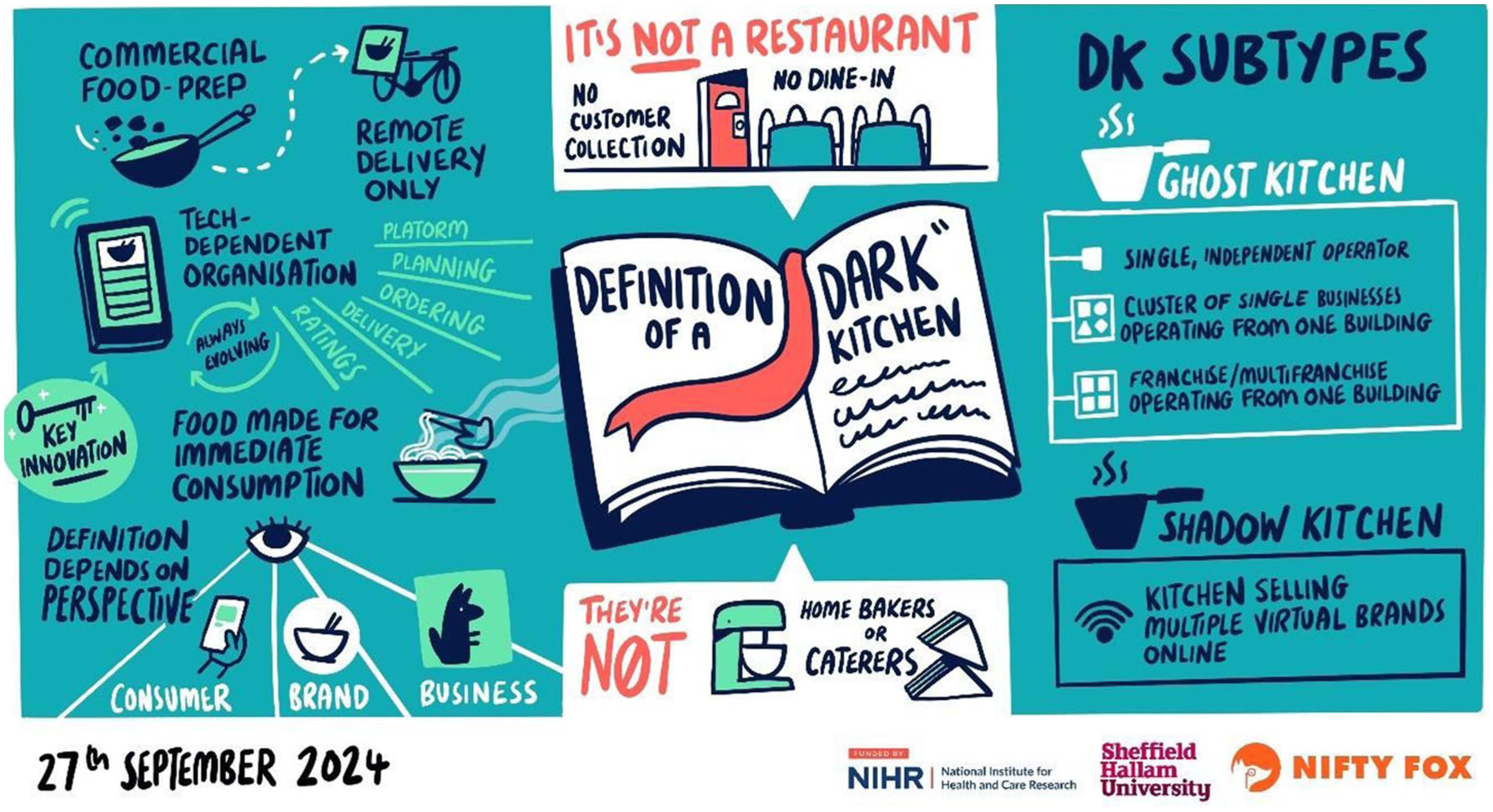
Considerations for defining what is, and is not a dark kitchen
While we acknowledge that the term ‘dark’ itself is problematic, with potentially misleading and/or derogatory connotations (e.g. poor food safety and hygiene practices), we have adopted this term because of its existing ‘currency’ among all stakeholders involved. As others have argued, 28 we take the term ‘dark’ to refer to the lack of visible physical presence to the consumer only.
Implication of Findings
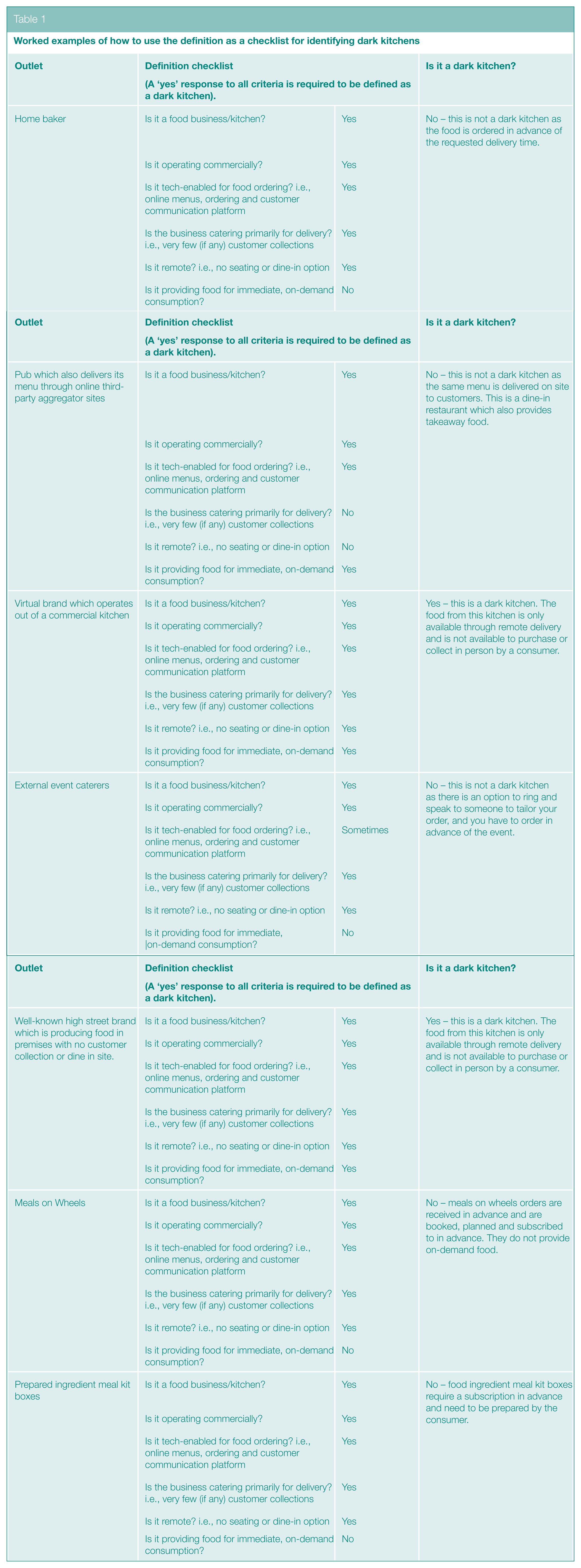
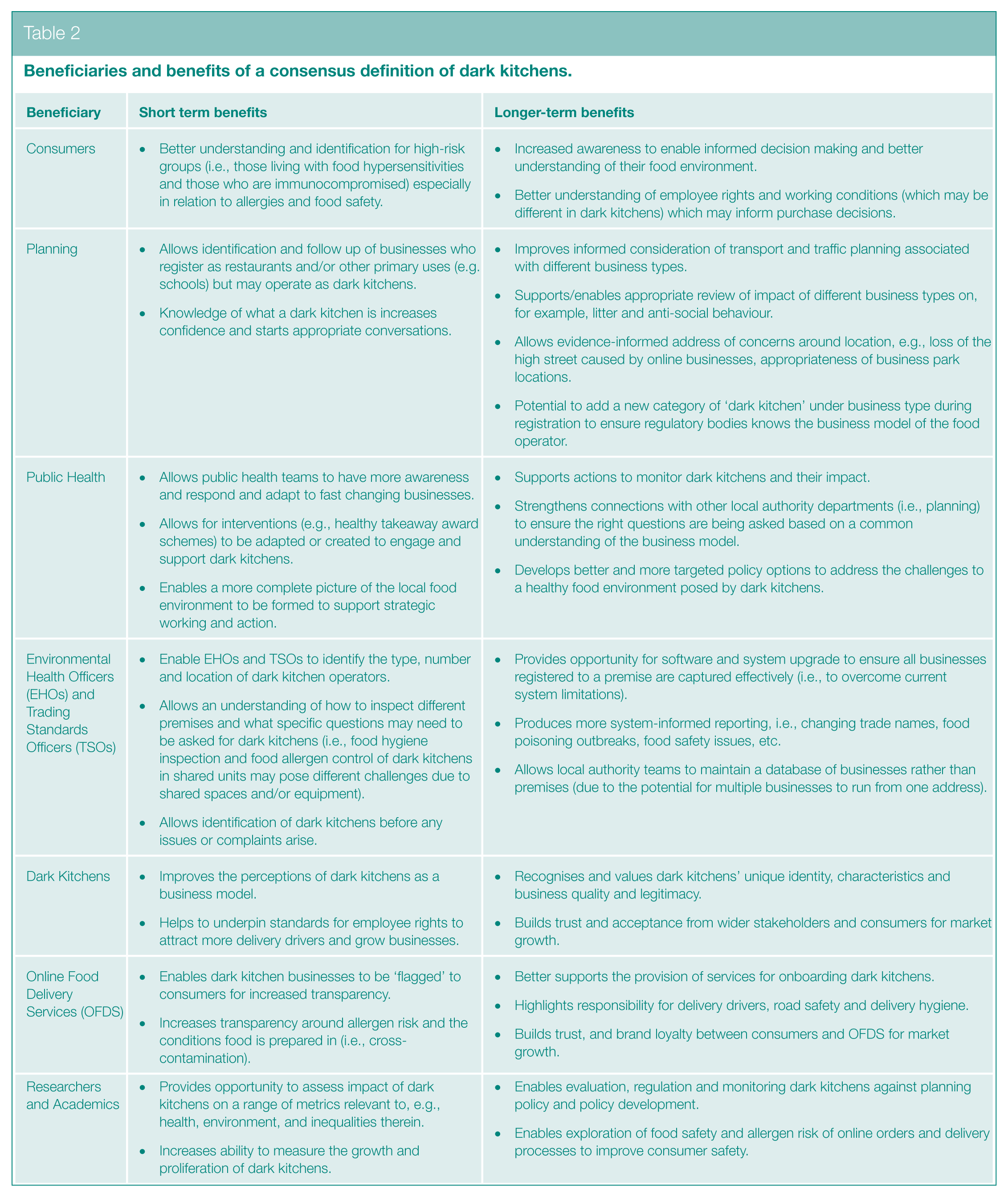
Our intention is that this definition is accepted into policy, practice and academic contexts to better support research, surveillance and regulatory processes of the dark kitchen sector. We believe it will allow for clearer communication between stakeholders and that it will provide clarity for consumers who have little insight into their changing food environment. 3 Fundamentally, a definition of dark kitchens which is universally adopted will allow for a consistent approach to the identification of relevant premises. Table 1 demonstrates some worked examples of how the consensus definition allows for dark kitchens to be identified quickly. In turn, this could support the development of more appropriate surveillance in support of public health, environmental health and planning agendas, improve awareness and trust in contemporary technology-enabled business models on a commercial scale and due to better regulation of food safety practices, and provide guidance for the sustainability of dark kitchens. Based on our consultations with stakeholders, we further clarify these multiple predicted cross-sectoral benefits in Table 2 according to short and long-term benefits which demonstrate the plethora of potential impact the definition could have, if adopted, for multiple stakeholder groups.
Worked examples of how to use the definition as a checklist for identifying dark kitchens
Beneficiaries and benefits of a consensus definition of dark kitchens.
Strengths and Weaknesses
As far as the authors are aware, this is the first consensus definition of dark kitchens which is derived from multiple stakeholder groups. The strength of this research was the comprehensive views and opinions that were collected from members of the public, local and national governments, academic experts and the industry members throughout the UK who had the opportunity to contribute to the definition development at a very early stage. In addition, our definition aligns with descriptions of dark kitchens used elsewhere in the literature validating the definition. In addition, the worked examples of ‘real-world’ examples of dark kitchens allowed the research team and stakeholders to sense-check and validate the definition to ensure it had a practical and user-friendly purpose.
The methodology used to collect the data was inclusive and multi-layered allowing people to contribute their thoughts and opinions via telephone call, online questionnaires, in person sessions and using creative scribes for knowledge exchange to improve communication between different stakeholder groups which helped to put all stakeholders on a level footing.
While this definition represents the current UK food environment and context, the stakeholder group was not international and consensus definition was therefore created by UK stakeholders for a UK audience. However, as previously described, the definition aligns to other international descriptions of dark kitchens in the literature.
While we feel that this definition provides a robust and workable solution for defining dark kitchens for multi-sector use, the food environment and digital food context is constantly evolving meaning that the definition may require reviewing as new food business models develop.
Suggestions for Future Research
Following on from the publication of this definition, there is further work to evaluate the adoption of the definition and to understand and monitor the short- and long-term impact of the definition, including any unintended consequences, and assess whether local authorities and planning teams ensure that dark kitchens and associated virtual brands are regulated, monitored and audited, with parity and to the correct standards.
Further research is required to understand the direct and indirect health implications of dark kitchens, online food delivery platforms and the foods sold by them, and the wider digital food environment on place-based health inequality including obesity, diet quality, employee working conditions and other public health priorities.
In summary, this work highlights the need for the adoption of a consensus definition of dark kitchens, as it is pivotal to the work and understanding of many stakeholder groups. The definition proposed here recognises the multiple perspectives of these stakeholders and offers benefits to cross-sectoral working. Our definition allows for transparency and improved communication between dark kitchen stakeholders and provides the opportunity to drive public health agendas at multiple points within the food system.
Footnotes
Acknowledgements
The authors would like to thank Chris Redford at Nifty Fox Creative for producing the live scribed images included in this article.
Author Contributions
Conflict of Interest
The authors declared no potential conflicts of interest with respect to the research, authorship, and/or publication of this article.
Funding
The authors disclosed receipt of the following financial support for the research, authorship, and/or publication of this article: This project was funded through internal fieldwork funding provided by Sheffield Hallam University. This work is supported by funding from the National Institute for Health and Care Research (NIHR) under four Application Development Awards (reference nos.: NIHR160326, NIHR160406, NIHR160884, and NIHR159200). The views expressed are those of the authors and not necessarily those of the NIHR or the Department of Health and Social Care. TB and YH were also supported by the Medical Research Council (grant no. MC_UU_00006/7). CR is supported by an NIHR Doctoral Fellowship (grant no. NIHR301784).
Ethical Approval and Informed Consent
Ethical approval was provided by all four institutions for the research data collection. Informed consent was obtained for all participants for the final stakeholder workshops from Sheffield Hallam University Research Ethics Council (ER61546845).
