



Abstract
Aims:
Smoking continues to pose a significant threat to health and well-being in Ireland. However, concerns have been raised about the enforcement of public health legislation in Ireland. The WHO has noted that enforcement of tobacco-control legislation is a vital factor in reducing tobacco-related harm. This research therefore sought to explore convictions, penalties, and associated costs imposed in the period 2014–2023 under various sections of the Public Health (Tobacco) Act 2002 as amended.
Method:
This article is based on secondary descriptive statistical analysis of tobacco conviction data released annually by the Health Service Executive’s (HSE) National Environmental Health Service.
Results:
Over 1900 inspections annually identify evidence of non-compliance with tobacco-control legislation. Convictions for non-compliance are rare, with 1.12% of instances of non-compliance resulting in a conviction. In total, 93.1% of fines and 85.5% of costs charged were for sums of €1500 or less. Convictions under the tobacco-control legislation resulting in a 1-day ban or less on tobacco sales occurred in 56.9% of convictions.
Conclusion:
The penalties imposed, which are at judicial discretion, are routinely far below the maximum possible under the Acts. The introduction of fixed penalty notices is recommended, as well as the re-introduction of minimum periods of removal from the Tobacco Retail Register to prohibit tobacco sales. The low level of enforcement and minimal penalties imposed undermine tobacco control in Ireland.
Plain Language Summary
Smoking is a real threat to the health of people in Ireland. In response to this, the Irish Government has introduced a number of laws to try and reduce the negative impacts of smoking. These laws are monitored by Ireland’s National Environmental Health Service. This research aimed to explore how well the tobacco-control laws are being followed and what happens to those breaking the law. We found that roughly 8 out of 10 premises inspected were following the law. However, given the large number of inspections carried out by Environmental Health Officers, almost 2000 premises were still found to be breaking the law. We then examined the penalties given to those breaking the tobacco laws. We found that very few people were prosecuted for breaking the tobacco-control laws – roughly just 1 in 100. Even those found guilty of breaking these tobacco-control laws received very small fines and penalties.
Introduction
The substantial levels of mortality and morbidity resulting from direct and indirect tobacco use underline tobacco’s place as an important commercial determinant of health in Ireland.1–6 Although Ireland has taken significant steps through legal intervention to promote tobacco control, levels of tobacco use are still a cause for concern. 6 Recent evidence suggests that among those aged 15 and over, 20% of males and 17% of females in Ireland are current smokers. 6 Rates of smoking remain high among some sections of Irish society. For instance, there is now a 20-percentage point gap between smoking rates among those in higher managerial, administrative, and professional occupations compared to those in routine and manual occupations (11% versus 31%). 7 Effective tobacco control can therefore make a significant contribution towards the improvement of health equity. Some estimates suggest that Ireland will now attain its tobacco-free target of a tobacco use prevalence rate below 5% by 2037, rather than by the original target of 2025. 7 However, even this target of 5% has been critiqued on both methodological grounds 8 and for being overly modest compared to those sought in other jurisdictions, such as Finland’s target of 2%. 9
Ireland has a strong track record on tobacco-control measures as illustrated by taxation on tobacco products, the introduction of a workplace smoking ban, and measures on tobacco-control marketing (e.g. restrictions on advertising and display of tobacco products at point-of-sale).7,10 Tobacco products in Ireland are relatively expensive compared to other EU and EEA countries. 11 In addition, Ireland has not only introduced combined graphics and text anti-tobacco warnings, in line with the Tobacco Products Directive, 12 but has gone further by introducing standardised packaging in 2017 via the Public Health (Standardised Packaging of Tobacco) Act 2015. 13 There is ample evidence to support the efficacy of these tobacco-control measures.14,15 For example, an evaluation of the point-of-sale display ban in Ireland found that compliance was high and the law was well supported, with the recall of displays dropping significantly among adults and young people and signs that the law helps to de-normalise smoking. 16 Moreover, longitudinal evidence from the UK has found that standardised packaging is achieving its intended impacts, such as increasing warning salience and decreasing brand appeal. 17
It was the Public Health (Tobacco) Act 2002 which provided the basis for many of the measures noted above. 18 The 2002 Act provided for the establishment of the, now disestablished, Office of Tobacco Control, and included measures that addressed the regulation and control of the sale, marketing, and smoking of tobacco products within the State. The Act has been amended on several occasions with notable amendments including the Public Health (Tobacco) (Amendment) Act 2004 and the Public Health (Tobacco) (Amendment) Act 2009.19,20 Among the changes, these amendments altered the penalties that may be imposed under the Principal Act. For instance, the 2004 amendment provided that on summary conviction a person may be liable to a fine not exceeding €3000, whereas the Principal Act had originally provided for a maximum fine of €1900.18,19 A summary conviction relates to an offence which is dealt with by a judge sitting without a jury. Certain sections carry higher potential penalties, whereby persons convicted on indictment may be subject to a fine not exceeding €125,000, or to imprisonment for a term not exceeding 2 years, or to both. An indictable offence is of a serious nature and is typically dealt with by a judge sitting with a jury.
Section 37 of the Principal Act addressed the establishment and maintenance of a National Register of Tobacco Retailers. 18 Where a retailer, registered under section 37, was convicted of an offence under the Act their details were to be removed from the register and they were not eligible to be registered again for 3 months if convicted summarily of an offence, or 1 year if convicted on indictment. This section was amended by the 2004 Act and was altered substantially by the Public Health (Tobacco) (Amendment) Act 2009. Sections 3 and 5 of the 2009 amendment provided for judicial discretion as to the period a retailer can be suspended from the National Register of Tobacco Retailers.19,20 In the case of a summary conviction, this period is now not to exceed 3 months, while a maximum 12-month period applies for conviction on indictment. This relaxation of sanctions seemingly runs counter to the increasingly strict public health measures that the State has sought to implement. This change in enforcement was the subject of some political debate at the time and was not without criticism by groups such as the Irish Cancer Society, which argued against the reduction in penalties given the negative impact of tobacco on mortality and morbidity. 21
A recent development in the legal framework is the enactment of the Public Health (Tobacco Products and Nicotine Inhaling Products) Act 2023. This provides for stronger protections for public health with measures including a ban on the sale of tobacco products or nicotine inhaling products at events aimed at children. The Act establishes an offence of selling nicotine inhaling products through self-service. However, the principal purpose of this legislation is provided for in Part 2 of the Act, which introduces mandatory annual licences for retailers who wish to sell tobacco and/or nicotine inhaling products. The effect of this licencing system is yet to be seen as the relevant sections will not commence until 2 February 2026.
It has been suggested that there is a low level of enforcement of public health-related legislation in Ireland generally.22–25 This is evident in both road traffic law enforcement 22 and environmental protection enforcement. 23 The absence of enforcement of legislation relating to smoking in cars with children in Ireland has also specifically been noted.24,25 A lack of tobacco-control enforcement is a long-standing, global issue.26–30 In their analysis of tobacco-related enforcement in California, Satterlund et al. 28 have identified five key factors that can limit tobacco control. These include: ineffective administrative structures; the issues involved in a complaint-driven approach to legislation enforcement; a lack of dedicated funding; low prioritisation; the minimal deterrence impact of sanctions. 28 The low prioritisation of smoking-related issues among police and judiciary noted in this research may have strong relevance in the Irish context. 28 Research on tobacco-control enforcement from Uganda identified similar resource issues, as well as the issue of a lack of knowledge about the law among both enforcers and the public. 26 Further research from California has noted lower enforcement of tobacco-control legislation influences youth beliefs about the easier accessibility of cigarettes. 27 Tobacco-control research from Massachusetts has also noted the need to keep elected public representatives and the judiciary aware of tobacco-control educational and law enforcement activities being undertaken with merchants. 30 It has been suggested that ‘anti-tobacco forces’ tend to focus on enacting new tobacco-control legislation and combating industry attempts to subvert these safeguards. 29 Although these factors are important, these efforts come at the expense of a focus on implementation and enforcement. 29
Ireland, in particular, has been identified as a country that has attempted to avoid a legalistic approach, instead focusing on behind-the-scenes negotiation.31,32 In recent research on the cognate field of alcohol control, Purves et al. 33 have noted a number of factors that inhibit enforcement in Ireland. This includes workload issues, as well as a lack of training and expertise among Environmental Health Officers (EHOs). Their research suggested that soft mandates, rather than sanctions, were preferable, partly because EHOs lack of confidence in the legal system treating breaches of legislation seriously. 33 In effect, measures other than the pursuit of a prosecution may be relied on to bring about change.
The HSE Tobacco Free Ireland Programme Implementation Plan 2022–2025 includes specific Environmental Health Service actions relating to tobacco-control legislation compliance. 7 These include Actions 3.1 and 3.2 which directly address issues of compliance and enforcement.
Ireland’s continuing deficits in public health enforcement, although seldom examined, are extremely problematic. The World Health Organisation is clear about the importance of successful implementation, enforcement, and compliance in ensuring the effectiveness of a policy. 34 Specifically, they highlight the need for adequate resourcing (both financial and technical), awareness-raising strategies to ensure public support, and meaningful mechanisms for identifying and addressing instances of non-compliance. 34
The WHO has also advocated strongly for the importance of compliance monitoring, stating that it needs to be ‘vigorously enforced’. 34 The tools the WHO suggests for effective enforcement monitoring include: ‘monitoring mechanisms such as compliance checks. . . and assessment of fines and or citations issued over time for non-compliance’. 34 This research aimed to explore the enforcement of tobacco-control legislation in Ireland from 2014 to 2023.
Method
This study involved secondary analysis of annual EHO returns on convictions and penalties imposed for the years 2014–2023. Tobacco conviction data was obtained from two sources. These included both Tobacco Free Ireland annual reports, 35 and annual returns on the Health Service Executive’s (HSE) National Environmental Health Service website on compliance and enforcement. 36 As such, ethical approval was not required for this study. This data was downloaded in Microsoft Excel format, coded, and then analysed using descriptive statistics, including 95% confidence intervals, in SPSS. The analysis details the number of convictions, fines, costs, and the time period of removal from the Tobacco Retail Register (i.e. the time period, if any, in which the retailer ceased to be legally permitted to sell tobacco products). Given the high level of variability and outliers, this analysis includes a range of descriptive statistics.
When prosecuting a merchant, the National Environmental Health Service directly issues a legal summons to a non-compliant premises (see Figure 1). Neither An Garda Síochána (the Irish Police), nor the Office of the Director of Public Prosecutions are involved in this decision or process. It is normal for a warning to be issued when non-compliance is first identified.
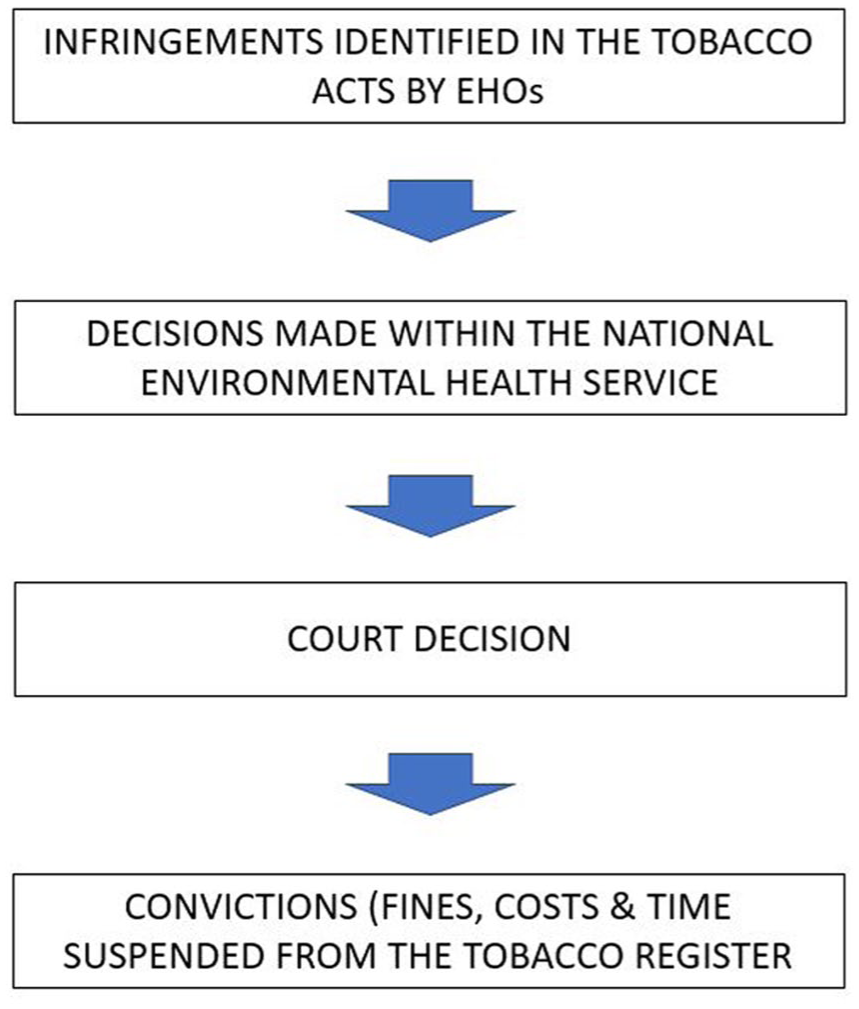
The conviction process under Ireland’s Public Health (Tobacco) Acts
Results
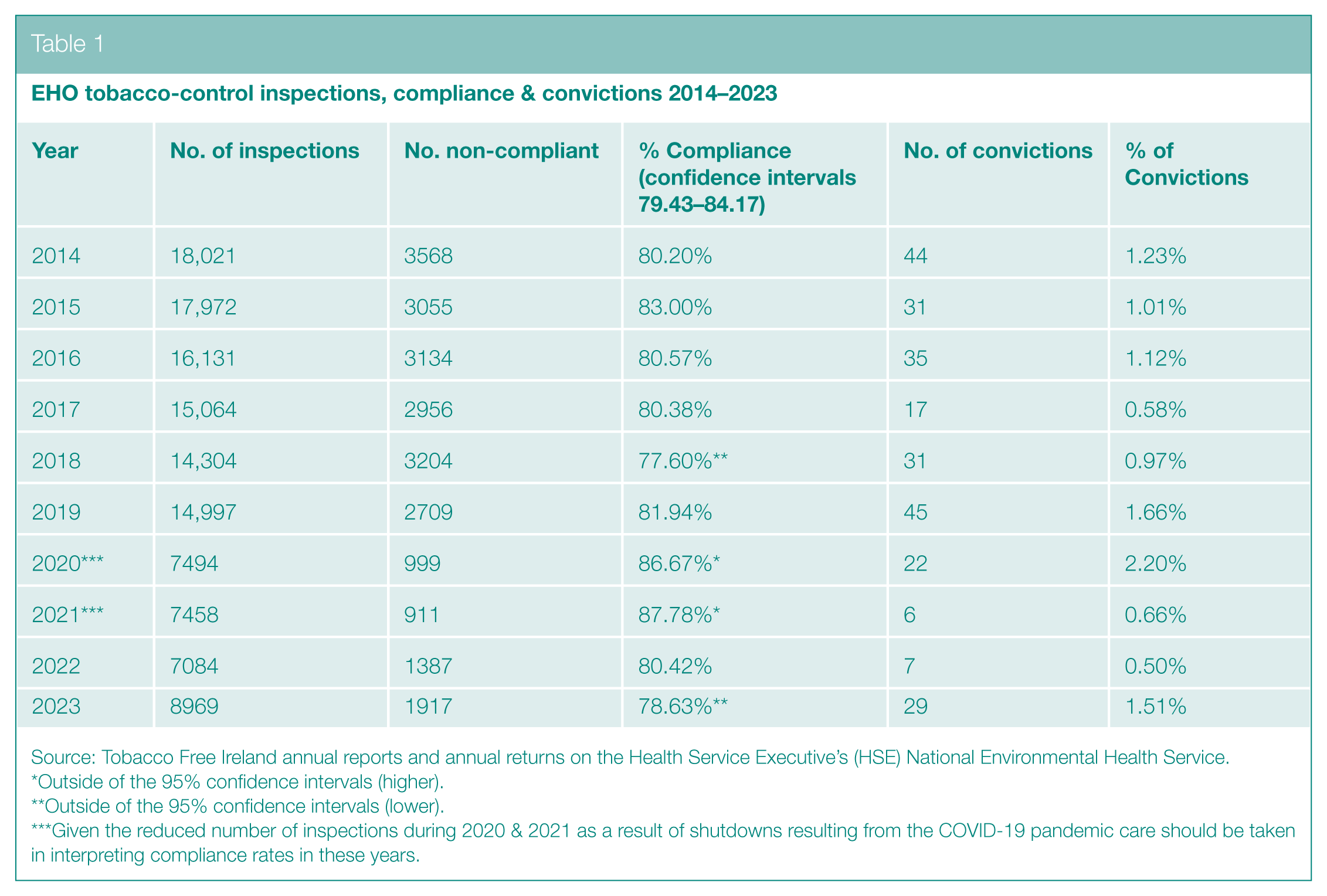
Table 1 details the number of EHO inspections that noted compliance and non-compliance with Ireland’s tobacco-control legislation. From 2014, up until the outbreak of the COVID-19 pandemic in 2020, the percentage of inspections that found compliance ranged from a high of 83% in 2015 to a low of 78% in 2018. Although compliance for the years 2020 and 2021 was 87% and 88%, respectively, these years should be treated with caution given the COVID-19 pandemic shutdowns, as this information may relate predominantly to shops rather than pubs, clubs or hotels. Compliance rates across the non-Covid years are relatively stable.
EHO tobacco-control inspections, compliance & convictions 2014–2023
Source: Tobacco Free Ireland annual reports and annual returns on the Health Service Executive’s (HSE) National Environmental Health Service.
Outside of the 95% confidence intervals (higher).
Outside of the 95% confidence intervals (lower).
Given the reduced number of inspections during 2020 & 2021 as a result of shutdowns resulting from the COVID-19 pandemic care should be taken in interpreting compliance rates in these years.
The most obvious finding in compliance and convictions data relating to the policing of the tobacco-control laws is the number of inspections reporting non-compliance compared to the number of convictions. The annual number of convictions has ranged between 17 and 45 per year in 2014 to 2019. As stated above, data for 2020 to 2021 were impacted by the COVID-19 pandemic. This average of 34 convictions per year is low in contrast to the 2709–3568 instances of non-compliance noted annually between 2014 and 2019. Non-compliance resulted in conviction in 1.12% of cases between 2014 and 2023. As can be seen from Table 1, in the 2014–2023 period (excluding the Covid shutdown years of 2020 and 2021), the percentage of non-compliance that resulted in a conviction varied from 0.5% to 1.66%.
Tobacco-related inspections declined during the COVID-19 pandemic as EHOs were re-assigned. However, the data from 2023 appears to continue this lower number of inspections.
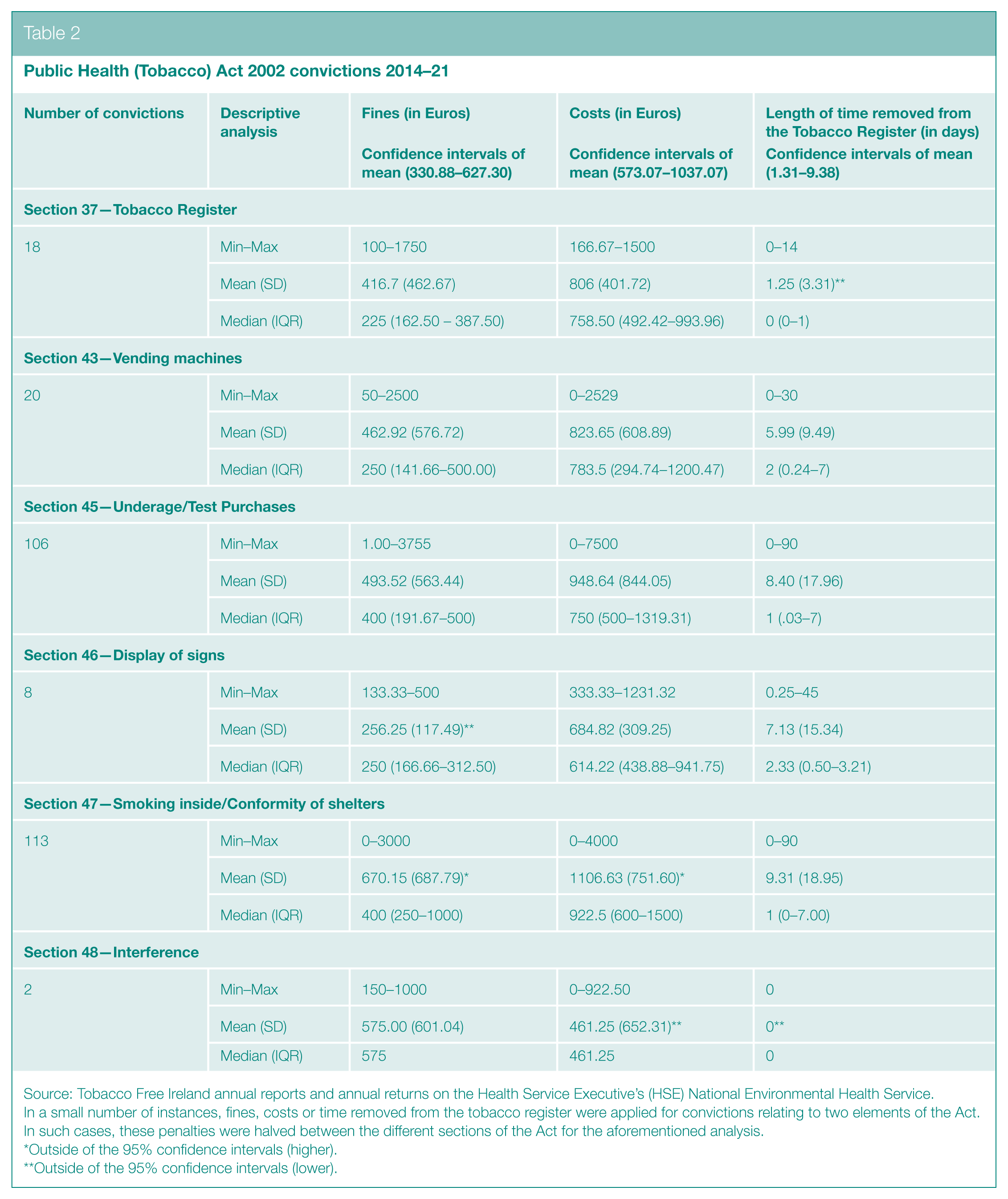
Table 2 details analysis of the number of convictions and subsequent sanctions imposed by year across various sections of the Act. Convictions for some sections of the Act are minimal, most notably Section 37 (being registered on the Tobacco Register), section 46 (display of signs), and section 48 (interference with an EHO carrying out their duties). Sections 43 (vending machines) and section 45 (underage sales) continue to be problematic. However, it is clear that Section 47, which relates to smoking in workplaces and the conformity of shelters, continues to have 10 or more convictions each year.
Public Health (Tobacco) Act 2002 convictions 2014–21
Source: Tobacco Free Ireland annual reports and annual returns on the Health Service Executive’s (HSE) National Environmental Health Service.
In a small number of instances, fines, costs or time removed from the tobacco register were applied for convictions relating to two elements of the Act. In such cases, these penalties were halved between the different sections of the Act for the aforementioned analysis.
Outside of the 95% confidence intervals (higher).
Outside of the 95% confidence intervals (lower).
From 2014 to 2023, 78.3% of convictions resulted in fines of less than €500. Overall, 93.1% of such fines were for €1500 or less. Regarding costs, 27.3% of instances involving costs being awarded against the tobacco retailer were for €500 or less, with 85.5% of such costs charged being for €1500 or less. These are costs arising from the prosecution of the offence. Turning to sanctions, 32.2% of convictions did not result in a sanction removing them from the retailer from the tobacco register. Of the remainder, 56.9% of convictions resulted in the removal from the tobacco register for 1 day or less. In total, 93.1% of convictions resulted in removal from the tobacco register for 30 days or less, only a third of the maximum period possible for such a conviction.
Table 2 shows the high level of variability in fines, costs, and periods of time a premises was removed from the tobacco register (thus preventing tobacco sales). For example, for underage test purchases, the sanctions varied from fines of €1 to €3755, the costs from €0 to €7500, and the time removed from the tobacco register from 0 to 90 days. The fines for breaches of the Acts in relation to Sections 37 (Tobacco Register), 43 (Vending Machines), and 45 (Underage/Test Purchases) are broadly similar. The higher rates of fines and costs for Section 47 (Smoking Inside/ Conformity of Shelters) are outliers. With the exception of Section 48 (Interference) and Section 37 (Tobacco Register), minimal differences were noted in the length of time convicted premises were removed from the Tobacco Register.
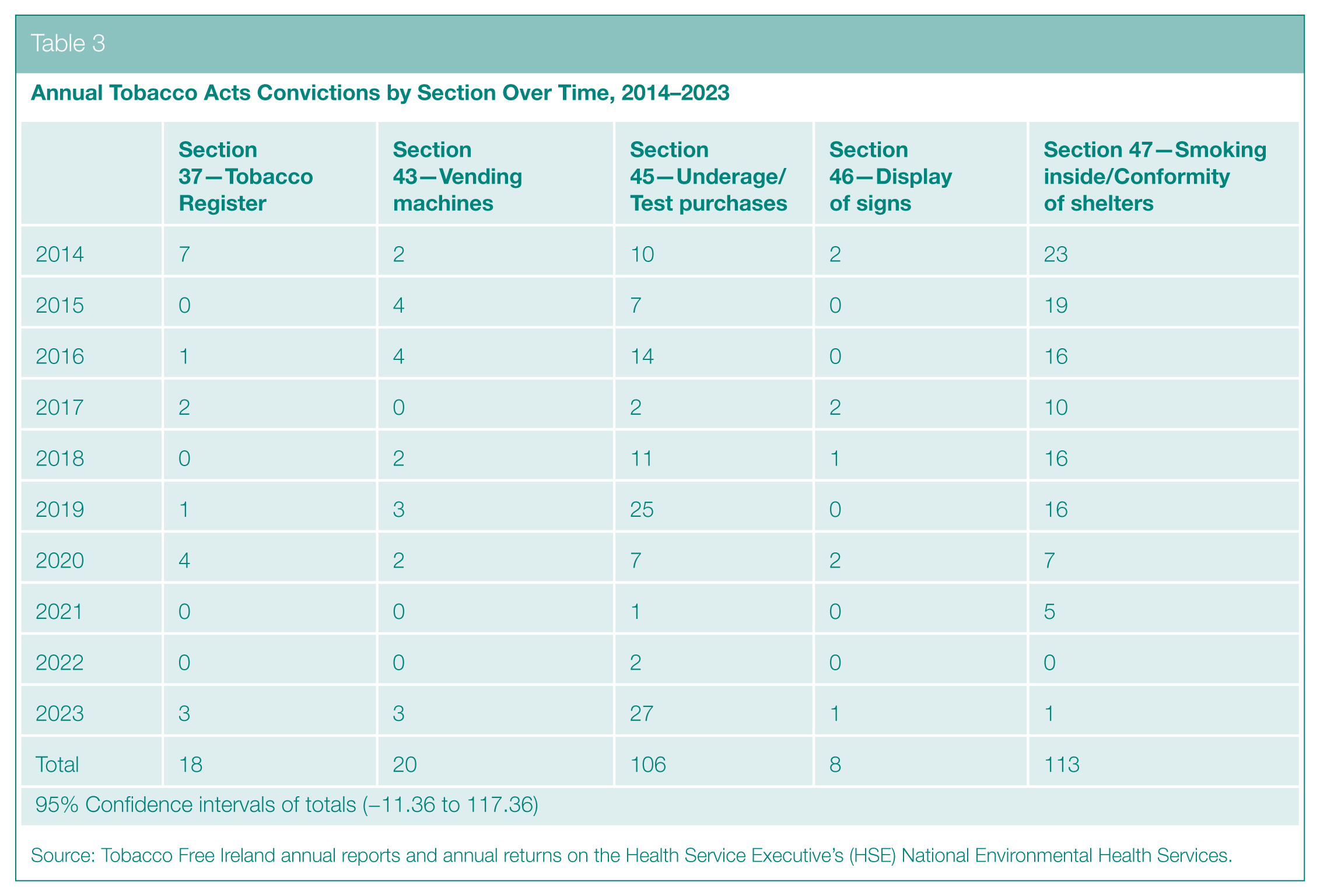
Table 3 details the annual number of convictions by Sections of the Tobacco Acts. It is clear convictions for Section 47, relating to Smoking Inside/ Conformity of shelters have declined over time since 2014. Convictions for Sections 37 (Tobacco Register), 43 (Tobacco Vending Machines) and 46 (Display of signs) remain relatively low. The year-to-year volatility in convictions from 1 to 27 for Section 45, relating to Underage Test Purchases is notable.
Annual Tobacco Acts Convictions by Section Over Time, 2014–2023
Source: Tobacco Free Ireland annual reports and annual returns on the Health Service Executive’s (HSE) National Environmental Health Services.
Fines and fees imposed from successful convictions remain highly variable and well below the maximum penalties allowed by the Act. The most notable variation in sanctions relates to the length of time removed from the tobacco register. Judges routinely impose sanctions requiring minimal or no removal from the tobacco register. A total of 56.9% of convictions resulted in removal from the Tobacco Registry for 1 day or less, while 6.9% of convictions resulted in removal for more than 30 days.
Discussion
Compliance with public health tobacco-control legislation is important in combating the scourge of tobacco. It is important to remember that tobacco is the leading cause of preventable mortality and morbidity globally. Compliance rates should be as close to 100% as possible. Despite this, as of 2023, 21.4% of inspections report non-compliance. Compliance rates with the Tobacco Acts are broadly stable over the 2014–2023 period. There is no indication of improvements in this rate. This may seriously undermine attempts to prevent tobacco-related harms. Although research on EHO enforcement in Ireland has noted a partiality towards soft mandates instead of sanctions, 33 the decade’s worth of data examined would appear to indicate that this may not be enough to attain a higher compliance rate.
The introduction of Fixed Charge Notices (FCN) may instead be appropriate, whereby, similar to a speeding ticket, fines are issued automatically at a fixed rate for non-compliance. Tobacco-control advocates and pressure groups may also need to balance their activities, so that they not only focus on developing improved tobacco-control legislation and responding to tobacco industry threats, but also maintain a focus on the implementation and enforcement of legislation. 29
From 2014 to 2023, there were 267 convictions, out of a total of 23,840 instances of non-compliance. This represents a conviction rate of 1.12% in cases of non-compliance. This rate is unacceptably low. As noted above, 93.1% of fines and 85.5% of costs are €1500 or less, and 56.9% of convictions involving removal from the Tobacco Retail Register are for 1 day or less. The penalties for non-compliance, even in the rare instances of conviction, are minimal. The findings from this analysis are in line with earlier findings from Ireland. The Tobacco Free Ireland Report of 2013 noted that despite the potential maximum sanction of removal from the tobacco register for 3 months, ‘almost half the suspensions applied to date were for a period of 1 day’. 37 The 2002 Act provided for a fine not exceeding €1900 (summary conviction). 18 This was increased to €3000 by the Public Health (Tobacco) (Amendment) Act 2004. 19 However, it is possible that the original Act has established a baseline for these fines over time and that behavioural economics may be an important factor here. 38
Further qualitative research is required for a more detailed exploration of the process that takes place between an EHO noting an instance of non-compliance and the decision to issue a summons. At present, this area remains something of a black box. There is little clarity on how a 1.12% conviction rate can be the result of approximately 3000 instances of non-compliance in any given year. Additional analysis should also examine the geography of enforcement of the Public Health Tobacco Acts to identify possible spatial variations. This more meso-level analysis might reveal more and less effective strategies in enforcement to achieve improved compliance rates.
Footnotes
Acknowledgements
Many thanks to the Health Services Executive’s National Tobacco Control Office and the Health Service Executive’s (HSE) National Environmental Health Service for access to data.
Author Notes
The phrase Once in a Blue Moon refers to the appearance of a second full moon within a calendar month, which roughly occurs every 32 months.
Conflict of Interest
The author(s) declared no potential conflicts of interest with respect to the research, authorship, and/or publication of this article.
Funding
The author(s) received no financial support for the research, authorship, and/or publication of this article.

Data Availability Statement
All data is available from the HSE’s National Environmental Health Service.