



Abstract
Aims:
This short report summarises the findings of a 51-page report on the social value of movement and dance in England, highlighting its contribution to public health, individual wellbeing, and community development.
Methods:
The report synthesises data from multiple sources and quantifies the social value of movement and dance.
Results:
Findings indicate that movement and dance contribute £3.5 billion in social value, including £430 million in healthcare savings and a £2.1 billion uplift in mental wellbeing. Movement and dance foster physical health benefits comparable to those of other exercise forms while providing unique psychological and social advantages.
Conclusion:
Movement and dance play vital roles in public health by preventing illness, improving mental wellbeing, and fostering community engagement. To maximise their impact, greater integration within health practices, funding, research investment, and policy engagement is needed.
This short report summaries a body of research available in a 51-page report published by the Sport and Recreation Alliance. The research was a collaboration between four researchers from leading university dance faculties, and over 20 organisations involved in the strategic delivery of movement and dance in the UK. 1 The purpose of the study is to articulate the value of movement and dance-based exercise to society, with a view to preventing this activity from falling through the ‘strategic cracks’ between sport and physical activity, and the arts and culture. The methods used in this study incorporated a literature review of both academic and the grey literature, including information posted on websites.
The research has demonstrated movement and dance have a total social value of £3.5 billion; comprising £430 million of savings in physical and mental health spending, mental wellbeing uplift equivalent to £2.1 billion, £14 million of improved individual development, and nearly £1 billion of social and community development. This represents around 5% of the total social value generated by all physical activity and volunteering in England or, in other words, for every £20 generated, £1 is uniquely generated by movement and dance-based activity (based on figures provided by the Sport England reports, 2018).2,3 A full breakdown of the social value contribution is provided in figure 1.
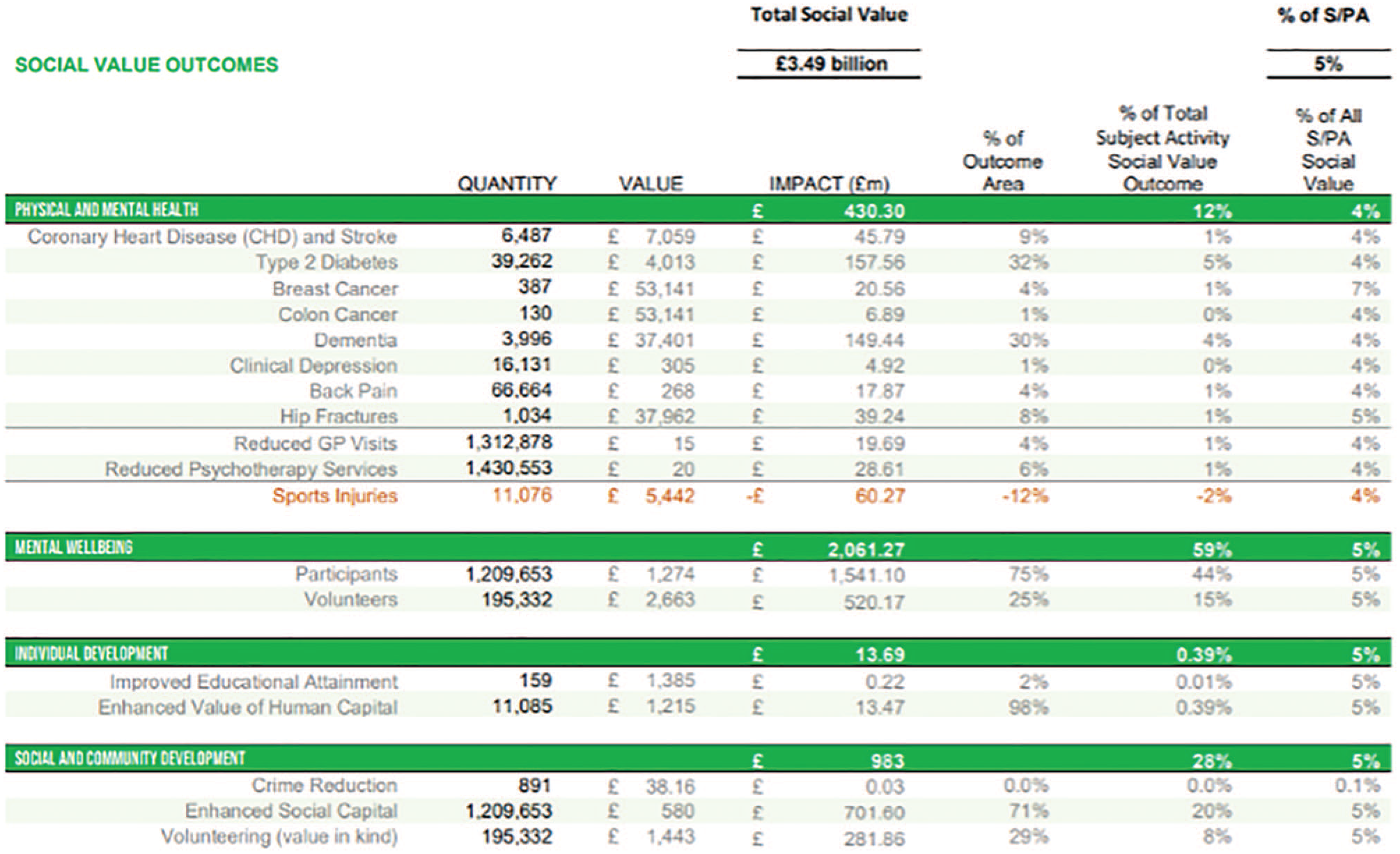
Social value breakdown of movement and dance
Specific to public health, the report collates evidence that movement and dance have distinctive positive outcomes for children and adults to prevent ill health and to manage chronic health conditions, including the mitigation of some of the costs of ill health, reduce burden on health and community services, and reduce the prevalence of specific health conditions.
Physical activity has been shown to have benefits on physical and mental health, but many children and adults do not achieve enough physical activity to meet the recommended guidelines for activity. 4 Levels of participation in physical activity in the UK are low, with UK adults participating in activity (more than 150 min of moderate activity / 75 min of intensive activity (or a blend of the two) per week) at a rate of 60.8% for women and 65.6% for men. 5
The general physical and mental health benefits of physical activity are summarised as follows: 6
Reduced risk of chronic heart disease and stroke in adults (16+) by 35%;
Reduced risk of type 2 diabetes in adults (16+) by 40%;
Reduced risk of breast cancer in females (16+) by 20%;
Reduced risk of developing colon cancer in adults (16+) by 20%;
Reduced risk of developing dementia in adults (16+) by 30%;
Reduced risk of clinical depression in adults (16+) by 30%;
Reduced risk of back pain in adults (16+) by 25%;
Reduced risk of hip fracture in adults (65+) by 52%;
Sport participants are 14.1% more likely to self-report good health than non-participants. This results in (1) reduced GP visits and (2) reduced psychotherapy service usage;
There is a ‘linear dose-response relationship’ between fairly active participation (30–149 min) in sport and physical activity, and a reduced risk of developing the outcomes identified above.
Adherence to traditional physical activity is low7,8 with high drop-out rates, but enjoyment in an activity is associated with greater adherence and retention. 9 Participation in movement and dance has been shown to be a promising alternative for older adults 7 and young women. 8 As two groups less likely to be physically active than their peers (and associated with higher rates of drop-out from minimum physical activity levels) movement and dance provide a key ‘offer’ to these groups.
Similarly, McKinley et al. 10 found that, when compared to older individuals undertaking physical activity as a means of recovering from medical intervention, those undertaking sessions in movement and dance had a 25% higher retention rate above other activities. Philip et al. 11 reinforce this, finding that the prevailing factor for attendance to the dance activity was that dance was an end in itself, rather than a means to an end as per more ‘direct’ exercise. Similar findings have been recorded in care homes and sheltered accommodations for older people. 12
It has been posited that dance has a similar impact on physical health outcomes as other physical activities, as strength, balance, gait, and improvements to aerobic capacity, 13 but may also hold greater psychological benefits, providing greater social cohesion and opportunities for creativity and expression. Despite the potential benefits of dance for the general population, funding for these activities is intermittent and therefore means that projects are often short term. This does not allow for sufficient research on the longitudinal impact of arts activities and has led to differing methodologies and difficulties in comparing outcomes of dance interventions, comparison with other physical activities and thus proposed outcomes and benefits.14,15
The above serves as a brief summary of some of the findings from the report. Based on these, and further considerations, the report makes the following recommendations.
More collaboration and cross-organisational working between organisations involved in the delivery of movement and dance.
Better integration of movement and dance into health, care and prevention practices, including ‘social prescribing’, to help relieve NHS pressures.
Utilising movement and dance as a key method to engage young girls and address the challenge of drop-off in activity when entering secondary education.
Promoting movement and dance as a key method to keep the population active as they get older, supporting an ageing population to age well, by reducing many conditions associated with being sedentary.
Improved research and data capture to understand and articulate the contribution movement and dance-based activities make.
Greater recognition of the sector’s unique social value contribution and for this to be reflected in wider funding, policy and strategy.
This report contributes to a growing interest in dance as a physical activity that can engage people across generations and attends to physical and mental health-related concerns. We emphasise the need for more initiatives, such as the Let’s Dance national campaign supported by the Sport and Recreation Alliance, designed to promote and encourage greater participation in dance and movement activities, as it has greater potential to support the Government’s mandate to the NHS of a shift from sickness to prevention.
Footnotes
Conflict of Interest
The author(s) declared no potential conflicts of interest with respect to the research, authorship, and/or publication of this article.
Funding
The author(s) received no financial support for the research, authorship, and/or publication of this article.
