



Abstract

Introduction
The high incidence of sexually transmissible infections (STIs) among Australian young people 1 and the growing use of digital technologies in young people’s sex lives have underscored the need for integrating digital literacy and online safety education into relationships and sexuality education. 2 Young people want youth-friendly sexual health and blood-borne virus (SHBBV) education provided by their friends and peers (peer education). Youth centres and youth health services are preferred sources of SHBBV education outside of school and can play a significant role in supporting young people with SHBBV education. 3
The Youth Educating Peers Project
The Youth Educating Peers (YEP) project (hereafter ‘the Project’) is coordinated by the Youth Affairs Council of Western Australia (YACWA) and aims to build capacity at the individual, organisation and youth sector i levels to implement peer-based youth sexual health promotion. Initiatives are responsive and timely and reflect the often rapidly evolving contexts of young people. Innovative practices prioritise the integration of research evidence with the expertise of place-based practitioners and the lived experience of young people.
The Project employs a group of paid peer educators aged 18–25 years (the YEP Crew) to give young people opportunities to connect with other young people (12–25 years), access education about the issues that affect their sexual health and take action to improve relationships and SHBBV outcomes. Monitoring and evaluation of the Project includes post-workshop debriefing and evaluation forms; annual youth and youth sector surveys; 4 staff supervision and mentoring; youth reference group (16–25 years); professional reference group (professionals from the youth and sexual health sectors); and regular academic review of evaluation tools.

Over the last decade, the Project has undergone substantial adaption, responding to changes within the youth community and SHBBV sector, and the COVID-19 pandemic. Before the pandemic, engagement with the youth sector and young people was largely conducted face-to-face through training for youth workers ii with limited engagement conducted through social media or the YEP website (https://theyepproject.org.au/). The focus was to increase young people’s engagement with sexual health services and increase STI testing.
How did YEP Adapt during the Covid-19 Pandemic?
During the peak of the COVID-19 pandemic (March to August 2020), the Project’s engagement with the youth sector and young people pivoted to online delivery. Dynamic multimodal responsive relationships and SHBBV education content (e.g. webinars, resources, blogs, videos, and social media initiatives) were created, updated, and delivered by the YEP Crew via the Project’s website and social media platforms – TikTok, Instagram, YouTube, and Facebook. The focus of the Project changed to providing responsive, engaging and diverse SHBBV messaging for young people and the youth sector including sexual health for everyone, safer sex, contraception, anatomy and pleasure, consent and healthy relationships, and sex and technology.
What Outcomes Resulted from the Change to Online Service Delivery?
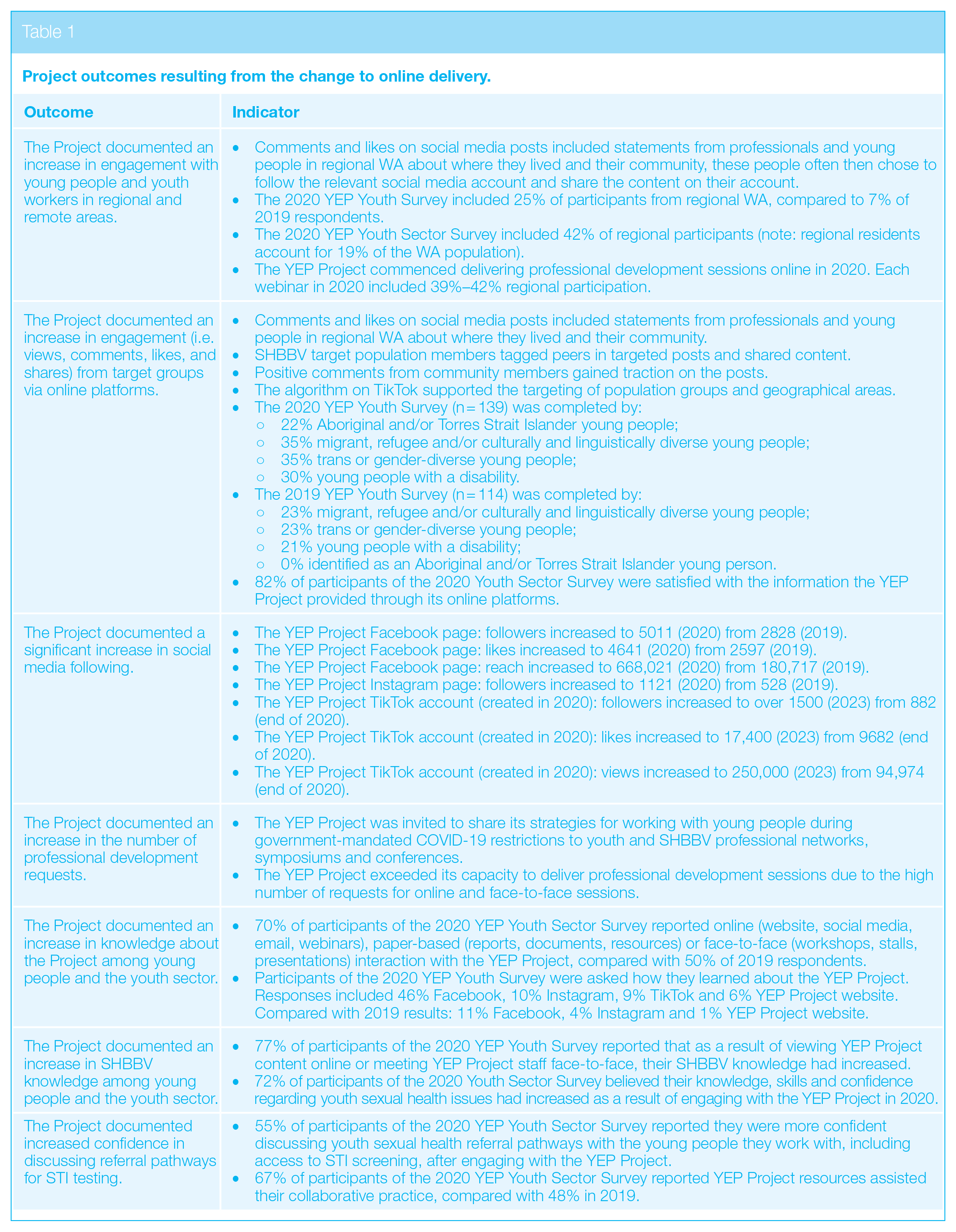
Table 1 summarises the outcomes and indicators of the Project after pivoting to online delivery.
Project outcomes resulting from the change to online delivery.
What was Learnt from the Change to Online Service Delivery?
Key learnings were as follows:
Consult with young people and the youth sector about relevant SHBBV education topics and messages.
Provide responsive, accurate, and engaging educational material promptly.
Provide consistent messages across several channels through a variety of media.
Collaborate with external agencies that can promote sexual health information.
Undertake regular engagement with young people and youth workers.
Create accessible and downloadable materials for people with low literacy and disability.
Promote messages that are validating and sex-positive and include peers who openly identify with SHBBV target populations.
Seek and implement feedback from young people.
Interrogate the success of resources and strategies, and leverage those that work.
Create ‘trending’ content to increase social media reach (e.g. use trending sounds and create collaborative posts).
How does YEP Currently Operate?
The current aims of the Project are to educate, empower, and positively evolve young people’s perceptions, attitudes, and behaviours around SHBBV issues through:
Youth education: Youth peer-led sexual health workshops, outreach sessions, and engaging online educational content.
Youth sector capacity building: Professional development and consultation services.
Consultation by the Project with young people revealed a hybrid model of face-to-face and online engagement was preferred ‘post COVID’. Peer education continues to feature as a youth participation and health promotion strategy and the diverse group (i.e. age, gender, sexuality) of peer educators (i.e. YEP Crew) create high-quality and engaging content.
Advice for Others Seeking to Implement a Sexual Health Youth Peer Education Project
Partnership
Youth services should partner with an SHBBV service. The youth service’s role is to support peer educators in delivering sexual health education. The SHBBV service should provide ongoing support through physical and human resources, intellectual property, and clinical guidance.
Service delivery
Aim to offer multimodal content – online, where most appropriate and accessible, along with face-to-face delivery, for example:
use a variety of media (e.g. online, print) to acknowledge young people’s varied learning styles and preferred contemporary visual representations of information (e.g. infographics, stories, reels, and posts);
balance ‘ever-green’ iii and ‘trend-specific’ content that is high-quality, engaging, and reflective of young people’s educational needs and interests;
be accessible to youth workers to increase their SHBBV knowledge and enable content sharing;
be peer-led or at a minimum co-designed with young people and be guided by clinical evidence and evidence-based practice from the youth and SHBBV sectors; and
be accessible for people with a variety of disabilities, be trauma-informed and sex-positive, and include representation of people from SHBBV target populations (e.g. sexuality, gender, and ethnically diverse young people).
Peer educators
Peer educator recruitment activities should be in partnership with relevant community services, key community leaders, and influencers to access people from SHBBV target populations.5,6 Peer educators should be provided with ongoing support, supervision, and training, for instance; SHBBV knowledge; trauma-informed practice; administrative, technological, and facilitation skills; strategies to effectively implement boundaries, create inclusive environments, manage challenging behaviours, respond to disclosures, and effectively challenge ableism, sexism, homophobia, and racism). They should also be given guidance on how to be continuously responsive in what and how content is delivered; and be financially reimbursed for their time, including project delivery, training, debriefing, supervision, and organisational and community networking and engagement.5,6
Evaluation
Adaption of existing evaluation tools or development of new tools that are responsive to the dynamic context of youth work is important to ensure appropriate data are collected to demonstrate impact and outcomes. Monitoring and evaluation data can establish programme-level progress and results; inform management and decision-making processes; support accountability; and guide organisational learning for programme improvement. 7
Conclusion
The YEP Project provides peer-based education and responsive SHBBV education for young people and was able to successfully pivot to online delivery during the peak of the COVID-19 pandemic. Lessons learned emphasise the importance of consultative approaches, peer-led sexual health education, accurate and consistent information dissemination through a variety of channels, collaboration with external agencies, and the creation of accessible, inclusive, and sex-positive content. Building the capacity of youth workers and peer educators to deliver youth SHBBV education using different modes is important to enable service responsiveness, continuity, and safety of young people.
Footnotes
Acknowledgements
The authors thank the Sexual Health and Blood-borne Virus Program, WA Department of Health, for funding the YACWA’s YEP Project and supporting the WA youth sector in providing sexual health promotion. The authors also extend their gratitude to the numerous WA SHBBV and youth services that have supported and steered the YEP Project and all the young people who have offered their time and expertise in a professional and/or voluntary capacity.
Author Contributions
K.M. contributed to writing – original draft. L.G. contributed to conceptualization, methodology, writing – original draft, project administration, and funding acquisition. R.L. contributed to writing – review and editing.
Conflict of Interest
The author(s) declared no potential conflicts of interest with respect to the research, authorship, and/or publication of this article.
Funding
The author(s) disclosed receipt of the following financial support for the research, authorship, and/or publication of this article: SiREN and YACWA receive funding from the Sexual Health and Blood-borne Virus Program, WA Department of Health.
Ethical Considerations
Curtin University Human Research Ethics Committee – approval no. HRE2018-0094.
Consent to Participate
Written consent to participate was obtained.
Consent for Publication
Not applicable.

Data Availability
The data sets generated during and/or analysed during the current study are not publicly available.