



Abstract
Introduction
In 1990, to help public health officials, politicians and key leaders compare human wellbeing, the UN Development Programme created the Human Development Index (HDI). 1 The aim was to create an index that was based on available country-specific data, whilst being transparent and sufficiently robust enough to withstand scientific scrutiny. The index is now widely used to compare world countries, and government leaders pay close attention to the individual rank of each country.
The HDI is based on the concept that people are the real wealth of a nation. The originators of the HDI recognised that there are three essential components required for humans to develop to their maximum ability: health, education and income. There is general agreement that if any one of these elements is absent, individual achievement will be severely limited. Currently, the composite index is obtained by first normalising each individual component to a maximum value of unity so that all are on a comparable scale. Then the overall HDI is computed by taking the geometric mean of the three individual index values. 2 The health component of the index is based solely on life expectancy at birth, and the wealth component is based upon the gross national income per capita. Since 2011, the education part of the HDI is calculated by combining two separate measures: mean schooling years for adults and expected school years for children entering the school system. The geometric mean of these two values comprises the education index.
For countries with large numbers of guest workers, mean years of schooling is likely to be low, because the majority of guest workers are unskilled labourers with a lower educational level than the citizen population. In contrast, the expected number of school years component would be relatively unaffected by guest workers because it is based upon students currently enrolled in the educational system.
The aim of this report is to determine the impact of guest worker status on the composite HDI ranking score. We focused on the 93 countries classified as high or very high human development because this group has the highest concentration of migrant guest workers.
Method
We used published HDI data from the UN Human Development Programme 2010 or the most recent year to examine country rankings for all the countries ranked in the high or very high HDI groups. 2 As an estimate of the number of migrant guest workers, we used the percentage of migrant workers aged 40–45 in the total population from available data in the UN migration database or, if unavailable, data from the World Bank.3,4 To determine the impact of migrant status on HDI, we plotted the country-specific ranking of each of the three individual HDI components (education, health, income) against migrant status. We also plotted each of the three components against the overall HDI, using a marker to identify those countries with the highest proportion of migrant workers.
We used linear least squares analyses to study the relationship between migrant status and HDI as well as the individual components of the HDI. For outcomes that appeared non-linear, we used locally weighted scatterplot smoothing (Lowess) to fit the data. For comparing continuous variables between groups of countries, we used t-tests. All p-values are two-sided, with a predetermined significance level of .05.
Results
Data for both HDI and migrant status were available for 89 of the 93 countries listed in the UN high or very high development group. When we plotted the educational component of the HD against the percentage of migrants in these countries, we noted a biphasic curve with an inflexion point when the percentage of migrant workers in the population reached 30%. After this level was reached, there was a robust negative correlation between the educational component of the HDI and percentage of migrant workers (R = 0.71, R2 = 0.51, p = .004) (Figure 1). For those countries with >30% migrant workers, the regression equation that best satisfies the available data is:

where Y represents the educational component of the HDI and X represents the percentage of migrants.
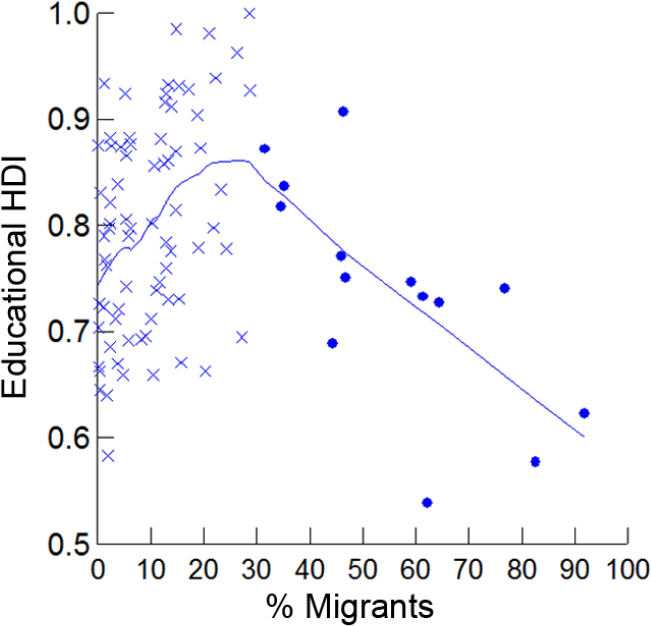
Regression analysis of educational HDI versus percentage of migrant guest workers in 89 countries in the high or very high HDI categories
The educational component of the HDI was the only element that was negatively affected by migrant status; both the income and health components increased in the countries with high levels of migrant workers (Table 1).
Comparison of HDI components by percentage of migrant workers
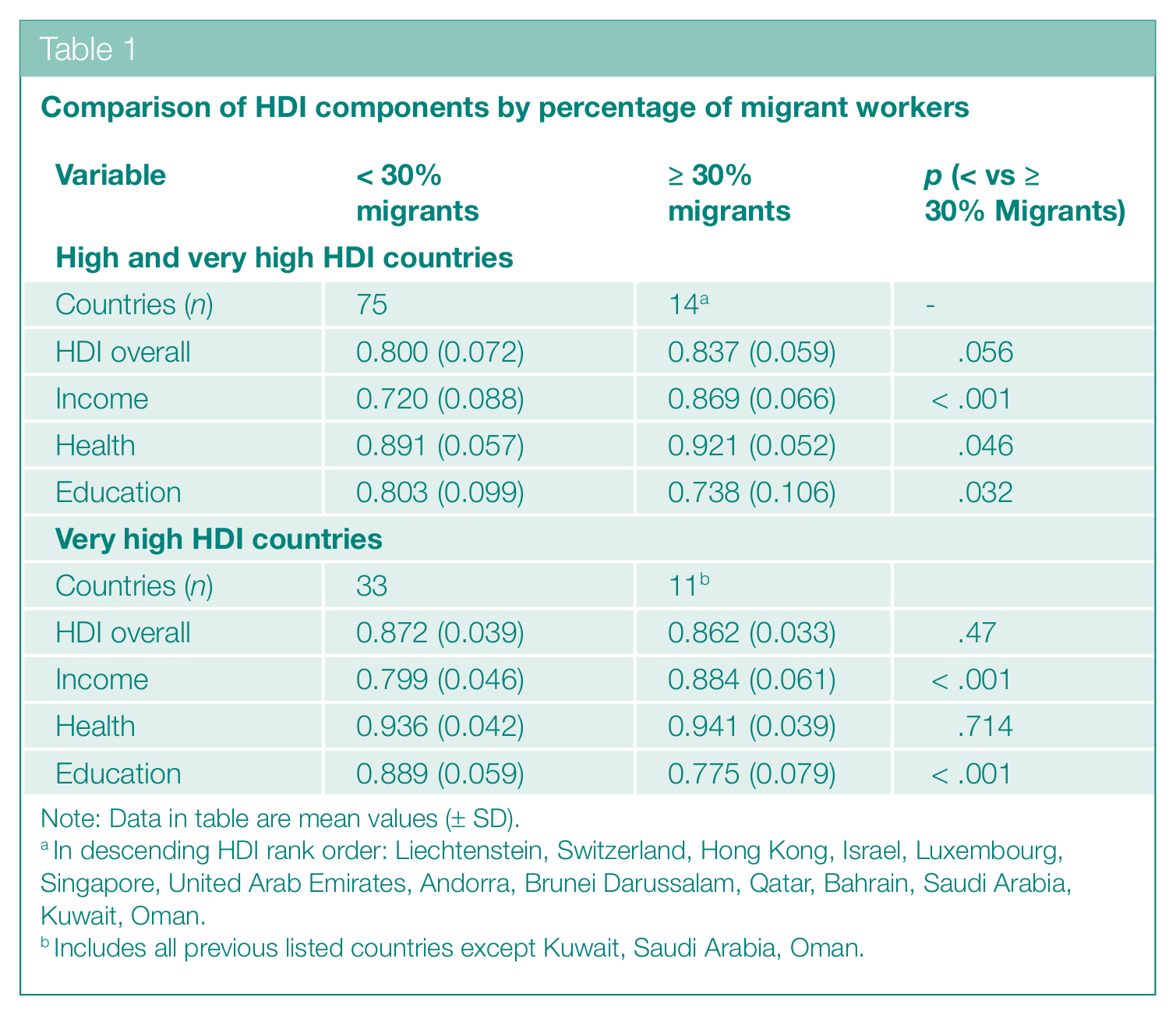
Note: Data in table are mean values (± SD).
In descending HDI rank order: Liechtenstein, Switzerland, Hong Kong, Israel, Luxembourg, Singapore, United Arab Emirates, Andorra, Brunei Darussalam, Qatar, Bahrain, Saudi Arabia, Kuwait, Oman.
Includes all previous listed countries except Kuwait, Saudi Arabia, Oman.
Because of the observed inflexion point at 30%, we analysed the data after grouping the countries depending on whether the percentage of migrant guest workers in the country was <30% or ≥ 30% (Table 1). Mean values for income and health were significantly higher in countries with >30% migrant workers, while educational levels were lower. When the analysis was limited to the 44 countries in the very high HDI group, the pattern was similar except that there was no significant difference in HDI values for health, while the difference in the educational HDI became highly significant (p < .001).
To study the impact of migrant status on the HDI in the 14 countries with > 30% migrant workers, we replaced the mean educational HDI with the mean educational value in those countries with <30% migrant workers. The overall mean HDI ranking on the UN list improved from 28 to 34. When we performed the same procedure for the 11 countries in the very high HDI list, the results were more pronounced: the overall mean rank changed from 28 to 10.
Discussion
The HDI is now widely used as a tool for studies of a variety of health outcomes in many different countries.5,6 The single measurement statistic provided by the HDI is carried out to three decimal places, implying a high degree of accuracy. In nations with a high proportion of migrant guest workers, the educational component of the current HDI index introduces a bias because the mean years of schooling for adults includes many migrant guest workers who are usually less well educated than the citizens of the country. This problem is particularly acute for the countries classified in the highest category of the HDI where the mean percentage of migrant guest workers is 23%. Eleven of the 44 countries in the highest HDI category have ≥ 30% guest workers and the overall HDI ranking of these 11 countries is significantly lowered by the inclusion of a large group of less well educated workers.
The migrant worker status affects mainly the educational component of the HDI. Income earned by migrant workers is generally sent home and is not taxed in the host country. With respect to the health HDI, only healthy workers are granted work permits.
One weakness of this study is the lack of exact data on the proportion of migrant guest workers in each country. We believe that using available UN data on the proportion of the migrant population in the age group 40–44 is a reasonable surrogate measure that allowed us to separate countries into high or low migrant categories. By using this age bracket, we effectively eliminated younger and older migrants who are unlikely to be workers. Choosing a different age group might have altered the results somewhat, but we believe that in those countries with a large number of migrant workers (>30%) the education component of the HDI would still be negatively correlated with the proportion of migrant workers.
Another study weakness is that we have only examined the impact of migrant guest worker status in wealthier countries who are members of either high or very high overall HDI groups. We selected these groups because the strongest flow of migrant workers is from poor to wealthy countries. On a global level the percentage of migrant workers is estimated to be 3.1% and for less developed regions of the world, the source of many migrant guest workers, the estimated percentage is 1.5%. These low levels of migrants are unlikely to have an impact on the HDI or its components.
Gender- and inequality-adjusted estimates of the HDI are already available and the ideal method to take care of the problem of migrant workers would be to recalculate the HDI based only upon the citizen population. This would be potentially possible, although data for educational attainment stratified by citizen status are not available in all countries. If this adjustment were performed, our results suggest that the ranking of very high developed HDI countries would be considerably different than at present. Qatar, the member of the very high development group with the largest number of guest workers, represents an extreme example. It has a current HDI ranking of 0.831, placing it 37th in the UN list. If the current educational ranking of 0.623 was replaced with 0.889, the average for all very high HDI countries with <30% migrant workers, Qatar’s overall HDI would increase to 0.936, and the country would then rank near Norway at the top of the UN HDI list.
Conclusion
In conclusion, migrant guest worker status distorts the overall HDI ranking because it has a measurable negative impact on the educational component. For the countries in the two highest HDI categories, there are 14 countries with more than 30% of migrant guest workers whose ranking is significantly impacted by the high proportion of migrant guest workers. The current HDI ranking of any country with a high proportion of migrant workers in the population should be interpreted cautiously.
Footnotes
Funding
Supported by the Biomedical Research Program funds at Weill Cornell Medical College in Qatar, a program funded by Qatar Foundation.