




Abstract
Students’ beliefs in schooling to achieve opportunity have been well documented in the school choice literature. How students make sense of successful entry into competitive and high-demand schools via high-stakes entrance exams is less researched. High-demand schools, including both public and private schools, can utilise entrance exams to enrol their students. This paper aims to contribute empirical and conceptual insights into school selectivity by tracing the experiences of students as they navigate exams into selective and high-fee private schools, to broaden understandings of how competitive school admissions processes can impact students. Interviews reveal that many students are motivated to achieve occupational opportunities through admission into competitive schools. Influenced by their families, all participants undergo private tutoring and exam coaching to prepare for entrance exams, from a few months to 8 years. Long-term tutoring, repetitive test-taking and applying for multiple high-demand schools both simultaneously and consecutively constitute ‘playing the game of selectivity’, an experience from which students develop conceptions of merit that normalises these processes. Such conceptions of merit include individualistic strategies that render invisible their own sense of economic advantage relative to others.
Introduction
In this paper, we explore the strategies and discourses underpinning students’ efforts to gain admission into selective schools. School selectivity is defined as school and system-devised processes which place additional demands upon students and families through rigorous competition with other school applicants for a place within a school or academic class, often underpinned by the notion of better outcomes than regular public schools (Tham, 2021).
Drawing on in-depth interviews with a small group of students who experienced entry exams into selective entry public schools, referred to as ‘selective schools’ and high-fee private schools, this paper analyses how these students make sense of their successful admission. Where previous scholars have focused on students’ and parents’ sense-making in relation to selective schools (Ho, 2020; Watkins, 2015), we extend the scope to include high-fee private schools because both school types utilise high-stakes entrance exams to enrol their students. We draw on Windle’s (2015) term ‘high-demand schools’, to collectively describe these school types because they have a high number of applicants relative to lower-performing schools.
Increasingly marketised school systems underpinned by discourses of ‘choice’ intersects across school sectors (Windle, 2015) and researchers have analysed the ways that competitive school enrolment processes can influence students. For example, research of public (Phillipo, 2019) and elite private schools (Khan and Jerolmack, 2013) have shown that competitive admissions processes can have profound effects upon students’ sense of self, their outlooks and understandings of competitive schooling. Saliently, how discourses of school choice, opportunity and competitive entry processes of schooling shape young people are not often theorised.
Drawing on Foucaultian conceptualisations of power and discourse (1970, 2001), as well as Browns’ (2003) notions of ‘opportunity bargains’, we explore the experiences of students as they play the ‘game of selectivity’, that is, prepare for and navigate academic entrance exams to secure a place within high-demand schools. We argue that a game of selectivity is played across sectors, whereby students’ techniques and approaches to entrance exam preparation are similar for both school types.
Foucault’s relational framework of power (1994) guides us to think about competitive entry and admission entry requirements as “regulated freedoms” that are encouraged, mandated and promoted in a “regime of truth” (Foucault, 1994) related to discourses of school choice. In the context of what is perceived to be a more competitive and uncertain skilled labour market, young people are encouraged to invest in the attainment of higher levels of education to obtain desirable work (Cuervo et al., 2013; Thomson, 2013). The idea that higher education leads to better employment outcomes - what Brown (2013) refers to as the “opportunity bargain” - drives some parents to seek enrolment of their children into high-performing and high-status secondary schools, such as selective schools (Campbell et al., 2009; Windle, 2015). A relational type of power comes into play - in order to attain educational opportunities through competitive schools, students and families become actively engaged in the intensive competition against others for a place within selective schools underpinned by discourses of school choice.
Writing about competitive schools in the United States for example, Finn et al. (2009) state that: “the [school] choice movement rests in significant part on the family’s right to choose the best education for its children and… on the school’s right to make certain academic demands on children and families” (p. 3, original emphasis), but what impact are these demands having on young people amid the increasing pressures to succeed? Brown (2003) observes that the competition for a livelihood implicates individuals and families into utilising certain strategies within “games of opportunity” because “if one does not play the game, there is little chance of winning” (p. 142). Underpinned by a framing of power as a relational force, we extend and apply Brown’s idea of opportunity “bargains” to the domain of competitive school enrolment. How students navigate entry into these schools and the strategies or manoeuvres they employ such as private supplementary tutoring and exam coaching constitute “games of selectivity”, with enrolment into selective entry schools as the end-game.
Context: The development of selective schools in Victoria
This paper draws from empirical research conducted in the Australian state of Victoria. There are three sectors of schooling in Australia: public, private Catholic and private non-Catholic schools (Australian Government, 2020).
Inequality is structurally reinforced through the way schools are funded. While resourcing to schools increased by over A$2 billion in the decade leading up to 2019, once wage growth is taken into account, private schools received over 80% of this extra funding despite educating less than 20% of Australia’s most disadvantaged students (Goss, 2019). Disparities are hard baked into Australia schooling through the historical segregation of schools (Greenwell and Bonnor, 2022). Private schools generally outperform non-selective public schools in Australian Tertiary Admission Rank (ATAR) scores. Universities use the ATAR, a student’s position relative to all students in their age group, along with other criteria, such as a personal statement, portfolio of work, audition, interview or test, to determine enrolment.
Entrance exams are one approach adopted by high-demand schools to determine student enrolment (Windle, 2015). Selective schools in the state of Victoria ‘provide for academically high-achieving students in years 9 to 12’ (Department of Education and Training, 2021b). Entrance exams typically comprise several aptitude components, with multiple choice items testing students’ numerical and verbal reasoning abilities, as well as written essays or creative writing components. While there are domain specific public schools that are also selective, such as those dedicated to science and arts, only four of over 1500 public schools in Victoria feature this particular type of high-stakes academic admission. Most selective schools produce the highest final year secondary school outcomes, and almost all students go on to university (Ho, 2018). The centralised selection process is administered by the Victorian Department of Education and Training. About 4000 students apply each year for 1,000 places (Department of Education and Training, 2021a).
Tracing the development of selective schooling back to the creation of schools in the late nineteenth century, schools offered a free education for all, seeking to establish a common civic culture funded by the state (Austin, 1964). Most importantly, they were intended to constitute the quality, character and virtues of the democratic nation-state. Central to the vision of schooling was merit, whereby educational opportunity is afforded to all and the distribution of educational rewards and success is based on individuals’ demonstrated talent, achievement and effort. Young (1958) expressed this idea in his satirical account of a dystopian society through the formula – merit equals intelligence plus effort.
Merit, meritocracy and the provision of opportunity are central to the present discourses of selective schooling in Victoria. The goal of selective schools is to provide for academically high-achieving students in years 9 to 12 (Victoria Government, 2024). In accordance with this goal, the entrance exam comprises aptitude style questions which are intended to test students’ ‘natural’ abilities. Selective schools reflect a relatively small but significant change in the orientation of public schooling, which echoes tensions arising in its formation during the nineteenth and early twentieth centuries.
Notably, Bentham’s utilitarian philosophy was arguably seeded in ‘utilitarian standards’ in Australian governance underpinning the formation of public education during the mid-1800s (Collins, 1985: p. 151). Bentham’s theory of utility favours private interest above all else, but this utilitarian view was at odds with certain aspirations of public education. The gestation of public education was characterised by tensions between the aspirations of the State, Catholic and Church of England; however, as Austin (1964) suggests, with the establishment of public education at the end of the nineteenth century, The State had triumphed. Now it had to justify its victory. It had to get children into the school-room, educate them without direct expense to their parents, prove that secular education would promote social harmony, raise industrial efficiency, increase political competence and foster national cohesion. The vanquished sought consolation in marking down each unfulfilled promise (p. 226).
The first decade of the twentieth century was a period of major development in public education across Australia. Victoria's first and long serving Director of Education (Selleck, 1982), Frank Tate fostered an expansion of secondary schooling that was in part meritocratic. Opening Victoria's first state high school (and future selective entry school) in 1905, Tate said: ‘Brains, not money, [could] be the passport to the higher realms of knowledge’ (Dean, 2011: p. 113). Echoing Tate, Victorian Selective Entry (public) High Schools are promoted as providing “a specialist environment that enables highly able students to more fully achieve extended intellectual and social growth” (Victoria Government, 2024).
Selective schools comprise students whose families are predominantly born from overseas and socioeconomically advantaged (Ho, 2018). Hence, we argue that the provision of opportunity through selective schools remains an ‘unfulfilled promise’ (Austin, 1964) that reinforce power imbalances along social lines, thereby reinforcing structural inequality that is antithetical to the democratic project of public education as described earlier in the paper.
Another question arises not in who competes for entry into selective and high-fee private schools, but how students navigate entrance exams for admission into high-demand schools and, importantly, what are the implications and effects of students' efforts to gain access to this platform. Our research, which focused on in-depth interviews with a small sample of selective entry students, found multiple discourses of ‘opportunity’ and merit that converge and intersect with their sense of purpose around school choice and competitive schooling. We argue that within the contemporary education system, students and families employ certain strategies to navigate entry, in what we call ‘playing the game of selectivity’, which is predicated on a belief in meritocracy as it applies to the system of selection, as well as other conceptions of merit which we describe below.
Students’ conceptions of merit and meritocracy in competitive schooling
In recent decades, government valorisation of school choice (Windle, 2009) and the increase in school competition for high-performing students have contributed to high selectivity and inequality in Australian schools (OECD, 2013). The school choice literature has explored the various drivers that underpin students’ and families’ motivations to enrol into selective schools (Campbell et al., 2009; Stacey, 2015). Competition for entry into public and private sectors varies depending on a range of factors, with parents reporting that school academic outcomes, prestige and status are key motivators (Windle, 2015).
Similar to selective grammar schools in the United Kingdom (Gorard and Siddiqui, 2018), most Australian selective school students’ families migrated from overseas (Ho, 2018). Research highlights that engagement with higher education as a means for securing employment, or achieving the ‘opportunity bargain’ (Brown, 2013), is especially important for ethnic migrant parents and their children, who see selective education as important to achieving upward social mobility (Watkins, 2017). Research indicates that high aspiration for future success, coupled with anxiety about job security and racial discrimination in the workforce, can also underpin the decisions of highly educated parents to enrol their children into selective, rather than non-selective schools (Ho, 2020).
Students’ beliefs in schooling as a means to achieve opportunity more generally has been well documented in the literature of competitive schooling (Phillippo et al., 2020), elite schooling (Kenway and Lazarus, 2017) and academic scholarships (Charles et al., 2020). How students make sense of successful entry into selective schools is less researched, but the extant literature highlights that students often espouse beliefs in meritocracy, whereby hard-working and intelligent students are selected into competitive institutions (Warikoo and Fuhr, 2014). Students navigating competitive schools such as selective, specialist and charter schools in Chicago, for example, reported a ‘near-universal embrace of merit’ (Phillippo et al., 2020: p. 1). Students at elite American boarding schools similarly believe that academic merit, rather than their familial incomes, determines their place within prestigious schools (Gaztambide-Fernández, 2009). Other studies find that elite school students attribute their place to educational merit, comprising individual intelligence coupled with hard work or effort, coupled with a disavowal of familial privilege (Kenway and Lazarus, 2017). These studies and those of populations more generally (Duru-Bellat and Tenret, 2012) demonstrate a pervasive belief in merit as the underlying principle that determines individuals’ admission into prestigious institutions. We contribute and extend this literature by exploring students’ conceptions of merit in the context of competitive entrance examinations for selective, as well as private schools.
Beyond elite private and selective schools, students’ conceptions of individual merit can be more nuanced and at times, inconsistent (Calarco, 2014; Hoxby and Avery, 2013). For instance, Charles et al. (2020) find that students draw on various constructions of merit as ‘morality’ and ‘worthiness’ to explain and justify why they are awarded prestigious university scholarships over unsuccessful others. Furthermore, research of students who attend Oxford University reveals, paradoxically, that students attribute the underrepresentation of Black students within the university to structural, social and economic disadvantage, but perceive their own success as an outcome of merit, intelligence and hard work (Warikoo and Fuhr, 2014).
Working from the position that meritocracy as enacted by selective schools remains an ‘unfulfilled promise’ (Austin, 1964), this paper aims to contribute empirical and conceptual insights to this literature by exploring the strategies students develop to navigate selective entry schools and how students are impacted by competitive admission processes. Few studies share this goal. Phillippo (2019) explored the experiences of 36 students as they competed for a place within Chicago’s public school system. While participants from well-educated families were more successful in entering high-demand public schools, it was argued that the outcomes for both groups were similar, including a sense of disempowerment, harsh self-criticism, portrayal of inaccurate racial identities and a decrease in civic concern for others. While we did not interview students who were ‘unsuccessful’, we explored the data for these themes.
Methodology
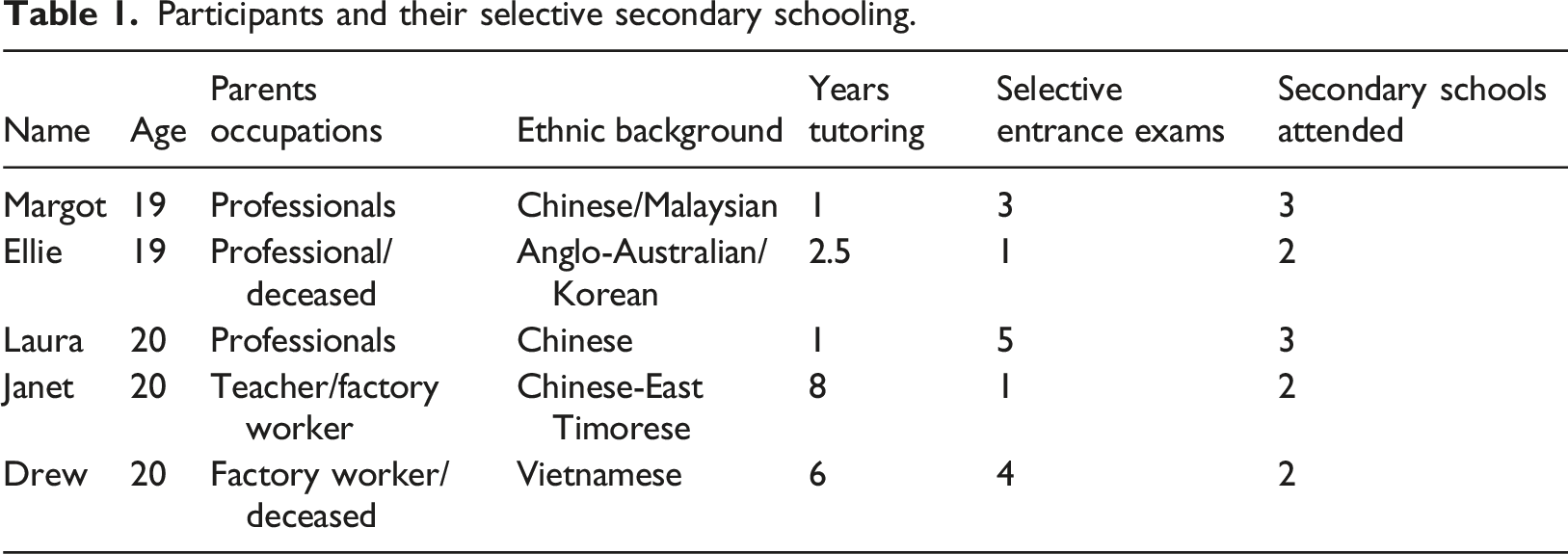
The sample of participants for the study comprised five students in total, four female and one male. The average age is 19.9 years. While all participants were born in Australia, the parents of all students had migrated to Australia either as teenagers or young adults. They all lived in the suburbs of a major metropolitan Australian city. Their parents ranged from professionals (accountants, nurses and teachers) and ‘factory workers’. Two of the five participants were from single-parent households.
Participants and their selective secondary schooling.
The participants were interviewed in person utilising an in-depth, semi-structured approach (Kvale, 1996), with interviews lasting between one to 2 hours. The authors were mindful that subjects might deploy possible strategies of presentation of the self in the interview settings for a university research project that may shape what is shared in the interview. Interview questions were deliberately semi-structured to enable free-form discussion, with provocations that sought to mitigate this possibility.
The interviews took place several years after participants’ admission into selective schools. Empirically, we observed that meritocracy studies that we have cited in the literature review typically interviewed students after selection, asking them about what they think contributed to their success. Methodologically, our research follows the same approach with a deliberate sample of ex-selective school students. Despite the time lag between engaging in school selection processes and the interviews, researchers highlight that significant life events such as employment and education are remembered well (Dex, 1995). It is reasoned that entry into competitive schools may constitute such a significant life event and hence helps to bolster the reliability of the data.
Interviews were audio recorded and fully transcribed for thematic analysis (Castleberry and Nolen, 2018) using NVivo (QSR) software. Following Byrne (2021), initial codes were generated from the data, which were grouped into sub-themes relating to students’ decisions to apply for selective schools, their exam preparation strategies and their reasoning for successful admission. Broad themes were constructed by drawing together the sub-themes that addressed the research questions.
Central to this study is the notion of discourse, relational forms of power (Foucault, 1970, 1980, 2001) and regimes of truth (Foucault, 1991; Foucault and Rabinow, 2001). Discourses constitute dominant ideas, values, norms, assumptions and rationalities which are infrequently questioned or interrogated, forming notions of ‘common sense’ knowledge that appear as ‘natural’ (Archer and Francis, 2006). Moreover, ‘truth’ to Foucault (1980) was approached as a historical question to be analysed in terms of its practices and effects (Singer and Weir, 2008), rather than being objective or obsolete truths about the world. Foucault (2001) saw truth as a ‘thing of this world… its “general politics” of truth: that is, the types of discourse which it accepts and makes function as true’ (p. 54). Rather than power emanating from a particular source, a Foucaultian approach seeks to analyse power through a series of ‘truths’ that individuals tell themselves and others (Kelly, 2016), critically examining instances whereby individuals’ constructions of truth overlap with discourses or reinforce power relations.
The methodology used is premised on an ‘understanding of truths as shifting, of subjectivities as dynamic, fluid, and discursively constituted’ (Chadderton, 2011: pp. 10–11). Fitting with the extant literature (Charles et al., 2020; Kenway and Lazarus, 2017) and the purpose of this paper, to analyse how these students make sense of their successful admission into competitive schools, we chose to capture these ‘truths’ in retrospect. Students were encouraged to explore their circumstances, feelings and reflect upon these throughout interviews, with the researchers playing a minimal role. Importantly, in drawing on this conceptual framework to analyse the data, one must bear in mind that despite perhaps some inconsistencies, contradictions or fragmentations in students’ reasoning, these ‘are not a sham. Indeed, they should be read in ways that allow space for the irony and ambiguity that they provoke’ (Kelly, 2016: p. 41).
But interviews involve a form of interaction between the interviewer and participant, designed to explore participants’ experiences, ideas, attitudes and perceptions about a particular topic (Longhurst, 2003). Following Chadderton (2011), the authors present the interview data with the caveat that we as researchers might be ‘unreliable narrators’ enmeshed in relations of power between students and adults and between students themselves (Robinson and Taylor, 2013). We also acknowledge the risk of treating ‘student voice’ in a singular, homogenous way and that researchers can shape how ‘raw’ voices are represented in research texts (Mayes, 2020; Mazzei and Jackson, 2012). This study draws upon participants’ ‘fragments’ of ‘their experiences and hopes’ (Authors names’ deleted for review).
Findings and discussion
Achieving opportunity through selective schooling involves intensive preparation
The data highlight students’ belief in the opportunity bargain, whereby ‘better’ educational opportunities and life outcomes eventuate from attending competitive and selective schools, compared to non-selective schools. Interviewees from migrant backgrounds describe attending private tutoring and engaging in selectivity as a means for getting ahead of others and achieving educational and occupational opportunities that were limited to their parents. For example, Janet’s parents were born in East Timor and are of Chinese cultural heritage. They migrated to Australia as refugees in the 1970s following the Indonesian invasion. In East Timor, school ‘only goes up to Year Nine’, but having migrated while young, her mother was ‘lucky enough’ to finish secondary school, attend university and become a teacher. Her father did not attend university and works in a ‘factory’.
In line with previous research of selective schools (Abbas, 2007; Shah et al., 2010), Janet’s parents, like all participants in the research, encouraged her to develop an overall value for education. Janet drew on discourses of opportunity to explain why getting into a ‘good school’ was important to her parents. Similar to the reasoning of the participants in Basit’s (2012) research, Janet felt the need to ‘make the most of’ educational ‘opportunities’ which she perceived to be inaccessible to her parents due to the educational opportunity structures in East Timor, poverty, lack of schooling infrastructure and events which interrupted their schooling.
Almost all participants reported that their parents explicitly communicated to them their expectations to get high-status occupations, such as becoming a doctor, lawyer, engineer or accountant. Accordingly, most participants aspired to these positions and being selected into a selective school signified to parents and themselves that they were on a trajectory towards reaching success through the opportunity bargain of selective schooling.
Echoing previous research (Ireson and Rushforth, 2011; Stacey, 2015), all participants undertook general tutoring during primary school, from 3 months up to 8 years by the time they reached secondary school. The findings deviate from previous research as three interviewees indicated that private tutoring and tutors suggested selective schooling. For example, Ellie began general tutoring in primary school. When Ellie questioned whether to attend exam coaching as during the transition to secondary school, the teacher replied: ‘there is no point doing [general] tutoring if you don’t apply for selective schools’. Similarly, Janet described her transition into selective exam coaching as something which occurred when commencing high school: ‘I went into high school and there was selective school tutoring, so we did that, [but] without that kind of [general] tutoring I probably wouldn’t have thought to go to a selective school’. Other students, such as Drew, merely recalled general tutoring ‘rolling over into exam coaching’ as he entered secondary school. While the sample is small, it appears that not applying for a selective school after attending tutoring was regarded as out of place within the regime of truth that saw selective schooling as a natural continuation in the broader trajectory of ‘getting ahead of others’. Hence, selective schools are positioned as ‘gateways’ to achieving this opportunity by participants such as Ellie: I feel like that’s what everybody goes to selective schools for. For a better education, for a better chance. Maybe public schools can’t give it to them (Ellie, 19).
Here, the operation of relational power can be observed as Ellie refers to non-selective schools as ‘public’ schools. Ironically, selective schools are public schools, but Ellie perceives these schools to offer ‘everybody’ a ‘better’ education and a ‘better chance’ because they are selective. Notionally, selectivity equates to an increased likelihood for future success as defined against its ‘other’, the non-selective public school.
Relatedly, the framing of opportunity in this way evoked the sense that opportunities will be ‘missed’ if students do not apply. Sara’s experience highlights the anxiety induced by mass examination and selective schooling. Sara attended a high-performing public school and many of her classmates planned to sit the entrance exam. She explains: At [high- performing government school] everyone was trying [to get into selective schools] and I wanted to try as well - I didn't want to miss out! I thought 'what am I missing out on there? It must be some sort of secret that if I get into a select entry it means better life prospects or I'll get a better ATAR so there was that anxiety that I wasn't doing what other people were doing. So, I sat for the test. People get peer pressured into other things and I get peer pressured into sitting a selective exam! (Sara, 20).
The data show that some families’ narratives of migration can instil in students a sense of valuing education and high achievement. Tutoring is taken up to improve the chances of overall academic success and as students’ progress towards secondary school, the opportunity bargain becomes amplified by other students, parents and evidently tutors, which instils in students that they are unquestionably better positioned to reap the rewards of ‘better life prospects’ if they apply for selective schools; the corollary is a fear of missing out on such opportunities and the two ideas compel some students towards selective schools.
Navigating school entry processes: Alternate conceptions of ‘meritocratic systems’ and individual ‘merit’
Interviews revealed that students not only applied for selective but also high-fee private schools via scholarship exams, with students familiarising themselves with test conditions in preparation for multiple entrance exams over time. For example, Margot undertook tutoring and sat three entrance exams for selective as well as high-fee private schools during the transition from primary to secondary school. Margot had been high-achieving throughout primary school and after undergoing some tutoring, was accepted into an all-girls private school. Her mother was unsatisfied with the amount of school tuition covered in the scholarship. After failing to negotiate a better offer with the private school, Margot attended a selective school for 1 year, before undergoing more intensive exam coaching and re-sitting a school scholarship exam for a private co-educational school, for which she was successfully selected. Margot believed that tutoring ‘paid off’, that it ‘works’ and had ‘proven results’ in securing a place within a selective school. When comparing the selective and scholarship exams, she reflected: I went to tutoring for a year, not because I needed it but just to practice for the test. My mum wanted me to go and I was fine with it. In terms of the tests, the select-entry [school exam] is harder. They are similar in what they test - both you can do with tuition and get in if you are already academic. It’s pretty easy with coaching (Margot, 19)
While other students perceived the selective school exam as more challenging than those for scholarships, most students saw selective and private scholarship exams as inherently similar, allowing them to apply the same techniques rehearsed and practised during coaching sessions to both types of entrance exams. For example, Janet recalls the following intensive exam coaching for the essay component of the entrance exam, which she attributes to her success: Every week we would write an essay and it'd be persuasive topics like ‘should something be banned?’ We had this special English tutor guy and he would train us to write two essays in half an hour like on the selective entry test. He would really drill us to be able to write essays in that short amount of time. So that was what I was able to do by year 8.
While private tutoring was undertaken by all participants to improve academic performance in general, this intensive exam coaching was undertaken specifically to prepare students for the selective school entrance exams. Although selective schools do not promote exam coaching, these data indicate that they perceive this preparation as attributable to their success. Further, the effect of repeating exam coaching and examination for multiple different schools appeared to normalise and desensitise students to the exam environment, as in the case of Drew: I low-key didn’t want to [sit the selective entrance exam], but I did six years of general tutoring with grandpa, then dad teaching. From Grade Six into Year Seven I tried to get into [four Private Schools] and messed up… I ended up getting into the academic class for [a High Performing Public School] - it’s not the most esteemed school, but better than my local high school. After all this, I’d walk into every exam incredibly confident. It made me more robotic. After a while, you develop a mentality where the score is everything (Drew, 20).
Drew became ‘comfortable’ and ‘confident’ undertaking high-pressure exams, which, underpinned by inter-generational family pressures, helped him to succeed. Selective school entrance exams are intended to utilise objective measures of intellect and effort, yet these data indicate that applicants can have unequal experiences of exam experience and preparation. Playing the game of selectivity by repetitive test-taking and undergoing several entrance exams to get into high-demand schools undermines the notion that selective schools provide opportunity ‘to all’, as it confers advantages that are disconnected to talent, or in Drew’s case, to a desire to even attend the selective school.
Common amongst the interviews was the perception that students who were ‘naturally bright’, or ‘talented’ were the exception to the norm, since ‘most’ who were successfully selected utilised private tutoring and coaching to get in. Margot sees herself as belonging to the former category and unpacks her own experiences with entry into selective schools: A lot of it (successful admission) is exam technique. I only did tutoring for three months, so for me it was natural ability, but for a lot of people, there is a lot of tutoring involved from a young age. I think the thing with the select-entry system is that they make it seem like it is open to all, but most people who get in are Asian because Asian families have that strong focus on tutoring and education (Margot, 19)
Further, Laura’s observation of the relationship between culture and individualised strategies reflects the game of selectivity: The White students were the ones who didn't do tuition. Not that [White students] didn't need tutoring, but the parents probably felt that there was no need, whereas Asian students were more into tutoring. It’s about parental upbringing - White people embraced thriving naturally. In Asian parenting, you send your child to tutoring because it has proven results. There were probably some Asians who got in without tutoring, but I didn’t know any - it’s a mix when you think about who gets in (Laura, 21).
Similar to research of elite schools and universities (Gaztambide-Fernández, 2009; Khan, 2011; Koh and Kenway, 2012; Warikoo and Fuhr, 2014), some students attributed the selection of some peers to individual merit without tutoring, but these students were regarded as the exception to the rule. Moreover, there is a pragmatic dimension to the ways that students develop strategies (e.g. through repeat testing). This vision of merit goes beyond ‘academic talent’ to a utilitarian ethos favouring individuals with the resources (and persistence) to play the game of selectivity and apply for competitive and high-demand schools, such as selective schools.
Consistent with a Benthamite view, the general sense from participants is that most students draw on their private resources to compete for access to public selective entry schools. This approach appeared to be accepted and engrained. Students did not problematise or interrogate this notion, rather, they saw meritocracy as enacted by the selective school system, as contradictory by appearing to be ‘open to all’ when indeed it is predominantly closed to all except those who have the economic resources, certain cultural characteristics and dispositions, that is, being from an ‘Asian’ family, and a mentality of persistence.
Scholars have problematised the enactment of meritocracy through schooling (Collini, 2021), highlighting that a genuine enactment of meritocracy remains an ‘unfulfilled promise’ that is indeed ‘unfulfillable’ as social and family background factors often influence the pupil composition of schools (Mijs, 2016). Markovits argues that: Like aristocracy once did, meritocracy […] organises the lives of people caught inside it… Establish[ing] a durable, self-sustaining hierarchy. Merit itself is not a genuine excellence, but rather, a pretense, constructed to rationalise an unjust distribution of advantage (pp. 10-11).
Others have argued that the discourse of merit could ‘magnify’ social inequalities (Steele, 2017) by reducing structural challenges to the efforts and intellect of individuals, upon whom both success and failure can be attributed to. The way in which the deployment of family advantage is normalised and invisbilised in the game of selectivity, enabling ‘most’ students to use well-rehearsed exam techniques to be successfully selected, as well as their perceptions that private tutoring, hard work and playing the game of selectivity constitutes a form of merit can be read in this way.
Similar to Phillipo’s (2019) participants, it is evident that for these students, in the contest for a place within selective schools, as Drew described, ‘the score is everything’ and there is little space left for the concern of disadvantaged others as the permeation of power is heightened and exacerbated by the opportunity bargain that compels students to take up individualistic practices to get into a ‘good school’ and avoid the ‘local high school’. We argue that attention must be paid on both how students go about achieving these high scores, the impacts on students’ wellbeing and lives as they undertake sometimes years of private tutoring and how selectivity is shaping students’ attitudes towards schools, students and families who may or may not be able to compete.
Our participants suggest that persistence, hard work and dedication constitute an alternate form of merit, albeit, one that is not recognised within the current system of selective schooling and schooling more generally, that instead favours ‘natural ability’. Rather than suggest that students and families are gaming the system, we argue that these alternate conceptions of merit speak to an internal contradiction within the discourse of school choice evident in both public and private sectors, whereby a perception of ‘natural ability’ constitutes merit favoured within the current meritocratic system and coaching is discouraged; meanwhile, competition is promoted and sustained through high-stakes testing for places within public secondary schools.
Conclusion
Within the regime of truth discussed in this paper, the scope of what individuals perceive as available choices for schooling is reduced. In our study, power operated through perceived ‘truths’ that are connected to broader ‘regimes’ of school choice and the opportunity bargain. The effect of these ‘regulated freedoms’ can be seen in students’ beliefs that they have no choice other than to play the game; as Ellie believes, ‘that’s what everybody goes to selective schools for. For a better education, for a better chance’. At a wider level, the development of selective schools reflect and instantiate historical tensions in the development of Australian schooling by favouring, rewarding and valorising individualistic tactic and practices to get ahead in the game of selectivity. Rather than criticise the young people in our study for their strategies to get into competitive schools, we argue that are they responding to the structures and discourses that they are situated within. How competitive entrance exams are set up and the proliferation of private tutoring immerses students and their families into a discursive context that perpetuates and sustains individualistic attitudes because what they perceive as how to get into competitive schools i.e. private tutoring, is re-framed as 'merit' within the game of selectivity. The students are embracing 'in it to win it' attitudes and doing what they perceive as 'what it takes' to win the game, but at what cost? Moreover, how many entrance exams are students undertaking and what are the accumulated effects of these on their attitudes towards schooling and wellbeing?
Our study draws attention to entrance exams, which has implications for policy makers. Selective school entrance exams are designed based on ‘higher order thinking skills’, with ‘required knowledge in any section will not exceed that found in the [school] curriculum'. The tests are designed to be ‘not coachable’; however, the data here suggest they are. Students can navigate both selective school and high-fee private school entrance exams because they require similar abilities and skills to play the game. Beyond small-scale studies (Ho, 2020; Sriprakash et al., 2016), the extent to which tutoring or private exam coaching is utilised to prepare for competitive entrance exams in Australia is not known. Dooley et al. (2018) found that there were 46 private tutoring suppliers operating in one suburban area in the Australian city of Brisbane alone, all of which used marketing techniques specifically aimed at ethnic minority families. Not all families can afford private tutoring or exam coaching, but alongside the repetitive test-taking and coaching, the data indicate that the more entrance exams students sit over time, the better they get. As inequality is related to the processes of test preparation, perhaps regulating advertising and marketing around private tutoring and coaching could reduce access and provide a way of making entrance exams more equitable. Lastly, this small study suggests that a more equitable system would require limiting the number of entrance exams undertaken across all sectors, both public and private.
Footnotes
Declaration of conflicting interests
The author(s) declared no potential conflicts of interest with respect to the research, authorship, and/or publication of this article.
Funding
The author(s) received no financial support for the research, authorship, and/or publication of this article.
