




Abstract
Researchers have criticised the pragmatic focus on the value of music education for its contribution to the acquisition of children’s academic skills such as literacy and numeracy development in schools across the international contexts driven by neoliberalism. In the context of Froebel’s Mother Songs, this paper via documentary research focuses on a Froebelian approach to music education in early childhood context to counterpart the neoliberal pragmatism in educational landscapes. The Froebelian perspective brings in implications for early childhood practice, research and policy-making by addressing the important role of music in supporting young children’s holistic learning and wellbeing in responding to the neoliberal pressures on children and practitioners in the 21st century.
Keywords
Introduction
Friedrich Froebel (1782–1852) was a German educational philosopher, thinker, reformer and the inventor of Kindergarten. As Bowen (1901: 47) argued, Froebel was ‘the first to apply the theory soundly and completely to education, and having so applied it, to translate it into practice’. This reflects Froebel’s contribution in translating his educational theory into practice by means of children’s agency, play, engagement with nature, positive relationships between children and adults, and knowledgeable and nurturing educator (Brehony, 2006; Bruce, 1987; Liebschner, 1992; Trust, 2023). Being one of the most influential early childhood pioneers, Froebel highlighted the value of childhood in its own right, recognised each child’s capacity and potential to develop and learn, addressed the importance of children’s holistic learning and paid close attention to wellbeing through his educational philosophy and practice (Bruce, 1987, 2021; Froebel, 1887, 1895; Tovey, 2017). Froebel has had positive impact on early childhood practice, research and policy making in the UK and international context. Froebel’s advocacy for the important role of education in developing human being to become creative, critical and intelligent thinkers (Froebel, 1887, 1895), which was and still is revolutionary and aspirational for educators in the 21st century.
The original German version of Froebel’s Mother Songs published in 1843 was a key part of Froebel’s published work in the 19th century. In Froebel’s view, the role of music is important in supporting children to know and understand themselves and others in connection with family, community, nature and the world around them including divinity (Bruce, 2021; Liebschner, 1992). This helps children to develop confidence about who they are, respect others and cultivate resilience facing challenges and difficulties. Froebel’s Mother Songs provides ‘a pedagogical tool and emotional conduit’ for supporting children’s positive learning experience as argued by Powell et al. (2013: 1). The significance of Mother Songs was addressed by Froebel himself as representing his educational philosophy and as starting point for education to support children’s healthy development and holistic learning (Liebschner, 1992).
There is a strong consensus that provision of music supports young children’s holistic learning and wellbeing based on research evidence, however, in practice the value of music education has been mostly reduced to its contribution to children’s cognitive development such as literacy and numeracy skills in schools across international contexts constrained by the neoliberal landscape as argued by many (Garvis, 2012; Reynolds and Burton, 2017; Young, 2007). In the context of Froebel’s Mother Songs, this paper aims to highlight the importance of maintaining early childhood heritage by addressing the role of music via a Froebelian approach in supporting young children to develop close relationships with family members, sense of belonging, an understanding of family and community life, connection to nature, and a sense of responsibility as part of their holistic learning experience and wellbeing.
Methodology
This paper is constructed via documentary research as our methodological approach. Documentary research requires the same rigour as any other type of social or educational research as argued by many. Bowen (2009) and Robinson (2010) emphasise the importance of the three main aspects of documentary research – access, selection, interpretation and analysis of the documentary materials. Access to sources is not necessarily straightforward. The availability of documents cannot be taken for granted and the documentary record at times is frustratingly fragile. In the case of our documentary research here, digitalisation of primary sources in relation to Froebel’s writing via Froebel Archive Digital Collection at University of Roehampton has aided the process of us accessing and selecting fragile historical sources written by Froebel himself and Froebelians in the past. We have sought to access a broad spectrum of documents including historical, primary sources such as Education of Man (Froebel, 1887), Pedagogics of the Kindergarten (Froebel, 1895), Froebel’s Letters on the Kindergarten (Froebel, 1891), and Froebel and Education by Self-activity (Bowen, 1901). We have also accessed secondary contemporary Froebelian writing such as Early Childhood Practice: Froebel Today (Bruce, 2012) and Bringing the Froebelian Approach to Your Early Years Practice (Tovey, 2017) to name a few as well as non-Froebelian sources such as Frames of Mind: The Theory of Multiple Intelligences (Gardner, 1983), Out of Our Minds: Learning to be Creative (Robinson, 2001), and various academic journal articles rather than relying heavily on one particular group to lay a good foundation for our analysis of documentary data.
One of the main challenges involved in documentary research is to read, interpret and find meaning in the documentary records, which demands a face-value reading to elicit factual information as well as a much more critical reading between the lines (Robinson, 2010). Hammersley and Arkinson (1995) further argue that it is important to take a critical approach by interrogating the historical, social, cultural, economic and political contexts, and carefully considering the audience and purpose of the documentary sources. In the meantime, O’Leary (2014) reminds us of the importance of evaluating own and other researchers’ subjectivity and biases in the process of interpreting the documents.
These aspects discussed by academics and researchers have led to our awareness of difficulty in understanding Froebel’s own writing and existing critiques of Froebel’s work. We admit our interpretation of Froebel’s ideas and existing research might be biased due to our own limited knowledge and understanding of what we can access and what we know. In addition, it is not easy to understand Froebel’s ideas due to the particular historicity in which Froebel lived, Froebel’s way of expression and language style alongside the great complexity and multi-layered thinking manifested in Froebel’s writing (Tang, 2021; Von Marenholz-Bulow, 1894).
Therefore, our documentary research here is far from being a perfect analysis of the role of music in early childhood via Froebel’s Mother Songs, nor being a comprehensive study of key Froebelian and non-Froebelian literature in the field. However, we aim to produce an account which is based on our great endeavour to understand, interpret and analyse what we are able to access with a critical manner. This would enhance rigour and criticality of our documentary research.
We aim to invite dialogues among educators, professionals and researchers in making deep reflections on the crucial role of music in supporting young children’s holistic learning and wellbeing via a Froebelian approach in the context of Froebel’s Mother Songs. Our research is guided by the following research questions: • What is the role of music in supporting young children’s development, learning and wellbeing? • How is music education translated into practice? • In what way does a Froebelian approach to music education support young children’s holistic learning and wellbeing? • What are the implications for early childhood practice, research and policy-making?
The forthcoming sections present findings to address the research questions above focussing on the role of music, music education in practice, a Froebelian approach to music education, followed by our Conclusion.
The role of music in supporting children’s development, learning and wellbeing
Prior to 1960s, human mental ability was measured using IQ (Intelligence Quotient) tests (Beadle, 2007; Boring, 1923; Gardner, 1983). The use of IQ tests since then has been critiqued to have been narrow and culturally specific, and it alienated people from different social-economic and cultural backgrounds. Not all people had been exposed to the kind of information tested in IQ tests but was based to test white European middle-class knowledge. Unfortunately, the IQ tests results were used to determine children’s academic abilities and later determine their career prospects. The focus on IQ tests was later professed as discriminatory and inadequate, although some people still use to date. Even so, Gardner (1983 & 1991) argued that human beings have diverse abilities and talents, which are not captured in the IQ tests. Gardener claimed that human beings have multiple intelligences such as linguistic, musical, logical, kinaesthetic intelligences etc. Gardner argued that a variety of intelligences should be identified in an individual and nurtured environment for people to thrive in their areas of strengths. Robinson (1999 & 2001) addresses that in a child-centred education, creativity should be upheld, where the teachers should be able to develop the best possible ways, children learn through identifying their interests and providing a variety of opportunities for exploration. For example, if a child is musically inclined, the teachers and parents should nurture that interest through the provision of music lessons, exposure to diverse musical instruments and other music activities to further cultivate children’s musicality. Gardner’s theory has been criticised that it may be unpractical to be able to support children diverse intelligences in current classroom, as more resources and time is needed (Gilman, 2001). We argue that it is crucial to support children’s diverse interests and abilities by overcoming challenges in setting up environments and providing resources.
Although in popular culture music has been perceived as a talent which can help individuals increase their social capital and celebrity status, including children who participate in national and global competitions. There are other benefits music offers to support children’s personal and emotional development, social skills and wellbeing (Rebecchini, 2021). Trevarthen (2002) observes that music reflects human relations, in which human beings including young children express their experiences, feelings, and emotions, and argues that musical activities provide space to enhance the quality of individual experience and relationships as part of companionship in children’s lives. The Reggio Emilia approach (Reggio, 2015) recognises the one hundred languages that children could communicate in, music being one of the languages to engage and empower children in a meaningful way. Indeed, since time immemorial children have always enjoyed songs and music activities in different communities across the world and manifested their agency and autonomy in their engagement with music activities (Corrado, 2020; Rebecchini, 2021). We argue that children’s agency through music upholds the right to good health, self-determination and wellbeing underpinned by the UNCRC (1989) article 12 and article 13.
From a neuroscience perspective, Dweck (2015) argues that the brain is not fixed but can expand through acquiring new knowledge and skills. Similarly, Goswami (2015) states that the neural activity of the brain is activated when individuals are exposed to an enriched environment and argues that individuals should be afforded a variety of activities and experiences to enable cognitive development. We would further support Dweck (2015) and Goswami (2015) in that the exposure of children to music is an activity and an experience that would enhance children’s cognitive development as well as emotional and social development by acquiring new experiences, knowledge, relationships and skills in the process of children expressing themselves through variety of music activities such as singing, dancing, movements playing an instrument etc.
The Department for Education (2021) has outlined the need for having music lessons in schools where children can sing, listen, compose and perform music. The provision of opportunities for all children to enjoy and experience music is crucial to their development and learning. Furthermore, some musically gifted children might even learn a language and ways to express themselves through music performances or composing songs (Fancourt et al., 2014). On the other hand, music could be used as a way to communicate feelings and creating social spaces where an individual can have a sense of belonging and acceptance. Scotland (2020) addresses the importance of providing environments with rich culture to support young children’s high-quality experiences and sensitive interactions and develop their emotional resilience they need to form a secure wellbeing base and recognises the important role of stories, songs and rhymes in supporting young children’s wellbeing and developing their empathy towards others.
The mental health issue experienced by children have been highlighted in recent years. The Early Years Foundation Stage (EYFS, 2022) and NHS (2022) have noted that issues of mental health are prevalent among children as young as below 5 years old. They have advocated for support for children and families The Department for Education (2018) reported that 1 in 10 children in the UK is diagnosed with a mental illness, while Place2be (2022) has stated that it is 1 in 6 children have a diagnosable mental illness. Place2be is a charity that supports children with mental health struggles, and has further reported that 1 in 10 boys with mental health issues are excluded from school (2022). These statistics have increased during the COVID-19 pandemic after the national lockdowns in the UK since March 2020. Indeed, the abrupt changes of life style and school disruptions as a result of the pandemic might have contributed to the amounting social issues such as mental health in children and families (Children Society, 2021). Hence, schools and the children’s departments need to support children and their families to deal with these issues, which may help to reduce the occurrence of poor health and wellbeing. One of the major causes of mental illness is unstructured lifestyles and feelings of loneliness and anxiety especially among the adult population. Similarly, anxiety and stress from staying at home, coupled with removal of coping mechanisms and reduction in support services are considered as main aspects to cause children’s mental health in the context of the COVID-19 pandemic (UNICEF, 2020).
The role of music and arts is important in reducing stress level and improving mental health and wellbeing although evidence base for understanding biological responses to music is still developing (Fancourt et al., 2014; Finn and Fancourt, 2018). Indeed, some therapists supporting children with emotional and psychological issues have utilised music therapy for support. Costa and Ockelford (2017) argue that there are music benefits when supporting individual with depression and anxiety. Zachariou and Whitebread (2015) also state that music helps individual with behavioural problems build their self-regulation abilities. Fautley (2018) argues that music education alongside art activities provide children and young people with important experience to engage with breadth and depth of learning and curriculum. We would thus argue that it is even more pertinent for the society to recognise the importance of providing children especially young children with environments and spaces where they belong. Furthermore, in these spaces, children would have opportunities to express themselves through music and other recreational activities to reduce mental health illness cases. Practitioners and professionals would be able to support young children’s wellbeing during the pandemic and beyond.
Music education in practice
The impact of music on children focussing on emotional and social development and wellbeing has been commonly recognised by scholars and researchers as we discussed in the previous section. Naughton and Lines (2013) highlight the importance of music as a mode of engagement between children and teachers/adults, as a way of communicating, express feelings, being part of the world, and as a way for children and adults to understand themselves with others in a social context. Naughton and Lines (2013) thus call for responsiveness of professionals to children and provision of time and space for children to explore and develop child-initiated music making activities in New Zealand context. In Musical Development Matters (2018), one of the key early years music education document in England, Burke (2018) addresses the importance of music as a core component of children’s holistic learning in offering children opportunities to explore, communicate and respond to experiences in the context of social interaction with others as a way of children’s expression of emotions and feelings. Burke (2018) strongly advocates the musical attributes of children via broad musical experiences in early childhood and beyond. The consensus here is that provision of music builds young children’s interest and confidence in engaging with music and supports their holistic learning and wellbeing.
In practice, however, the value of music education has been most reduced to its contribution to development of children’s literacy and numeracy skills due to performativity pressures in the context of neoliberalism, which is a cruel reality as argued by many. Garvis (2012) examined the weekly planning of 76 early years teachers across kindergartens, preparatory classes, and Years 1, 2 and 3 in Queensland, Australia. The findings are that the majority of the weekly plans were dedicated to literacy and numeracy, little time was devoted to the teaching of music apart from the scheduled 30-min music lesson with a specialist teacher in some schools, and of the limited number of weekly plans that featured music, activities were teacher-directed (Garvis, 2012). This reflects the observation of Barretta et al. (2019) that there is decline in the provision of specialist music education at schools alongside a significant decline in the allocation for music education in the preparation of generalist early childhood and primary teachers in Australia, which is a cause of national concern. Reynolds and Burton (2017) hold that music learning and development begins in the womb, continues during infancy and needs to be prioritised in preschool and elementary education. Reynolds and Burton (2017) trace the policy landscape for music education in the United States since 2008 and argue that it is a long way to go for early childhood professionals to provide quality musical opportunities for young children with many constraints such as lack of funding, training and beliefs about the value of music.
This might be similar to the UK or many other countries too when arts and music education are marginalised in comparison to core subjects in early childhood and later stages of schooling. Ouvry (2012) argues that the marginalisation of music teaching in England and the society’s downgrading the value of musical activities for children’s learning experiences might have led to a lack of confidence among early childhood practitioners in music practice. Fautley (2017) observes that music teachers would benefit from subject-specific continuous professional development in curriculum construction in order to enhance music teaching and learning at Key Stage 3. Similarly, Poulter and Cook (2022) observe that many generalist primary school teachers in the UK feel that they do not have the confidence or pedagogical knowledge required to teach music in a way that engages and extends children’s music experience. Student teachers therefore may not have the opportunity to observe good practice or to organise music teaching during placement.
Considering the value and importance of music for young children’s life experiences, we would argue that there is a great need to consider the implications for early childhood practice and policymaking. Early childhood might be a relatively less endangered phase in comparison to the education of older children in relation to flexibility and autonomy of practitioners in providing learning opportunities and assessing children’s learning. However, impact of neoliberalism centred around accountability and performativity might restrict practitioners’ ability to exercise agency (Moss and Dahlberg, 2008) and prevent practitioners from empowering themselves to make professional judgement and decisions constrained by the ‘regulatory gaze’ as argued by Osgood (2006). Similarly, Garvis (2012: 126) argues, ‘If we consider the arts, including music, important for young children we must begin to question our current practice focussing on a ‘curriculum centered approach’’, which limits children’s music learning opportunities in schools, and calls upon the importance of 'growing from the roots' upwards with young children.
Despite the benefits of music for positive childhood experiences, there is a lack of music provision in education systems, which is driven by economic productivity and international competitiveness in the context of ‘the knowledge economy’ (Ball, 2021: 3). Penn (2010) claims that human capital perspectives address society investment in childhoods focussing on the futuristic of children such as potential labour market, capital gain and future careers, rather than the childhood experiences at the time. Quortrup (1994), Becker (2006) and Hill (2007) argue that we are in the ‘age of human capital’, where education aims for a capitalist approach. As a result, education systems focus on promoting and funding academic subjects such as STEM and thus overlook creative and humanity subjects such as arts, music, sports and religious education. This deprives children of rich learning opportunities.
Gardner (1983) and Robinson (2010) as noted earlier have contended that the lack of support for creativity disadvantages learners with interests and intelligences in areas like arts and music. The capitalist approach also limits children’s agency and self-determination in the context of the UNCRC (1989), where individuals should be provided opportunities to freely choose, explore and learn, without capitalist pressure but benefiting from equal opportunities. However, the capitalistic approach exacerbates inequalities in childhood experiences risking the health, learning and wellbeing of children from disadvantaged backgrounds. This clearly reflects Ball’s (2021) and Thompson’s (2021) critiques of the narrowly defined school effectiveness discourse rooted in the neoliberal regime, which undermines the socio-cultural contexts and creates inequalities among school children.
A Froebelian approach to music education in the context of Froebel’s mother songs
Facing these issues and challenges that have occurred in practice as discussed earlier on, we as academics and researchers strongly feel the need to draw stakeholders’ attention to a Froebelian approach as an alternative perspective by dialoguing with academics, researchers and practitioners to interrogate the role of music in supporting young children’s holistic learning and wellbeing in the context of Froebel’s Mother Songs.
Froebel's Mother Songs was published in German in 1843, a collection of about 50 nursery rhymes, songs, fingerplays and games. Froebel intended to use Mother Songs to support young children at home and provide learning resources for family use, especially women as mothers and educators to engage with children and learn together about family and community life, get to know, experience and appreciate nature, and cultivate children’s morality, symbolic thoughts and spirituality (Bruce, 2012; Bruce, 2021; Liebschner, 1992; Powell et al., 2013; Tovey, 2017). This is further reflected in Bowen (1901) in that the Mother Songs aimed to lead the child to a consciousness of his connections between himself, family, community, nature, physical world and spiritual side of the world. Froebel also addresses the importance of child physical activity, movement, sensory experiences and recognition of mothers and carers' responsibility to engage with children, and the importance of educating children via songs, rhymes and movement (Blow, 1895; Bowen, 1901; Tovey, 2017; Bruce, 2021). Considering kindergarten as a place for connection and expansion of home-life (Froebel, 1887), Mother Songs therefore acted as the starting point of the very young children's education, in which children's dispositions are nourished and fostered so that children develop and grow healthily (Bowen, 1901; Liebschner, 1992).
With awareness of the monocultural connotation reflected in Mother Songs considering the context of German romanticism and idealism in the mid-19th century, there were efforts made by Froebelians to develop different versions of Mother Songs in order to make adaptations for kindergarten practices in the late 19th and early 20th centuries to reflect localities and cultural diversities (Bowen, 1901). Key Froebelian principles such as the concept of Unity and Connectedness, the importance of sensory learning and first-hand experience, children’s self-activity and autonomy in learning, positive relationships, adult role in supporting children as 'freedom with guidance', and trust of women as capable educators are clearly reflected in the Mother Songs. As Liebschner (1992) observes, the Mother Songs support young children to develop gratitude and respect to people who work for the good of the family and community. This was reflected in many songs and figure plays in Mother Songs including The Little Gardener (see Figure 1, in Blow, 1895: 228). Little Gardener (in Blow 1895: 228).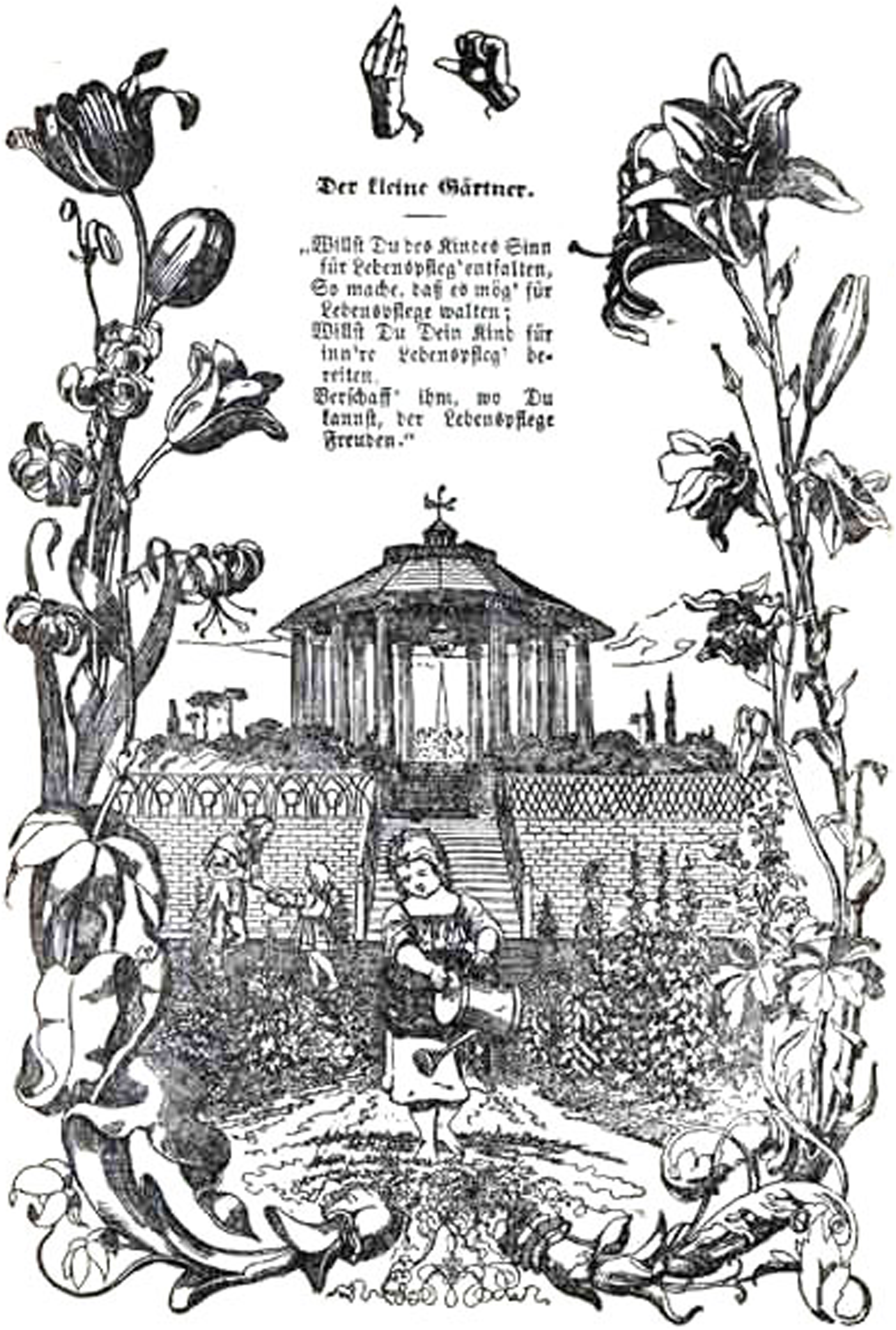
Froebel’s Mother Songs has impacted today’s early childhood practice across the world (Bruce, 2011, 2021; Tovey, 2017) although there is a lack of recognition of the rich Froebelian tradition among practitioners (Ouvry 2012). We believe that a Froebelian approach to music education can encourage practitioners to develop a principled approach by engaging with the Froebelian heritage in support of young children’s holistic learning and wellbeing. As argued by Tovey (2017: 2), ‘A Froebelian approach is not a method. There is no formula or recipe to follow or set of equipment to purchase or prescribed curriculum to adhere to. Nor is it a series of ideas and activities which practitioners can dip in and out of. Rather it is a whole way of thinking about children and childhood, based on a set of values and principles’.
A Froebelian approach is not about looking back and trying to preserve outdated theories and practices from the past, rather it is about deepening our understanding of the roots of current ideas and practices in ways that can help us move forward with more strength and confidence as argued by Tovey (2017). A Froebelian approach is not a static, rigid approach, but open to interpretation and enables flexibility and openness for early childhood educators to articulate and strengthen informed pedagogical beliefs and develop quality education and care to benefit children and families (Tang, 2021).
Professionals, practitioners and scholars inspired by the Froebelian heritage have contributed to music education in various ways. For example, Ouvry (2012) reflects on own experience of music and movement as routine practice in infant schools in the 1950s in England. Considering many practitioners not aware of the Froebelian heritage, Ouvry calls for efforts via research and training programmes with early childhood settings to connect and reignite the Froebelian tradition and engage with music practice. Similarly, Baker (2012) and Spratt (2012) apply a Froebelian approach to home, early childhood settings and schools with the hope to arouse stakeholder’s awareness of the importance of musical activities for young children and promote change to benefit children’s life experiences. Spratt (2012) has taken forward Froebelian practice with finger rhymes and action songs whilst Barker (2012) has brought family songs to the work with the very young children and reignite the Froebelian tradition of lullabies, rhymes, and songs to support children’s holistic learning.
A Froebelian approach to music highly addresses the importance of the connection and interconnection between the child, nature, families, communities and the wider worlds by providing children with meaningful music activities for children to feel connected and develop understanding of cultures, rituals and traditions. This is reflected in the practice of Froebelian settings and schools in the UK, such as the Annan Froebel School, Cowgate Under 5s Centre, Guildford Nursery School and Family Centre, Linden Tree Nursery Schools and Ludwick Nursery School among many. The sense of Unity and Connectedness has proved especially important for children, families and communities to keep connected with each other in the context of the COVID-19 pandemic. Dyke (2020) further highlights the value of nursery rhymes and songs in supporting young children to develop strong, healthy relationships with key people in their lives. Practitioners in Froebelian settings have developed informed understanding about the importance of music and singing in enhancing strong relationships and healthy development of young children. Daily routine activities can be adapted to incorporate music activities as an effective way to be in tune with children and enhance positive relationships (Dyke 2020). For example, changing a baby’s nappy can be accompanied by lyrics and simple cheerful songs, such as adapting ‘Here we go round the mulberry bush’ to ‘Now is the time to change your nappy, change your nappy, change your nappy. Now is the time to change your nappy in a cold, frosty morning…’ as observed by Dyke (2020: 4).
The importance of children’s holistic learning and wellbeing is reflected in Froebelian language ‘forms of life’, ‘forms of beauty’ and ‘forms of knowledge’ by offering a wide range of curricular activities to enable children’s first-hand experience, healthy development of sense of self and others, communication and language development, creativity and imagination, and understanding of cultures and the world around them (Dyke, 2020; Whinnett, 2021). A Froebelian approach addresses the crucial role of music in supporting children’s holistic learning and wellbeing. As argued by Bruce and Spratt (2011), it is important for early childhood settings to provide resources and opportunities for children to engage with nursery rhymes, action songs and movement plays, which cultivate and enhance children’s creativity, sensitivity to others, coordination, communication and increased language development as well as mathematical understanding of sequencing, predicting and an awareness of detail and anticipation. For the very young children, as observed by Powell et al. (2013), provision of singing and rhymes plays a crucial role in developing children’s sense of belonging, intimacy and connectedness, enhancing their engagement and enjoyment, and supporting wellbeing of both children and adults.
A Froebelian approach to music addresses the importance of adult role via ‘freedom with guidance’ in supporting children’s learning (Dyke, 2020; Liebschner, 1992). It is common among early childhood settings inspired by the Froebelian heritage to provide opportunities for creativity via arts, music, storytelling as part of children’s holistic learning experience (Dyke, 2020). The Froebelian term ‘freedom with guidance’ features the practitioner role in providing resources, space and time for young children to engage, explore and play following own interest with spontaneity alongside practitioners’ guidance via developing sensitivity in observing children, adjusting interactions with children and developing informed decisions of when and how to offer children support and extend their learning, which is a demanding task to practitioners (Louis, 2022; Tovey, 2017). In Bruce’s (Bruce, 1997: 97) words, extending means offering help with ‘physical materials, create space, give time, dialogue and converse about the play idea’ as well as ‘sensitivity and adding appropriately stimulating material provision and the encouragement of the child’s autonomous learning’. Young (2005) addresses the importance of providing space for young children to play with songs, engage with movement and music activities, which distinguishes from children performing songs directed by adults. Playing with songs encourages children’s motivation and spontaneity in creating something original and of children’s interests and enhances collaboration and problem solving whilst performing songs might reduce or restrict opportunities to enrich young children’s creativity and imagination as argued by Young (2005). A Froebelian approach encourages adults including practitioners and parents/carers to adapt finger plays, nursery rhymes and songs in daily routine activities for children in early childhood settings and home environments to enable children’s rich enjoyable learning experience (Bruce, 2021; Dyke, 2020).
Conclusion
We would like to conclude with important implications of a Froebelian approach for early childhood practice, research and policy-making. A Froebelian approach to music education in early childhood has played an important role in guiding practitioners to deepen understanding of the importance of broader musical experiences in supporting young children’s holistic learning and wellbeing and encouraging practitioners to develop a principled approach to practice based on pedagogical values and beliefs (Bruce, 2021; Tovey, 2017; Whinnett, 2021). A Froebelian approach ignites practitioners’ confidence in resisting the data driven, compartmentalised educational approaches focussing on reading/writing/numeracy readiness (Bruce, 2021; Gill, 2020). Our research here does not aim to solve issues of neoliberalism, nor can it on its own, however, it is important to address that a Froebelian approach to music in the context of Froebel’s Mother Songs offers a strong, valuable alternative perspective by addressing the prime importance of the role of music in supporting young children’s holistic learning and wellbeing. This would challenge the status quo and help to reallocate early childhood practice by igniting courage and hope among practitioners facing vast amount of neoliberalist pressures in the 21st century as argued by many (Ball, 2021; Moss and Dahlberg, 2008; Osgood, 2006; Thompson, 2021).
Footnotes
Declaration of conflicting interests
The author(s) declared no potential conflicts of interest with respect to the research, authorship, and/or publication of this article.
Funding
The author(s) received no financial support for the research, authorship, and/or publication of this article.
