



Abstract
The notion of inert benevolence has been written about in the context of primary school teachers working with languages beyond English (Cunningham and Little, 2022). However, the concept has a broader relevance for those working in education and this paper seeks to explore it more fully, through the use of the metaphor of a flower press in order to understand how the power of numerous factors bearing down on teachers leads to inert benevolence.
Keywords
Introduction
Mainstream teachers in many international contexts are required to perform their duties against an ever-increasing list of competing priorities and pressures and with what seems to be an ever-decreasing funding and resource allowance and the disempowering effect of de-professionalisation. For almost half a century now, there has been a legislative push towards ‘inclusive practice’ in classrooms, ensuring that as many children as possible are educated in the mainstream classroom. Additionally, with the protection of legislation such as the Equality Act of 2010 in the UK, children with certain protected characteristics should be experiencing inclusive practices and relevant accommodations in classrooms.
Most teachers are reported to be positive about working towards socially just and inclusive classrooms. The notion of inert benevolence (Cunningham and Little, 2022), however, has been written about in the context of primary school teachers working with languages beyond English (Cunningham, 2019a). The concept also has a broader relevance for those working in education and this paper seeks to explore this more fully, through the use of the metaphor of a flower press in order to understand how the power of numerous factors bearing down on teachers leads to inert benevolence.
‘Inert benevolence’ in multilingualism research
Author and Cunningham and Little (2022) explored what we termed ‘inert benevolence’ during our analysis of interview data from mainstream primary school teachers in England involving discussions about working with multilingual and emergent multilingual children, as part of a wider international and comparative project. Largely positive and very benevolent attitudes towards the notion of multilingualism were expressed by almost all of the teachers, which echoes the findings from for many other studies (Karabenick and Clemens, 2024: Gkaintartzi and Tsokalidou, 2011, Kearney, 2014; Bailey and Marsden, 2017; Cunningham, 2019b, Cunningham, 2019c), although there is, of course, variability in the overall level of positivity towards multilingualism, which depends on various practical as well as demographic reasons and predictors of attitudes to linguistic diversity, explored elsewhere (Byrnes et al., 1997; Flores and Smith, 2009; Youngs and Youngs, 2001).
However, there is typically a lack of action with regards to what teachers actually do to incorporate what Moll et al. (1992) called the ‘funds of knowledge’ that multilingual children bring to the classroom. There are plenty of examples of good supportive practice such as buddy systems and translations of resources, and sometimes even space for translanguaging (pedagogical practice that allows space for all children’s linguistic repertoires in the classroom) in the data set of 40 interviews and this does need acknowledging and applauding. But there is no significant evidence of multilingual pupils being actively supported in using all of their languages in the classroom other than as part of a typical transition model to English-only with a focus on the access the curriculum and assessment being wholly in English. Additionally, in the teachers’ interviews, many barriers to action were noted and there were numerous contradictions in the participants’ discourses about multilingualism and the support of multilingual children and these can be seen as examples of or as flags of ‘inert benevolence’. Something or someone is stopping teachers from working with the intrinsic positivity that they initially bring to the classroom.
‘Inert benevolence’ beyond multilingualism in the classroom
The concept of ‘inert benevolence’, however, is one that can also be of value in exploring many other social justice issues in the mainstream classroom. Research has shown us that teachers working with children who are neurodivergent and/or disabled and LGBTQ + pupils and students, amongst other often marginalised communities, are also usually intrinsically positive about the inclusion of those individuals. In these domains too then, we see the same or similar ‘inert benevolence’, the positive mindset towards advocacy or classroom support in principle but circumstances where individual teachers may lack any real power or agency to turn their benevolence into concrete action, support or activism.
Swanson and Gettinger (2016) and Garrett and Spano (2017), for example, found that teachers of all self-reported sexualities held generally relatively positive attitudes towards LGBTQ + students and acknowledged the need to support LGBTQ + youth. However, Swan and Gettinger (2016) note that they do not consistently intervene on behalf of LGBTQ + students. Dukmak (2013) and Van Steen and Wilson (2020) indicated that teachers have a positive attitude towards the inclusion of children with disabilities in mainstream schools, although they note that these attitudes are affected by multiple and intersectional cultural and demographical factors. However, Avramidis and Norwich (2002) found that attitudes were heavily influenced by the nature and severity of the children’s disability and environmental and resource factors, and rather less by the teacher-related variables. The impact of an increase in neutrality and bystander behaviour where issues of social justice are concerned can be extremely detrimental, as highlighted by Lam et al. (2023) in a recent Canadian study. Therefore, it is to a deeper exploration some of these environmental and resourcing factors that we should now turn our attention.
‘Inert benevolence’ and the pressure on teachers: The Flower Press analogy
The fact that teachers in a modern global society impacted by the processes of educationalisation (Smeyers and Depaepe, 2008) have been working under increasing pressure has been a topic of research focus for some time now (MacBeath, 2008). Probably the most commonly used metaphor to describe the situation that teachers find themselves in is that of the ‘pressure cooker’ with teachers under scrutiny from many directions (Perryman et al., 2011) and Ball (2008, cited in Perryman et al. (2011) also refers to the ‘ratchet’ effect in terms of the normalising of constant policy changes and ever-increasing curriculum pressures. In this paper, I will explore a potentially more useful metaphor, that of the Flower Press. This allows for both layered pressures and for a ratcheting effect to be included in the analogy.
Using the metaphor of a flower press, I conceive of intrinsically positive teachers as being the flowers, initially living and growing, potentially providing a home and sanctuary for all kinds of wildlife and working individually around the challenges that are in their way to reach up for the rays of the sun. Figure 1 The teachers can, however, then find themselves in a ‘flower press’ and over time the layers of pressure build up on them and prevent them from being able to be more active in working in alignment with their initial benevolent and positive attitudes. The separate layers of scrutiny (seen in the illustrated figure below) each exert a differing level and type of pressure onto the teachers. Some are lighter than others and some layers may exist in some school environments and circumstances and not in others. For example, if a teacher works in a school with a very supportive head teacher who puts into place particular language policies, they may find that certain layers are not as heavy as they perhaps felt in another institution. But in a school with a zero-tolerance attitude to the use of unstandardised Englishes, for example, such as those reported by Cushing (2021), teachers will not just feel obliged to correct their pupils’ linguistic choices, but also to monitor their own in fear of the surveillance from above. Flower press model.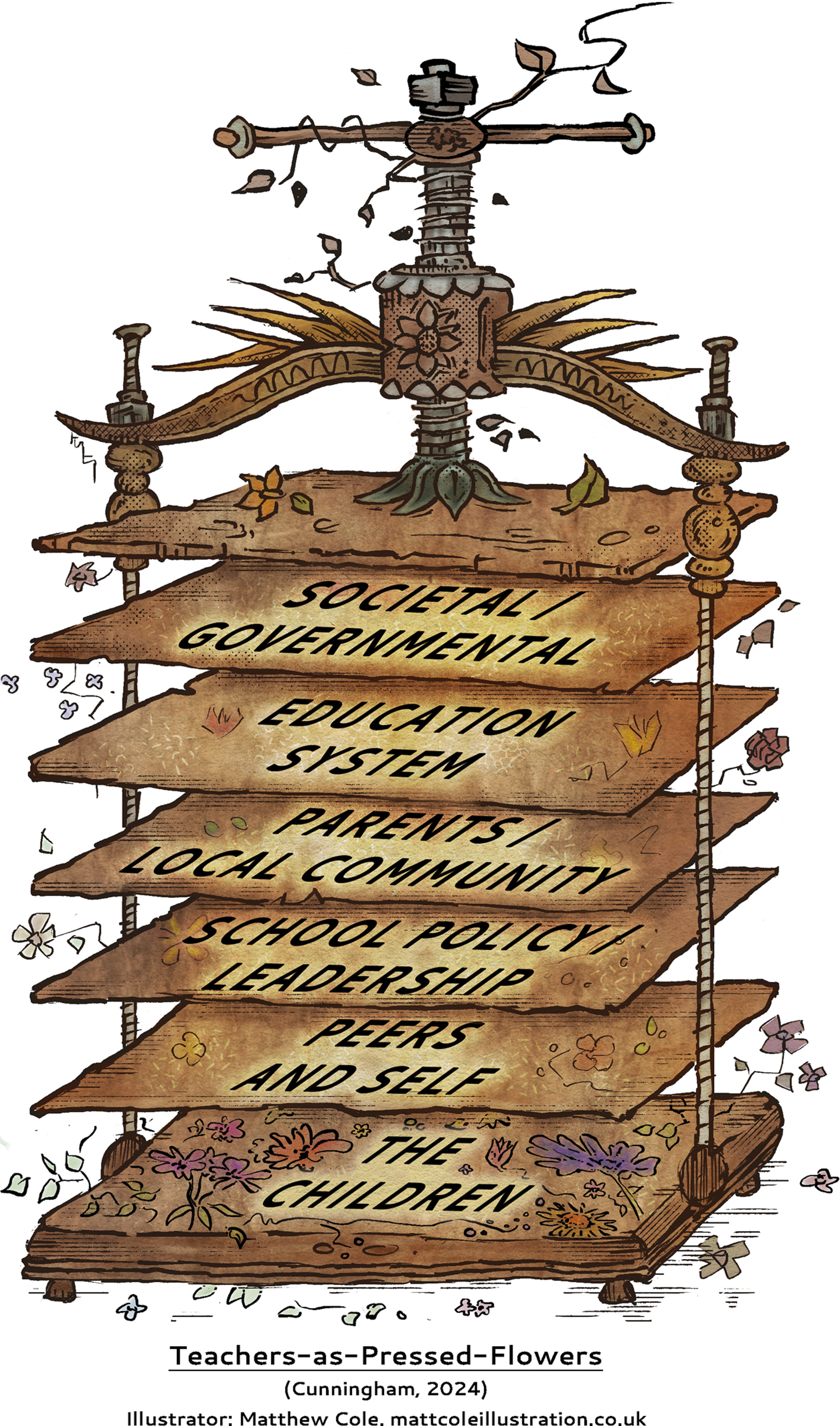
Because experiences vary, the layers shown in this figure above cannot be said to be inclusive of all potential pressures on teachers in schools but offer a likely and broadly construed range that the research literature suggests is present in many education systems globally. The model is therefore open to adaptation by others globally to suit local, regional and national circumstances. Bourke et al. (2015: 95) describe teachers as being ‘covertly placed under perpetual uninterrupted scrutiny by parents, colleagues, regulatory authorities and education systems’. This scrutiny and surveillance of teachers is panoptic and involves a ‘network of gazes’ (Foucault, 1995; cited in Bourke et al., 2015), which can lead to teachers adapting their behaviours and practices, in and out of the classroom, for example, by not picking up on a potential tangent suggested by a child for fear of being seen to be off-topic by a classroom observer. A participant in Perryman et al.’s study (2011: 187) lists some of the pressures: ‘any sense of the teacher’s opinion, even though they’re the people that actually deal with it every day, it’s completely ignored. Totally ignored. It’s all about awareness of grades going up, awareness of parental pressure, awareness of government pressure’.
In my flower press model, these layers and the network of gazes are categorised as Societal/Governmental, the Education System, the Parents/Local Community, the School Policy/Leadership, Peers and the Individual Teacher, and underneath the Teachers-as-flowers there is the bottom layer, the Children. I will now take each of these layers in turn and explore them drawing on the flower press model to briefly discuss their roots and some of the potential impacts.
Societal/governmental
The top of the flower press here is the Societal and Governmental layer in which the ideological aspects of, for example, living in a post-Brexit Britain, might create pressures for teachers in the UK, as well as the monolingual mindset that the country is well-known for, along with other nations with a highly dominant language (Gogolin, 1997). Societal gendered assumptions about families and parenting, for example, (Bower-Brown, 2022) will exert pressure or expectations on teachers to talk about families in certain ways. Dominant, hegemonic ideologies that value White and middle-class ways of being as higher in cultural capital will impact on teachers’ assessments of their pupils’ soft skills in ways that are likely to be subconscious due to the normalisation of these ideologies (Hutchinson et al., 2019).
Societal crises can, of course, exacerbate some of the pressures. We see this in the so-called austerity budget cuts following the global financial crisis of 2008, leading to role inflation for teachers in the face of staff shortages and we also saw it globally during the COVID pandemic, explored in detail in the Australian context by Fray et al. (2023).
Legislation such as No Child Left Behind (2001 in the USA) and Every Child Matters (2003 in the UK) put enormous pressures on schools and teachers from the beginning of this century, despite the best intentions of the legislators. These pressures can cause already wavering benevolent attitudes to worsen, and therefore classroom practices to become more hostile to the children supposedly protected, however, so there are real dangers in the national or federal demands (Walker et al., 2004).
Education system
Over the last four decades, in many countries, there has been a move away from the trust in teacher professionalism, which had teachers being accountable to themselves, their peers and their pupils in a self-regulated way, to accountability through an increasingly hierarchical and managerial structure internally alongside scrutiny from and formal audits by top-down external agencies (Fray et al., 2023; Perryman et al., 2011), clearly mirroring the top-down pressure of the flower press on teachers.
Teaching is now tightly controlled by prescriptive curriculum documents in many countries internationally, and by performance management frameworks, which impact on teachers’ pay and require ambitious target-setting creating significant pressures to achieve beyond the basics of getting the job done. A key pressure on teachers is that the evidence gathered about their performance is largely based on pupil outcomes, which leads to the pressures on children I briefly discuss below. The children then become objectified and test scores are products used to rate teachers’ performance, which positions teachers as test preparation coaches rather than trained professionals (Benesch, 2020).
Youn (2018) suggests that testing pressure lowers teachers’ sense of empowerment and impacts negatively on their sense of community and professional commitment. It was also observed in their work in South Korea that the negative impact of these testing pressures fell more on lower socio-economic status schools, which seems likely to be replicated elsewhere globally. The impact of the requirement to teach to the test has led to teachers reporting that it is increasingly hard for teachers to adapt the curriculum content to meet the needs of individual pupils, especially those who are seen as low-achieving (Rustique-Forrester, 2005). This can lead to students acting out through frustration and being more likely to experience exclusion from school due to their behaviour (Rustique-Forrester, 2005), something that impacts students of colour and neurodivergent pupils disproportionally (Demie, 2021; Smagorinsky, 2020).
Parents/local community
The scrutiny from parents can be multi-faceted. On the one hand, there’s the pressure to be a professional in and out of the school environment. This has been described as the ‘gaze from beside’ by Bourke et al. (2015) with Kate (one of their participants) saying ‘I think they [teachers] need to be aware that the community has high expectations of them’ and another (Mabel) admitting ‘I was aware of not being seen with a gin and tonic in my hand’. The pressures of this gaze extend to teachers ensuring they protect their privacy on social media accounts, and to ensuring they meet the implicit demands of an appropriate dress code (Bourke et al., 2015).
The pressures on teachers are also high with regards to classroom practices. Multilingual parents, for example, may want to see a swift transition to English because of a belief in some of the myths around multilingualism that still prevail as well as not wanting their children to stand out in the classroom, a factor that can drive other parents of potentially marginalised children to intervene in a teacher’s preferred classroom operations. Parents of children with special educational needs may need to regularly advocate for their children, in ensuring that appropriate accommodations are in place in classrooms, and the additional pressures of these, sometimes daily, conversations at the school door, as well as the required actions, which may contradict what others in the class need, should not be under-estimated.
The increase in parental choice whether real or perceived with regards to choosing schools for their children in a number of countries globally has brought with it a greater sense of power and a notion of holding teachers and schools accountable to parents, which has been shown to greatly favour White parents over those from other ethnicity groups (Donner, 2013). The increased pressures from certain White parents is likely then to impact on teachers and lead to an inertia around actions that may benefit Black and Asian students more.
School policy/leadership
Whilst it must be acknowledged that school leadership teams are often under extraordinary pressure from the same sources above as the individual class teachers in schools, due to the fact they are publicly accountable (Perryman et al., 2011), it is at the level of the school where pressures on individuals can either be ratcheted up or ramped down. Certain schools lack the support structures needed for quality staff communication and collaboration, and this can be related to the intersectional challenges of being located in a more economically deprived area (Youn, 2018), as seen above, but was also a factor seen in Rustique-Forrester’s (2005) study on English schools and their exclusion policies, where higher-excluding schools seemed to lack the support structures that allow teachers to better handle the pressures of the profession.
School policies on special education needs, languages and protected characteristics can either be supportive documents, encouraging teacher autonomy and offering guidance and valuable resources, or they can increase pressure through being too prescriptive and/ or lacking the resource to implement the policy adequately. For example, school language policies in the UK often include highly prescriptive stipulations around the use of so-called Standard English which both position the individual teacher as a powerful authority in policing children’s language use and concurrently, dictate the teacher’s own language use (Cushing, 2021). Alternatively, policies (especially on the place for minority languages, e.g.) may be entirely missing, or present but never used and largely forgotten.
Peers and the individual teacher
At the level of the individual teachers themselves, of course, there are challenges to do with limited training to deal with disabilities, neurodivergence, multilingualism and other personal characteristics. Additionally, teachers’ own backgrounds and habitus, as well as their own demographic, cultural and learning experiences all impact on the level of potential benevolence and to some extent, their ability and capacity to take action on that. Furthermore, Benesch (2020) discusses her participants’ internal struggle that stems from their professional training, knowledge and beliefs sitting in direct conflict with the institutional requirements to prepare students for standardised tests.
In this flower press analogy, we can also see the place for teachers’ peers as a sideways pressure in the flower press – perhaps with a sense of jostling for position, on occasion, as well as pressure through what Ozga (2009: 152 cited in Perryman et al., 2011) calls ‘disciplined self-management’ of an individual or group. Performativity approaches such as this create pressure which can, and does, lead to stress.
The bottom layer: The children
Whilst the upper layers are those that are really exerting the pressure on teachers, it must be observed that there is also an upward physical pressure in the flower press too, due to the tightening screws, with the expectations of children about what their teachers should be doing in the classroom a factor for many, sometimes as a result of parental pressure on the children, as well as the broader challenges of handling student reluctance or incapacity with regards to the curriculum content (Yan, 2015).
Clearly, however, whilst we have seen that the layers of pressure in the flower press do bear down on the teacher, they also subsequently bear down on the children at the bottom of the flower press too, and indeed the pressure of the flowers themselves can also be felt. In other words, children indirectly feel all of the pressures that the teachers do, because they feel directly the pressures that the teachers themselves bring to bear on the children as a result.
However, whilst this layer is at the bottom of the flower press and therefore at the base of the hierarchical education system structure, the relationships here are some of the most important and the proximity of the teachers-as-flowers to the base of the children, in direct contact and influencing each other can be construed as providing the opportunity for dialogic teaching and learning which may even go some way to combat some of the pressures from above.
Tightening the screws
Once the flower press is constructed and all elements are in place, the screw or screws are tightened. Raiida, a participant in Perryman et al.’s study, (2011) talks about the fact that if teachers resist a change, it often just happens more slowly. Screws still get tightened as the teachers-as-flowers resist the pressing. Resistance can, of course, also be less deliberate and implementation gaps can exist because of misalignments between all the layers of the flower press (Yan, 2015) but the nature of the hierarchical structures and performance frameworks mean that the teacher can be held accountability for the failure of an initiative.
The flower press leaves teachers-as-flowers that do remain intact. Their positivity is still seen by the pupils, but the layers discussed above can have a real impact on their capacity to both remain positive (Avramidis and Norwich, 2002) and/or to act in the caring way they would wish to support the pupils and their varying needs for advocacy and activism (Benesch, 2020). Whilst the flowers remain intact, they become 2D. They lack weight, they lack substance, they lack capacity and life and they can end up very brittle and easily broken. Essentially, they are for display purposes only which reflects the panoptic scrutiny of classroom observations as well as the overt and rhetorical demonstration of inclusivity such as multilingual displays being encouraged in school spaces for the purposes of external agency inspections, which has been discussed elsewhere (Cunningham, 2019b, Cunningham, 2019c) or institutions performatively embracing equality and diversity initiatives ‘while simultaneously deploying strategies that prevent dismantling systemic inequalities’ (MacKenzie et al., 2023: 1).
Conclusion: Sowing seeds for the future
However, whilst our teachers-as-flowers have found the pressures of the education system and the societal and ideological expectations around the role of schools has rendered them inert in their intrinsically benevolent and positive attitudes towards the more marginalised pupils in their care, these flowers still have intact seeds. These seeds are the hope for the future. Benesch (2020: 37) posits that the emotional labour teachers are experiencing is because of a desire to care for their pupils’ needs functions to ‘let teachers know that it is time to organize with colleagues to improve unfair and unjust conditions’, that is, it is a call to action.
However, to take such organisational action requires psychological safety and feeling dispensable and unappreciated, as Fray et al. (2023) suggest many teachers have been made to feel, does not give them the psychological safety (Edmondson, 1999) to know they can resist or challenge those in power. Perryman et al. (2011) point out that those in high-demand or high-pressure subject areas (such as Maths or English in England, e.g.), however, do potentially hold more power to effect change, whilst also experiencing some of the greatest pressures. It is not enough for just one teacher to remain outside of the flower press, given enough autonomy to keep clear of the pressures that might diminish the capacity to advocate for social justice in their schools. The whole team is important, when we note the research on the value of multiple supporters for students who have additional support needs (Connor et al., 2014). Therefore, to combat the pressures of the flower press and to be able to move from ‘inert benevolence’ to genuine positive action and advocacy for the benefit of those children who need the additional support in schools what may be needed is collective action led by staff who are in more privileged or valued positions in schools, acting on behalf of others more likely to be experiencing the full weight of the flower press.
The likelihood of such collective action feeling possible will depend on the political situation nationally and institutionally in each case, and for many, this will feel impossible in the current climate. However, it is hoped that the flower press model and a deeper understanding of the role of inert benevolence and the potential power of those who currently experience it may offer glimpses of what could be in the future if we are able to nurture seeds and develop collective action to ensure all children are adequately cared for in the education system.
Footnotes
Acknowledgements
The author would like to thank Prof. Helen Sauntson, Dr Liz Morrish and Dr Charlotte Haines Lyon for their valuable input on initial drafts of this paper.
Declaration of conflicting interests
The author(s) declared no potential conflicts of interest with respect to the research, authorship, and/or publication of this article.
Funding
The author(s) received no financial support for the research, authorship, and/or publication of this article.
