




Abstract
This paper explores the role of material design as a form of institutional power within contemporary school settings. Drawing on concepts of ‘coercive design’ and ‘hostile architecture’ from design studies, the paper examines three ‘innovative’ designs for classroom chairs – relatively mundane but integral elements of the regulation and disciplining of school space. It is argued that the design intentions of these material objects reveal a number of constrained, conservative intentions to maintain the traditional ordered notion of the classroom as a place where students stay in their seats and engage in work. Tellingly, however, this corporeal manipulation and moderation is now couched in claims around desirable physiological and cognitive conditions for learning – with students’ bodies seen as objects to arrange and constrain in ways deemed conducive for learning. The paper problematises this de-socialised view of classrooms, alongside the underpinning sense of design solutionism and (mis)appropriation of ‘learning science’ by product designers to justify their products’ capacities to somehow cause learning to take place.
Introduction
Are you sitting comfortably? Then we can begin …
By their very nature, schools have always been inherently coercive places. It could be argued that the fundamental premise of ‘school’ is as a place where children and young people (in the role of ‘student’) are coerced to learn. As Schein and Shani (2014: 22) puts it, ‘all managed learning situations involve coercion of some sort’. Failing that, schools are places where students are coerced into behaving in a manageable fashion – sitting still, facing the front, and maintaining the appearance of being ‘engaged’. While coercion is usually understood in general terms as anything that narrows or constrains a person’s choices or actions, this paper builds on Anderson’s (2016) more specific definition of ‘coercion as enforcement’ – that is, the intentional imposition of a constraint on action (see also Wertheimer 1987). In this sense, there is an established literature from Foucault (1975) onwards, detailing how the underpinning regulatory model of schools remains centred around intentionally instilling certain behaviours and forming specific habits (particularly habits relating to bodies, time and space), subjectifying and sorting students, and encouraging conformity to normalised ideals.
Of course, many educationalists would contend that the 19th century schools documented by Foucault are far removed from the schools of today. Indeed, it might be presumed that the schools of the 2020s are very different places – based around principles of ‘21st century learning’, ‘personalised learning’, ‘growth mindsets’ and other facets of what has been labelled a ‘neoliberal’ sensibility (see Bradbury 2019). As such, it is important to consider how logics of coercion persist in contemporary education. This article explores the coercive conditions of contemporary schooling through in-depth consideration of a deceptively mundane educational object – the classroom chair. Taking a few examples of recent ‘innovations’ in classroom chair design, we consider the imperatives of coercion that are currently driving schooling in the 2020s, and how these are being translated into classroom arrangements, practices and other forms of school organisation.
Schools as sites of coercion
While it might appear at odds with current educational enthusiasms for personalised learning, self-regulation and so on, schools continue to be institutions concerned with the normalisation of students’ behaviours, dispositions and other forms of conduct. Indeed, the notion of ‘compulsory schooling’ denotes a degree of mandated conformity for even the most willing of students. The opportunity and threat of schooling is of students being made to do things that they otherwise might not necessarily be doing – from the clearly beneficial act of engaging with high-status and/or genuinely empowering knowledge, to the less obviously beneficial ritual of regularly pledging allegiance to a flag, monarch and/or god. In a basic sense, then, school is an institution characterised by a set of practices, arrangements and techniques aimed at governing students in a continuous and regulated fashion.
As mentioned above, the overt purpose of schooling is now generally presented as supporting young people to engage in ‘learning’. As Ball and Collet-Sabé (2022) put it, school is understood as a place where ‘we “learn” and learn what learning is’. In recent times, this has led to students being seen almost exclusively in terms of someone that is taught – ‘the pedagogical gaze de-socialises and objectifies the student as a cognitive entity’ (Ball and Collet-Sabé 2022: 7). Of course, implicit within this process is a broader ‘taming’ of young people from an unruly natural state of childhood ‘to a state of culture as assiduous pupil. That is, a move from … the enfant sauvage to the reasonable and reasoning learner’ (Ball and Collet-Sabé 2022: 6). Implicit within this dual emphasis on ‘taming’ and ‘teaching’ is a normalisation of every student’s actions, behaviours, identities, sensibilities, and ways of being. In short, then, schools are institutions built around an intended uniformity of being and acting.
Of interest to the present paper, is how this taming and uniformity is approached and achieved in the schools of the 2020s. The contemporary school is often imagined to be more civilised and consensual place than was ever the case in the 19th or 20th centuries – tolerant of diversity, run along more participatory ‘learner-centred’ lines, and receptive to ‘student voice’. There has certainly been a welcome decrease in traditional disciplining practices – from the outlawing of corporal punishment through to a decline in practices such as detention and writing lines. Many of the traditionally recognised modes of institutional coercion and discipling familiar to previous generations of school students are no longer a feature of contemporary schooling.
Instead, schools are seen to be based around subtly different lines of individualised self-governance – what is often referred to as a ‘neoliberal’ sensibility and other specific shifts along the lines of ‘21st century learning’, ‘growth mindset’ and ‘resilience’. Here, emphasis is placed on the moulding of a particular student subjectivity – specifically the individual in the guise of being a ‘learner’. These ‘learners’ are expected to be rational consumers of education who need to be supported to make beneficial choices about how and what they learn. Education is therefore framed as a process of self-improvement and self-transformation – overseen by the teacher but ultimately dependent on students who are able to ‘self-regulate’ their own learning, and act in ways that are flexible, reflective and resilient, among other attributes (Bradbury 2019). Tellingly, despite this emphasis on individual responsibilisation, schooling remains a homogenising project – seeking to mould individual students en masse into the same single ‘learner’ form through a process that Ball describes as a de-socialised ‘agglomeration of individuals’ (Ball and Collet-Sabé 2022: 36).
In this sense, neoliberal schooling involves increased emphasis being placed on manipulating and influencing students’ cognitive actions – from directly stimulating neurological processes through to manipulating emotions and affect, and indirectly shaping individuals’ consciousness. At the same time, the physical environments of school campuses, corridors and classrooms continue to be imagined as essentially governable spaces – especially in terms of continuing to regulate individual bodies and how these bodies move within these spaces. In particular, classrooms remain key sites for the management and regulation of student behaviour – in essence, spaces based around what Foucault identified as the disciplining of ‘docile bodies’. Thus, despite the underpinning rhetoric of flexible self-determination, current modes of schooling continue to treat the student’s body ‘as an object to be dominated and controlled’ (Grosvenor and Rasmussen 2018: 3). Where-ever possible, students’ movements within a school and its classrooms are trained to be routinised and predictable as possible – with conventions of the school timetable, assigned seating, and other forms of social order all continuing to steer students away from transgressing the established norms of the classroom, and therefore freeing up time and space for school-work to occur.
Indeed, the institutional governance of contemporary classroom spaces takes multiple forms – from written statements of ‘appropriate behaviour’ through to camera-based surveillance systems. The centrality of mass forms of institutional governance (instead of a reliance on individual self-governance) was illustrated in the return to face-to-face schooling after the COVID school shutdowns of 2020 and 2021. Here, we saw classrooms regulated by social-distancing measures ranging from spacing-signage to in-class barriers and protective screening. Indeed, such reconfigurations of the socially distanced ‘COVID safe’ classroom prefaces the central theme of this paper – the significance of the materiality of the classroom as a means of coercion and moderating behaviour. Traditionally, this is most obvious in the construction of the school built environment and its corridors, rooms, hallways and other interior and exterior spaces. In contrast, the present paper looks at a less obvious (but no less important) manifestation – the design, production and marketing of the material objects that lie within these built environments.
Conceptual background: The coercive nature of material design
Various lines of thought can help inform these questions of school space and place, student bodies and power. Alongside Foucault, post-structural theorists of everyday practice from Bourdieu to Lefebvre have explored ways in which social order is inscribed on our bodies through the spaces and environments through which we pass – as evident in educational applications of ideas such as Lefebvre’s notion of ‘conceived space’ (see Middleton 2014). Elsewhere, philosophers such as Bakhtin noted the ways in which inanimate objects remain in mutual correspondence with social actors. Perhaps most notable in educational research is growing use of sociomaterialist thinking. This starts from the understanding that physical objects are entwined intrinsically with social aspects of schooling – meaning that all educational practices, processes and procedures are a material matter. As Fenwick (2015: 83) notes, ‘everyday [educational] practice is constituted through entangled social and material forces that continually assemble and reassemble’.
While remaining mindful of these traditions, the central conceptual conceit of this paper draws on alternative perspectives taken from the material design literatures. This moves us away from questions of outcome (ie how student practices are shaped by encounters with material objects) to questions of intentionality. In other words, taking a design approach raises questions about the values and politics that are implicit in the design, development, production and procurement of the material objects that end up in schools and classrooms. In the educational literature, the most notable accounts of the material dimensions of schooling have perhaps come from work addressing the history of school design across the 20th century. Here, scholars such as Ian Grosvenor have explored how ‘material school designs’ are an integral aspect of how school institutions (and the design professions that supply them) work to produce desirable students – ‘shaping bodies, social categories and more generally the overall experiences of school and education’ (Grosvenor and Rasmussen 2018: 1).
This historical work has examined a variety of material aspects of schools – including school uniforms, school halls and corridors, classroom lighting and acoustics, as well as desks, chalkboards and other items of school furniture. From a material design perspective, all of these artefacts can be seen as means of exerting power over how students act – not least in terms of setting the parameters of what a ‘student’ is. As Lawn and Grosvenor (2005) detail, schools have long been home to what they term ‘governance by design’, with material aspects of schooling concerned with directing the conduct of students in line with school policies and tacit institutional expectations of behaviour, deportment and disposition – therefore, constituting (in Foucauldian terms) a key ‘machinery of control’. Recently, this approach has seen the emergence of work interested in the material design of schools of the 2020s, especially in light of the neoliberal school turn described earlier. To date, most attention has been paid to architectural efforts to respond to the corporate reforms of ‘21st century’ schooling. This has seen a renewed ‘belief in the inherent capacity of material design to both support and enhance pedagogies’ (Grosvenor and Rasmussen 2018: 16), as evident in trends around ‘vertical schools’ and ‘flexible learning spaces’.
This focus on the material design of school governance also chimes with wider moves within the field of critical design to address the emergence of what has been variously termed ‘hostile architecture’ and ‘disciplinary architecture’ (eg Rosenberger 2017, 2020). This relates to the deployment of architectural features in public space to manage behaviour (and, ultimately, deter the presence of particular bodies) within public areas through both explicit and implicit design features. This is evident in the implementation of objects across public space such as anti-homeless spikes, ‘skatestoppers’ and anti-sleep benches with multiple armrests – all designed to push particular behaviours out of public spaces.
Also of relevance here, is the development of the idea of ‘coercive design’ – offering an explanation of how designs can influence behaviour and actions. In contrast to weak forms of ‘seductive’ and ‘persuasive’ design’, Tromp et al. (2011) identify coercive designs as explicit in their intent, although not always noticed by people who encounter them. A familiar example of this is the presence of speed cameras to discourage fast driving. Coercive designs arise when there are conflicts of agendas (such as when institutional concerns over moderating behaviour come into conflict with some individual ideas of personal freedom), yet where the coerced behaviour is generally accepted and understood. As such, ‘coercive influence is very restricting, and it therefore requires authority to be applied. As a result, the public domain and institutional domains are domains for which coercive design often is suitable, in that government and managers have the authority to implement such interventions’ (Tromp et al., 2011: 17-18).
These notions of coercive design, hostile architecture and defensive architecture point to rise of design that is based around a distinctly neoliberal set of logics, where people are directed by the designed objects that they encounter. While undesirable behaviour is not explicitly curtailed, choosing to act in a particular (undesirable) manner is made uncomfortable, awkward and frictional. Seen in the distinctly neoliberal terms of behavioural economics, these designs therefore provide clear ‘nudges’ to the individual to ‘choose’ to behave differently. Critical work on defensive architecture therefore addresses the question of what type of social spaces these designs produce – pointing to the links between defensive architecture and the desire for constrained, individualised and consumption-orientated interactions with (and within) contemporary public spaces. As Smith and Walters (2018: 2980) contend, this has the effect of making public space ‘more palatable and attendant to the needs of capital’ while coming at the expense of a vibrant ‘public realm’ – resulting in a ‘sanitised place’.
The modern classroom chair: Three examples of ‘innovative’ design
This paper goes onto apply these materialist and critical design lenses to the contemporary classroom – in particular, the case of the modern school chair. While school chairs feature very rarely in accounts of the power relations of classrooms, our focus on these objects in this paper is deliberate. Seating is a key element of the ordering and regulation of classroom space, and ways in which classrooms ‘call upon [students] and demand specific ways of sitting or moving’ (Lenz Taguchi 2010: 5). As such, even the most elegantly crafted classroom chair could be said to have a dual existence as both being ‘a design triumph but also a child restraint’ (Bone 2019: 138). Indeed, public seating and benches have proven to be a key focus for defensive/hostile architecture scholars, with a growing body of writing on how various forms of public seating in parks, airports and bus-stops are designed to deter lying down or extended periods of ‘loitering’ (eg Bergamaschi et al., 2014). Indeed, for scholars of defensive architecture, seating is a key way in which public spaces are rendered ‘predictable, orderly and decorous’ as well as more governable, with sitting-down acknowledged as a key way in which the public is ‘disciplined in to “appropriate” ways of use and engagement’ (Smith and Walters 2018). As such, there is a lot that chairs can tell us about the nature of the contemporary school.
Against this background, we now consider three recent chair designs for the educational market in the UK, US and Australia – contemporary products currently being sold to schools as ‘state-of-the-art’ and ‘innovative’ furniture designs. What intentions underpin these designs? What might possibly be imagined as achievable through these classroom chairs, and what does this tell us about the nature of contemporary schools that are investing in such products?
The ‘turn and learn’ stool (UK)
Learniture is a small UK company with family connections to Stephen Heppell – a progressive education ‘guru’ who is best known for pushing ideas of experimental learning spaces and ‘shoeless learning’. Learniture specialises in a small range of classroom furniture guided by progressive education values of encouraging collaborative, creative and imaginative learning. This maverick streak is reflected in one of their taglines for their furniture: “Whoever coined the phrase ‘sit still and concentrate' didn't understand very much about blood flow, cognitive function and the inherent need to move that is present in all humans, especially smaller ones”.
The ‘Turn&Learn’ stool (see Figure 1) is one such product – described in its marketing as a chair that ‘actively supports learning’. This is a small stool mounted on casters, with no back-rest that is designed to sat on in ‘a saddle-like posture’, described as akin to riding a bicycle or a horse. The grey 40 cm by 38 cm seat is manufactured using polypropylene, with a 56 cm diameter black nylon base that reach an adjustable height of up to 66 cm. The design brief for this chair focuses on two issues related to children’s bodies and brains – the need for children to expend energy through movement, and the need for children to adopt a correct posture for optimum cognitive functioning. The ‘turn and learn’ stool.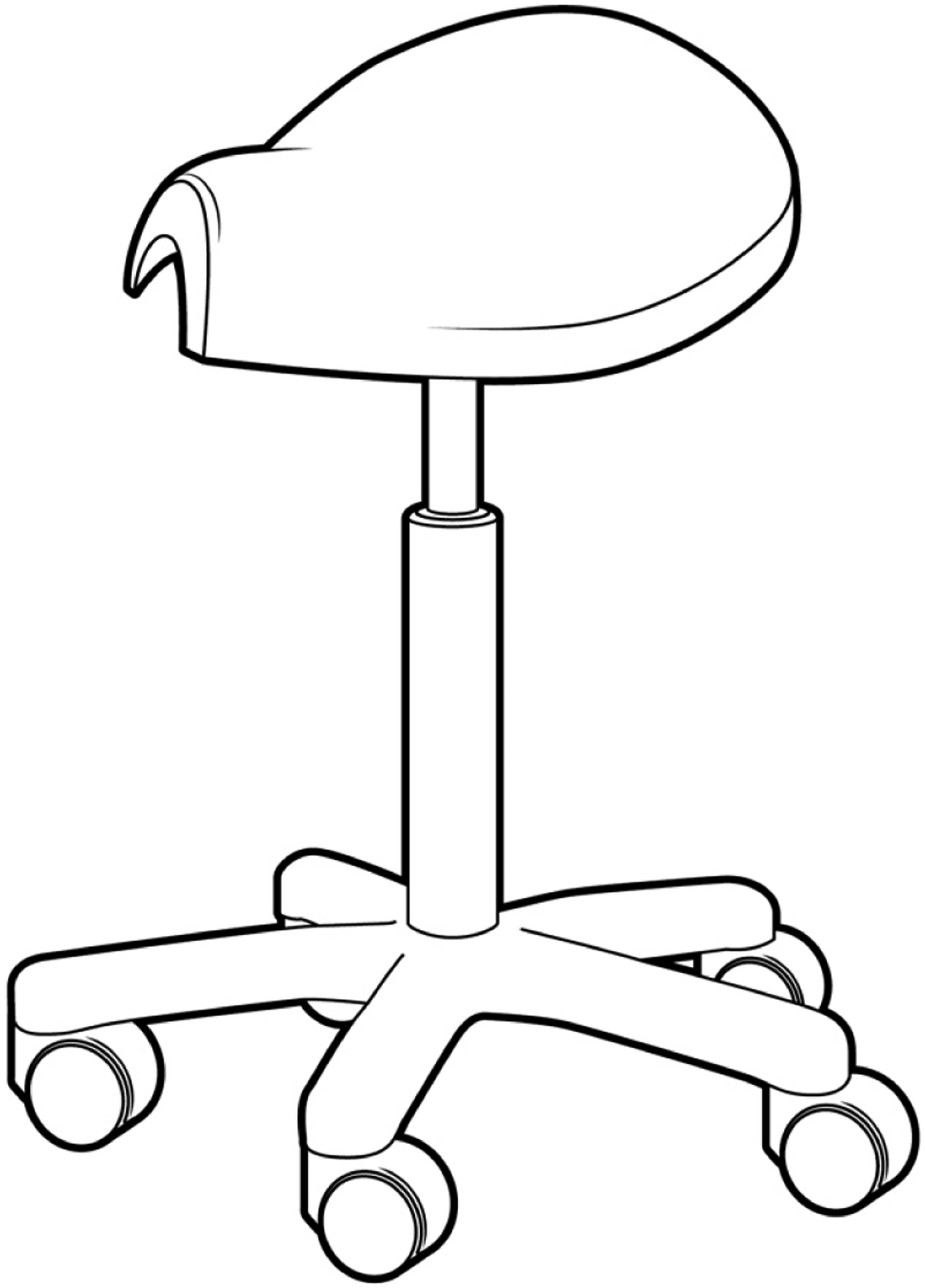
In the first instance, the Turn&Learn is framed as a response to the fact that ‘children aren’t designed to sit still’, and the in-class consequence that ‘children focus better if they can fidget and move around a bit’. As such, the absence of back-rest and chair arms is designed to allow students to turn around and interact with their neighbours. That said, this need for movement is limited to acceptable levels, with students only moving within the confines of ‘staying in their seats’. This state of stationary movement is ensured by the addition of ‘braked casters’ meaning that the stools remain in fixed locations. As the marketing material puts it, the Turn&Learn is ‘mounted on casters (that lock when someone sits down, so, sorry kids, you can’t race around on them)’.
In the second instance, the Turn&Learn is framed as a means to optimise the physiological arrangement of the student. Sitting on a Turn&Learn is claimed to position the student in a ‘perfectly balanced’ position that somehow optimises the student’s body and internal organs into a state conducive for ‘attention’, ‘concentration’ and ‘learning’. As Learniture’s marketing materials put it, the chair ‘delivers comfort while opening up the angle between torso and thighs to increase blood flow to vital internal organs and the brain. This increases the amount of oxygen reaching the brain which can improve cognitive function and helps learners to stay alert’.
In2It’ seating (US)
This second seat (see Figure 2) is perhaps more conventional in appearance, but comes with a similar set of claims regarding what it can achieve. This is evident in the naming of ‘In2It’ – a product name that infers that students will be ‘into it’ and/or are able to ‘intuit’ – that is, directly know things. In2It is one of a range of different chairs (including the ‘Planner’ and ‘Interchange’ lines) produced by Smith Systems – a large US educational furniture manufacturer originally founded in 1905 to produce heaters for one-room schools, and taken over in 2018 by a large multi-billion dollar architecture and technology group. The ‘In2It’ chair.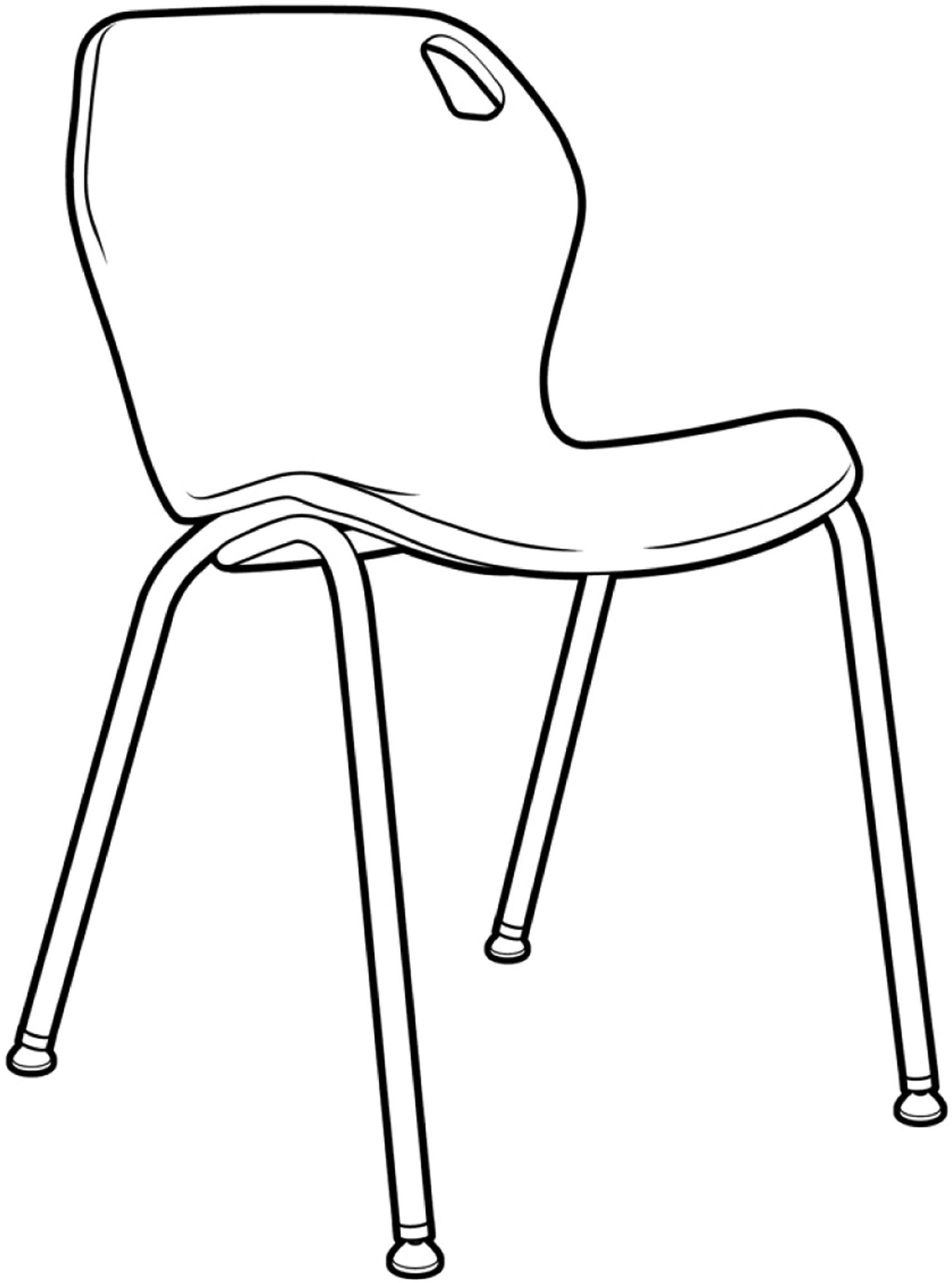
The ‘In2It’ chair comprises a 19 inch by 20 inch polypropylene bucket seat, with a steel tubular frame. The chair weights just over 15 lbs with three different sizes of leg height (14, 16 and 18 inch versions). This ‘In2It’ chair is presented as manipulating each student’s body to face toward the front of the classroom, and therefore toward the teacher. As the marketing material puts it: ‘In2it® Seating – conceived to contain movement and direct attention straight ahead. It works like a bucket seat, providing back and shoulder support, while orienting the student toward the front’.
This product pitch conveys a sense of comfort and coercion. Alongside the notion of ‘comfortably orienting the student toward the front’, is the idea of the chair being perceived as welcoming and comfortable, while ensuring only ‘limited’ sideways and backward movement: “The In2it chair was designed to make the student feel comfortable before even sitting down through its use of familiar, graceful curves. … the chair’s inviting shape gives an honest indication of how comfortable it is”.
As with Learniture, Smith Systems is keen to make connections with how this design fits with the ‘learning science’ of the classroom – not least in the company tagline ‘Explore the science of student seating with us’. Their website is littered with short articles with illusions to ‘the ergonomics research community’, university departments of kinesiology, and current education trends such as 21st Century learning and socio-emotional learning. These missives often recycle observations and quotations from popular online education media sources such as EdWeek, EdSource and Edutopia. The language used to describe these products is therefore in tune with contemporary educational thinking. Indeed, one of the four ways that the firm’s products are catalogued is by the tagline of ‘Learning Dynamics’ – taken to denote ideas of collaborative learning, social learning, independent learning, hybrid learning and so on.
The Espy Zone chair (Australia)
BFX is an Australian school furniture supplier – established in 1980 as an office furniture retailer and then branching out into designing and manufacturing its own products for education, healthcare and other ‘office’ markets. The Espy Zone (see Figure 3) stands 88 cm high and 80 cm wide, made out of black polypropylene with an upholstered seat height of 45 cm. The ‘zone’ chair.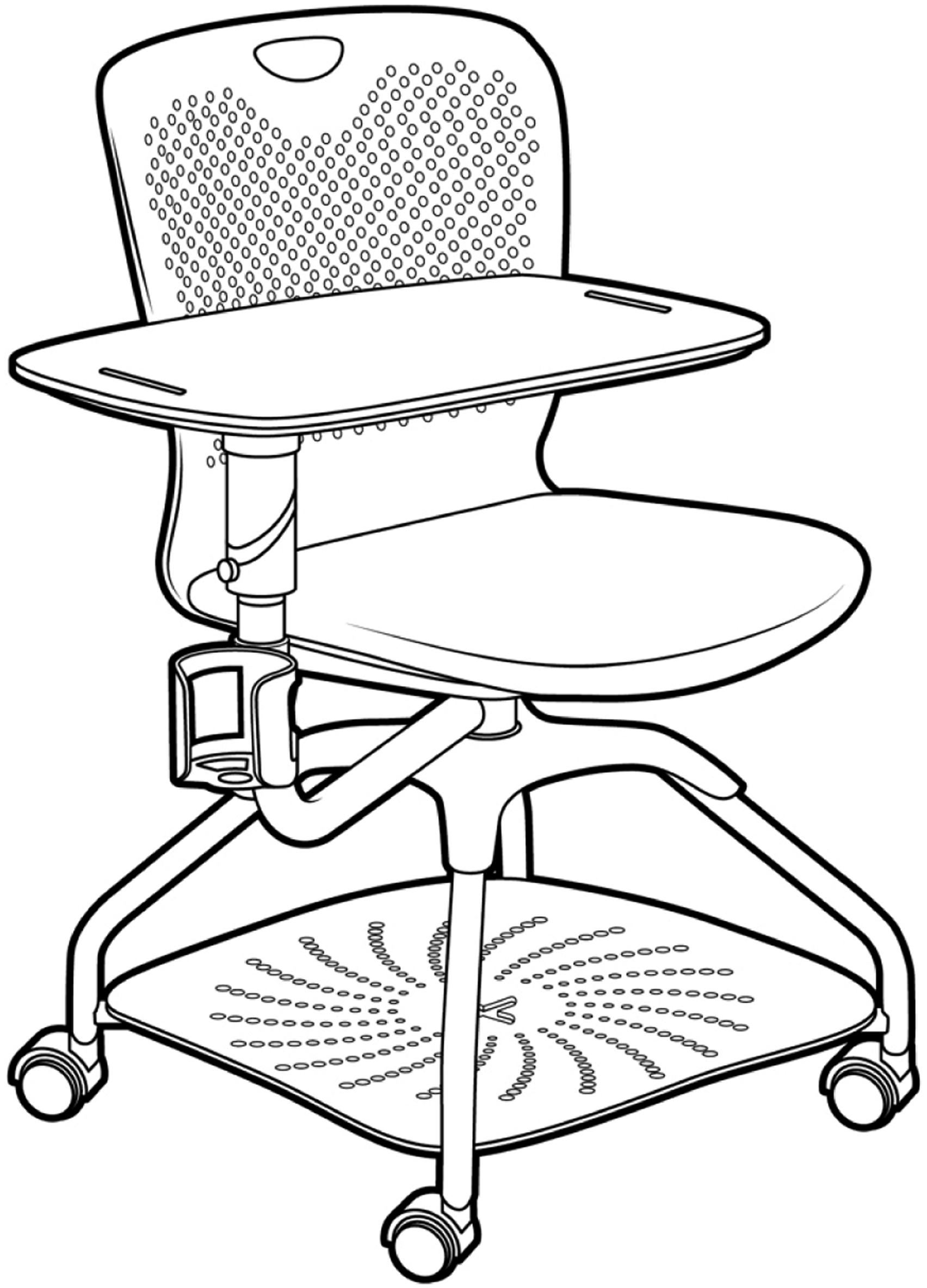
The idea of a ‘Zone’ chair forms the basis of two BFX designs – ‘zone’ denoting that students’ are placed in a self-contained space with everything that they require to learn made easily accessible around them. This involves the student being encompassed in a high-back chair with a heavy duty ‘tablet arm’ pivoted over their lap in the style of a large aeroplane tray-table. Beneath the seat is a perforated plastic base where students can stow backpacks and laptops. At the side is a water bottle holder designed ‘to ensure no spillage occurs’. All told, the student can remain in this chair with all of their likely needs to hand – as Espy’s marketing puts it ‘incorporating all student requirements’.
BFX’s marketing material claims that this is a chair ‘designed with student choice in mind’. As with the previous examples, this chair is focused on supporting specific types of student engagement. Primarily, the all-inclusive design is seen to ‘encourage individual learning’. The ‘mobility’ derived from the chair’s castors is also presented as an ‘important feature’ that facilitates ‘active learning’ and ‘boosts collaboration’ by ‘encouraging students to relocate quickly to form a cluster to share ideas and brainstorm’. As such, this chair is sold on the promise of fulfilling all conceivable ‘learning space requirements’. Elsewhere in the BFX catalogue, educators are encouraged ‘team up’ their purchase of the Zone with other chairs in the same series (such as the ‘Task’ chair) to ‘giv[e] your learning space a corporate style’.
Making sense of these objects
There is clearly more to each of these school chair designs than meet the eye. As such, Turn & Learn, In2It and Zone are insightful and revealing objects in a number of ways. First, are the intentions attached to these products – not least recurring promises relating to ‘learning’ gains. In affective terms, this is evident in portrayals of attentive students who concentrate on their individual work, yet collaborate with others when appropriate. In corporeal terms, this involves manipulation of the student’s bodily composition – from their whole-body posture through to claims over the arrangement of separate internal organs, blood flow and brain. Amidst these ‘learning’ outcomes are accompanying organisational promises of classroom control and order. The ‘In2It’ classroom is a traditional setting of all students ‘facing the front’. The ‘Zone’ classroom is a place where students do not spill water, have to get up from their chairs to retrieve materials from their bag and are individually self-contained. Even the progressively-minded ‘Turn-and-Learn’ promises a classroom where students stay in their seats, and do not race around the room.
Underpinning these different designs, then, is the disciplining of the student’s body for both classroom order and efficient cognition. As such, these design features have dual intentions – acting as facilitators of comfort and convenience, but also as forms of compliance and moderating behaviour. Some of these dualities are explicit, such as the Turn&Learn’s ‘braked casters’ and the In2It’s ‘comfortable’ bucket-shaped orientation of the forward-facing student. Other coercive features are perhaps less obvious. For example, while a lowered tablet arm on the Zone chair provides a ready surface on which to work, a raised tablet arm could be viewed by a teacher (or surveillance camera) as a conspicuous signal of a student who is not working (or at least not using their laptop). Similarly, while a Zone-bound student has all their requirements to hand, they are also hemmed in by their lowered tablet arm – to the extent that they could be wheeled around by a teacher in a similar fashion to an infant being pushed in a pram. Belying its talk of ‘active’ learning, the Zone design results in the student being rendered inert and self-contained.
Of course, the significance of analysing the Zone, Espy and Turn&Learn lies in what these products reveal more broadly about the nature and conditions of the contemporary school – that is, the ‘epistemological character’ of the settings in which these products are being taken up within (Ball and Collet-Sabé 2022). Premium school chairs such as the three designs just outlined are a non-essential investment for schools. These new products are designed along quite specific lines in order to appeal to school leaders and managers who could easily procure basic school chairs at far less cost. As such, these three products are all presented in ways that fit neatly with the broader ideals of the modern ‘innovative’ school. In short, these are objects that are designed to project a specific set of values, ideas, principles and ideals of what contemporary classrooms should – and could – be like. In this sense, it is important to further interrogate what values and logics are implicit within these designs.
So, do these different chairs tell us about contemporary schooling? In other words, what educational ideals might these different chairs be constituent elements of? All three chairs are designed for schools where classrooms are firmly framed as ‘learning environments’ where students are narrowly cast in the role of ‘learners’ whose bodies need to be arranged in order to learn. In Biesta’s (2015) terms, then, these chairs are a manifestation of the ongoing ‘learnification’ of education. Beyond their primary role as ‘learner’, students are primarily seen in terms of bodies that are ‘designed’ rather than people who are formed. Moreover, these are bodies that need to be rendered immobile, manipulated into conducive positions and containing minds that need to be oxygenated. In this account, the social field of the classroom is confined explicitly to matters of learning. For example, students are not configured as social beings per se, unless they are required to engage in bouts of ‘collaborative’ or ‘social’ learning – in which case they can be conjoined temporarily with others. For the most part, these chairs allow classrooms to accommodate (and segregate) a set of individual consumers of schooling. Perhaps most indicative of this underpinning neoliberal framing were the marketing promises around the Espy ‘Zone’ lending a ‘corporate style’ to the classroom environment. Thus, these chairs are designed to house individuals in their own self-contained personalised ‘learning spaces’ and work ‘zones’ – akin to the open-plan cubicles that many students might find themselves inhabiting once having left school and entered the workforce.
These issues therefore correspond with a specific framing of the contemporary classroom which continues to be ‘spaces that are designed to manipulate those who exist within them’ (Lefebvre 1991: 222), albeit along distinctly individualised lines. These designs function to moderate each student’s body and their individual actions with a neoliberal twist. In other words, these are designs that do not exert a direct forceful discipline, but push each student to ‘choose’ to act, sit and behave in a particular way – echoing the ‘behavioural economics’ mantra of the ‘nudge’, and a focus on regulating each students’ personal ‘learning space’ rather than the classroom as a whole. As such, these designs could be seen as embodying values of self-regulation where classrooms are places where students remain seated in relative isolation from the collective social space of the classroom. For example, students in the Turn&Learn are allowed to fidget, but only to a certain extent. Students in the Turn&Learn can be active but not in a disruptive way, and can be mobile but only in a productive way (turning to collaboratively learn, rather than racing around the room). In one sense, then, chairs such as Turn&Learn and Espy purport to cater for the needs and desires of the individual student. The Espy frames the classroom as a room of 20 or so individually cocooned students – each with everything they require immediately to hand. By rendering the student chairbound, the Espy takes away many of the ‘choices’ that a student might make to get up and leave their seat (to get water, to fetch something from their bag, to move over to speak to someone). Similarly, the Turn&Learn literally works to ergonomically nudge, prod and tilt the student’s body into an optimum composition. At no point should the student notice that they are being manipulated or compelled.
Discussion
Of course, these individual designs cannot be understood exclusively in isolation. These products are a minor constituent part of the broader pattern of design across the education systems in which they are inserted. As such, these individual chairs are just one element of the social and material relations of any classroom, and therefore work to discipline students’ bodies and minds in conjunction with distributed networks of people, objects and routines associated with the classroom, school and wider education system (Lawn and Grosvenor 2005). These chairs therefore correspond with various policies, discourses, modes of assessment, tacit expectations that go together to constitute the management, organisation and regulation of schools. In this sense, despite the bluster of Learniture’s marketing, most school students in the 2020s are still required to be ‘sitting still and facing the front’ despite any progressive educational ambitions to the contrary. For example, many contemporary classrooms continue to be places of ‘broadcast pedagogies’ with content projected onto screens and smartboards, and students engaged in passively gazing forward. Less obviously, contemporary classrooms are increasingly places that are surveilled by remote cameras and other sensors, both for passive monitoring purposes and for more active inferential uses (see Andrejevic and Selwyn 2020). All told, there are various reasons that students in the 2020s still need to be relative immobile and uniformly arranged.
Perhaps understandably, the design briefs for the three chairs presented in this paper make little acknowledgement of these broader connotations, preferring to focus on the evocation of the contemporary classroom as a place of ‘learning’. This framing of ‘learning’ and ‘learners’ is distinct in a few ways, not least in terms of the foregrounding of classroom activities primarily around the physiological and cognitive process of coercing learning – that is, improving blood flow and oxygenation of the brain. This marks a shift from material designs intended to simply discipline the child’s exterior body, or impacting on children’s psychology. For example, the growth of material classroom designs during the 1960s and 1970s were often intended to incite students to become playful, curious and self-motivated (Kozlovsky 2010). In contrast, the school chair designs of the 2020s are focused on physiological disciplining – coercing the neurological functioning of the brain, and literally coercing the student to ‘lean into’ learning.
Of course, these intentions are also shaped by the machinations of the commercial school furniture marketplace. One chair cannot somehow cause learning to occur. Not all children in a classroom kitted out with Turn&Learn stools will suddenly become more cognitively efficient and ‘learn’ at greater rates. These chairs are no more able to consistently ‘make’ learning happen or to focus a child’s attention than any other aspect of the classroom. As Grosvenor and Rasmussen (2018: 22) remind us, material structure and mental intentions are ‘conflicting and irreconcilable categories’. As such, these ‘design determinist’ claims are not really intended to be taken at face value. These objects are commercial products that are materially scripted in ways that fit neatly with the broader social script of the neoliberal school (following Akrich 1992). In short, these are objects that are designed and promoted to reinforce the illusions of neuroscience, individual focus, collaborative learning and other such buzzwords of ‘21st century learning’ that many school leaders might feel a need to subscribe to.
Indeed, these three chairs highlight the influence of product designers (and those whom they work for) in shaping what goes on within the classroom in a number of ways. As such, it is also interesting to consider what these products tell us about the commercial actors that are supplying these products to schools – not least the product designers, and the firms they design for. Perhaps most obvious, is a sense of innovative design and the heroic-designer – most evident in Learniture’s edgy dismissal of conventional thinking, and its appropriation of progressive educational thinking. This might be charitably described in terms of the designer as a technological and cultural ‘intermediary’ (Julier 2012), acting as a conduit for new trends and thinking in educational science to reach schools. However, this might be less charitably described as a cynical form of ‘solutionism’, with companies willing to sell the idea that deep-rooted educational problems can be alleviated with a slightly tilted chair. Design critic Fuller (2019, n.p) describes this as ‘the designer-saviour industrial complex that tells us the designer can parachute into any problem and, with some design thinking, fix it, indicating change from the top-down’. That said, it was notable the three chair designs featured in this paper were also deeply conservative products – promising to not disrupt the fundamental order of the classroom, and to reinforce the basic idea of students staying their seats and working. Thus, as Fuller (2019, n.p) continues, ‘much of what [designers] call “creative” today is not creative at all but rather cementing the status quo, forever in the service of capital, labour, and consumption’.
These latter points are extended into the ways that these firms presented themselves as bringing the latest educational science ideas to credulous educators. It was notable how these products were wrapped in references to learning-related ‘science’ and academic theories about learning. These were firms that were keen to show that they had done their reading, and ground their claims with references to cognitive science, neuro-science, learning theory and ergonomic design. These were companies that presented themselves (in Learniture’s words) as ‘understanding about blood flow, cognitive function and the design of ‘little people’. These were companies that drew on research from Stanford and MIT, and engaged in what Ideland and Serder (2022, n.p) describe as a common practice amongst edu-businesses of the ‘assetization of educational research’. These products were conveying superficial readings of quite complex science to educational consumers who would not other have time to read the original research reports, but work in contexts where ‘evidence driven’ practice is an increasing expectation. As such, appearing to base the design of a polypropylene chair within vague illusions to brain science further aligns these products in the vernacular of the contemporary classroom.
Conclusions
Whether or not one sees the ‘coercion’ implicit in these designs as problematic is a value judgement. It is possible to presume everything described in this paper as ultimately a rational response to supporting students to overcome behaviours that might impinge on their school studies. Indeed, school administrators purchasing these chairs are likely doing so in the expectation of empowering students – liberating each student from any possible personal bodily and behavioural impediment to learning. In the underpinning logic of ‘libertarian paternalism’, these are material designs that are intended to coerce, manipulate and ‘nudge’ students in their own self-interests (White 2013). In short, these might be perceived as designs that are rightly being introduced into classrooms for the ultimate good of students.
Yet, this logic can be questioned for a number of reasons – not least the complicity of these designs in the broader constriction of classroom environments along individualised and de-socialised ‘learnified’ lines. For example, these designs work to narrow the relational possibilities of what a classroom might be – especially in terms of being social spaces where diverse forms of communication, collaboration and conviviality might be possible. As such, these designs also function to narrow the types of students (and types of student bodies) that are deemed to be acceptable in a classroom. If nothing else, the dubious promises attached to these designs need to be challenged in terms of their veracity and their value. In bald terms, spending tens of thousands of dollars to furnish a classroom with Espy Zone chairs is itself worth challenging. Finally, on a broader note (and returning to the earlier notion of ‘coercion as enforcement’) one of the primary concerns to be raised over any form of coercion is its ‘wrongful[ness] in the absence of special justification’ (Anderson 2016: 526).These chairs therefore raise the fundamental question of what ‘special justification’ schools have for coercing students to ‘learn’. To what extent are schools justified in constraining students’ in-class actions, bodies and behaviours? To what extent can schools reasonably expect to shackle, restrain, contort students’ bodies and movements in the cause of ‘learning’? The three chairs in this paper raise questions that need to be further considered in light of current enthusiasms to introduce all manner of other constrictive artefacts and technologies in classrooms, such as EEG brain-caps, headbands and similar devices.
Regardless of our critical reservations, objects such as these three chairs continue to be installed into classrooms, and therefore demand our continued scrutiny. Indeed, in order to get a full sense of the issues raised in this paper, further research is required, not least the study of these objects in situ. One task for future research would be to trace exactly how the material and social relations that form around these chairs actually actively influence learning and teaching practices, as well as the broader exercise of power and moderating behaviour within different school contexts. Similarly, there is scope to further examine the range of resistant practices that these chairs engender, and how students find ways to navigate these coercions. It also seems necessary to continue to examine the ways in which product designers act as enablers and protagonists of educational ideas and values within school. Above all, is the need to begin to broaden the conversation around what alternate forms of classroom design and configuration might be possible (if not desirable) – especially along participatory lines of co-design and ‘design justice’ (Costanza-Chock 2020). To take the humble example of the school chair, what might a genuinely inclusive and/or empowering school chair design look like if designed by students themselves? What would a ‘bring your own seat’ classroom look like? As with all aspects of the neoliberal narrowing of contemporary schooling, it is important to explore the possibility of other values, ideals and politics. In this sense, relatively mundane material design might well be a fruitful aspect of education to start pushing back and ‘thinking otherwise’.
Footnotes
Declaration of conflicting interests
The author(s) declared no potential conflicts of interest with respect to the research, authorship, and/or publication of this article.
Funding
The author(s) received no financial support for the research, authorship, and/or publication of this article.
