




Abstract
This exploratory study sought to investigate how beginning teacher educators (BTEs hereafter) constantly examine and reframe their identities when transitioning from being a classroom teacher to being a teacher educator of pre-service teachers. Through interviews of nine participants selected from Jamaica, England and the United Arab Emirates (UAE), the paper presents a cross-cultural discourse. Beginning teacher educator identities were examined using Goffman’s Impression Management Framework (1968). Findings presented highlight the experiences and expectations that underpinned the beginning teacher educators’ period of transition from K-12 teaching to teaching pre-service teachers. Although educational research acknowledges that social perception processes are relevant in understanding and evaluating situations, impression management has not been used as a lens to understand beginning teacher educator experiences so far. This study attempts to open new perspectives in understanding how BTE identities are shaped and redefined in the higher education context and discusses implications for teacher education.
Introduction
The first years of being a teacher educator are usually met with much anticipation and excitement by enthusiastic teachers, who want to contribute to the training of pre-service and in-service teachers. However, very little is evident in the literature about how these teachers transition to being teacher educators. Studying how teachers transition to become teacher educators is critical in understanding the learning that is involved in being a teacher educator since they are expected to influence future teachers and lead new reform initiatives. Linked to this is the process of developing a new professional identity as a teacher educator and as such there is need for an understanding of the complexities interwoven in this seemingly linear process. Furthermore, studying how teachers transition to become teacher educators will provide insights to those intent on learning to be a teacher educator. Czerniawski (2018) uses the term teacher educator to include all who are professionally engaged in the initial and ongoing education of teachers, including those who work in universities, colleges and schools. However, our conceptualisation of teacher educators may not apply to teacher educators who operate at the school level. This study focuses on BTEs working in higher education institutions with three or less years of teaching experience. As it is difficult to find a satisfying definition of a teacher educator (Koster et al., 2005) our task here is not to offer a prescription of who is a teacher educator but to share the parameters for the group of focus in the study.
New teacher educators are in general an under-researched and poorly understood occupational group (Sachs, 2012). Teaching in school and college/university is different in many ways, not least because one involves children, and the other adults. According to Lunenberg (2010) teacher educators are assigned such a title based on acceptance of a job but there is little support to prepare them for transitioning to what could be considered a second profession. Understanding how BTEs engage in the complex process of transition management in the new environment can be helpful in designing support mechanisms which should also consider intrinsic and extrinsic motivations which brought the BTEs into this professional space initially.
Through interviews conducted in Jamaica, England and the United Arab Emirates, this study sought to illuminate the experiences of BTEs as they transitioned from being classroom teachers to college/university teacher educators. The findings offer a cross-cultural discourse on beginning teacher educators and make a modest contribution to the literature in this area through an interdisciplinary lens.
Teacher education context in Jamaica, England and United Arab Emirates
Teacher educators in Jamaica
In Jamaica, there is no specialised training programme to undertake to become a teacher educator. Having a minimum of 5 years teaching experience as a first order teacher (teaching school children) and at least a master’s degree in education are the usual requirements to become a teacher educator. The Jamaica Teaching Council (JTC) was established to regulate and promote the teaching profession as a part of education reform in 2008. Although the JTC has responsibility for developing standards for teachers and by extension teacher educators, those standards have not been enforced so far. Teacher educators may work in two main types of institutions located across the island: teacher training colleges which offer initial and in-service teacher education, or, universities that offer a variety of programmes including teacher education programmes within education departments. While scholarly research engagement for teacher educators is encouraged in teacher training colleges, the pressure to publish is substantial in the university departments.
Teacher educators in England
Most teacher educators teaching on initial teacher education (ITE) courses in higher education (HE) institutions in England join the profession with prior classroom teaching and middle or senior management experience in the school sector. A master’s degree and Qualified Teacher Status (QTS) increasingly are becoming prerequisites to become a teacher educator in England. However, not all ITE institutions require a master’s degree to be a teacher educator. A wealth of pedagogical knowledge and expertise accrued in and through first order school teaching is often the main reason for teacher educators’ recruitment. In England, teacher educators work within academic departments and in educational partnerships with schools.
Teacher educators in UAE
The UAE higher education sector does not encourage K-12 teachers to transition directly into higher education as new teacher educators. Instead, teacher educators in UAE universities are drawn mostly from the western world, with priority given to native English speakers or to bilingual speakers of Arabic and English with native speaker proficiency. Universities offering teacher education in the UAE are usually not research-intensive universities – while there is an expectation that teacher educators will engage in research and publishing, this is not mandatory. Engaging in research however is valuable. Interestingly, all pre-service teachers in the local universities are female, a characteristic of the local culture, where local Arab men do not favour taking up teaching as a profession.
Theoretical framing
Boyd and Harris (2010) identified that though there are many transferrable skills and strategies from their previous roles, as BTEs transition, they also need to learn to teach subject matter with a new purpose and at a new level. Meanwhile Izadinia (2014) in a study examining experiences and tensions in BTE’s experiences noted that new teacher educators typically develop negative views about their abilities and professional identities and as such self-support and community support activities were found to facilitate their transition and enhance their identity development.
Not many studies so far (Murray, 2016;. Van Velzen et al., 2010; Boyd et al., 2011; Darling-Hammond et al., 1999) have looked at how previous professional experiences and personalising induction needs of new teacher educators entering higher education work from schools can be instrumental in making them more effective. As such Lynn Hamilton, Pinnegar and Davey (2016) have argued for research that documents in an intimate way the place of teacher educators in their institutions and the strategies they use to sustain themselves.
Teacher educators engage with three main areas: curriculum, pedagogy and research (Loughran, 2014; Griffiths et al., 2010). This may include supervision of classroom practice, assessing teaching and learning, designing courses, equipping student teachers in times of change, and navigating partnerships with internal and external stakeholders (Roofe and Miller, 2013; Lynch et al., 2016). More recently, given the increasing academisation of teacher educators’ work, most teacher educators in Higher Education (HE) are expected to pursue vigorous programmes of research (Ferguson and Roofe, 2020; Gallagher et al., 2011; Labaree, 2000) which involves significant shift in ways of thinking, new learning and identity formation. This has led to suggestions and calls for informed research based practices in creating more flexible and adaptable induction processes for new teacher educators in countries such as England (Murray, 2016). Davey (2013) reminds us that this new expectation on those transitioning from school (where there may be less emphasis on research) can be problematic. Consequently, expectation in role performance can be characterised by a period of professional unease, discomfort and frustration (Murray and Male, 2005). Loughran (2014) noted that BTEs often are given little professional development support or mentoring to become research active. Loughran (2014) also highlights the complexity and difficult nature of this often seen as simplistic work. Furthermore, BTEs in the presence of often more experienced and research active colleagues, have to act intentionally or unintentionally to express themselves, and others will in turn have to be impressed in some way by them. Goffman (1983) defined the ways in which people represent themselves and engage with each other in a socially situated process as ‘impression management’.
Impression management and presentation of the self
If teaching is understood as a form of pedagogical action and communication in the classroom (Forster-Heinzer et al., 2019), then teaching pre-service teachers can also be considered the same albeit at the higher level. Impression management has often been considered from a sociological as well as social psychological perspective but not enough through the lens of education (where the focus has been students instead of educators). Since impression management primarily concerns itself with how one presents his or her image in new situations or places, it can also be considered from the point of view of self-presentation. Self-presentation therefore is a process ‘by which people [try to] convey to others that they are a certain kind of person or possess certain characteristics’ (Leary, 1996: p. 3). Since then, Tetlock and Manstead (1985, p. 62) have viewed impression management as ‘the product of highly overlearned habits or scripts’ and can also be considered a habitual behaviour (Leary et al., 2011).
Therefore, self-presentation can be seen as an essential part of impression management and can be defined as a cognitive structure that allows a person to think consciously about themselves and allows interpretation which are directed towards understanding one’s own inner world (Leary, 1996: p. 19). In the context of BTEs, depending on how conscious they are of their perceived lack of experience in research or teaching pedagogies, they may or may not engage in impression management. If a BTE is more concerned and, provided they understand the expectations and norms of the new environment/role; he or she will probably invest more in presenting the self as being committed, motivated and experienced to take on the new role. Goffman (1971) emphasised that for a successful self-presentation, the audience (more experienced fellow colleagues in this case) must be convinced of the sincerity of the presentation. For this to be true, BTEs must have a clear idea of what the new role in the university expects of them; he/she must know how judgements or perceptions come about and possess the required sensitivity demanded by the professional situations in HE. Therefore, the successful handling of professional demands and expectations would require newly starting teacher educators to quickly understand the role that they have to play, the position that they are filling and the structures and protocols they have to follow. They need to recognise not only how higher education works but also acquire the necessary organisational knowledge which is not always straightforward.
For the purpose of this study, BTEs initial experiences are explored through the five dimensions of IM proposed by Firster-Heinzer, Nagel and Beedermann’s study (2019) involving students. These dimensions are demonstrative engagement, self-promotion, situational adaptation, personal adaptation and ingratiation. From the BTEs’ point of view, these can be understood as follows: demonstrative engagement is a conscious effort to appear interested and committed through participation at all levels of the new job. Situational adaptation requires conscious effort to adapt to the circumstances even if they are undesirable or not fully understood. Personal adaptation and ingratiation are visible in the effort put into developing relationships with fellow colleagues as well as students. Self-promotion refers to projecting a confident and well – informed and well – prepared persona as and when the situation demands. Impression management also serves the purpose of identity development and self-construction. We have a desire to socially validate our identity, and one of our major tasks in life is ‘make one’s actual self-correspond as closely as possible with the ideal self’ (Baumeister, 1989: p. 61).
Methodology
This generic qualitative study comprising individual interviews of teacher educators in England, Jamaica and the UAE sought to explore BTEs’ transitioning experiences. The interviews conducted sought to understand the meanings that BTEs attach to their experiences as they occur in their natural context. Choosing to interview a participant allowed knowledge to be generated between two humans through a conversation (Kvale, 1996). This made the process of collecting research a social and personal encounter rather than an impersonal way of collecting data (Cohen, 2017). The interviews also allowed for flexibility in exploring the issue in depth with each teacher educator in each country and for exploring how they made connections between ideas, values, opinions and behaviours (Hochschild, 2009). This was important as this study aimed to uncover BTEs’ experiences as they transitioned from classroom teaching to teaching pre-service teachers in university and college.
Furthermore, the study was undertaken based on the assumption that teacher educators play a critical role in ensuring the provision of quality teachers and as such understanding how they transition to embody their roles is crucial to developing policies and practices to support them. The main research question that guided the study was: • How do beginning teacher educators articulate their experiences during their transition from teaching children to teaching adults (pre-service teachers)?
Research participants and procedures
Nine teacher educators were interviewed in this study as an exploratory phase of a larger study: three from each country’s context. These participants were selected using network and purposeful sampling. Network sampling was used to identify participants throughout each researcher’s teacher educator network who matched the criteria, and had no more than 3 years’ experience as a teacher educator in his or her current context. From this group, BTEs were approached to ascertain willingness to participate in the study. Participants were then selected based on those who expressed interest, were available and had least time constraints. Since the researchers were interested in detailed personal descriptions of transitioning rather than generalisability, these participants were also selected to ensure feasibility in arriving at convincing accounts that were as true as possible to participant’s day-to-day experiences with transitioning (Miles and Huberman, 1994). Ethical approval for conducting the research was sought by each country author before the research was conducted. Additionally, participants were assured of personal and institutional anonymity and steps were taken to ensure that they understood the process for which they were being engaged. Interviews of participants lasting around forty-five to sixty minutes each were tape-recorded.
Jamaica
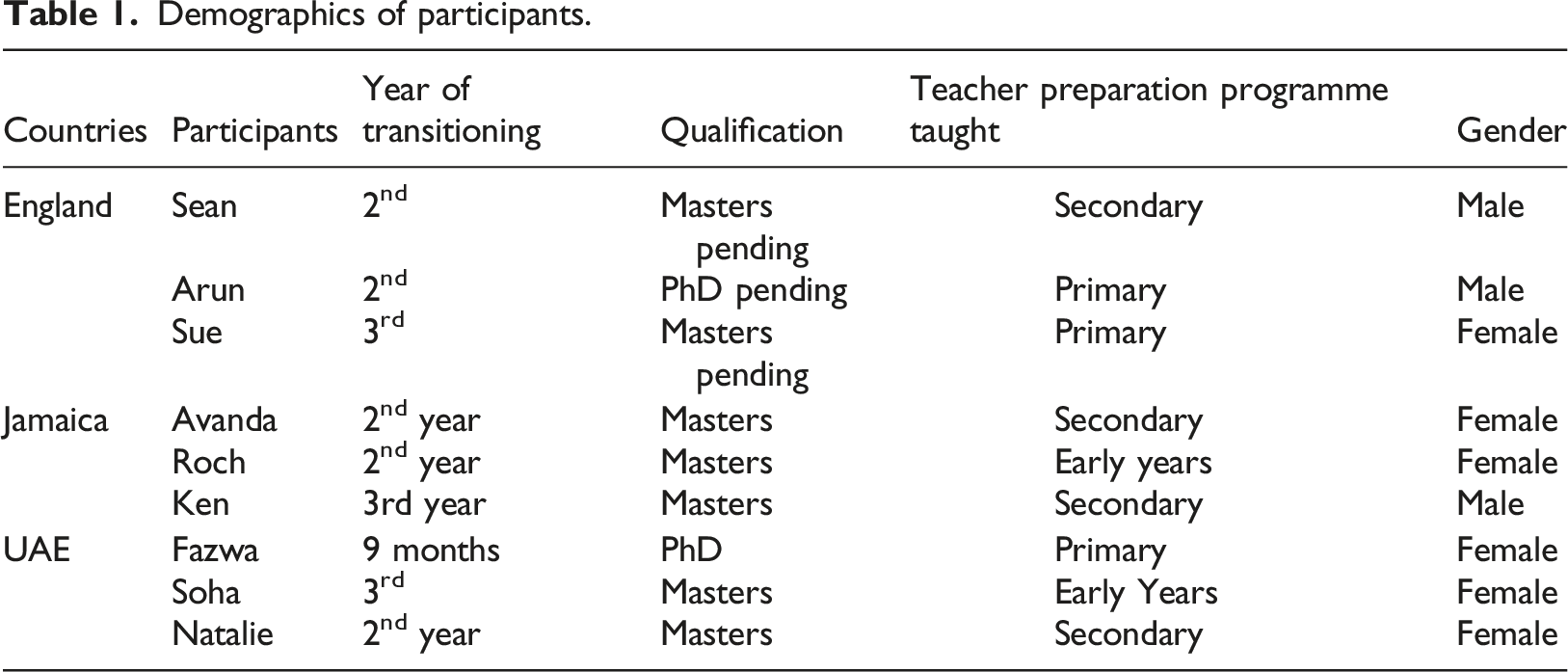
All participants had master’s degrees in education and worked in dedicated teacher training colleges. Two were females, namely, Avanda and Roch and one male named Ken (all pseudonyms). Avanda and Roch were both in their second year of transitioning while Ken was in his third year. A secondary geography teacher, Avanda along with supervising the field experience for secondary education trainees, taught research to students across different specialisations in her college. Before training teachers, Roch was a member of a special project team supervising teachers in the early years sector. At the time of the study, along with supervising the field work of early years and primary teachers, she also taught pedagogy and specialist content courses. Ken was a teacher educator in modern languages and he supervised research and field experience for secondary school teacher trainees.
England
The participants worked in university based teacher education departments. Two were male, Sean and Arun and one female, Sue (all pseudonyms). Sean, a secondary science teacher, was a primary Advanced Skills Teacher (AST) for approximately 28 years. As a part of his probation, he was working on his master’s in research degree. Arun, a secondary teacher in citizenship, with 10 years of classroom teaching experience, was currently working on his PhD while teaching and leading on a Secondary Citizenship Post Graduate Certificate in Education (PGCE). Both Sean and Arun were in the second year of their careers. Sue, a primary school teacher with more than 20 years’ experience in senior management roles, was in her third year of being a teacher educator. She was also working on her master’s degree as part of her probation. Sean and Sue taught core subjects on the undergraduate and postgraduate primary teacher training courses.
United Arab Emirates
The teacher educators were three females with advanced degrees at the master’s or Doctorate level: Fawzia, Soha and Natalie. Fawzia, a local participant and a teacher educator for 9 months, had a doctorate in Curriculum and Instruction and taught teaching methodology to her students in the university. Soha with extensive experience in mentoring adult (in the K-12 sector) educators in her previous role, taught research methodology and specialised in Early Childhood education. Natalie, a native English speaker, held a master’s degree in Education. She believed that an advanced Masters’ degree along with being a native speaker was an advantage that helped her secure her position in the UAE. She had been a teacher educator for 1 year and 6 months.
Data analysis
Data collected from the interviews were analysed through narrative and thematic analysis. The accounts of each teacher educator were first transcribed by each country researcher, arranged in a logical order and then coded (Miles, Huberman and Saldana 2016). Attribute and structural coding were used in the first cycle of the coding process based on the research question that guided the study. Given that this is an under-researched area a combination of deductive and inductive coding were utilised. Following this process the codes derived were then examined in the second cycle coding process using pattern and analytical coding. Pattern and analytical coding were guided by Impression Management Theory. Where single instances were identified in each interview, these were examined for the specific meaning it had for the issue of BTEs transitioning (Leedy and Ormrod, 2001). From the established categories, themes were then derived for each country data set and shared across countries. The data set across each country were also examined (Yin, 2013) to decide on the themes in all the three countries. Additionally, terms and phrases used to present final themes were decided through meetings and e-mails with each country researcher reviewing to ensure that the final themes told the story as outlined in our purposes of the research. Direct quotes from the beginning teacher educators are, therefore, used to provide an understanding of how beginning teacher educators interpret their experiences as they transition.
Findings and discussion
This section presents, interprets and discusses the findings of this study. The research question is discussed in relation to themes that have emerged throughout the study. A strength of qualitative methodology is the discussions that are informed by the data gathered; hence, this study will combine the findings and discussion to strengthen the interpretations and meanings garnered. By combining both sections a cohesive discussion will be possible as the primary data is compared with previously published literature (where applicable) (Neumann, 2006). Firstly, Table 1 the demographics of the sample used in this study is presented to provide an understanding of the participants in the study and allow for inferences to be made and generalisability where possible to the participants of the study. This is then followed by a discussion of the findings based on the research question and themes. RQ 1. How do beginning teacher educators articulate their experiences during their transition from teaching children to teaching adults (Pre-service teachers)? Demographics of participants.
Types of IM strategies used by participants.
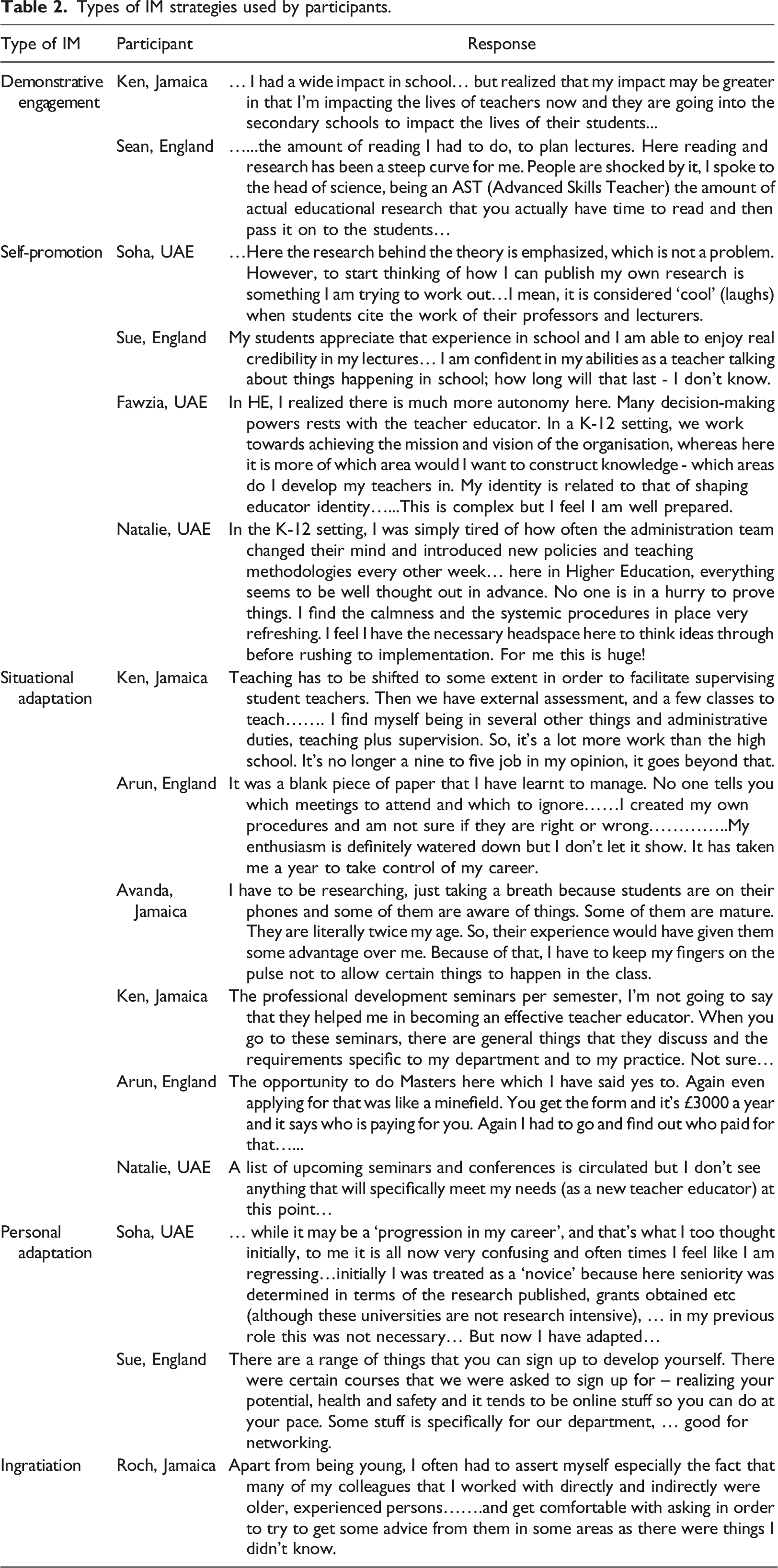
The findings from the research across the three countries, Jamaica, England and the UAE, have highlighted that as beginning teacher educators’ transition they have a range of experiences, and utilise a range of impression management strategies to navigate these experiences. Importantly, these experiences seem to transcend geographical borders and are not necessarily linked to the political or cultural context of each country. For example, the teachers in all three countries, experienced emotional turmoil as they grappled with: (i) feelings of isolation; (ii) losing their identities as teachers of children (classroom teachers) to becoming novices as teachers of pre-service teachers; (iii) lack of understanding of the systems, structures and procedures; and (iv) having autonomy but not knowing how to use it and dealing with extended work hours and pressures.
The five dimensions linked with Goffman’s theory of Impression Management (1959) were exemplified in data collected from participants in all three countries. For example, demonstrative engagement was evident when BTEs presented themselves as committed, motivated and experienced enough to take on the role based on their past teaching experiences as well as projecting a confident and reliable persona as a new colleague (e.g. Sue, England). This confident persona was also reflected in the conscious efforts they made to adapt to their circumstances. However, this newfound confidence also turned into some apprehension as some became anxious about their growing workload and in some instances, felt lost because of the newness of the job which was evident in the situational adaptation undertaken by some (Ken, Arun and Avanda in Table 2).
The themes of identity negotiation, linking theory to practice and balancing teaching with organisational protocols are in turn discussed to provide a more explicit understanding of the BTE’s experiences.
Identity negotiation
Across the three countries, BTEs recognised how their new role challenged their understanding of teacher education and the role they were expected to perform. This led to not only reflection on their past roles as classroom teachers but also their current roles as BTEs and the actions needed to communicate an image of self that was effective or successful. Careful consideration was also given to impression management while they almost subconsciously and carefully self-promoted the identity that they perceived was needed to be an effective teacher educator (e.g. Soha, UAE). Such finding aligns with the views of Lynn Hamilton, Pinnegar and Davey (2016) that identity formation remains a site for growth of professional knowledge and evolves with experience. Identity formation is a crucial aspect of the teacher educator’s understanding of role performance and managing one’s professional self in Higher Education. It is this understanding that will aid in their abilities to successfully manage the unease and emotional turmoil associated with the process of transitioning (Murray and Male, 2005; Boyd and Haris 2010). Additionally, it will aid in the autonomy needed for managing teaching and research roles as teacher educators.
Linking theory to practice
Participants in all three countries were conscious of more time spent in preparation for teaching sessions which consumed a lot of their personal time. Having said that, being adequately prepared for their sessions was more critical for them at this level since they were now teaching adults for whom they not only needed to model best practices in teaching but also model embedding those practices in theoretical frameworks (e.g. Sean, England). For Boyd and Haris (2010) this is where the BTE needs to learn to address subject matter and teach with a new purpose compared to when they were classroom teachers, teaching children. Also, knowing that their student teachers had access to technology during class sessions and could tell if they were not knowledgeable in their content areas, added to anxiety as well as a need for engaging in situational adaptation from time to time (e.g. Avanda, Jamaica). This markedly influenced a change in how they prepared for teaching now in comparison to how they prepared for teaching as K-12 teachers. Their narratives suggest that the demands on their skills and expertise presented ongoing wrestling with self-understanding at this level and the persona they needed to communicate to their students and colleagues. All BTEs therefore made a conscious effort to adapt to their circumstances.
In these instances, they struggled with letting go of the old ways and the old identities and embracing newness (Springbett, 2018; Swennen et al., 2010; Bridges, 2004). All participants faced challenges making productive use of the freedom that underpinned their position and, depending on their age, were uncomfortable with soliciting help to make sense of teaching subject matter at a deeper level. Additionally, depending on their perceptions of collegiality in their context, even where systems and procedures were enabling the BTEs experienced isolation in managing connections between theory and practice. All BTEs interviewed for this study also reported anxieties about engagement with mature-aged students and with over dependent younger students whose expectations were further coloured by their fee-paying status, and the high stakes riding on their success in the employability market. Therefore, as concluded by a study conducted by Walker, Gleaves and Grey in the UK, in 2006 and then in 2015, even the apparently straightforward issue of preparing new teacher educators to work with adults rather than children warrant much closer investigation and consideration to help navigate their new roles and responsibilities.
Balancing teaching with organisational protocols
Systems, structures and procedures in teacher education constitute organisational protocols and the way they are understood facilitates activities crucial to teacher educators and trainees. These include administrative procedures, supervision processes and human resource systems and procedures in the various institutions. BTEs in Jamaica and England expressed that navigating these organisational protocols were a part of their new roles which placed fresh demands on their time resulting in increased workload, which was challenging and difficult to understand (e.g. Ken and Arun). In the UAE, while one teacher educator’s experience (Soha) aligned with those of the Jamaican and English BTEs, the other two expressed appreciation for the flexibility and stability of the systems, structures and procedures in teacher education (Natalie and Fawzia, UAE).
Furthermore these organisational protocols either enabled or inhibited the participants' effective or successful management of their circumstances and identities. Hence, Tetlock and Manstead’s (1985, p.62) understanding of impression management as the product of highly overlearned habits or scripts or even a habitual behaviour (Leary et al., 2011) was manifested through the relationships BTEs formed or did not form; and in the ways they adapted to their circumstances to project the image they wanted on themselves, their colleagues or students. Also, some BTEs were more willing to design their own systems than others (e.g. Arun, England) even if it was out of frustration of not knowing where to seek help. This behaviour exhibited by the BTEs was also in line with what Becker-Lindenthal (2015) pointed out that impression management makes self-experimentation possible. Consequently, given the diverse backgrounds, working circumstances and evolving self-identities of teacher educators it is understandable that the feeling of belonging as a teacher educator is not self-evident. Hence, research undertaken by teacher educators themselves in studying and improving their complex and tenacious identities and practice needs to be encouraged.
Conclusion
This study sought to understand the experiences of beginning teacher educators as they transition from first order teaching to second order teaching in England, Jamaica and the UAE. In England, the findings indicate that there are some established policies and procedures for how BTEs transition to higher education in some (research-intensive) institutions. In Jamaica and the UAE, the findings point to the need for clearly established policies, formalised procedures and support systems. Currently, the process seems to be mostly driven by each institution’s context with no collective understanding of all the factors involved. In the UAE, it seems that effective and veteran teachers see becoming administrators in schools as their only natural career progression. It is therefore necessary to make career advancement for experienced K-12 teachers more explicit and evident in the UAE. This will help to draw on the collective expertise of veteran teachers in shaping policy and practice in the UAE, and in bridging the gap between theory and practice. However, considering this in further depth could be a focus for future research.
As BTEs transition, continued professional development should assist with shaping how they learn to engage with new identities, new colleagues, new demands, new learning and adult learners. Additionally, improved understanding of identity transformation could inform continued professional development needed for self-understanding of the underlying principles and broader issues associated with not only higher education but also teacher education. However, it is pertinent to state here that the role of CPD and support available to BTEs could not be considered in this paper and as such is a limitation here in painting a fuller picture.
Transitioning teacher educators are a critical component in the provision of quality teachers. The quality of their experiences will have ripple effects on the quality of teachers produced. It therefore means that attention to how this group transitions and the systems and procedures designed to manage how they engage in higher education should be given key consideration by policymakers and teacher education administrators internationally. Embracing similarities and differences in teacher educators’ identities, maybe one of the few ways forward for all providers of teacher education so that teacher educators, as a collective group, have confidence to represent themselves as an occupational group in ways that are trusted, valued and respected (Sachs, 2012 in Livington, 2014). This may be done through advocacy for a more personalised and context specific approach to continued professional development for BTEs. Personalising professional development will yield more sustainable benefits for the pedagogical, mentoring and research active roles that BTEs will need to perform as they continue their careers in higher education.
Footnotes
Declaration of conflicting interests
The author(s) declared no potential conflicts of interest with respect to the research, authorship, and/or publication of this article.
Funding
The author(s) received no financial support for the research, authorship, and/or publication of this article.
