




Abstract
The aim of this article is to discuss how to research into phenomena that no one wants to talk about: silenced and tabooed phenomena. With the outset in data culled in two research projects concerning student’s conceptualization of small group learning, the article discusses methodology, theory, and ethics in researching into silenced and tabooed phenomena of in educational settings. The article is theoretical inspired by the Israeli sociologist Evitar Zerubavel, the French philosopher Michel Foucault and the Italian philosopher Giorgio Agamben.
Introduction
As one might expect, what we ignore or avoid socially is often also ignored or avoided academically and conspiracies of silence is therefore still a somewhat undertheorized as well as understudied phenomenon, Furthermore, they typically consist of nonoccurrence, which, by definition, are rather difficult to observe. (Zerubavel, 2006: 13)
For the social researcher, it is essential to get an insight into all the elements of what is going on in the context of research. Otherwise, we are unable to gain knowledge about the phenomenon—and in the end it will be difficult to be able to develop the phenomenon. 1 Though, we every now and then may get the feeling, that it is difficult to grasp what is really at stake, that something is kept hidden for us and perhaps also for at least some of the individuals, our research concerns.
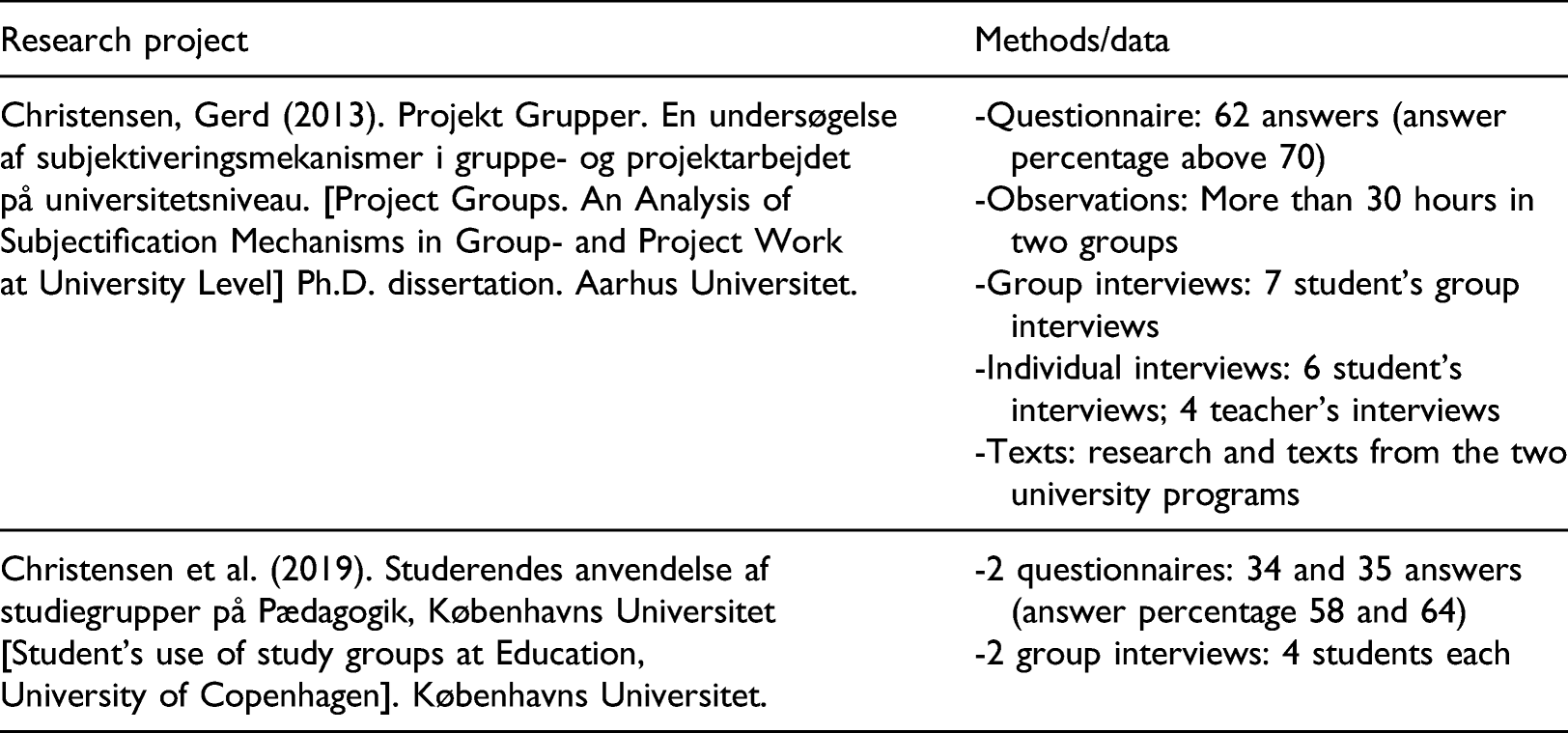
The intention with this article is to discuss how the social researcher can be able to identify and conceptualize phenomena that no one wants to talk about, and to what extend silenced and tabooed phenomena can and must be brought into the open. This is a discussion of method, theoretical framing and not least of ethics of researching into taboos and silenced phenomena. The discussion will take its outset in data culled from two research projects concerning small group learning at three Danish universities (Christensen, 2013; Christensen et al., 2019)2,3. The theoretical framing is inspired by the French philosopher Michel Foucault, the Italian philosopher Giorgio Agamben, and the Israeli sociologist Evitar Zerubavel, who particularly has focused on the process of tabooing.
As Zerubavel says in the quotation above, it can be difficult for a researcher to identify and conceptualize phenomena that no one wants to talk about. Not least, because the participants in the social context seem to co-work in order to keep the phenomenon from being illuminated: “In order to study conspiracies of silence we must first recognize, therefore, that, whether it is only a couple of friends or a large organization, they always involve an entire social system.” (Zeburavel, 2006: 47). When informants seem to co-work in order to keep a phenomenon hidden, the researcher may recognize this as if it is dangerous for the informants to illuminate the subject and that silencing, thus, is vital to the social system (Zerubavel, 2006: 77).
Though Zerubavel in his illuminating discussions of the process of tabooing seems to conflate silencing and tabooing, I find it fruitful to distinguish between the two levels of suppressing. Thus, I use the term “silencing” in order to express the mere veiling of a phenomenon, while tabooing runs deeper and is far more serious. Though taboos from the first sight seem necessary and advantageous, they on the long run create serious problems for individuals as well as for social groups and organizations: Many of the advantages offered by such conspiracies are but short-term seeds of the long-term problems they so often create […] Indeed, much of what seems to benefit us in the short run often comes to haunt us in the long run […] Yet conspiracies of silence create problems not only for individuals. Indeed, many of those problems are unmistakably social. (Zerubavel, 2006: 79–83)
According to Zerubavel, illuminating taboos are dangerous, but necessary. And, for the researcher, it is evident to consider how to manage the difficult process of this research. This article is an attempt to do so.
Setting the scene: Small group learning at Danish universities
As a researcher, I encountered the processes of silencing and tabooing in my ethnographic explorations of in student’s small group learning at three Danish universities. In Denmark, student’s small groups are applied to all kinds of teaching and learning contexts from preschool to university and career development courses. It may be as short-term discussion groups in an otherwise leacher-led lesson, as study groups of different size and durability, or as an element in Problem-Based Learning (PBL) (Christensen, 2013).
At Danish universities, this practice has expanded since the 1970 that is, and small group organization is nowadays considered to improve the student’s learning and to prevent student’s dropouts (Christensen et al., 2019). The small group-phenomenon is to a great extent idealized, which, for example, manifests in the fact that instruction books about team-based and cooperative learning tend to focus one-sided on the positive effects of small groups as forums for discussion, learning, and development (see e.g., Kagan, 1994; Hvenegaard et al., 2003; Kolmos and Krogh (eds), 2002).
However, empirical research shows that the student’s groups are not always well-functioning, and that conflicts and exclusion of fellow students is part of small group learning (Christensen, 2013; Christensen et al., 2019; Barslev-Olsen et al., 1997; Keldorff, 1996; Keldorff and Nibe, 1999; Simonsen and Ulriksen, 1998; Trolle, 1997). While many groups are well-functioning, some are suffering from severe conflicts between the group members. which eventually end up in group members who are being excluded or free willingly leave the group or even in the collapse of the whole group. For some students, this may lead to social marginalization at school and in the end perhaps to student dropout, which is contradictory to the former mentioned expectations of the small group organization as preventing student’s dropout. Thus, there seems to be a contradiction between the ideals and the reality in small group learning.
Still, conflicts and processes of exclusion that seems to be an essential element in student’s groups and teams are rarely conferred by the students nor discussed in the literature. At Danish universities, it is illegitimate to exclude fellow students, and it can be hard to be excluded and even harder to bring it into the open. So, everyone avoids talking about it and may even deny that it exists. In other words: the perfect scene for silencing and taboos.
Methodology and analytical complex
Methodologically, my research of student’s small groups was a multi-methodological study, which combined field-studies at the universities with qualitative interviews of teachers, study-program leaders and students individually and in groups, a qualitative questionnaire focusing on the student’s experiences in groups and text analyses (discourse analyses) about small groups as a pedagogical tool in Denmark and internationally (Christensen, 2013). This gave me a rich insight into the field of study, since it was possible to confront different kinds of data with each other, for example, analyze the answers to the questionnaire in the light of interview-transcriptions, observations and texts.
The theoretical complex for analyzing the data was inspired by the French philosopher Michel Foucault and his conceptualization of power, knowledge, and the human subject. Foucault’s main interest was disciplinary power, which he defined in opposition to juridical power. While juridical power is working top-down, an oppressive force which is possessed by somebody, disciplinary power is working bottom-up, a productive force, which is not (necessarily) in somebody’s possession.
According to Foucault disciplinary power is always attached to knowledge in what he calls the power/knowledge complex (Foucault, 1980). Thus, power/knowledge are the micro-processes of power, which produces (subjectivate) human subjects as on the one hand subjugated, on the other hand, tied to their own subjectivation: “The individual, that is, is not the vis-à-vis of power; it is, I believe, one of its prime effects.” (Foucault, 1980: 98). Power/knowledge works through discursive mechanisms of separation and normalization, which mean through distinction between true versus false, correct versus incorrect, and good versus evil. In other words, a force that works through inclusion and exclusion.
While Foucault conceptualize inclusion and exclusion as binary phenomena, the Italian philosopher Gorgio Agamben ad some important nuances to the concept with the concept included exclusion and excluded inclusion, which conceptualizes that a phenomenon/person may be simultaneously included and excluded (Agamben, 1998): “The analysis of the ban—which is assimilated to the taboo—determines from the very beginning the genesis of the doctrine of the ambiguity of the sacred: the ambiguity of the ban, which excludes in inclusion, implies the ambiguity of the sacred.” (Agamben, 1998: 77).
In the following, I intend to combine these theoretical contributions in order to analyze student’s small groups at university.
Power, silencing, and tabooing: Group formation at university
According to Zerubavel, the researcher who is interested in identifying taboos must focus on the role of power: A first step in this direction [to identify taboos; XX] would be to examine the role of power in the social organization of our attention and discourse. After all, social relations usually involve power, and silence and denial are often products of the way it is asymmetrically distributed among us. (Zerubavel, 2006: 34; my italics).
Zerubavel’s emphasis on power links to Foucault’s emphasis on disciplinary power and his conceptualization of power/knowledge as a discursive force that works through mechanisms of inclusion and exclusion. In other words, a force that allows some standpoints to be revealed while other are kept private or concealed, that allows some individuals to talk while others are kept silent (Foucault, 1994b).
Thus, in my observations, I focused on what was not being said, the closing down of discussions, certain changes in a conversation, “empty spaces” in a discussion and “veiled discourse” for example, disguised conversation where someone are excluded from participating.
The example below is an observation from “the group-formation process” at one of the universities. The process of forming the PBL-groups takes place at the university throughout a week in the beginning of the semester. The students take this event very serious because PBL is mandatory at every semester at this university. The PBL-groups must consist of 3–7 members, who choose a shared topic, coordinate the teamwork and write a shared thesis that they in the end must defend individually or in their PBL-group at an oral exam. In other words: they are very dependent on their PBL-group, and without the group it would be very difficult for them to pass their exams.
Observing the group-formation, I identified that something strange was going on: while some students were invited into the group-discussions, others were not. While some students engaged in the discussions, others kept silent. And though it was illegitimate for the groups to consolidate before all the students were in a PBL-group, it seemed evident, that the students used subtle strategies for excluding some of their fellow students. Those students recognizably felt unwelcome: 11.10 a.m., first day of the ‘group-formation week’: I have accompanied one of the groups of students from the plenary into a group room. There are 9 students present. The project proposals submitted under the theme of this group are presented by the proposers. Some of the fellow students ask questions or raise objections to the proposed angle of the project. 3 students come into the room and 1 student leave. Sometimes no one asks. Then you proceed to the next project proposal. 1 student arrives and 2 students leave the room. When leaving the room, it is to continue to another group room. In this way, the students commute between group rooms where the various project proposals are being discussed. The proposers of the projects stay in the room on this first day. The project proposals are discussed based on academical interests and possible angles of the projects, possible and impossible supervisors and the academical dimensions that the students need to be covered. It is far from everyone who is participating in the discussions. Several are very quiet. (Christensen, 2013: 214, my translation)
During the week, I saw red-eyed students walking up and down the corridor panickily talking into their mobile phone, trying to team up with fellow students who had stayed at home. I saw students trying to headhunt specific fellow students while avoiding others. And I saw students who finally gave up finding a group and tried to convince the study-administrator that they should get supervision anyhow, even though teacher-supervision is for groups only. While some students called the group-formation week “a nightmare” others talked about “social Darwinism” (Student, Christensen, 2013: 218, 268).
There are a lot of “empty spaces,” things that are not being said and students who are not allowed to speak in my data. Parallelly, there are students who flourished and who were headhunted into the groups. According to Foucault, power can be defined as mechanisms of inclusion and exclusion, meanwhile exclusion is the condition for inclusion. Perhaps the students, who were excluded were the condition for other students to be included?
Silencing and tabooing
The example from the group-formation can be reflected in the light of the difference between silencing and tabooing. There are a lot of things which are not being said: that some fellow students are more attractive in a group than others, that there are fellow students who the other students do not want to team up with. These phenomena are silenced.
Thus, focusing on relations of power in discourse in order to identify taboos as Zerubavel recommends, can be conceptualized as focusing on the mechanisms of inclusion and exclusion in discourse: What can, and what cannot be said? What is defined as correct and incorrect, good and bad? And who is allowed to speak? At university, it may also be identified through the student’s way of positioning themselves and each other as “good” and “bad” students.
As such, the silenced phenomena demarcate taboos at universities in Denmark as well as at this specific university of my concern; that Danish universities since the 1970s have emphasized equality among the students, and that it is explicit illegitimate at this university to form a PBL-group based on personal preferences (Christensen, 2013). Group-formation must be based on choice of topic only. Similarly, it is illegitimate for the students to articulate and point at differences in academic and intellectual skills among themselves and their fellow students. These phenomena are taboo, which is identifiable in the way they occur in my data in transformed configurations.
Tabooed student positions
Thus, my data is loaded with student’s stories about fellow students who did not function in the PBL-groups, like, for example, Mette’s story about “Him”: When I think about conflicts in groups, I always think about my first-semester’s group. In this group we had a person who I…who I do not think had the competence to... attend university, or at least not to be in the group […] I would have had to spend a year on the project to get him to understand what the project work was all about. Not even when we tried to discuss the common focus of the project work, or what we wanted and things like that […] there was nothing…there was nothing to come for. It was really exhausting, but then eventually he…he gave it all up…(Christensen, 2013: 281-282, my translation)
The male student in Mette’s story is never mentioned by name. In the story, “he” serves the function of defining the borders between correct and incorrect student behavior in the PBL-groups. Though my interview-data are loaded with equivalent stories about incompetent fellow students, “the Other” students.
Throughout my analyses, I condensed four categories of these Other students: “the Stupid,” “the Lazy,” “the Dominant,” and “the Anti-social” 4 . I never met them face to face, only through the student’s stories about fellow students that coursed troubles in the groups. In the student’s stories, the four categories of problematic students on the one hand functioned as an explanatory frame for the rest of the student’s choice of group: it made it seem reasonable to select some fellow students while avoiding others—often grounded on merely rumors. On the other hand, the four categories of Other students seemed to function as the student’s tool of differentiation: that the students, I interviewed, did not belong to these four categories but were “good students.”
As such, the four categories seemed to be a powerful instrument in the students’ social and academic life at university. And the way, Mette tells her story, indicates the illegitimacy of highlighting differences and pointing at “him” as incompetent. With her story, Mette fears to be categorized as “Anti-social,” not least because she is afraid to be accused of excluding “Him” and thus lead to his dropout of university.
While the students in the four categories were pointed out as problematic, the process of deliberately selecting group members among fellow students and pointing someone out as incompetent were tabooed. On the surface, it did not exist though everyone knew its existence. Likewise, it was the case with deliberately exclusion of group members.
The taboo of excluding group members
So, one thing for the students was forming the groups while hiddenly choosing some fellow students and avoiding others. Another thing was how to co-work if ones PBL-group unintendedly had included a group member, who turned out to belong—or the rest of the group chose to position—in one of the tabooed categories.
The case of Irene in one of the groups, I observed, is an example of how this could be handled. At the first group meetings, I observed that Irene was seldom invited into the group’s discussions. After a few weeks, I noticed that she was rarely present at the meetings. Instead, she emailed her written contributions to the project rapport, which—as the observation below show—were “written out” of the group’s final thesis. This happened at the group meetings, where she was not present: Work-meeting in the HUM-BAS group: Irene is absent. Mette begins with an evaluation of the groups writing-week in a summerhouse […] Next follows a discussion of the latest drafts and the different writing style of the group members. The authors defend their drafts. Irene’s drafts are criticized by everyone. Irene is not there to defend her writing. Then a lot of time is spent on planning the further work process. Carl is self-appointed observer on the discussions. He impatiently summarizes the other member’s ideas. The three female members are all participating in the discussions. Agnete summarize on her laptop. The group want to secure Irene’s future accept of the deletion of the parts that she has written. (Christensen, 2013: 255, my translation)
Without it ever being said, Irene was not part of the group or of the project. The rest of the group seemed to have an unspoken contract about eliminating her contributions from the group’s final product, the thesis. Even though, Irene went to the final (group-)exam with the rest of the group and got the same grade as the other group members. Without being included, Irene was not explicitly excluded from the group. 5
Agamben’s concept included exclusion may be a way of theorizing the position of Irene and a lot of other students in the PBL-groups: they did not participate and/or were not allowed to participate in the PBL-group’s work process. Even though, these students were not explicitly excluded or expelled from the group. The silence included exclusion of those students was an elephant in the room: something everyone knew was there but still avoided to mention (Zerubavel, 2006).
According to Zerubavel, the process of tabooing is depending on a collective endeavor: the group seems to collaborate on an implicit level in not talking about certain issues: “Many groups, in fact, view silence breakers as threads to their very existence […] In fact, we often view conspiracies of silence as far less threatening than the efforts to end them” (Zerubavel, 2006: 78). Conspiracies of silence always involve an entire social system (Zerubavel, 2006: 47).
In the forementioned PBL-group, it seemed to have become legitimate to including exclude Irene, if it was not illuminated through an open exclusion. Irene was just silenced, and her contributions were written out and forgotten. It is difficult to say how she would manage the next semester, and if she would be adopted in a new PBL-group or if “grapevine has spoken” as the students put it (Christensen 2013: 302). Perhaps she ended up positioned in one of the unwanted categories as “stupid,” “lacy,” “dominant,” or “anti-social.” As a researcher, I do not know. I left the context.
The tabooed group conflict
The four categories of tabooed student positions highlight some of the problems, that may appear in the groups’ work process. Thus, the students’ explanations for not wanting to team up with these (anonymous) fellow students may be that they might lead to conflicts in the group: While “the Stupid” is time-consuming for the group (e.g., “Him” in Mette’s story), “the Anti-social” is violating the rule of not sneaking on other group members (as Mette did?), “the Lazy” is not lifting their part of the group’s workload (perhaps Irene?), and “the Dominant” wants to be “the leader” of the group thus highlighting difference in skills amongst the students (Christensen 2013: 302).
Conflicts in the PBL-groups are difficult for the students to handle and they get inadequate help from the university in doing so. Teachers and supervisors report that they often know nothing about any conflicts in the student’s groups until the group is in a severe crisis and break up, often resulting in failing their exam (Christensen 2013).
While Zerubavel encourages the researcher to look for relations of power, sudden silence, “missing speech,” and words that are not being said if we want to identify taboos, he also encourages us to look for euphemisms (Zerubavel, 2006: 6). The two quotations below are culled from the two research projects (Christensen, 2013; Christensen et. al., 2019). In the quotations, the students talk about how they have experienced and handled conflicts in their study- and PBL-groups. Suddenly it’s not just academically, so it becomes something else, like Uhh… (Irene (student), Christensen 2013: 238; my translation) […] because, arh, it was a little, uuuh, to talk about how it was to be in the group. You didn’t want to. (A (student); Christensen et al. 2019: 11; my translation)
Everyday intuition tells us that something is at stake here, something that the students do not want to explain. Instead, they use a euphemism: “Uhh…”. “Uhh” indicates something scarry. According to Zerubavel, the main reasons for using euphemisms are fear and embarrassment (Zerubavel, 2006: 6). Thus, the student’s rewording and leaving out words in the quotations above, may point at something important: that the subject, in this case, conflicts in the student’s groups, is not only difficult but perhaps even dangerous to put it into words. This points at conflicts in small groups at university as not merely silenced but tabooed: something, we do not talk about, while imagining that they are non-existing.
As Zerubavel says, bringing tabooed phenomena into the open may be considered as dangerous to the life and wellbeing of the group.: “Not only can breaking a conspiracy of silence hurt at group’s public image, it can destroy its very fabric.” (Zerubavel, 2006: 77). The students in the interview quotations above act as if revealing their experiences of conflicts in groups could do severe damage. So, illuminating taboos is not uncomplicated, but an act that demands ethical concern, also when it comes to the role of the researcher.
Ethical considerations when researching in taboos
This raises the question of ethics: what are the limits of the ethical code of conduct for researching into tabooed phenomena? As social researchers, we have an obligation to comply to the conventional rules of research ethics, that is, informed consent, opportunities to withdraw and anonymization—and primarily: do no harm.
But researching into something that no one wants to talk about and that might even seem dangerous to reveal seems to add a further dimension: how can we do this without damaging the individuals who participate in our research? Are we allowed or obliged to illuminate the phenomena, that are kept hidden? And what will happen, if the silenced phenomena are brought out into the open? In this case: could I as a researcher, instead of impowering the students, damage them through my research?
As mentioned, Zerubavel argues that illuminating taboos are dangerous but necessary, because taboos in themselves create long-term problems: “Indeed, in an attempt to ‘protect’ groups, they often make them become somewhat dysfunctional. Silence is also morally corrosive, as it inevitably opens the door to abuse.” (Zerubavel, 2006: 85). This turns illumination of hidden phenomena into an ethical obligation for the researcher. Though, it seems vital to do this in a way, that does no harm to the individuals involved.
Relational ethics and ethos
Carolyn Ellis’ (Ellis, 2007) relational ethics and Foucault’s principle of ethos (Foucault, 1994b) may provide a theoretical frame for discussing ethics when researching into phenomena that no one wants to talk about.
Ellis defines relational ethics as an addition to procedural ethics, which ensure that the researcher “adequately deal with informed consent, confidentiality, rights to privacy, deception, and protecting human subjects from harm” and situational ethics “that deal with the unpredictable, often subtle, yet ethically important moments that come up in the field” (Ellis, 2007: 4). Finally, relational ethics “recognizes and values mutual respect, dignity, and connectedness between researcher and researched, and between researchers and the communities in which they live and work […] Central to relational ethics is the question “What should I do now?” rather than the statement “This is what you should do now” (Ellis, 2007, 4).
Ellis’ discussion of relational ethics highlights the challenge in research ethics: that following the ethical rules and conventions of the discipline is never sufficient. During a research process, the social researcher inevitably will encounter things or themes that illuminate the shortfall of procedural ethics. Thus, in addition to following the ethical rules of the discipline, the researchers must decide for themself what to do in the situation and which kind of researcher/person to be.
Applied to researching in taboos, this implies that the researcher must observe, listen, and decide in which cases it is appropriate and maybe even necessary to illuminate silenced and/or tabooed phenomena and in which cases it will do more damage than leaving them in the shade. In other words: the researchers must use their personal judgment, empathy and integrity. Though, this leads to an individualization of ethics which need theoretical elaboration. In this case, I find that Foucault’s concept of ethos fruitful.
While Foucault considered power to be an all-permeating productive force, which produces human subjects through mechanisms of inclusion and exclusion, he also discussed how to handle relations of power as ethos. He defined ethos as a practice of the self on the self; a practice, that “[…] will allow us to play these games of power with as little domination as possible.” (Foucault, 1994a, 298).
Hence, the ethical endeavor becomes a personal endeavor where the individuals construct themselves as ethical agents through their practice. A way of caring for others (Foucault, 1988: 287). Foucault encourages us to “[an] examination that consists of suspending as far as possible the values to which one refers when testing and assessing it. In other words: what am I doing at the moment I’m doing it?” (Foucault, 1988: 107).
Applied to research ethics, Foucault’s concept of ethos requires the researcher to be continuously aware of the mechanisms of power/knowledge that they themselves introduce and how discourse set the framing for subjectivation. Thus, the core of ethos could be defined as asceticism: “[…] the self-forming activity (pratique de soi) or l’ascétism—asceticism in a very broad sense” (Foucault, 1984: 355) or what we avoid doing (Foucault, 1994b: 285). This is not to say that the researchers ought to be overwhelmed and paralyzed, but that they must consider that they are powerful participants themselves.
To return to the examples from my research, I had to question my own ethos, and to which extend I have empowered the students through illumination of some of the taboos of the group work at university, for example, the taboos of excluding fellow students in the group-formation process, the taboo of excluding group members like Irene and the taboo of group conflicts. Zerubavel emphasizes that breaking a collective denial is inevitable for development and empowerment: “Ironically, it is precisely the effort to collective deny their ubiquitous presence that makes ‘elephants’ so big. As soon as we acknowledge it, they almost magically begin to shrink. And only then, when we no longer collude to ignore it, can we finally get the proverbial elephant out of the room.” (Zerubavel, 2006: 87).
Following this, the right thing to do for the researcher is to illuminate the taboos and what is happening in the context of our research. This must be done with as little domination as possible and respectfully to the individuals who are engaged in our research and who trust us with letting us into their praxis. Hence, there still seems to be a fine and undefined line between what must be brought out into the open and what is better left in the darkness.
Concluding remarks
In this article, I discuss methodological, theoretical, and ethical questions of researching into phenomena that no one wants to talk about: the silenced and the tabooed phenomena. With an outset in two research projects concerning small group learning at university, I argue for a multi-methodological approach and a focus on relations of power in discourse and practice.
The methodological focus on relations of power was theoretically inspired by Foucault’s power/knowledge complex and his concept of subjectivation through mechanisms of inclusion and exclusion in discourse. His theories were supplemented by Agamben’s concept included exclusion and excluded inclusion in order to analyze the empirical findings.
The analyzes showed a couple of taboos, which are related to the student’s formation of groups at university: the taboo of deliberately choosing and selecting group members among fellow students, a tabooing of fellow students who were defined (positioned) as dominant, stupid, lazy, or anti-social and finally the tabooing of group conflicts and of excluding group members.
All these taboos seem to be interrelated in the fact that the students are (or imagine that they are) quite depending on their small group in order to pass their exam. Thus, it seems evidently important to them to be able to form a group that does not include time-consuming elements such as ineffective or troublesome group members that lead to conflicts.
Finally, ethics were debated, partly in relation to Ellis’ concept of relational ethics, partly inspired by Foucault’s concept of ethos as “practices of the self.” To paraphrase Foucault, researchers must ask themselves what they are doing with what they are doing. For Ellis, this is a question about the researcher’s empathy and personal integrity, while it for Foucault is a question about minimizing the use of power and domination.
According to Zerubavel, conspiracies of silence create problems which are social as well as individual. Silence is morally corrosive, and it opens the door to abuse. In order to stimulate development and emancipation, the researchers are, hence, obliged to take part in the illumination of taboos. At the same time, researchers must be aware of their responsibility while doing so. We must question phenomena, that are taken for granted and illuminate the things, that people do not see, perhaps because no one wants to see them. Anyhow, it is the researchers’ integrity and ethos that secure that the illumination “do no harm.”
Even if we accept the statement that taboos lead to abuse and that illumination of taboos therefore must be fundamental for emancipation and development, it remains an open question if illumination of taboos are always an ethical act or if somethings sometimes are better left in the shade.
Footnotes
Declaration of conflicting interests
The author(s) declared no potential conflicts of interest with respect to the research, authorship, and/or publication of this article.
Funding
The author(s) received no financial support for the research, authorship, and/or publication of this article.
ORCID iD
| Research project | Methods/data |
|---|---|
| Christensen, Gerd (2013). Projekt Grupper. En undersøgelse af subjektiveringsmekanismer i gruppe- og projektarbejdet på universitetsniveau. [Project Groups. An Analysis of Subjectification Mechanisms in Group- and Project Work at University Level] Ph.D. dissertation. Aarhus Universitet. | -Questionnaire: 62 answers (answer percentage above 70) |
| -Observations: More than 30 hours in two groups | |
| -Group interviews: 7 student’s group interviews | |
| -Individual interviews: 6 student’s interviews; 4 teacher’s interviews | |
| -Texts: research and texts from the two university programs | |
| Christensen et al. (2019). Studerendes anvendelse af studiegrupper på Pædagogik, Københavns Universitet [Student’s use of study groups at Education, University of Copenhagen]. Københavns Universitet. | -2 questionnaires: 34 and 35 answers (answer percentage 58 and 64) |
| -2 group interviews: 4 students each |