




Abstract
In this article, we explore more than 100 Chinese school leaders’ views about gender, equality and the historical and social contexts of Chinese education that they have experienced. China’s success in international student assessment programmes is rising, and Chinese females are continuing a steady trend of outdoing their male counterparts at all levels of schooling. So importance grows for the world to better understand Chinese education and the influential roles leaders, especially women leaders, hold in that sector. Our research is underpinned by a theoretical framework that considers whether gender role-modelling by school leaders affects students’ beliefs about gender roles and norms because they observe adult staff in schools for years. We present data that reveal most of our participants believe they are leading schools in China where gender equality is being role modelled and has been achieved. We discuss and theorise about a form of ‘gender equality with Chinese characteristics’ which seems to value a rigid gender binary with different, gendered expectations for adults. Finally, we consider whether Chinese school leaders may be reinforcing rather than changing gender inequality, even with the best intentions that they do not.
Why should we care about gender equality in Chinese schools?
China has the largest public education sector in the world, and its school leaders are responsible for leading the teaching of more than 180 million young people 1 and role-modelling what those youth can expect in their future lived experiences as gendered adults. Chinese females have made impressive strides in attaining gender equality goals in recent decades. One indicator is that since 2004, Chinese female students have attained better academic track records than their male counterparts in all school levels (OECD, 2018). Global standardised tests, such as PISA, indicate that in some areas of Eastern China (i.e. Beijing, Shanghai, Jiangsu and Guangdong), students have become among the most successful education test-takers in the world (OECD, 2019). As China begins to lead education trends in what some argue to be a politically polarised and dangerous decade (Giroux, 2021; Harris, 2020; Mutch, 2015), we think importance grows for the world to better understand Chinese education and the influential roles leaders, especially women leaders, hold in that sector.
Chinese women who hold leadership positions in schools are elite, highly educated influencers of the next generation of Chinese students. Yet, gender researchers such as Zheng (2020: 161) question ‘why young Chinese women are not embracing feminist ideologies as an avenue towards gender equality?’ Her research focused on elite female students in STEM higher education, and we seek to add to this conversation by examining what another group of highly educated Chinese women think about gender equality. We will present research exploring the gender perceptions of 126 Chinese school leaders and consider how they may be shaping the thinking of present and future generations of girls and boys about gender equality and the roles and responsibilities men and women play in mainstream Chinese society.
Our study contributes to a growing field of research in gender and education about mainland China, but focuses on school leaders rather than the teachers (Yang and McNair, 2019), students (Kajanus, 2015; Liu and Morgan, 2020) or ‘leftover women 2 ’ (Hong Fincher, 2014; To, 2017) who have been more prominent subjects in recent Chinese gender studies. Within Chinese society, school leadership positions are elite roles for women and respectable, face-saving roles for men (Yang and McNair, 2019). School leaders are unique research subjects in that all are members of the Chinese Communist Party, since being a comrade is a prerequisite for school leadership roles (Burns and Wang, 2010; White, 1981), and they are expected and required to be role models in their schools and local communities (Feng, 2020). Most are also parents who juggle family life, school leadership responsibilities and a continual cycle of required academic study and political training (Feng, 2020).
Our study is underpinned by a theoretical framework that considers gender role-modelling by school leaders (and teachers) and whether it affects students’ beliefs about gender roles and norms because they observe adult staff in schools for years (e.g. Carrington and Skelton, 2003; Faulstich-Wieland, 2013; Martino 2009; McDowell and Klattenberg, 2019; Olsson and Martiny, 2018). Since Chairman Xi came to power a decade ago, he has exulted school leaders as role models and patriots and reinforced the morality of distinct gendered roles in Chinese society (Xi, 2017). Chinese educators are expected to impart these official moral values onto their students (Cunningham, 2014); hence, we wanted to explore how school leaders are internalising Xi’s vision for gender and education in China.
A recent Chinese government report on progress towards their version of gender equality, after seven decades of rule, offers extensive data to suggest they are progressing well, but there is more to achieve: In the entire course of history, the liberation and progress of women have been indispensable to the liberation and progress of mankind. Since its inception, the Communist Party of China (CPC) has been struggling for women’s liberation and gender equality… Since the 18th CPC National Congress…there has been a firmer belief in the future of women’s development based on Chinese socialism …As masters of the nation, women now can find the best ways to fulfil themselves while gaining increasing senses of achievement, happiness, and safety (State Council Information Office of the People’s Republic of China, 2019: 3).
But unofficial data, especially collated outside of mainland China, offers a bleaker perspective on current gender rights in China. For example, the female employment rate in mainland China is nearly 14% lower than males, and this gap has been widening since the one-child policy was rescinded on 1 January 2016 (Wang and Hesketh, 2018). Also, according to a recent report by Human Rights Watch (2018), a study conducted in 2014 by the All China Women’s Federation found that: …87 percent of female college graduates reported that they had been subjected to one or more forms of gender discrimination while looking for their jobs, such as ‘advertisements stating men only or men preferred,’ ‘rejecting or refusing to review female applicants’ resumes,’ ‘rejecting female applicants for second-round interview opportunities,’ and ‘having higher requirements for educational attainment from female applicants.’ (Human Rights Watch, 2018: 17)
Due to such contrasting findings in various data, our research team first revisited the history and context of gender equality in Chinese education. This reinforced our interest in learning more about Chinese school leaders’ views and attitudes about gender equality, and theorising about what female and male leaders think they are role-modelling for their students and how closely that aligns to the official, optimistic expectations of the Chinese Communist government. Hence, in the sections that follow, we present and discuss the historical context of gender equality and Chinese education, gender role-modelling and schooling in contemporary China and gender and Chinese educational leadership.
Historical and contemporary context
Gender equality and Chinese education
As China’s State Council Information Office (2019) report noted and Ming-Hsuan Lee (2014) explains, there has been an extensive history of gender inequality in Chinese education. Schooling remained the privilege of men for millennia in China, and most women received no education until the end of the 19th century, at which point 30–40% of Chinese men but only 2–10% of women were literate. A well-known Chinese saying, 女子无才便是德, which translates to a ‘women’s virtue is without literacy or artistic talent,’ is illustrative of how educated Chinese women were viewed. At the end of the 19th century, feminist revolutionary Qiu Jin fought pro-male customs including female infanticide, foot-binding and forced illiteracy. However, the philosophy of Yin and Yang 阴阳, which describes women as passive, soft and yielding in contrast to men, as well as the Confucian patriarchal structure of Chinese society, continued to be strong obstacles to elevating the status of Chinese females (Zuckerman et al., 2000; Karl, 2013).
The first half of the 20th century saw slow improvement in gender education statistics. For example, the 1982 census showed that the national literacy rate for females aged over 60 was only 5% compared to 39% for males (World Bank and Asian Development Bank, 2006). When Mao came to power in 1949, he spoke against Confucianism, deeming China’s old ways as feudal and patriarchal ideologies needing to be overthrown (Karl, 2013). Mao (1961) said that it was his communist government’s duty to protect the interests of women and children by ensuring gender equality: 时代不同了, 男女都一样. In the 1950s, Mao acted on these ideals by outlawing foot binding and forced marriages. He decreed men and women should receive equal pay for equal work.
Under Mao’s rule, co-educational schools and female literacy rose rapidly. However, the nature of the education that was offered to boys and girls meant they were being educated and ‘politically conditioned at the same time’ (Guenfoud, 2017). During the Cultural Revolution in the 1960s, Mao promoted the Zhongshan suit or ‘Mao suit’ 中山装 to personify the Communist ideal that all Chinese adults be treated the same, as comrades and equals in reshaping society (Ip, 2003; Karl, 2013). Yang and Yan (2017: 63) argue that Mao used State rhetoric to appropriate a ‘discourse of women’s equality to silence women and depoliticize gender as a political category.’ They contend that a gender equality paradox arose during this era: This disavowal of traditional femininity and declaration of supposed gender equality marked not so much the disappearance of gender from people’s daily lives but rather, the subordination of femininity to masculinity. Women were pressured to dress and act like men, but not vice versa; likewise, women were now measured by traditionally male standards of success. Feminism or any discussion of women’s specific problems was declared bourgeois and hence counter-revolutionary, and femininity or any assertion of a specifically female identity was denounced and labelled a ‘backward element’. (Yang and Yan, 2017: 67)
Mao’s revolutionary attempts to overthrow a thousand years of Confucius patriarchy did not fully succeed. After Mao died, Deng Xiaoping positioned China as a socialist market economy. Deng’s (1994) reforms kept previous gender-equality laws in place, and in 1980, China signed on to the United Nations Convention on the Elimination of All Forms of Discrimination against Women (Attané, 2012). Still, gender discrimination has continued in Chinese education, and especially so in rural areas (Brown and Park, 2002; Hannum, 2003, 2005; Hannum et al., 2009, 2010; Song et al., 2006). Huang and Placier’s (2015) microhistory of four generations of Chinese women’s educational experiences in their rural community provides an evocative account of changes in gender inequality from 1930 to 1990. They found that gender inequality did not disappear but changed over time from outright ‘denying access to schooling to stereotypes embedded in everyday life experience’ (Huang and Placier, 2015: 600).
Women’s education and employment opportunities increased enormously in China during Deng’s time, but this occurred in parallel with a rise in pay inequality and increased gender discrimination in employment (Dong, 2014; Guenfoud, 2017). From 1979, a one-child only policy was imposed on nearly all Chinese families which has seen education opportunities for women increase rapidly such that they now represent over half (51.7%) of all Chinese tertiary graduates (OECD, 2018). In the 21st century, a large-scale, influential beauty economy or ‘meinü jingji’ 美女经济 (Xu and Feiner, 2007) has developed. Women are again being judged on their youthfulness and femininity (Otis, 2016; Wen, 2016) and, especially since 2016 with the introduction of the two-children policy, their mothering goals. In fact, feminist scholars (Hong Fincher, 2014; To, 2017) have argued Chinese women are now encouraged to stop studying and working and instead marry a Chinese man before they turn 27 years of age or they will be deemed failures irrespective of any career successes, as bluntly described in this extract from an article posted on the All-China Women’s Federation website in 2011: Pretty girls don’t need a lot of education to marry into a rich and powerful family, but girls with an average or ugly appearance will find it difficult. These kinds of girls hope to further their education in order to increase their competitiveness. The tragedy is, they don’t realize that as women age, they are worth less and less, so by the time they get their M.A. or Ph.D., they are already old, like yellowed pearls. (cited in Hong Fincher, 2014: 3)
A re-gendering view may be becoming more popular, if not sanctioned, under the patriarchal leadership of Xi. In his first prominent speech as China’s leader in 2013, Xi argued a strongly gendered position that, ‘he was “man enough” to stand up for the Communist Party’ and ‘possessed the manly qualities needed to defend China from those seeking to undermine Communist rule’ (Hong Fincher, 2018: 164). Since then, Xi has continually campaigned to strengthen traditional family values (Golley, 2018) asserting that men and women can be both ‘different and equal’ consistent with the conceptualisation of gender equality in China as a gender-binary society with a ‘vision of “harmonious” male-female households with a working father and a virtuous mother who cares for children and the elderly’ (Rauhala, 2018: para. 14).
Gender role modelling and schooling in contemporary China
While more research is clearly needed about gender role modelling in contemporary Chinese education, there have been some micro-level studies suggesting continued discrimination and separation of gender roles. A decade ago, in a relatively small study based in Shanghai, Chen and Rao (2010) observed that gender socialisation begins in kindergartens. In common with most societies across the globe, few men in Shanghai teach young children and ‘stereotypical gender roles limit opportunities for both men and women in the profession’ (Chen and Rao, 2010: 288). In 2019, Yang and McNair conducted a phenomenological study of male early childhood teachers in Shanghai and reported little change from Chen and Rao’s findings. They highlighted that parents/grandparents and male and female staff themselves contribute to the continued gender divisions in early childhood education (Yang and McNair, 2019: 274), and concluded that ‘in societies where gendered roles are deeply embedded in social norms, change will likely be slow to emerge’.
Swan’s 2017 study about gender socialisation in an elementary school in Kunming, China involved a month of classroom observations and teacher interviews that produced vignettes about young children and gendered expectations: Though teachers claimed to treat boys and girls equally in the classroom, teachers in fact held different expectations for children based on traditional gender stereotypes, creating a hidden curriculum of gender relations that children were expected to learn… By speaking more frequently with boys in class, demanding quieter and calmer behavior from girls, and permitting more rowdiness and loudness from boys, teachers reinforce a model of gender in which boys can be active and girls must be passive. (Swan, 2017: iii)
A study at the high school level by Chen et al. (2019) used baseline data from a Chinese Education Panel Survey to examine if there is a relationship between a teacher’s gender and their students’ academic performance. The authors found that female teacher role models had significant positive impacts on changes in female students’ math and English performance, but not so for male students. The paper also explains a traditional Chinese cognitive gender ladder where males are viewed as cognitively superior to females, and argue this ladder is reversing. A 2017 study argued that when gendered stereotypes are role-modelled in maths classrooms, this affects Chinese students’ career intentions, and female students are less likely than their male counterparts to pursue work as a mathematician (Song et al., 2017).
A study by Yang and Gao (2019) suggests that Chinese teachers, together with Chinese parents, can be regarded as gatekeepers of traditional gender norms and they may encourage students to conform to them. They observed that female students continue to be expected to perform traditional serving roles in their families, and, as a result, girls who follow this gender socialisation process are likely to have gendered attitudes towards what success in later life should be. This aligns with a recent qualitative study by Zheng (2020) which showed that few Chinese female students in their study are choosing tertiary study in traditionally male fields and women struggle when they traverse male-dominated higher education spaces.
Gender and Chinese educational leadership
Leadership in China has traditionally sat within a masculine framework (Louie, 2002), and there have been few women in leadership positions throughout Chinese history. For example, Empress Wu Zetian (690–705 CE) has been the only female emperor in the history of China. Lin (2008) argues that most scholarly literature on Chinese leadership is conceptualised around three key systems: Confucianism, collectivism and communism. Even in 2020, after almost seven decades of communist rule in China, Hong-Fincher (2018: 170) points out ‘there has never been a single woman on the Politburo’s elite Standing Committee.’
Recent Chinese research has investigated what Chinese children think about school, their society and its leadership. A study by Liu et al. (2012: 116) explored children’s images of leadership in China and found that when asked to draw a leader leading, ‘the majority of children drew a male leader (75.9%), while 24.1% drew a female leader’, and that the boys (90.0%) were significantly more likely than the girls (61.3%) to draw male leaders. Consistent with this, logistic regression analysis revealed that the child’s gender was a significant predictor of the gender of the leader drawn, but not the child’s school grade (Liu et al., 2012).
Huang and Wiseman’s (2011) study of Chinese educational leadership in compulsory schooling (i.e. catering for students aged 6–15 years) found that: Although no national or provincial statistics are available detailing the numbers of female school administrators, our available evidence points to an extremely low proportion of female principals in China. Further, there seems to be a general trend that the higher the grade level becomes, or the more rural the school site is, or the more ethnic residents that the community has, the smaller the female principal population (Huang and Wiseman, 2011: 134).
Yu and Wang’s (2018) study of gender and leadership in China’s higher education system involved examining the resumes of over 6700 male and female leaders. They found that when it comes to female leadership in Chinese higher education, ‘women’s status and power have greatly improved and made unprecedented progress’ (Yu and Wang, 2018: 147), but ‘women still occupy a low proportion of leadership positions; they hold less power; and experience horizontal isolation’ (Yu and Wang, 2018: 154).
In another recent study of higher education leadership in China, Zhao and Jones (2017: 1) noted that women hold less than 5 percent of the leadership positions. They found that female leaders tended to distance themselves from leadership as a professional identity and observed this was ‘true for those in middle management positions, as well as women in early career stages, who might otherwise aspire to leadership.’ They argued that female educational leaders have ‘learnt to position themselves… in ways that are congruent with social and cultural norms and expectations’ (Zhao and Jones, 2017: 13).
Finally, a new textbook, Understanding China’s School Leadership: Interpreting the Terminology (Feng, 2020), offers the first-known English textbook detailing how Chinese school principals are expected to lead their schools. Gender is not mentioned at all in the 250+ pages, but there is a section dedicated to the importance of school leaders’ ‘moral modelling’ which means being a role-model ‘of virtue for students’ or wei-ren-shi-biao 为人师表 (Feng, 2020: 82).
In summary, our review of recent research and grey literature suggests that there is an impasse between the Chinese government’s official constitutional goal of gender equality and the historical and social contexts of Chinese schooling that perpetuate and reinforce gender inequality. We therefore focused our exploratory study on school leadership and, in designing and conducting the research, have been informed by the notion that school leaders in China are expected to, and likely do, role-model gender norms to students which may have a powerful influence on their future behaviour and career choices.
Method
Accessing Chinese research participants safely and ethically
In aiming to learn more about current Chinese school leaders’ views on gender equality and gain insights into their attitudes and assumptions about gender roles, we were particularly cognisant of the need to find and recruit Chinese research participants in ways that are both safe and ethical for all parties. Our research team included Australian and Chinese academics and Mandarin–English translators who share a research epistemology aligned to critical education theory (e.g. Gur-Zeʼev, 2005; Smyth et al., 2014) and especially the sub-genre of feminist critique (e.g. hooks, 1981, 1990, 2010; Hong Fincher, 2018; Thayer-Bacon et al., 2013). Unfortunately, our mainland Chinese counterparts, working under Chairman Xi’s official instructions regarding research (Xi, 2017), could not be co-authors as gender theorising and critique is a contentious research field in mainland China’s academia.
In developing this study, we were mindful of the importance of cultural sensitivity and validity (Cohen et al., 2018) and the warnings by Smith et al. (2008) of the challenges in collecting data in mainland China and analysing survey data in Mandarin. The latter include a range of language-related problems that can lead to misinterpretation of data, and the phenomenon of ‘cultural politeness’ that may result in less rigorous and honest discussions and disclosures by research participants. Hence, we made it a priority to take the time and effort to build trusting relationships in the research team and trial and rectify errors of language and cultural sensitivities in the data collection instruments over time.
After university ethics approval was finalised, we began trialling an initial survey piloted with 50 Chinese school leader participants in 2017, then refined and re-tested in 2018 with another 50 school leader participants. We learned in our pilot stages that our mainland colleagues could only countenance a gender and education survey that assumed ‘male’ and ‘female’ are the only choices for categorising sex or gender. We understand that, outside of mainland China, researchers are able to construct studies that problematise the mainland’s binary views of gender and are able to explore intersectionality as well (e.g. Ang, 2014; Hong Fincher, 2018; Zheng, 2015)’ however, we could not. So, the final gender and educational leadership survey defined gender equality 性别平等 as a phrase meaning when males/men 男 and females/women 女 are treated equally in a society.
In 2019, we selected the WeChat© app as the best platform to deliver the final survey since this app is very popular in China and allowed us to reach Chinese education leaders with whom we had had no previous contact. The WeChat© survey garnered 126 final participants who self-identified as having a school leadership role in any level of Chinese education (early childhood through to senior secondary); and they were assured confidentiality and anonymity except for identifying their gender (73 females and 53 males) and general location (Zhejiang and Shandong provinces, plus the Beijing municipality).
Our final survey listed 12 agree or disagree statements about gender equality, followed by an open-ended question which invited participants to comment on how they lead their schools to promote gender equality 您的学校是如何促进学生性别平等的? The 12 statements were constructed with an even split between those written in the negative (e.g. men not women are…) and in the positive (e.g. men and women are…). To reduce the possibility of acquiescent bias, each statement popped up in random order when survey participants linked into the survey via WeChat©.
The survey data was downloaded and then analysed using Microsoft Excel then SPSS. The Fisher’s exact test of independence was performed on the first 12 statements to determine whether there were any significant differences between the responses of the male and female school leaders. Fisher’s exact test was used since it is more accurate than the Pearson chi-square test when the numbers in some of the response categories are small (i.e. less than 5) and is recommended when the overall sample size is less than 1000 (McDonald, 2014).
Results
Survey results and open-ended comments
The overall results of the closed questions used in the data from the final collection period are summarised in Figure 1. This shows the percentages of the 126 participants who ‘agreed’ or ‘disagreed’ with the 12 statements from the Chinese school leadership survey. Note that we have deliberately presented the statements in an order that best depicts the pattern of participant responses. Survey responses (%).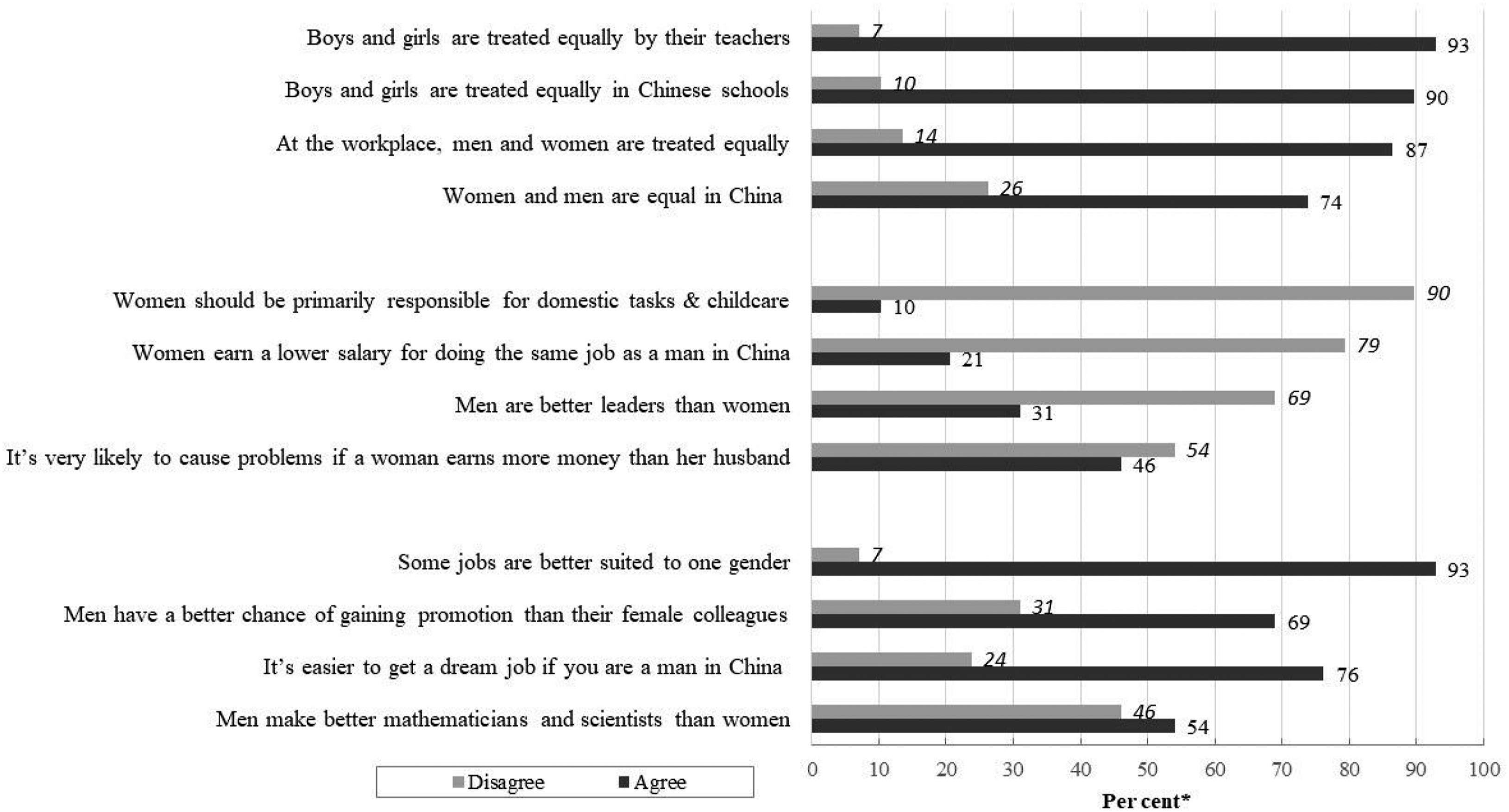
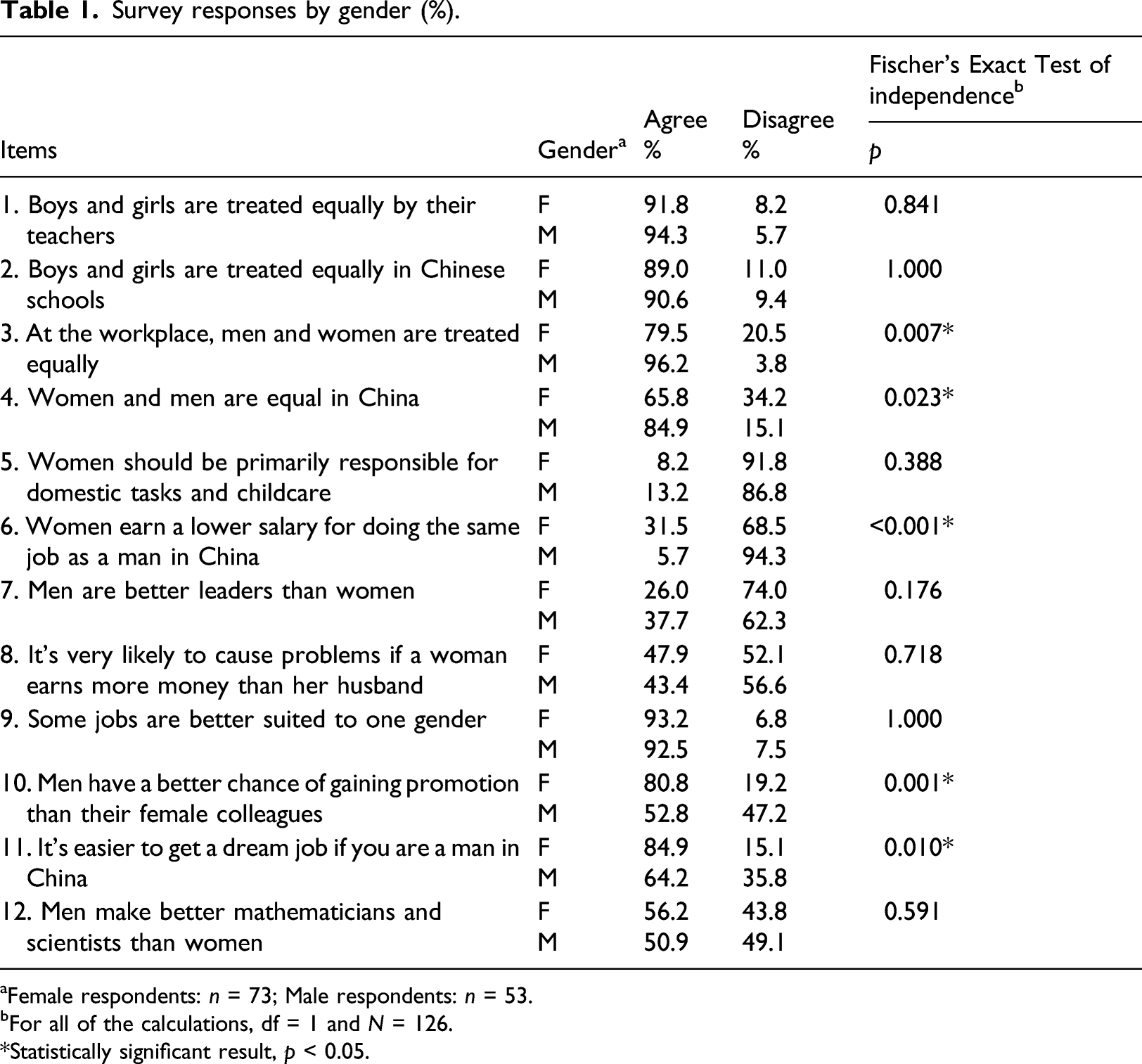
Survey responses by gender (%).
aFemale respondents: n = 73; Male respondents: n = 53.
bFor all of the calculations, df = 1 and N = 126.
*Statistically significant result, p < 0.05.
Statistically significant differences between the male and female respondents were found for each of the items shown in bold in Table 1. Notably, while the male and female respondents were similar in their agreement that boys and girls are treated equally, the female respondents were significantly more likely to disagree that men and women are treated equally. Furthermore, statistically significant differences between the male and female responses were found for three survey items which focused on the school leaders’ work experience. More women leader participants agreed that in China there is a salary gap between the genders for the same role, and that dream jobs and promotions are more likely to be gained by men.
An open-ended comment section at the end of our survey stayed the same in the pilot, second test and final survey data instrument. The comments offered up evocative details of the participants’ thinking about their school, their leadership and gender equality in China. Here are just a few translated examples of different responses about gender equality from participants’ data collected in both 2017 and 2018: Physiologically men and women are inherently different. For example, at railway stations we can feel that there are long queues for women’s toilets but men’s toilets tend to be relatively empty. This shows that the equality standard we gave from the beginning was wrong; we did not specify the criteria in conjunction with women’s physical characteristics. (Male participant) We should profoundly recognise the fact that the implementation of two-child policy will increase families’ burden, and women are the most direct bearers and the most affected groups of the burden. (Female participant) ‘Little man’ is a book which was published by Shanghai Education Publishing House this year (in December 2017). It is the first sex (education) material for boys in China. There is currently no sex teaching material for girls. (Female participant)
In the final survey results in 2019, nearly all of the participants left a few words, a sentence and some even paragraphs of comments at the end of their WeChat© submissions. There are far too many to present in this article, but here are a few translated examples of the idiosyncratic comments written by the participants about gender equality in China broadly and in the schools they lead: At present, in terms of gender discrimination in education, developed areas are superior to underdeveloped areas, coastal cities are superior to inland cities, and Han nationality is superior to ethnic minorities. (Female participant) Since humans are born, men and women have different roles in society, in families and in interpersonal relationships. Actually, gender gives the world different colours and makes the world full of diversity. So gender inequality is the common sense or the feature of human society. Without it, the world will lose life and colour. (Female participant) Boys and girls are also taught differently. We teach girls to be gentle, to be considerate, to take care of their families, to have children. And we always teach our boys to be brave, to protect their families, to earn money, to take responsibility. (Female participant) According to the general view in China, men are better leaders than women. Of course, there are some very good women who are just as good at leadership as men. (Male participant) Why hasn’t gender equality been achieved? Schools seem to prefer male headmasters since most of the leaders are men. Men can get jobs easier than women. In my opinion because men and women are born different. They are biologically different. Men and women think differently. Men are taller and stronger than women. Women have to give birth to babies, but men don't get pregnant. Men are more generous while women are more careful. In fact, every living thing has this characteristic. The cock looks prettier than the hen. The cock can crow and the hen is born to lay and hatch. It is a law of nature. (Male participant) There is gender discrimination, or male preferencing, in the selection and training of school leaders. The recruitment and screening of educational leaders is based on qualifications and physiological conditions that help men; encourages the hiring of men first, and restricts the development of female managers. (Female participant)
Discussion
As a research team, we wanted to explore what school leaders in China role-model and think about gender equality. Our male and female Chinese research team members were both able to see some reflections of their own experiences in the findings and offered analysis and discussion points that helped explain Chinese cultural norms, whilst the Australians in our team were fascinated with examining another society’s beliefs and experiences of gender equality from an outsider perspective. Together, we now present our shared analysis of what we think the data we collected can tell us about gender equality in Chinese education sites and why it matters.
Gender equality: school teachings and adult realities
The majority of school leader participants think boys and girls are treated equally by their teachers and in Chinese schools more broadly. Three-quarters of participants also perceive women and men are equal in China. This data suggests to us that school leaders in China believe educators are teaching the message of gender equality and that children are receiving that message effectively. This does not align to the research findings of Chen and Rao (2010), Swan (2017) nor Zheng (2020) whose research found few male teachers are employed in the early year levels of the education profession, boys and girls being treated differently in classrooms and universities encourage males and females into gendered career paths.
When we asked our participants to think about life after students grow up and join the Chinese workforce, the reality of gendered employment emerged. More than 90% of participants believe some jobs are better suited to one gender and more than half think that men make better mathematicians and scientists than women. These attitudes do seem to reflect the anecdotal evidence of a ‘different but equal’ mentality in gender relationships in contemporary Chinese society (Golley, 2018; Liu and Morgan, 2020; Rauhala, 2018; Wen, 2016), but they are not in-line with China’s official view and laws that prohibit gender discrimination 3 . Remembering that we have defined gender equality as meaning when males/men and females/women are treated equally in a society, these findings are inconsistent with that definition. We conclude that it is possible these unfavourable opinions of gendered career roles held by the large majority of our participants are being role-modelled to the children they lead and teach, even with the best intentions that they do not.
Blindness to their privilege
Our findings also suggest that many male participants have little idea women can receive lower salaries for the same role and that their female colleagues believe it is easier to get a dream job or a promotion as a man. These findings align with the All-China Women’s Federation research from 2014, as reported by Human Rights Watch (2018), in which a majority of women graduates said they faced gender discrimination in employment. The findings also concur with the male privilege evidenced in the research by both To (2017) and Yang and McNair (2019). Privilege is difficult to discern when a person is accustomed to it, and males in China have experienced privilege for thousands of years. It is possible that male school leader participants in our study are somewhat blinded to their privilege and have assumed that they have been rewarded for all of their successes in life solely due to meritocratic means.
Just as our male participants could not see their privilege, our female participants revealed that they too may be blinded by the privileges offered them in the power of the status quo. We started this paper wanting to contribute to the academic conversation about why few Chinese women are embracing feminist ideologies (Zheng, 2020). Our elite, powerful women participants believe they are succeeding in gaining the goal of gender equality by conforming to the expectations of Chinese communist society. This may help to explain why a radical agenda of feminism seems not to be attracting their attention. This may have some comparability and resonance with the work of Swedish researcher Tina Mattsson who describes educated women as ‘Good Girls’ who have found success in their careers by ascribing to a conservative femininity that is expected of them in their profession (Mattsson, 2015: 695).
Before completing this discussion, we note our participants in this research were all education leaders in China, and the majority were women (58.3%). This is an interesting result in itself, because according to recent studies (Huang and Wiseman, 2011; Yu and Wang, 2018; Zhao and Jones, 2017), far fewer women hold leadership positions than men in all levels of China’s education sector. Our data indicated that these powerful and privileged ‘Good Girls’ do want change, for example, our participants have strong opinions that Chinese mothers should no longer be primarily responsible for domestic tasks and childcare. In their lived experience, this sharing, or perhaps outsourcing, of caring roles has allowed our participants to believe and role-model that men are not better leaders than women, as both genders can run schools, day care centres, vocational training centres and universities.
School leadership and the future of gender equality in China
Our study has been exploratory and relatively small scale, and further research needs to be conducted to confirm or refute our findings. However, even at this stage, the research raises implications for current Chinese school leaders given the differing perspectives expressed by our male and female school leader participants. Also, further research about gender equality in Chinese education could benefit from studies conducted with Chinese students themselves. A recent Australian study by Fitzsimmons et al. (2018) of the confidence and career intentions of adolescent girls and boys raised the issue of ‘gender congeniality’ – that is, society’s expectations about the roles men and women should occupy. A Chinese study similar in design to that of Fitzsimmons et al. (2018) may provide critical insights into whether gender congeniality is a factor affecting China’s aspirations for gender equality in education and the broader society.
Conclusion
Our research asked Chinese school leaders what they think about gender equality, and we discovered intriguing discordances in the data between the participants’ ideals and experiences of gender equality in China. Our research attempted to go beyond what official policy and polite conversations suggest, and we felt there was strong merit in better understanding what is being role-modelled to girls and boys in China from very influential education leaders. We have shown that the female Chinese school leader participants have a more pessimistic view than their male counterparts regarding the current state of gender equality in Chinese society. And yet, so many of our participants conveyed a very hopeful vision of gender relations in Chinese schools and assumed they were helping to reach gender parity for all of their students. As we have shown, their hopes and opinions contradict a lot of previous, less hopeful research and have helped to further our theorising that gender equality is defined differently and uniquely role-modelled in China so that gender equality encompasses difference and separation within its meaning. We foresee that our Chinese school leader participants, of both genders, will continue to shape the values of the next generation of Chinese students to be supportive of ‘gender equality with Chinese characteristics’, and this will become more important for the world to understand as Chinese culture norms and soft power continue to grow in influence around the globe in the 2020s.
Footnotes
Author Contributions
All authors contributed to the study conception and design. Material preparation, data collection and analysis were performed by Christine Cunningham, Susan Hill and Wei Zhang. The first draft of the manuscript was written by Christine Cunningham, and all authors commented on previous versions of the manuscript. All authors read and approved the final manuscript.
Declaration of conflicting interests
The author(s) declared no potential conflicts of interest with respect to the research, authorship, and/or publication of this article.
Funding
The author(s) received no financial support for the research, authorship, and/or publication of this article.
Compliance with Ethical Standards
All authors certify that they have no affiliations with or involvement in any organisation or entity with any financial interest or non-financial interest in the subject matter or materials discussed in this manuscript.
Research involving human participants and/or animals
Ethics approval: The questionnaire and methodology for this study were approved by the Human Research Ethics committee of Edith Cowan University (Ethics approval number: 15806)
Informed consent
Informed consent was obtained from all individual participants included in the study. The authors affirm that human research participants provided informed consent for publication of research findings from Ethics approved project #15806.
