




Abstract
Long regarded as the “great equalizer” across all social identity categories, including race/ethnicity, class, and gender, the education system plays a pronounced role in the curation and dissemination of knowledge on social stratification. In contemporary times, this role is perhaps no more evident than in academia’s gatekeeping role in discussions of race and racism. Contemporary racial injustice in the U.S. provides raw material for consideration of how the American education system in particular has articulated the forces that give rise to racial injustice and, in turn, how academia shapes--and also places itself inside and outside of--these conversations. Examining the pedagogy of “education on race,” this piece explores whether academia can be expected to meaningfully set a course for addressing systemic and structural racism, or indeed directly address it. Considering Foucault, Freire, and Bonilla-Silva’s interlocking arguments about the persuasive nature of power, we contextualize the emergence of corrosive academic "love languages" on race to explore how educational institutes produce and reproduce systems of oppression through gestures of racial solidarity that stop purposefully short of substantive action. We close with a proposal for using indigenous, empathy-focused interventions to generate impactful dialogue and action towards anti-racism in educational spaces and beyond.
Racism as a hydra
Racism is “the Hydra that threatens the quality of American life…,” acting as a “venom… injected into all facets of the American experience.” (Moody, 1977). The notion of a Hydra derives from the Greek mythology of a nine-headed, serpent-like beast that represented an existential challenge to townsfolk due to its capacity to regrow heads after severance. As part of his review of Sedlacek and Brooks’ 1976 book, Racism in American Education: A Model for Change, Moody asks, “How does one deal with this monster that strikes in so many different ways?” Taken beyond its ominous metaphor, the query invites us to ruminate not just on which aspects of racism to tackle, but to consider (1) which aspect of racism is the most potent and perhaps most central to the continuation of the Hydra’s existence, and hence, (2) which aspect of racism we must tackle first to slow and then eliminate the Hydra’s regenerative capabilities. This piece discusses the traditional position of educational institutions in discussions of race and racism—in short, education on race--arguing for a purposeful reconstruction of academia’s role in the contemporary Civil Rights movement on racial equity. We emphasize solutions that can move institutes of higher education, in particular, beyond performative racial pedagogy and decorative allyship to evidence-based, empathy-focused policies and programming that are generative in their focus on racial equity.
The wanton murder of George Floyd by Minnesota police officer Derek Chauvin on 25 May 2020 lit and spread a racial justice movement throughout America and beyond the likes of which had not been seen since the height of the Civil Rights movement which peaked in the late 1960s. Incidentally, the Civil Rights movement had reached something of a nadir around the time of Sedlacek and Brooks’ book, as Nixon’s War on Drugs had achieved full bloom and begun to rapidly strip the fabric of inner-city communities populated by Black and Latino people and their hard-fought gains in the prior decade (Hari, 2015; Provine, 2008). As Nixon waged this calamitous, racialized war, he also led both a “principled assault on de jure school desegregation… [and] a politically expedient surrender to de facto school segregation” (McAndrews, 1998: 187), vociferously opposing mandatory busing. Simultaneously, on separate fronts, Nixon and his allies were contributing greatly to America’s current racially inequitable educational landscape through strategic disinvestment in other communal resources--housing, infrastructure, commercial development, etc.—in predominantly racial/ethnic minority communities throughout America (Davies, 2007; Quadagno, 1994).
The successful conviction of Chauvin, roughly a year after he murdered Floyd, has heartened some, this standing in stark contrast to the high-profile acquittals of law enforcement officers involved in the deaths of Eric Garner, Michael Brown, Philando Castille, and other Black men before them. Underlying the relief and feeling of auspice following Chauvin’s conviction is the perhaps wistful belief that a seismic shift in how American courts, and by extension, law enforcement, public policy chambers, and perhaps the American public writ large, is afoot. The question of what comes next animates these considerations (Canady, 2021; Clauson, 2021), as contemplation now goes into how to leverage this visceral momentum into the stimulation and fortification of the nation’s civil rights mechanisms against the frequently unchecked power of its carceral and judicial systems. But from the standpoint of prevention, the heart of the Hydra, much more salient questions circulate on the “fundamental causes” of racial inequity (Merolla and Jackson, 2019; Phelan and Link, 2015)—in short, the ideologies, attitudes, and beliefs, materializing in behavior and policy, that prompt the need for aggressive anti-racism efforts.
Recognizing the socially constructed nature of race, and hence the learned nature of racism, the “monster” Moody alluded to could be said to germinate chiefly from one’s formative education. The education system broadly consists of formal educators, such as instructors in K-12 schools and institutes of higher education, as well as informal educators, such as family members, peers, and other social network constituents. With the contemporary spread and growing impact of celebrity activism and the Internet, the spectrum of informal educators has widened, now inclusive of entertainment figures, mainstream TV media personalities, social media “influencers,” etc. This evolution of knowledge production and transfer has blurred the line between formal and informal education, and accordingly, education has become increasingly atomized and niche, and thus is in epistemological flux.
The education system, a system insofar as it is comprised of reinforcing inputs and outputs of both material and symbolic value, is an incipient force in the epistemology of race and all associated valences (Sonn, 2008). As a system, it is subject to disruptions and manipulations by its constituents. Knowledge is, most centrally, a social object, and thus movements towards objective truths on race are inherently fraught, as the production and control of knowledge is a primary means of identity preservation and power maintenance (Popkewitz & Brennan, 1998; Schieman and Plickert, 2008).
In education systems, ideas and beliefs about race and racial identity are invoked, filtered, and substantiated, and dispositions and behaviors toward the concept of race (i.e. understanding its meaning(s)) and toward the manifestation of race (i.e. interactions with racial groups) are subsequently shaped in correspondence with these ideas and beliefs (Bolgatz, 2005; Feagin and Van Ausdale, 2001; Howard, 2004; Winkler, 2009).
Illustrating a reciprocating and bi-directional relationship vis-à-vis the influence of systems and networks on knowledge production, formal educators facilitate the education of informal educators (Cole and Verwayne, 2018; DeCuir and Dixson, 2004). However, formal educators first gain their knowledge through informal education—in short, one is not naturally a formal educator but acquires knowledge via informal networks before their formal education begins, and during it. In equal measure, knowledge acquisition is a continual, lifelong process; formal educators adopt informal education, which then becomes formal knowledge. And so is the case for knowledge about race, how its context is contoured and transmitted. In short, “context is protean and it flows into and out of the school, being intimately connected to emic and etic racial dynamics in community and society” (Brooks and Watson, 2019: 636). Hence, it can be said that individuals’ most instructive notions on race are produced through a series of circular and reproducing social interactions (Howard, 2004). Likewise, knowledge becomes legitimized through these reciprocal, iterative processes that are fundamentally social in nature, oscillating between formal and informal systems. Freirian logic accentuates this rubric, persistently focusing on the utility of dialogue and discussion through a practice of active reflection for learners to gain knowledge of their social reality. These circular social interactions, reinforced by one’s environment, are situation-dependent, and can serve as opportunities for critical reflection of formal and informal educational systems. Freire notes: People, as beings ‘in a situation,’ find themselves rooted in temporal-spatial conditions which mark them and which they also mark. They will tend to reflect on their own ‘situationality’ to the extent that they are challenged by it to act upon it. Human beings are because they are in a situation. And they will be more the more they not only critically reflect upon their existence but critically act upon it. (Freire, 2017: 109).
As such, it is crucial to engage—and most specifically in these engagements, to challenge—the learner in personal critical reflection of their situation and racial dynamics surrounding (and within) them. Knowledge is constructed through the very process of learning; engaging a learner in the process of cultivating their knowledge has direct implications for disassembling engrained racialized systems of knowledge, both formal and informal.
The banality of education on race
The ‘happening-ness’ of practice/praxis, its ‘sensuousness’, its human-ness and its sociality, is at once both obvious and difficult to grasp. It is difficult to grasp because when we make practice/praxis an object of our thought we risk shifting from the ‘rawness’ of conscious human social activity to discourse about it… The point is, one might say, to act in the world, to practise, and to do – and not just to engage in discourse about it. If this is so, then we have reached this small and not entirely original insight: knowledge is not action; theory is not practice; and words are not the world. (Kemmis, 2010: 11)
Can education on race have defined answers to questions on race and racism, like algebraic questions on the relationships between numbers or questions in physics on the properties of matter, or will its answers continue to change in perpetuity in response to fluid collective action? The subtext for education on any subject is that sufficient, efficacious treatment of the topic will generate knowledge on the subject. However, knowledge is not action. Defining what constitutes actionable education on race represents a complex calculus, inducing a constant epistemological tug-and-pull inside and outside of academia. Indeed, race and its social and biological gravitas are contested within the sciences and humanities (Glasgow et al., 2019; Goodman et al., 2019; Tawa, 2016), and no small portion of the general population conceives racism as highly subjective, systemic racism as minimal or non-existent, and society as largely or fully post-racial and colorblind (Bonilla-Silva, 2006; Lentin, 2018; Love and Tosolt, 2010). In a recent poll from NPR/Ipsos, only 50% of Whites, compared to 83% of Blacks, agreed that institutional racism exists in America, and 83% of Blacks agreed that White people have an advantage compared to people of color, compared to 49% of Whites (White and Black Americans far apart on racial issues, 2020).
Depressed in part by critiques on how anti-racism pedagogy and policy suppresses academic freedom and free speech (Arneback and Jämte, 2021; Dreher et al. 2021), the zeitgeist of education on race appears amorphous and vulnerable. To the matter of the efficacy of education on race, unsurprisingly, comparatively nominal ground has been achieved on both fronts—in terms of codifying what race is and whether racism exists and also vis-à-vis the overlay of achieving racial equity—in the last half-century. Viewed in this context, in its current state, education on race would appear to be ineffective in both theory and application, formless, obtuse, and saddled by academic inertia which has likewise arrested meaningful public discourse and subsequent purposeful action.
As Critical Race Theory (CRT), the subject of considerable approbation among those challenging the precepts of systemic and structural racism (Smith, 2020; Walton, 2020), posits, the curation and dissemination of knowledge about race, and racism, rests in the domain of “master culture” powerbrokers who stand to benefit by the production of ideas that diminish, devalue, and displace racial and ethnic minorities (Juárez and Hayes, 2010; Steinberg and Kincheloe, 2010). This tableau results from the accumulation and leveraging of power and subsequent maintenance of racialized hierarchies through the amassing of symbolic resources like trust, respect, and legitimacy. In these dyads, powerbrokers’ ideas are consumed as formal knowledge, replicated in the behaviors of institutions’ actors, and then forged in policy. Accordingly, at the axis of racist beliefs and racist actions is the education system, both its formal and informal cognates (Brooks and Watson, 2019; Darling-Hammond, 2017).
Historically, racism perpetrated by the education system has manifested in explicit acts of oppression of racial/ethnic minorities, as seen in the dispossession of Native land for the development of college campuses, the usage of Black slave labor to build these campuses, assimilation of Natives into boarding schools, school segregation during Jim Crow and, as it were, the new Jim Crow (Child, 2018; Fuller et al., 2019; Highsmith and Erickson, 2015; Mustaffa, 2017). In modern times, racism in the education system frequently manifests more indirectly. For example, we see racism on display in educators’ implicit biases and deficits-oriented mentalities about racial/ethnic minority students’ capacity and potential (Solórzano, 1998; Sue, 2010). These biases are further accelerated by a broader lack of reflexivity and sensitivity among educators and administrators, leading to under-structured, low-quality instruction and disproportionate behavioral punishments, factors further fueled by a broader lack of investment in institutions that predominantly serve Black and Latino students (Pica-Smith and Veloria, 2012; Valencia, 2010). Collectively, these forces contribute to inequities in academic achievement and galvanize the “school-to-prison” pipeline through policies that unevenly suspend and expel and hence halt the learning of Black and Latino students (McCarter et al., 2019; Nance, 2015; Skiba et al., 2014). As part of these double movements, “...the productive increase of power can be assured only if on the one hand, it can be exercised continuously in the very foundations of society, in the subtlest possible way, and if on the other hand, it functions outside these sudden, violent, discontinuous forms that are bound up with the exercise of sovereignty.” (Foucault, 2007: 208)
To this end, a frequently proposal for resolving the vast inequities that exist in the realm of social and economic opportunity in America is to, first and foremost, address inequities in education, a logic that places education as the “great equalizer” (Bernardi and Ballarino, 2016; Growe and Montgomery, 2003). This hypothesis, which treats education as a panacea for the wider orbit of quality of life imbalances observed across race/ethnicity, has been increasingly cast into doubt, at least partially, as studies find that intergenerational mobility is impacted by a multitude of factors apart from education (Fiel, 2020; Jerrim and Macmillan, 2015; Torche, 2011). Moreover, research suggests that education exerts a substantially greater “protective” effect for Whites as compared to Blacks (Hendi, 2017; Olshansky et al., 2012). Therefore, education level only vaguely corresponds to upward mobility and, even so, largely in a micro-level context rather than within a racial category, or at a macro or meso-level.
It is only in the last two decades that a deeper view on the connectivity between education and race has been purposefully raised in the literature. This canon examines social processes involved in the discussion of race and racism, rather than focusing solely or chiefly on the effects and consequences of race and racism (Bolgatz, 2005; Bonilla-Silva, 2006; Bonilla-Silva and Baiocchi, 2001; Sonn, 2008). This research illustrates that, while formal education may be a positive “downstream” force in generating racial equity, education on race may be more valuable as an “upstream” solution—that is, a solution that prevents racist attitudes, dispositions, and policies, etc. before they emerge, ossify, and create adverse racialized impacts. Along these lines, education on race, the process of examining and elucidating race as a social product, represents an “upstream” solution to the extent that it targets beliefs and ideas contributing to the cascade of forces directly justifying, or simply passively enabling, racism. Indeed, broadly efficacious education on race—across both dominant and non-dominant racial categories—may indirectly improve academic attainment in historically disenfranchised racial/ethnic minority populations by improving one’s sense of belonging and eliminating chronic racialized stressors such as microaggressions (Johnson-Ahorlu, 2012; Merolla and Jackson, 2019; Reynolds et al., 2010).
In America, academia is firmly entrenched as an adjudicator for introducing, framing, and dissecting the construct of race (Bolgatz, 2005; DiAngelo, 2012; Sleeter, 1993). And yet, paradoxically, academia has been both a seismic source and instigator for racist paradigms and ensured their legitimacy through various forms of social reproduction, chiefly by the focus on race as a biological construct and attendant dysgenics theories signaling the heritability of undesirable, supposedly-race-linked traits like low IQ and criminality (Crichlow, 2013; Gillborn, 2008; Herrnstein and Murray, 2010; Rooks, 2020; Sedlacek and Brooks, 1976; Taylor et al., 2009). Accordingly, as producers of various forms of racial inequity, academic institutions, particularly institutes of higher education, are well-positioned to use their positionality and resources—in short, their power—to generate and promote changes both in discursive action and applied policy toward racial equity. In accord with this, the sweeping racial justice protests that took place in 2020 have presented a prime opportunity for collective action within the education sphere to both place and reframe discussions of race and racism. Such activities can focus specifically on pedagogy generating substantive, scalable interventions geared at sustaining racial equity, a proposal we contextualize and provide a roadmap for in the remaining sections.
Academic “love languages” during racial crises
If power were never anything but repressive, if it never did anything but to say no, do you really think one would be brought to obey it? What makes power hold good, what makes it accepted, is simply the fact that it doesn’t only weigh on us as a force that says no, but that it traverses and produces things, it induces pleasure, forms knowledge, produces discourse. It needs to be considered as a productive network that runs through the whole social body, much more than as a negative instance whose function is repression. (Foucault, 1980: 119)
In the flurry of racial crises and racialized disinformation about race and racism, academic institutions’ persuasive power-plays are fundamentally disruptive in the manner in which they place, package, and deliver their “official response” to racial turmoil. To their recipients, these official responses are delivered as a kind of academic “love language,” a term popularized by Gary Chapman (Chapman, 2009). According to Chapman, there are five primary love languages that connote and communicate one’s love for another, including words of affirmation, quality time, receiving gifts, acts of service, and physical touch.
A Freirian form of communication that attempts to create a symbiosis between administrators, faculty, staff, and students, academic love languages likewise seek to positively convey institutional temperament and sentiment. In the case of racial injustices, the induction of academic love languages is meant to convey institutions’ understanding of the unease being felt by its constituents (Adams et al., 2006; Lesick and Zell, 2021; Unzueta and Lowery, 2008). Indeed, the mere acknowledgment by powerbrokers that racial injustice has occurred is at least moderately is affirming, telegraphing awareness and concern. As other examples, the creation of committees, working groups, and panels to discuss race and racism reflect a commitment to quality time (for reflection) and also functions as acts of service to constituents. Further, counseling and support groups are developed and packaged as gifts to communicate institutions’ desire to create space for constituents to grieve, vent, etc. Each academic love language is fundamentally enshrined as a tactile physical and psychosomatic touch by the operational core of the institution. To wit, it is a highly palpable, reverberating form of direct outreach reserved for and usually performed by the most powerful and prominent institutional leaders (e.g. the President, Provost, Department Chair, etc.) as a way of connoting how high the issue has arisen in the typically unobserved conscience of the institutional structure.
Through the Panoptic prism, it can be argued that academic love languages are impactful precisely because they effectively project watchfulness, power, and control amid feelings of there being an external vacuum in social and political order during racial crises. Yet, the education system’s real “strength is that it never intervenes, it is exercised spontaneously during racial crises, even as institutions propagate "mini racial crises" on a recurring basis as part of administrative operationalization and without noise, it constitutes a mechanism whose effects follow from one another” (Foucault, 2007: 206)
In his seminal text, Racism without Racists, Bonilla-Silva (2006) discusses the powerful ways in which ideas about race become racialized and refracted among White powerbrokers and elites, such as academics, to project racial accord and harmony without explicitly acknowledging racism. As largely performative gestures, these strategies gather and maintain their power by the adoption of dominant approaches to the curation and dissemination of information related to race and gatekeeping around popular race theories (Bonilla-Silva, 2006). Acts of racial violence become critical flashpoints for these gestures, occurring with little interference, as academics weave between two interstitial ideological frames in their communications. One frame is focused on verbal affirmation of the racialized incident and the associated departure from the aspiration of racial harmony. The second frame is focused on highlighting a generalized need to eradicate these incidents. Both frames artfully deflect attention from powerbrokers and their institutions and their lax or absent anti-racist pedagogy and policies (e.g. a commitment to decolonizing curriculum, diversifying staffing and student enrollment, etc.). These frames rely on the ongoing salience of deficits-oriented racial tropes related to oppression and marginality, etc. and “cosmetic diversity” (Ford and Patterson, 2019), obscuring the power being exercised in institutional actions and inactions. The central component of any dominant racial ideology is its frames or set paths for interpreting information. These set paths operate as cul-de-sacs because after people filter issues through them, they explain racial phenomena following a predictable route. Although by definition dominant frames must misrepresent the world (hide the fact of dominance), this does not mean that they are totally without foundation. (Bonilla-Silva, 2006: 26)
Pursuing an inquiry into Bonilla-Silva’s paradigm of racial filtering among academics, Harper (2012) conducted an extensive review of higher education research exploring campus racial climate and racial differences in the domains of access, achievement, etc.. Findings from the review point to a general diffusion of prescripts related to racial differentiation and racism (Harper, 2012). Harper observes middling, highly speculative language (“perhaps,” “may,” “possibly”) in academics' discussions of the role or function of race or racism on academic and socioeconomic outcomes, concluding that “Rarely were racism and racist institutional norms explicitly named among the range of plausible reasons for racial differences [in outcomes].” (Harper, 2012: 16). Such opaque explanations pave the way for affirmation of the existence of racial inequity, but for the causes of racial inequity to be anything but racism (or the education system) (Bonilla-Silva and Baiocchi, 2001; Harper, 2012). Still producing the ‘pleasure’ effect that Foucault describes (Foucault, 1980), affirmation of racial injustice, without reference to the genesis of it, absolves powerbrokers from responsibility, or suspends consideration of their involvement, helping to maintain symbiosis and keep academic power structures undisturbed.
Relatedly, investigations into the language employed by academic institutions in response to state violence against Black and Brown people infrequently reference state or structural violence, police oppression, or the like (Bridgeforth, 2021; Ford and Patterson, 2019; Hoffman and Mitchell, 2016; Kiang and Tsai, 2020; Squire et al., 2019). One recent review of 140 press releases and communications from academic institutions in response to police-related violence against Black people found that academic entities seek, chiefly, to distance themselves from the actions of law enforcement and courts, who they have directly and indirectly educated focusing secondarily and tertiarily on the need for anti-racism policies and specific modalities of redress (Bridgeforth, 2021). Furthermore, the call for these policies and modalities of redress, when evoked, faintly draw attention to the stark need for anti-racist reform within their institutions (Bridgeforth, 2021).
As such, statements in response to racialized state violence, adopting the language of Diversity, Equity, and Inclusion paradigms, frequently represent identity maintenance strategies for institutions and aim at communicating lush, sweeping motifs for action rather than outlining specific steps they will undertake. In this view, official responses to racial injustice serve dual functions as part of the “trickle-down racial empathy economy”(Ezell, 2021). The first function is allowing institutions to passively project commonality with the oppressed—acknowledging that racial injustice has happened, expressing distaste for the injustice, promoting a shared desire to create racial equity, etc. The second function is diversion—by virtue of acknowledgment, institutions draw attention away from their historic and present-day role in fomenting and bolstering these racially oppressive systems (Bonilla-Silva and Baiocchi, 2001). We draw upon Foucault again, to recall that power is not a thing, but a relationship amongst individuals, one that can be built-upon, expanded, and utilized to direct one’s behavior. Today’s poignant moments of racial injustice invite individual and collective reflection and action, and a reimagining of academia as the center of gravity in this space of racial truth and reconciliation. Empathy-invoking interventions relaying experiences with race and racism, and thereby, problematizing power structures in education are pivotal in creating personal and collective change.
Empathy on race: toward an endgame on education on race
In exploring the hydrae of racism through the vista of power and knowledge, we have pointed to the issue of our fraught education on race as central in the persistence of this social ill. In now examining and presenting potential solutions, we consider two opposing dimensions in tandem: what can be done to improve education on race, and what should not be done in relation to education on race. Before this discussion, we note that regarding the broader matter of racial equity, a critical dimension of creating systems of racial justice in academia, others have written thoughtfully about the value of actions such as cluster hires, targeted recruitment/retention of underrepresented racial/ethnic minority students, and implicit bias and anti-racism training, in improving racial representation and fostering environments conducive to teaching/learning for racial/ethnic minorities (Alderman et al., 2021; Arneback and Jämte, 2021; Sgoutas-Emch et al., 2016). While recognizing the need for solutions in these veins, we focus here instead on enhancing how race and racism are discussed and acted upon within academia.
Figure 1 outlines proposed mechanisms—and modalities to avoid—to improve education on race and anti-racist pedagogy and practice. With this in mind, the latent racial justice reckoning in the U.S. is forestalled by three seemingly straightforward, but shape-shifting questions: (1) What can be expected of people in terms of their capacity to develop objective knowledge of what constitutes racism via education on race?; (2) When, or after how much education on race, can objective knowledge on racism (and, in turn, anti-racist attitudes and behaviors) be expected?; and (3) How, or to what extent, will this objective knowledge translate to sustainable anti-racist attitudes and behavior, hence transforming systems? These questions take us to the ultimate endgame for education on race—that is, when education on race, or race as a social or scientific object of study, becomes “un-racialized” and de-politicized, and there is a cessation in boundary-making, discrimination, and oppression in relation to race (i.e. racialized education, policing, housing practices, healthcare delivery, etc.). We argue that this endgame will be achieved when there is a transformation in pedagogy towards bi-directional empathy-building on race and culturally humility and responsiveness (Khalifa et al., 2016; Ladson-Billings, 1995)—that is, empathy that understands and affirmatively responds to the experience of racism as well as the antecedents for racism from those who can (directly) account. Reflexively, we simultaneously contend that the endgame cannot be clarified or achieved by traditional academic love languages, messaging and gestures that simply account for and acknowledge racial inequities and the existence of racism. Key mechanisms for expanding education on race and anti-racist pedagogy and practice.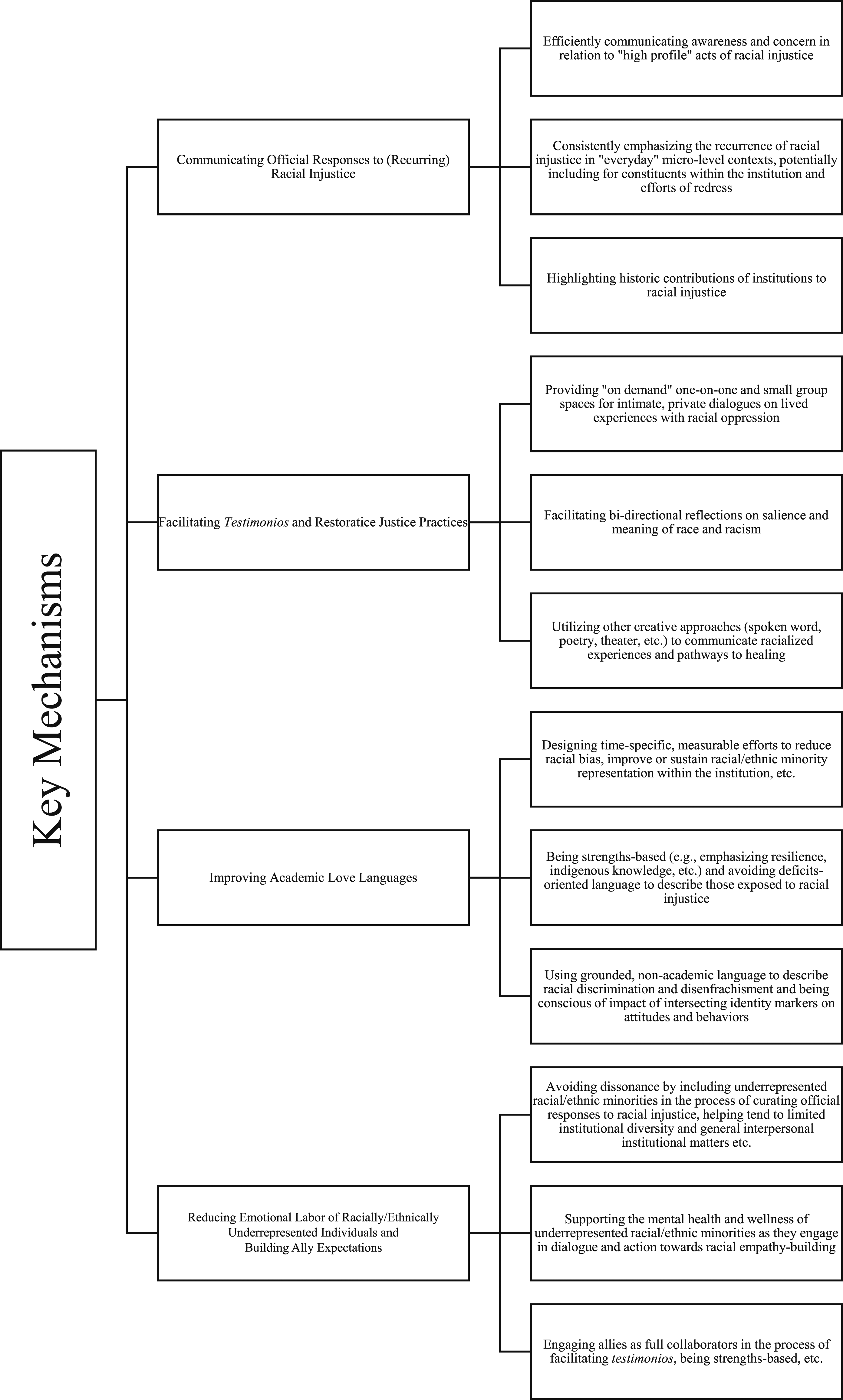
While definitions for “empathy” vary, most share the recognition of empathy as an affective emotion that is dependent upon interaction and the recognition that “the source of the emotion is not one’s own” (Cuff et al., 2014: 150). Along these lines, we devote the remainder of this piece to a discussion of a possible vehicle to cultivate racial empathy. Decades of seminal research on racial attitudes and beliefs stresses that empathy is not only a critical factor, but the preeminent factor, in addressing racism (Forgiarini et al., 2011; Gutsell and Inzlicht, 2012; Zembylas, 2012). Psychological studies, for example, have found that differential neural responses of empathy to other race’s physical pain—e.g., White individuals respond with more empathy to White individuals’ pain than to Black individuals’ pain, etc. (Avenanti et al., 2010; Contreras-Huerta et al., 2013; Han, 2018; Sessa et al., 2014). For a variety of reasons, particularly a lack of exposure to “neutralizing” information (i.e. information that counters predominating views on a subject that a learner has) and a lack of proximal or vicarious experiences, and limited racial heterogeneity in one’s social network, these kinds of differential responses, and hence racialized beliefs and racism, persist. The most salient and powerful way to generate racial empathy, and thus racial equity, is to expose individuals to information and personalized experiences that reflect or replicate the experience towards those whom the individual is not (fully) empathetic. Accordingly, the education system is the most logical, scalable forum to implement an intervention focused on education on race.
To generate empathy and counteract academic love languages on race, we suggest the routine usage of testimonies or testimonios in academic curriculum, panels, and conferences, etc.. Derived from the indigenous traditions of Latin American and Central American women, migrants, and survivors of war, domestic violence, etc., testimonios serve as an authentic form of bearing witness to the lived realities and history of marginalized peoples (Blackmer Reyes and Curry Rodríguez, 2012; Delgado Bernal et al., 2012; Logan, 1997). Testimonios involve a first-person oral or written account; they are intuitively deliberate and humanistic in showing the direct manifestation and impact of racial stratification at the individual level (Blackmer Reyes and Curry Rodríguez, 2012). Scaffolded around restorative justice--that is, an understanding of the need for both parties in the oppressed-oppressor binary to engage in reflection and dialogue—testimonios are a path toward direct mediation on race. By placing “everyday” people, rather than powerbrokers and institutions (and their official responses), at the center of the dialogue, testimonios can more rapidly cultivate legitimacy. To this end, to ensure their salience, we specifically recommend that individuals be mandated to participate in testimonios should they be called upon to do so. This will allow testimonios to intuitively shift discussions of racial oppression from a deficits-based orientation that is invoked and curated by powerbrokers when they deem it appropriate—namely, in the aftermath of high-profile racial injustices (where silence is simply untenable)—to a strengths-based positionality that focuses on the need to identify and strengthen individual assets and attributes (e.g. resiliency, indigenous knowledge, etc.) as part of a recurring process (Maton et al., 2004; Rubin et al., 2012).
The empathy-building testimonios paradigm we propose has three components and would ideally be delivered as part of an ongoing academic curriculum, via individual-to-individual mediation, and through community outreach and engagement. The first, most central, component of this pedagogy involves creating exposure to personalized, nuanced race-related information. A cornerstone of this component is the presentation and curation of personal narratives discussing the impacts of race on one’s lived experience. Firsthand and secondhand accounts of racism can serve as powerful jumping-off points for critical introspection among individuals who have not experienced racism or who have experienced it infrequently and thus have not meaningfully absorbed its impacts or cognitively “operationalized” it (McKown, 2004; Truong et al., 2016). In contrast, an exorbitant focus on “remote” cases of racism—that is, to a prior point, the high-profile cases that appear in the media but not necessarily in geographic proximity to the individual—may fail, in the long-term, to engender empathy, due to humans’ out-of-sight-out-of-mind disposition. Aligning with Du Bois’ ideas on the impact of the color line—that racism persists in large part due to a lack of “cross-pollinating” spatial encounters and cultural immersion between the races (Du Bois, 2015)—the extrapolation here is that testimonios are directly positioned to facilitate togetherness and breed familiarity and comfort because the racialization is happening right before participants.
The second component of this paradigm focuses on increasing learner receptivity to race-focused knowledge. Pedagogy that is guided by an implicit view that, for example, the “average” White individual understands racism--let alone, academic vernacular on race ranging from terms like systemic racism, structural racism, White privilege, and CRT--is likely to be unsuccessful in building sustainable, empathetic outcomes. As DiAngelo’s theorization emphasizes (DiAngelo, 2018), it is frequently the language and messaging of anti-racism, moreso than, strictly speaking, the ethos of anti-racism, that thwarts anti-racism efforts. Increasing learner receptivity requires cultural humility (Danso, 2018) —the process of meeting the learner where they are at in terms of their conceptual understanding of race and racism, reducing these racialized constructs to digestible framings (in consideration of the general public’s average level of education, temperament for scholastic terms, etc.). As part of this process, there is an associated need to engender socioemotional space and comfort for the consumption of new formal/informal educators and new/neutralizing information on race and racism. To this end, critical engagement and reflection create internal change, but shame and guilt may mediate and stall this relationship (Gausel and Brown, 2012; Lickel et al., 2014; Tangney et al., 2014). Thus, anti-racist pedagogy that solely seeks to castigate and reprimand, hence operating from a deficits-oriented position on one’s capacity to change, may be antithetical to efforts to stimulate empathy. In contrast, anti-racist pedagogy that are strengths-based is likely to alleviate concerns from non-minoritized groups around the discussion of race and racism, namely by allaying fears about saying the “wrong” thing. Accordingly, anti-racist pedagogy that is strengths-based is likely to circumvent some of the challenges that is currently mounting from segments of the White public and state governments around the U.S. against the explicit and implicit introduction of anti-racism/CRT into K-12 and collegiate pedagogy (Farag, 2021).
The third component of the testimonios paradigm emphasizes the benefits of a racially integrative society, namely the exchange of new cultural ideas and approaches to living and more tangible feelings of cohesion, belongingness, and solidarity. Heretofore, education administrators have failed to make a consistent, full-throated case for racial/ethnic diversity within the education system that has resonated beyond populations of underrepresented people. Views on institutional policies like Affirmative Action have never gained widespread support in the public, particularly among Whites, nor have they received strong, consistent implementation within even more liberal or progressive academic institutions, despite their legality (Hideg and Ferris, 2017; Hirschman and Berrey, 2017; Skrentny, 2018): Elite, private K-12 schools and universities, in particular, maintain high levels of racial homogeneity in student and faculty pools, despite administrative fiat allowing admissions selectivity, with Black and Latinx students and faculty bearing the brunt of the inaction (Lutz et al., 2020).
Continuing, academic institutions’ signaling of interest in racial harmony is undermined by directly observable gaps in their efforts to achieve and maintain a racially/ethnically diverse campus. As Foucault emphasized, an institution’s legitimacy is functionally lost when its expressed values are deemed incongruent with its actions (Foucault, 2007). However, legitimacy can be retained, to some degree, when the institution misrepresents or obscures its (in) actions. In view of this, academic institutions that do not themselves possess palpable racial/ethnic diversity will forfeit at least some legitimacy in guiding discussions of race and racism and in their efforts to advocate for reform outside of their institution. Thus, demonstrable campaigns to increase institutional racial/ethnic diversity will help move institutions beyond the role of “unreliable narrator” to that of earnest actor.
Through the collectivist goals of testimonios, academia can generate and reproduce racial empathy as speakers allow the audience to vicariously experience their everyday realities, and the audience reflects on and engages with these realities. Testimonios, in this regard, are pedagogical tools that lend themselves as forms of teaching and learning that bring the mind, body, spirit, and political urgency to the forefront (Delgado Bernal et al., 2012). Testimonios represent theory in the flesh, with the goal of achieving new, sustainable understandings, and behaviors, in the present case, in reflection of race and racialized experiences. When approached with reverence, testimonios can form a pedagogical practice that bridges critical consciousness and action to connect with others through compassion. These intimate narratives—a process that intuitively exposes the audience to narratives and a reckoning with injustices and inequities—speak to the process of dehumanization, and reappropriate traumatic experiences in hopes of empowerment and eliciting empathetic connection.
Studies have empirically analyzed the use of testimonios within the classroom setting. Cruz (2012) explores the use of testimonio in urban classrooms in Los Angeles and uses it as a tool to re-center and revitalize curriculums that are agnostic to certain racialized experiences, and in her case, the realities that include homelessness, poverty, and the marginalization of queer youth. Similarly, Cantú (2012) uses testimonio theory to analyze the published testimonios of Chicanas in science, technology, engineering, and math (STEM) fields. Cantú demonstrates how the testimonios of Chicanas in STEM have the potential to motivate and inspire other minority students who are also struggling in these fields and how these testimonios can highlight systemic inequities that can later be translated into policy recommendations. Here, building on these findings, we propose recurrent dialogue between administration, faculty, and students, to discuss issues of race and racism, where each side presents its views and experiences, while focusing on specific goals and timelines for redress. We also recommend that these discussions take place in one-on-one or small group settings and, where possible, maintain a balanced degree of racial diversity in participants. Using approaches similar to restorative justice practices (Fronius et al., 2016; McCold, 2006), forging an intimate, diversified space for understanding and listening can evoke empathy between racialized and non-racialized peoples, reducing the need to “perform” to specific in-group expectations. Importantly, these spaces must be treated as private and sacred, to ensure involved parties feel comfortable in relaying their perspectives and histories and are not concerned about being canceled and related bugaboos of the anti-CRT contingent (Bouvier and Machin, 2021). Along these lines, however, guidelines can be established ahead of the execution of testimonios to ensure that specific triggers are accounted for and maneuvered around and that subsequent emotional support is available.
To an earlier point about language and messaging, for academia to have a broadly accessible reckoning with race that is inclusive of anti-racists and non-anti-racists, it must also allow for nontraditional modes of education to take root and advance understandings of race and racism. A continued reliance solely on the classroom, panels, forums, and the like as spaces for dialogue on race will continue to silo discussions and preclude cross-cultural exposures within academia and between academia and the general population. To this end, going beyond oral histories, testimonios can also focus on spoken word, poetry, as well as acting, art therapy, and other forms of creative communication (Kobin and Tyson, 2006; McGann, 2006; Sajnani, 2012; Wasmuth et al., 2020). In this way, nontraditional education can advance empathy-focused education by utilizing materials and media that are grounded in the indigenous traditions of racial/ethnic minorities and that may thus allow for richer, more nuanced engagements.
Continuing, there are some important considerations to how to best fine-tune this empathy-focused model. First, in view of the matter of intersectionality, it is not always wholly possible to discern which aspects, or aspects, of person's social identity that unfavorable attitudes or behaviors may derive from. For example, factors such as gender and class (or perception of one’s class by visual cues such as style of clothing, etc.) often are, as or, more salient in shaping attitudes and behaviors towards an individual. Thus, empathy pedagogy must be responsive to multiple social identity markers, and their additive or reductive effects, maintaining cognizance of how individual markers they act upon may accelerate or serve as a proxy for other social identity markers. Second, to be accepted as legitimate knowledge, pedagogy in this space that is restorative in nature must consider multiple aspects of racial reflections, including those that are in fact racist or racially toxic. Moreover, there is a need to avoid supercilious academic language in favor of simple explanations on what constitutes racial discrimination and disenfranchisement and avoid orientations that may be construed as adversarial “virtue signaling” in favor of postures that highlight one’s capacity for individual growth into anti-racism.
In brief, the emphasis of any intervention focused on education on race must be squarely on the impacts of race and racism, the collectivist benefits of racial understanding and racial integration, message clarity, and be reflective and reflexive about how academia is situated as a stimulant to much of the racial injustice embedded in our systems. To avoid dissonance and deepening relational fissures, institutions must include racial/ethnic minorities in all levels of discussion and execution of institutional priorities as it relates to messaging around racial violence, policies aimed at diversity, equity, and inclusion, and interpersonal institutional matters more generally. Moreover, institutions must be cognizant of the additional emotional labor these forms of empathy-inducing paradigms impose upon their racial/ethnic minority constituents. Racialized people often experience a disproportionate amount of emotional labor, largely as a result of navigating racial microaggressions, the erasure and denial of the relevance of these experiences, and the emotive burden of educating, often inefficaciously, non-minoritized individuals about these issues and their experiences. (Evans and Moore, 2015). As such, this anti-racist work necessitates (1) that underrepresented racial/ethnic minorities be provided mental health resources and supports as they navigate and implement these interventions and (2) that non-racialized allies substantively aid in the process of engaging fellow constituents and the broader public about institutional and individualized racism, guided and grounded by the decisions and experiences of those marginalized by these systems.
Conclusion
In closing, power and knowledge are inextricably fused, with deep historic antecedents that have helped embed racial/ethnic inequities throughout every facet of life in America. America’s education system, as the primordial soup for knowledge and socialization, represents the nexus from which the most auspicious, evidence-based solutions for racial justice can be crafted. The striking, broad demographic representation reflected in the 2020 racial justice protests provides additional evidence that empathy is situational and possesses an elastic quality—and thus that views on race are not fixed and can be modified in alignment with principles of anti-racism. Accordingly, empathy serves as a potentially prime benchmark for the measurement of the efficacy of interventions focused on addressing and improving race relations. Along these lines, pedagogy and policy that is focused on generating action-oriented empathy is well-positioned to move beyond academic love languages toward the cultivation of substantive patterns of racial equity, beginning first in the formal education system before becoming ensconced in informal educations systems and across our vast, but modifiable social ecologies.
Footnotes
Declaration of conflicting interests
The author(s) declared no potential conflicts of interest with respect to the research, authorship, and/or publication of this article.
Funding
The author(s) received no financial support for the research, authorship, and/or publication of this article.
