




Abstract
Introduction
This special issue of Power and Education analyses the ways neoliberal policy agendas inflect and infect primary school communities. In recognising that ‘schools are complex and sometimes incoherent social assemblages’ (Ball et al., 2012: 2), this widened perspective – beyond a customary focus on just pupils and teachers – marks the particular contribution of the Special Issue. In examining how neoliberal logics thread through and organise relations between parts of primary school communities, the collection enables a critical view of the factious contemporary socio-political landscape through the lens of primary schooling. In doing so, the varied papers address what Piper and Sikes suggest are central concerns of the Power and Education journal: to interrogate ‘the general and specific imposition of crude discourses of neoliberalism and managerialism; the need to analyse carefully what is happening in particular contexts; and the possibility of constructing resistance and concrete alternatives’ (2015: 4).
Under scrutiny here is the evolution of a new educational ecosystem that reflects a re-engineering of the primary schooling terrain. This terrain might once have been characterised by the aims of nurturing children intellectually, emotionally and culturally, so that they can become socially aware, confident and critical citizens, actively able to contribute to communities that are inclusive and socially just. As these aims are re-engineered, their contested evolution can be witnessed in the tensions between: first, specific stakeholder groups like parents or teachers organising against curricula they view as dominated by metrics that damage self-actualisation; and second, policy intentions that stress the importance of security, safety and happiness (Department for Education (DfE), 2017). This is a crucial area of struggle, precisely because learning is increasingly governed by discourses of human capital and efficiency, where new school governance structures and tangible re-workings of teachers’ priorities have emerged to re-shape a vision of primary education. Are the proposed outcomes holistic child development with a capacity to stimulate community-oriented social justice, or productive, long-term economic activity, or something else?
In this special issue, a range of authors seek to place primary educational policy in the global North in relation to the concrete experiences of teachers, senior leaders, parents, children and community members. The purpose of this is to reveal the tensions that erupt between policy drivers for productivity, human capital, efficiency, excellence and so on, in effect policy drivers for-value, against the impetus for education to frame humane values. One core terrain in which such tensions are played out is the school, and yet the school is more than a simple set of linear relationships. Such relationships emerge at the intersection of, for instance, family and caring responsibilities, educational engagements, faith-based interactions, racialized or gendered asymmetries, the public and the private, the communal and the corporate. As such, the definition and co-option of the idea of the school as a community or the school community is complex. In this collection, we seek to highlight this complexity and to demonstrate how the concrete, lived experiences of groups inside primary schools are affected by specific flavours of policy.
Neoliberalism and primary education
Crucially then, a set of tensions erupt between the hopes for what a meaningful childhood engagement with education might look like, grounded in enhancement and self-actualisation of the individual child, and the re-engineering of primary education, grounded in narratives of efficiency, excellence and value-for-money. This re-engineering comes in the form of an educational ecosystem defined in terms of neoliberalism. In this collection we recognise that there are various categorisations of neoliberalism, and that the term is contested. Moreover, we note that there are different geographical and cultural engagements with neoliberalism as a form of economic optimisation that operates individually and socially, with a particular set of political priorities. However, in this special issue, the papers organise their thinking around neoliberalism in terms of: ideas of marketisation and autonomy; parents’ right to choose the ‘best school for their child’; schools’ freedom from local authority ‘bureaucracy’; administrators’ ability to pay teachers based on ‘performance’; risk-based approaches to performance management and educational outcomes; the use of data to drive responsible activity; and the re-purposing of education for human capital development.
Thus, a critical moment is in the development of discourses of choice and freedom, mobilised to place responsibility on service users (pupils, parents) and institutions (schools), rather than the Government as service provider, for their own outcomes. The activities of schools and teachers then become subject to greater control via surveillance of pupil progress and exam results in order to hold schools accountable for public money expended – most often in subject areas deemed vital for the nation’s prosperity, reflecting a view that education is primarily for supporting a globally competitive economy (Adams, 2013; Ball, 2008; Kelly, 2013). These regimes of audit and accountability work to undercut the apparent freedoms granted in a devolved system, with the consequence that choice and autonomy are often limited to those groups and institutions who already hold relative privilege (e.g. Roda, 2013).
A prominent feature of such an ecosystem is the diversification of school types, emerging within national contexts that seek to improve school standards via increased choice of provision, via competition. Mechanisms such as Charter Schools in the USA, Swedish friskolor and recent United Kingdom (UK) Government Academies policies allow sponsors to replace local Government authorities in the management of schools. The introduction of Free Schools by the UK Coalition Government in 2010 marked a prominent development in the Academies policy in England. This is an example of how the notion of community – or the ‘Big Society’ as the Conservative party framed it – has been leveraged to support the rhetoric of choice. The policy allows any group of private stakeholders, notably parents, to propose and set up a new school. Here parents are framed as both consumers and producers of education, and the policy can be seen as a route by which communities, loosely defined, were to be ‘empowered’ in the provision of public services (Morris and Perry, 2019).
Three terrains of critique
Three interlinked terrains of critique emerge in this active, policy-driven process of competitive diversification. The first focuses upon the reduction of democratic accountability in this form of public service provision (see Saltman, 2019). The restructuring of primary education, in particular in the global North, repositions that sector of education against a need to map the lives of individuals as a whole around ordered liberties that prioritise the economy or the market, through the development of human capital (Bruff and Tansel, 2018). Democratic, political rights are secondary to the efficient provision of educational services for value-driven ends.
The second highlights what it means for primary schools when certain key stakeholders are able to carve out enclaves that favour their own particular group interests. As Morris and Perry’s research on Free Schools in England suggests, parents often choose those schools because of an impression that they have an advantaged social intake. There is therefore ‘a danger that such impressions of social distinction contribute to a less inclusive school environment and lead to increased clustering of certain groups of children within different schools’ (Morris and Perry, 2019: 15). Here, there is a social restructuring based around the development of punitive, non-democratic and unequal re-organisation of access to education (as there is to social welfare, healthcare and so on in other contexts), such that access to collective, public goods is predicated upon dominant, patriarchal notions of productivity and success.
Building on these economic, ordered and stratified tensions, is the very idea of community itself, and whether it is possible to define the communities that wrap around, flow through or are situated against individual primary schools. Is it possible to speak of a primary school community? If so, what is the relationship between the school, its communities and policy-implementation? Here the role of corporate forms, operating through labour market reforms and regulation, recalibrate the management and governance of institutions, in part through quantification (Connell, 2013). Such reforms are designed to increase flexibility and productivity, including changes to teacher training requirements, mandated professional development, pensions and retirement ages, and the role of private partners. This situates the idea of community against the corporate parasitisation of the State through ideology, policy and practices of privatisation, marketisation and financialisation. Thus, the rise of Academy Trusts in the UK can be read as a way of prioritising the position of the corporation in delivering public goods and social services like education. As a result, we question whether there are differential flows of privilege and power made possible by the relationship between schooling and policy, which enable agency for certain groups or individuals including corporations as legal entities with rights (Davies, 2017). How does this affect our understanding of the community as a concrete concept, useful in the struggle for primary education?
Thus, central to the neoliberal re-engineering of the primary school terrain is the import of market-based logics that pit members or factions of communities against each other in pursuit of improved standards and efficiency: pupils, teachers, parents, and schools must compete. Such competitive individualism and individuation instilled in contemporary educational cultures weaken social ties and limit the possibilities for a shared sense of purpose and collaboration (see, for example, Golden, 2018; Noula and Govaris, 2018). Community, therefore, can be disavowed or distorted; rather than working towards cohesion and cooperation, the neoliberal institution and its subjects – shaped as self-determining and self-regulating – must seek to increase their own usability and positioning within neoliberal economies (Keddie, 2018; Noula and Govaris, 2018). Those members of primary school communities who are able to position themselves as most valuable are able to reap the reward of a ‘meritocratic’ system, which prompts questions about the role and definition of those learners, parents, teachers, community groups and schools who do not make the grade. There is insidious work done by labels of failure where competition trumps cooperation. We must therefore ask what it means to have a stake in a contemporary primary school community – and to what extent all stakes are valued.
The organisation of this special issue: Ecosystems and subjectivities
Within the set of ideas outlined above are two organising concepts for thinking about neoliberal policy and the lived experiences of primary school communities: ecosystem and subjectivity (see Figure 1). The relationship between these ideas resonate in the six papers of this special issue. Broadly speaking, the first three papers (by Jopling, Purves and Potterton) focus on examining educational ecosystems and the final three papers (by Bradbury, Sibley-White and Pulsford) address questions to do with individual and group subjectivities that emerge in response to that neoliberal ecosystem.
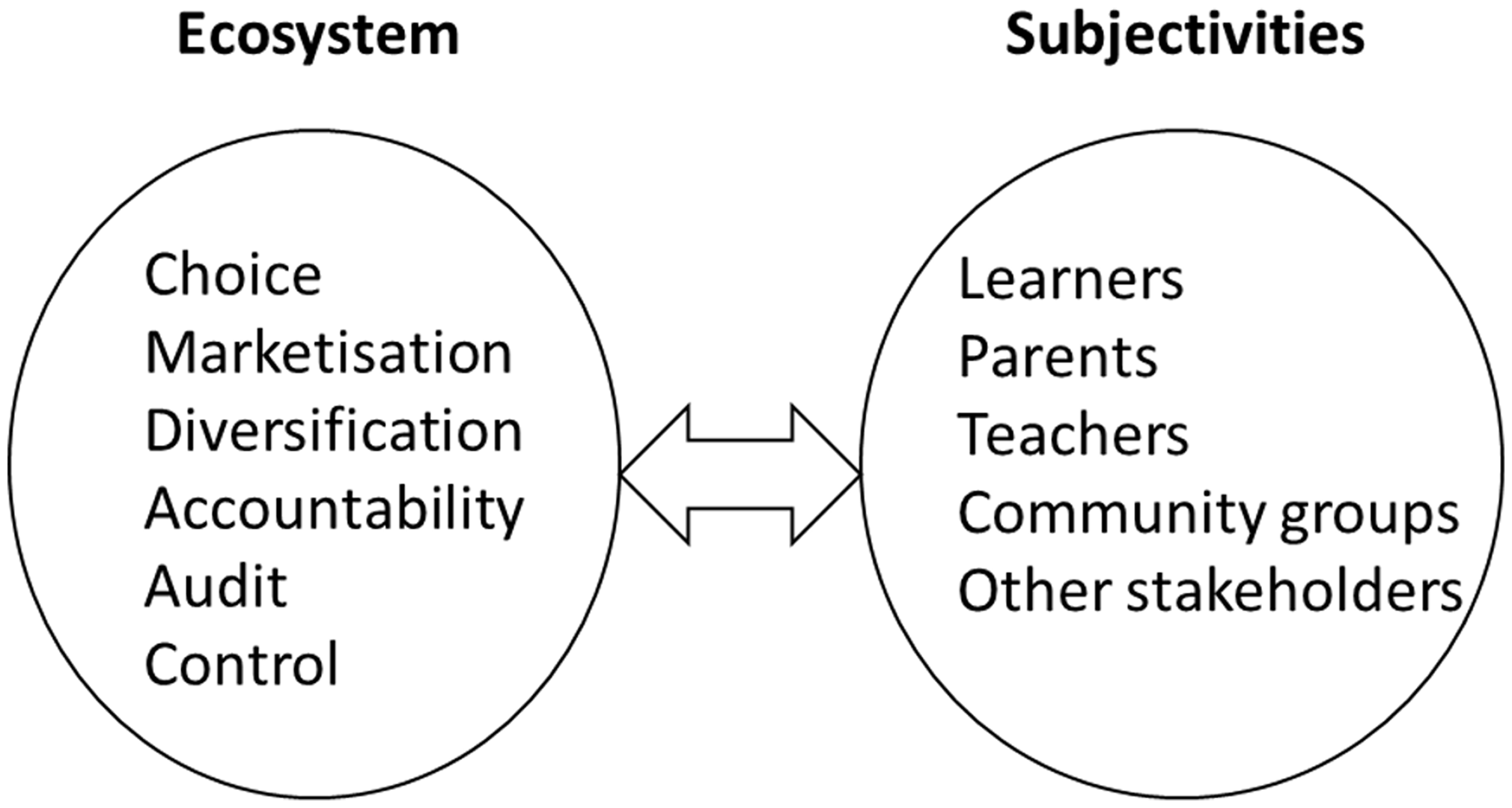
Conceptualising neoliberal policy and the lived experiences of primary school communities: ecosystemand subjectivity.
Using New Social Movements theory, Jopling examines the challenge of building collaboration within a partnership of schools in a region of northern England. Designed to address underachievement and raise school standards, this partnership of schools was dysfunctional as it grappled with the paradox of competition alongside collaboration; whilst ‘school-to-school support’ is lauded in the context of school autonomy and devolved governance, pressures of competition based on standardised test performance in ‘traditional’ subject areas meant that ‘aspirational’ parents often chose schools outside of the partnership. Jopling notes that this exacerbated the pupil recruitment issues the schools faced due to their geographically isolated location and lack of wider support structures.
The conclusions here are reflected in Purves’ study of music education ‘hubs’ in one English local authority. As an examination of network governance, this research explores how patterns of music tuition uptake reflect area- and school-level social advantage. Within a diversified and complex network of provision, groups with stronger neoliberal market acumen and greater economic capital are able to maximise the potential music opportunities available. Drawing on theories of the ‘neoliberal parent’ and ‘concerted cultivation’, Purves argues that even the best-intentioned educational access strategies based on patterns of take-up risk cementing deep-seated social and contextual inequalities as families seek opportunities to ‘invest’ in their children.
Similarly, Potterton’s paper, based on a study of a school community in Arizona, USA, makes the case that neoliberal free-market approaches to education raise questions about equitable student access. This research examined relationships and relations in community stakeholders’ engagement with Charter Schools and the process of choosing schools within an incentivising, market-based system. In a context of thinning democratic accountability and collective action, however, Potterton uncovers resistance, refusal and disruption of commonly-held narratives that privilege the role of the market in education. Community groups began to agitate in order to challenge privatisation and social injustice, despite these efforts being tempered by fragile school environments for families and sense of inevitability about having to compete for some.
The first three papers in this special issue have neoliberal educational ecosystems as their starting points, yet each also highlight issues of identity: the identity of schools; of families; of community groups. The second set of papers recount research more explicitly focused on how the ecosystem we are describing draws particular subjectivities; how within the discourses, cultures and practices of neoliberal education, boundaries are drawn within which individuals must situate themselves. Bradbury’s paper utilises a post-structural theoretical framework to examine the ideal neoliberal learner, focusing on the way policy and practice in the early years of primary education constructs ‘little neoliberals’. The paper argues that the production of particularly restrictive learner subjectivities, defined by self-regulation and self-improvement, works in tandem with drives to measure academic outcomes in the name of accountability. These modes of working thereby prepare the youngest children for formal schooling, which acts as a ‘calculative rationality’ that not only highlights an impoverishment of primary education, but also has social justice implications. When even the youngest children are assumed to be rational actors responsible for their own learning choices, so unjust societal structures are obfuscated as social disadvantage becomes seen, instead, as a flaw in individual pupils. Therefore, as Bradbury argues, those less recognisable as ‘ideal learners’ based on raced and classed discourses are placed further outside of ‘educational acceptability’.
Bradbury analyses the ‘datafication’ of primary education where high value is accorded to what can be measured or tested, and this critique is taken up in Sibley-White’s critical discourse analysis paper. This draws on Foucauldian notions of governmentality to address how the accountability regime based on national standardised tests works as a technology of control through, in part, shaping the discursive possibilities for stakeholders’ understanding of the role of testing. Sibley-White’s study of a parent protest opposing ‘high-stakes’ primary school tests shows how the neoliberal rhetoric of choice and implied future success are adopted in both Government and protestors’ discourses, and thereby demonstrates how tenets of the re-engineered ecosystem have become self-evident and naturalised. Here there are resonances with Jopling’s paper, where parents and teachers in his research had ‘absorbed’ the neoliberal rhetoric of ‘high aspirations’ and could articulate only a narrow definition of these. We sense in both cases how the subjectivities of parents, teachers and pupils are forged in relation to a delimited range of meanings about the purpose and procedures of primary education within the neoliberal ecosystem. But it also becomes clear that the actions of those subjects in response to their subjectification generates and replenishes that ecosystem.
This relationship can be found in Pulsford’s account of ‘neoliberal teacher-hood’ that utilises Beverley Skeggs’ Bourdieusian theory of hierarchies of personhood. The contemporary neoliberal self is required to continually reveal its value through accruing and investing in various capitals, an idea that reflects Purves’ argument about the neoliberal parent scanning for ‘investment’ opportunities. Pulsford examines how men who teach in primary schools position themselves as subjects of value by drawing on traditional and entrenched social hierarchies, notably of gender but also sexuality, class and race. These distinctions are compounded by technologies of neoliberal educational governance (for example, comparative-competitive school inspection preparations and managerialist foci on procedures and processes) that invite teachers to find ways of performing their value and adding to their stock of personal capital. The argument Pulsford makes is that this mesh of social and governmental hierarchies amplifies a set of narratives that privilege those with relative advantage – white, able-bodied, professional class, male subjects – within primary school communities. As is the case with Bradbury’s and Sibley-White’s conclusions, we are invited to challenge the uneven terrain mapped out for othered subjectivities and discourses about education within neoliberal education ecosystems.
Methodologies and units of analysis
A crucial strand in understanding the development of neoliberal logics has been a focus upon evidence-based reality. Across terrains previously identified as socialised or framed by collective, communal goods, like education, social care, welfare and healthcare, the qualitative experiences of individuals and families have become increasingly governed or conditioned by data and flows of information (Davies, 2016). In large part, metrics hold the key to truth, in that they define models and practices of efficiency and value, in relation to money, and they reinforce flows of power and privilege, conditioned by the management of risk (Crawford, 2016). Here, the priority is on reducing the risk that educational outcomes and standards do not contribute to productive performance. In this process, the conditioning of outcomes and standards in the name of productivity, also conditions the activity of individuals whose lived experience is structured by those very outcomes and standards.
Thus, neoliberalism has prioritised a lived experience that is methodological, in that it imposes a particular systematic mode of social operation that claims specific forms of truth that are increasingly algorithmic. Here, claims are made for learning analytics, big data, quantification, and so on, that materially affect individual teachers and pupils, families, school policies and practices, sector-based funding, the role of faith groups and corporations, and so on. Therefore, there are a range of tensions in the use of both qualitative and quantitative methodologies to make sense of these lived experiences, precisely because the terrain against which those lived experiences exist is shaped qualitatively amongst people, but is defined quantitatively in terms of the allocation of resources and the reinforcement of asymmetrical privileges (Moore and Robinson, 2016). As a result, there are distinct tensions and contradictions between the needs of corporations and governments for-value, and the needs of individuals for self-actualisation. As we note above, policy attempts to pull in both productive/economic and democratic/political directions, without being able to re-integrate these two polarities.
In attempting to make sense of these polarities in their own case study contexts, our authors take a range of methodological approaches that challenge the neoliberal, governance and regulatory obsession with data as truth. These approaches cut across our categorisations of ecosystems and subjectivities, precisely because this special issue highlights the messy and contested nature of the use of evidence in categorisation. Purves uses what he terms an ecological study design, in order to unpick the factors that affect take-up of music education and persistence in sustaining that education, which is often regarded as desirable rather than essential. Critical in this understanding are a range of contextual, demographic factors, which enable us to draw insights about the relationship between home and school. As a result, data-driven, statistical analyses are contextualised around the socio-economics of both the home and the school, in order to address the differential impacts on sub-populations.
Here, Purves is able to question the extent to which mapping and relating datasets enables generalisations about educational provision, and the impact of politics/policies of austerity on that provision, to be made. This is important in questioning whether methodologies are able to relate individual-level correlations to community-level correlations for all sub-populations, in order to make judgements or develop practice. Thus, Purves is clear about the importance of qualitative, individual-level analysis in providing insight in addition to group-level analyses that describe particular impacts for particular groups. This enables us to think through issues of power and privilege, and hegemonic methodological prescription, in addressing issues of social mobility, access to resources, maximising human capital and social reproductive potential through entrepreneurship, and so on.
For Jopling, similar to Purves, there is a focus upon the allocation of resources through neoliberal governance, in terms of social disadvantage that enables a critique of discourses of social mobility. Whilst Jopling’s focus is upon new social movement theory, this also informs his methodological engagement. He takes a qualitative approach, focused upon understanding the idea and reality of partnership-working and partnership-building, with a range of institutional stakeholders. Thus, he engages with 74 participants from 10 settings, in individual and group interviews, followed by a further four focus groups, designed to test the authenticity of the modelling that follows. Central to this methodological approach is an idea of stakeholder voice in communities made marginal. Here, there is a methodological and theoretical connection to the work of Sibley-White, in the definition of collective identities amongst actors and groups.
In thinking about power in the context of charter schools in Arizona, Potterton utilises an ethnographic approach, in order to uncover both the perceptions and actions of a range of community stakeholders. Thus, through semi-structured interviews with 35 stakeholders, she engages with issues of power, resistance, protest and social justice, with school leadership, teachers, parents, pupils and community organisers. By working in this way, across a single setting over a two-year period, Potterton is able to uncover the mechanics and possibilities of change, grounded in agency. Here, she is able to demonstrate methodological approaches that centre the researcher as an active contributor in dialogue with communities, through the use of memos and observant field notes.
This is crucial in centring and challenging privilege in specific roles, in order to demonstrate a deeper understanding of power in specific school communities. For Potterton, a crucial approach was an ongoing engagement with data, analysis and coding, in order to construct policy and practice as a movement. Once again, her analysis highlights deep intersectional and gendered injustices, which such an ethnographic methodological approach enables. This is also reinforced in Bradbury’s research, which synthesises qualitative and quantitative outcomes from two research projects conducted eight years apart under different policy regimes. Her work takes in-depth case study analyses grounded in interviews and focus groups with practitioners, alongside observation, and situates it against large-scale survey work with teachers at a national level.
Bradbury’s work situates an understanding of subjectivity, and in particular learner-subjectivity, through the everyday, lived experience of teachers and school leaders. This offers a counterpoint to the understanding of specific subjectivities, and the construction of particular, productive identities, to that of Sibley-White in her analysis of the UK, 2015 Let Our Kids Be Kids’ campaign. In this article, Sibley-White uses critical discourse analysis of policy, campaign communications from social media, and related newspaper reports, in relation to thick descriptions of both governmental and campaigners’ positions. The focus of this methodological approach is to uncover moments of consensus and a richer understanding of how action can be mobilised on either side, alongside an understanding of how resistance is either developed or addressed.
Finally, Pulsford uses a multi-interview approach, in order to understand the experiences of a specific group of educational professionals. He utilises rich, deep, dialogic interviews with three men who are mid-career Special Educational Needs Co-ordinators, in order to situate their experience against ideas of masculinity, personhood and ideas of value. This methodological approach again enables us to look qualitatively at the confines and constrictions of particular forms of governance and regulation, in relation to differential experiences in the school and in communities. Linking back to Purves’ work, we can point towards the tensions implicit in individual aggregation of data and experience, and instead look at how different bodies or groups are able to move through particular communities and school structures. Indeed, a crucial outcome of the range of methodological approaches in this special issue is that we are able to see how certain bodies or groups are unable to move through particular communities and school structures, precisely because of particular policy positioning.
Conclusion: Alternative lived experiences and modes of renewal
Although this special issue focuses upon lived experiences under particular governance and regulatory regimes, which in turn impose and reproduce particular forms of privilege and power, its papers also point towards possibilities for resistance and the description of new futures. They highlight the tensions implicit in policy structures that promote collaboration and competition, and that promise the potential for social justice and humane values through the provision of mechanisms of efficiency and value-for-money. One crucial outcome of this collection is the extreme tension that exists inside schools and across school sectors in the global North, between policy demands for particular types of function or ways of functioning, and emergent dysfunction at the level of the individual, the family, the group or sub-population or the school.
By dysfunction, we might think about how particular bodies are unable to connect to particular outcomes because of structural, political imperatives, and the demand that individual subjectivities are constructed in particular ways, in order to be productive. Thus, Purves enables us to use particular forms of creative education to understand the conditioning of social mobility whereby some families can access or consume precisely because they have access to resources or because they can mobilise social, cultural and financial capital. Here, certain bodies are able to maximise skills, experience and knowledge in order to develop their own human capital, and act as entrepreneurs. One moment of resistance then is in revealing what neoliberal governance and regulation makes concrete in such distortions, and to flag intersectional, demographic injustices.
This is an issue that Jopling develops in terms of social mobility and disadvantage, and that connects to Purves’ description of who has access to particular resources or datasets. Jopling enables us to identify such forms of access, reproduced hegemonically, as particular moments of function and dysfunction for particular bodies and groups. Moreover, Jopling situates this against issues of geography and temporal, material histories, which are repressive for some people precisely because they offer choice as a universal idea that is a closed reality for those without the necessary capital. At issue here is whether it is possible to define new collective identities, and to utilise these to develop new movements of people that can resist the domination of a political horizon mediated by the market. We might ask whether it is possible for self-actualisation to be mediated against the market?
In addressing this question, the generation of alternatives is situated against the apparent hopelessness of market-based solutions for some individuals and communities. For some, the inability to move or to become socially mobile realises negative emotional outcomes, which cannot be contained. These include hostility, blame, distrust and disempowerment, which are themselves an ongoing outcome of the internalisation of neoliberal demands for responsibility and productivity. Pulsford looks at this in terms of specific masculinities, grounded in self-projection, self-protection and self-separation. Potterton reinforces this process of internalisation, alongside highlighting how society projects its negative self-conceptions onto those it regards as unproductive, precisely because being unproductive in a society governed by economic value is sinful. Those who are unproductive and in poverty, are seen to have made bad life choices.
Thus, in these contexts, alternatives need to reimagine human life in opposition to this terrain of negativity, and for an alternative set of humane values. There is a need to connect co-operation to resistance and agitation, as witnessed in Sibley-White’s recording of a specific protest movement aimed at promoting self-mediation of life, rather than self-regulation in relation to the market. This is a challenge that emerges in relation to Bradbury’s work, in forcing us to question how particular subjective positions are excluded and made impossible through particular governing regimes, or how particular structures of institutions deny particular individuals movement through them. This might be because those individuals look different or behave differently, carry different characteristics, have different characters or mobilise weak forms of human capital (Ahmed, 2017).
One moment of resistance is to refuse these moments of negative emotion and self-conception, at the level of the individual teacher, parent or pupil, where they are framed intersectionally, and reinforced at the level of the school or the school community. Such a refusal recognises the humanity of those individuals existing inside a range of networks, institutions, family groupings and communities, and connects that humanity to concrete skills, knowledge, expertise and demands. These concrete moments are experienced outside the self, under neoliberal policy, framed by discourses of entrepreneurship, responsibility, risk, excellence, efficiency and so on. As a result, particular ecosystems demand the construction of particular subjectivities. In revealing these constructions, and the structures and policies that require them, it is possible to open out new demands grounded in new departure points for resistance.
In this special issue, each of the six papers describe and analyse new departure points for resistance. They highlight the messiness of policy that imposes particular forms of governance and regulation that prescribed particular, market-focused and commodified types of activity. This messiness spills over into the idea of community, communities, sub-groups or sub-populations, and whether they are able to generate agency and self-actualisation. However, joining the links between these departure points is fundamental if resistance is to be generated and maintained. Joining links between these departure points beyond primary education in the global North is crucial in demonstrating differential injustice in the global South, and in linking to injustices in other sectors of the economy. Only in this way can a meaningful engagement with lived experiences promote a scalable engagement with change.
Footnotes
Declaration of Conflicting Interests
The authors declared no potential conflicts of interest with respect to the research, authorship, and/or publication of this article.
Funding
The authors received no financial support for the research, authorship, and/or publication of this article.