




Abstract
Abstract
This critical discourse analysis examines the construction of an “appropriate” education by Florida administrative law judges in their special education final orders over time. The results indicate that despite each child being different, the construction of an appropriate education was uniform within the given time periods. Prior to the Rowley decision, the administrative law judges utilized their own judgment in constructing an appropriate education. This construction was based on whether or not the proposed Individualized Education Program was designed to meet the needs of the child. Each final order avoided discussing the law in detail, credibility, deference, or burden of proof. The results indicate that after Rowley and the Individuals with Disabilities Education Act (2004), the Rowley decision established an epistemic hierarchy. It gave deference to school districts—not parents—as experts. Additionally, after Rowley and the Individuals with Disabilities Education Act, the power of an administrative law judge to construct an appropriate education was constrained by the discourse in the Rowley decision. Throughout all three time periods, the administrative law judges all emphasized that students were not entitled to the best education possible.
Introduction
The US Congress recognized that the long-term implications of denying an “appropriate” education to children with disabilities translates to dependent adults with disabilities and diminished productivity and quality of life. The Education for All Handicapped Children Act of 1975 envisioned that disabled children would have a right to an education, with state and local agencies accountable for providing these services.
The right to adjudicate the appropriateness of a disabled student’s education in the USA is mandated by the Individuals with Disabilities Education Act (IDEA, 2004), formerly Public Law 94-142. IDEA affords students with disabilities both procedural and substantive due process rights. Both the parents of a student with a disability and the local education agency charged with providing a free and appropriate public education (FAPE) can dispute what constitutes an appropriate education (IDEA, 2004).
Special education is provided via an Individualized Education Program (IEP) document, which consists of present levels of performance, annual goals and objectives, and special education and related services. This enables the student to participate with non-disabled peers. The IEP also delineates how progress will be measured and reported. When disputes cannot be resolved, IDEA grants the right to a due process hearing. A due process hearing is akin to a court trial (Mueller, 2009). In due process, an administrative law judge (ALJ) must determine if a FAPE was afforded to a student with disabilities based on the merits of the evidence provided. The ALJ has the power to issue subpoenas, compel witnesses to testify, weigh evidence, and come to a final written decision within 45 days of the filing, unless waived (Florida IDEA, 2006). The final order is the judge’s written decision settling the dispute.
Coming to a decision on the provision of a FAPE has been litigated at the administrative due process and federal levels. The US Supreme Court defined “appropriate” in its landmark Board of Education of the Hendrick Hudson Central School District v. Amy Rowley (1982) decision; the court ruled that Public Law 94-142 mandated no substantive educational standards other than access to a FAPE.
The law and the rulings of other courts affect new rulings of the ALJ by limiting and perpetuating a particular legal discourse. By way of title, agency, and reliance on previous discourse, such as the Rowley decision, an ALJ perpetuates power dynamics in his or her construction and adjudication of “appropriate.” Therefore, with the precedent set by the Rowley decision and the language of IDEA (2004), a critical analysis of discourse is warranted on how “appropriateness” is constructed in the ALJ’s final orders pre-Rowley, post-Rowley, and post-reauthorization of IDEA.
Research problem
Public Law 94-142 provided students with disabilities with access to a FAPE (Education for All Handicapped Children Act, 1975). However, the law did not specify what it meant by an “appropriate” education. Consequently, it fell upon ALJs to define an appropriate education on an individual basis. In 1982, in response to a challenge from a lower court and the decision of an ALJ in Board of Education of the Hendrick Hudson Central School District v. Amy Rowley, the US Supreme Court defined FAPE as “access to an education” or a “basic floor of educational opportunity” (Wright and Wright, 2010).
In the 2004 reauthorization of IDEA, the purpose of special education was defined as an education that prepares students with disabilities for college, a career, and independent citizenship. Some scholars and researchers believed that the Rowley standard of “appropriate” was replaced by a higher standard (Bateman, 2010; Blau, 2007; Brizuela, 2011; Jefferson County v. Elizabeth E, 2012; Johnson, 2012; Kaufman and Blewett, 2012; Macfarlane, 2012; US Department of Education, 2014; Valentino, 2006; Weber, 2012; Zirkel, 2008, 2013). Others doubted that Congress intended to increase the standard of an appropriate education set by the Supreme Court in Rowley (Brizuela, 2011; Brunt and Bostic, 2012; OS v. Fairfax County, 2015).
Judicial and legislative shifts have contributed to the scholarly debate on what constitutes an appropriate education for a student with a disability. Since it is unclear what is meant by an “appropriate” education, practitioners, policymakers, and parents need to better understand how it is constructed in a special education due process hearing.
Purpose
The purpose of this qualitative critical discourse analysis was to investigate how Florida ALJs construct an “appropriate” education for students with disabilities. This qualitative critical discourse analysis examined final orders across three time periods. Primarily, this study examined and compared the construction of an “appropriate” education prior to the Supreme Court decision in Board of Education of the Hendrick Hudson Central School District v. Amy Rowley (1975–1978), after the decision in Rowley (1983–1986), and after the reauthorization of IDEA in 2004 (2004–2007). This study provided an analysis of each period and an evaluation of differences between them. Furthermore, it helps policymakers and practitioners to understand how an appropriate education is constructed. This understanding helps to align policy and practice.
Methodology
Critical discourse analysis using the Johnstone method was used to examine ALJs’ construction of an appropriate education. Critical discourse analysis is a qualitative method of examining pressing social issues, especially those related to power and justice (Mogashoe, 2014). Critical discourse analysis attempts to triangulate the data and establish connections between text, context, and wider sociocultural practice by exposing systemic hegemony and advocating for change (Fairclough, 1992; Foucault, 1972; Johnstone, 2008; Van Dijk, 2006). Johnstone (2008) asserts that a major reason to use discourse analysis is to explore the meaning and effects of communication. Johnstone’s heuristic is used to explore how discourse is influenced by prior discourse, and how it influences future discourse and society by means of the type and function of discourse, and the contributors to that discourse. Discourse analysts examine data from a multitude of angles, styles, and perspectives to make qualitative assertions rather than generalizations about the data. The research questions and limitations associated with discourse analysis do not differ greatly from other qualitative methodologies. The primary difference between critical discourse analysis and other qualitative research is the methodology used for analyzing text to uncover meaning. In this study, immersive line-by-line coding and specific grounding of claims in textual evidence were used to establish trustworthiness (Guba, 1981).
Data sources
The data-selection process was purposive. Six final orders were selected that met the richness criteria on a researcher-created rubric (Table 1). Each time period had to have a final order with a parental victory and a school district victory for comparison. These final orders included only Florida cases, as different circuits have the potential for different precedential interpretations of identical parts of IDEA (Brizuela, 2011; Brunt and Bostic, 2012). The focus on one judicial circuit reduced the possibility of conflicting rulings among judicial circuits. Florida, along with 41 other states, uses a one-tier system, with the ALJ as the final decision-maker unless appealed to a higher court (Florida Procedural Safeguards Act, 2006; Zirkel and Scala, 2010). Only cases that received a full ruling from the ALJ were selected for review. Cases settled in mediation and resolution meetings were not analyzed.
Inclusion/exclusion criteria rubric.
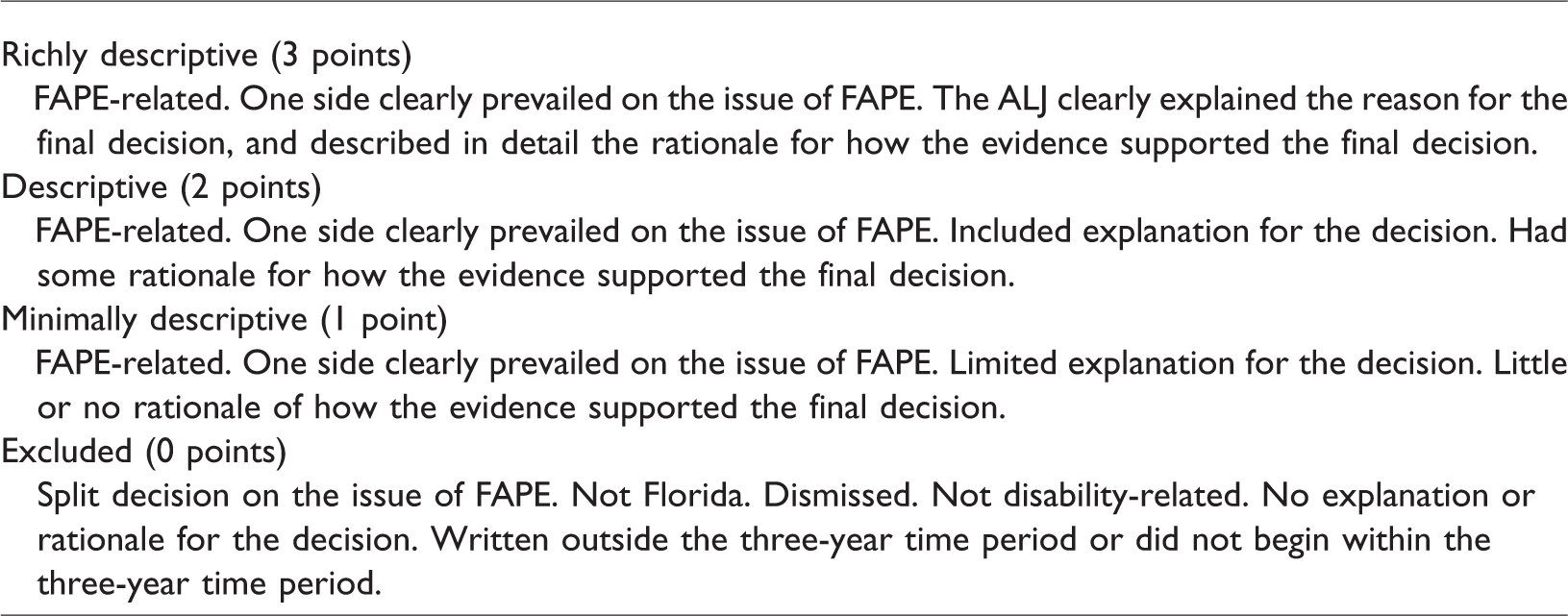
Inclusion/exclusion criteria
In order to be included in the final analysis, the disputed issues in the final order had to address issues related to the appropriateness of the education for a student with a disability, and had to be held in Florida during the selected time periods. The cases had to provide a clear victory for one side. Partial victories on the issue of a FAPE were excluded. A detailed rationale for the rulings had to be provided. In order to be included in this study, the final order had to be rated as a 3 on the researcher-created thickness scale for the degree of description (Table 1).
Sample
One hundred and twenty-seven cases met the inclusion/exclusion criteria across all three time periods. The final sample of cases represented two cases from each time period. For the first period, only two final orders were available that met the inclusion/exclusion criteria. For the period of 1983–1986, there were 35 cases, 10 of which met the criteria of scoring a 3 on the rubric. For the period from December 2004 to 2007, there were 90 available cases, but only 23 met the richness criteria. Out of those 23, the cases with the most extensive rationale for decisions were selected. If there were equally rich final orders available, the disability, grade level, and issues disputed were matched.
The depth of the ultimate orders included in the final sample was substantial. The selected cases from 1975 to 1978 included two 12-page final orders (six single-spaced typewritten pages). Among the selected cases from 1983 to 1986, there was a 32-page final order where the parent prevailed and a 20-page final order where the school district prevailed. The cases from the last time period included a 37-page final order from 2006 where the parent prevailed and a 95-page final order from 2007 where the school district prevailed.
Procedures
The steps in the analysis were iterative. First, the final orders were read uncritically. Second, they were reread critically, looking for any themes to be coded. The Johnstone (2008) heuristic was the guide for determining what was notable about the final orders. The Atlas.ti computer program for analyzing complex phenomena was employed as a tool to engage in line-by-line coding. Throughout this process, the uncommon coded constructs were operationally defined. Third, the coded text was compared by period. Fourth, the coded lines were examined and compared for embedded messages by period. Fifth, it was determined what questions could be asked and what claims could be made from the text. And finally, the study was contextualized based on the time periods, and propositions and corollary propositions from the data were determined.
Results
This critical discourse analysis analyzed the construction of an appropriate education before the US Supreme Court decision in Board of Education of the Hendrick Hudson Central School District v. Amy Rowley (1975–1978), after Rowley (1983–1986), and after the reauthorization of IDEA in 2004 (2004–2007). Then, it analyzed the evolution of the construction of an appropriate education across these time periods.
Construction of “appropriate” prior to the Rowley decision
Parents as the prevailing party (1976)
In a 1976 final order where the parents were the prevailing party, a first-grader qualified as a student with a disability due to cystic fibrosis. The school district offered the parents a choice of two programs—one for students with physical disabilities or one for students with learning disabilities. The parents refused to place their child in either program, alleging that the school district’s only available programs were inappropriate and therefore constituted a denial of a FAPE, and asked the ALJ to render a ruling for the school district to pay for private education at public expense.
The ALJ detailed why the proposed school district programs were inappropriate. An illustration of this is when the ALJ stated: The Petitioner could be enrolled in the learning disability program at XXX School without being tested, and without suffering from any learning disability. This program is inappropriate for the Petitioner because it does not appear that he suffers from any learning disability.
The ALJ wrote that the student needed a “normal” class with typically developing peers. This proposed placement would increase the student’s chance of contracting a communicable disease due to the large class size. He further highlighted: He is not physically handicapped except for his susceptibility to infectious illnesses. It does not appear that the Petitioner suffers from any learning disabilities. It appears that the Petitioner is fully intellectually capable of functioning in a normal manner in a normal classroom environment.
In constructing an appropriate ruling in favor of the parents, the ALJ ordered the school district to find something “suitable”—that is, a program that could meet the needs of the student.
School district as the prevailing party (1978)
A 1978 due process hearing was held to determine if a school district’s program for students with learning disabilities was appropriate. A mother asserted that the placement was not appropriate because the school failed to put the student on the bus as agreed, and the student was found wandering 24 blocks away from the school. She asserted that the large class size and inability to provide appropriate transportation constituted denial of a FAPE. The parents requested transportation and reimbursement for private school tuition.
The ALJ included the needs of the child in programming and suitable placement in the construction of an appropriate education. The ALJ stated “that the child’s primary educational needs were activities to remediate visual motor deficits, visual closure activities, visual association, and visual sequential memory activities, and a program for gross motor development”. The ALJ detailed that a “certified” teacher provided “individual attention” to “deficits,” despite having a large class. Despite the “unfortunate” bus incident, “insufficient evidence” was presented to show “negligence” or that the student was “traumatized” to an extent that made him unable to go to public school. Thus, the ALJ denied the parents’ request for reimbursement of the US$350 per month private school and van service.
Construction of “appropriate” after Rowley and before IDEA 2004
School system as the prevailing party
In a 1986 case of a child with severe emotional and behavioral disabilities, as well as language impairment, the school system funded attendance at a private school for students with disabilities, where the child was making progress. The school system developed a program that it thought would meet the child’s needs, and therefore planned to discontinue funding, against the wishes of the parents. The parents were afraid that the child would become disconnected, “fearful,” and “suicidal” if removed from his current placement and put in a general education classroom, and filed for due process to block the change of placement.
In this case, an appropriate education was constructed through a discourse of expertise and deference. For example, a school district evaluator said that “[b]ased on evaluation … a normal classroom” was the correct placement for the student. On the other hand, the ALJ stated that the student’s father had a “sincere belief ” that his child would commit suicide if compelled to attend a general education classroom. The contrast between the father and the evaluator is remarkable. The ALJ was transparent in assigning deference to the school district’s expert, while believing that the father was basing his view on “sincerity,” which accomplished the task of assigning deference, power, and expertise, stating: For the 1986–1987 school year, however, the Board decided that its programs were now sufficiently developed and matured to successfully provide an appropriate program for [the child] in the mainstream public school system … Before arriving at this conclusion, however, the Board conducted a thorough and comprehensive re-evaluation of [the child’s] situation.
The discourse of expertise continued as the ALJ specifically referenced the school district’s expert as having “24 years’ experience dealing with students with special needs.” When the father contested an evaluation, the ALJ challenged this by referring to the experience of the psychologist. The ALJ wrote that the school district’s psychologist had “accomplished over 200 evaluations of this nature over her term with the Board.” The ALJ further stated: “[The father] did not produce, however, any firm, independent evidence other than his own testimony, which at times was questionable because of his obvious emotional involvement in this case.”
In the appendix to the final order, the ALJ conceded that “the process of providing special education and related services to handicapped children is not guaranteed to produce any particular outcome.” The ALJ stated, based on the Rowley decision, that: “It cannot be said that the framers of the legislation intended to guarantee any particular level of education. Rowley at 3043. Instead, implicitly, a FAPE must only include access sufficient to confer some educational benefit upon the handicapped child.” In this case, the parents were viewed as being “sincere” and having “heartfelt desires” rather than having any knowledge or expertise in relation to their child. It also suggests that the goal of an appropriate education is the “basic floor” of access, and not a specific educational standard.
Parental victory in the era of Rowley
In this 1986 challenge of a school district’s provision of a FAPE, a child with a cleft lip and palate (in this case referred to as a harelip), “brain dysfunction,” depression, and a learning disability, but of average intelligence, attended a private school for students with learning disabilities for most of his elementary education. When his family relocated, the student was placed in a self-contained classroom for students with emotional and behavioral disabilities. Across the seventh and eighth grades, the amount of special education was dramatically decreased and his academics were rapidly regressing, and the child began to engage in increasingly violent behavior and was suspended. Thus, his parents met with the school district to review the findings of his physician and to discuss appropriate educational programming. When no appropriate programming was found, the parents proceeded to file for due process.
As in the above post-Rowley case, the ALJ deferred to the school district in constructing an appropriate education. The school board conceded at the due process hearing that it did not have an appropriate program for the student. The ALJ wrote: “Respondent did not contend at hearing that this placement was appropriate … Nobody seemed to know the solution.” The ALJ then went on to support the discourse on constructing an appropriate education by detailing that the school psychologist had 26 years’ experience and “offered to teach [the student] at home, but [sic] decided that (student) did not qualify for home-bound.”
The ALJ ultimately ruled in favor of the parents, concluding that the child needed a residential placement at public expense and that nothing in the recent Hendry County School Board v. Kujawski (1986) prohibited awarding reimbursement. The ALJ discredited the experts who said that the student did not need a residential placement. The ALJ noted that neither of the two school system experts had ever met the child. In the ruling, the judge stated that “the evidence established that respondent needs the constant repetition and practice, the coordinated team approach and the highly-structured atmosphere of a residential setting,” further noting that the residential placement’s “ultimate objective is vocational education to prepare [the student] for useful work.”
The era of IDEA (2004)
Finding for the school system
In the 2007 case of an English-language learner whose parents were highly accomplished professionals from Chile, the child was diagnosed with autism and language impairment. The student was assigned to a self-contained (special education) classroom in a public school for students with autism. The parents requested a class for typically developing children. The school system placed the child in an alternative program that included typically developing children as peer models. The parents were dissatisfied with this placement and wanted their child in regular education.
In this finding, the parents were politely discredited through terminology that signified care and not expertise, providing deference to educators and experts while not substituting the ALJ’s opinion on appropriateness and methodology. The ALJ noted that the law is clear that the adjudication of an appropriate education is not dependent on any particular outcome other than being designed so that the student with a disability will receive some benefit, regardless of whether that benefit is actually achieved, even in hindsight. The ALJ cited that the law requires “sufficient” support, similar to a “serviceable Chevrolet,” requiring “some benefit” with “no requirement to meet every need” or “cure” a student’s disability: “The [law] does not demand that [a district school board] cure the disabilities which impair a child’s ability to learn, but [merely] requires a program of remediation which would allow the child to learn notwithstanding [the child’s] disability.” The ALJ further wrote that “‘appropriate’ does not mean the best possible education that a school could provide if given access to unlimited funds.”
This ruling that the school district provided a FAPE further supported the argument of using experts to construct a FAPE. The ALJ ruled: Through the credible and persuasive testimony of these witnesses, together with its accepted exhibits, the School Board affirmatively established (although it was not its burden to do so) that the 2006–2007 IEPs were not substantially deficient in any of the ways alleged by the Parents, but rather were reasonably calculated to, and upon their implementation did in fact, address [the student's] educational and behavioral needs and provide … with meaningful educational benefit and therefore a “free appropriate public education.”
Finding for the parent
The primary issue in this 2006 FAPE case was whether the school district denied a FAPE in the least restrictive environment by not considering an independent educational evaluation and removing a 17-year-old student with autism and a language impairment from the standard diploma track to a certificate-of-completion track. The school district requested an IEP team meeting, but the mother became concerned because the request did not address whether “transitional and vocational rehabilitative services” would be considered and no experts from “transitional or vocational rehabilitative services” would be in attendance at the meeting. The parent filed due process and that IEP meeting was not held. The parties went to a resolution meeting and agreed that the student would be re-evaluated at public expense, and transitional and vocational rehabilitative services would be in attendance. At that meeting, the school team determined that the student would be in a self-contained classroom for the majority of the day and would no longer be eligible to complete the standard diploma. Instead, he would get a special diploma which indicated that he had attended high school. The mother objected and requested that the school district adjourn the IEP meeting until the independent educational evaluation was completed. The school district rejected the request and moved to place the student on the special diploma track.
Using experts to construct an appropriate education is supported by substantial evidence in the final order. The parents’ expert, Dr G, who completed the independent educational evaluation, was found by the ALJ to be “credible.” The ALJ emphasized that Dr G suggested “[r]esearch-based accommodations and intense remediation for [the student’s] dyslexia and learning.” Dr G issued a grave warning about the inappropriateness of placing the student in special education, warning that the student would remain “illiterate” if the placement was changed from general education to special education. The ALJ wrote: “The School Board did not present the testimony of an expert in opposition to the testimony presented by Dr. G.” In fact, the ALJ stated: “No evidence was presented by the School Board to contradict the evidence that [the student] suffers from dyslexia.” The ALJ ruled: “The evidence presented demonstrates that the IEE [independent educational evaluation] was not considered at the IEP meeting held on December 15, 2006.” Additionally, the ALJ wrote: “The disabled child must be making measurable and adequate gains in the classroom, but more than de minimus gains J.S.K. v. Hendry County School Board, 941 F.2d 1563 (11th Cir. 1991).” The ALJ ruled that a FAPE was denied and a new IEP had to be drafted.
Discussion
Prior to Rowley, ALJs heard testimony and reviewed evidence without assigning deference to either party. The ALJ constructed an appropriate education based on the needs of the child and the educational program offered. Each case reviewed demonstrated that the ALJ was careful not to award the best possible services for the child. Instead, the ALJ focused on what was “adequate,” “appropriate,” “normal,” and “suitable.” In the post-Rowley period, the final orders utilized a discourse of deference, expertise, and minimized benefit in constructing an appropriate education for a student with a disability. In the IDEA 2004 cases, ALJs cited deference to school district officials as a legal basis in constructing an appropriate education. For example, one ALJ wrote: “In examining an IEP, great deference is given to the educators who develop the IEP.” The ALJ only used one case as the legal basis in supporting this argument.
In both of the final orders analyzed prior to Rowley, the ALJ utilized his or her own judgment in constructing an appropriate education. The testimonies of the parents and the school district were given equal weight. Neither final order suggested that the child should have anything above what the ALJ suggested was adequate, given the child’s disability. Each final order avoided discussing the law in detail, the weight of credibility, deference, or burden of proof. The ALJs made the decision to rule in favor of either party by using his or her own judgment. Overall, in constructing an appropriate education pre-Rowley, the ALJ looked at whether the program could meet the needs of the child. These pre-Rowley findings are consistent with the study on due process final orders conducted by Kuriloff (1985). However, unlike the findings of Kuriloff (1985), this critical discourse analysis did not find that parental insistence on a particular program had any impact on prevailing.
Although each child is different, the construction of an appropriate education post-Rowley and post-IDEA (2004) followed a pattern consistent with what Foucault (1972) described as a prescribed discourse with epistemic rights being assigned to the privileged. The results of this study indicated that an appropriate education post-Rowley (1982) is constructed by ALJs through an epistemic hierarchy. This epistemic hierarchy is established by ALJs giving deference to school districts—not parents—as the experts. Even though the law moved past simple access to a basic education, ALJs emphasized access to special education rather than successful outcomes. These findings are consistent with the work of others which has suggested that experts are necessary in constructing an appropriate education for students with disabilities (Meyer, 2011; Zirkel, 2014). Nonetheless, no definition of an appropriate education was apparent from the six final orders analyzed in this study.
Strengths and limitations
In this study, emphasis was placed not on how often the ALJ used the word “appropriate” or other words that signified appropriate, such as “adequate.” Instead, it looked at how “appropriate” was used and the power dynamics associated with its construction. This critical discourse analysis analyzed the messages being conveyed by final orders without a simple focus on the words.
The limitations of this critical discourse analysis are similar to other types of qualitative research in that the findings are not generalizable due to the small sample size. However, the patterns uncovered and noted in this discussion are concerning. In this analysis, there was no understanding of how the other participants at the hearing viewed the information being presented. The only evidence that was available to understand this process was the information that the ALJ chose to include and exclude. This gives the power of voice to the ALJ. It is equally important to note that the researcher also has the power of what to include and exclude by reducing an approximately 100-page final order to several pages and inferring specific meaning when that meaning was not intended. In other words, the reduction makes this data manageable, yet there is still the potential to silence the voice of a participant and the ALJ.
Implications for future research
If the data exists, a critical discourse analysis that follows how a single ALJ constructed an appropriate education for a student with a disability across the three time periods would be useful. Also, the triangulation of what the ALJ included in the final order with textual evidence and speaking to the parties involved could prove useful in understanding the importance of what is included and excluded by the ALJ. Another aspect of the construction of an appropriate education that should be explored is how appellate judges ruled in these cases. For example, Zirkel (2012) reviewed 65 Seventh Circuit due process appellate decisions in Illinois after the Rowley decision, and the results indicated that the results of appeal were often the same result as at due process. It would be useful to see if there are any differences in the way the appellate court constructs an appropriate education in cases where the ruling of the ALJ has been reversed.
Additionally, for a qualitative critical discourse analysis, the quantification of phrases is not useful in itself, however knowing this information could shed light on what words are frequently emphasized by ALJs. Quantification could also be used in conjuntion with textual evidence to determine if there are any patterns in regard to power dynamics.
Policy implications
Although there is uniformity in the law, there is variability in how different ALJs will rule based on a variety of factors, such as occupation and gender (McKinney and Schultz, 1996; Newcomer et al., 1998). The law empowers and disempowers ALJs. They are empowered by being the final adjudicator in deciding if an “appropriate” education has been provided. At the same time, they are disempowered because they are limited by what the law has said and left unsaid. Conducting this critical discourse analysis on a micro level helps practitioners, parents, and policymakers to understand special education on a macro level. With the ambiguity in IDEA (2004) concerning an appropriate education for students with disabilities, and the US Supreme Court decision in Rowley, the power of an ALJ to construct an appropriate education is constrained by the discourse in the Rowley decision and the lack of an outcomes-based construction of an appropriate education for students with disabilities.
The purpose of special education as outlined in IDEA (2004)—to prepare students with disabilities for college, a career, or independent citizenship—was not addressed by the ALJs in the final orders analyzed here. This lack of accountability marginalizes students with disabilities and could fall short of what Congress intended (Blau, 2007; Valentino, 2006). Discerning the intentions of Congress is difficult. IDEA (2004) explicitly states that parents are equal partners in the IEP process, yet when there is a challenge to the IEP at due process, that equal partnership is dissolved and deference is given to school district officials. It is imperative that Congress acts to improve the fairness of the construction of an appropriate education for students with disabilities.
Conclusions
The construction of an appropriate education for students with disabilities perpetuates an imbalance of power between the parents of the student with a disability and the school district through an epistemic hierarchy. In the critical discourse analysis pre-Rowley, an appropriate education was constructed by an ALJ examining the needs of the child and the programming available to meet those needs. The discourse in the final order is constrained by the ruling in Board of Education of the Hendrick Hudson Central School District v. Amy Rowley, which set the parameters on how an appropriate education can be constructed. Appropriate is constructed by way of experts. This construction gives deference to the school district and experts. The discourse of deference, the “basic floor” of opportunity, and experts play a pivotal role in how an appropriate education is constructed by ALJs.
Understanding the assigning of deference is critically important because embedded in that hierarchy is the proposition that experts are equipped to construct an appropriate education for a student with a disability—therefore they must be heard without skepticism. Parents are not experts, and therefore should not be heard. Their opinions have no legal persuasion when contesting an opinion of a school district expert. Parents have no epistemic rights in determining an appropriate education. Knowledge of the child through experience alone is not enough to give parents a voice. This knowledge is discredited by ALJs post-Rowley as being of no value. This construction works to perpetuate an epistemic hierarchy of school district dominance and parental submission.
Footnotes
Disclaimer
The opinions expressed herein are those of the authors and are not necessarily representative of those of the Uniformed Services University of the Health Sciences (USUHS), the U.S. Department of Defense (DOD) or the U.S. Department of Veterans Affairs.
Authors' Note
The views expressed in this article are those of the authors and do not necessarily reflect the views of Uniformed Services University of the Health Sciences or the United States government.
Michelle Henry is also affiliated to University of South Florida, USA.
Declaration of Conflicting Interests
The authors declared no potential conflicts of interest with respect to the research, authorship, and/or publication of this article.
Funding
The authors received no financial support for the research, authorship, and/or publication of this article.